
Inuit Civilization and Arctic Survival Technologies
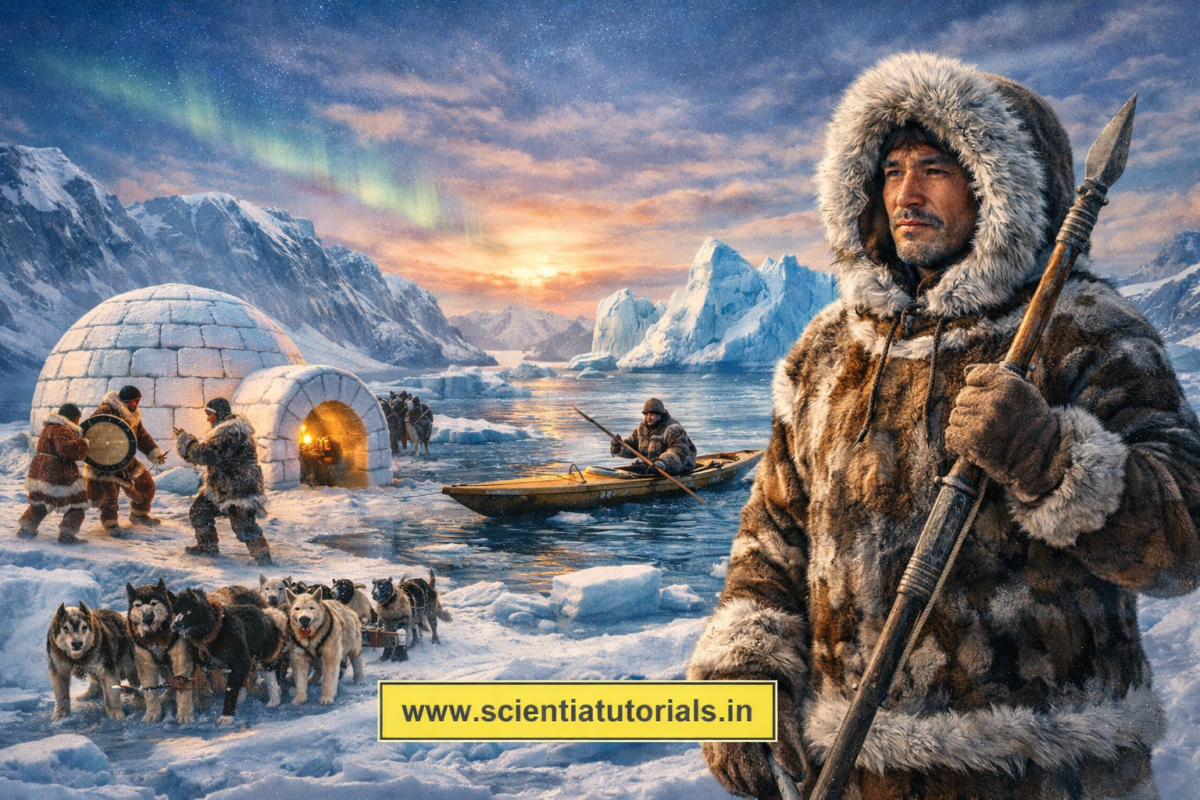

Inuit Civilization in Greenland: Arctic Survival Technologies Explained
Module 1: Greenland in the Prehistoric and Indigenous World
Lesson: Inuit Civilization and Arctic Survival Technologies
Era Framework: Prehistoric Period to c. 10th Century CE
This lesson is systematically organized into four clearly structured sections, as detailed below:
- Chronologically Structured Study Module
- Short-Answer Type Questions
- Long-Answer Type Questions
- Multiple-Choice Questions (MCQs) with Answers and Detailed Explanations
Chronologically Structured Study Module
Introduction to the Lesson
The Inuit civilization represents one of the most remarkable examples of human adaptability in world history. Emerging in the extreme environmental conditions of the Arctic, Inuit societies developed sophisticated survival technologies, social systems, and cultural practices that allowed sustained human habitation in Greenland and the broader circumpolar region long before external contact. This lesson examines the chronological evolution of Inuit civilization from prehistoric Arctic migrations to the early medieval period, emphasizing how environmental challenges shaped indigenous innovation, social organization, and worldview.
Understanding Inuit civilization is essential for interpreting Greenland’s early history and its later global significance. Indigenous Arctic knowledge systems laid the foundations for long-term habitation, territorial continuity, and ecological balance in one of the planet’s most inhospitable regions.
I. Prehistoric Arctic Migrations (c. 2500 BCE – 500 BCE)
1. Origins of Arctic Human Migration
The earliest human presence in Greenland is connected to broader prehistoric migrations across the Arctic from northeast Asia into North America. These movements occurred gradually, facilitated by land bridges, coastal navigation, and adaptive hunting strategies. Groups moved eastward from Alaska across the Canadian Arctic and eventually into Greenland.
These early migrants were not static populations but highly mobile hunter-gatherers who followed seasonal animal migrations. Their survival depended on intimate knowledge of ice conditions, weather patterns, and animal behavior.
2. Early Paleo-Inuit Cultures
The earliest known inhabitants of Greenland belonged to Paleo-Inuit cultures, often identified by archaeologists as part of the Arctic Small Tool tradition. These societies were characterized by:
- Small, portable stone tools
- Seasonal camps rather than permanent settlements
- Dependence on marine mammals and Arctic wildlife
Technological simplicity did not imply cultural primitiveness. Instead, efficiency, portability, and adaptability defined these societies, reflecting a deep understanding of Arctic constraints.
3. Environmental Challenges and Adaptation
The Arctic environment imposed severe limitations:
- Extreme cold
- Long periods of darkness
- Scarcity of plant-based food
- Dangerous ice conditions
Early Arctic peoples responded by developing layered clothing, portable shelters, and cooperative hunting techniques. These foundational adaptive strategies would later be refined by Inuit civilization.
II. Transition Toward Inuit Cultural Foundations (c. 500 BCE – 500 CE)
1. Cultural Continuity and Innovation
Between the late prehistoric period and early centuries of the Common Era, Arctic societies experienced both continuity and innovation. While maintaining core survival strategies, communities introduced improved tool-making techniques, expanded social networks, and more efficient food storage methods.
These developments marked the gradual emergence of cultural patterns recognizable as precursors to Inuit civilization.
2. Social Organization in Early Arctic Communities
Social survival in the Arctic required cooperation. Communities were organized around:
- Extended family units
- Collective hunting expeditions
- Resource sharing systems
Leadership was informal and based on experience, hunting skill, and wisdom rather than coercive authority. Social cohesion ensured survival during periods of scarcity.
3. Spiritual Relationship with Nature
Early Arctic belief systems emphasized harmony with the natural world. Animals were viewed as spiritual beings whose cooperation was essential for human survival. Ritual practices, taboos, and storytelling reinforced ethical hunting practices and ecological balance.
III. Emergence of Classical Inuit Civilization (c. 500 – 1000 CE)
1. The Thule Cultural Expansion
By the first millennium CE, a highly advanced Arctic culture emerged, often associated with the Thule tradition. This period marks the full development of Inuit civilization in Greenland.
Key features included:
- Large-scale marine mammal hunting
- Advanced transportation technologies
- Semi-permanent coastal settlements
This expansion allowed Inuit communities to occupy nearly the entire Greenlandic coastline.
2. Mastery of Arctic Survival Technologies
a. Housing Technologies
Inuit housing adapted to seasonal needs:
- Winter dwellings made from snow, stone, and animal skins provided insulation
- Summer tents were lightweight and portable
These structures maximized heat retention while minimizing resource use.
b. Clothing and Thermal Engineering
Inuit clothing represents a triumph of functional design:
- Multi-layered garments made from seal, caribou, and polar bear skins
- Fur orientation optimized insulation
- Waterproof outer layers for marine hunting
Such clothing allowed extended exposure to freezing temperatures without modern materials.
c. Transportation Innovations
Transportation technologies were crucial for mobility:
- Kayaks enabled stealthy marine hunting
- Umiaks transported families and goods
- Dog sleds facilitated winter travel across ice
These innovations enhanced trade, communication, and territorial control.
3. Hunting and Subsistence Systems
Inuit subsistence relied on a diversified strategy:
- Seal hunting through ice holes
- Whale hunting using coordinated group efforts
- Fishing and bird hunting
- Seasonal land animal hunting
Food preservation through drying and freezing ensured survival during long winters.
IV. Inuit Knowledge Systems and Intellectual Traditions
1. Indigenous Environmental Knowledge
Inuit survival depended on precise environmental understanding:
- Ice thickness assessment
- Weather prediction
- Animal migration patterns
This knowledge was transmitted orally across generations and adapted continuously.
2. Oral Traditions and Education
Without written language, Inuit societies preserved knowledge through:
- Storytelling
- Song and dance
- Apprenticeship-based learning
Myths explained natural phenomena while reinforcing social values and survival ethics.
3. Shamanism and Cosmology
Spiritual specialists played key roles in maintaining balance between humans, animals, and spirits. Illness, hunting success, and environmental change were interpreted through spiritual frameworks that emphasized responsibility and restraint.
V. Inuit Society and Gender Roles
1. Division of Labor
Inuit society featured complementary gender roles:
- Men specialized in hunting and tool-making
- Women focused on clothing production, food preparation, and childcare
These roles were flexible and pragmatic rather than rigidly hierarchical.
2. Family and Kinship Structures
Kinship formed the foundation of social organization. Extended families cooperated in hunting, shelter construction, and child-rearing. Marriage alliances strengthened inter-community relations.
3. Conflict Resolution and Social Harmony
In the absence of formal legal systems, Inuit communities relied on mediation, storytelling, and social pressure to resolve disputes. Maintaining harmony was essential in small, interdependent populations.
VI. Greenland in the Indigenous Arctic World (Up to c. 10th Century CE)
1. Regional Networks and Interaction
Inuit communities were not isolated. Trade networks connected Greenland with the wider Arctic world, facilitating the exchange of tools, raw materials, and cultural practices.
2. Environmental Sustainability
Inuit subsistence practices were inherently sustainable. Hunting regulations, spiritual taboos, and seasonal restrictions prevented overexploitation of resources.
3. Foundations for Later Historical Encounters
By the 10th century CE, Inuit civilization had firmly established control over Greenland’s environment. Their technologies and knowledge systems enabled long-term habitation, shaping how later external groups would interact with the region.
VII. Historical Significance and Legacy
The Inuit civilization demonstrates that technological sophistication must be understood within environmental context. Inuit innovations were not industrial but ecological, emphasizing efficiency, sustainability, and resilience.
Their legacy remains vital in contemporary discussions on:
- Climate adaptation
- Indigenous knowledge systems
- Arctic geopolitics
- Environmental sustainability
Understanding Inuit civilization is essential for appreciating Greenland’s historical continuity and its enduring global strategic importance.
Conclusion
From prehistoric migrations to the early medieval period, Inuit civilization evolved through continuous interaction with the Arctic environment. Through advanced survival technologies, cooperative social structures, and profound ecological knowledge, Inuit societies transformed Greenland from an inhospitable landscape into a lived and meaningful homeland.
This chronologically structured study of Inuit civilization highlights the central role of indigenous adaptation in world history and provides a foundational understanding for subsequent modules exploring Greenland’s encounters with external powers and its role in the global system.
Short Answer Type Questions and Answers
1. Who were the earliest human inhabitants of Greenland?
Answer:
The earliest human inhabitants of Greenland were Paleo-Inuit groups who migrated from the Arctic regions of North America during prehistoric times.
2. What is meant by Arctic human migration?
Answer:
Arctic human migration refers to the gradual movement of prehistoric populations from northeast Asia through Alaska and the Canadian Arctic into Greenland, adapting to extreme polar environments.
3. Why was Greenland considered a challenging environment for early humans?
Answer:
Greenland posed challenges due to extreme cold, long periods of darkness, limited vegetation, and dependence on marine and animal resources for survival.
4. What were the main characteristics of Paleo-Inuit cultures?
Answer:
Paleo-Inuit cultures were characterized by small mobile groups, stone tool technology, seasonal camps, and reliance on hunting marine and Arctic animals.
5. How did early Arctic communities ensure survival during harsh winters?
Answer:
They ensured survival through cooperative hunting, food storage, insulated clothing, and temporary shelters adapted to cold conditions.
6. What role did cooperation play in Inuit society?
Answer:
Cooperation was essential for collective hunting, sharing resources, building shelters, and ensuring community survival in an extreme environment.
7. How did Inuit housing reflect environmental adaptation?
Answer:
Inuit housing used materials like snow, stone, and animal skins to provide insulation, conserve heat, and suit seasonal living conditions.
8. What materials were commonly used in Inuit clothing?
Answer:
Inuit clothing was made from seal, caribou, and polar bear skins, designed in layers to provide warmth and waterproofing.
9. Why is Inuit clothing considered technologically advanced?
Answer:
It was designed with precise layering, fur orientation, and tailored construction that maximized insulation and mobility in extreme cold.
10. What were kayaks used for in Inuit society?
Answer:
Kayaks were used for stealthy marine hunting, particularly for seals and other sea mammals.
11. What was the significance of dog sleds for Inuit communities?
Answer:
Dog sleds enabled efficient winter transportation across ice and snow, improving mobility, trade, and communication.
12. What was the primary subsistence base of Inuit civilization?
Answer:
The primary subsistence base was hunting marine mammals such as seals and whales, supplemented by fishing and land animal hunting.
13. How did Inuit societies preserve food?
Answer:
Food was preserved through drying, freezing, and storing meat in cold natural conditions for use during winter months.
14. What was the Thule cultural tradition?
Answer:
The Thule tradition represents the advanced stage of Inuit civilization marked by large-scale marine hunting, improved tools, and coastal settlements.
15. How was knowledge transmitted in Inuit society?
Answer:
Knowledge was transmitted orally through storytelling, songs, rituals, and practical learning from elders to younger generations.
16. What was the role of oral traditions in Inuit culture?
Answer:
Oral traditions preserved history, survival knowledge, moral values, and explanations of natural phenomena.
17. What beliefs shaped Inuit attitudes toward animals?
Answer:
Inuit believed animals possessed spiritual significance, requiring respectful hunting practices to maintain harmony with nature.
18. Who were shamans in Inuit society?
Answer:
Shamans were spiritual specialists who mediated between humans, animals, and spirits to ensure balance and well-being.
19. Describe the division of labor in Inuit society.
Answer:
Men primarily hunted and made tools, while women prepared food, made clothing, and managed households, though roles were flexible.
20. Why was social harmony important in Inuit communities?
Answer:
Small population size and environmental dependence made cooperation essential; conflict threatened survival.
21. How were disputes resolved in Inuit society?
Answer:
Disputes were resolved through mediation, storytelling, community pressure, and informal social mechanisms.
22. What role did kinship play in Inuit social organization?
Answer:
Kinship structured cooperation, resource sharing, marriage alliances, and collective survival strategies.
23. Were Inuit communities isolated from the wider Arctic world?
Answer:
No, they maintained regional networks for trade, communication, and cultural exchange across the Arctic.
24. How did Inuit practices promote environmental sustainability?
Answer:
Sustainable hunting practices, spiritual taboos, and seasonal restrictions prevented overexploitation of resources.
25. Why is Inuit civilization historically significant for Greenland?
Answer:
Inuit civilization established long-term human habitation in Greenland and laid the cultural and ecological foundations for its later global importance.
Long Answer Type Questions and Answers
1. Trace the prehistoric human migrations that led to the settlement of Greenland.
Answer:
The settlement of Greenland was the result of long-term prehistoric Arctic human migrations originating in northeast Asia. These migrations occurred gradually as hunter-gatherer groups moved across the Bering land bridge into Alaska and then eastward through the Canadian Arctic. Driven by climatic fluctuations, animal migration routes, and resource availability, these populations adapted to increasingly colder environments. By approximately 2500 BCE, Paleo-Inuit groups reached Greenland. Their mobility, seasonal hunting strategies, and technological adaptability enabled them to survive in one of the world’s harshest regions, laying the foundations for later Inuit civilization.
2. Discuss the major environmental challenges faced by early Arctic societies in Greenland.
Answer:
Early Arctic societies in Greenland confronted extreme cold, prolonged darkness during winter months, limited vegetation, and unpredictable ice conditions. The absence of agriculture forced complete dependence on hunting and fishing. Seasonal scarcity of food, risks associated with sea ice travel, and exposure to freezing temperatures posed constant threats. Survival required precise environmental knowledge, cooperative social systems, and innovative technologies such as insulated clothing and shelters, demonstrating extraordinary human resilience.
3. Examine the characteristics of Paleo-Inuit cultures in Greenland.
Answer:
Paleo-Inuit cultures were marked by small, mobile populations organized around seasonal camps. Their toolkits consisted of finely crafted stone tools designed for hunting and processing animal resources. Subsistence focused on marine mammals, fish, and Arctic wildlife. Social organization emphasized cooperation and resource sharing. Although technologically simple by modern standards, Paleo-Inuit societies displayed sophisticated environmental adaptation and survival intelligence.
4. Explain how environmental adaptation shaped Inuit civilization.
Answer:
Environmental adaptation was the defining feature of Inuit civilization. Every aspect of Inuit life—housing, clothing, transportation, and social organization—was shaped by Arctic conditions. Inuit technologies maximized insulation, minimized energy expenditure, and optimized resource use. Seasonal mobility and diversified subsistence strategies reduced ecological pressure. These adaptations enabled long-term habitation of Greenland and ensured cultural continuity over centuries.
5. Describe Inuit housing technologies and their seasonal variations.
Answer:
Inuit housing varied seasonally to meet environmental demands. Winter dwellings were constructed using snow, stone, and animal skins to retain heat and provide protection from wind. Snow structures, often associated with temporary winter camps, offered excellent insulation. In summer, lightweight skin tents were used to facilitate mobility. This architectural flexibility reflects Inuit mastery of environmental engineering.
6. Analyze the technological significance of Inuit clothing.
Answer:
Inuit clothing represents one of the most advanced pre-industrial thermal technologies. Made from seal, caribou, and polar bear skins, garments were designed with multiple layers and precise fur orientation to trap heat. Waterproof outer layers protected hunters during marine expeditions. Clothing was tailored to allow mobility while retaining warmth, enabling extended outdoor activity in sub-zero temperatures.
7. Discuss the importance of transportation technologies in Inuit society.
Answer:
Transportation technologies were crucial for survival and expansion. Kayaks allowed stealthy marine hunting, while umiaks transported families and goods. Dog sleds enabled long-distance winter travel across ice-covered landscapes. These innovations enhanced hunting efficiency, facilitated trade networks, and strengthened social connections between dispersed communities.
8. Examine Inuit subsistence strategies in Greenland.
Answer:
Inuit subsistence relied on a diversified strategy centered on marine mammals such as seals and whales. Fishing, bird hunting, and seasonal land animal hunting supplemented the diet. Food preservation through drying and freezing ensured year-round availability. This diversified approach reduced vulnerability to environmental fluctuations and ensured food security.
9. Explain the role of cooperation and social organization in Inuit survival.
Answer:
Cooperation was essential in Inuit society due to environmental constraints. Collective hunting increased success rates, while shared resources ensured community survival during scarcity. Social organization revolved around kinship networks and extended families. Leadership was informal, based on experience rather than authority, reinforcing egalitarian values and mutual dependence.
10. Analyze the role of oral traditions in preserving Inuit knowledge.
Answer:
Oral traditions served as the primary means of knowledge transmission. Through storytelling, songs, and rituals, Inuit elders passed down survival techniques, moral values, and historical memory. These traditions functioned as educational systems, ensuring continuity of cultural identity and environmental knowledge across generations.
11. Discuss Inuit spiritual beliefs and their relationship with nature.
Answer:
Inuit spirituality emphasized harmony between humans, animals, and the natural world. Animals were believed to possess spirits that required respectful treatment. Rituals and taboos governed hunting practices to prevent ecological imbalance. This belief system reinforced sustainable resource use and ethical behavior.
12. Evaluate the role of shamans in Inuit society.
Answer:
Shamans acted as spiritual mediators, addressing illness, environmental disruptions, and hunting success. They interpreted natural events through cosmological frameworks and performed rituals to restore balance. Their authority stemmed from spiritual knowledge rather than political power.
13. Describe gender roles in Inuit civilization and their social significance.
Answer:
Inuit society featured complementary gender roles. Men primarily hunted and crafted tools, while women prepared food, made clothing, and managed households. These roles were flexible and based on practicality rather than hierarchy. Mutual dependence ensured social stability and survival.
14. Explain the importance of kinship and family structures in Inuit society.
Answer:
Kinship formed the foundation of Inuit social organization. Extended families cooperated in hunting, shelter construction, and childcare. Marriage alliances strengthened inter-group relations. These structures fostered trust, cooperation, and resilience.
15. How were conflicts resolved in Inuit communities?
Answer:
Conflict resolution relied on informal mechanisms such as mediation, public storytelling, and social pressure. Maintaining harmony was essential in small communities where cooperation was vital for survival. Violence was discouraged as socially destructive.
16. Discuss the Thule cultural tradition and its significance in Greenland.
Answer:
The Thule tradition represents the mature phase of Inuit civilization. It featured advanced hunting technologies, large-scale whale hunting, improved transportation, and semi-permanent settlements. This tradition enabled widespread Inuit settlement along Greenland’s coast.
17. Examine the role of environmental knowledge in Inuit civilization.
Answer:
Inuit environmental knowledge included ice assessment, weather prediction, and animal behavior understanding. This knowledge was empirical, adaptive, and transmitted orally. It enabled safe travel, successful hunting, and ecological balance.
18. Analyze Inuit approaches to environmental sustainability.
Answer:
Inuit sustainability practices included regulated hunting, seasonal restrictions, and spiritual taboos. These measures prevented overexploitation and ensured long-term resource availability, demonstrating an early model of sustainable living.
19. Explain how Inuit civilization prepared Greenland for later historical encounters.
Answer:
Inuit knowledge systems and technologies made Greenland habitable and navigable. Their territorial presence, environmental mastery, and trade networks shaped later interactions with external groups and influenced Greenland’s historical trajectory.
20. Assess the historical significance of Inuit civilization in world history.
Answer:
Inuit civilization exemplifies human adaptability to extreme environments. Its technologies, social systems, and ecological ethics challenge conventional definitions of technological advancement and highlight the global importance of indigenous knowledge.
MCQs with Answers and Explanations
1. The earliest human settlement of Greenland is associated with which group?
A. Norse settlers
B. Paleo-Inuit communities
C. European traders
D. Viking explorers
Correct Answer: B
Explanation:
Greenland’s earliest known inhabitants were Paleo-Inuit groups who migrated into the Arctic during prehistoric times, long before Norse or European contact.
2. Arctic human migration into Greenland primarily occurred due to:
A. Agricultural expansion
B. Religious missions
C. Hunting-based mobility
D. Industrial exploration
Correct Answer: C
Explanation:
Arctic migrations were driven by hunting patterns, animal migration routes, and survival needs rather than agriculture or trade.
3. Which environmental condition posed the greatest challenge to early Arctic societies in Greenland?
A. Excessive rainfall
B. Dense forests
C. Extreme cold and prolonged darkness
D. Volcanic activity
Correct Answer: C
Explanation:
Extreme cold, long winters, and limited daylight defined Arctic life and shaped Inuit survival strategies.
4. Paleo-Inuit cultures are best described as:
A. Sedentary agricultural communities
B. Nomadic hunter-gatherer groups
C. Urban trading societies
D. Pastoral nomads
Correct Answer: B
Explanation:
Paleo-Inuit societies were mobile hunter-gatherers who followed seasonal animal migrations.
5. What was the primary subsistence base of Inuit civilization?
A. Agriculture
B. Fishing only
C. Marine mammal hunting
D. Trade with Europeans
Correct Answer: C
Explanation:
Hunting seals, whales, and other marine mammals formed the core of Inuit subsistence.
6. Which factor most strongly encouraged cooperation in Inuit society?
A. Political hierarchy
B. Religious authority
C. Environmental necessity
D. External threats
Correct Answer: C
Explanation:
Survival in the Arctic required collective hunting, sharing, and mutual support, making cooperation essential.
7. Inuit winter houses were designed mainly to:
A. Showcase artistic skill
B. Store surplus goods
C. Retain heat and block wind
D. Accommodate large populations
Correct Answer: C
Explanation:
Winter dwellings used snow, stone, and skins for insulation and protection against extreme cold.
8. Inuit summer shelters differed from winter dwellings because they were:
A. Made entirely of stone
B. Heavily fortified
C. Lightweight and portable
D. Underground structures
Correct Answer: C
Explanation:
Summer tents were designed for mobility during seasonal hunting and travel.
9. Inuit clothing is considered technologically advanced because it:
A. Used metal fasteners
B. Was decorative in nature
C. Maximized insulation and mobility
D. Followed European fashion
Correct Answer: C
Explanation:
Multi-layered fur clothing with precise design allowed warmth without restricting movement.
10. Kayaks in Inuit society were primarily used for:
A. Cargo transport
B. Fishing and marine hunting
C. Religious ceremonies
D. Trade negotiations
Correct Answer: B
Explanation:
Kayaks enabled stealthy and efficient hunting of marine animals.
11. Dog sleds contributed most directly to:
A. Agricultural production
B. Religious rituals
C. Winter mobility and transport
D. Artistic expression
Correct Answer: C
Explanation:
Dog sleds allowed long-distance travel over snow and ice during winter months.
12. Food preservation among the Inuit relied mainly on:
A. Canning techniques
B. Artificial refrigeration
C. Drying and freezing
D. Fermentation
Correct Answer: C
Explanation:
The Arctic climate naturally supported freezing and drying as preservation methods.
13. The Thule tradition represents:
A. The earliest Paleo-Inuit culture
B. A European settlement phase
C. The mature phase of Inuit civilization
D. A post-medieval transformation
Correct Answer: C
Explanation:
The Thule culture marked advanced hunting, transportation, and settlement systems.
14. Inuit knowledge systems were primarily transmitted through:
A. Written records
B. Stone inscriptions
C. Oral traditions
D. Formal schools
Correct Answer: C
Explanation:
Storytelling, songs, and practical instruction preserved knowledge across generations.
15. Inuit oral traditions served which key function?
A. Legal enforcement
B. Military training
C. Knowledge preservation
D. Political propaganda
Correct Answer: C
Explanation:
Oral traditions preserved history, survival skills, and moral values.
16. Inuit spiritual beliefs emphasized:
A. Human dominance over nature
B. Harmony between humans and animals
C. Worship of a single deity
D. Rejection of natural forces
Correct Answer: B
Explanation:
Animals were believed to possess spirits, requiring respectful and sustainable hunting.
17. Shamans in Inuit society primarily functioned as:
A. Political rulers
B. Economic managers
C. Spiritual mediators
D. Military leaders
Correct Answer: C
Explanation:
Shamans mediated between humans, animals, and the spiritual world.
18. Gender roles in Inuit society were best described as:
A. Rigid and unequal
B. Complementary and flexible
C. Entirely reversed
D. Matriarchal
Correct Answer: B
Explanation:
Roles were divided based on practical needs, ensuring efficiency and survival.
19. Kinship in Inuit society was important because it:
A. Determined political rank
B. Controlled religious authority
C. Structured cooperation and survival
D. Encouraged competition
Correct Answer: C
Explanation:
Extended family networks supported hunting, childcare, and resource sharing.
20. Conflict resolution in Inuit communities relied mainly on:
A. Written laws
B. Military punishment
C. Mediation and social pressure
D. External authorities
Correct Answer: C
Explanation:
Harmony was maintained through informal, community-based mechanisms.
21. Inuit communities before the 10th century CE were:
A. Completely isolated
B. Connected through Arctic networks
C. Dependent on European trade
D. Urbanized
Correct Answer: B
Explanation:
Trade and interaction linked Inuit groups across the Arctic region.
22. Environmental sustainability in Inuit society was ensured by:
A. Government regulation
B. Agricultural surplus
C. Cultural taboos and seasonal hunting
D. Industrial resource extraction
Correct Answer: C
Explanation:
Cultural norms regulated resource use and prevented overhunting.
23. The success of Inuit civilization in Greenland demonstrates:
A. Superiority of industrial technology
B. Effectiveness of ecological adaptation
C. Dependence on external support
D. Rapid urban development
Correct Answer: B
Explanation:
Inuit survival reflects deep environmental knowledge and adaptive innovation.
24. By the 10th century CE, Inuit civilization had:
A. Abandoned Greenland
B. Established sustainable habitation
C. Converted to agriculture
D. Formed centralized states
Correct Answer: B
Explanation:
Inuit societies successfully occupied Greenland through adaptive technologies.
25. Historically, Inuit civilization is significant because it:
A. Initiated European colonization
B. Introduced writing to the Arctic
C. Demonstrated long-term Arctic resilience
D. Created global empires
Correct Answer: C
Explanation:
Inuit civilization stands as a powerful example of human resilience and indigenous innovation in extreme environments.