
Greenland in the Context of Early Circumpolar History
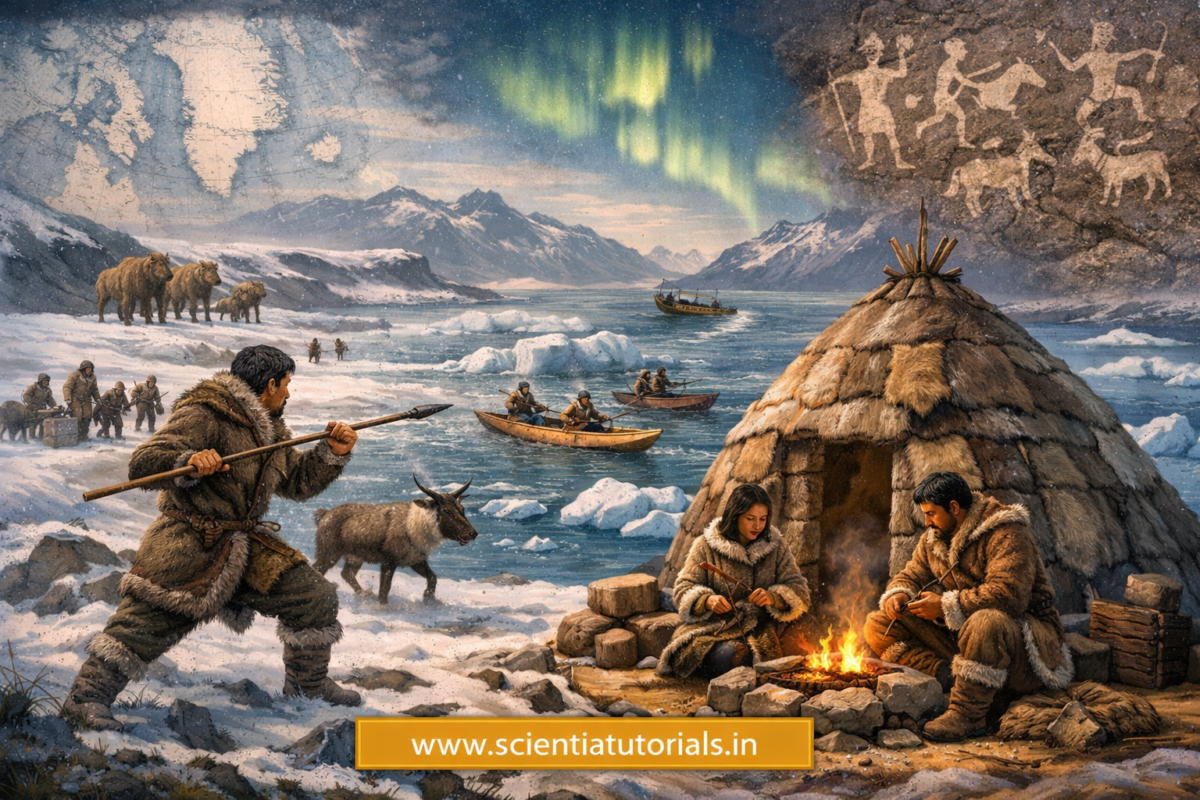

Greenland in Early Circumpolar History and Arctic World
Module 1: Greenland in the Prehistoric and Indigenous World
Lesson: Greenland in the Context of Early Circumpolar History
Era Framework: Prehistoric Period to c. 10th Century CE
This lesson is systematically organized into four clearly structured sections, as detailed below:
- Chronologically Structured Study Module
- Short-Answer Type Questions
- Long-Answer Type Questions
- Multiple-Choice Questions (MCQs) with Answers and Detailed Explanations
Chronologically Structured Study Module
Introduction to the Lesson
Greenland’s early history cannot be understood in isolation. From prehistoric times to the early medieval period, Greenland formed an integral part of the wider circumpolar world—a vast Arctic region stretching across northern Eurasia and North America. Human migration, cultural adaptation, technological innovation, and ecological knowledge in Greenland were closely connected to developments across this Arctic zone.
This lesson situates Greenland within the broader framework of early circumpolar history, examining how Arctic human migration, indigenous adaptation, and early cultural systems linked Greenland to other Arctic regions. By placing Greenland in this wider context, the lesson highlights the shared patterns of survival, interaction, and cultural continuity that defined Arctic societies up to the 10th century CE.
I. The Circumpolar World: Geographic and Environmental Context
1. Defining the Circumpolar Region
The circumpolar world refers to the northernmost regions of the globe surrounding the Arctic Ocean. This zone includes Greenland, northern Canada, Alaska, Siberia, and parts of Scandinavia. Despite vast distances, these regions shared similar environmental conditions:
- Extreme cold and seasonal darkness
- Ice-covered seas and tundra landscapes
- Limited vegetation
- Dependence on marine and terrestrial animals
These shared conditions produced comparable patterns of human adaptation across the Arctic.
2. Environmental Constraints and Human Possibilities
The Arctic environment imposed strict limits on population size, settlement patterns, and economic activity. Agriculture was impossible, and survival depended entirely on hunting, fishing, and gathering. However, the environment also offered opportunities, particularly through rich marine ecosystems.
Greenland’s coastal geography made it especially suitable for marine-based subsistence, connecting it naturally to the wider circumpolar ecological system.
II. Arctic Human Migration and Greenland’s Place (c. 3000 BCE – 500 BCE)
1. Early Human Movement Across the Arctic
The settlement of Greenland was part of a long process of Arctic human migration originating in northeast Asia. Over thousands of years, small groups of hunter-gatherers moved across the Arctic regions of Siberia, Alaska, and northern Canada.
These migrations were gradual and adaptive rather than rapid expansions. People followed animal migration routes and coastal corridors, carrying with them technologies and knowledge suited to cold environments.
2. Greenland as the Eastern Frontier of Arctic Migration
Greenland represented the easternmost extension of these Arctic migrations. Reaching Greenland required advanced survival skills, including ice navigation, marine hunting, and extreme cold adaptation.
The successful settlement of Greenland demonstrates the culmination of circumpolar adaptation rather than an isolated event.
3. Cultural Continuities Across the Arctic
Archaeological evidence reveals striking similarities across Arctic regions:
- Stone tool traditions
- Hunting equipment
- Seasonal mobility patterns
These continuities indicate that Greenlandic societies were part of a broader circumpolar cultural world rather than culturally isolated.
III. Indigenous Adaptation in the Circumpolar Context (c. 500 BCE – 500 CE)
1. Shared Survival Strategies
Across the circumpolar world, indigenous societies developed similar survival strategies:
- Marine mammal hunting
- Seasonal migration
- Insulated clothing
- Temporary and semi-permanent shelters
Greenlandic adaptations mirrored those found in other Arctic regions, reflecting shared responses to environmental challenges.
2. Technological Exchange and Innovation
Although direct long-distance contact was limited, technologies spread gradually across the Arctic through migration and inter-group interaction. Tools and techniques were refined locally but shared common design principles.
Greenland benefited from this collective circumpolar knowledge system, adapting it to local conditions such as extensive coastlines and drifting sea ice.
3. Environmental Knowledge as a Shared Tradition
Circumpolar societies possessed detailed knowledge of:
- Ice behavior
- Weather patterns
- Animal migration cycles
This knowledge was empirical, cumulative, and transmitted orally. Greenlandic indigenous knowledge formed part of this wider Arctic intellectual tradition.
IV. Early Cultural Systems in the Circumpolar World
1. Social Organization Without States
Across the circumpolar region, societies were organized without centralized political institutions. Greenlandic communities, like their Arctic counterparts, relied on:
- Kinship-based organization
- Informal leadership
- Collective decision-making
This model was highly effective in environments where cooperation was essential for survival.
2. Belief Systems and Cosmology
Circumpolar belief systems shared common features:
- Animistic worldviews
- Spiritual significance of animals
- Emphasis on balance between humans and nature
Greenlandic indigenous beliefs reflected this broader Arctic cosmology, reinforcing ethical hunting and ecological restraint.
3. Oral Tradition and Cultural Continuity
Without writing systems, circumpolar societies preserved history and knowledge through oral traditions. Myths, songs, and stories served as educational tools, transmitting survival skills and social values across generations.
Greenlandic oral traditions formed part of this shared Arctic heritage.
V. Greenland in Circumpolar Economic Networks (c. 500 – 1000 CE)
1. Subsistence Economies Across the Arctic
Economic life across the circumpolar world was subsistence-based. In Greenland, as elsewhere, economies centered on:
- Seal and whale hunting
- Fishing
- Seasonal land animal hunting
There was little accumulation of surplus, and resource sharing was central to economic life.
2. Exchange and Interaction
While long-distance trade was limited, regional exchange existed throughout the Arctic. Items such as tools, raw materials, and symbolic objects circulated between neighboring groups.
Greenland participated in these networks, linking it to the wider circumpolar world and reinforcing cultural continuity.
3. Moral Economy and Sustainability
Circumpolar economies were governed by moral principles rather than market logic. Ethical constraints, spiritual taboos, and social expectations regulated resource use.
Greenlandic societies shared this moral economy, ensuring environmental sustainability and long-term survival.
VI. Greenland and the Thule Expansion in Circumpolar Perspective
1. The Thule Phenomenon
During the first millennium CE, a highly adaptive Arctic culture expanded across the circumpolar world. This expansion connected Greenland more firmly to Arctic North America.
The Thule movement brought advanced hunting techniques, improved transportation, and greater mobility.
2. Greenland as a Key Node in Arctic Expansion
Greenland became a vital part of this circumpolar expansion. Its coastal resources supported large-scale marine hunting, while its geography encouraged settlement along shorelines.
This integration reinforced Greenland’s place within the circumpolar system rather than at its margins.
3. Cultural Integration and Local Adaptation
Although part of a wider movement, Greenlandic societies adapted Thule technologies to local conditions. This balance between shared culture and local innovation characterizes circumpolar history.
VII. Greenland in the Early Medieval Circumpolar World (Up to c. 10th Century CE)
1. Stability Without Centralization
By the 10th century CE, circumpolar societies, including Greenlandic communities, had achieved stable patterns of life without states or urban centers. Social norms, belief systems, and economic cooperation ensured order.
2. Greenland Before External Contact
Before sustained contact with non-Arctic societies, Greenland was fully integrated into the indigenous circumpolar world. Its inhabitants possessed:
- Advanced environmental knowledge
- Sustainable economic systems
- Strong social cohesion
These factors enabled long-term habitation in extreme conditions.
3. Foundations for Later Historical Change
Greenland’s circumpolar connections shaped how it would later interact with external cultures. Indigenous adaptation provided the resilience necessary to survive future encounters and transformations.
Historical Significance of Greenland in Circumpolar History
Placing Greenland in the context of early circumpolar history reveals several key insights:
- Arctic societies were interconnected, not isolated
- Indigenous knowledge systems were highly sophisticated
- Cultural continuity across the Arctic spanned millennia
- Greenland’s history reflects broader Arctic patterns rather than anomalies
This perspective challenges Eurocentric and state-centered interpretations of world history.
Conclusion
From prehistoric migrations to the early medieval period, Greenland functioned as an integral part of the circumpolar world. Human settlement, cultural development, and economic adaptation in Greenland were deeply connected to broader Arctic processes.
By situating Greenland within early circumpolar history, this lesson demonstrates that Greenland’s indigenous societies were participants in a vast, interconnected Arctic system characterized by resilience, cooperation, and ecological intelligence. This understanding provides essential context for later modules examining Greenland’s encounters with external powers and its growing global strategic importance.
Short Answer Type Questions and Answers
1. What is meant by the circumpolar world?
Answer:
The circumpolar world refers to the Arctic regions surrounding the North Pole, including Greenland, northern Canada, Alaska, Siberia, and parts of Scandinavia.
2. Why is Greenland considered part of the circumpolar world?
Answer:
Greenland shares similar Arctic environmental conditions, subsistence patterns, and cultural adaptations with other circumpolar regions.
3. What environmental features define the circumpolar region?
Answer:
Extreme cold, seasonal darkness, ice-covered seas, tundra landscapes, and limited vegetation.
4. How did the Arctic environment influence human settlement patterns?
Answer:
It limited population size, encouraged coastal settlement, and required seasonal mobility and cooperation.
5. From where did Arctic human migrations into Greenland originate?
Answer:
They originated in northeast Asia and moved through Siberia, Alaska, and northern Canada before reaching Greenland.
6. Why is Greenland described as the eastern frontier of Arctic migration?
Answer:
It represented the farthest eastern extension of prehistoric Arctic human movement.
7. What evidence shows cultural continuity across the Arctic?
Answer:
Similar tool traditions, hunting techniques, and settlement patterns across circumpolar regions.
8. How did indigenous adaptation in Greenland mirror other Arctic regions?
Answer:
Through marine hunting, insulated clothing, seasonal migration, and cooperative social organization.
9. What role did marine resources play in circumpolar societies?
Answer:
They formed the primary subsistence base, especially seal and whale hunting.
10. How was environmental knowledge transmitted in circumpolar societies?
Answer:
Through oral traditions, storytelling, and practical learning across generations.
11. What type of social organization was common in early circumpolar societies?
Answer:
Kinship-based, egalitarian societies without centralized political institutions.
12. Why were centralized states absent in the circumpolar world?
Answer:
Small populations, mobility, and survival cooperation made centralized authority unnecessary.
13. What belief system characterized early circumpolar societies?
Answer:
Animistic belief systems emphasizing spiritual relationships with nature and animals.
14. How did belief systems influence hunting practices?
Answer:
Through rituals and taboos that regulated hunting to maintain ecological balance.
15. What was the economic nature of circumpolar societies?
Answer:
Subsistence-based economies focused on hunting, fishing, and gathering.
16. Did circumpolar societies accumulate large economic surpluses?
Answer:
No, economic practices emphasized sharing rather than surplus accumulation.
17. What forms of exchange existed in the circumpolar world?
Answer:
Limited regional exchange of tools, raw materials, and symbolic items.
18. How did Greenland participate in circumpolar networks?
Answer:
Through shared cultural practices, technologies, and regional exchange.
19. What was the Thule expansion?
Answer:
A major Arctic cultural expansion during the first millennium CE connecting Greenland to Arctic North America.
20. Why was the Thule expansion significant for Greenland?
Answer:
It brought advanced technologies and strengthened Greenland’s integration into the circumpolar world.
21. How did circumpolar economies ensure sustainability?
Answer:
By regulating resource use through ethical norms, taboos, and seasonal practices.
22. What role did oral tradition play in circumpolar history?
Answer:
It preserved knowledge, values, and survival skills across generations.
23. How was social order maintained without formal law?
Answer:
Through shared norms, belief systems, and community consensus.
24. Why is Greenland’s circumpolar context historically important?
Answer:
It shows Greenland was interconnected with broader Arctic developments, not isolated.
25. How does circumpolar history challenge traditional historical narratives?
Answer:
It highlights non-state, indigenous systems as successful and enduring forms of civilization.
Long Answer Type Questions and Answers
1. Explain the concept of the circumpolar world and its relevance to Greenland’s early history.
Answer:
The circumpolar world refers to the Arctic regions encircling the North Pole, including Greenland, northern Canada, Alaska, Siberia, and parts of Scandinavia. These regions share similar environmental conditions such as extreme cold, seasonal darkness, and reliance on marine ecosystems. Greenland’s early history must be understood within this context because its settlement, cultural development, and survival strategies were part of wider Arctic patterns rather than isolated developments. Viewing Greenland as part of the circumpolar world highlights shared human adaptations and cultural continuities across the Arctic.
2. Discuss the environmental characteristics of the circumpolar region and their impact on human life.
Answer:
The circumpolar region is defined by severe cold, long winters, short summers, ice-covered seas, and limited vegetation. These conditions restricted population growth, made agriculture impossible, and required dependence on hunting and fishing. Human life was shaped by mobility, cooperation, and deep environmental knowledge. In Greenland, these constraints encouraged coastal settlement, seasonal movement, and highly adaptive technologies, similar to other Arctic regions.
3. Trace the prehistoric Arctic human migrations that connected Greenland to the wider circumpolar world.
Answer:
Arctic human migrations began in northeast Asia and gradually moved across Siberia, Alaska, and northern Canada. Over thousands of years, hunter-gatherer groups followed animal migration routes and coastal corridors. Greenland was the easternmost extension of this movement. The settlement of Greenland represents the culmination of Arctic adaptation, linking it directly to broader circumpolar migration patterns.
4. Why is Greenland described as the eastern frontier of Arctic human migration?
Answer:
Greenland is described as the eastern frontier because it marks the furthest eastward expansion of prehistoric Arctic populations. Reaching Greenland required advanced survival skills such as marine hunting, ice navigation, and cold adaptation. Its successful settlement demonstrates the high level of circumpolar human resilience and adaptability.
5. Examine the cultural continuities that linked Greenland with other circumpolar regions.
Answer:
Cultural continuities included similar stone tool technologies, hunting equipment, seasonal mobility, and social organization. Archaeological evidence shows shared design principles across the Arctic. These similarities indicate that Greenlandic societies were culturally connected to the wider circumpolar world rather than isolated communities.
6. Analyze indigenous adaptation strategies in Greenland within the circumpolar context.
Answer:
Indigenous adaptation strategies in Greenland mirrored those of other Arctic societies. These included marine mammal hunting, insulated clothing, seasonal migration, and cooperative social structures. Greenlandic communities adapted shared circumpolar knowledge to local conditions such as extensive coastlines and drifting sea ice, demonstrating both continuity and local innovation.
7. Discuss the role of environmental knowledge in circumpolar societies.
Answer:
Environmental knowledge was essential for survival and included understanding ice behavior, weather patterns, and animal migration. This knowledge was empirical, accumulated over generations, and transmitted orally. In Greenland, such knowledge enabled safe travel, effective hunting, and sustainable resource use, aligning closely with circumpolar traditions.
8. Explain the nature of social organization in early circumpolar societies, including Greenland.
Answer:
Early circumpolar societies were organized into small, kin-based, egalitarian groups. There were no centralized states or formal political institutions. Leadership was informal and situational. This social organization was well suited to environments where cooperation and flexibility were essential for survival.
9. Why did centralized political institutions not emerge in the circumpolar world?
Answer:
Centralized political institutions did not emerge because small populations, seasonal mobility, and subsistence economies made such structures unnecessary. Social norms, kinship ties, and belief systems effectively regulated behavior. In Greenland, these informal systems ensured order and stability without formal governance.
10. Examine belief systems shared across the circumpolar world and their significance.
Answer:
Circumpolar belief systems were largely animistic, emphasizing spiritual relationships between humans, animals, and nature. Animals were considered spiritually significant, and hunting was regulated by rituals and taboos. These beliefs reinforced ethical behavior, social cooperation, and environmental sustainability across Arctic societies, including Greenland.
11. How did belief systems influence economic practices in Greenland and the circumpolar region?
Answer:
Belief systems acted as moral regulators of economic activity. Taboos restricted overhunting, rituals governed hunting practices, and spiritual consequences were believed to follow unethical behavior. These mechanisms ensured sustainable resource use without formal laws, maintaining ecological balance.
12. Discuss the subsistence-based economy of circumpolar societies with reference to Greenland.
Answer:
Circumpolar economies were based on hunting, fishing, and gathering, with a strong emphasis on marine resources. In Greenland, seal and whale hunting formed the economic core. There was little surplus accumulation, and food sharing was a moral obligation, ensuring collective survival.
13. Analyze the concept of the moral economy in circumpolar societies.
Answer:
The moral economy prioritized collective well-being over individual gain. Economic actions were evaluated ethically rather than materially. Sharing, restraint, and respect for nature defined economic success. Greenlandic societies shared this moral framework, which prevented inequality and resource depletion.
14. Evaluate the role of exchange and interaction in the circumpolar world.
Answer:
Although long-distance trade was limited, regional exchange existed across the Arctic. Tools, raw materials, and symbolic items were exchanged between neighboring groups. Greenland participated in these networks, reinforcing cultural continuity and social connections within the circumpolar world.
15. Discuss the Thule expansion in the context of circumpolar history.
Answer:
The Thule expansion during the first millennium CE represents a major phase of circumpolar cultural development. It introduced advanced hunting technologies, improved transportation, and greater mobility. This expansion strengthened connections between Greenland and Arctic North America.
16. Why was the Thule expansion significant for Greenland’s integration into the circumpolar world?
Answer:
The Thule expansion enhanced Greenland’s role within the Arctic system by improving subsistence efficiency and mobility. Greenland became a key node in circumpolar networks, supporting large-scale marine hunting and sustained settlement.
17. Examine Greenland’s role in the early medieval circumpolar world (up to c. 10th century CE).
Answer:
By the 10th century CE, Greenland was fully integrated into the indigenous circumpolar world. Its societies exhibited stable social organization, sustainable economies, and advanced environmental knowledge. This integration ensured resilience and continuity before external contact.
18. How was social order maintained in circumpolar societies without formal law?
Answer:
Social order was maintained through shared norms, belief systems, kinship obligations, and community consensus. Spiritual beliefs reinforced ethical behavior, while social pressure discouraged conflict and selfishness.
19. Assess the historical importance of viewing Greenland through a circumpolar lens.
Answer:
Viewing Greenland through a circumpolar lens reveals its interconnectedness with Arctic societies and challenges interpretations that portray it as isolated. It highlights indigenous knowledge systems, cultural continuity, and adaptive strategies shared across the Arctic.
20. How does circumpolar history challenge state-centered models of civilization?
Answer:
Circumpolar history demonstrates that complex, stable societies can exist without states, cities, or agriculture. Greenlandic and Arctic societies achieved long-term sustainability through cooperation, ethical economies, and ecological knowledge, challenging conventional definitions of civilization.
21. Explain how Greenland’s circumpolar past shaped its later historical trajectory.
Answer:
Greenland’s circumpolar past provided resilience, adaptability, and environmental mastery. These foundations shaped later encounters with external powers and contributed to Greenland’s enduring strategic and historical significance.
22. Why is Greenland’s early circumpolar history relevant for contemporary historical studies?
Answer:
It offers insights into climate adaptation, sustainability, and indigenous knowledge systems. Greenland’s circumpolar history demonstrates alternative pathways to human survival and social organization in extreme environments.
MCQs with Answers and Explanations
1. The term “circumpolar world” refers to:
A. Regions around the Equator
B. Areas surrounding the Arctic Ocean
C. Coastal regions of Europe
D. Mountainous regions of Asia
Correct Answer: B
Explanation:
The circumpolar world includes Arctic regions surrounding the North Pole, such as Greenland, northern Canada, Alaska, Siberia, and Scandinavia.
2. Greenland is considered part of the circumpolar world mainly because of its:
A. Political history
B. Colonial connections
C. Arctic environment and adaptations
D. Agricultural development
Correct Answer: C
Explanation:
Greenland shares environmental conditions and survival strategies with other Arctic regions, linking it to the circumpolar world.
3. Which environmental condition most strongly shaped circumpolar societies?
A. Dense forests
B. Abundant farmland
C. Extreme cold and seasonal darkness
D. Heavy rainfall
Correct Answer: C
Explanation:
Extreme cold and long periods of darkness dictated subsistence strategies and social organization across the Arctic.
4. Arctic human migration into Greenland originally began from:
A. Southern Europe
B. Central Asia
C. Northeast Asia
D. Africa
Correct Answer: C
Explanation:
Prehistoric migrations began in northeast Asia and moved across Siberia, Alaska, and northern Canada before reaching Greenland.
5. Greenland is described as the eastern frontier of Arctic migration because it:
A. Was agriculturally rich
B. Had dense populations
C. Represented the furthest eastward settlement
D. Was colonized first
Correct Answer: C
Explanation:
Greenland marked the easternmost extension of Arctic human migration.
6. Which factor made Greenland’s settlement especially challenging?
A. Political instability
B. Advanced enemies
C. Extreme Arctic conditions
D. Lack of rivers
Correct Answer: C
Explanation:
Severe cold, ice navigation, and limited resources made Greenland one of the most challenging Arctic regions to inhabit.
7. Cultural similarities across the Arctic suggest that Greenlandic societies were:
A. Isolated and unique
B. Politically dominant
C. Part of a shared circumpolar tradition
D. Dependent on agriculture
Correct Answer: C
Explanation:
Similar tools, hunting methods, and social structures show cultural continuity across the Arctic.
8. Which subsistence activity was central to most circumpolar societies?
A. Agriculture
B. Pastoralism
C. Marine mammal hunting
D. Mining
Correct Answer: C
Explanation:
Marine resources such as seals and whales formed the economic foundation of circumpolar societies.
9. Indigenous adaptation strategies in Greenland included all EXCEPT:
A. Seasonal migration
B. Insulated clothing
C. Agricultural farming
D. Cooperative hunting
Correct Answer: C
Explanation:
Agriculture was not possible in Arctic conditions; survival depended on hunting and fishing.
10. Environmental knowledge in circumpolar societies was primarily transmitted through:
A. Written texts
B. Formal schools
C. Oral traditions
D. Trade contracts
Correct Answer: C
Explanation:
Knowledge was passed down orally through storytelling, myths, and practical teaching.
11. Social organization in early circumpolar societies was typically:
A. Centralized and bureaucratic
B. Kinship-based and egalitarian
C. Militarized and hierarchical
D. Urban and commercial
Correct Answer: B
Explanation:
Small kin-based groups with shared decision-making were best suited for Arctic survival.
12. Why did centralized states not develop in the circumpolar world?
A. Cultural resistance to leadership
B. Constant warfare
C. Small populations and mobility
D. External colonization
Correct Answer: C
Explanation:
Low population density and seasonal movement made centralized governance unnecessary.
13. Which belief system was common across circumpolar societies?
A. Monotheism
B. Animism
C. Atheism
D. Philosophical rationalism
Correct Answer: B
Explanation:
Animism emphasized spiritual relationships between humans, animals, and nature.
14. How did animistic beliefs influence economic behavior?
A. Encouraged exploitation
B. Promoted competition
C. Regulated hunting through taboos
D. Eliminated rituals
Correct Answer: C
Explanation:
Beliefs imposed moral and spiritual limits on hunting and resource use.
15. Circumpolar economies are best described as:
A. Commercial and market-based
B. Industrial
C. Subsistence-oriented
D. Capital-intensive
Correct Answer: C
Explanation:
Economic activity focused on survival rather than surplus or profit.
16. The concept of a “moral economy” in the circumpolar world emphasized:
A. Profit maximization
B. Individual accumulation
C. Collective well-being
D. State regulation
Correct Answer: C
Explanation:
Economic behavior was guided by ethical norms and community survival.
17. Food sharing in Greenlandic and other circumpolar societies was:
A. Optional
B. Enforced by law
C. A moral obligation
D. Limited to elites
Correct Answer: C
Explanation:
Sharing ensured group survival and reinforced social cohesion.
18. Which type of exchange existed in the circumpolar world?
A. Long-distance global trade
B. Monetary exchange
C. Regional exchange of tools and materials
D. Agricultural trade
Correct Answer: C
Explanation:
Exchange networks were limited but helped maintain cultural connections.
19. The Thule expansion refers to:
A. European colonization
B. A major Arctic cultural expansion
C. Agricultural development
D. Urban growth
Correct Answer: B
Explanation:
The Thule expansion spread advanced Arctic technologies across the circumpolar region.
20. The Thule expansion strengthened Greenland’s:
A. Agricultural output
B. Political centralization
C. Integration into the circumpolar world
D. Colonial administration
Correct Answer: C
Explanation:
It enhanced Greenland’s role within Arctic cultural and economic networks.
21. By the 10th century CE, Greenland was:
A. Politically centralized
B. Agriculturally developed
C. Fully integrated into the circumpolar world
D. Abandoned
Correct Answer: C
Explanation:
Greenland had stable indigenous societies connected to wider Arctic systems.
22. Social order in circumpolar societies was maintained primarily through:
A. Written laws
B. Military enforcement
C. Shared norms and beliefs
D. External authority
Correct Answer: C
Explanation:
Belief systems and social consensus regulated behavior.
23. Viewing Greenland in a circumpolar context helps historians to:
A. Isolate its history
B. Emphasize European influence
C. Understand Arctic interconnectedness
D. Ignore indigenous systems
Correct Answer: C
Explanation:
This perspective highlights shared Arctic adaptations and cultural continuity.
24. Circumpolar history challenges traditional historical models because it shows:
A. The dominance of empires
B. The inevitability of states
C. Successful non-state societies
D. Early industrialization
Correct Answer: C
Explanation:
Circumpolar societies thrived without states, cities, or agriculture.
25. Greenland’s early circumpolar history is significant because it:
A. Led directly to colonization
B. Demonstrates indigenous resilience and adaptation
C. Created early empires
D. Encouraged urbanization
Correct Answer: B
Explanation:
Greenland’s history exemplifies long-term human adaptation in extreme environments.