
Greenland’s Place in the Medieval Global Order
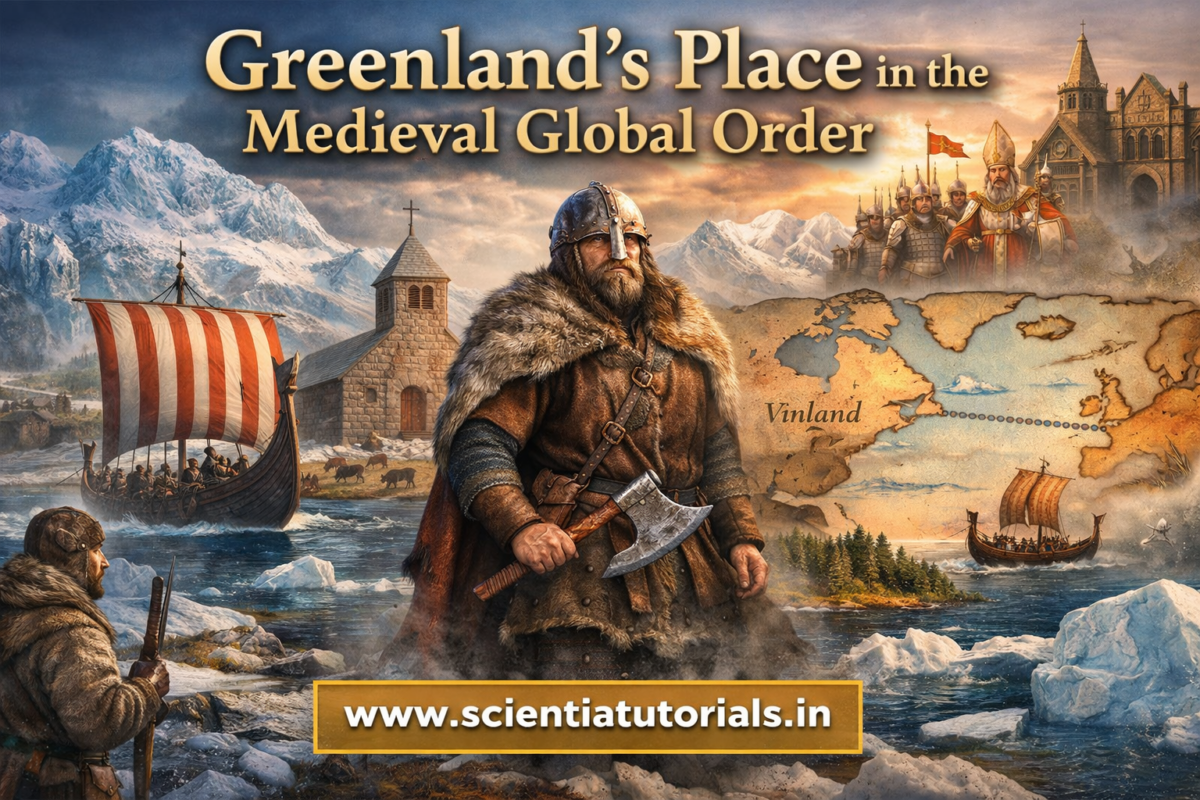

Greenland’s Place in the Medieval Global Order | Norse Expansion
Module 2: Norse Expansion and Medieval Greenland
Lesson: Greenland’s Place in the Medieval Global Order
Era Framework: c. 10th Century – 15th Century
This lesson is systematically organized into four clearly structured sections, as detailed below:
- Chronologically Structured Study Module
- Short-Answer Type Questions
- Long-Answer Type Questions
- Multiple-Choice Questions (MCQs) with Answers and Detailed Explanations
Chronologically Structured Study Module
Introduction: Medieval Greenland in a Connected World
Between the 10th and the 15th centuries, Greenland was not an isolated Arctic outpost but an integrated frontier within the medieval global order. The Norse settlement of Greenland emerged during the wider era of Viking expansion, when Scandinavian societies were extending their political, economic, and cultural reach across the North Atlantic. This lesson situates medieval Greenland within interconnected systems linking Scandinavia, the North Atlantic islands, Western Europe, and even the broader Eurasian world through trade, religion, and climate-driven historical change.
Understanding Greenland’s medieval role requires viewing it chronologically: from its settlement during the Viking Age, through its integration into Christian Europe, to its decline and disappearance in the late medieval period. Greenland’s history thus reflects key global medieval themes—frontier expansion, environmental adaptation, trans-oceanic connectivity, and systemic vulnerability.
I. The Viking Expansion and the North Atlantic World (c. 9th–10th Century)
1. Scandinavia and the Age of Expansion
By the late 8th century, Scandinavian societies had entered a period of outward expansion driven by population pressures, political consolidation, maritime technology, and opportunities for trade and land acquisition. The Viking Age (c. 800–1050) witnessed Norse movements across Europe, from the British Isles and the Baltic to the Mediterranean and Eastern Europe.
This expansion created a North Atlantic corridor linking Scandinavia, Iceland, and eventually Greenland. Rather than random raiding, this was a structured movement involving settlement, trade, and political organization.
2. Iceland as a Stepping Stone
The settlement of Iceland in the late 9th century formed the immediate precondition for Greenland’s colonization. Iceland functioned as a staging ground for further western exploration, supplying ships, manpower, and social institutions such as assemblies (þings). It also established a tradition of oceanic navigation essential for Greenland’s settlement.
3. Discovery and Naming of Greenland
According to medieval sources, notably the Icelandic sagas, Greenland was explored and named by Erik the Red around c. 982 CE. The name “Greenland” was a deliberate act of promotional geography, intended to attract settlers by emphasizing arable potential rather than harsh reality. This reflects a broader medieval pattern of frontier myth-making.
II. Establishment of Norse Greenland (c. 985–1050)
1. Settlement Patterns
By c. 985 CE, Norse settlers established two primary colonies in southern Greenland:
- The Eastern Settlement, located near modern-day Qaqortoq
- The Western Settlement, further north near present-day Nuuk
These settlements were agriculturally based, relying on livestock farming (cattle, sheep, goats) supplemented by hunting, fishing, and limited cultivation. Farms were organized around fjords, mirroring Icelandic settlement models.
2. Political and Social Organization
Greenland’s society was structured along familiar Norse lines:
- Chieftain-led farmsteads
- Local assemblies for dispute resolution
- Kinship-based social hierarchy
Despite geographic remoteness, Greenland remained socially and legally connected to the wider Norse world.
3. Integration into the Norse World
Greenland was not independent but functioned as an extension of Norse society. Regular voyages connected it to Iceland and Norway, ensuring the flow of people, goods, and ideas. This integration demonstrates how medieval globalization functioned through maritime networks rather than land-based empires.
III. Greenland in the Medieval Economic System (c. 11th–13th Century)
1. Trade and Economic Exchange
Greenland’s economic significance lay primarily in its export commodities, which were highly valued in medieval Europe:
- Walrus ivory (used for luxury carvings and ecclesiastical objects)
- Polar bear skins
- Falconry birds
- Narwhal tusks (often sold as “unicorn horn”)
These goods linked Greenland to European markets, including England, Scandinavia, and continental Europe.
2. Greenland and the Luxury Economy of Medieval Europe
In medieval Europe, elite consumption drove long-distance trade. Greenland’s Arctic products fitted neatly into this system, making the colony economically relevant despite its marginal environment. This highlights how peripheral regions could become central within niche economic networks.
3. Monetary and Barter Systems
Greenland functioned largely within a barter economy, with limited coin circulation. European goods—iron tools, timber, grain, and luxury items—were imported in exchange for Arctic resources. This asymmetrical dependency would later prove significant.
IV. Christianization and Integration into Medieval Christendom (c. 1000–1200)
1. Conversion to Christianity
Greenland’s Christianization followed the broader Scandinavian conversion. Churches were established early, and by the early 12th century, Greenland was fully integrated into the Christian world.
2. The Diocese of Greenland
In 1126, Greenland became an official diocese under the Archbishopric of Nidaros (Trondheim). The establishment of a bishopric signified:
- Institutional integration into European Christendom
- Regular communication with ecclesiastical authorities
- Cultural alignment with medieval Europe
Cathedrals, parish churches, and monasteries emerged, embedding Greenland in the ideological and spiritual structures of the medieval global order.
3. Cultural Consequences
Christianity reinforced European identity among Greenland’s Norse settlers. Latin literacy, ecclesiastical architecture, and religious rituals connected this Arctic society to Rome-centered Christendom, illustrating the cultural reach of medieval globalization.
V. Greenland and Trans-Atlantic Contacts
1. Voyages Beyond Greenland
Greenland served as a launching point for further exploration westward. Norse expeditions reached areas of North America, including Vinland (likely parts of modern Newfoundland).
The most famous associated figure is Leif Erikson, whose voyages symbolize Greenland’s role as a bridge between Europe and the Americas.
2. Limits of Trans-Atlantic Integration
Despite these contacts, trans-Atlantic exchange remained limited and did not result in sustained colonization. Nonetheless, Greenland’s position in this network demonstrates that medieval globalization extended beyond Europe’s traditional boundaries.
VI. Environmental Constraints and Adaptation (c. 11th–14th Century)
1. Climate and the Medieval Warm Period
Early settlement coincided with the Medieval Warm Period, which provided relatively favorable climatic conditions. This allowed pastoral agriculture to flourish in southern Greenland.
2. Resource Limitations
Greenland lacked:
- Timber for shipbuilding
- Grain for bread production
- Metals for tools and weapons
Dependence on imports made the colony vulnerable to disruptions in trade routes.
3. Interaction with Indigenous Arctic Peoples
Norse settlers coexisted with Inuit groups (ancestors of the Thule culture). Interaction appears limited but included occasional trade and cultural contact. The Norse largely failed to adopt Inuit survival strategies, a factor contributing to their decline.
VII. Greenland in Crisis: Late Medieval Decline (c. 14th–15th Century)
1. The Onset of the Little Ice Age
From the 14th century, the Little Ice Age brought colder temperatures, shorter growing seasons, and increased sea ice. These changes severely affected agriculture and navigation.
2. Disruption of Trade Networks
European demand for walrus ivory declined as elephant ivory became more accessible. At the same time, political and economic changes in Europe reduced attention to distant colonies.
The weakening of maritime connections isolated Greenland further.
3. Demographic and Social Collapse
The Western Settlement disappeared by the mid-14th century, followed by the Eastern Settlement by the 15th century. Causes included:
- Environmental stress
- Economic isolation
- Rigid adherence to European lifestyles unsuited to Arctic conditions
Greenland’s collapse illustrates the limits of medieval globalization when systems failed to adapt.
VIII. Greenland’s Place in the Medieval Global Order: Analytical Perspectives
1. Frontier Society within Global Systems
Greenland exemplifies how medieval global systems incorporated distant frontiers through trade, religion, and culture without political centralization.
2. Connectivity and Vulnerability
Integration brought benefits—status, trade, identity—but also dependency. When connections weakened, peripheral societies suffered disproportionately.
3. Lessons for World History
Greenland’s medieval experience highlights:
- The importance of environmental adaptation
- The fragility of long-distance networks
- The interconnectedness of medieval societies across oceans
Conclusion: Medieval Greenland as a Global Case Study
From the 10th to the 15th century, Greenland functioned as a vital yet vulnerable node in the medieval global order. Its Norse settlers carried European institutions to the Arctic, participated in trans-Atlantic networks, and contributed to medieval economic and cultural systems. At the same time, Greenland’s eventual decline reveals the structural weaknesses of medieval globalization in the face of climate change and shifting economic priorities.
By situating Greenland within Viking expansion, Christian Europe, and late medieval transformation, this lesson underscores its significance far beyond its geographic margins. Medieval Greenland was not a historical footnote but a revealing case study of how global systems operate, adapt, and sometimes fail.
Short Answer Type Questions (with Answers)
1. In which century was Greenland settled by the Norse?
Greenland was settled by the Norse in the late 10th century, around 985 CE.
2. Who led the Norse settlement of Greenland?
The Norse settlement of Greenland was led by Erik the Red, an Icelandic exile.
3. Why was the name “Greenland” chosen?
The name “Greenland” was chosen to attract settlers, as it suggested fertile land despite the harsh climate.
4. What were the two main Norse settlements in Greenland?
The two main settlements were the Eastern Settlement and the Western Settlement.
5. What economic activity formed the base of Norse Greenland’s economy?
The economy was based on pastoral farming, supplemented by hunting, fishing, and trade.
6. How was Greenland connected to the medieval global economy?
Greenland was connected through North Atlantic trade networks linking it with Iceland, Norway, and Europe.
7. Name two major export commodities of medieval Greenland.
Two major exports were walrus ivory and polar bear skins.
8. Why was walrus ivory important in medieval Europe?
Walrus ivory was valued for making luxury items and religious artifacts.
9. What role did Christianity play in medieval Greenland?
Christianity integrated Greenland into medieval European religious and cultural systems.
10. When was the Diocese of Greenland established?
The Diocese of Greenland was established in 1126 CE.
11. Under which ecclesiastical authority did Greenland fall?
Greenland came under the Archbishopric of Nidaros (Trondheim).
12. How did Greenland participate in trans-Atlantic exploration?
Greenland served as a base for voyages to North America, including Vinland.
13. Which Norse explorer is associated with voyages from Greenland to North America?
Leif Erikson is associated with these voyages.
14. What climatic phase supported early Norse settlement in Greenland?
The Medieval Warm Period supported early settlement by providing milder conditions.
15. What major climatic shift affected Greenland after the 13th century?
The Little Ice Age brought colder temperatures and harsher living conditions.
16. Why was Greenland dependent on European trade?
Greenland lacked timber, grain, and metal resources, making imports essential.
17. Who were the indigenous people living in Greenland during Norse settlement?
The indigenous people were Inuit groups, ancestors of the Thule culture.
18. Why did Norse settlers struggle to adapt to Arctic conditions?
They retained European farming practices and did not fully adopt Inuit survival strategies.
19. What happened to the Western Settlement?
The Western Settlement disappeared by the mid-14th century, likely due to climate and isolation.
20. When did Norse Greenland completely disappear?
Norse Greenland disappeared by the 15th century.
21. How did changes in European markets affect Greenland?
Declining demand for walrus ivory reduced Greenland’s economic importance.
22. What does Greenland’s decline reveal about medieval globalization?
It shows that medieval globalization was fragile and dependent on stable networks.
23. Why is Greenland considered a medieval frontier society?
Because it represented European expansion into extreme and marginal environments.
24. How did religion strengthen Greenland’s ties to Europe?
Christian institutions reinforced cultural identity and political legitimacy.
25. What is Greenland’s historical significance in world history?
Greenland illustrates early trans-Atlantic connectivity, environmental limits, and the reach of medieval global systems.
Long Answer Type Questions with Answers
1. Examine the historical background of Norse expansion and explain how it led to the settlement of Greenland.
The Norse settlement of Greenland was part of the broader Viking expansion that began in the late 8th century. Population growth, political consolidation in Scandinavia, and advancements in maritime technology encouraged Norse communities to seek new lands. After the settlement of Iceland in the 9th century, Greenland emerged as the next frontier in the westward movement. Around 985 CE, Greenland was settled under the leadership of Erik the Red, who promoted the island as suitable for farming. Thus, Greenland’s colonization was a direct outcome of Viking mobility and frontier expansion within the medieval North Atlantic world.
2. Discuss the geographical and environmental factors that shaped Norse settlement patterns in Greenland.
Greenland’s Norse settlements were concentrated along the southwestern coast, where fjords provided relatively milder climates, grazing land, and access to the sea. The settlers established the Eastern and Western Settlements in areas suitable for pastoral farming. However, Greenland’s environment imposed severe limitations, including a lack of timber, arable land, and metals. While early climatic conditions during the Medieval Warm Period were favorable, environmental constraints always shaped settlement size, economic activities, and long-term sustainability.
3. Analyze the political and social organization of Norse Greenland.
Norse Greenland was organized along familiar Scandinavian social lines. Society revolved around farmsteads controlled by chieftains, with kinship networks forming the basis of social hierarchy. Local assemblies (þings) resolved disputes and maintained order. Greenland had no centralized state but remained politically connected to Iceland and Norway. This decentralized structure reflected the broader medieval Norse world, where authority was personal, local, and customary rather than bureaucratic.
4. Explain how Greenland was integrated into medieval European trade networks.
Despite its remoteness, Greenland was economically integrated into medieval Europe through North Atlantic trade routes. Its main exports—walrus ivory, polar bear skins, falcons, and narwhal tusks—were luxury goods highly valued by European elites. In return, Greenland imported essential items such as iron tools, timber, grain, and cloth. These exchanges linked Greenland to markets in Scandinavia and Western Europe, making it a peripheral yet significant node in the medieval global economy.
5. Evaluate the economic importance of walrus ivory in medieval Greenland.
Walrus ivory was the backbone of Greenland’s medieval economy. It was used in Europe for religious artifacts, luxury carvings, and royal gifts. Greenland’s access to Arctic walrus populations gave it a niche economic role within medieval trade systems. However, reliance on a single primary export made Greenland vulnerable. When European demand declined due to increased availability of elephant ivory, Greenland’s economic foundation weakened significantly.
6. Discuss the role of Christianity in integrating Greenland into the medieval global order.
Christianity played a crucial role in embedding Greenland within medieval European civilization. The conversion of the Norse settlers followed Scandinavian patterns, and by the early 12th century Greenland had its own diocese. Churches, monasteries, and Christian rituals reinforced European cultural identity. Ecclesiastical ties connected Greenland to Rome-centered Christendom, demonstrating how religion functioned as a unifying force in medieval globalization.
7. Describe the establishment and significance of the Diocese of Greenland.
The Diocese of Greenland was established in 1126 CE under the Archbishopric of Nidaros in Norway. Its creation symbolized Greenland’s full inclusion within the institutional framework of medieval Christendom. Bishops, clergy, and church buildings linked Greenland to European religious networks. This ecclesiastical connection also ensured continued contact with Europe, reinforcing Greenland’s place in the medieval global order.
8. Analyze Greenland’s role in trans-Atlantic exploration during the medieval period.
Greenland served as a launching point for Norse exploration further west. From Greenland, voyages reached parts of North America, including Vinland. These expeditions, associated with Leif Erikson, represent some of the earliest European contacts with the Americas. Although these contacts were limited and short-lived, they demonstrate Greenland’s role as a bridge between Europe and the New World in the medieval era.
9. Why did Norse trans-Atlantic contacts not result in permanent American settlements?
Permanent settlements failed due to distance, limited economic incentives, resistance from indigenous populations, and logistical difficulties. Greenland itself struggled to sustain its population, making further colonization impractical. As a result, Norse exploration of North America remained episodic rather than transformational.
10. Examine the impact of the Medieval Warm Period on Norse Greenland.
The Medieval Warm Period (c. 950–1250) provided relatively favorable climatic conditions that allowed pastoral farming to flourish. Longer growing seasons and navigable seas supported settlement expansion and trade. This climatic phase was crucial for Greenland’s initial success, demonstrating how environmental factors shaped medieval historical outcomes.
11. Assess the consequences of the Little Ice Age for Greenland’s Norse settlements.
From the 14th century onward, the Little Ice Age brought colder temperatures, increased sea ice, and shorter growing seasons. Agriculture declined, sea routes became dangerous, and isolation intensified. These changes severely undermined Greenland’s economic and social stability, accelerating the collapse of Norse settlements.
12. Discuss the relationship between Norse settlers and Inuit populations.
The Norse encountered Inuit groups (ancestors of the Thule culture) who were well adapted to Arctic conditions. Interaction appears to have included limited trade and occasional conflict. Crucially, the Norse failed to adopt Inuit technologies such as advanced hunting methods and clothing, reducing their ability to cope with environmental change.
13. Explain why Greenland remained economically dependent on Europe.
Greenland lacked key resources such as timber, grain, and metals. This made imports essential for survival. The colony’s economy depended on exporting luxury goods in exchange for necessities, creating a dependency on stable trade routes and European demand.
14. Analyze the decline of the Western Settlement.
The Western Settlement disappeared by the mid-14th century. Factors included harsher climate, declining trade, soil exhaustion, and isolation. Its collapse marked the beginning of the end for Norse Greenland and reflected the fragility of peripheral settlements.
15. What factors led to the final disappearance of Norse Greenland?
The disappearance of Norse Greenland by the 15th century resulted from environmental deterioration, economic isolation, declining trade relevance, and cultural rigidity. Together, these factors overwhelmed the colony’s ability to adapt and survive.
16. How does Greenland’s history illustrate the strengths and weaknesses of medieval globalization?
Greenland shows that medieval globalization connected distant regions through trade, religion, and culture. However, it also reveals weaknesses—dependency on long-distance networks and vulnerability to climate and economic shifts. When connections failed, peripheral societies collapsed.
17. In what ways can Greenland be described as a medieval frontier society?
Greenland was a frontier society characterized by migration, adaptation to marginal environments, and dependence on external connections. It extended European institutions into the Arctic, reflecting the outward reach of medieval Europe.
18. Compare Greenland’s medieval experience with other Norse settlements in the North Atlantic.
Unlike Iceland, which survived and adapted, Greenland collapsed due to harsher environmental conditions and greater isolation. This comparison highlights how geography and adaptability influenced historical outcomes.
19. Discuss the historical significance of Greenland in world history.
Greenland holds significance as an early example of trans-oceanic connectivity, European expansion, and environmental limitation. Its history contributes to understanding medieval global systems beyond traditional European centers.
20. Conclude by evaluating Greenland’s place in the medieval global order.
Greenland was a marginal yet meaningful component of the medieval global order. Integrated through trade, religion, and exploration, it demonstrates both the reach and the limits of medieval globalization. Its rise and fall provide valuable lessons on adaptation, connectivity, and systemic vulnerability in world history.
Multiple Choice Questions (MCQs) with Answers and Explanations
1. Greenland was first settled by the Norse around:
A. 850 CE
B. 900 CE
C. 985 CE
D. 1050 CE
Correct Answer: C
Explanation:
Norse settlement in Greenland began around 985 CE during the westward expansion of Viking society, following the earlier settlement of Iceland.
2. The Norse settlement of Greenland was led by:
A. Harald Hardrada
B. Erik the Red
C. Olaf Tryggvason
D. Leif Erikson
Correct Answer: B
Explanation:
Erik the Red, an Icelandic exile, organized and promoted Greenland as a settlement, giving it a favorable name to attract migrants.
3. Greenland was named primarily to:
A. Reflect its climate
B. Honor Norse gods
C. Attract settlers
D. Mark territorial conquest
Correct Answer: C
Explanation:
The name “Greenland” was a promotional strategy, emphasizing perceived fertility rather than environmental reality.
4. Which of the following were the two main Norse settlements in Greenland?
A. North and South Settlements
B. Eastern and Western Settlements
C. Coastal and Inland Settlements
D. Greenlandic and Icelandic Settlements
Correct Answer: B
Explanation:
Norse Greenland consisted of two main population centers—the Eastern and Western Settlements—both located in the southwestern coastal region.
5. The primary economic base of Norse Greenland was:
A. Mining
B. Fishing alone
C. Pastoral farming combined with trade
D. Urban commerce
Correct Answer: C
Explanation:
The Norse relied on livestock farming supported by hunting, fishing, and long-distance trade.
6. Which commodity was most important for Greenland’s medieval exports?
A. Timber
B. Fur only
C. Walrus ivory
D. Iron tools
Correct Answer: C
Explanation:
Walrus ivory was highly valued in medieval Europe for luxury and religious artifacts, forming the backbone of Greenland’s export economy.
7. Greenland was connected to medieval Europe mainly through:
A. Overland caravan routes
B. Mediterranean trade
C. North Atlantic maritime routes
D. Silk Road networks
Correct Answer: C
Explanation:
Greenland was integrated into Europe via maritime routes linking it to Iceland, Norway, and Western Europe.
8. Greenland’s incorporation into Christian Europe was marked by:
A. Viking raids
B. Royal coronations
C. Establishment of a diocese
D. Monastic isolation
Correct Answer: C
Explanation:
The establishment of the Diocese of Greenland in 1126 symbolized full integration into medieval Christendom.
9. The Diocese of Greenland was under the authority of:
A. Rome directly
B. Canterbury
C. Archbishopric of Nidaros
D. Paris
Correct Answer: C
Explanation:
Greenland fell under the Archbishopric of Nidaros (Trondheim), linking it ecclesiastically to Scandinavia.
10. Which Norse explorer is associated with voyages from Greenland to North America?
A. Erik the Red
B. Olaf the Lucky
C. Leif Erikson
D. Sven Forkbeard
Correct Answer: C
Explanation:
Leif Erikson’s voyages from Greenland to Vinland represent early European contact with North America.
11. Greenland’s role in medieval trans-Atlantic exploration can best be described as:
A. An isolated outpost
B. A failed empire
C. A staging point for western voyages
D. A colonial capital
Correct Answer: C
Explanation:
Greenland acted as a stepping stone for further exploration rather than a permanent expansion center.
12. Which climatic phase supported early Norse settlement in Greenland?
A. Ice Age
B. Medieval Warm Period
C. Little Ice Age
D. Modern Warming
Correct Answer: B
Explanation:
The Medieval Warm Period provided milder temperatures and longer growing seasons, enabling agriculture.
13. The Little Ice Age primarily affected Greenland by:
A. Increasing trade
B. Improving farming
C. Reducing agricultural productivity
D. Expanding settlements
Correct Answer: C
Explanation:
Colder temperatures shortened growing seasons and increased sea ice, undermining survival.
14. Greenland’s economy became vulnerable because it:
A. Had too many resources
B. Was politically independent
C. Depended on a narrow export base
D. Controlled European markets
Correct Answer: C
Explanation:
Reliance on walrus ivory made Greenland susceptible to changes in European demand.
15. Indigenous Arctic peoples encountered by the Norse were ancestors of the:
A. Sami
B. Aleuts
C. Inuit (Thule culture)
D. Celts
Correct Answer: C
Explanation:
The Inuit were highly adapted to Arctic life, unlike the Norse settlers.
16. One major weakness of Norse society in Greenland was its:
A. Lack of leadership
B. Excessive warfare
C. Failure to adapt Inuit technologies
D. Overpopulation
Correct Answer: C
Explanation:
The Norse retained European practices rather than adopting effective Arctic survival strategies.
17. The Western Settlement disappeared around:
A. 1200 CE
B. Mid-14th century
C. Late 15th century
D. 1600 CE
Correct Answer: B
Explanation:
Environmental stress and isolation led to the early collapse of the Western Settlement.
18. Norse Greenland completely disappeared by the:
A. 13th century
B. 14th century
C. 15th century
D. 17th century
Correct Answer: C
Explanation:
By the 15th century, Norse settlements had vanished entirely from Greenland.
19. Declining European demand for walrus ivory was mainly due to:
A. Religious bans
B. Climate change
C. Availability of elephant ivory
D. Overhunting
Correct Answer: C
Explanation:
Elephant ivory became more accessible, reducing the value of Arctic ivory.
20. Greenland’s medieval history best illustrates which feature of medieval globalization?
A. Military imperialism
B. Industrial expansion
C. Fragile long-distance connectivity
D. Urban centralization
Correct Answer: C
Explanation:
Greenland shows how distant regions were integrated yet highly vulnerable within medieval global networks.
21. Greenland can be described as a medieval frontier because it:
A. Was centrally located
B. Had dense cities
C. Represented European expansion into marginal environments
D. Controlled trade empires
Correct Answer: C
Explanation:
Greenland was a frontier zone extending European society into the Arctic.
22. Christianity strengthened Greenland’s global connections by:
A. Promoting isolation
B. Ending trade
C. Linking it to European institutions
D. Replacing Norse culture entirely
Correct Answer: C
Explanation:
Religious institutions connected Greenland culturally and politically to Europe.
23. Greenland’s collapse shows that medieval societies were:
A. Completely self-sufficient
B. Immune to climate
C. Dependent on environment and trade
D. Militarily dominant
Correct Answer: C
Explanation:
Environmental change and trade disruption deeply affected survival.
24. Compared to Iceland, Greenland:
A. Was more adaptable
B. Had better resources
C. Was more isolated and vulnerable
D. Survived longer
Correct Answer: C
Explanation:
Iceland adapted better due to richer resources and closer ties to Europe.
25. Greenland’s significance in world history lies mainly in its role as:
A. A medieval empire
B. A religious capital
C. An example of early trans-oceanic globalization
D. A modern nation-state
Correct Answer: C
Explanation:
Greenland highlights early long-distance connectivity and the limits of medieval global systems.