
Political Reforms and Home Rule Movements
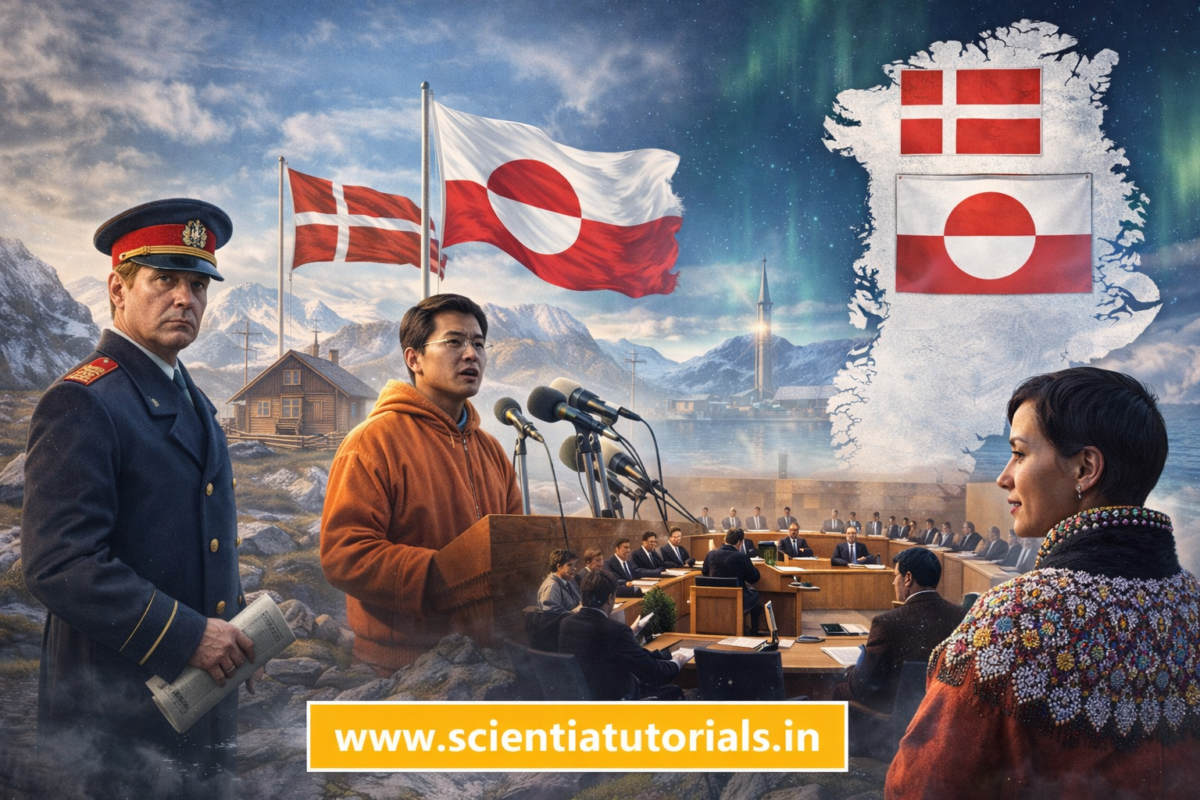

Political Reforms and Home Rule Movements in Greenland | Cold War Era
Module 4: Greenland in the Age of World Wars and the Cold War
Era Framework: Early 20th Century – Late 20th Century
This lesson is systematically organized into four clearly structured sections, as detailed below:
- Chronologically Structured Study Module
- Short-Answer Type Questions
- Long-Answer Type Questions
- Multiple-Choice Questions (MCQs) with Answers and Detailed Explanations
Chronologically Structured Study Module
Introduction: From Strategic Territory to Political Consciousness
The twentieth century was not only a period of military and geopolitical transformation for Greenland, but also a decisive era of political awakening, institutional reform, and the emergence of Home Rule movements. While global attention often focused on Greenland’s strategic importance within US–European security frameworks, equally significant changes were taking place within Greenlandic society itself. These changes reshaped the relationship between Greenland and Denmark, laying the foundations for modern self-governance.
This lesson examines the evolution of political reforms and Home Rule movements in Greenland from the early 20th century through the Cold War era. It highlights how colonial administration, wartime disruptions, Cold War militarization, and social modernization collectively stimulated Greenlandic demands for political representation, cultural recognition, and autonomy.
I. Greenland’s Colonial Political Structure in the Early 20th Century
At the start of the 20th century, Greenland functioned as a centralized Danish colony, administered directly from Copenhagen. Political power rested almost entirely with Danish officials, and Greenlanders had little influence over governance.
Key Characteristics of Early Colonial Rule
- Governance through Danish trading and administrative monopolies
- Absence of democratic representation for Greenlanders
- Limited local decision-making authority
- Paternalistic policies framed around “protection” rather than participation
Greenlandic society at this stage remained largely rural and subsistence-based, with political life shaped more by local custom than formal institutions.
II. Early Political Reforms and Limited Representation (1900s–1930s)
A. Introduction of Advisory Councils
In the early decades of the 20th century, Denmark introduced limited political reforms, including local advisory councils. These bodies allowed Greenlandic representatives to voice concerns on issues such as hunting regulations, education, and welfare.
However:
- Councils had no legislative authority
- Final decisions remained with Danish administrators
- Representation was uneven and tightly controlled
Despite their limitations, these councils played an important role in political socialization, familiarizing Greenlanders with formal governance processes.
B. Emergence of an Educated Greenlandic Elite
Missionary schools and Danish educational initiatives produced a small but influential Greenlandic elite. These individuals:
- Acted as intermediaries between colonial authorities and local communities
- Began articulating early demands for cultural respect and participation
- Laid the intellectual groundwork for later autonomy movements
III. World War II as a Turning Point in Greenlandic Political Awareness
World War II marked a profound political rupture. The German occupation of Denmark severed direct administrative links between Greenland and Copenhagen, forcing Greenland to manage many of its own affairs for the first time.
Political Consequences of Wartime Separation
- Local administrators assumed greater responsibility
- Greenland experienced de facto political autonomy
- Greenlanders witnessed alternative models of governance through interaction with the United States
The war demonstrated that Greenland could function with greater self-administration, challenging long-standing assumptions about colonial dependence.
IV. Post-War Reforms and the End of Formal Colonial Status (1945–1953)
A. Reassessment of Colonial Governance
After World War II, international attitudes toward colonialism changed rapidly. Denmark faced growing pressure to modernize its relationship with Greenland in line with emerging norms of self-determination.
Key developments included:
- Expanded social services and infrastructure
- Increased educational opportunities
- Greater political consultation with Greenlandic representatives
B. Greenland’s Integration into the Danish Realm (1953)
A major milestone occurred in 1953, when Greenland’s colonial status was formally abolished, and it was incorporated as an integral part of the Danish state.
Significance of this reform:
- Greenlanders became Danish citizens
- Representation in the Danish parliament was granted
- Legal equality replaced colonial subordination
While this marked a significant constitutional advance, it also generated new tensions, as integration often meant centralization rather than autonomy.
V. Modernization Policies and Political Discontent (1950s–1960s)
A. Social and Economic Transformation
Post-war modernization programs aimed to transform Greenland into a modern welfare society. These policies included:
- Urbanization and resettlement programs
- Expansion of wage labor
- Danish-language education
While modernization improved living standards for many, it also disrupted traditional livelihoods and cultural practices.
B. Growing Political Alienation
Many Greenlanders perceived modernization as:
- Imposed from above
- Insufficiently responsive to local needs
- Culturally assimilative
This period witnessed the rise of political critique, particularly among younger, educated Greenlanders, who began demanding greater local control and cultural recognition.
VI. Cold War Militarization and Its Political Impact
The Cold War intensified Greenland’s strategic importance, particularly through US military installations. While these developments strengthened Greenland’s geopolitical role, they also deepened political awareness among Greenlanders.
Political Effects of Militarization
- Limited consultation in defense decisions
- Displacement of local communities near military sites
- Heightened awareness of Greenland’s strategic value
Greenlanders increasingly questioned why decisions affecting their land were made by external powers with minimal local input.
VII. Rise of Greenlandic National Consciousness (1960s–1970s)
By the 1960s and 1970s, Greenland experienced a cultural and political revival.
Key features included:
- Promotion of Greenlandic language and identity
- Emergence of political organizations advocating autonomy
- Growing critique of Danish dominance in administration and education
This period marked the transition from reformist demands to explicit calls for self-government.
VIII. The Home Rule Movement and Political Mobilization
A. Political Organization and Public Debate
Greenlandic political leaders increasingly framed autonomy as both a democratic right and a practical necessity. Public debates emphasized:
- Control over natural resources
- Cultural preservation
- Democratic accountability
Home Rule became a unifying political goal across much of Greenlandic society.
B. Negotiations with Denmark
Negotiations between Greenlandic representatives and Denmark culminated in the drafting of a Home Rule framework. These negotiations reflected:
- Denmark’s willingness to decentralize authority
- Greenland’s growing political confidence
- International norms supporting self-government
IX. Establishment of Home Rule (1979)
The introduction of Home Rule in 1979 marked the most significant political reform in Greenland’s modern history.
Key Features of Home Rule
- Creation of a Greenlandic parliament and executive
- Transfer of authority over domestic affairs such as education, health, and culture
- Retention of Danish control over defense and foreign policy
Home Rule institutionalized Greenland’s political autonomy while maintaining its constitutional link with Denmark.
X. Significance of Home Rule in the Cold War Context
Home Rule emerged during the late Cold War, a period when Greenland remained strategically vital. The new political framework allowed Greenlanders to:
- Assert political agency within global security structures
- Engage more confidently with Denmark and allied powers
- Strengthen cultural identity alongside strategic relevance
This balance between autonomy and alliance became a defining feature of Greenland’s late 20th-century political order.
XI. Long-Term Political Legacy
The political reforms and Home Rule movements of the 20th century produced lasting outcomes:
- Institutional foundations for later self-government
- Enhanced democratic participation
- Reframing of Greenland as a political actor rather than a colonial object
These developments fundamentally reshaped Greenland’s relationship with Denmark and the wider international community.
Conclusion: Political Reform as a Parallel to Strategic Transformation
While Greenland’s strategic importance during the World Wars and the Cold War attracted global attention, its internal political transformation was equally historic. The evolution from colonial administration to Home Rule reflected broader global trends toward decolonization and self-determination, adapted to Greenland’s unique Arctic and geopolitical context.
The lesson of political reforms and Home Rule movements demonstrates that Greenland’s modern history cannot be understood solely through military or strategic lenses. It is also a story of political agency, cultural resilience, and the gradual assertion of self-government within a rapidly changing world order.
Short Answer Type Questions and Answers
Lesson: Political Reforms and Home Rule Movements
1. What was Greenland’s political status at the beginning of the 20th century?
Answer: Greenland was a centralized colony administered by Denmark, with no democratic self-government for Greenlanders.
2. How was Greenland governed during the early colonial period?
Answer: Governance was carried out by Danish officials through centralized administration and trading monopolies, with minimal local participation.
3. What role did advisory councils play in early political reforms?
Answer: Advisory councils allowed limited Greenlandic consultation but had no legislative authority and remained under Danish control.
4. Why were early political reforms in Greenland considered limited?
Answer: Because decision-making power remained with Danish authorities, and Greenlanders lacked real legislative or executive control.
5. How did education contribute to political awareness in Greenland?
Answer: Education created a small Greenlandic elite that articulated early demands for participation, cultural respect, and political reform.
6. Why was World War II a turning point in Greenland’s political development?
Answer: The war disrupted Danish control, forcing Greenland to manage its own affairs and demonstrating the feasibility of self-administration.
7. How did the German occupation of Denmark affect Greenland politically?
Answer: It severed administrative ties, giving Greenland de facto autonomy during the war years.
8. What new political experience did Greenland gain during World War II?
Answer: Greenland experienced increased local responsibility and exposure to alternative governance models.
9. Why did post-war global trends influence Greenland’s political reforms?
Answer: International norms increasingly favored decolonization, equality, and self-determination after World War II.
10. What major constitutional change occurred in 1953?
Answer: Greenland’s colonial status was abolished and it was integrated as an equal part of the Danish state.
11. What political rights did Greenlanders gain after 1953?
Answer: Greenlanders became Danish citizens and gained representation in the Danish parliament.
12. Why did integration with Denmark create new political tensions?
Answer: Integration increased centralization and cultural assimilation rather than local autonomy.
13. What were the goals of post-war modernization policies in Greenland?
Answer: To improve living standards through urbanization, education, infrastructure, and welfare expansion.
14. How did modernization policies affect traditional Greenlandic society?
Answer: They disrupted subsistence livelihoods, weakened cultural practices, and caused social dislocation.
15. Why did political discontent grow in the 1950s and 1960s?
Answer: Many Greenlanders felt reforms were imposed from above and ignored local needs and identity.
16. How did Cold War militarization influence political awareness in Greenland?
Answer: It highlighted Greenland’s strategic value while exposing the lack of local consultation in defense decisions.
17. What political issue arose from foreign military presence in Greenland?
Answer: Community displacement and limited local influence over land use and security decisions.
18. What characterized the rise of Greenlandic national consciousness?
Answer: Increased emphasis on language, culture, political rights, and self-government.
19. Which decades saw the strongest push for Home Rule?
Answer: The 1960s and 1970s.
20. What were the main demands of the Home Rule movement?
Answer: Control over domestic affairs, cultural preservation, and democratic accountability.
21. How did negotiations for Home Rule reflect changing Denmark–Greenland relations?
Answer: They showed Denmark’s willingness to decentralize power and Greenland’s growing political confidence.
22. When was Home Rule officially established in Greenland?
Answer: In 1979.
23. What powers were transferred to Greenland under Home Rule?
Answer: Authority over education, health, culture, and internal administration.
24. Which areas remained under Danish control after Home Rule?
Answer: Defense, foreign policy, and overall constitutional authority.
25. What is the long-term significance of the Home Rule movement?
Answer: It laid the institutional foundation for modern self-government and strengthened Greenlandic political identity.
Long Answer Type Questions and Answers
Lesson: Political Reforms and Home Rule Movements
1. Examine the nature of Danish colonial administration in Greenland in the early 20th century.
Answer:
In the early 20th century, Greenland was governed as a centralized colony under Denmark. Political authority rested almost entirely with Danish officials, while Greenlanders had minimal participation in decision-making. Administration was paternalistic, focused on economic control, missionary activity, and social regulation rather than political inclusion. This system limited democratic development but laid the structural background against which later reform movements emerged.
2. Discuss the objectives and limitations of early political reforms introduced in Greenland before World War II.
Answer:
Early reforms aimed to improve administrative efficiency and social welfare while maintaining Danish control. Advisory councils were introduced to consult Greenlanders on local issues, but these bodies lacked legislative power. Decision-making authority remained centralized, making reforms symbolic rather than transformative. Nevertheless, these measures familiarized Greenlanders with formal political processes.
3. How did the emergence of an educated Greenlandic elite contribute to political change?
Answer:
Education produced a small Greenlandic elite capable of articulating political and cultural grievances. Acting as intermediaries between colonial authorities and local communities, they raised early demands for representation, respect for Greenlandic culture, and participation in governance. This group played a crucial role in shaping later Home Rule movements.
4. Analyze World War II as a turning point in Greenland’s political development.
Answer:
World War II disrupted Danish control due to Germany’s occupation of Denmark. Greenland was forced to manage its own affairs, experiencing de facto autonomy. This period demonstrated Greenland’s capacity for self-administration and weakened the ideological foundations of colonial dependence, profoundly influencing post-war political reforms.
5. How did wartime separation from Denmark alter Greenlanders’ political consciousness?
Answer:
The absence of direct Danish governance during the war increased local responsibility and confidence. Interaction with Allied powers exposed Greenlanders to alternative political models, encouraging the belief that greater self-governance was both possible and desirable.
6. Discuss the impact of post-war global decolonization trends on Greenland.
Answer:
After 1945, international norms increasingly emphasized equality, self-determination, and decolonization. These trends pressured Denmark to reform its relationship with Greenland, leading to constitutional changes, expanded rights, and eventual Home Rule arrangements.
7. Evaluate the significance of the 1953 constitutional reform for Greenland.
Answer:
The 1953 reform abolished Greenland’s colonial status and integrated it into the Danish state. Greenlanders became Danish citizens and gained parliamentary representation. While this ended formal colonialism, it also introduced centralized integration that many later viewed as insufficiently autonomous.
8. Why did political integration after 1953 generate new forms of discontent?
Answer:
Integration prioritized uniformity and modernization, often sidelining Greenlandic culture and local decision-making. Many Greenlanders felt that equality within the Danish state did not equate to genuine self-rule, fueling demands for deeper autonomy.
9. Assess the role of modernization policies in shaping Greenlandic political movements.
Answer:
Modernization improved infrastructure, education, and welfare but disrupted traditional livelihoods and cultural practices. Perceived as imposed from above, these policies generated political alienation and strengthened calls for local control over development.
10. How did Cold War militarization affect Greenland’s internal politics?
Answer:
Militarization increased Greenland’s strategic importance but highlighted the lack of Greenlandic participation in decisions affecting land and communities. This contradiction intensified political awareness and strengthened arguments for self-government.
11. Examine the relationship between strategic importance and political marginalization in Greenland.
Answer:
Despite being central to global security, Greenlanders often had little influence over strategic decisions. This imbalance underscored the need for political reform, as Greenlanders sought agency commensurate with their territory’s global significance.
12. Discuss the rise of Greenlandic national consciousness in the 1960s.
Answer:
The 1960s witnessed a cultural and political revival emphasizing language, identity, and history. Greenlanders increasingly rejected assimilationist policies and began framing autonomy as essential for cultural survival and democratic legitimacy.
13. What role did youth and education play in the Home Rule movement?
Answer:
Educated youth were instrumental in articulating political critiques and mobilizing public opinion. They linked cultural revival with political autonomy, energizing the Home Rule movement.
14. Analyze the political arguments advanced by Home Rule advocates.
Answer:
Home Rule proponents argued that local control would ensure culturally appropriate policies, democratic accountability, and sustainable development. Autonomy was presented as both a right and a practical necessity.
15. Describe the negotiation process that led to the establishment of Home Rule.
Answer:
Negotiations involved dialogue between Greenlandic leaders and Denmark, reflecting changing power dynamics. Denmark accepted decentralization, while Greenland demonstrated political maturity and unity in its demands.
16. Outline the main features of the Home Rule system established in 1979.
Answer:
Home Rule created a Greenlandic parliament and executive, transferring authority over domestic affairs such as education, health, and culture, while Denmark retained control over defense and foreign policy.
17. Why is the year 1979 considered a milestone in Greenland’s political history?
Answer:
1979 marked the institutionalization of self-government, transforming Greenland from an administratively integrated territory into a politically autonomous entity within the Danish realm.
18. Evaluate Home Rule within the broader Cold War context.
Answer:
Home Rule emerged while Greenland remained strategically vital. It balanced local political autonomy with continued participation in Western security frameworks, demonstrating coexistence between self-government and alliance commitments.
19. How did Home Rule reshape Greenland–Denmark relations?
Answer:
The relationship shifted from hierarchical control to negotiated partnership. Greenland gained political voice, while Denmark redefined its role as a constitutional partner rather than colonial ruler.
20. Assess the long-term political legacy of 20th-century reforms in Greenland.
Answer:
Political reforms laid the foundations for modern self-government, strengthened democratic institutions, and redefined Greenland’s identity as a political actor rather than a colonial dependency.
Multiple Choice Questions (MCQs)
Lesson: Political Reforms and Home Rule Movements
1. At the beginning of the 20th century, Greenland was politically governed as
A. An autonomous territory
B. A UN trusteeship
C. A centralized colony
D. A federal state
Correct Answer: C
Explanation:
Greenland was administered as a centralized colony with political authority concentrated in the colonial administration, leaving Greenlanders with little or no decision-making power.
2. Greenland’s colonial administration in the early 20th century was controlled by
A. Norway
B. Britain
C. The United States
D. Denmark
Correct Answer: D
Explanation:
Denmark exercised direct political and administrative control over Greenland, shaping its governance, economy, and social policies.
3. Which institution represented the earliest form of political participation for Greenlanders?
A. National parliament
B. Advisory councils
C. Trade unions
D. Military committees
Correct Answer: B
Explanation:
Advisory councils allowed limited consultation with Greenlanders but had no legislative or executive authority.
4. Why were early advisory councils politically ineffective?
A. They were dominated by Greenlanders
B. They lacked legislative powers
C. They controlled defense policy
D. They opposed modernization
Correct Answer: B
Explanation:
Advisory councils could only make recommendations, while final decisions remained with Danish officials.
5. Which factor contributed most to the rise of early political awareness in Greenland?
A. Industrialization
B. Expansion of mining
C. Development of education
D. Growth of tourism
Correct Answer: C
Explanation:
Education produced a small Greenlandic elite that began articulating political and cultural demands.
6. World War II influenced Greenland’s political development mainly by
A. Destroying its economy
B. Isolating it completely
C. Disrupting Danish control
D. Abolishing colonial rule
Correct Answer: C
Explanation:
The German occupation of Denmark cut administrative ties, forcing Greenland to manage many of its own affairs.
7. Greenland’s wartime experience demonstrated that
A. Colonial rule was essential
B. Self-administration was possible
C. Militarization reduced autonomy
D. Political reform was unnecessary
Correct Answer: B
Explanation:
Wartime self-management showed that Greenland could function with greater political autonomy.
8. Which global trend after World War II most influenced Greenland’s political reforms?
A. Militarization
B. Industrial capitalism
C. Decolonization
D. Protectionism
Correct Answer: C
Explanation:
Post-war international norms increasingly emphasized equality, citizenship, and self-determination.
9. What major constitutional change occurred in Greenland in 1953?
A. Independence was declared
B. Home Rule was introduced
C. Colonial status was abolished
D. Military control was ended
Correct Answer: C
Explanation:
In 1953, Greenland ceased to be a colony and was formally integrated into the Danish state.
10. After 1953, Greenlanders gained
A. Complete independence
B. Danish citizenship
C. Control over defense policy
D. Membership in NATO
Correct Answer: B
Explanation:
Greenlanders became Danish citizens and gained parliamentary representation, marking legal equality.
11. Why did political dissatisfaction persist after integration with Denmark?
A. Economic decline
B. Cultural assimilation
C. Loss of citizenship
D. Military withdrawal
Correct Answer: B
Explanation:
Integration promoted centralized modernization and cultural assimilation, limiting local autonomy.
12. Post-war modernization policies in Greenland focused mainly on
A. Preserving traditional lifestyles
B. Urbanization and welfare expansion
C. Military expansion
D. Agricultural reform
Correct Answer: B
Explanation:
Policies aimed to modernize Greenland through infrastructure, education, and urban development.
13. Which negative consequence was linked to modernization policies?
A. Economic isolation
B. Cultural disruption
C. Increased independence
D. Political stability
Correct Answer: B
Explanation:
Rapid modernization disrupted traditional livelihoods and weakened cultural practices.
14. How did Cold War militarization affect Greenlandic political awareness?
A. It reduced political interest
B. It delayed reforms
C. It highlighted lack of local control
D. It ended colonial influence
Correct Answer: C
Explanation:
Foreign military presence emphasized that major decisions were made without Greenlandic consent.
15. Which decade marked the rise of strong Greenlandic national consciousness?
A. 1930s
B. 1940s
C. 1960s
D. 1980s
Correct Answer: C
Explanation:
The 1960s saw cultural revival and political mobilization centered on identity and autonomy.
16. The Home Rule movement primarily demanded
A. Immediate independence
B. Military neutrality
C. Local control over domestic affairs
D. Withdrawal from Denmark
Correct Answer: C
Explanation:
Home Rule focused on self-government in internal matters rather than full independence.
17. Which factor strengthened public support for Home Rule?
A. Declining strategic importance
B. Cultural revival
C. Economic isolation
D. Military disengagement
Correct Answer: B
Explanation:
Revival of language and culture reinforced demands for political self-expression.
18. Negotiations for Home Rule reflected
A. Colonial confrontation
B. Armed resistance
C. Political compromise
D. Foreign intervention
Correct Answer: C
Explanation:
Home Rule emerged through negotiations between Greenlandic leaders and Danish authorities.
19. Home Rule in Greenland was formally introduced in
A. 1953
B. 1965
C. 1972
D. 1979
Correct Answer: D
Explanation:
The Home Rule Act came into force in 1979, marking a new phase of autonomy.
20. Under Home Rule, Greenland gained authority over
A. Foreign policy
B. Defense
C. Education and culture
D. Monetary policy
Correct Answer: C
Explanation:
Domestic affairs such as education, health, and culture were transferred to Greenlandic institutions.
21. Which area remained under Danish control after Home Rule?
A. Social policy
B. Natural resources
C. Defense and foreign affairs
D. Local administration
Correct Answer: C
Explanation:
Denmark retained responsibility for defense and foreign relations.
22. Why is Home Rule considered a milestone in Greenland’s history?
A. It ended modernization
B. It introduced democracy for the first time
C. It institutionalized self-government
D. It reduced global relevance
Correct Answer: C
Explanation:
Home Rule created permanent political institutions for Greenlandic self-administration.
23. How did Home Rule coexist with Cold War geopolitics?
A. By rejecting alliances
B. By limiting strategic importance
C. By balancing autonomy with security commitments
D. By ending militarization
Correct Answer: C
Explanation:
Greenland gained internal autonomy while remaining part of Western security structures.
24. The long-term outcome of political reforms in Greenland was
A. Renewed colonialism
B. Political marginalization
C. Strengthened democratic identity
D. Loss of sovereignty
Correct Answer: C
Explanation:
Reforms empowered Greenlanders politically and reshaped their national identity.
25. The Home Rule movement primarily transformed Greenland from
A. A military base into a neutral state
B. A colony into a political actor
C. A welfare state into an empire
D. A peripheral region into a metropolis
Correct Answer: B
Explanation:
Home Rule redefined Greenland as an active political entity rather than a passive colonial territory.