
Greenland in US–European Security Frameworks
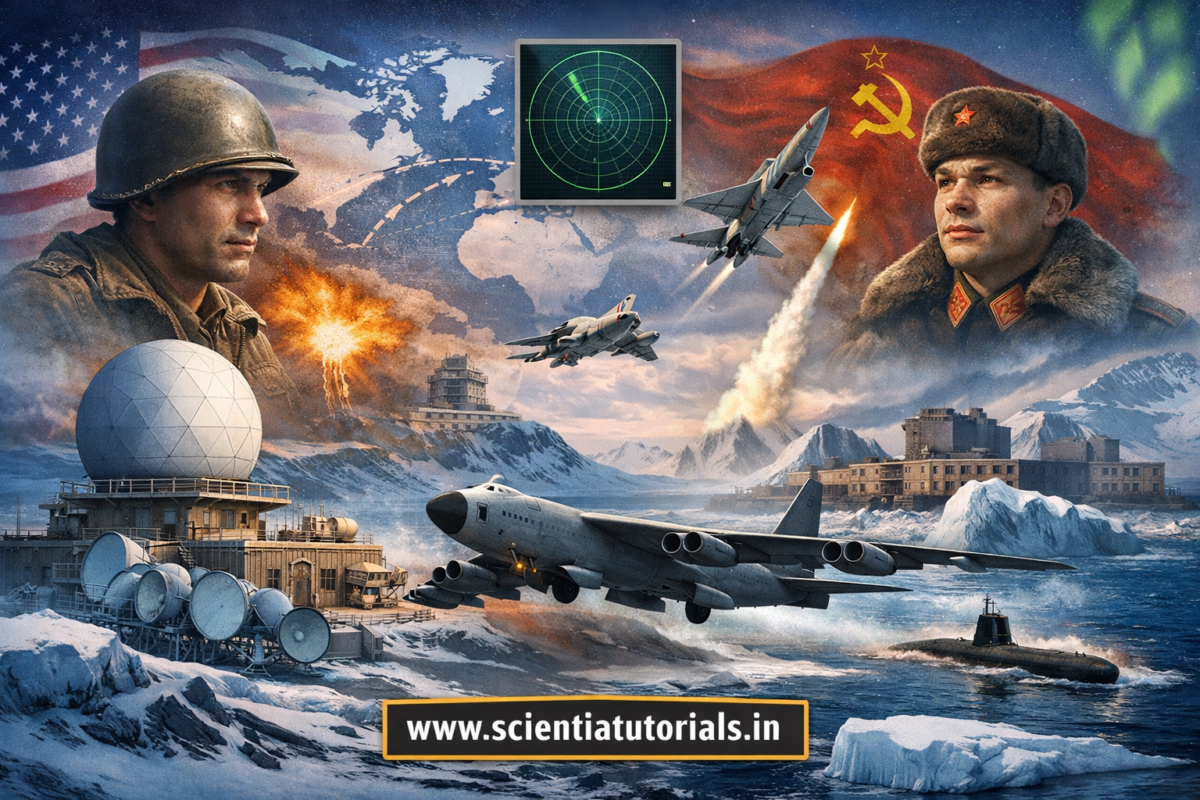

Greenland in US–European Security Frameworks | World Wars & Cold War Strategy
Module 4: Greenland in the Age of World Wars and the Cold War
Era Framework: Early 20th Century – Late 20th Century
This lesson is systematically organized into four clearly structured sections, as detailed below:
- Chronologically Structured Study Module
- Short-Answer Type Questions
- Long-Answer Type Questions
- Multiple-Choice Questions (MCQs) with Answers and Detailed Explanations
Chronologically Structured Study Module
Introduction: Greenland’s Strategic Repositioning in the 20th Century
The twentieth century marked a decisive transformation in Greenland’s global significance. From a remote Danish colony, Greenland emerged as a critical strategic node within US–European security architectures, especially during the World Wars and the Cold War. Advances in military aviation, long-range warfare, nuclear deterrence, and Arctic surveillance repositioned Greenland from the margins of European colonial administration to the very heart of transatlantic security planning.
This lesson examines how Greenland became embedded within US–European security frameworks, tracing the evolution of its strategic role from World War I, through World War II, and into the Cold War era, culminating in its integration into NATO-led defense systems. The analysis highlights the interaction between geography, geopolitics, and military technology in shaping Greenland’s modern strategic identity.
I. Greenland on the Eve of the World Wars: Strategic Geography and Colonial Status
At the beginning of the 20th century, Greenland remained under Denmark’s colonial administration, governed largely as an economic and missionary outpost rather than a strategic military asset. However, its geographical location between North America and Europe, straddling the North Atlantic and the Arctic Ocean, already hinted at future geopolitical importance.
Key Strategic Attributes
- Control of North Atlantic sea lanes
- Proximity to emerging transatlantic air routes
- Access to Arctic weather systems crucial for military forecasting
- Position astride the shortest routes between Europe and North America
Although these features were underutilized before 1914, they would soon become central to modern warfare planning.
II. World War I and the Awakening of Strategic Awareness (1914–1918)
During World War I, Greenland did not experience direct military conflict. Nevertheless, the war marked the first time major powers began to appreciate the strategic implications of Arctic and North Atlantic geography.
- Maritime warfare emphasized the importance of controlling Atlantic shipping routes.
- Submarine threats increased the need for surveillance and refueling points.
- Greenland’s isolation limited immediate militarization but raised strategic awareness among Allied planners.
While Denmark remained neutral during much of the conflict, the war subtly shifted perceptions of Greenland from a colonial hinterland to a potential strategic asset in future global conflicts.
III. World War II: Greenland’s Entry into US–European Security Planning (1939–1945)
A. German Occupation of Denmark and Strategic Vacuum
In 1940, Nazi Germany’s occupation of Denmark created a strategic vacuum in Greenland. With Denmark unable to exercise effective control, Greenland’s security became a matter of urgent concern for the Allied powers.
This situation led to unprecedented developments:
- Greenland effectively detached from direct Danish governance
- Local authorities assumed emergency administrative responsibilities
- The United States emerged as Greenland’s primary security guarantor
B. The 1941 US–Greenland Defense Agreement
In 1941, Greenland entered into a defense agreement with the United States, marking a watershed moment in its strategic history.
Key provisions included:
- Establishment of US military bases
- Construction of airfields and weather stations
- Joint defense against Axis threats in the North Atlantic
This agreement brought Greenland firmly into the US–European wartime security framework, even before the United States formally entered the war.
C. Greenland’s Wartime Functions
During World War II, Greenland served multiple strategic roles:
- Weather intelligence hub for Allied operations
- Aircraft ferry route between North America and Europe
- Naval patrol base against German U-boats
- Early warning point for North Atlantic threats
These roles demonstrated Greenland’s operational value and permanently altered its geopolitical status.
IV. Post-War Transition and the Emergence of Cold War Geopolitics (1945–1949)
The end of World War II did not diminish Greenland’s strategic importance. Instead, the onset of the Cold War transformed Greenland into a frontline territory in the emerging confrontation between the Western bloc and the Soviet Union.
Strategic Shifts
- Emergence of long-range nuclear bombers
- Development of intercontinental military aviation
- Rising importance of early-warning and radar systems
- Militarization of the Arctic as a potential theater of conflict
Greenland’s location placed it directly along the shortest polar routes between North America and Eurasia.
V. Greenland and NATO: Integration into Collective Security (1949–1960s)
A. Denmark’s NATO Membership
In 1949, Denmark became a founding member of the North Atlantic Treaty Organization (NATO). This decision had profound implications for Greenland.
- Greenland was incorporated into NATO’s collective defense planning
- US military presence was formalized within a multilateral framework
- Arctic defense became a shared transatlantic responsibility
B. Establishment of Thule Air Base
One of the most significant developments was the construction of Thule Air Base in the early 1950s.
Functions of Thule Air Base:
- Strategic bomber staging point
- Ballistic missile early warning
- Radar and space surveillance
- Command-and-control node for Arctic defense
Thule became a cornerstone of US–European nuclear deterrence strategy.
VI. Greenland in the Nuclear Age: Deterrence and Surveillance (1960s–1980s)
A. Role in Nuclear Deterrence
As Cold War tensions intensified, Greenland assumed a critical role in nuclear deterrence architecture.
- Monitoring Soviet missile launches
- Supporting US Strategic Air Command operations
- Integrating into NATO’s early-warning systems
Greenland’s Arctic position made it indispensable for detecting threats originating from the Soviet Union.
B. Political and Social Implications
The expansion of military infrastructure had significant consequences:
- Relocation of Indigenous communities near military sites
- Environmental concerns linked to military activity
- Rising Greenlandic political consciousness
These developments contributed to debates about sovereignty, autonomy, and the costs of militarization.
VII. Greenland, Denmark, and the Balance of Sovereignty
Throughout the Cold War, Greenland occupied a complex constitutional position:
- Formally part of Denmark
- Strategically vital to the United States
- Embedded within NATO security planning
This triangular relationship required constant negotiation:
- Denmark sought to preserve sovereignty
- The US prioritized strategic access
- Greenlandic leaders increasingly demanded political recognition
The security frameworks of the Cold War thus intersected with evolving debates over self-governance.
VIII. Late Cold War Adjustments and Strategic Continuity (1980s–1990s)
As the Cold War entered its final phase:
- Arms control agreements reduced nuclear tensions
- Surveillance roles remained essential
- Greenland continued to function as an early-warning hub
Even after the Cold War’s end, Greenland’s infrastructure and strategic value did not disappear, demonstrating the enduring relevance of Arctic security frameworks.
IX. Historical Significance and Long-Term Strategic Legacy
Greenland’s integration into US–European security frameworks during the 20th century produced lasting outcomes:
- Permanent militarization of the Arctic
- Institutionalized transatlantic defense cooperation
- Transformation of Greenland’s global political relevance
The lesson underscores how global conflicts can rapidly elevate peripheral regions into strategic centers of international politics.
Conclusion: Greenland as a Pillar of Transatlantic Security
From a quiet Danish colony to a pivotal component of NATO’s Arctic defense system, Greenland’s twentieth-century history illustrates the profound impact of global warfare and Cold War geopolitics on regional identities. Its role within US–European security frameworks was shaped by geography, technology, and ideology, embedding Greenland firmly within the strategic architecture of the modern world.
Understanding this transformation is essential for comprehending both Greenland’s contemporary geopolitical importance and the broader dynamics of Arctic militarization in global history.
Short Answer Type Questions and Answers
Lesson: Greenland in US–European Security Frameworks
1. Why did Greenland gain strategic importance in the 20th century?
Answer: Greenland gained importance due to its strategic location between North America and Europe, making it vital for transatlantic defense, Arctic surveillance, and military aviation during the World Wars and the Cold War.
2. What was Greenland’s political status at the start of the 20th century?
Answer: Greenland was a colony under Danish administration with limited self-governance and minimal military infrastructure.
3. How did World War I affect Greenland’s strategic perception?
Answer: World War I raised awareness of Greenland’s geographic importance, especially for North Atlantic shipping and future military planning, although it saw no direct conflict.
4. Why did Greenland become strategically vulnerable during World War II?
Answer: The German occupation of Denmark in 1940 created a security vacuum, leaving Greenland exposed to potential Axis threats.
5. Which country emerged as Greenland’s primary security guarantor during World War II?
Answer: The United States emerged as Greenland’s main security provider during World War II.
6. What was the 1941 US–Greenland Defense Agreement?
Answer: It was an agreement allowing the United States to establish military bases and defense installations in Greenland to protect the North Atlantic region.
7. What strategic role did Greenland play during World War II aviation?
Answer: Greenland served as a critical aircraft ferry route between North America and Europe.
8. Why were weather stations in Greenland important during World War II?
Answer: Arctic weather data from Greenland was essential for planning military operations across the North Atlantic and Europe.
9. How did the Cold War change Greenland’s military significance?
Answer: Greenland became a frontline territory for early warning systems, nuclear deterrence, and Arctic surveillance against the Soviet Union.
10. What made Greenland crucial in polar military strategy?
Answer: The shortest flight paths between North America and Eurasia passed over the Arctic, making Greenland vital for detection and interception.
11. When did Denmark join NATO, and why was this important for Greenland?
Answer: Denmark joined North Atlantic Treaty Organization (NATO) in 1949, formally integrating Greenland into Western collective defense systems.
12. What was Thule Air Base?
Answer: Thule Air Base was a major US military installation used for strategic bombers, missile warning systems, and Arctic surveillance.
13. How did Thule Air Base support nuclear deterrence?
Answer: It hosted radar and early-warning systems capable of detecting intercontinental ballistic missile launches.
14. What role did Greenland play in early-warning systems?
Answer: Greenland housed radar installations that provided early detection of potential Soviet attacks during the Cold War.
15. How did militarization affect Greenland’s local population?
Answer: It led to community relocations, environmental concerns, and increased political awareness among Greenlanders.
16. What was Denmark’s role in Greenland’s Cold War security arrangements?
Answer: Denmark retained sovereignty while permitting US military presence under NATO and bilateral agreements.
17. Why was Greenland important to US strategic air command planning?
Answer: Its location allowed rapid deployment and monitoring of long-range bombers across Arctic routes.
18. How did Cold War geopolitics influence Arctic militarization?
Answer: Superpower rivalry turned the Arctic into a strategic zone for surveillance, deterrence, and potential conflict.
19. What tension existed between sovereignty and security in Greenland?
Answer: Balancing Danish sovereignty, US strategic interests, and Greenlandic political aspirations created ongoing political challenges.
20. Did Greenland’s strategic role decline after World War II?
Answer: No, its importance increased during the Cold War due to nuclear strategy and Arctic defense requirements.
21. How did NATO shape Greenland’s defense role?
Answer: NATO institutionalized Greenland’s integration into collective transatlantic defense planning.
22. Why was Greenland important despite being sparsely populated?
Answer: Its geographic position outweighed demographic factors in strategic military planning.
23. What technological developments increased Greenland’s importance?
Answer: Long-range bombers, radar systems, and missile detection technologies enhanced its military value.
24. How did the end of the Cold War affect Greenland’s security role?
Answer: While tensions eased, Greenland retained strategic relevance for surveillance and Arctic security.
25. What is Greenland’s long-term strategic legacy from the 20th century?
Answer: Greenland emerged as a permanent pillar of US–European security frameworks and Arctic geopolitics.
Long Answer Type Questions and Answers
Lesson: Greenland in US–European Security Frameworks
1. Examine the geographical factors that made Greenland strategically important in the 20th century.
Answer:
Greenland’s strategic importance arose primarily from its geographical position between North America and Europe. Located along the shortest transatlantic and polar air routes, Greenland became crucial for military aviation, early-warning systems, and Arctic surveillance. Its proximity to North Atlantic sea lanes also made it valuable for naval patrols. With the development of long-range bombers and missiles in the 20th century, Greenland’s Arctic location placed it at the center of emerging global security architectures.
2. Discuss Greenland’s political and strategic status before the outbreak of World War I.
Answer:
Before World War I, Greenland functioned largely as a Danish colonial possession with limited international strategic relevance. Administered by Denmark, it lacked military infrastructure and was governed primarily for economic and missionary purposes. However, technological advances in navigation and warfare gradually drew attention to its latent strategic value.
3. How did World War I contribute to changing perceptions of Greenland’s strategic value?
Answer:
Although Greenland was not directly involved in World War I, the conflict highlighted the importance of controlling North Atlantic routes and weather intelligence. Naval warfare and submarine threats demonstrated that even remote regions could influence global conflict dynamics. As a result, Greenland began to be viewed as a potential strategic asset in future wars rather than a peripheral colony.
4. Analyze the impact of the German occupation of Denmark on Greenland during World War II.
Answer:
The German occupation of Denmark in 1940 created a political and strategic vacuum in Greenland. With Denmark unable to govern or defend the island, Greenland became vulnerable to Axis influence. This situation prompted the United States to assume responsibility for Greenland’s defense, fundamentally altering its role in international security frameworks.
5. Explain the significance of the 1941 US–Greenland Defense Agreement.
Answer:
The 1941 agreement allowed the United States to establish military bases and defense installations in Greenland. This marked Greenland’s first formal integration into a major power’s security system. The agreement ensured protection against Axis threats and laid the foundation for Greenland’s long-term role in transatlantic defense.
6. Describe Greenland’s strategic functions during World War II.
Answer:
During World War II, Greenland served as an aircraft ferry route, a weather intelligence center, and a naval patrol base. Weather stations in Greenland provided critical data for Allied operations in Europe. These roles demonstrated Greenland’s operational value and elevated its importance within Allied strategic planning.
7. Why was weather intelligence from Greenland crucial during World War II?
Answer:
Arctic weather systems strongly influenced conditions across the North Atlantic and Europe. Accurate forecasting from Greenland helped Allied forces plan naval convoys, air missions, and amphibious operations. Control of weather data also denied similar advantages to Axis powers.
8. Assess the strategic transformation of Greenland in the immediate post-war period.
Answer:
After World War II, Greenland transitioned from a wartime outpost to a permanent strategic asset. The emerging Cold War and the threat of nuclear confrontation made Arctic regions central to defense planning. Greenland’s location along polar routes ensured its continued military relevance.
9. How did Cold War geopolitics elevate Greenland’s importance?
Answer:
The Cold War introduced the possibility of nuclear conflict between superpowers, with missiles and bombers traveling over the Arctic. Greenland became a frontline territory for early-warning systems and surveillance, linking it directly to global nuclear deterrence strategies.
10. Discuss the significance of Denmark’s NATO membership for Greenland.
Answer:
Denmark’s entry into the North Atlantic Treaty Organization (NATO) in 1949 formally integrated Greenland into Western collective defense. Greenland became part of NATO’s Arctic defense planning, legitimizing continued US military presence within a multilateral framework.
11. Examine the role of Thule Air Base in US–European security frameworks.
Answer:
Thule Air Base was a cornerstone of Cold War defense strategy. It supported strategic bombers, hosted radar systems, and contributed to missile early-warning networks. Thule linked North American defense systems with European security concerns.
12. How did Greenland contribute to nuclear deterrence during the Cold War?
Answer:
Greenland housed radar and surveillance systems capable of detecting missile launches from the Soviet Union. These installations enhanced early-warning capabilities, reduced the risk of surprise attacks, and reinforced mutual deterrence between rival blocs.
13. Analyze the relationship between Arctic militarization and technological change.
Answer:
Technological advances such as long-range aircraft, radar, and intercontinental missiles transformed the Arctic into a strategic theater. Greenland’s importance grew alongside these technologies, as it provided ideal locations for detection, monitoring, and response systems.
14. What were the social and political consequences of militarization in Greenland?
Answer:
Militarization led to population relocations, environmental concerns, and increased awareness of external control over Greenland’s territory. These factors contributed to growing Greenlandic political consciousness and demands for greater autonomy.
15. Discuss the triangular relationship between Greenland, Denmark, and the United States during the Cold War.
Answer:
Greenland remained formally under Danish sovereignty while hosting extensive US military infrastructure. Denmark balanced alliance commitments with domestic concerns, while the United States prioritized strategic access. Greenlanders increasingly questioned decisions made without their consent.
16. How did NATO institutionalize Greenland’s security role?
Answer:
NATO incorporated Greenland into collective defense planning, ensuring coordinated surveillance, shared intelligence, and joint defense responsibilities. This institutional framework stabilized Greenland’s strategic role within transatlantic security systems.
17. Why did Greenland remain strategically relevant even as Cold War tensions eased?
Answer:
Despite détente and arms control agreements, surveillance and early-warning functions remained essential. Greenland’s infrastructure continued to support monitoring and Arctic security operations.
18. Evaluate Greenland’s importance in early-warning and radar systems.
Answer:
Greenland’s position allowed radar systems to detect potential threats at the earliest possible stage. This capability was vital for national and alliance-level decision-making during periods of high tension.
19. How did Cold War security frameworks affect Greenland’s sovereignty debates?
Answer:
Security arrangements often prioritized strategic needs over local governance, prompting debates about sovereignty, autonomy, and self-determination. These tensions influenced later political reforms in Greenland.
20. Assess the long-term strategic legacy of Greenland’s integration into US–European security frameworks.
Answer:
Greenland emerged as a permanent strategic hub in Arctic geopolitics. Its integration into US–European security frameworks reshaped its global relevance, ensured continued militarization, and linked its future to transatlantic defense cooperation.
Multiple Choice Questions (MCQs)
Lesson: Greenland in US–European Security Frameworks
1. Greenland’s strategic importance in the 20th century was primarily due to its
A. Rich agricultural resources
B. Large population base
C. Location between North America and Europe
D. Industrial development
Correct Answer: C
Explanation:
Greenland’s importance stemmed from its geographical position along transatlantic and Arctic routes, making it vital for military aviation, surveillance, and early-warning systems rather than economic or demographic factors.
2. At the beginning of the 20th century, Greenland was administered by
A. The United States
B. Norway
C. Britain
D. Denmark
Correct Answer: D
Explanation:
Greenland functioned as a Danish colony with limited self-governance and minimal military infrastructure before the World Wars.
3. Which global conflict first highlighted Greenland’s potential strategic value?
A. Napoleonic Wars
B. World War I
C. Russo-Japanese War
D. Korean War
Correct Answer: B
Explanation:
World War I emphasized the importance of North Atlantic routes and maritime security, indirectly drawing attention to Greenland’s geographic significance.
4. Why did Greenland face a strategic vacuum during World War II?
A. Economic collapse
B. Indigenous resistance
C. German occupation of Denmark
D. Allied naval blockade
Correct Answer: C
Explanation:
When Germany occupied Denmark in 1940, Denmark could no longer ensure Greenland’s defense, creating a strategic vacuum.
5. Which country assumed primary responsibility for Greenland’s defense during World War II?
A. Britain
B. Canada
C. France
D. United States
Correct Answer: D
Explanation:
The United States stepped in to protect Greenland from Axis influence and integrated it into Allied defense planning.
6. The 1941 defense agreement concerning Greenland was signed between Greenland and
A. Britain
B. Canada
C. The United States
D. Norway
Correct Answer: C
Explanation:
The 1941 agreement allowed the US to build bases and military installations in Greenland for North Atlantic defense.
7. During World War II, Greenland was especially important for
A. Armored warfare
B. Weather intelligence
C. Naval shipbuilding
D. Industrial production
Correct Answer: B
Explanation:
Arctic weather patterns originating near Greenland affected operations across the North Atlantic and Europe, making weather stations strategically vital.
8. Greenland served as an important aircraft ferry route connecting
A. Asia and Europe
B. Africa and Europe
C. North America and Europe
D. South America and Africa
Correct Answer: C
Explanation:
Aircraft were ferried from North America to Europe via Greenland during World War II, reducing risks from long over-water flights.
9. After World War II, Greenland’s importance increased mainly because of
A. Decolonization movements
B. Nuclear weapons and long-range bombers
C. Growth in Arctic tourism
D. Industrial mining
Correct Answer: B
Explanation:
The Cold War’s nuclear dimension made Arctic routes central to strategic planning, elevating Greenland’s importance.
10. Greenland became a frontline territory during the Cold War because
A. It bordered the Soviet Union
B. It lay on polar flight paths
C. It had major naval ports
D. It possessed nuclear weapons
Correct Answer: B
Explanation:
The shortest routes for bombers and missiles between superpowers crossed the Arctic, placing Greenland on critical polar paths.
11. Denmark’s membership in which organization formally integrated Greenland into Western defense?
A. United Nations
B. European Economic Community
C. Warsaw Pact
D. North Atlantic Treaty Organization
Correct Answer: D
Explanation:
Denmark joined NATO in 1949, making Greenland part of NATO’s collective defense system.
12. The establishment of Thule Air Base occurred mainly during
A. World War I
B. Inter-war period
C. Early Cold War
D. Late Cold War
Correct Answer: C
Explanation:
Thule Air Base was built in the early 1950s as Cold War tensions intensified.
13. Thule Air Base was primarily used for
A. Naval ship repair
B. Agricultural research
C. Strategic bombing and early warning
D. Civil aviation training
Correct Answer: C
Explanation:
Thule Air Base supported strategic bombers, radar systems, and missile detection.
14. Which military function made Greenland critical to nuclear deterrence?
A. Troop deployment
B. Missile production
C. Early-warning radar
D. Tank warfare
Correct Answer: C
Explanation:
Radar and surveillance systems in Greenland provided early detection of potential missile launches.
15. Arctic militarization during the Cold War was driven mainly by
A. Resource extraction
B. Climate research
C. Superpower rivalry
D. Population growth
Correct Answer: C
Explanation:
Competition between the US and the Soviet Union turned the Arctic into a strategic military zone.
16. Greenland’s strategic role was influenced most by advances in
A. Agricultural technology
B. Radar and aviation technology
C. Naval artillery
D. Industrial manufacturing
Correct Answer: B
Explanation:
Long-range aircraft and radar systems transformed Greenland into a key surveillance and defense site.
17. Which issue emerged among Greenland’s population due to militarization?
A. Increased urbanization
B. Environmental and social concerns
C. Agricultural decline
D. Language extinction
Correct Answer: B
Explanation:
Military bases caused relocations and environmental challenges, increasing political awareness.
18. Greenland’s sovereignty during the Cold War can best be described as
A. Fully independent
B. Direct US control
C. Danish sovereignty with US military presence
D. UN trusteeship
Correct Answer: C
Explanation:
Greenland remained under Danish sovereignty while hosting US bases under alliance agreements.
19. NATO’s role in Greenland primarily involved
A. Economic development
B. Cultural exchange
C. Collective defense planning
D. Migration control
Correct Answer: C
Explanation:
NATO integrated Greenland into Arctic surveillance and transatlantic defense strategies.
20. Why did Greenland remain important even during periods of Cold War détente?
A. Tourism expansion
B. Decline in Arctic ice
C. Continued need for surveillance
D. Discovery of oil
Correct Answer: C
Explanation:
Even when tensions eased, early-warning and monitoring systems remained essential.
21. Greenland’s strategic value outweighed its limited population because
A. Military planning prioritizes geography
B. Population size determines defense value
C. It was economically rich
D. It had major cities
Correct Answer: A
Explanation:
Strategic geography often matters more than demographics in defense planning.
22. Which factor most directly linked Greenland to European security concerns?
A. Cultural ties
B. Colonial trade
C. Transatlantic defense routes
D. Agricultural exports
Correct Answer: C
Explanation:
Greenland connected North American and European defense systems via Arctic routes.
23. The Cold War transformed Greenland from a colony into
A. A neutral state
B. A global trade hub
C. A strategic military asset
D. A demilitarized zone
Correct Answer: C
Explanation:
Cold War geopolitics elevated Greenland into a key node in global security frameworks.
24. Which concept best explains Greenland’s role in early-warning systems?
A. Forward deployment
B. Strategic depth
C. Peripheral isolation
D. Maritime blockade
Correct Answer: B
Explanation:
Greenland added strategic depth by extending detection and response capabilities far from continental centers.
25. The long-term legacy of Greenland’s Cold War role is
A. Complete demilitarization
B. Loss of strategic relevance
C. Continued Arctic geopolitical importance
D. Withdrawal from NATO
Correct Answer: C
Explanation:
Greenland remains geopolitically significant due to enduring Arctic security considerations.