
Future Prospects: Sustainability, Sovereignty, and Global Relevance
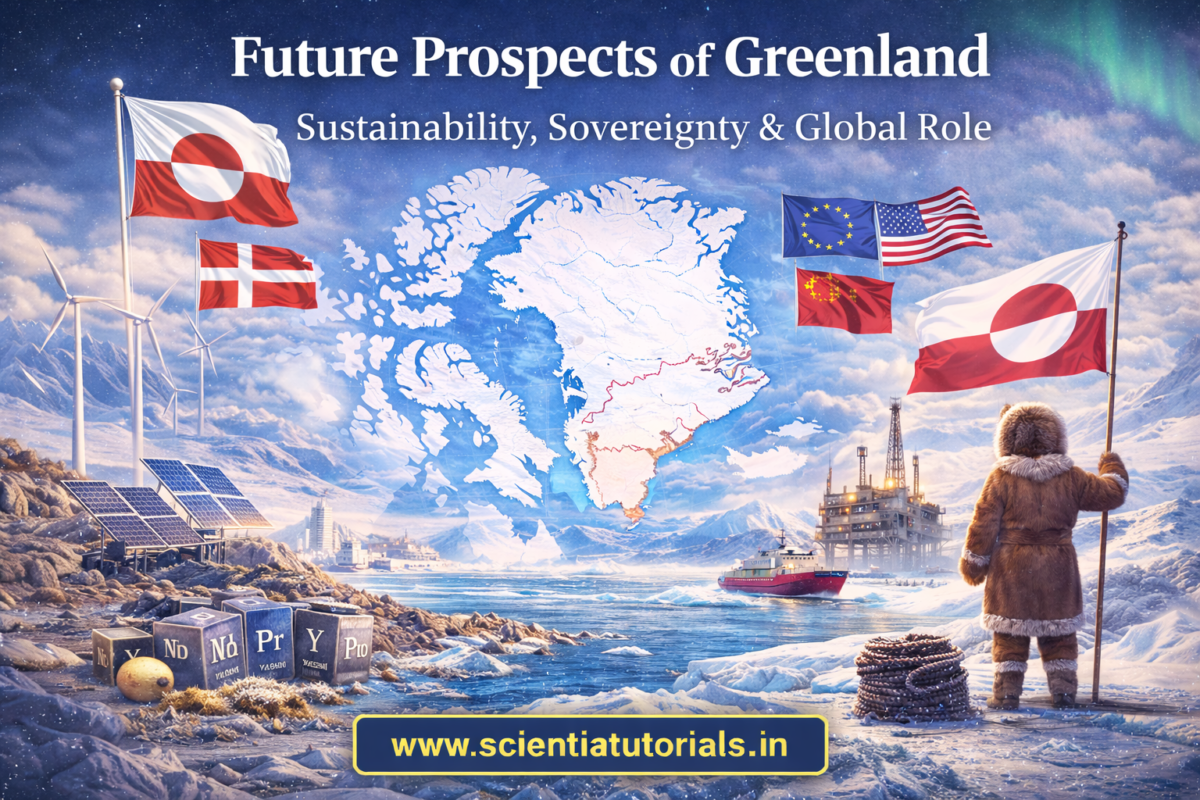

Future Prospects of Greenland | Sustainability, Sovereignty & Global Role
Module 5: Contemporary Greenland and Global Strategic Importance
Era Framework: Late 20th Century – 21st Century
(Globalization, Climate Change, Arctic Geopolitics)
Lesson: Future Prospects – Sustainability, Sovereignty, and Global Relevance
This lesson is systematically organized into four clearly structured sections, as detailed below:
- Chronologically Structured Study Module
- Short-Answer Type Questions
- Long-Answer Type Questions
- Multiple-Choice Questions (MCQs) with Answers and Detailed Explanations
Chronologically Structured Study Module
Introduction: Greenland at a Historical Crossroads
In the early twenty-first century, Greenland stands at a decisive historical crossroads. The forces of globalization, climate change, and intensifying Arctic geopolitics have converged to redefine Greenland’s future prospects. Once viewed primarily as a remote Arctic periphery, Greenland is now increasingly recognized as a region of global relevance, whose decisions will have implications far beyond its shores.
This lesson examines Greenland’s future through three interconnected lenses: sustainability, sovereignty, and global relevance. These themes are not isolated; rather, they interact dynamically, shaping Greenland’s political choices, economic strategies, and international positioning. Understanding these prospects requires situating Greenland’s future within the broader historical trajectory of decolonization, environmental transformation, and shifting global power structures.
1. Historical Foundations of Greenland’s Contemporary Future
1.1 From Colonial Dependency to Self-Government
Greenland’s future prospects cannot be understood without reference to its historical evolution. Under Danish colonial rule, Greenland’s political and economic development was tightly controlled, with limited local autonomy. The introduction of Home Rule in 1979 and the Self-Government Act of 2009 marked decisive steps toward political self-determination.
These reforms transferred substantial authority over domestic affairs and natural resources to Greenland, laying the institutional foundation for future sovereignty debates. However, defense and foreign policy remain under the authority of Denmark, creating an ongoing tension between autonomy and dependency.
1.2 The Late 20th Century as a Turning Point
By the late twentieth century, Greenland began transitioning from a protected, subsidized economy toward a more globally integrated model. This shift exposed Greenland to both new opportunities and new vulnerabilities, setting the stage for contemporary debates on sustainability and independence.
2. Sustainability as a Central Future Challenge
2.1 Environmental Vulnerability in a Warming Arctic
Climate change represents the most profound long-term challenge to Greenland’s future. The Arctic is warming at more than twice the global average, leading to glacier retreat, permafrost thaw, and ecosystem disruption. For Greenland, these changes threaten infrastructure, traditional livelihoods, and environmental stability.
Sustainability, therefore, is not an abstract ideal but a practical necessity. Greenland’s future development must account for environmental limits while responding to the immediate pressures of economic growth and social welfare.
2.2 Sustainable Resource Management
Greenland possesses significant mineral, energy, and marine resources that could support economic development. However, unsustainable exploitation risks long-term ecological damage and social disruption. The challenge lies in balancing economic use with environmental stewardship.
Future prospects depend on whether Greenland can establish regulatory frameworks that ensure responsible mining, sustainable fisheries, and environmental protection. This balancing act will shape Greenland’s credibility as a responsible Arctic actor.
3. Economic Sustainability and Development Pathways
3.1 Reducing Dependency on External Subsidies
A key element of Greenland’s future is reducing dependence on financial transfers from Denmark. While these subsidies support public services, they also limit fiscal autonomy and complicate sovereignty ambitions.
Economic sustainability requires diversification beyond a narrow resource base. Fisheries, mining, tourism, and emerging knowledge-based sectors must be developed in a way that provides stable, long-term income rather than short-term booms.
3.2 Risks of Resource-Driven Growth
Resource-based development carries inherent risks, including price volatility, environmental damage, and external dependency on foreign capital. Greenland’s future prospects hinge on whether resource wealth can be transformed into broad-based development rather than reinforcing dependency.
This dilemma mirrors global debates on the “resource curse,” making Greenland a valuable case study in sustainable Arctic development.
4. Sovereignty: Aspirations and Constraints
4.1 The Legal and Political Path to Independence
The Self-Government Act recognizes Greenland’s right to pursue independence through democratic means. This legal recognition places sovereignty firmly on the political agenda, transforming it from a symbolic aspiration into a practical possibility.
However, sovereignty is not merely a legal status; it requires economic viability, administrative capacity, and international recognition. Greenland’s future prospects depend on its ability to meet these conditions.
4.2 Economic Preconditions for Sovereignty
Economic self-sufficiency is widely seen as a prerequisite for full independence. Without a stable revenue base, sovereignty risks becoming symbolic rather than substantive. Thus, debates on independence are inseparable from discussions on sustainability and economic development.
Greenland’s future sovereignty will likely emerge gradually, shaped by incremental gains rather than abrupt separation.
5. Global Relevance in a Changing World Order
5.1 Greenland’s Strategic Location
Greenland’s geographic position between North America and Europe gives it enduring strategic significance. In an era of renewed great-power competition and Arctic accessibility, this location enhances Greenland’s global relevance.
As global powers reassess Arctic security, Greenland increasingly finds itself at the intersection of environmental, economic, and strategic interests.
5.2 Participation in Arctic Governance
Greenland plays an active role in Arctic governance through institutions such as the Arctic Council. Although not a sovereign state, Greenland contributes to shaping norms on environmental protection, indigenous rights, and sustainable development.
This participation enhances Greenland’s international visibility and prepares it for a more autonomous global role in the future.
6. Indigenous Identity and Social Sustainability
6.1 Inuit Culture and Political Identity
Greenland’s Inuit majority forms the cultural and moral foundation of its future. Political debates on sustainability and sovereignty are deeply intertwined with questions of cultural preservation, language, and identity.
Future development strategies must respect indigenous values and knowledge systems, ensuring that modernization does not erode cultural continuity.
6.2 Social Equity and Governance
Sustainable futures require inclusive governance that addresses social inequality, education, healthcare, and community resilience. Greenland’s future relevance depends on its ability to combine global engagement with social cohesion.
7. Climate Change: Risk and Opportunity
7.1 Environmental Risk
Climate change poses existential risks to Greenland’s environment and society. Infrastructure damage, coastal erosion, and ecological disruption threaten long-term stability.
7.2 Strategic Opportunity
At the same time, climate change has increased Greenland’s global relevance by opening Arctic routes and exposing resources. Greenland’s future prospects depend on how effectively it manages this dual reality of risk and opportunity.
8. Foreign Relations and Diplomatic Evolution
8.1 Constraints under the Danish Realm
Greenland’s foreign relations remain constitutionally linked to Denmark. This limits independent diplomacy but also provides security and international representation.
8.2 Gradual Expansion of International Engagement
In practice, Greenland has expanded its international presence through trade missions, environmental diplomacy, and Arctic cooperation. These incremental steps suggest a future in which Greenland exercises growing diplomatic agency, even without full sovereignty.
9. Competing Futures: Possible Scenarios
9.1 Sustainable Autonomy within the Danish Realm
One scenario envisions Greenland strengthening sustainability and economic resilience while remaining within the Danish Kingdom, enjoying high autonomy and global relevance.
9.2 Gradual Independence
Another scenario foresees a gradual transition toward independence, driven by economic diversification, institutional development, and international engagement.
9.3 Dependency and Vulnerability
A less favorable scenario involves environmental degradation, economic dependency, and geopolitical pressure, limiting Greenland’s ability to shape its own future.
Conclusion: Greenland’s Future as a Global Case Study
Greenland’s future prospects illustrate some of the most pressing challenges of the contemporary world: balancing sustainability with development, sovereignty with interdependence, and local identity with global relevance. From the late twentieth century into the twenty-first, Greenland has moved from the margins of global history to a position of growing strategic and symbolic importance.
Whether Greenland’s future is defined by sustainable autonomy, full sovereignty, or continued dependency will depend on choices made today—choices shaped by historical experience, environmental reality, and global power dynamics. As such, Greenland stands not only as an Arctic territory but as a global case study in navigating the future under conditions of rapid change.
Key Examination Takeaway
Greenland’s future prospects lie at the intersection of sustainability, sovereignty, and global relevance, making it a critical example of how environmental change and globalization reshape political destiny in the 21st century.
Short Answer Type Questions with Answers
Lesson: Future Prospects – Sustainability, Sovereignty, and Global Relevance
1. Why is Greenland described as standing at a historical crossroads in the 21st century?
Answer:
Because climate change, globalization, and Arctic geopolitics are simultaneously reshaping its environment, economy, and political future.
2. What three themes define Greenland’s future prospects?
Answer:
Sustainability, sovereignty, and global relevance.
3. Why is Greenland no longer viewed as a global periphery?
Answer:
Due to its strategic location, resource potential, and growing importance in Arctic geopolitics.
4. How did the Self-Government Act of 2009 shape Greenland’s future?
Answer:
It granted extensive autonomy and recognized Greenland’s right to pursue independence democratically.
5. Which areas remain under Danish control despite Greenland’s self-government?
Answer:
Defense and foreign policy remain under Denmark.
6. Why is sustainability a central issue for Greenland’s future?
Answer:
Because rapid Arctic warming threatens ecosystems, infrastructure, and traditional livelihoods.
7. What does environmental sustainability mean in the Greenlandic context?
Answer:
Balancing economic development with protection of fragile Arctic ecosystems.
8. How does climate change pose risks to Greenland?
Answer:
Through glacier melt, permafrost thaw, coastal erosion, and ecosystem disruption.
9. Why is resource management crucial for Greenland’s future?
Answer:
Because resources can support development but may cause long-term damage if exploited unsustainably.
10. What economic challenge limits Greenland’s sovereignty aspirations?
Answer:
Dependence on financial subsidies from Denmark.
11. Why is economic diversification important for Greenland?
Answer:
To reduce dependency and ensure long-term economic sustainability.
12. What risks are associated with resource-based economic growth?
Answer:
Price volatility, environmental damage, and dependency on foreign capital.
13. How is sovereignty defined beyond legal independence?
Answer:
As economic viability, administrative capacity, and international recognition.
14. Why is economic self-sufficiency seen as essential for independence?
Answer:
Because political sovereignty without a stable economy would be unsustainable.
15. How does Greenland’s geographic location enhance its global relevance?
Answer:
It lies between North America and Europe, making it strategically important in the Arctic.
16. Which Arctic institution enhances Greenland’s international visibility?
Answer:
The Arctic Council.
17. Why is indigenous identity central to Greenland’s future?
Answer:
Because Inuit culture, language, and traditions shape political priorities and social sustainability.
18. What is meant by social sustainability in Greenland?
Answer:
Ensuring equity, cultural preservation, education, healthcare, and community resilience.
19. How does climate change create both risks and opportunities for Greenland?
Answer:
It threatens the environment but increases strategic importance and global attention.
20. Why is Greenland’s foreign policy autonomy limited?
Answer:
Because international diplomacy is constitutionally handled by Denmark.
21. How has Greenland expanded its international engagement despite constraints?
Answer:
Through trade missions, environmental diplomacy, and Arctic cooperation.
22. What is one possible future scenario for Greenland?
Answer:
Sustainable autonomy within the Danish Realm.
23. What does a gradual independence scenario involve?
Answer:
Step-by-step economic development, institutional strengthening, and expanded global engagement.
24. What risks could undermine Greenland’s future prospects?
Answer:
Environmental degradation, economic dependency, and geopolitical pressure.
25. Why is Greenland considered a global case study for the future?
Answer:
Because it illustrates how sustainability, sovereignty, and globalization interact in the 21st century.
Examination Tip
For short answers, emphasize climate change, economic sustainability, independence debates, Arctic governance, and future scenarios—these are high-yield themes.
Long Answer Type Questions with Answers
Lesson: Future Prospects – Sustainability, Sovereignty, and Global Relevance
1. Explain why Greenland’s future prospects are described as a historical turning point.
Answer:
In the 21st century, Greenland faces simultaneous pressures from climate change, globalization, and Arctic geopolitics. These forces have transformed Greenland from a remote periphery into a region of global concern. Decisions made today regarding sustainability, governance, and economic development will determine whether Greenland moves toward long-term autonomy, full sovereignty, or continued dependency, making this period a historical turning point.
2. Analyze the interrelationship between sustainability, sovereignty, and global relevance in Greenland’s future.
Answer:
Sustainability, sovereignty, and global relevance are deeply interconnected. Sustainable resource management is essential for economic viability, which underpins sovereignty aspirations. At the same time, Greenland’s global relevance—driven by climate change and Arctic geopolitics—creates both opportunities and constraints. Without sustainability, sovereignty is economically fragile; without sovereignty, global relevance may be externally controlled.
3. Trace the historical foundations that shape Greenland’s contemporary future prospects.
Answer:
Greenland’s future is rooted in its transition from Danish colonial rule to Home Rule (1979) and Self-Government (2009). These reforms transferred control over domestic affairs and resources while leaving defense and foreign policy with Denmark. This historical trajectory established autonomy but also structural dependence, shaping present debates on sustainability and independence.
4. Why is sustainability considered a central challenge for Greenland’s future?
Answer:
The Arctic is warming at more than twice the global average, making Greenland highly vulnerable to climate impacts such as glacier melt, permafrost thaw, and ecosystem disruption. Sustainability is therefore essential not only for environmental protection but also for safeguarding infrastructure, livelihoods, and long-term economic stability.
5. Discuss the environmental risks posed by climate change to Greenland.
Answer:
Climate change threatens Greenland through coastal erosion, infrastructure damage, biodiversity loss, and altered marine ecosystems. These changes affect traditional Inuit livelihoods and impose high adaptation costs, making environmental resilience a critical determinant of Greenland’s future stability.
6. Examine the dilemma of sustainable resource management in Greenland.
Answer:
Greenland possesses valuable mineral, energy, and marine resources that could support economic development. However, unsustainable exploitation risks irreversible environmental damage. The dilemma lies in using resources to reduce dependency while ensuring long-term ecological balance and social consent.
7. Evaluate the role of economic sustainability in Greenland’s future sovereignty.
Answer:
Economic sustainability is widely seen as a prerequisite for sovereignty. Continued reliance on Danish subsidies constrains political independence. Without diversified and stable revenue sources, sovereignty risks becoming symbolic rather than functional.
8. Why is economic diversification crucial for Greenland’s future?
Answer:
Overdependence on a narrow resource base exposes Greenland to market volatility and external control. Diversification into fisheries, tourism, renewable energy, and knowledge-based sectors can provide resilience and long-term growth.
9. Discuss the risks associated with resource-driven development in Greenland.
Answer:
Resource-driven growth can lead to environmental degradation, social inequality, and dependency on foreign capital. These risks mirror the global “resource curse,” making governance quality central to Greenland’s future prospects.
10. Analyze the legal and political framework governing Greenland’s sovereignty aspirations.
Answer:
The Self-Government Act of 2009 recognizes Greenland’s right to independence through democratic means. However, sovereignty requires more than legal recognition; it demands economic capacity, administrative competence, and international acceptance.
11. Why is sovereignty in Greenland viewed as a gradual rather than immediate process?
Answer:
Given economic constraints, limited population, and administrative challenges, abrupt independence could destabilize governance. A gradual approach allows institutional strengthening, economic diversification, and international engagement to mature over time.
12. Examine Greenland’s strategic location and its implications for global relevance.
Answer:
Situated between North America and Europe, Greenland occupies a critical Arctic position. Climate change has increased accessibility, enhancing Greenland’s relevance in security, shipping, and global geopolitics.
13. Discuss Greenland’s role in Arctic governance and international institutions.
Answer:
Through participation in bodies such as the Arctic Council, Greenland contributes to environmental governance, indigenous rights, and sustainable development. This engagement enhances international visibility despite limited sovereignty.
14. How does indigenous identity shape Greenland’s future development strategies?
Answer:
Inuit culture, language, and land-based traditions form the moral foundation of Greenlandic society. Future development must respect indigenous values, ensuring that modernization does not undermine cultural continuity or social cohesion.
15. Explain the concept of social sustainability in the Greenlandic context.
Answer:
Social sustainability involves equitable access to education, healthcare, housing, and participation in decision-making. It ensures that economic and political change benefits communities rather than exacerbating inequality.
16. Assess climate change as both a risk and an opportunity for Greenland.
Answer:
Climate change threatens Greenland’s environment and society but also increases global attention, strategic relevance, and access to resources. Managing this dual reality is central to Greenland’s future success.
17. Analyze the constraints on Greenland’s foreign policy autonomy.
Answer:
Foreign relations and defense remain under Danish authority, limiting Greenland’s independent diplomacy. However, this arrangement also provides security guarantees and international representation.
18. How has Greenland expanded its international engagement despite constitutional limits?
Answer:
Greenland has increased its global presence through trade missions, environmental diplomacy, scientific cooperation, and Arctic forums, gradually building international experience and recognition.
19. Discuss possible future scenarios for Greenland within the Danish Realm.
Answer:
One scenario involves strengthened autonomy with sustainable development while remaining within the Danish Kingdom, balancing security and global engagement with local control.
20. Examine the scenario of gradual independence for Greenland.
Answer:
Gradual independence envisions phased economic development, institutional capacity-building, and expanded diplomatic engagement, culminating in sovereignty when conditions are favorable.
21. What risks could undermine Greenland’s future prospects?
Answer:
Environmental degradation, overreliance on external capital, weak governance, and geopolitical pressure could limit Greenland’s ability to shape its own future.
22. How does globalization influence Greenland’s future relevance?
Answer:
Globalization integrates Greenland into global markets and geopolitics, creating opportunities for growth while exposing it to external economic and political forces.
23. Critically analyze the balance between interdependence and independence in Greenland’s future.
Answer:
Complete independence may be unrealistic in an interconnected world. Greenland’s challenge is to achieve meaningful autonomy while managing interdependence through strategic partnerships.
24. Why is Greenland considered a global case study for 21st-century challenges?
Answer:
Greenland illustrates how climate change, sustainability, sovereignty, and globalization interact, making it a valuable example for understanding future global governance challenges.
25. Conclude by evaluating Greenland’s long-term global relevance.
Answer:
Greenland’s long-term relevance will depend on its ability to balance sustainability, economic resilience, cultural integrity, and political ambition. Its future trajectory will shape not only Arctic governance but also global debates on development and sovereignty in a changing world.
Concluding Examination Insight
Greenland’s future prospects must be analyzed as an integrated process where sustainability enables sovereignty, and sovereignty shapes global relevance in the context of climate change and globalization.
Multiple Choice Questions (MCQs) with Answers and Explanations
Lesson: Future Prospects – Sustainability, Sovereignty, and Global Relevance
1. Why is Greenland considered to be at a historical crossroads in the 21st century?
A. Decline in population
B. Simultaneous impact of climate change, globalization, and geopolitics
C. End of Arctic governance
D. Collapse of fisheries
Correct Answer: B
Explanation:
Greenland’s future is being reshaped simultaneously by rapid climate change, deeper global integration, and rising Arctic strategic importance.
2. Which three themes define Greenland’s future prospects?
A. Militarization, migration, modernization
B. Sustainability, sovereignty, global relevance
C. Trade, tourism, technology
D. Autonomy, agriculture, alliances
Correct Answer: B
Explanation:
The lesson emphasizes sustainability, sovereignty, and global relevance as the core dimensions shaping Greenland’s future.
3. The Arctic is warming faster than the global average primarily due to:
A. Industrial activity in Greenland
B. Ocean currents alone
C. Polar amplification
D. Volcanic activity
Correct Answer: C
Explanation:
Polar amplification causes Arctic regions to warm at more than twice the global average, intensifying environmental risks for Greenland.
4. Why is sustainability a practical necessity for Greenland?
A. To increase tourism only
B. To meet European Union standards
C. To protect fragile ecosystems and long-term livelihoods
D. To reduce cultural diversity
Correct Answer: C
Explanation:
Environmental sustainability is essential to protect Greenland’s ecosystems, infrastructure, and indigenous livelihoods.
5. Which development risk is most associated with unsustainable resource exploitation?
A. Cultural revival
B. Long-term ecological damage
C. Increased autonomy
D. Reduced global interest
Correct Answer: B
Explanation:
Unregulated extraction can permanently damage fragile Arctic ecosystems, undermining future development.
6. Economic sustainability is important for Greenland primarily because it:
A. Eliminates globalization
B. Enables political sovereignty
C. Ends Arctic cooperation
D. Prevents climate change
Correct Answer: B
Explanation:
Without economic viability, political sovereignty would be difficult to sustain in practice.
7. Greenland’s financial dependence is mainly associated with:
A. China
B. Norway
C. Denmark
D. Canada
Correct Answer: C
Explanation:
Greenland receives significant financial transfers from Denmark, which affects fiscal autonomy.
8. Why is economic diversification crucial for Greenland’s future?
A. To end fishing activities
B. To reduce exposure to market volatility
C. To expand population size
D. To increase military spending
Correct Answer: B
Explanation:
Diversification reduces dependency on a single sector and improves long-term economic resilience.
9. Which concept best describes the risk of overreliance on natural resources?
A. Green economy
B. Sustainable growth
C. Resource curse
D. Economic integration
Correct Answer: C
Explanation:
The “resource curse” refers to economic instability and dependency caused by excessive reliance on resource extraction.
10. The Self-Government Act of 2009 is significant because it:
A. Ended Danish sovereignty
B. Recognized Greenland’s right to independence
C. Created the Arctic Council
D. Introduced military autonomy
Correct Answer: B
Explanation:
The Act legally recognizes Greenland’s right to pursue independence through democratic means.
11. Which area remains under Danish authority despite Greenland’s self-government?
A. Education
B. Health
C. Natural resources
D. Defense and foreign policy
Correct Answer: D
Explanation:
Defense and foreign affairs are still managed by Denmark under the constitutional framework.
12. Why is sovereignty in Greenland viewed as a gradual process?
A. Due to population decline
B. Due to lack of international interest
C. Due to economic and administrative constraints
D. Due to climate stability
Correct Answer: C
Explanation:
Gradual sovereignty allows time for economic diversification and institutional capacity-building.
13. Greenland’s global relevance has increased mainly because of:
A. Cultural exports
B. Climate change and Arctic accessibility
C. Population growth
D. Decline of global trade
Correct Answer: B
Explanation:
Melting ice has increased access to Arctic regions, raising Greenland’s strategic and global importance.
14. Which institution enhances Greenland’s visibility in Arctic governance?
A. NATO
B. United Nations Security Council
C. European Union
D. Arctic Council
Correct Answer: D
Explanation:
The Arctic Council promotes cooperation on environmental protection and indigenous issues, providing Greenland an international platform.
15. Indigenous identity is central to Greenland’s future because it:
A. Limits modernization
B. Shapes political and cultural priorities
C. Reduces global engagement
D. Prevents economic growth
Correct Answer: B
Explanation:
Inuit culture and traditions influence governance choices and development strategies.
16. What does social sustainability primarily emphasize?
A. Military strength
B. Cultural homogeneity
C. Equity, welfare, and community resilience
D. Rapid urbanization
Correct Answer: C
Explanation:
Social sustainability ensures inclusive development, access to services, and cultural continuity.
17. Climate change presents Greenland with which dual reality?
A. Only environmental risk
B. Only strategic opportunity
C. Risk and opportunity simultaneously
D. Decline and isolation
Correct Answer: C
Explanation:
While climate change threatens ecosystems, it also increases Greenland’s strategic and global relevance.
18. Why is Greenland’s foreign policy autonomy limited?
A. Due to lack of population
B. Due to EU regulations
C. Due to constitutional arrangements with Denmark
D. Due to Arctic Council rules
Correct Answer: C
Explanation:
Foreign affairs remain constitutionally managed by Denmark.
19. Despite constraints, Greenland has expanded its global role through:
A. Military alliances
B. Trade missions and environmental diplomacy
C. Territorial expansion
D. Nuclear agreements
Correct Answer: B
Explanation:
Greenland engages internationally through trade, research, and environmental cooperation.
20. Which future scenario emphasizes continued autonomy within the Danish Realm?
A. Immediate independence
B. Sustainable autonomy
C. Strategic isolation
D. Resource exhaustion
Correct Answer: B
Explanation:
This scenario combines self-government with economic sustainability while remaining within Denmark.
21. Gradual independence for Greenland would most likely involve:
A. Sudden political separation
B. Economic collapse
C. Phased institutional and economic development
D. Withdrawal from Arctic cooperation
Correct Answer: C
Explanation:
A step-by-step process allows Greenland to build capacity before full sovereignty.
22. Which factor could undermine Greenland’s future prospects?
A. Cultural preservation
B. Environmental degradation
C. Arctic cooperation
D. Sustainable governance
Correct Answer: B
Explanation:
Environmental damage could weaken economic stability and social resilience.
23. Globalization affects Greenland by:
A. Isolating it from world markets
B. Integrating it into global economic and political networks
C. Ending sovereignty debates
D. Reducing Arctic interest
Correct Answer: B
Explanation:
Globalization increases both opportunities and external pressures for Greenland.
24. Why is Greenland considered a global case study for the 21st century?
A. Because it is densely populated
B. Because it represents post-industrial decline
C. Because it illustrates sustainability–sovereignty–globalization interactions
D. Because it dominates Arctic trade
Correct Answer: C
Explanation:
Greenland exemplifies how environmental change and globalization reshape political futures.
25. Greenland’s long-term global relevance will depend most on its ability to:
A. Expand military capacity
B. Balance sustainability, autonomy, and global engagement
C. Reduce indigenous influence
D. Avoid international cooperation
Correct Answer: B
Explanation:
Balancing environmental protection, economic resilience, and political ambition is key to Greenland’s future.
Examination Insight
For MCQs, prioritize climate change impacts, economic sustainability, sovereignty frameworks, Arctic governance, and future scenarios—these are high-yield objective exam themes.