
Norse–Inuit Interactions and Cultural Encounters
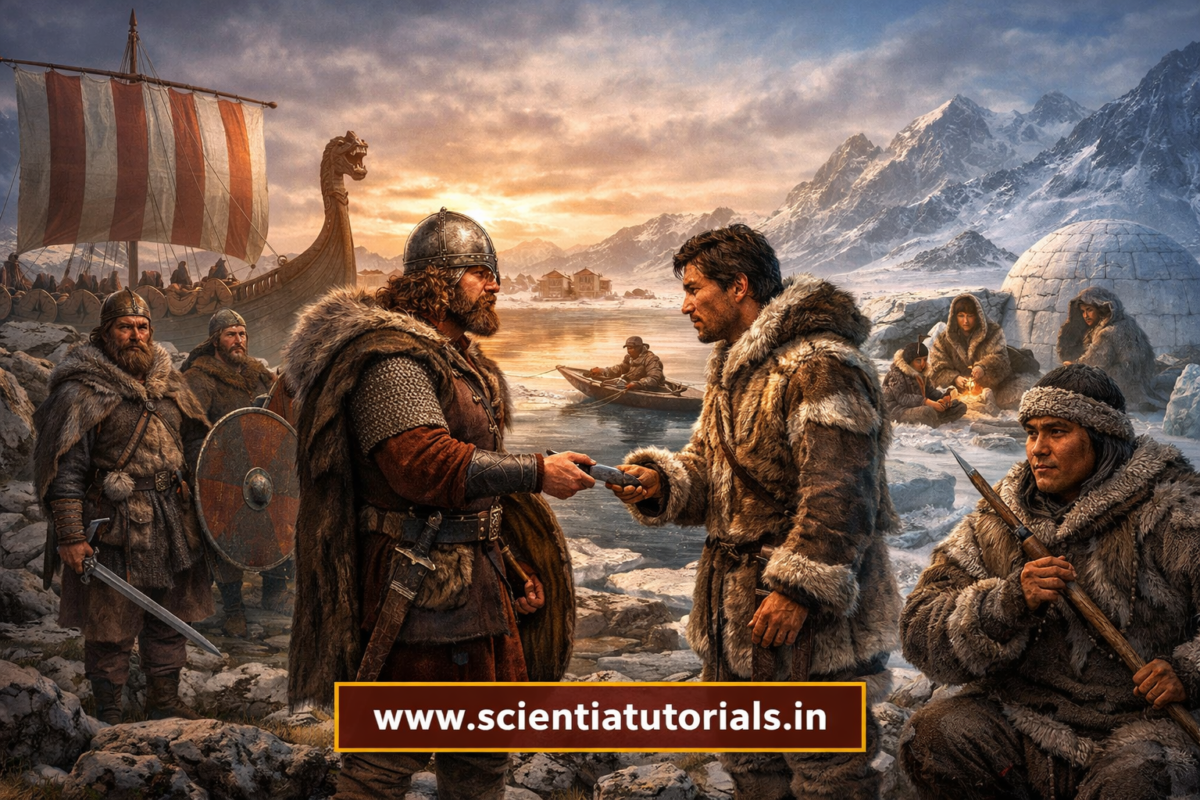

Norse–Inuit Interactions in Medieval Greenland | Cultural Encounters & Survival
Module 2: Norse Expansion and Medieval Greenland
Lesson: Norse–Inuit Interactions and Cultural Encounters
Era Framework: c. 10th Century – 15th Century
(Viking Expansion, Medieval Europe, Trans-Atlantic Contacts)
This lesson is systematically organized into four clearly structured sections, as detailed below:
- Chronologically Structured Study Module
- Short-Answer Type Questions
- Long-Answer Type Questions
- Multiple-Choice Questions (MCQs) with Answers and Detailed Explanations
Chronologically Structured Study Module
Introduction: Cultural Encounters at the Arctic Frontier
The interaction between the Norse settlers of Greenland and the Indigenous Inuit populations represents one of the earliest sustained encounters between medieval European societies and Arctic hunter-gatherer cultures. These encounters unfolded in a harsh and dynamic environment where survival depended on adaptation, cooperation, and ecological knowledge. Despite sharing the same geographic space for several centuries, Norse and Inuit societies followed distinct cultural, economic, and technological paths.
This lesson examines the nature of Norse–Inuit interactions from the late tenth century to the fifteenth century. It explores patterns of contact, exchange, conflict, and mutual perception, while situating these encounters within broader themes of medieval expansion, environmental adaptation, and cultural boundaries. Chronologically structured, the lesson highlights how differing worldviews and survival strategies shaped the outcomes of these encounters.
I. Indigenous Presence in Greenland before Norse Arrival
Early Arctic Cultures
Long before the arrival of the Norse, Greenland was inhabited by Arctic peoples whose ancestors had migrated across the North American Arctic. These populations developed highly specialized adaptations to polar environments, relying on marine hunting, seasonal mobility, and sophisticated technologies such as skin boats, harpoons, and tailored fur clothing.
By the time the Norse arrived in the late tenth century, Inuit ancestors associated with the Thule cultural tradition were expanding eastward into Greenland from Arctic Canada. Their subsistence strategies were closely attuned to ice, sea mammals, and migratory patterns.
II. Norse Settlement and the First Cultural Contacts (Late 10th – 11th Century)
Norse Arrival in Southern Greenland
The Norse settled primarily in southern Greenland, establishing the Eastern and Western Settlements in fjord regions suitable for limited agriculture and animal husbandry. Initially, Norse settlers encountered little direct contact with Inuit groups, as early Inuit populations were concentrated farther north.
However, as Inuit migration expanded southward over time, zones of contact between the two cultures gradually developed.
Norse Perceptions of Indigenous Peoples
Norse sources, especially Icelandic sagas and later medieval accounts, refer to Indigenous peoples using the term “Skrælings.” These descriptions often portray Inuit groups as unfamiliar, threatening, or inferior, reflecting Norse ethnocentric worldviews common in medieval Europe.
Such perceptions shaped the nature of interactions, limiting opportunities for sustained cooperation or cultural exchange.
III. Zones and Nature of Contact (11th – 13th Century)
Geographic Overlap and Resource Competition
By the twelfth and thirteenth centuries, Inuit groups had expanded into regions closer to Norse settlements. Contact zones emerged along hunting grounds, coastal areas, and trade routes. These areas were often rich in resources such as seals, walruses, and fish.
Competition for access to these resources increased the likelihood of encounters, some of which were peaceful while others were hostile.
Trade and Limited Exchange
Archaeological evidence suggests limited trade between Norse and Inuit groups. Items such as metal tools, wood fragments, and carved objects indicate occasional exchange. For the Inuit, Norse iron and wood were valuable resources. For the Norse, Inuit knowledge of Arctic hunting may have been potentially useful, though rarely adopted.
Despite this, trade remained sporadic rather than institutionalized, and no sustained trade networks developed between the two cultures.
IV. Conflict and Violence in Norse–Inuit Relations
Evidence of Hostile Encounters
Both archaeological findings and saga narratives indicate episodes of conflict. Norse accounts describe attacks by Skrælings, while Inuit oral traditions speak of clashes with foreign settlers. These conflicts likely arose from competition over hunting grounds and mutual mistrust.
The Norse, accustomed to agrarian and pastoral life, were less mobile and more vulnerable during hunting expeditions, making them susceptible to Inuit tactics adapted to Arctic conditions.
Impact of Conflict on Norse Settlements
While conflict alone did not cause the collapse of Norse Greenland, it added to existing pressures. The Western Settlement, located closer to Inuit migration routes, appears to have been particularly vulnerable and disappeared earlier than the Eastern Settlement.
V. Contrasting Cultural and Economic Systems
Norse Subsistence Strategies
The Norse relied heavily on livestock farming, hay production, and seasonal hunting. Their economic model was rooted in European medieval practices, emphasizing land ownership, fixed settlements, and social hierarchy.
This approach worked marginally during favorable climatic conditions but struggled as temperatures cooled and resources became scarce.
Inuit Adaptive Strategies
In contrast, Inuit societies practiced highly flexible subsistence strategies centered on marine hunting, seasonal mobility, and communal resource sharing. Their technologies—such as kayaks, dog sleds, and efficient hunting tools—were well suited to Arctic environments.
These differences gave Inuit communities greater resilience in the face of climatic deterioration.
VI. Cultural Boundaries and Limited Assimilation
Lack of Cultural Integration
Despite centuries of coexistence, there is little evidence of intermarriage, religious exchange, or cultural assimilation between Norse and Inuit populations. Each group maintained distinct identities, technologies, and worldviews.
The Norse remained culturally oriented toward Europe, Christianity, and agrarian life, while Inuit societies continued indigenous traditions adapted to Arctic conditions.
Barriers to Knowledge Transfer
One of the most striking aspects of Norse–Inuit interaction is the Norse failure to adopt Inuit survival technologies on a significant scale. Cultural conservatism, social hierarchy, and a strong European identity limited the willingness of Norse settlers to learn from Indigenous practices.
VII. Environmental Change and Shifting Power Dynamics (13th – 14th Century)
Climate Deterioration
From the thirteenth century onward, Greenland experienced colder conditions associated with the Little Ice Age. These changes affected Norse agriculture, reduced hay yields, and increased sea ice, making hunting and trade more difficult.
For Inuit societies, however, colder conditions did not pose the same level of threat, as their subsistence systems were already adapted to extreme Arctic environments.
Inuit Expansion and Norse Vulnerability
As Norse settlements weakened, Inuit groups continued to expand into southern Greenland. The balance of power gradually shifted, with Inuit societies demonstrating greater environmental resilience and adaptability.
VIII. The Decline of Norse Greenland and the End of Contact
Western Settlement Disappearance
The Western Settlement vanished by the mid-fourteenth century. While climate change and economic isolation were major causes, proximity to Inuit populations and competition over resources likely contributed to its vulnerability.
Eastern Settlement and Final Disappearance
The Eastern Settlement survived longer but eventually declined by the fifteenth century. As Norse society collapsed, Inuit populations remained, becoming the primary human presence in Greenland.
IX. Historical Interpretations of Norse–Inuit Encounters
Earlier Interpretations
Earlier historians often portrayed Inuit groups as hostile forces responsible for Norse decline. Modern scholarship, however, emphasizes environmental and economic factors while recognizing conflict as only one element.
Contemporary Perspectives
Today, Norse–Inuit interactions are understood as complex cultural encounters shaped by environmental adaptation, cultural rigidity, and unequal resilience rather than simple conquest or replacement.
X. Significance of Norse–Inuit Interactions in World History
Frontier Encounters in Medieval History
These interactions represent a rare example of medieval European–Indigenous contact in the Arctic, offering insight into how different societies respond to extreme environments.
Lessons on Cultural Adaptation
The contrasting outcomes of Norse and Inuit societies underscore the importance of adaptability, environmental knowledge, and cultural flexibility for long-term survival.
Greenland in Global Historical Context
Norse–Inuit encounters link Greenland’s local history to global themes such as migration, cultural contact, and climate change, reinforcing its importance in world history studies.
Conclusion
Norse–Inuit interactions in medieval Greenland were shaped by coexistence, limited exchange, occasional conflict, and profound cultural differences. While both societies inhabited the same landscape, their responses to environmental challenges diverged sharply. The Inuit’s adaptive strategies allowed continuity, while the Norse reliance on European models ultimately proved unsustainable.
This lesson highlights how cultural encounters at the edges of the medieval world reveal broader truths about human adaptation, resilience, and the limits of expansion—making Norse–Inuit interactions a vital component of Greenland’s historical evolution and global significance.
Short Answer Type Questions with Answers
(Norse–Inuit Interactions and Cultural Encounters)
1. Who were the Indigenous inhabitants of Greenland before the Norse arrival?
Answer: Greenland was inhabited by Arctic Indigenous peoples, ancestors of the Inuit, long before Norse settlement.
2. When did the Norse begin settling in Greenland?
Answer: The Norse began settling in Greenland in the late 10th century, around 985–986 CE.
3. Which regions of Greenland were primarily settled by the Norse?
Answer: The Norse mainly settled in southern Greenland, establishing the Eastern and Western Settlements.
4. What term did Norse sources use for Indigenous Arctic peoples?
Answer: Norse sources referred to Indigenous peoples as “Skrælings.”
5. What does the term “Skrælings” reflect about Norse perceptions?
Answer: It reflects Norse ethnocentric views and a perception of Indigenous peoples as unfamiliar or inferior.
6. Why was early contact between Norse and Inuit limited?
Answer: Early contact was limited because Inuit populations initially lived farther north, away from Norse settlements.
7. During which centuries did Norse–Inuit contact increase?
Answer: Contact increased between the 11th and 13th centuries as Inuit groups expanded southward.
8. Where did most Norse–Inuit interactions occur?
Answer: Interactions occurred mainly in coastal areas, hunting grounds, and regions rich in marine resources.
9. What resources caused competition between Norse and Inuit groups?
Answer: Competition focused on seals, walruses, fish, and access to coastal hunting areas.
10. Is there evidence of trade between the Norse and Inuit?
Answer: Yes, archaeological evidence suggests limited and informal trade between the two groups.
11. What Norse goods were valuable to Inuit communities?
Answer: Iron tools and wood were particularly valuable to Inuit groups.
12. Did the Norse widely adopt Inuit technologies?
Answer: No, the Norse rarely adopted Inuit technologies despite their effectiveness in Arctic conditions.
13. Name one Inuit technology suited to Arctic survival.
Answer: Kayaks, dog sleds, and efficient harpoons were key Inuit technologies.
14. How did Norse subsistence strategies differ from Inuit practices?
Answer: The Norse relied on farming and livestock, while Inuit depended on marine hunting and seasonal mobility.
15. What role did conflict play in Norse–Inuit relations?
Answer: Conflict occurred intermittently, often due to resource competition, but was not constant.
16. Which Norse settlement was most vulnerable to Inuit contact?
Answer: The Western Settlement was more vulnerable due to its location and environmental exposure.
17. How did climate change affect Norse–Inuit interactions?
Answer: Cooling temperatures weakened Norse settlements while Inuit societies remained resilient.
18. Why were Inuit societies better adapted to Arctic conditions?
Answer: They had flexible subsistence systems, specialized technologies, and deep environmental knowledge.
19. What cultural barrier limited cooperation between Norse and Inuit?
Answer: Strong cultural identity and European orientation limited Norse willingness to adopt Indigenous practices.
20. Was there evidence of intermarriage between Norse and Inuit?
Answer: There is little to no evidence of intermarriage or cultural assimilation.
21. How did Norse cultural rigidity affect their survival?
Answer: It prevented adaptation to Arctic conditions, increasing vulnerability during climatic deterioration.
22. What happened to the Western Settlement by the mid-14th century?
Answer: The Western Settlement disappeared, likely due to climate stress, isolation, and resource competition.
23. Did Inuit societies disappear with the Norse decline?
Answer: No, Inuit societies continued and became the primary population in Greenland.
24. How do modern historians view Norse–Inuit interactions?
Answer: They see them as complex encounters shaped by environment and adaptation, not simple conflict.
25. Why are Norse–Inuit interactions historically significant?
Answer: They illustrate early cultural encounters, adaptation strategies, and the limits of medieval expansion.
Long Answer Type Questions
1. Explain the historical background that led to Norse settlement in Greenland.
Answer:
The Norse settlement of Greenland began in the late 10th century, driven by Viking expansion from Scandinavia and Iceland. Factors such as population pressure, political conflicts, and the search for arable land motivated exploration. Led by Erik the Red, Norse settlers established Eastern and Western Settlements along Greenland’s southwestern coast around c. 985 CE. These settlements formed part of the wider North Atlantic Viking world, linking Greenland with Iceland, Norway, and Europe.
2. Who were the Inuit peoples encountered by the Norse in Greenland, and where did they originate?
Answer:
The Inuit encountered by the Norse were primarily ancestors of the Thule culture, who migrated eastward from Arctic Alaska around the 13th century. Skilled in Arctic survival, they relied on hunting marine mammals using advanced tools such as harpoons and kayaks. Their arrival postdated early Norse settlement but eventually brought the two cultures into contact.
3. Describe the term “Skrælings” and its significance in Norse sources.
Answer:
“Skrælings” was the term used by Norse sources to describe indigenous Arctic peoples, including the Inuit. The word often carried negative connotations, reflecting cultural misunderstanding and ethnocentrism. It highlights how the Norse perceived the Inuit as outsiders and culturally inferior, shaping the tone of recorded encounters.
4. What types of interactions occurred between the Norse and Inuit in medieval Greenland?
Answer:
Interactions ranged from limited trade and indirect contact to occasional conflict. Archaeological evidence suggests the exchange of goods such as iron tools and walrus ivory. However, competition for resources, especially hunting grounds, sometimes led to violence. Sustained cultural integration was minimal.
5. Examine archaeological evidence supporting Norse–Inuit contact.
Answer:
Archaeological findings include Norse metal artifacts found at Inuit sites and Inuit-style tools discovered near Norse settlements. Thule harpoon heads near Norse farms and European iron objects in Inuit camps suggest interaction. However, the evidence points to sporadic rather than continuous engagement.
6. Why was trade between the Norse and Inuit limited?
Answer:
Trade was limited due to cultural barriers, mutual mistrust, language differences, and differing economic systems. The Norse focused on pastoral farming and European trade networks, while the Inuit relied on mobile hunting economies. Environmental constraints also restricted regular interaction.
7. How did environmental conditions shape Norse–Inuit relations?
Answer:
Greenland’s harsh climate and fragile ecosystems intensified competition over resources such as seals and walrus. As the climate cooled during the later medieval period, survival became more difficult, increasing tensions and reducing the likelihood of peaceful coexistence.
8. Compare Norse and Inuit subsistence strategies.
Answer:
The Norse practiced livestock farming, relying on cattle, sheep, and limited agriculture, supplemented by hunting. Inuit subsistence centered on marine hunting, using sophisticated technologies suited to Arctic conditions. Inuit adaptability gave them a long-term survival advantage.
9. Why did the Norse struggle to adopt Inuit survival techniques?
Answer:
Cultural rigidity, attachment to European identity, and social prestige associated with farming prevented the Norse from fully adopting Inuit methods such as seal-hunting from kayaks or wearing fur clothing. This resistance limited their adaptability to Arctic conditions.
10. Assess the role of violence in Norse–Inuit encounters.
Answer:
Saga literature and archaeological evidence suggest sporadic violent encounters, often over resources. However, large-scale warfare was rare. Violence contributed to insecurity and reinforced cultural separation rather than integration.
11. How reliable are Norse sagas as sources for understanding Inuit interactions?
Answer:
Norse sagas provide valuable insights but must be used critically. They reflect Norse biases, exaggerations, and oral traditions. When corroborated with archaeology, they help reconstruct aspects of intercultural contact.
12. Discuss the cultural misunderstandings between Norse and Inuit societies.
Answer:
Misunderstandings arose from contrasting worldviews, religious beliefs, and social structures. The Norse viewed the Inuit as uncivilized, while Inuit may have seen the Norse as strange and intrusive. These perceptions hindered cooperation.
13. What role did religion play in shaping Norse attitudes toward the Inuit?
Answer:
Christian Norse settlers often viewed non-Christian peoples as pagans, reinforcing social distance. Religious difference justified exclusion and limited willingness to integrate or learn from Inuit practices.
14. Analyze the impact of Norse–Inuit relations on the decline of Norse Greenland.
Answer:
While Inuit contact was not the sole cause, competition and lack of cooperation contributed to Norse vulnerability. Inuit adaptability contrasted sharply with Norse inflexibility, highlighting structural weaknesses in Norse society.
15. Why did the Inuit survive while the Norse settlements disappeared?
Answer:
The Inuit’s mobile lifestyle, efficient hunting technologies, and deep ecological knowledge enabled them to adapt to climatic deterioration. The Norse reliance on European-style farming proved unsustainable in the long term.
16. Examine the role of climate change in shaping intercultural dynamics.
Answer:
The onset of cooler conditions reduced pasture productivity and sea ice expanded. Inuit hunting techniques thrived under these conditions, while Norse agriculture declined, widening the survival gap between the two societies.
17. How did Norse–Inuit interactions reflect broader medieval global patterns?
Answer:
These encounters mirrored global medieval trends of cultural contact, conflict, and asymmetrical adaptation, similar to European encounters with indigenous peoples elsewhere during expansionary phases.
18. What does the Greenland case reveal about cultural adaptability?
Answer:
It demonstrates that adaptability, rather than technological superiority alone, determines survival. The Inuit’s flexible response to environmental challenges contrasts with Norse conservatism.
19. Discuss gender and social organization in Norse and Inuit societies.
Answer:
Norse society was hierarchical and farm-centered, with defined gender roles linked to agriculture. Inuit society emphasized cooperation and shared labor, with gender roles oriented toward survival in extreme environments.
20. Why did sustained cultural blending fail to occur in Greenland?
Answer:
Strong cultural identities, social boundaries, limited population sizes, and mutual suspicion prevented long-term integration or intermarriage.
21. Evaluate the significance of Norse–Inuit encounters for Arctic history.
Answer:
These encounters represent one of the earliest sustained European–Arctic indigenous contacts, offering critical insights into adaptation, resilience, and cross-cultural interaction in extreme environments.
22. How do modern historians reconstruct Norse–Inuit relations?
Answer:
Historians combine saga literature, archaeological data, paleoenvironmental studies, and Inuit oral traditions to create a balanced interpretation.
23. In what ways did Norse ethnocentrism affect intercultural outcomes?
Answer:
Ethnocentrism discouraged learning from Inuit practices and reinforced isolation, reducing Norse capacity to survive environmental stress.
24. Assess the importance of resource competition in shaping relations.
Answer:
Competition for seals, walrus, and coastal access intensified as resources declined, making peaceful coexistence increasingly difficult.
25. Conclude with the historical significance of Norse–Inuit cultural encounters.
Answer:
Norse–Inuit interactions illustrate the limits of medieval European expansion in extreme environments and underscore the decisive role of cultural adaptability. The episode remains central to understanding Greenland’s historical evolution and its long-term strategic and environmental significance.
MCQs: Norse–Inuit Interactions and Cultural Encounters
1. Who led the initial Norse settlement of Greenland around the late 10th century?
A. Leif Erikson
B. Harald Fairhair
C. Erik the Red
D. Olaf Tryggvason
Correct Answer: C
Explanation:
Greenland was settled by Norse migrants led by Erik the Red around c. 985 CE after his exile from Iceland. His leadership marks the beginning of sustained Norse presence in Greenland.
2. The Norse referred to the indigenous Arctic peoples they encountered as:
A. Thule
B. Skraelings
C. Kalaallit
D. Saami
Correct Answer: B
Explanation:
“Skrælings” was the Norse term used for indigenous peoples, including Inuit groups. The term reflects cultural misunderstanding and often carried derogatory implications.
3. The Inuit groups encountered by the Norse in medieval Greenland were primarily associated with which culture?
A. Dorset culture
B. Paleo-Eskimo culture
C. Thule culture
D. Saqqaq culture
Correct Answer: C
Explanation:
The Thule culture migrated eastward into Greenland around the 13th century and are the direct ancestors of modern Inuit populations.
4. Which economic activity formed the backbone of Norse society in Greenland?
A. Nomadic hunting
B. Marine mammal hunting
C. Pastoral farming
D. Fishing-based trade
Correct Answer: C
Explanation:
Norse settlers relied heavily on livestock farming—raising cattle, sheep, and goats—reflecting European medieval agricultural traditions.
5. Inuit subsistence strategies primarily focused on:
A. Agriculture and animal husbandry
B. Trade and craftsmanship
C. Marine hunting and mobility
D. Mining and metalwork
Correct Answer: C
Explanation:
The Inuit specialized in hunting seals, whales, and other marine mammals, using highly adapted technologies such as kayaks and harpoons.
6. Which factor most limited sustained trade between Norse and Inuit communities?
A. Geographic distance
B. Religious conflict
C. Cultural and economic differences
D. Lack of trade goods
Correct Answer: C
Explanation:
Different worldviews, subsistence systems, and social structures restricted regular trade, despite occasional exchanges of goods.
7. Archaeological evidence of Norse–Inuit contact includes:
A. Written treaties
B. Shared religious sites
C. Norse metal objects at Inuit sites
D. Joint settlements
Correct Answer: C
Explanation:
Findings such as iron tools and metal fragments at Inuit sites indicate limited contact, as Inuit lacked indigenous metalworking.
8. Why did the Norse struggle to adapt to Arctic environmental conditions?
A. Lack of technology
B. Shortage of resources
C. Cultural resistance to change
D. Inuit hostility
Correct Answer: C
Explanation:
The Norse largely maintained European farming traditions and resisted adopting Inuit survival techniques, reducing their adaptability.
9. Which Inuit technology best symbolized Arctic adaptability?
A. Longships
B. Chainmail armor
C. Kayaks and umiaks
D. Stone fortifications
Correct Answer: C
Explanation:
Kayaks and umiaks enabled efficient marine hunting and mobility, giving Inuit societies a decisive survival advantage.
10. Norse sagas are considered limited historical sources primarily because they:
A. Are entirely fictional
B. Ignore Greenland
C. Reflect Norse cultural bias
D. Lack chronological structure
Correct Answer: C
Explanation:
Saga narratives often portray Inuit negatively and must be critically evaluated alongside archaeological evidence.
11. What role did climate deterioration play in Norse–Inuit relations?
A. It improved Norse agriculture
B. It reduced Inuit mobility
C. It increased resource competition
D. It ended all contact
Correct Answer: C
Explanation:
Cooling conditions strained resources, intensifying competition and making coexistence more difficult.
12. Which group demonstrated greater long-term ecological resilience in Greenland?
A. Norse settlers
B. European traders
C. Inuit communities
D. Icelandic migrants
Correct Answer: C
Explanation:
Inuit adaptability to Arctic ecosystems allowed them to survive environmental changes that proved fatal to Norse settlements.
13. The Norse failure to adopt Inuit clothing practices resulted in:
A. Improved trade
B. Increased vulnerability to cold
C. Cultural assimilation
D. Religious conflict
Correct Answer: B
Explanation:
European-style wool clothing was less effective than Inuit fur garments in Arctic conditions.
14. Which resource became a major source of conflict between Norse and Inuit?
A. Timber
B. Iron ore
C. Seals and walrus
D. Agricultural land
Correct Answer: C
Explanation:
Marine mammals were essential for food, fuel, and trade, making them highly contested resources.
15. Violence between Norse and Inuit communities was best characterized as:
A. Continuous warfare
B. Organized conquest
C. Sporadic and localized
D. Entirely absent
Correct Answer: C
Explanation:
Evidence suggests occasional violent encounters rather than sustained warfare.
16. Which factor most clearly distinguishes Norse and Inuit social organization?
A. Use of iron
B. Religious beliefs
C. Mobility versus sedentism
D. Language family
Correct Answer: C
Explanation:
Norse society was farm-based and sedentary, while Inuit society emphasized seasonal mobility.
17. Why did sustained cultural blending fail to occur in Greenland?
A. Geographic isolation
B. Strong cultural boundaries
C. Population decline
D. Lack of leadership
Correct Answer: B
Explanation:
Both societies maintained rigid identities and social separation, preventing long-term integration.
18. The decline of Norse Greenland was caused primarily by:
A. Inuit conquest
B. European abandonment
C. Environmental and cultural inflexibility
D. Disease outbreaks
Correct Answer: C
Explanation:
Environmental change combined with cultural resistance to adaptation undermined Norse survival.
19. Which historical discipline is most crucial for reconstructing Norse–Inuit interactions?
A. Political science
B. Archaeology
C. Economics
D. Linguistics
Correct Answer: B
Explanation:
Material evidence fills gaps left by biased written sources and oral traditions.
20. Norse–Inuit encounters are historically significant because they represent:
A. The first Arctic empire
B. Early trans-Atlantic colonial success
C. Early European–indigenous contact in the Arctic
D. The spread of Christianity in Greenland
Correct Answer: C
Explanation:
These encounters offer rare insights into medieval cross-cultural interaction in extreme environments.
21. Which factor best explains Inuit survival after Norse disappearance?
A. Superior weaponry
B. External trade networks
C. Environmental knowledge
D. Larger population size
Correct Answer: C
Explanation:
Inuit ecological expertise allowed sustained habitation despite climatic challenges.
22. Norse ethnocentrism primarily resulted in:
A. Cultural exchange
B. Adaptation and innovation
C. Isolation and vulnerability
D. Military dominance
Correct Answer: C
Explanation:
Ethnocentric attitudes discouraged learning from Inuit practices.
23. The Greenland case study most strongly illustrates which historical theme?
A. Technological determinism
B. Cultural adaptability and survival
C. Imperial expansion
D. Religious transformation
Correct Answer: B
Explanation:
Survival depended less on origin or power and more on adaptability to environment.
24. Inuit society differed from Norse society in gender roles by emphasizing:
A. Strict hierarchy
B. Centralized authority
C. Cooperative survival labor
D. Religious leadership
Correct Answer: C
Explanation:
Inuit gender roles were flexible and survival-oriented, unlike the rigid agrarian roles of Norse society.
25. In global historical context, Norse–Inuit encounters resemble:
A. Modern colonialism
B. Industrial-era imperialism
C. Early intercultural contact under environmental constraints
D. Missionary expansion
Correct Answer: C
Explanation:
The interactions reflect early contact marked by adaptation challenges rather than large-scale domination.