
Climate Change and the Decline of Norse Greenland
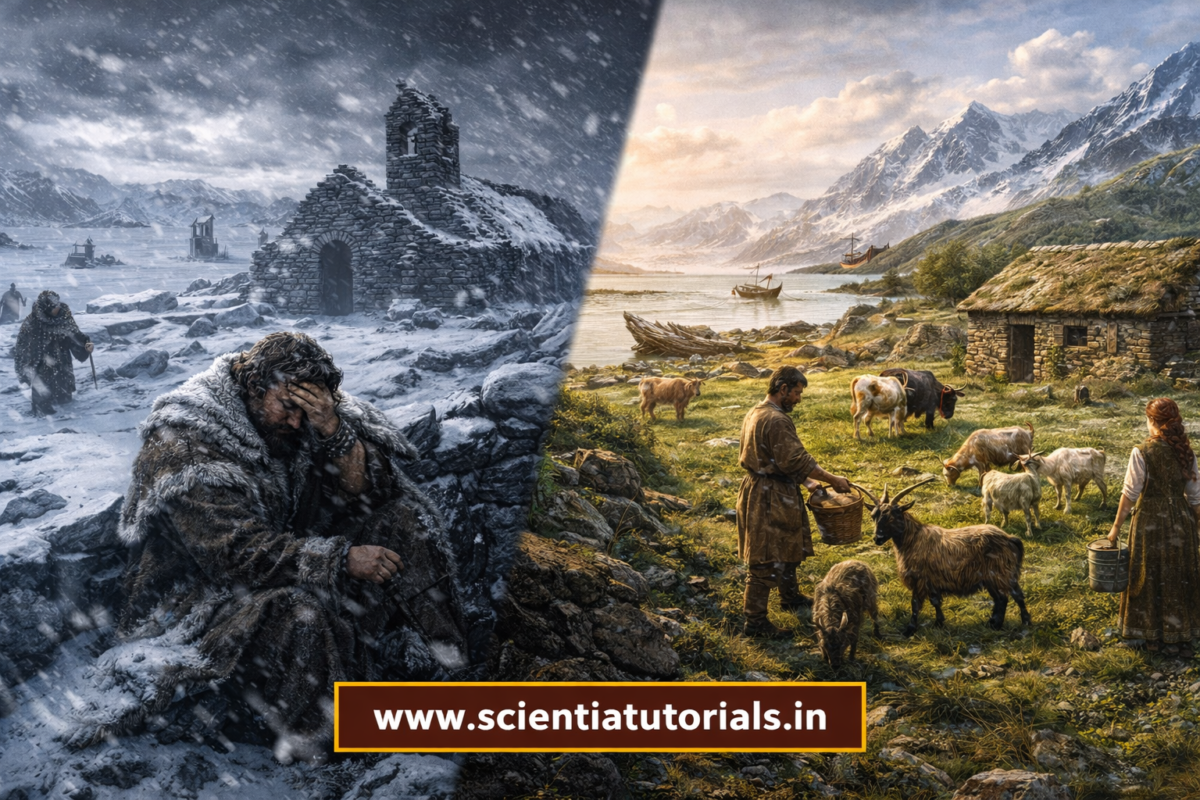

Climate Change and the Decline of Norse Greenland
Chronologically Structured Study Module (c. 10th–15th Century)
This lesson is systematically organized into four clearly structured sections, as detailed below:
- Chronologically Structured Study Module
- Short-Answer Type Questions
- Long-Answer Type Questions
- Multiple-Choice Questions (MCQs) with Answers and Detailed Explanations
Chronologically Structured Study Module
This chronologically structured study module is developed under the course Greenland: Historical Evolution and Its Global Strategic Importance, Module 2: Norse Expansion and Medieval Greenland. It examines how climatic transformation, combined with economic, cultural, and geopolitical factors, contributed to the decline and eventual disappearance of Norse settlements in Greenland between the 10th and 15th centuries.
By the end of this module, learners will be able to:
- Understand the environmental foundations of Norse settlement in Greenland
- Analyze the impact of medieval climate change on Norse agriculture and society
- Evaluate the interaction between climate stress and cultural inflexibility
- Situate the decline of Norse Greenland within broader medieval global history
I. Greenland in the Medieval Warm Period (c. 950–1200 CE)
1. Climatic Background of Norse Settlement
The Norse settlement of Greenland occurred during a relatively warm climatic phase known as the Medieval Warm Period (c. 900–1200 CE). During this era, temperatures across the North Atlantic were milder, sea ice was reduced, and marginal lands became temporarily viable for pastoral farming.
This climatic window made Greenland appear suitable for European-style settlement. When Erik the Red led settlers from Iceland around 985 CE, they encountered fjords with seasonal grasslands capable of supporting livestock.
2. Establishment of the Norse Settlements
Two major settlement zones emerged:
- Eastern Settlement (largest and most prosperous)
- Western Settlement (smaller and more environmentally fragile)
Norse society in Greenland mirrored medieval Europe:
- Cattle, sheep, and goat herding
- Turf-and-stone farmsteads
- Christian institutions, including churches and bishoprics
The Greenland Norse were culturally and economically integrated into the wider North Atlantic world, maintaining links with Iceland, Norway, and continental Europe.
II. Environmental Limits of Norse Greenland (12th–13th Centuries)
3. Marginal Ecology and Agricultural Vulnerability
Despite early success, Norse Greenland existed on a fragile ecological edge. Even during favorable climatic conditions:
- Growing seasons were short
- Soils were thin and vulnerable to erosion
- Winter fodder for animals was limited
Norse farming required careful balance. Any prolonged climatic deterioration posed a serious threat to survival.
4. Dependence on Climate-Sensitive Resources
The Norse economy relied on:
- Pasture-based livestock farming
- Walrus ivory for export to Europe
- Seasonal hunting and fishing as supplements
Unlike indigenous Arctic societies, the Norse did not base their economy primarily on marine hunting, making them particularly vulnerable to climate instability.
III. Onset of Climatic Cooling: The Little Ice Age (c. 1250–1450 CE)
5. Transition from Warmth to Cooling
From the late 13th century onward, Greenland experienced the early phases of what historians and climatologists term the Little Ice Age. This period was marked by:
- Lower average temperatures
- Longer and harsher winters
- Expanded sea ice in North Atlantic waters
These changes were gradual but cumulative, placing increasing stress on Norse livelihoods.
6. Impact on Agriculture and Livestock
Cooling temperatures directly affected Norse farming:
- Grass growth declined, reducing winter fodder
- Livestock mortality increased
- Starvation forced emergency slaughter of animals
Zooarchaeological evidence shows a gradual shift toward eating smaller animals and even dogs, indicating rising food stress.
IV. Sea Ice, Isolation, and the Breakdown of Trade
7. Disruption of Maritime Networks
As sea ice expanded:
- Shipping routes between Greenland, Iceland, and Norway became increasingly dangerous
- Trade ships arrived less frequently
- Greenland became economically isolated
European demand for walrus ivory also declined with the increasing availability of elephant ivory, weakening Greenland’s export economy.
8. Consequences of Economic Isolation
Trade collapse had cascading effects:
- Loss of iron imports (essential for tools)
- Decline of church authority and ecclesiastical support
- Reduced access to luxury goods reinforcing social status
Isolation undermined both the material and symbolic foundations of Norse society.
V. Cultural Inflexibility and Environmental Stress
9. Resistance to Adaptation
One of the most critical factors in the decline of Norse Greenland was cultural rigidity. Despite living alongside Inuit communities, the Norse largely resisted adopting:
- Kayaks and umiaks
- Intensive seal-hunting techniques
- Fur-based Arctic clothing
European identity and Christian norms reinforced a preference for familiar practices over environmental adaptation.
10. Contrast with Inuit Adaptability
Inuit societies were:
- Highly mobile
- Specialized in marine hunting
- Adapted to cold through technology and clothing
Their survival during the same climatic deterioration highlights the decisive role of cultural adaptability in Arctic environments.
VI. Settlement Abandonment: A Chronological Perspective
11. Decline of the Western Settlement (c. 1350 CE)
The Western Settlement disappeared first. Archaeological evidence suggests:
- Gradual abandonment rather than violent destruction
- Starvation and emigration as likely causes
By the mid-14th century, the Western Settlement ceased to exist.
12. Persistence and Final Disappearance of the Eastern Settlement (c. 1400–1450 CE)
The Eastern Settlement endured longer due to:
- Better pasture access
- Larger population
However, climatic cooling, isolation, and declining morale eventually led to its abandonment. The last written reference to Norse Greenland is a wedding recorded at Hvalsey Church in 1408 CE.
After this, Norse Greenland vanished from historical records.
VII. Evaluating Competing Explanations
13. Climate Change as a Central Factor
Modern scholarship emphasizes climate change as a primary structural cause, not an isolated trigger. Cooling magnified existing weaknesses in:
- Agriculture
- Trade dependency
- Social resilience
14. Interacting Causes
The decline resulted from a convergence of factors:
- Environmental deterioration
- Economic marginalization
- Cultural conservatism
- Demographic fragility
No single cause explains the collapse; climate change acted as a catalyst that exposed systemic vulnerabilities.
VIII. Norse Greenland in Global Medieval Context
15. Part of a Wider Medieval Climate Crisis
The Little Ice Age affected societies across Europe and Asia:
- Crop failures
- Famines
- Social unrest
Greenland represents an extreme case where environmental stress exceeded adaptive capacity.
16. Lessons in Human–Environment Interaction
The Norse Greenland case underscores key historical themes:
- Environmental limits of expansion
- The importance of cultural flexibility
- The risks of ecological overreach
These lessons resonate strongly in modern discussions of climate resilience and sustainability.
IX. Historical Significance and Long-Term Implications
17. Why Norse Greenland Matters Today
The disappearance of Norse Greenland is not merely a regional curiosity. It:
- Demonstrates early climate-induced societal collapse
- Highlights the Arctic’s sensitivity to environmental change
- Offers comparative insight into modern climate challenges
18. Greenland’s Continuing Strategic Importance
In contemporary global politics, Greenland has re-emerged as a region of strategic importance due to:
- Climate change
- Resource access
- Arctic geopolitics
Understanding its medieval past provides essential historical depth to present-day debates.
Conclusion
The decline of Norse Greenland between the 13th and 15th centuries was a slow, complex, and multifactorial process, driven primarily by climate change interacting with cultural, economic, and environmental constraints. The transition from the Medieval Warm Period to the Little Ice Age undermined the fragile foundations of Norse settlement, while resistance to adaptation sealed its fate.
As a chronologically structured case study, Norse Greenland stands as one of history’s most compelling examples of how climate change can reshape human societies, making it central to both medieval world history and contemporary global discourse.
Short Answer Type Questions: Climate Change and the Decline of Norse Greenland
1. When did the Norse settlement of Greenland begin?
Answer:
The Norse settlement of Greenland began around 985 CE during a period of relatively warm climatic conditions.
2. Who led the initial Norse settlement in Greenland?
Answer:
The settlement was led by Erik the Red, a Norse explorer exiled from Iceland.
3. Which climatic phase supported early Norse settlement in Greenland?
Answer:
The Medieval Warm Period supported Norse settlement by providing milder temperatures and reduced sea ice.
4. Name the two main Norse settlements in Greenland.
Answer:
The Eastern Settlement and the Western Settlement.
5. What was the primary economic base of Norse Greenland?
Answer:
Pastoral farming based on livestock such as cattle, sheep, and goats.
6. Why was Norse agriculture in Greenland environmentally fragile?
Answer:
Because of short growing seasons, thin soils, limited fodder, and dependence on stable climatic conditions.
7. What major climatic shift began affecting Greenland after the 13th century?
Answer:
The onset of colder conditions associated with the Little Ice Age.
8. How did colder temperatures affect Norse livestock?
Answer:
Reduced pasture growth led to fodder shortages, increased animal mortality, and emergency slaughter.
9. What evidence suggests increasing food stress among the Norse?
Answer:
Archaeological evidence shows increased consumption of smaller animals and dogs.
10. How did climate change affect maritime trade with Greenland?
Answer:
Expanded sea ice made navigation difficult, reducing ship arrivals and isolating Greenland from Europe.
11. Which export commodity connected Greenland to European markets?
Answer:
Walrus ivory, used in luxury goods and religious artifacts.
12. Why did Greenland’s trade economy decline in the late medieval period?
Answer:
Due to increased sea ice, fewer ships, and declining European demand for walrus ivory.
13. How did economic isolation weaken Norse society?
Answer:
It limited access to iron, tools, and trade goods, undermining agriculture and social stability.
14. What role did cultural conservatism play in Norse decline?
Answer:
The Norse resisted adopting Inuit survival techniques better suited to Arctic conditions.
15. Name one Inuit adaptation the Norse failed to adopt.
Answer:
Efficient seal-hunting techniques using kayaks and harpoons.
16. Which settlement disappeared first and why?
Answer:
The Western Settlement, due to harsher climate, isolation, and limited resources.
17. Around which century did the Western Settlement vanish?
Answer:
By the mid-14th century (around 1350 CE).
18. Which settlement survived longer?
Answer:
The Eastern Settlement survived longer due to better pasture and larger population.
19. What is the last written record of Norse Greenland?
Answer:
A wedding recorded in 1408 CE at Hvalsey Church.
20. Did violent conflict cause the collapse of Norse Greenland?
Answer:
No, evidence suggests gradual abandonment rather than violent destruction.
21. How did Inuit societies respond differently to climatic cooling?
Answer:
They adapted through mobility, marine hunting, and specialized Arctic technologies.
22. Why is climate change considered a structural cause of Norse decline?
Answer:
Because it systematically weakened agriculture, trade, and settlement sustainability over time.
23. Was climate change the only cause of Norse disappearance?
Answer:
No, it interacted with economic isolation, cultural rigidity, and demographic weakness.
24. How does Norse Greenland fit into broader medieval history?
Answer:
It reflects wider medieval climate stress that affected societies across Europe and beyond.
25. What is the historical significance of the decline of Norse Greenland?
Answer:
It is a classic example of climate-induced societal collapse and the limits of human adaptation.
Long Answer Type Questions
1. Examine the climatic conditions that enabled the initial Norse settlement of Greenland.
Answer:
The Norse settlement of Greenland began during the Medieval Warm Period (c. 900–1200 CE), when North Atlantic temperatures were relatively mild. Reduced sea ice improved navigation, and short but reliable summers supported grass growth. These conditions allowed Norse settlers, led by Erik the Red, to establish pastoral farming communities along Greenland’s southwestern fjords. Climate thus provided the essential environmental foundation for Norse colonization.
2. Describe the structure and economic foundations of Norse Greenlandic society.
Answer:
Norse Greenland was organized around farmsteads practicing livestock-based pastoralism. Cattle, sheep, and goats formed the core of the economy, supplemented by hunting and fishing. The society reflected medieval European norms, including Christian churches, social hierarchy, and trade connections with Iceland and Norway. This European model, however, was poorly suited to long-term Arctic conditions.
3. Why was Norse agriculture in Greenland inherently vulnerable?
Answer:
Norse agriculture depended on narrow ecological margins: short growing seasons, limited fodder, thin soils, and stable climate patterns. Any prolonged cooling reduced pasture productivity, leading to fodder shortages and livestock mortality. This vulnerability meant climate deterioration had immediate and severe consequences.
4. Analyze the significance of walrus ivory in Greenland’s medieval economy.
Answer:
Walrus ivory was Greenland’s primary export to Europe, used in luxury goods and ecclesiastical art. It linked Greenland to wider medieval trade networks. However, dependence on a single export made the economy fragile. When European demand declined and trade routes weakened, Greenland’s economic lifeline collapsed.
5. Discuss the onset and characteristics of the Little Ice Age in Greenland.
Answer:
From the late 13th century, Greenland entered the early Little Ice Age, marked by cooler temperatures, longer winters, and expanding sea ice. These gradual changes shortened growing seasons, intensified storms, and increased environmental unpredictability, placing sustained pressure on Norse livelihoods.
6. How did climatic cooling affect livestock and food security?
Answer:
Cooling reduced grass growth, leading to insufficient winter fodder. Livestock deaths increased, forcing emergency slaughter. Archaeological remains show a shift toward consuming smaller animals and dogs, indicating rising food insecurity and declining living standards.
7. Evaluate the impact of expanding sea ice on Norse Greenland’s external relations.
Answer:
Expanded sea ice disrupted shipping routes between Greenland, Iceland, and Norway. Trade ships became rare, isolating Greenland economically and socially. Loss of imports such as iron tools weakened agricultural productivity and everyday life, accelerating decline.
8. Why did economic isolation prove so damaging to Norse Greenland?
Answer:
Norse society relied on imported iron, timber, and trade goods. Isolation undermined both material survival and social cohesion. The decline of church authority and elite status symbols further eroded morale and stability within the settlements.
9. Examine the role of cultural conservatism in the Norse decline.
Answer:
Despite living alongside Inuit communities, the Norse largely refused to adopt Inuit technologies such as kayaks, seal-hunting techniques, and fur clothing. Cultural identity, Christian norms, and attachment to European farming traditions discouraged adaptation, reducing resilience.
10. Compare Norse and Inuit responses to climatic deterioration.
Answer:
The Inuit adapted through mobility, marine hunting, and Arctic technologies suited to colder conditions. The Norse, by contrast, remained sedentary and farm-based. This contrast highlights how adaptability, rather than technological level alone, determined survival.
11. Trace the decline of the Western Settlement.
Answer:
The Western Settlement, smaller and more climatically exposed, declined first. By the mid-14th century, it was abandoned, likely due to starvation, isolation, and emigration rather than violence. Its disappearance marked a critical stage in Norse collapse.
12. Why did the Eastern Settlement survive longer than the Western Settlement?
Answer:
The Eastern Settlement had better pasture access, a larger population, and stronger ecclesiastical presence. These factors delayed collapse, though they could not ultimately overcome climatic and economic pressures.
13. Discuss the significance of the last written record of Norse Greenland.
Answer:
The final record is a wedding held in 1408 CE at Hvalsey Church. After this, Norse Greenland disappears from written sources, indicating gradual abandonment rather than sudden catastrophe.
14. Was violent conflict a major cause of Norse disappearance?
Answer:
No. Archaeological and historical evidence suggests gradual decline through starvation, emigration, and isolation. There is little proof of large-scale violence causing the collapse.
15. To what extent can climate change be considered the primary cause of decline?
Answer:
Climate change was a central structural cause, but not the sole factor. It interacted with economic dependency, cultural rigidity, and demographic fragility, amplifying existing weaknesses within Norse society.
16. Analyze the relationship between environment and cultural identity in Norse Greenland.
Answer:
Norse cultural identity emphasized European farming, Christianity, and sedentary life. This identity limited flexibility, preventing effective adaptation to environmental stress. Culture thus shaped environmental response and survival outcomes.
17. How does the Norse Greenland case contribute to environmental history?
Answer:
It provides one of the earliest well-documented examples of climate-induced societal decline, demonstrating how environmental change can undermine complex human systems.
18. Place the decline of Norse Greenland within the wider medieval climate crisis.
Answer:
The Little Ice Age affected Europe and Asia through crop failures and famines. Greenland represents an extreme frontier case where marginal environments amplified the impact of climatic cooling.
19. Discuss demographic factors in the collapse of Norse Greenland.
Answer:
Small population size limited labor availability, resilience, and recovery capacity. Emigration further reduced numbers, creating a downward spiral of decline.
20. Why did Norse Greenland fail to transition to a marine-based economy?
Answer:
Cultural preference for farming, lack of technological adoption, and social prestige tied to livestock prevented a full economic transition to marine hunting.
21. Examine the role of the Church in sustaining Norse Greenland.
Answer:
The Church provided social cohesion and links to Europe, but it also reinforced conservative values and dependence on external support, limiting adaptability.
22. What lessons does Norse Greenland offer for understanding human adaptability?
Answer:
The case shows that adaptability, cultural flexibility, and ecological knowledge are critical for survival, especially in extreme environments.
23. How do archaeologists reconstruct the decline of Norse Greenland?
Answer:
Through settlement ruins, animal remains, isotopic analysis, and climate proxies such as ice cores, combined with sparse written records.
24. Why is Norse Greenland relevant to modern climate debates?
Answer:
It demonstrates how climate stress can interact with social and economic systems, offering historical perspective on present-day climate vulnerability.
25. Conclude with the historical significance of the decline of Norse Greenland.
Answer:
The decline of Norse Greenland illustrates the limits of medieval European expansion, the decisive role of climate change, and the importance of cultural adaptability. It remains a landmark case in world history and environmental studies.
MCQs: Climate Change and the Decline of Norse Greenland
1. The Norse settlement of Greenland began during which climatic phase?
A. Little Ice Age
B. Holocene Maximum
C. Medieval Warm Period
D. Atlantic Cold Phase
Correct Answer: C
Explanation:
The Medieval Warm Period (c. 900–1200 CE) provided milder temperatures and reduced sea ice, enabling Norse settlement and farming in Greenland.
2. Who led the initial Norse settlement of Greenland around 985 CE?
A. Leif Erikson
B. Olaf Tryggvason
C. Erik the Red
D. Harald Hardrada
Correct Answer: C
Explanation:
Erik the Red led Norse settlers from Iceland after his exile, founding Greenland’s first permanent European settlements.
3. Which economic activity formed the foundation of Norse Greenland?
A. Marine hunting
B. Fishing-based trade
C. Pastoral farming
D. Mining
Correct Answer: C
Explanation:
Norse society relied primarily on livestock farming—cattle, sheep, and goats—reflecting medieval European agricultural traditions.
4. Why was Norse agriculture in Greenland particularly vulnerable to climate change?
A. Lack of tools
B. Dependence on imported food
C. Short growing seasons and limited fodder
D. Poor farming knowledge
Correct Answer: C
Explanation:
The Greenlandic environment allowed only marginal farming; even small climatic shifts sharply reduced pasture productivity.
5. The climatic deterioration after the 13th century is associated with which phenomenon?
A. Younger Dryas
B. Little Ice Age
C. Industrial Cooling
D. Arctic Oscillation
Correct Answer: B
Explanation:
The Little Ice Age brought colder temperatures, longer winters, and expanding sea ice, severely affecting Norse livelihoods.
6. One direct effect of climatic cooling on Norse livestock was:
A. Improved breeding
B. Increased milk production
C. Fodder shortages
D. Expansion of pasturelands
Correct Answer: C
Explanation:
Colder temperatures reduced grass growth, leading to fodder shortages and higher livestock mortality.
7. Zooarchaeological evidence of food stress among the Norse includes:
A. Increased cattle bones
B. Decline in fish remains
C. Consumption of dogs
D. Exclusive reliance on seals
Correct Answer: C
Explanation:
Dog bones found in later layers indicate extreme food shortages and declining living standards.
8. Which factor most disrupted Greenland’s connection with Europe during the late medieval period?
A. Political conflict
B. Decline of Christianity
C. Expansion of sea ice
D. Loss of population
Correct Answer: C
Explanation:
Expanding sea ice made navigation dangerous, isolating Greenland from trade networks.
9. Greenland’s main export commodity to medieval Europe was:
A. Fish oil
B. Seal skins
C. Walrus ivory
D. Timber
Correct Answer: C
Explanation:
Walrus ivory linked Greenland to European luxury markets, especially for religious and elite objects.
10. Why did Greenland’s ivory-based economy collapse?
A. Inuit competition
B. Exhaustion of walrus populations
C. Declining European demand and isolation
D. Religious bans
Correct Answer: C
Explanation:
Elephant ivory became more accessible, while sea ice reduced trade, weakening Greenland’s export economy.
11. Economic isolation weakened Norse society primarily by:
A. Eliminating warfare
B. Cutting access to iron and tools
C. Increasing self-sufficiency
D. Promoting adaptation
Correct Answer: B
Explanation:
Iron was essential for tools and farming; its scarcity undermined productivity and survival.
12. Which cultural factor limited Norse adaptation to Arctic conditions?
A. Technological inferiority
B. Population decline
C. Cultural conservatism
D. Inuit hostility
Correct Answer: C
Explanation:
Strong attachment to European identity and farming traditions discouraged adoption of Inuit survival strategies.
13. Which Inuit adaptation did the Norse largely fail to adopt?
A. Christianity
B. Pastoral farming
C. Kayak-based seal hunting
D. Long-distance trade
Correct Answer: C
Explanation:
Kayaks and marine hunting techniques were crucial for Arctic survival but remained largely unused by the Norse.
14. Which settlement disappeared first?
A. Eastern Settlement
B. Northern Settlement
C. Western Settlement
D. Southern Settlement
Correct Answer: C
Explanation:
The Western Settlement was smaller and more climatically exposed, disappearing by the mid-14th century.
15. The decline of the Western Settlement is best described as:
A. Violent destruction
B. Sudden epidemic collapse
C. Gradual abandonment
D. Military conquest
Correct Answer: C
Explanation:
Archaeological evidence suggests starvation and emigration rather than violence.
16. Why did the Eastern Settlement survive longer?
A. Better military defenses
B. Stronger Inuit alliances
C. Better pasture and larger population
D. Richer mineral resources
Correct Answer: C
Explanation:
Environmental advantages delayed collapse but did not prevent it.
17. The last written record of Norse Greenland refers to:
A. A trade treaty
B. A royal decree
C. A church consecration
D. A wedding
Correct Answer: D
Explanation:
A wedding held in 1408 CE at Hvalsey Church is the final documentary reference.
18. Which factor is NOT considered a major cause of Norse decline?
A. Climate change
B. Economic isolation
C. Cultural rigidity
D. Large-scale warfare
Correct Answer: D
Explanation:
There is little evidence of widespread warfare causing the collapse.
19. Climate change is considered a “structural cause” because it:
A. Acted suddenly
B. Affected only agriculture
C. Gradually weakened multiple systems
D. Was easily reversible
Correct Answer: C
Explanation:
Climate stress undermined farming, trade, and settlement sustainability over generations.
20. Inuit survival during the same period demonstrates the importance of:
A. Military power
B. Population size
C. Cultural adaptability
D. European trade
Correct Answer: C
Explanation:
Inuit societies adapted effectively to colder conditions through mobility and technology.
21. Which historical field is most important for reconstructing climate impacts on Norse Greenland?
A. Political history
B. Archaeology and paleoclimatology
C. Literary studies
D. Theology
Correct Answer: B
Explanation:
Ice cores, animal remains, and settlement archaeology reveal long-term climate trends and responses.
22. The Norse Greenland case best illustrates which historical theme?
A. Imperial expansion
B. Technological determinism
C. Human–environment interaction
D. Religious conflict
Correct Answer: C
Explanation:
The case highlights how environmental limits shape human societies.
23. Why did Norse Greenland fail to transition to a marine-based economy?
A. Lack of marine resources
B. Inuit resistance
C. Cultural preference for farming
D. Absence of boats
Correct Answer: C
Explanation:
Livestock farming carried social prestige and cultural identity, discouraging economic transition.
24. In the broader medieval context, Norse Greenland’s decline coincides with:
A. European population boom
B. Global warming
C. Widespread climate instability
D. Industrialization
Correct Answer: C
Explanation:
The Little Ice Age caused famines and social stress across Europe and beyond.
25. Why is the decline of Norse Greenland historically significant today?
A. It ended Viking culture
B. It explains Inuit origins
C. It provides an early case of climate-driven societal collapse
D. It marked the beginning of colonialism
Correct Answer: C
Explanation:
Norse Greenland is a key historical example showing how climate change can interact with social systems to cause collapse.