
Indigenous Social Organization, Belief Systems, and Economy
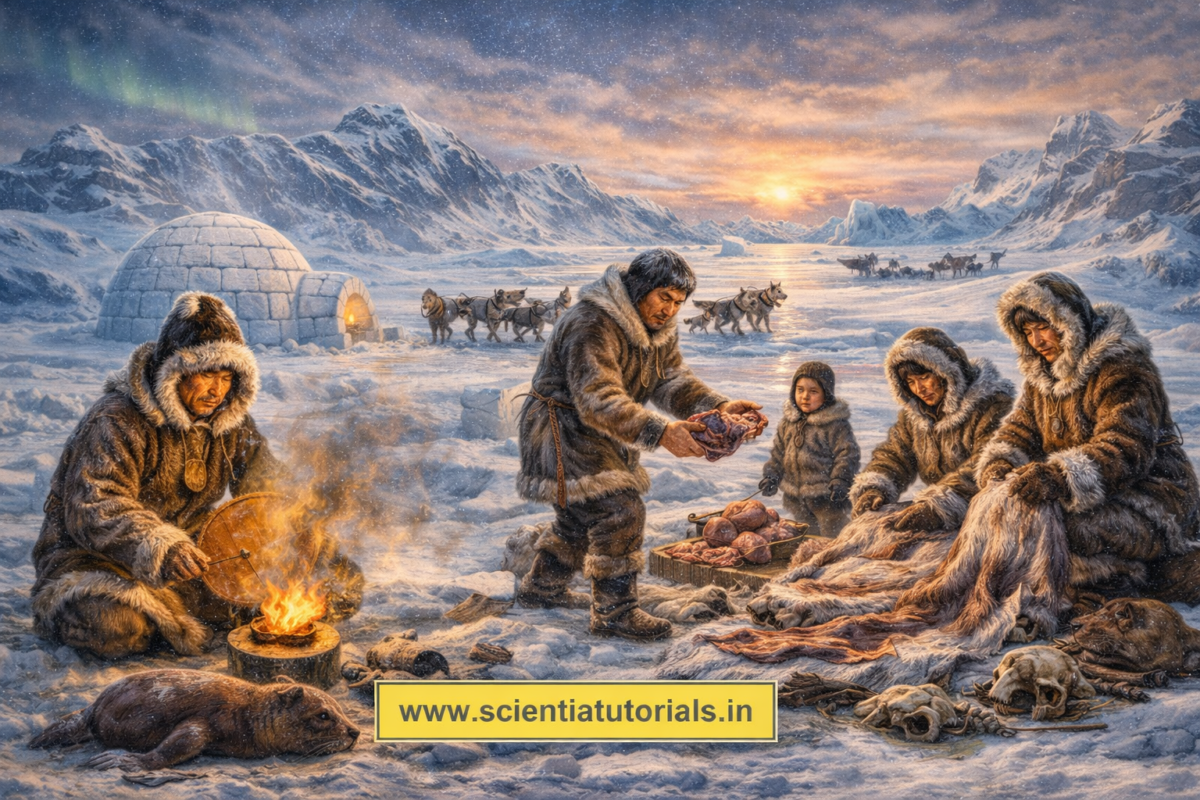

Indigenous Social Organization and Economy in Prehistoric Greenland
Module 1: Greenland in the Prehistoric and Indigenous World
Lesson: Indigenous Social Organization, Belief Systems, and Economy
Era Framework: Prehistoric Period to c. 10th Century CE
This lesson is systematically organized into four clearly structured sections, as detailed below:
- Chronologically Structured Study Module
- Short-Answer Type Questions
- Long-Answer Type Questions
- Multiple-Choice Questions (MCQs) with Answers and Detailed Explanations
Chronologically Structured Study Module
Introduction to the Lesson
Before the arrival of external powers, Greenland was shaped by indigenous Arctic societies whose survival depended on complex social organization, deeply rooted belief systems, and an economy finely adapted to extreme environmental conditions. These indigenous systems were not static or primitive; rather, they evolved gradually from prehistoric times through continuous interaction with the Arctic landscape.
This lesson examines the chronological development of indigenous social structures, spiritual worldviews, and economic practices in Greenland up to the 10th century CE. It highlights how environment, culture, and survival needs collectively shaped Inuit and earlier Arctic societies, forming a resilient indigenous civilization that sustained long-term human habitation in Greenland.
I. Prehistoric Foundations of Indigenous Society (c. 2500 BCE – 500 BCE)
1. Early Arctic Communities and Social Survival
The earliest human groups in Greenland lived in small, mobile bands. Population size was limited by the environment, and survival depended on cooperation rather than hierarchy. Social organization during this period was egalitarian, with no centralized political authority.
Key features of early indigenous social organization included:
- Small kin-based groups
- Shared access to resources
- Collective decision-making
- Emphasis on group survival over individual accumulation
Leadership was informal and situational, often emerging during hunting expeditions or periods of crisis.
2. Kinship as the Core Social Unit
Kinship formed the backbone of prehistoric Arctic society. Extended family units pooled labor and resources, ensuring that food, shelter, and tools were shared among members. This system reduced individual risk in an unpredictable environment.
Marriage alliances strengthened ties between groups, enabling cooperation across wider territories. Kinship thus functioned as both a social and economic institution.
3. Early Economic Practices
The prehistoric indigenous economy was entirely subsistence-based. There was no concept of surplus accumulation or private ownership of land. Economic activity centered on:
- Hunting marine mammals
- Fishing
- Gathering limited plant resources
- Seasonal mobility
Economic equality was reinforced by the necessity of sharing food, as hoarding threatened collective survival.
II. Evolution of Indigenous Belief Systems (c. 2500 BCE – 500 CE)
1. Animistic Worldview
Early indigenous belief systems were rooted in animism, the belief that all elements of the natural world—animals, weather, ice, and sea—possessed spiritual significance. Humans were viewed as part of nature rather than dominant over it.
This worldview shaped behavior, particularly hunting practices, which were governed by ritual and respect rather than exploitation.
2. Spiritual Regulation of Social Life
Beliefs were not separate from daily life; they regulated social conduct and economic activity. Taboos dictated when and how animals could be hunted. Violations were believed to result in environmental imbalance, illness, or scarcity.
Such beliefs functioned as informal laws, maintaining discipline and ecological sustainability without formal institutions.
3. Emergence of Ritual Specialists
As belief systems evolved, certain individuals emerged as spiritual mediators. These ritual specialists interpreted natural events, healed illness, and restored harmony between humans and the spiritual world. Their authority was moral and spiritual, not political.
III. Development of Indigenous Economic Systems (c. 500 BCE – 500 CE)
1. Diversification of Subsistence Strategies
By the late prehistoric and early historic periods, indigenous economies became increasingly diversified. Communities exploited a range of resources to reduce risk:
- Seal and whale hunting
- Fishing in coastal waters
- Bird hunting and egg collection
- Seasonal hunting of land animals
This diversification allowed flexibility in response to climatic fluctuations.
2. Seasonal Economic Cycles
Economic life followed seasonal rhythms:
- Winter focused on ice-based hunting
- Summer emphasized fishing and coastal movement
- Transitional seasons involved migration and preparation
Seasonal planning was essential, reinforcing cooperation and long-term thinking.
3. Early Trade and Exchange Networks
Although primarily subsistence-oriented, indigenous groups engaged in limited trade and exchange. Tools, raw materials, and symbolic items circulated between communities, strengthening social ties and cultural continuity across the Arctic.
IV. Indigenous Social Organization in the Classical Inuit Period (c. 500 – 1000 CE)
1. Expansion and Social Adaptation
During the first millennium CE, indigenous societies expanded along Greenland’s coastline. Social organization adapted to larger populations and more complex economic activities, yet retained egalitarian principles.
Communities remained small and flexible, preventing the emergence of rigid hierarchies.
2. Leadership and Authority
Leadership was based on:
- Hunting skill
- Experience
- Wisdom
- Ability to mediate conflicts
There were no hereditary chiefs or centralized states. Authority was temporary and situational, ensuring accountability to the community.
3. Gender Roles and Social Balance
Gender roles were complementary rather than unequal. Men generally hunted and manufactured tools, while women prepared food, made clothing, and managed households. These roles were practical responses to environmental demands, not rigid social constraints.
Women’s economic contributions, especially clothing production, were essential to survival, granting them high social respect.
V. Indigenous Belief Systems in the Inuit Worldview (c. 500 – 1000 CE)
1. Cosmology and Moral Order
Inuit belief systems emphasized balance between humans, animals, and spiritual forces. Misfortune was often interpreted as a sign of moral or ritual imbalance rather than random chance.
Stories and myths explained:
- The origin of animals
- Weather patterns
- Social norms
- Moral responsibilities
These narratives reinforced ethical behavior and communal values.
2. Role of Shamans
Shamans acted as intermediaries between the human and spiritual worlds. They performed rituals to:
- Heal illness
- Ensure hunting success
- Restore environmental harmony
Their influence reinforced social cohesion, especially during crises.
3. Education Through Oral Tradition
Without written language, belief systems and social norms were transmitted orally. Storytelling served as both education and entertainment, ensuring that knowledge was preserved across generations.
VI. Indigenous Economy and Sustainability (c. 500 – 1000 CE)
1. Ethical Economic Practices
Indigenous economies were governed by ethical constraints. Overhunting was discouraged through spiritual taboos, social pressure, and ritual sanctions. Waste was avoided, and every part of hunted animals was utilized.
2. Resource Sharing and Redistribution
Food sharing was a moral obligation. Successful hunters distributed meat throughout the community, ensuring collective survival and reinforcing social bonds. This redistribution prevented inequality and social fragmentation.
3. Long-Term Environmental Stewardship
Indigenous economic practices were inherently sustainable. By aligning economic activity with ecological rhythms, communities maintained resource availability over centuries, demonstrating a deep understanding of environmental limits.
VII. Greenland in the Indigenous Arctic World (Up to c. 10th Century CE)
1. Inter-Community Networks
Indigenous Greenland was part of a wider Arctic world. Cultural similarities, shared technologies, and exchange networks linked Greenland to neighboring Arctic regions, fostering continuity and resilience.
2. Social Stability Without States
Despite the absence of formal political institutions, indigenous societies achieved remarkable stability. Social norms, belief systems, and economic cooperation substituted for centralized authority.
3. Foundations for Later Historical Developments
By the 10th century CE, indigenous societies had fully adapted to Greenland’s environment. Their social organization, belief systems, and economy formed the foundation upon which later encounters with external cultures would occur.
Historical Significance of Indigenous Systems
The indigenous societies of Greenland challenge conventional definitions of “civilization.” Their achievements lay not in monuments or states but in:
- Environmental adaptation
- Social cooperation
- Ethical economic practices
- Sustainable resource management
These systems ensured survival in extreme conditions and remain relevant for understanding climate adaptation and indigenous knowledge today.
Conclusion
From prehistoric migrations to the early medieval period, indigenous societies in Greenland developed complex social organizations, belief systems, and economic practices perfectly adapted to Arctic conditions. Kinship-based cooperation, spiritually regulated behavior, and sustainable subsistence strategies enabled long-term human habitation in one of the world’s most challenging environments.
This chronologically structured study highlights the foundational role of indigenous systems in Greenland’s history and provides essential context for understanding the region’s later global strategic importance.
Short Answer Type Questions and Answers
1. What characterized the earliest indigenous social organization in Greenland?
Answer:
It was based on small, kin-based, egalitarian groups emphasizing cooperation and shared survival rather than hierarchy.
2. Why was kinship central to indigenous Arctic society?
Answer:
Kinship ensured cooperation, resource sharing, collective hunting, and reduced survival risks in a harsh environment.
3. What type of leadership existed in prehistoric Greenlandic societies?
Answer:
Leadership was informal and situational, based on experience, skill, and wisdom rather than hereditary authority.
4. Define animism in the context of indigenous belief systems.
Answer:
Animism is the belief that animals, natural forces, and objects possess spiritual significance and agency.
5. How did belief systems regulate hunting practices?
Answer:
Spiritual taboos and rituals dictated when and how animals could be hunted to maintain ecological balance.
6. What role did ritual specialists or shamans play in indigenous society?
Answer:
They acted as spiritual mediators, healing illness and restoring harmony between humans and nature.
7. What was the primary economic system of early indigenous Greenlandic societies?
Answer:
A subsistence-based economy focused on hunting, fishing, and seasonal resource use.
8. Why was surplus accumulation rare in indigenous economies?
Answer:
Environmental unpredictability and survival ethics emphasized sharing rather than hoarding resources.
9. How did seasonal cycles influence indigenous economic life?
Answer:
Economic activities followed seasonal rhythms, with winter ice hunting and summer coastal movement.
10. What forms of early trade existed among indigenous Arctic communities?
Answer:
Limited exchange of tools, raw materials, and symbolic items strengthened social and cultural ties.
11. How did indigenous belief systems function as informal laws?
Answer:
Taboos and spiritual consequences regulated behavior without written rules or centralized authority.
12. Describe gender roles in indigenous Greenlandic society.
Answer:
Gender roles were complementary: men mainly hunted, while women managed food preparation and clothing.
13. Why were women’s roles socially significant in indigenous economies?
Answer:
Women’s skills in clothing and food preparation were essential for survival in extreme Arctic conditions.
14. How was conflict resolved in indigenous Greenlandic communities?
Answer:
Through mediation, storytelling, social pressure, and community consensus rather than punishment.
15. What ensured social stability in the absence of formal political institutions?
Answer:
Shared norms, belief systems, kinship ties, and cooperative economic practices ensured stability.
16. How did indigenous societies ensure environmental sustainability?
Answer:
By regulating hunting through taboos, seasonal limits, and ethical resource use.
17. What was the moral obligation associated with hunting success?
Answer:
Successful hunters were expected to share food throughout the community.
18. Why was resource sharing vital for survival?
Answer:
Sharing reduced individual risk and ensured collective survival during periods of scarcity.
19. How was knowledge transmitted in indigenous societies without writing?
Answer:
Through oral traditions such as storytelling, myths, and practical learning from elders.
20. What role did myths play in indigenous belief systems?
Answer:
Myths explained natural phenomena, reinforced moral values, and guided social behavior.
21. How did indigenous economies adapt to climatic fluctuations?
Answer:
By diversifying subsistence strategies and adjusting seasonal activities.
22. Were indigenous Greenlandic communities isolated from the wider Arctic world?
Answer:
No, they were connected through cultural similarities and exchange networks across the Arctic.
23. Why did centralized states not emerge in indigenous Greenland?
Answer:
Small population sizes, mobility, and cooperative survival needs made centralized authority unnecessary.
24. How did belief systems reinforce social cooperation?
Answer:
Spiritual consequences encouraged ethical behavior and discouraged actions harmful to the community.
25. Why are indigenous social and economic systems historically significant?
Answer:
They enabled long-term human survival in Greenland and shaped the region’s historical continuity.
Long Answer Type Questions and Answers
1. Examine the nature of indigenous social organization in prehistoric Greenland.
Answer:
Indigenous social organization in prehistoric Greenland was shaped primarily by environmental constraints and survival needs. Societies were organized into small, kin-based groups with egalitarian structures. There was no centralized political authority; instead, cooperation and mutual dependence governed social life. Leadership was informal and situational, emerging during hunting expeditions or crises. This social model ensured flexibility, reduced conflict, and promoted collective survival in an extreme Arctic environment.
2. Discuss the role of kinship in the functioning of indigenous Greenlandic societies.
Answer:
Kinship was the core organizing principle of indigenous society in Greenland. Extended families formed economic and social units that shared resources, labor, and responsibilities. Kinship networks facilitated cooperation in hunting, shelter construction, and childcare. Marriage alliances strengthened inter-group relations and expanded support systems. In the absence of formal institutions, kinship ensured social cohesion and stability.
3. Analyze how environmental conditions shaped indigenous social structures.
Answer:
The harsh Arctic environment limited population size and discouraged rigid hierarchies. Survival required cooperation, mobility, and adaptability, leading to egalitarian social structures. Scarcity of resources made sharing essential, while seasonal migration prevented permanent settlements and centralized authority. Thus, social organization was directly shaped by environmental necessity rather than political ambition.
4. Explain the animistic worldview of indigenous Greenlandic societies.
Answer:
Indigenous belief systems were rooted in animism, which held that animals, weather, ice, and natural forces possessed spiritual significance. Humans were seen as part of a larger natural order rather than dominant over it. This worldview fostered respect for nature and guided ethical behavior, particularly in hunting and resource use.
5. How did belief systems regulate economic activities in indigenous Greenland?
Answer:
Belief systems acted as informal regulatory mechanisms. Taboos and rituals governed hunting seasons, animal treatment, and resource use. Violations were believed to cause illness, bad weather, or hunting failure. These spiritual controls ensured sustainable economic practices without the need for formal laws or enforcement institutions.
6. Evaluate the role of shamans in indigenous Greenlandic society.
Answer:
Shamans served as spiritual mediators between humans, animals, and the supernatural world. They addressed illness, environmental disturbances, and hunting failures through rituals and spiritual guidance. Their authority was moral rather than political, reinforcing social cohesion and belief-based regulation of behavior.
7. Describe the main features of the indigenous economic system in prehistoric Greenland.
Answer:
The indigenous economy was subsistence-based, relying on hunting, fishing, and seasonal resource use. There was no agriculture, private land ownership, or large-scale surplus accumulation. Economic equality was maintained through food sharing and collective labor. This system minimized risk and ensured survival in a highly unpredictable environment.
8. Discuss the importance of food sharing in indigenous Greenlandic societies.
Answer:
Food sharing was both an economic necessity and a moral obligation. Successful hunters distributed meat across the community, ensuring that all members survived periods of scarcity. Sharing reinforced social bonds, prevented inequality, and reduced conflict. Hoarding was socially condemned as it threatened collective survival.
9. Examine the seasonal nature of indigenous economic life in Greenland.
Answer:
Indigenous economic activities followed seasonal cycles. Winter focused on ice-based hunting, while summer emphasized fishing and coastal movement. Transitional seasons were used for migration and preparation. This seasonal planning required long-term cooperation and detailed environmental knowledge, reinforcing social discipline.
10. Analyze the development of trade and exchange networks among indigenous Arctic communities.
Answer:
Although primarily subsistence-oriented, indigenous societies engaged in limited trade. Tools, raw materials, and symbolic objects were exchanged between communities, strengthening social ties and cultural continuity. These networks integrated Greenland into the wider Arctic world and enhanced resilience.
11. Discuss gender roles in indigenous Greenlandic society.
Answer:
Gender roles were complementary and based on practicality. Men typically hunted and manufactured tools, while women prepared food, made clothing, and managed domestic life. These roles were flexible rather than rigid. Women’s contributions, especially clothing production, were crucial for survival and socially respected.
12. How were conflicts managed in indigenous Greenlandic communities?
Answer:
Conflict resolution relied on informal methods such as mediation, storytelling, public opinion, and social pressure. Maintaining harmony was essential in small, interdependent communities. Formal punishment was rare, as social exclusion posed a greater threat to survival than legal sanctions.
13. Why did centralized political institutions not emerge in indigenous Greenland?
Answer:
Small population sizes, mobility, and cooperative survival strategies made centralized authority unnecessary. Social norms, belief systems, and kinship networks effectively regulated behavior, eliminating the need for formal states or hierarchies.
14. Explain how indigenous belief systems reinforced social cooperation.
Answer:
Belief systems linked moral behavior to environmental outcomes. Cooperation, sharing, and respect for nature were spiritually rewarded, while selfishness and violation of taboos were believed to cause misfortune. This spiritual framework reinforced ethical behavior and social unity.
15. Discuss the relationship between indigenous economy and environmental sustainability.
Answer:
Indigenous economic practices were inherently sustainable. Hunting was regulated by taboos, seasonal restrictions, and ethical norms. Waste was avoided, and all parts of animals were utilized. These practices maintained ecological balance and ensured long-term resource availability.
16. Examine the role of oral tradition in preserving indigenous social and economic systems.
Answer:
Oral traditions transmitted knowledge, values, and survival skills across generations. Stories, myths, and songs educated younger members about social norms, belief systems, and economic practices. In the absence of writing, oral tradition ensured cultural continuity.
17. How did indigenous societies adapt their social organization during the first millennium CE?
Answer:
As populations expanded along Greenland’s coast, social organization adapted without abandoning egalitarian principles. Communities remained flexible, leadership situational, and cooperation central. This adaptability allowed sustained expansion without social fragmentation.
18. Analyze the moral economy of indigenous Greenlandic societies.
Answer:
The moral economy emphasized collective well-being over individual gain. Economic actions were evaluated ethically rather than materially. Sharing, restraint, and respect for nature defined economic success, contrasting sharply with profit-oriented systems.
19. Discuss Greenland’s place within the wider indigenous Arctic world.
Answer:
Indigenous Greenland was not isolated but part of a broader Arctic cultural sphere. Shared technologies, belief systems, and exchange networks linked Greenlandic societies with neighboring Arctic regions, fostering resilience and cultural continuity.
20. Assess the historical significance of indigenous social organization in Greenland.
Answer:
Indigenous social organization enabled long-term human survival in extreme conditions. Its emphasis on cooperation, flexibility, and sustainability challenges conventional state-centered models of civilization and highlights the importance of indigenous knowledge in world history.
21. How did indigenous belief systems act as substitutes for formal law?
Answer:
Belief systems enforced norms through spiritual consequences rather than coercion. Fear of ecological imbalance or spiritual punishment ensured compliance, making formal legal institutions unnecessary.
22. Why are indigenous economic and social systems relevant in contemporary historical studies?
Answer:
They offer insights into sustainable living, climate adaptation, and non-state forms of social organization. Indigenous Greenlandic systems demonstrate alternative pathways to civilization rooted in ecological balance and cooperation.
MCQs with Answers and Explanations
1. The earliest indigenous societies in Greenland were primarily organized as:
A. Centralized chiefdoms
B. Clan-based feudal units
C. Small kin-based egalitarian groups
D. Urban administrative communities
Correct Answer: C
Explanation:
Environmental constraints favored small, flexible, kin-based groups with shared decision-making rather than centralized authority.
2. Which factor most strongly shaped indigenous social organization in Greenland?
A. Military conflict
B. Agricultural surplus
C. Arctic environmental conditions
D. External political influence
Correct Answer: C
Explanation:
Extreme cold, limited resources, and mobility needs made cooperation and egalitarianism essential.
3. Leadership in indigenous Greenlandic societies was generally:
A. Hereditary and permanent
B. Religious and absolute
C. Informal and situational
D. Bureaucratic and centralized
Correct Answer: C
Explanation:
Leadership emerged based on experience, hunting skill, or wisdom and was not institutionalized.
4. Kinship in indigenous Greenlandic society primarily functioned to:
A. Enforce taxation
B. Organize warfare
C. Ensure cooperation and survival
D. Control land ownership
Correct Answer: C
Explanation:
Kinship structured food sharing, labor cooperation, and mutual support in a harsh environment.
5. Indigenous belief systems in Greenland were largely based on:
A. Monotheism
B. Polytheism with temples
C. Animism
D. Philosophical rationalism
Correct Answer: C
Explanation:
Animism emphasized spiritual significance in animals, nature, and environmental forces.
6. How did animistic beliefs influence human–environment relations?
A. Encouraged environmental exploitation
B. Promoted dominance over nature
C. Fostered respect and restraint
D. Eliminated ritual practices
Correct Answer: C
Explanation:
Nature was viewed as spiritually alive, requiring ethical interaction and balance.
7. Spiritual taboos in indigenous societies mainly regulated:
A. Political authority
B. Trade agreements
C. Hunting and resource use
D. Marriage alliances
Correct Answer: C
Explanation:
Taboos prevented overhunting and ecological imbalance by restricting economic behavior.
8. Ritual specialists or shamans primarily acted as:
A. Military commanders
B. Economic managers
C. Spiritual mediators
D. Judicial officials
Correct Answer: C
Explanation:
Shamans mediated between humans, animals, and spiritual forces to restore harmony.
9. The indigenous economy of Greenland before the 10th century CE was mainly:
A. Commercial
B. Industrial
C. Subsistence-based
D. Agricultural
Correct Answer: C
Explanation:
Economic life centered on hunting, fishing, and survival rather than surplus production.
10. Why was surplus accumulation uncommon in indigenous Greenlandic economies?
A. Cultural prohibition of work
B. Lack of storage technology
C. Ethical emphasis on sharing
D. Absence of trade
Correct Answer: C
Explanation:
Survival ethics and environmental unpredictability made hoarding socially unacceptable.
11. Food sharing among indigenous communities was:
A. Voluntary and rare
B. Enforced by military power
C. A moral and social obligation
D. Limited to elites
Correct Answer: C
Explanation:
Sharing ensured collective survival and reinforced social cohesion.
12. Seasonal cycles influenced indigenous economies by:
A. Eliminating hunting activities
B. Determining migration and resource use
C. Encouraging permanent settlements
D. Promoting agriculture
Correct Answer: B
Explanation:
Economic activities were planned around seasonal availability of resources.
13. Which activity dominated indigenous economic life during winter?
A. Coastal fishing
B. Ice-based hunting
C. Trade expeditions
D. Plant gathering
Correct Answer: B
Explanation:
Winter survival depended on hunting seals and other animals through ice.
14. Early trade among indigenous Greenlandic communities involved:
A. Agricultural goods
B. Precious metals
C. Tools and raw materials
D. Currency exchange
Correct Answer: C
Explanation:
Trade was limited and focused on practical or symbolic items.
15. Gender roles in indigenous Greenlandic society were best described as:
A. Rigid and hierarchical
B. Unequal and exploitative
C. Complementary and practical
D. Entirely interchangeable
Correct Answer: C
Explanation:
Roles were divided by function and survival needs rather than inequality.
16. Women’s economic contributions were especially significant because they:
A. Led hunting expeditions
B. Managed long-distance trade
C. Produced essential clothing and food
D. Controlled political authority
Correct Answer: C
Explanation:
Clothing and food preparation were crucial for Arctic survival.
17. Conflict resolution in indigenous Greenland relied primarily on:
A. Written legal codes
B. Armed enforcement
C. Mediation and social pressure
D. External arbitration
Correct Answer: C
Explanation:
Harmony was maintained through informal, community-based mechanisms.
18. Why did centralized states not develop in indigenous Greenland?
A. Cultural rejection of leadership
B. Influence of foreign powers
C. Small populations and mobility
D. Continuous warfare
Correct Answer: C
Explanation:
Population size and survival cooperation made centralized authority unnecessary.
19. Indigenous belief systems reinforced social cooperation by:
A. Promising material rewards
B. Linking behavior to spiritual outcomes
C. Enforcing strict punishments
D. Encouraging competition
Correct Answer: B
Explanation:
Moral behavior was tied to environmental and spiritual balance.
20. Indigenous economic practices were environmentally sustainable because they:
A. Used advanced technology
B. Avoided all hunting
C. Respected ecological limits
D. Relied on external supplies
Correct Answer: C
Explanation:
Hunting limits, taboos, and ethical norms prevented overexploitation.
21. Oral traditions in indigenous societies primarily served to:
A. Entertain elites
B. Preserve social and economic knowledge
C. Record trade accounts
D. Enforce political laws
Correct Answer: B
Explanation:
Stories and myths transmitted survival knowledge and cultural values.
22. Myths in indigenous belief systems helped to:
A. Legitimize political rulers
B. Explain natural and social order
C. Promote warfare
D. Encourage migration
Correct Answer: B
Explanation:
Myths provided explanations for nature, morality, and social norms.
23. Indigenous Greenland was part of the wider Arctic world because of:
A. Colonial administration
B. Religious uniformity
C. Shared cultural networks
D. Written communication
Correct Answer: C
Explanation:
Cultural similarities and exchange connected Greenland to other Arctic regions.
24. The moral economy of indigenous Greenland emphasized:
A. Profit maximization
B. Individual accumulation
C. Collective well-being
D. Market competition
Correct Answer: C
Explanation:
Economic actions were judged by their contribution to community survival.
25. Historically, indigenous social and economic systems are significant because they:
A. Created early states
B. Supported imperial expansion
C. Enabled long-term Arctic survival
D. Introduced industrial techniques
Correct Answer: C
Explanation:
These systems ensured sustainable habitation of Greenland in extreme conditions.