
Greenland and European Imperial Rivalries
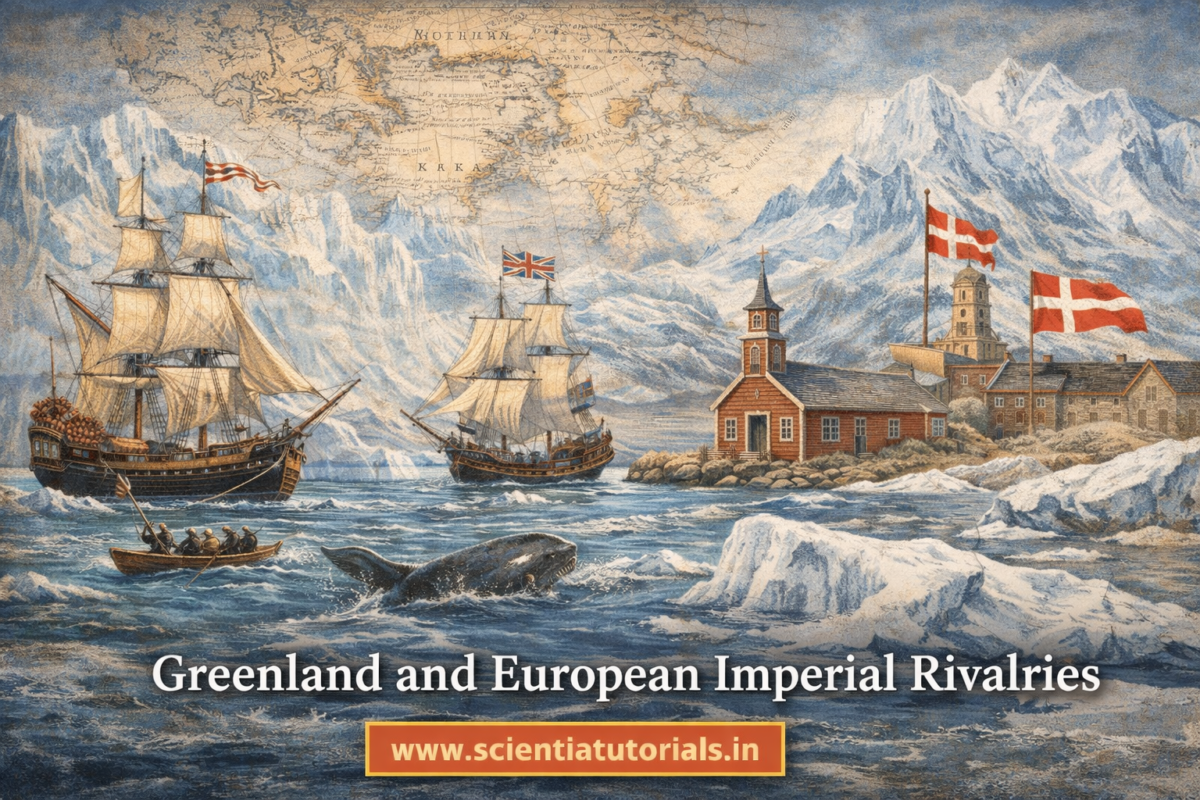

Greenland and European Imperial Rivalries (16th–19th Century)
Course: Greenland: Historical Evolution and Its Global Strategic Importance
Module 3: Colonial Encounters and Early Modern Transformations
Era Framework: 16th Century – 19th Century
(European expansion, mercantilism, missionary activity)
This lesson is systematically organized into four clearly structured sections, as detailed below:
- Chronologically Structured Study Module
- Short-Answer Type Questions
- Long-Answer Type Questions
- Multiple-Choice Questions (MCQs) with Answers and Detailed Explanations
Chronologically Structured Study Module
Lesson Objectives
This lesson enables learners to:
- Understand how Greenland became entangled in European imperial rivalries during the early modern period
- Examine the strategic, economic, and symbolic importance of Greenland in North Atlantic geopolitics
- Analyze the competing interests of European maritime powers in Greenland and Arctic waters
- Assess how mercantilism, whaling, exploration, and missionary activity shaped imperial competition
- Evaluate the long-term consequences of imperial rivalry for Greenland’s colonial trajectory
Introduction: Greenland in the Age of European Empires
The early modern period (16th–19th centuries) was defined by the rapid expansion of European empires across the globe. While imperial rivalry is often associated with tropical colonies, plantations, and trade routes to Asia, the Arctic world also emerged as a contested space. Greenland, long marginal to European affairs after the medieval Norse decline, re-entered global history as a strategic and economic frontier.
Although Greenland did not witness large-scale warfare or settlement rivalries comparable to the Caribbean or India, it became deeply embedded in imperial competition through exploration, whaling, trade monopolies, and symbolic claims of sovereignty. This lesson examines how Greenland functioned as a peripheral yet strategically significant arena of European imperial rivalry.
I. Greenland and the Reopening of the North Atlantic World (16th Century)
1. European Expansion and the Arctic Frontier
The 16th century marked the reopening of the North Atlantic following advances in navigation, shipbuilding, and cartography. European powers expanding westward in search of wealth and new routes inevitably encountered Greenland.
Greenland attracted attention for several reasons:
- Its proximity to trans-Atlantic sea routes
- Its potential role in the search for the Northwest Passage
- Its rich marine resources, particularly whales and seals
Though not immediately colonized, Greenland became visible again as a strategic space.
2. Greenland as a Symbolic Imperial Claim
Early modern imperialism often involved symbolic acts of possession—mapping, naming, and flag-raising. Greenland’s coastlines appeared on European maps as markers of imperial reach, even when effective control was minimal.
II. Whaling, Commerce, and Economic Rivalry (17th Century)
1. The Rise of Arctic Whaling
The 17th century witnessed the explosive growth of commercial whaling, driven by European demand for whale oil and baleen. Arctic waters around Greenland became economically valuable zones, attracting intense competition.
Dutch, English, and later Scandinavian whalers operated seasonally in Greenlandic waters. Control over whaling grounds became a form of economic rivalry rather than territorial conquest.
2. Economic Competition Without Settlement
Unlike warmer colonies, Greenland did not support plantation agriculture or dense European settlement. As a result:
- Rivalry focused on access to resources, not land
- Seasonal presence replaced permanent occupation
- Maritime power mattered more than territorial armies
Greenland exemplified a maritime model of imperial competition.
III. Imperial Rivalry and Arctic Exploration
1. The Northwest Passage and Strategic Imagination
Greenland’s location made it central to European efforts to find a sea route to Asia via the Arctic. British and Dutch explorers viewed Greenland as a gateway to Arctic navigation rather than a colony to be populated.
Although these efforts failed to produce a viable passage during the early modern period, they reinforced Greenland’s strategic importance in imperial planning.
2. Scientific Exploration as Imperial Competition
Exploration was not purely economic. Scientific expeditions in cartography, astronomy, and natural history allowed empires to:
- Assert intellectual and symbolic dominance
- Improve navigation and maritime control
- Legitimize imperial claims through knowledge production
Greenland became part of the Enlightenment-era contest for imperial prestige.
IV. Danish Consolidation and the Limits of Rivalry (18th Century)
1. Assertion of Sovereignty
By the 18th century, Greenland came increasingly under the control of Denmark-Norway. Danish authorities asserted sovereignty based on medieval Norse claims and reinforced it through trade monopolies and missionary activity.
This consolidation limited direct rivalry but did not eliminate foreign interest.
2. Trade Monopolies as Imperial Tools
Mercantilist policy shaped Danish strategy:
- All trade with Greenland was monopolized
- Foreign traders were excluded
- Economic activity was tightly regulated
Trade monopolies served both economic and political purposes, reinforcing Denmark-Norway’s imperial authority.
V. British, Dutch, and Other European Interests
1. British Strategic Concerns
Britain’s interest in Greenland was linked to:
- Arctic exploration
- Naval dominance in the North Atlantic
- Control over maritime routes
While Britain did not establish colonies in Greenland, it remained attentive to Danish control and Arctic developments.
2. Dutch Commercial Influence
The Dutch dominated Arctic whaling in the 17th century and viewed Greenlandic waters as essential to their maritime economy. Their influence declined as whale stocks fell and Danish regulation increased.
3. Absence of Direct Military Conflict
Notably, imperial rivalry in Greenland rarely resulted in open warfare. Harsh geography, limited profits, and logistical difficulties discouraged military confrontation. Rivalry remained economic, symbolic, and strategic rather than violent.
VI. Missionary Activity and Imperial Legitimacy
1. Religion as a Tool of Empire
Missionary activity strengthened imperial claims by:
- Establishing permanent European presence
- Reshaping Indigenous societies in line with imperial norms
- Providing moral justification for sovereignty
Missions complemented trade and administration rather than competing with them.
2. Cultural Influence as Imperial Power
By spreading Christianity, literacy, and European social norms, missionaries reinforced Denmark-Norway’s cultural authority. This “soft power” approach was particularly effective in a region where military force was impractical.
VII. Indigenous Peoples and Imperial Rivalry
1. Inuit Agency in a Competitive Imperial Space
Despite imperial rivalry, Inuit communities were not mere bystanders. They:
- Controlled access to resources through ecological knowledge
- Interacted with Europeans selectively
- Benefited from competition among traders in earlier phases
Inuit agency shaped how imperial rivalry played out on the ground.
2. Limits of Imperial Penetration
Even at the height of imperial competition, European control over Greenland remained partial. Inuit societies retained autonomy in daily life, limiting the depth of imperial rivalry.
VIII. The 19th Century: From Rivalry to Administration
1. Decline of Economic Competition
By the 19th century:
- Whaling declined due to overexploitation
- Arctic exploration lost immediate commercial appeal
- Danish control became uncontested
Greenland shifted from a contested frontier to a managed colonial possession.
2. Strategic Value Without Conflict
Although no longer a site of rivalry, Greenland retained strategic importance as:
- A northern outpost
- A symbol of sovereignty
- A base for scientific observation
Imperial rivalry gave way to administrative consolidation.
IX. Greenland’s Place in Global Imperial History
1. A Peripheral Yet Strategic Colony
Greenland challenges traditional models of empire. It was:
- Economically marginal
- Strategically symbolic
- Governed through trade, religion, and knowledge rather than force
Its importance lay not in wealth alone but in geography and prestige.
2. Foundations of Modern Strategic Importance
Early modern imperial rivalries laid the groundwork for Greenland’s later geopolitical role in the 20th and 21st centuries. Control over Arctic space, routes, and knowledge continues to echo these earlier contests.
Conclusion
Between the 16th and 19th centuries, Greenland emerged as a subtle yet significant arena of European imperial rivalry. Though lacking the dramatic conflicts of other colonial regions, Greenland played a vital role in North Atlantic geopolitics through whaling, exploration, mercantilist control, and symbolic sovereignty.
Imperial competition in Greenland was shaped by maritime power, economic extraction, and cultural influence rather than conquest and settlement. The consolidation of Danish authority ended overt rivalry, but the legacy of early modern imperial competition permanently embedded Greenland within global strategic systems.
Understanding Greenland’s role in European imperial rivalries reveals how even remote Arctic regions contributed to the making of the modern global order.
Short Answer Type Questions with Answers
Lesson: Greenland and European Imperial Rivalries (16th–19th Century)
1. Why did Greenland regain importance during the early modern period?
Greenland regained importance due to European maritime expansion, Arctic exploration, and growing demand for marine resources such as whale oil.
2. Which century marked the reopening of the North Atlantic world for European powers?
The 16th century marked the reopening of the North Atlantic due to advances in navigation and cartography.
3. What strategic factor made Greenland significant in imperial geopolitics?
Its location between Europe and North America made it strategically important for navigation and Arctic exploration.
4. How was Greenland linked to the search for the Northwest Passage?
Greenland was viewed as a gateway to Arctic waters potentially leading to a sea route to Asia.
5. What type of imperial rivalry dominated Greenland in the 17th century?
Economic and maritime rivalry, especially over whaling grounds, dominated Greenland rather than territorial conquest.
6. Which economic activity attracted European powers to Greenlandic waters?
Commercial whaling attracted European powers due to the high value of whale oil and baleen.
7. Which European groups were most active in Arctic whaling near Greenland?
Dutch and English whalers were most active, followed later by Scandinavian interests.
8. Why did Greenland not become a settler colony like Caribbean territories?
Its harsh climate and geography made large-scale European settlement and agriculture impractical.
9. How did imperial rivalry in Greenland differ from that in tropical colonies?
It focused on resource access and maritime power rather than land conquest, plantations, or large armies.
10. What role did cartography play in imperial rivalry over Greenland?
Mapping Greenland helped assert symbolic claims of sovereignty and imperial presence.
11. Which political authority consolidated control over Greenland in the 18th century?
Greenland came under the control of Denmark-Norway.
12. On what basis did Denmark-Norway assert sovereignty over Greenland?
It relied on medieval Norse claims reinforced by trade monopolies and missionary activity.
13. What was the purpose of Danish trade monopolies in Greenland?
They aimed to exclude foreign traders, regulate commerce, and strengthen imperial control.
14. Why did imperial rivalry in Greenland rarely lead to military conflict?
Limited profits, extreme climate, and logistical challenges discouraged armed confrontation.
15. How did Britain express interest in Greenland without colonizing it?
Through Arctic exploration, naval strategy, and concern over North Atlantic dominance.
16. Why did Dutch influence in Greenland decline after the 17th century?
Overexploitation of whale stocks and increased Danish regulation reduced Dutch commercial dominance.
17. How did scientific exploration contribute to imperial rivalry?
Scientific expeditions enhanced navigation, knowledge, and imperial prestige without direct conquest.
18. Why was missionary activity important for imperial legitimacy in Greenland?
It established permanent European presence and reinforced cultural and political authority.
19. How did missions function as tools of empire?
They supported colonial administration, spread Christianity, and stabilized imperial control.
20. What role did Inuit communities play within imperial rivalry?
They exercised agency by controlling access to resources and engaging selectively with Europeans.
21. Did European empires fully control Greenland during this period?
No, control remained limited, especially over Inuit daily life and interior regions.
22. What change occurred in Greenland’s imperial status by the 19th century?
It shifted from a contested frontier to a managed colonial possession.
23. Why did economic rivalry in Greenland decline in the 19th century?
Declining whaling profits and reduced interest in Arctic trade led to diminished competition.
24. How did Greenland remain strategically important despite reduced rivalry?
It served as a symbol of sovereignty and a base for Arctic science and observation.
25. Why is Greenland considered a “peripheral but strategic” colony?
It was economically marginal but geopolitically valuable due to location and symbolic imperial claims.
Long Answer Type Questions with Answers
Lesson: Greenland and European Imperial Rivalries (16th–19th Century)
1. Explain why Greenland re-entered European strategic thinking during the early modern period.
Greenland re-entered European strategic thinking due to the expansion of maritime exploration in the 16th century. Advances in navigation, shipbuilding, and cartography encouraged European powers to explore the North Atlantic. Greenland’s proximity to trans-Atlantic routes, its potential role in the search for the Northwest Passage, and its rich marine resources made it strategically and economically relevant despite its harsh climate.
2. Analyze how Greenland’s geography shaped the nature of European imperial rivalry.
Greenland’s Arctic geography limited agricultural settlement and large populations, discouraging plantation-style colonization. As a result, imperial rivalry focused on maritime power, seasonal settlements, and access to resources rather than territorial conquest. Geography thus transformed imperial competition into a naval and economic contest rather than a military one.
3. Discuss the role of the North Atlantic world in bringing Greenland into imperial competition.
The reopening of the North Atlantic connected Europe, Greenland, and North America into a shared strategic space. Greenland functioned as a northern node within this system, offering access to Arctic waters, fishing grounds, and exploration routes. Its inclusion strengthened imperial control over Atlantic navigation and reinforced geopolitical reach.
4. Examine the importance of whaling in shaping European rivalry over Greenland.
Whaling was central to Greenland’s early modern significance. European demand for whale oil and baleen turned Arctic waters into contested economic zones. Dutch and English whalers competed intensely in the 17th century, making control over Greenlandic waters a key dimension of imperial rivalry focused on commerce rather than land.
5. Why did imperial rivalry in Greenland differ from that in tropical colonies?
Unlike tropical colonies, Greenland lacked fertile land, plantation agriculture, and large Indigenous labor forces suitable for exploitation. Consequently, rivalry centered on resource access, navigation, and symbolic sovereignty rather than settlement, slavery, or warfare. This made Greenland a peripheral but strategic colony.
6. Analyze the relationship between mercantilism and imperial rivalry in Greenland.
Mercantilism emphasized state-controlled trade, monopolies, and exclusion of foreign competitors. In Greenland, mercantilist policies transformed economic competition into imperial rivalry by regulating access to resources and enforcing exclusive trade rights. Control over commerce became synonymous with political sovereignty.
7. Explain how cartography and mapping functioned as tools of imperial rivalry in Greenland.
Mapping Greenland allowed European powers to symbolically assert possession and project imperial authority. Even without effective occupation, maps, place names, and charts reinforced claims of sovereignty. Cartography thus played a crucial role in early modern imperial competition.
8. Discuss the strategic importance of Greenland in the search for the Northwest Passage.
Greenland was viewed as a gateway to Arctic navigation and a possible route to Asia. British and Dutch explorers used Greenlandic waters as staging areas for Arctic exploration. Although the Northwest Passage remained elusive, the search reinforced Greenland’s strategic value within imperial planning.
9. Assess the role of scientific exploration in European imperial rivalry over Greenland.
Scientific expeditions contributed to imperial rivalry by enhancing navigation, cartographic accuracy, and environmental knowledge. During the Enlightenment, scientific exploration became a means of asserting intellectual dominance and imperial prestige. Greenland served as a laboratory for Arctic science within imperial competition.
10. Examine how sovereignty over Greenland was consolidated in the 18th century.
Sovereignty was consolidated primarily by Denmark-Norway, which asserted historical Norse claims and reinforced them through trade monopolies and missionary activity. This reduced direct rivalry while formalizing Greenland’s colonial status.
11. Analyze the role of trade monopolies in limiting imperial rivalry.
Trade monopolies excluded foreign traders and regulated all economic activity. By controlling commerce, Denmark-Norway neutralized competing European interests and transformed Greenland from a contested zone into a regulated colonial possession.
12. Why did Britain not establish a colony in Greenland despite strategic interest?
Britain’s interests focused on naval power, Arctic exploration, and Atlantic dominance rather than colonization. Greenland’s limited economic returns and harsh environment discouraged settlement, making indirect strategic interest more practical than formal colonization.
13. Discuss Dutch involvement in Greenland and reasons for its decline.
The Dutch dominated Arctic whaling in the 17th century and benefited greatly from Greenlandic waters. However, overexploitation of whale stocks and increased Danish regulation reduced profitability, leading to a decline in Dutch influence.
14. Explain why imperial rivalry in Greenland rarely resulted in armed conflict.
Extreme climate, logistical difficulties, and limited economic rewards discouraged military confrontation. Maritime competition and economic regulation proved more effective than warfare, keeping rivalry largely peaceful.
15. Analyze the role of missionary activity in strengthening imperial authority.
Missionaries established permanent European presence, reshaped Indigenous societies, and provided moral justification for colonial rule. Religious influence complemented trade and administration, reinforcing sovereignty without military force.
16. How did cultural influence function as a form of imperial power in Greenland?
Cultural influence—through religion, education, and social norms—allowed imperial powers to legitimize control. This “soft power” approach was particularly effective in Greenland, where military domination was impractical.
17. Discuss Inuit agency within the context of European imperial rivalry.
Inuit communities were not passive participants. They controlled access to resources through ecological knowledge and engaged selectively with Europeans. Their agency shaped how imperial rivalry unfolded locally, limiting European penetration.
18. Evaluate the limits of European control over Greenland during the early modern period.
European authority was largely coastal and administrative. Interior regions and daily Indigenous life remained beyond direct control. This limited sovereignty highlights the incomplete nature of imperial dominance in Greenland.
19. Examine the transformation of Greenland from a contested frontier to a managed colony.
By the 19th century, declining whaling profits and reduced foreign interest ended active rivalry. Greenland became a managed colonial possession focused on administration, missions, and stability rather than competition.
20. Why did Greenland retain strategic importance even after rivalry declined?
Greenland remained strategically valuable as a northern outpost, symbol of sovereignty, and site for scientific observation. Strategic importance persisted even without economic competition.
21. Compare Greenland’s imperial experience with that of plantation colonies.
Unlike plantation colonies, Greenland lacked enslaved labor, large settler populations, and agricultural exploitation. Its imperial experience emphasized trade regulation, cultural influence, and strategic positioning rather than economic extraction through labor.
22. How does Greenland challenge traditional models of European imperialism?
Greenland demonstrates that empire could operate through commerce, religion, and knowledge rather than conquest. It highlights a non-violent, maritime-oriented form of imperial rivalry.
23. Analyze Greenland’s role as a “peripheral yet strategic” colony.
Economically marginal but geopolitically significant, Greenland’s value lay in location, sovereignty claims, and control of Arctic space rather than wealth generation.
24. Discuss the long-term legacy of early modern imperial rivalry in Greenland.
Early modern rivalry embedded Greenland into global strategic systems. Later geopolitical importance in the modern era builds upon these early foundations of sovereignty and Arctic control.
25. Why is the study of European imperial rivalries in Greenland important for understanding its modern global significance?
Understanding early modern rivalry explains why Greenland continues to hold strategic importance today. Historical patterns of control, geography, and symbolic power continue to influence contemporary global politics.
MCQs with Answers and Explanations
Lesson: Greenland and European Imperial Rivalries (16th–19th Century)
1. Greenland became significant in early modern European politics primarily because of
A. Agricultural potential
B. Gold and mineral discoveries
C. Strategic location and marine resources
D. Large Indigenous population
Correct Answer: C
Explanation:
Greenland’s importance lay in its Arctic location between Europe and North America and its rich marine resources, especially whales, rather than agriculture or minerals.
2. The reopening of the North Atlantic world occurred mainly during the
A. 14th century
B. 15th century
C. 16th century
D. 19th century
Correct Answer: C
Explanation:
Advances in navigation and cartography in the 16th century renewed European exploration of the North Atlantic, including Greenland.
3. Greenland attracted European attention largely in connection with the search for
A. Southern trade routes
B. The Northwest Passage
C. Silk Road revival
D. Overland routes to Asia
Correct Answer: B
Explanation:
European powers viewed Greenland as a potential gateway to an Arctic sea route to Asia, known as the Northwest Passage.
4. The dominant form of imperial rivalry in Greenland during the 17th century was
A. Territorial warfare
B. Agricultural competition
C. Maritime and economic rivalry
D. Religious warfare
Correct Answer: C
Explanation:
Rivalry centered on maritime access to whaling grounds rather than land conquest or warfare.
5. Which economic activity was most responsible for attracting European powers to Greenlandic waters?
A. Timber extraction
B. Fur farming
C. Commercial whaling
D. Fishing for cod
Correct Answer: C
Explanation:
Whaling provided valuable whale oil and baleen, crucial to early modern European economies.
6. Which European groups dominated Arctic whaling in the 17th century?
A. Spanish and Portuguese
B. French and Italian
C. Dutch and English
D. Russian and Swedish
Correct Answer: C
Explanation:
The Dutch and English were the leading maritime powers in Arctic whaling during this period.
7. Greenland did not become a plantation colony primarily because
A. European disinterest
B. Lack of Indigenous labor
C. Harsh climate and geography
D. Religious opposition
Correct Answer: C
Explanation:
Greenland’s extreme Arctic conditions made plantation agriculture and dense settlement impractical.
8. How did imperial rivalry in Greenland differ from rivalry in tropical colonies?
A. It involved large-scale slavery
B. It focused on land conquest
C. It emphasized maritime access and resources
D. It relied on military fortification
Correct Answer: C
Explanation:
Greenland’s rivalry centered on maritime power and resource access rather than settlement or plantations.
9. Cartography and mapping were important in Greenland because they
A. Helped agricultural planning
B. Established trade routes
C. Asserted symbolic sovereignty
D. Encouraged Indigenous settlement
Correct Answer: C
Explanation:
Maps and charts allowed European powers to claim and symbolize control over Greenland even without full occupation.
10. Which political authority consolidated sovereignty over Greenland in the 18th century?
A. Britain
B. France
C. Denmark-Norway
D. The Netherlands
Correct Answer: C
Explanation:
Denmark-Norway asserted sovereignty based on historical claims and strengthened it through trade monopolies and missions.
11. Danish trade monopolies in Greenland were designed mainly to
A. Encourage free trade
B. Promote Indigenous self-rule
C. Exclude foreign competitors
D. Increase European settlement
Correct Answer: C
Explanation:
Trade monopolies were a mercantilist tool to control commerce and limit imperial rivalry.
12. Why did imperial rivalry in Greenland rarely result in military conflict?
A. Strong Indigenous armies
B. European peace treaties
C. Limited economic rewards and harsh conditions
D. Permanent European alliances
Correct Answer: C
Explanation:
The Arctic environment and modest profits discouraged costly military confrontations.
13. Britain’s interest in Greenland was mainly connected to
A. Plantation agriculture
B. Arctic exploration and naval strategy
C. Religious conversion
D. Mining operations
Correct Answer: B
Explanation:
Britain focused on exploration and North Atlantic naval dominance rather than colonization.
14. Dutch influence in Greenland declined primarily due to
A. Military defeat
B. Missionary opposition
C. Overexploitation of whale stocks and regulation
D. Indigenous resistance
Correct Answer: C
Explanation:
Declining whale populations and tighter Danish controls reduced Dutch economic incentives.
15. Scientific expeditions to Greenland during the Enlightenment aimed to
A. Promote Indigenous education
B. Improve agriculture
C. Enhance navigation and imperial prestige
D. Establish plantations
Correct Answer: C
Explanation:
Scientific exploration supported navigation, mapping, and imperial authority.
16. Missionary activity supported imperial rivalry by
A. Encouraging warfare
B. Weakening colonial control
C. Providing cultural and moral legitimacy
D. Ending trade monopolies
Correct Answer: C
Explanation:
Missions reinforced sovereignty by establishing permanent presence and cultural influence.
17. Inuit communities influenced imperial rivalry by
A. Remaining completely isolated
B. Serving as military allies
C. Controlling access to Arctic resources
D. Rejecting all European contact
Correct Answer: C
Explanation:
Indigenous ecological knowledge gave Inuit communities leverage in interactions with Europeans.
18. European control over Greenland during the early modern period was
A. Complete and uniform
B. Mostly symbolic and coastal
C. Centered in the interior
D. Militarily enforced everywhere
Correct Answer: B
Explanation:
European authority was limited, especially beyond coastal trading and mission centers.
19. By the 19th century, Greenland’s imperial status shifted toward
A. Active military rivalry
B. Plantation development
C. Managed colonial administration
D. Complete independence
Correct Answer: C
Explanation:
Declining competition transformed Greenland into a regulated colonial possession.
20. Economic rivalry in Greenland declined mainly because
A. Indigenous revolts
B. Discovery of new colonies
C. Decline in whaling profits
D. Religious reforms
Correct Answer: C
Explanation:
Overexploitation reduced whale populations, lowering the economic value of Arctic competition.
21. Even after rivalry declined, Greenland remained important because of its
A. Population growth
B. Industrial output
C. Strategic and symbolic value
D. Agricultural surplus
Correct Answer: C
Explanation:
Greenland continued to symbolize Arctic sovereignty and strategic presence.
22. Greenland is best described as a
A. Core industrial colony
B. Plantation economy
C. Peripheral but strategic colony
D. Settler-dominated colony
Correct Answer: C
Explanation:
Its value lay in geography and sovereignty rather than economic productivity.
23. Which feature best characterizes European imperialism in Greenland?
A. Large-scale warfare
B. Forced labor systems
C. Maritime and administrative control
D. Industrial exploitation
Correct Answer: C
Explanation:
Empire in Greenland relied on trade regulation, navigation, and cultural influence.
24. Greenland challenges traditional models of empire because
A. It resisted all colonial control
B. It lacked any imperial interest
C. Empire operated without conquest
D. It was economically dominant
Correct Answer: C
Explanation:
Greenland shows that empire could function through commerce, mapping, and culture rather than conquest.
25. The long-term significance of early modern imperial rivalry in Greenland lies in
A. Agricultural development
B. Cultural homogenization
C. Foundations of modern strategic importance
D. Industrial leadership
Correct Answer: C
Explanation:
Early modern rivalry embedded Greenland into global strategic systems that continue to matter today.