
Greenland and the Global Cold War Order
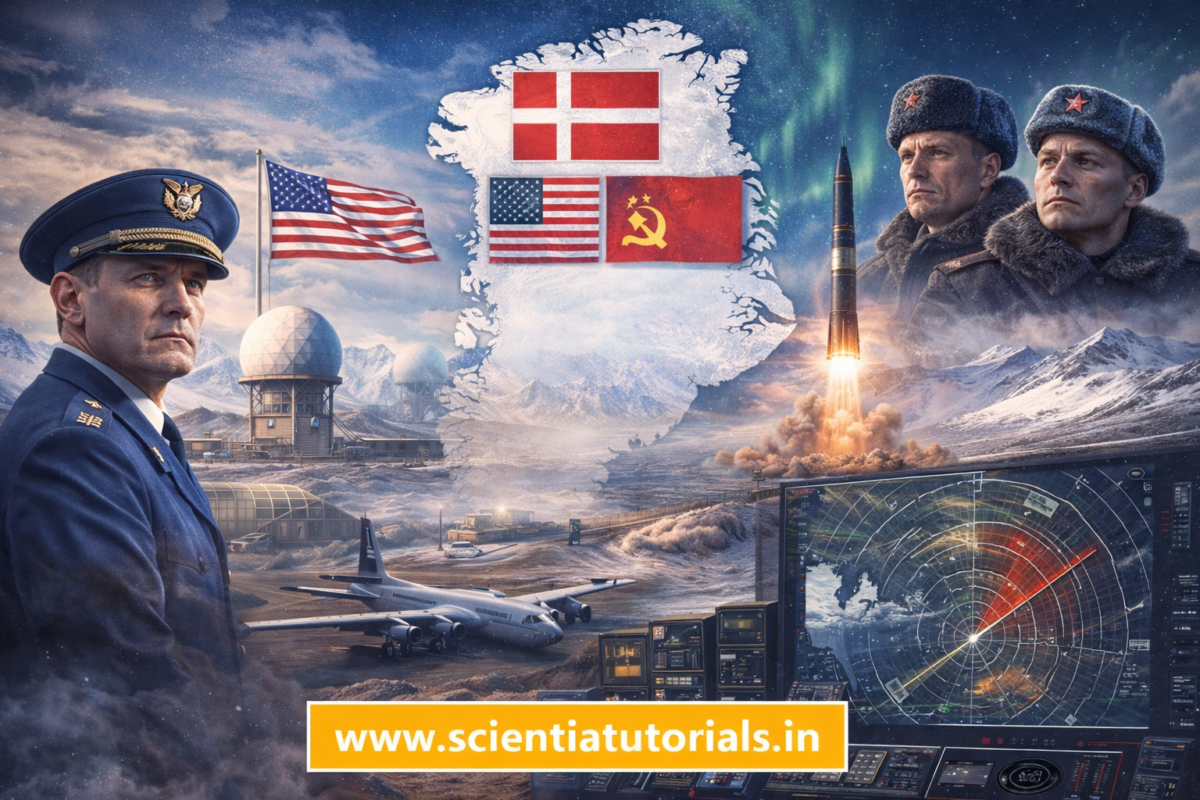

Greenland and the Global Cold War Order | Arctic Strategy & NATO
Module 4: Greenland in the Age of World Wars and the Cold War
Era Framework: Early 20th Century – Late 20th Century
This lesson is systematically organized into four clearly structured sections, as detailed below:
- Chronologically Structured Study Module
- Short-Answer Type Questions
- Long-Answer Type Questions
- Multiple-Choice Questions (MCQs) with Answers and Detailed Explanations
Chronologically Structured Study Module
Introduction: Greenland in a Bipolar World Order
The Cold War transformed the global political system into a bipolar order dominated by the United States and the Soviet Union. In this environment, geography assumed unprecedented strategic significance, particularly in the Arctic. Greenland, once a marginal colonial possession, emerged as a critical node in the global Cold War order, linking North America, Europe, and the Arctic frontier.
This lesson examines Greenland’s role within the global Cold War system, emphasizing how military technology, alliance structures, and ideological rivalry reshaped Greenland’s geopolitical position. It situates Greenland not merely as a regional outpost, but as an integral component of global deterrence, surveillance, and alliance politics.
I. Greenland at the Dawn of the Cold War (Late 1940s)
A. Transition from World War II to Cold War
The end of World War II did not lead to demilitarization in Greenland. Instead, the rapid deterioration of relations between former Allies created a new security environment. The Arctic, once peripheral, became central to strategic calculations due to:
- The emergence of long-range bombers
- Development of nuclear weapons
- The importance of early-warning systems
Greenland’s wartime infrastructure and experience positioned it for immediate integration into Cold War defense planning.
B. Constitutional and Political Context
Greenland remained under the sovereignty of Denmark, but Denmark’s limited military capacity meant that Greenland’s defense was closely tied to the United States. This arrangement placed Greenland at the intersection of national sovereignty and global security imperatives.
II. The Arctic in Cold War Strategic Thought
A. The Arctic as the Shortest Strategic Route
Cold War military planners recognized that the shortest flight paths between North America and Eurasia crossed the Arctic. As a result:
- Greenland became a frontline zone rather than a rear area
- The Arctic shifted from a barrier to a corridor of conflict
- Surveillance and early detection became strategic priorities
This reconceptualization fundamentally altered Greenland’s global significance.
B. Nuclear Weapons and Strategic Deterrence
The development of nuclear weapons transformed the nature of warfare. Greenland’s location made it indispensable for:
- Detecting incoming bombers and missiles
- Supporting retaliatory strike capabilities
- Stabilizing deterrence by reducing surprise attacks
Thus, Greenland became embedded in the logic of mutually assured deterrence.
III. Greenland within the Western Alliance System
A. Denmark, NATO, and Collective Defense
In 1949, Denmark joined the North Atlantic Treaty Organization (NATO), formally integrating Greenland into the Western alliance system. This decision had several consequences:
- Greenland became part of NATO’s Arctic defense planning
- US military presence gained multilateral legitimacy
- Greenland’s security became a shared transatlantic concern
NATO transformed Greenland from a bilateral security arrangement into a collective defense asset.
B. The United States and Greenland’s Strategic Role
The United States assumed primary responsibility for Greenland’s military defense. American strategic planners viewed Greenland as:
- A shield protecting North America
- A forward observation post facing the Soviet Union
- A critical link between European and North American defense systems
This perception anchored Greenland firmly within the Western Cold War order.
IV. Thule Air Base and the Architecture of Cold War Defense
A. Establishment and Expansion
One of the most visible symbols of Greenland’s Cold War role was the construction of Thule Air Base in the early 1950s. The base became a cornerstone of Arctic defense.
Its functions included:
- Hosting strategic bombers
- Operating radar and missile-detection systems
- Supporting space and satellite surveillance
B. Integration into Early-Warning Networks
Thule was integrated into North American and NATO early-warning systems designed to detect Soviet missile launches. This capability was essential for:
- Providing decision-makers with response time
- Preventing accidental or surprise nuclear war
- Reinforcing deterrence stability
Thule thus linked Greenland directly to the global nuclear balance.
V. Greenland and the Soviet Union in Cold War Calculations
A. Perceptions of Threat
From the perspective of the Soviet Union, Greenland represented:
- A forward surveillance platform near Soviet territory
- A potential staging ground for Western military operations
- A critical component of NATO’s Arctic posture
Although Greenland was not a site of direct confrontation, it remained deeply embedded in Soviet threat assessments.
B. Absence of Direct Conflict
Despite its strategic importance, Greenland did not become a battlefield. This reflected a broader Cold War pattern in which:
- Deterrence prevented direct military confrontation
- Strategic installations served defensive and surveillance roles
- Stability depended on mutual recognition of red lines
Greenland exemplified how Cold War rivalry often manifested through infrastructure rather than combat.
VI. Technological Change and the Intensification of Greenland’s Role
A. Radar, Missiles, and Space Surveillance
Advances in military technology during the Cold War reinforced Greenland’s importance. These included:
- Ballistic missile early-warning radars
- Satellite tracking and space monitoring
- Communications systems linking global command networks
Greenland evolved from an air-defense outpost into a multi-domain surveillance hub.
B. Strategic Stability and Crisis Management
By enhancing detection capabilities, Greenland contributed to crisis stability. Early-warning systems reduced the risk of miscalculation during periods of tension, such as missile crises and arms races.
VII. Political and Social Implications within Greenland
A. Militarization and Local Society
Cold War militarization had profound local effects:
- Displacement of communities near military sites
- Environmental and land-use concerns
- Limited local participation in strategic decisions
These issues heightened Greenlandic awareness of their territory’s global importance.
B. Cold War Order and Political Consciousness
Greenland’s role in the global Cold War order reinforced demands for political agency. Many Greenlanders questioned why decisions with global implications were made without adequate local input, linking strategic importance to calls for autonomy.
VIII. Greenland in Late Cold War Adjustments (1970s–1980s)
A. Détente and Arms Control
Periods of détente and arms control did not reduce Greenland’s importance. Surveillance and monitoring remained essential even as tensions eased.
B. Continuity amid Change
Despite shifting geopolitical conditions:
- Military infrastructure remained operational
- Greenland continued to anchor Arctic defense
- The island retained its relevance in global security planning
Greenland demonstrated the enduring nature of Cold War strategic geography.
IX. Greenland’s Place in the Global Cold War System
Greenland’s role in the Cold War can be summarized as:
- A strategic bridge between continents
- A surveillance platform within nuclear deterrence
- A symbol of how peripheral regions become central in global conflicts
Its integration into the Cold War order illustrates the global reach of superpower rivalry.
X. Historical Significance and Long-Term Legacy
The Cold War left a lasting imprint on Greenland:
- Permanent strategic infrastructure
- Deep integration into transatlantic security systems
- Reinforced global awareness of Arctic geopolitics
Even after the Cold War’s end, Greenland’s strategic relevance persisted, shaped by the legacy of bipolar confrontation.
Conclusion: Greenland as a Pillar of the Global Cold War Order
Greenland’s Cold War history reveals how geography, technology, and ideology converge to reshape global power structures. From early-warning systems to alliance politics, Greenland functioned as a pillar of the global Cold War order, despite its small population and remote location.
Understanding Greenland’s role during the Cold War is essential for grasping both the dynamics of 20th-century geopolitics and the continuing strategic importance of the Arctic in global affairs.
Short Answer Type Questions and Answers
Lesson: Greenland and the Global Cold War Order
1. Why did Greenland gain global strategic importance during the Cold War?
Answer: Greenland’s Arctic location lay along the shortest routes between North America and Eurasia, making it vital for surveillance, early warning, and nuclear deterrence.
2. Which global political system defined the Cold War era?
Answer: A bipolar world order dominated by the United States and the Soviet Union.
3. How did World War II influence Greenland’s Cold War role?
Answer: Wartime military infrastructure and experience prepared Greenland for immediate integration into Cold War defense planning.
4. Which country retained sovereignty over Greenland during the Cold War?
Answer: Denmark retained sovereignty over Greenland.
5. Why was the Arctic redefined as a strategic corridor during the Cold War?
Answer: Advances in long-range bombers and missiles made the Arctic the shortest and fastest route for potential attacks.
6. What role did nuclear weapons play in increasing Greenland’s importance?
Answer: Nuclear weapons required early-warning and detection systems, for which Greenland’s location was ideal.
7. What is meant by “early-warning systems” in the Cold War context?
Answer: Radar and surveillance networks designed to detect incoming enemy bombers or missiles at the earliest possible stage.
8. How did Denmark’s NATO membership affect Greenland?
Answer: Denmark’s entry into North Atlantic Treaty Organization (NATO) integrated Greenland into Western collective defense planning.
9. Which country assumed primary responsibility for Greenland’s military defense?
Answer: The United States assumed primary responsibility.
10. Why was Greenland important to US strategic planners?
Answer: It functioned as a forward observation post and defensive shield for North America.
11. What was Thule Air Base?
Answer: Thule Air Base was a major US military installation central to Arctic defense and missile detection.
12. When was Thule Air Base established?
Answer: In the early 1950s, during the intensification of the Cold War.
13. How did Thule Air Base support nuclear deterrence?
Answer: By hosting radar and missile-detection systems that reduced the risk of surprise attacks.
14. How did Greenland fit into NATO’s early-warning network?
Answer: It provided Arctic-based radar coverage essential for monitoring Soviet missile and bomber activity.
15. How did the Soviet Union view Greenland strategically?
Answer: The Soviet Union viewed Greenland as a forward Western surveillance platform near its northern approaches.
16. Did Greenland become a battlefield during the Cold War?
Answer: No, Greenland remained a strategic surveillance and deterrence zone rather than a site of direct conflict.
17. Why was deterrence central to Greenland’s Cold War role?
Answer: Greenland’s surveillance systems helped prevent surprise attacks, reinforcing mutual deterrence.
18. How did technological advances strengthen Greenland’s strategic value?
Answer: Radar, missile detection, and space surveillance technologies made Greenland indispensable to modern defense systems.
19. What was the impact of Cold War militarization on Greenlandic society?
Answer: It caused community displacement, environmental concerns, and increased political awareness.
20. How did Greenland’s Cold War role influence political consciousness?
Answer: Greenlanders increasingly demanded political agency due to their territory’s global strategic importance.
21. Did periods of détente reduce Greenland’s strategic relevance?
Answer: No, surveillance and monitoring remained essential even during détente.
22. Why did Greenland remain important in the late Cold War period?
Answer: Arctic defense and early-warning systems continued to be critical despite easing superpower tensions.
23. How did alliance politics shape Greenland’s Cold War position?
Answer: Greenland became a key link between North American and European defense systems within NATO.
24. What does Greenland’s Cold War history reveal about global geopolitics?
Answer: It shows how geographically remote regions can become central to global power struggles.
25. What is Greenland’s long-term legacy in the global Cold War order?
Answer: Greenland emerged as a permanent strategic hub in Arctic and transatlantic security planning.
Long Answer Type Questions and Answers
Lesson: Greenland and the Global Cold War Order
1. Explain why Greenland became strategically important in the global Cold War order.
Answer:
Greenland’s importance arose from its Arctic location along the shortest routes between North America and Eurasia. With the emergence of nuclear weapons, long-range bombers, and missiles, early detection became essential. Greenland offered ideal sites for radar and surveillance, making it a critical component of global deterrence and Cold War security planning.
2. Discuss how the transition from World War II to the Cold War shaped Greenland’s geopolitical role.
Answer:
World War II left Greenland with military infrastructure and experience in strategic cooperation. As tensions between former allies escalated, Greenland was rapidly absorbed into Cold War defense systems. Instead of demilitarization, its wartime role evolved into a permanent strategic function within the emerging bipolar world order.
3. Analyze the importance of the Arctic in Cold War strategic thinking.
Answer:
The Arctic was redefined from a natural barrier into a strategic corridor. Polar routes offered the fastest paths for bombers and missiles between superpowers. As a result, Arctic regions like Greenland became frontline zones for surveillance, early warning, and deterrence.
4. How did nuclear weapons transform Greenland’s strategic relevance?
Answer:
Nuclear weapons increased the need for early-warning systems to prevent surprise attacks. Greenland’s position allowed detection of incoming threats at the earliest stage, integrating it into the architecture of nuclear deterrence and strategic stability.
5. Examine Greenland’s constitutional position during the Cold War.
Answer:
Greenland remained under the sovereignty of Denmark, but Denmark relied heavily on alliance arrangements for defense. This created a situation where Greenland was politically Danish but strategically central to Western global security systems.
6. Discuss Denmark’s NATO membership and its implications for Greenland.
Answer:
Denmark’s entry into the North Atlantic Treaty Organization (NATO) in 1949 formally integrated Greenland into collective Western defense planning. This legitimized the US military presence and embedded Greenland within transatlantic security frameworks.
7. Analyze the role of the United States in Greenland’s Cold War defense.
Answer:
The United States assumed primary responsibility for Greenland’s defense. US planners viewed Greenland as a protective shield for North America and a forward observation post against the Soviet Union, linking European and American security interests.
8. Evaluate the strategic significance of Thule Air Base.
Answer:
Thule Air Base became a cornerstone of Arctic defense. It hosted strategic bombers, radar installations, and missile-detection systems, making Greenland indispensable to early-warning networks and nuclear deterrence strategies.
9. How did early-warning systems in Greenland contribute to Cold War stability?
Answer:
Early-warning systems provided critical response time in the event of an attack, reducing the risk of miscalculation or accidental war. By enhancing detection, Greenland helped stabilize the balance of power between rival blocs.
10. Examine the Soviet Union’s perception of Greenland during the Cold War.
Answer:
The Soviet Union viewed Greenland as a forward Western surveillance platform near its northern approaches. While not a battlefield, Greenland figured prominently in Soviet strategic assessments and threat perceptions.
11. Why did Greenland not become a direct battlefield during the Cold War?
Answer:
Cold War strategy emphasized deterrence rather than direct confrontation. Greenland’s role was primarily defensive and observational, reinforcing stability through surveillance rather than offensive operations.
12. Discuss the relationship between technological change and Greenland’s Cold War role.
Answer:
Advances in radar, missile detection, and space surveillance intensified Greenland’s importance. As warfare expanded into air and space domains, Greenland evolved into a multi-domain surveillance hub within global defense networks.
13. How did Cold War militarization affect Greenlandic society?
Answer:
Militarization led to displacement of communities, environmental concerns, and limited local participation in decision-making. These impacts heightened awareness of Greenland’s global importance and fueled political consciousness.
14. Analyze how Greenland’s strategic role influenced demands for political agency.
Answer:
Greenlanders increasingly questioned why decisions with global implications were made without local consent. Strategic importance strengthened arguments for political representation and autonomy.
15. Assess Greenland’s role during periods of détente.
Answer:
Even during détente, surveillance and early-warning functions remained essential. Greenland continued to play a stabilizing role in monitoring compliance and preventing strategic surprises.
16. Why did Greenland remain relevant in the late Cold War period?
Answer:
Despite easing tensions, nuclear weapons and long-range missiles ensured the continued need for Arctic surveillance. Greenland’s infrastructure and geography sustained its strategic relevance.
17. Discuss Greenland as a link between European and North American security.
Answer:
Greenland functioned as a strategic bridge, connecting NATO’s European defenses with North American security systems and reinforcing alliance cohesion.
18. Evaluate Greenland’s role within the broader global Cold War system.
Answer:
Greenland exemplifies how remote regions became central to global geopolitics. Its integration into deterrence and alliance structures illustrates the global reach of superpower rivalry.
19. What long-term strategic legacy did the Cold War leave in Greenland?
Answer:
The Cold War left permanent military infrastructure, deepened transatlantic security integration, and entrenched Greenland’s importance in Arctic geopolitics.
20. Conclude by assessing the historical significance of Greenland in the global Cold War order.
Answer:
Greenland’s Cold War history highlights the decisive role of geography in global power politics. Despite its small population, Greenland became a pillar of deterrence, surveillance, and alliance security, shaping both Cold War outcomes and post–Cold War Arctic geopolitics.
Multiple Choice Questions (MCQs)
Lesson: Greenland and the Global Cold War Order
1. Greenland’s strategic importance during the Cold War was primarily due to its
A. Rich mineral resources
B. Large population
C. Arctic geographical location
D. Industrial capacity
Correct Answer: C
Explanation:
Greenland’s Arctic location placed it along the shortest routes between North America and Eurasia, making it vital for surveillance, early-warning systems, and nuclear deterrence.
2. The Cold War global order was characterized by
A. Multipolar rivalry
B. Unipolar dominance
C. Bipolar confrontation
D. Regional alliances
Correct Answer: C
Explanation:
The Cold War featured a bipolar world dominated by the United States and the Soviet Union, shaping global strategic planning.
3. Which development most directly increased Greenland’s importance after World War II?
A. Decolonization
B. Nuclear weapons
C. Industrial growth
D. Population migration
Correct Answer: B
Explanation:
The emergence of nuclear weapons required early-warning and surveillance systems, for which Greenland’s location was ideal.
4. During the Cold War, Greenland remained under the sovereignty of
A. The United States
B. Norway
C. Britain
D. Denmark
Correct Answer: D
Explanation:
Despite its strategic role, Greenland remained a Danish territory throughout the Cold War.
5. Why was the Arctic redefined as a strategic corridor during the Cold War?
A. Due to oil discoveries
B. Because it shortened flight paths
C. For naval trade routes
D. Because of settlement expansion
Correct Answer: B
Explanation:
Advances in aviation and missile technology made Arctic routes the fastest paths for potential attacks.
6. Which military function made Greenland central to nuclear deterrence?
A. Troop deployment
B. Missile manufacturing
C. Early-warning radar
D. Naval shipbuilding
Correct Answer: C
Explanation:
Radar and detection systems in Greenland provided early warning of incoming threats, reducing the risk of surprise attacks.
7. Denmark’s membership in which organization integrated Greenland into Western defense planning?
A. United Nations
B. European Economic Community
C. Warsaw Pact
D. North Atlantic Treaty Organization
Correct Answer: D
Explanation:
Denmark joined NATO in 1949, making Greenland part of collective Western defense systems.
8. Which country assumed primary responsibility for Greenland’s Cold War defense?
A. Britain
B. Canada
C. United States
D. France
Correct Answer: C
Explanation:
The United States viewed Greenland as essential for protecting North America and managing Arctic surveillance.
9. Thule Air Base was established mainly to
A. Promote civilian aviation
B. Support Arctic research
C. Strengthen early-warning and defense systems
D. Encourage regional trade
Correct Answer: C
Explanation:
Thule Air Base played a central role in missile detection, radar surveillance, and strategic defense.
10. Thule Air Base became operational during the
A. Inter-war period
B. Early Cold War
C. Late Cold War
D. Post–Cold War era
Correct Answer: B
Explanation:
Thule was established in the early 1950s as Cold War tensions intensified.
11. Greenland’s role in early-warning systems helped to
A. Increase the likelihood of war
B. Encourage colonial control
C. Reduce chances of surprise attacks
D. Promote military neutrality
Correct Answer: C
Explanation:
Early detection provided response time, reinforcing strategic stability and deterrence.
12. How did the Soviet Union primarily view Greenland during the Cold War?
A. As an economic competitor
B. As a neutral buffer
C. As a Western surveillance outpost
D. As a colonial anomaly
Correct Answer: C
Explanation:
The Soviet Union saw Greenland as a forward NATO surveillance platform near its northern approaches.
13. Despite its strategic importance, Greenland did not become a battlefield because
A. It lacked military bases
B. It was diplomatically neutral
C. Deterrence prevented direct conflict
D. It was geographically isolated
Correct Answer: C
Explanation:
Cold War strategy emphasized deterrence and surveillance rather than direct military confrontation.
14. Which technological development further increased Greenland’s Cold War role?
A. Agricultural mechanization
B. Space and satellite surveillance
C. Urban industrialization
D. Maritime trade expansion
Correct Answer: B
Explanation:
Satellite tracking and space surveillance expanded Greenland’s function beyond air defense.
15. How did Cold War militarization affect Greenlandic society?
A. Reduced political awareness
B. Complete economic dependency
C. Community displacement and environmental concerns
D. Immediate independence
Correct Answer: C
Explanation:
Military installations displaced communities and raised environmental and political concerns.
16. Greenland’s strategic importance strengthened demands for
A. Cultural isolation
B. Political autonomy
C. Military neutrality
D. Economic protectionism
Correct Answer: B
Explanation:
Greenlanders increasingly sought political agency proportional to their territory’s global significance.
17. Did détente reduce Greenland’s strategic importance?
A. Yes, completely
B. Yes, partially
C. No, surveillance remained vital
D. Only temporarily
Correct Answer: C
Explanation:
Even during détente, monitoring and early-warning systems remained essential.
18. Greenland’s Cold War role best illustrates
A. Peripheral isolation
B. Colonial irrelevance
C. Strategic importance of geography
D. Economic globalization
Correct Answer: C
Explanation:
Greenland demonstrates how geography can elevate remote regions to global significance.
19. Greenland served as a strategic bridge between
A. Asia and Europe
B. Africa and Europe
C. North America and Europe
D. South America and Africa
Correct Answer: C
Explanation:
Greenland connected North American and European defense systems within NATO.
20. Which concept best describes Greenland’s Cold War function?
A. Economic hub
B. Forward surveillance zone
C. Neutral buffer
D. Diplomatic center
Correct Answer: B
Explanation:
Greenland functioned primarily as a surveillance and early-warning zone.
21. Why was early detection critical in nuclear strategy?
A. It ensured economic stability
B. It enabled pre-emptive colonization
C. It reduced miscalculation risks
D. It promoted disarmament
Correct Answer: C
Explanation:
Early detection reduced the likelihood of accidental or surprise nuclear war.
22. Greenland’s integration into alliance systems mainly occurred through
A. Bilateral treaties alone
B. UN peacekeeping
C. NATO collective defense
D. Non-alignment
Correct Answer: C
Explanation:
NATO institutionalized Greenland’s role within Western security frameworks.
23. The Cold War left Greenland with
A. Demilitarized status
B. Temporary relevance
C. Permanent strategic infrastructure
D. Reduced global attention
Correct Answer: C
Explanation:
Military installations and surveillance systems left a lasting strategic legacy.
24. Greenland’s Cold War experience shows that
A. Population size determines power
B. Geography outweighs demography
C. Resources drive strategy
D. Neutrality ensures security
Correct Answer: B
Explanation:
Despite a small population, Greenland’s geography made it strategically indispensable.
25. The long-term legacy of Greenland in the global Cold War order is
A. Loss of sovereignty
B. Decline in relevance
C. Enduring Arctic geopolitical importance
D. Complete demilitarization
Correct Answer: C
Explanation:
Greenland remains central to Arctic and transatlantic security due to Cold War foundations.