
Greenland in Contemporary Arctic Geopolitics
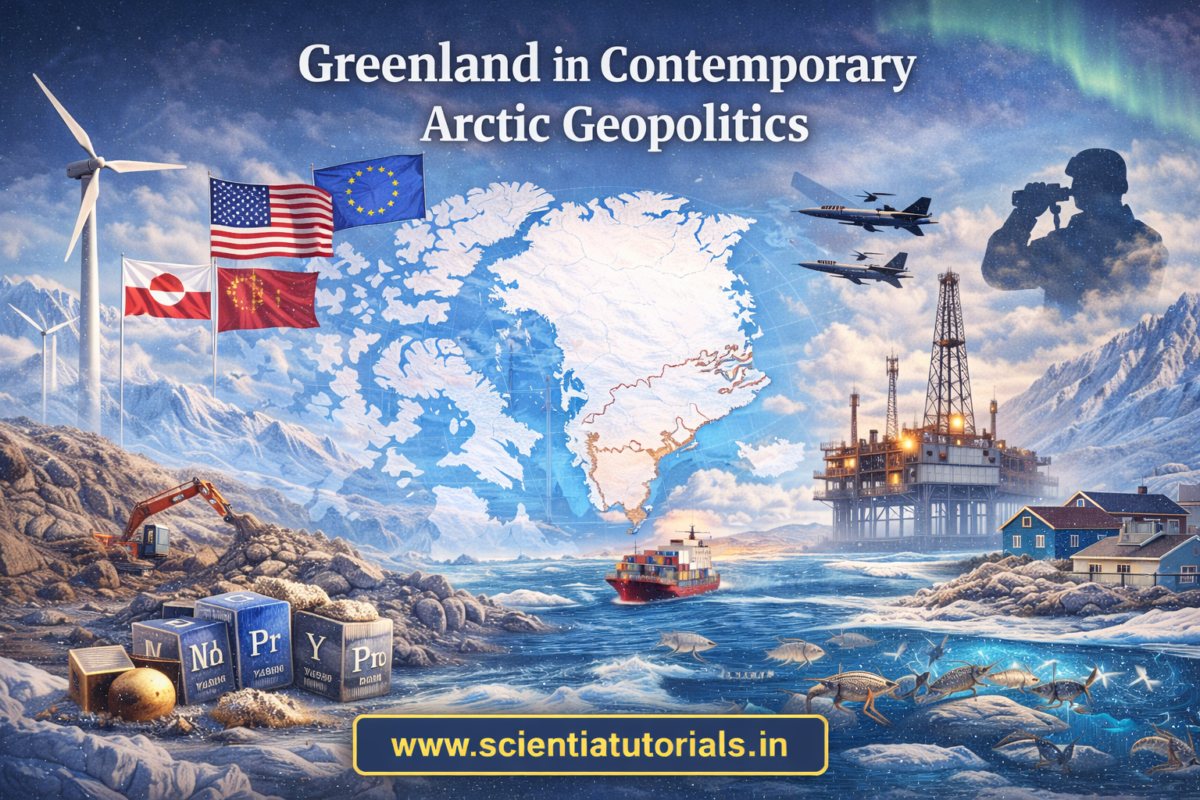

Greenland in Contemporary Arctic Geopolitics | Climate Change & Strategy
Module 5: Contemporary Greenland and Global Strategic Importance
Era Framework: Late 20th Century – 21st Century
(Globalization, Climate Change, Arctic Geopolitics)
Lesson: Greenland in Contemporary Arctic Geopolitics
This lesson is systematically organized into four clearly structured sections, as detailed below:
- Chronologically Structured Study Module
- Short-Answer Type Questions
- Long-Answer Type Questions
- Multiple-Choice Questions (MCQs) with Answers and Detailed Explanations
Chronologically Structured Study Module
Introduction: Greenland and the New Arctic Geopolitical Landscape
In the contemporary era, the Arctic has transformed from a peripheral frozen frontier into a central arena of global geopolitics. Climate change, technological advancement, and renewed great-power competition have fundamentally altered how states perceive and engage with the Arctic region. At the heart of this transformation lies Greenland, whose strategic location, political status, and resource potential make it one of the most geopolitically significant territories of the 21st century.
Greenland’s position between North America and Europe, combined with its evolving autonomy and exposure to climate change, has placed it at the intersection of security concerns, economic interests, and environmental governance. This lesson examines Greenland’s role in contemporary Arctic geopolitics through a chronological and thematic framework, tracing developments from the late Cold War period to the present.
1. Greenland at the End of the Cold War: Strategic Foundations (Late 20th Century)
1.1 Cold War Legacy and Strategic Geography
During the Cold War, Greenland’s importance was primarily military. Its geographic position made it a critical link in trans-Atlantic defense systems, particularly for early warning against intercontinental ballistic missiles. Military installations established during this period laid the foundation for Greenland’s long-term strategic relevance.
Although political authority rested with Denmark, decisions regarding defense and security were driven by broader alliance politics rather than local priorities. This disconnect between strategic importance and political agency shaped Greenlandic attitudes toward autonomy in later decades.
1.2 Transition to the Post–Cold War World
With the end of the Cold War, Arctic militarization appeared to decline temporarily. Attention shifted toward cooperation, environmental protection, and scientific research. However, Greenland’s strategic value did not disappear; instead, it entered a phase of latent importance that would re-emerge strongly in the 21st century.
2. Climate Change and the Re-Geopoliticization of the Arctic
2.1 Environmental Transformation as a Geopolitical Catalyst
Climate change has been the single most important factor reshaping Arctic geopolitics. Rising temperatures have reduced sea ice, lengthened navigable seasons, and improved access to Arctic regions. These changes transformed the Arctic from a natural barrier into a zone of opportunity and competition.
For Greenland, melting ice increased accessibility to resources and transportation routes, elevating its geopolitical significance well beyond its population size.
2.2 Arctic as a Global Commons under Pressure
The Arctic’s transformation has blurred the line between environmental and strategic issues. Environmental change now directly influences security planning, economic strategy, and diplomatic engagement, making Greenland a focal point of these intersecting concerns.
3. Greenland’s Strategic Location in Arctic Security Architecture
3.1 Gateway between Continents
Greenland occupies a pivotal position between North America and Europe, controlling key air and sea corridors across the North Atlantic and Arctic. This location makes it indispensable for surveillance, communication, and defense coordination.
3.2 Role within Western Security Frameworks
Greenland is indirectly integrated into Western security systems through Denmark’s membership in NATO. Although Greenland itself is not a sovereign member, its territory plays a vital role in alliance defense planning, particularly in missile detection and Arctic monitoring.
4. Renewed Great Power Competition in the Arctic
4.1 The United States and Greenland
The United States has long viewed Greenland as strategically indispensable. In the 21st century, U.S. interest has intensified due to concerns over Arctic security, missile defense, and great-power rivalry. Greenland’s location enhances U.S. early-warning capabilities and Arctic presence.
This renewed attention has increased Greenland’s diplomatic visibility and bargaining power, even while defense policy remains under Danish authority.
4.2 Russia and the Militarization of the Arctic
Russia has expanded its Arctic military infrastructure and economic activity, emphasizing the region’s importance for national security and energy development. Although Greenland is geographically distant from Russia’s Arctic coastline, Russian actions have reshaped the broader security environment in which Greenland operates.
4.3 China as a Near-Arctic Actor
China has emerged as a significant non-Arctic stakeholder, describing itself as a “near-Arctic state.” Chinese interest in Arctic shipping routes, scientific research, and resource investment has raised strategic concerns among Western powers, indirectly increasing Greenland’s geopolitical relevance.
5. Greenland, Denmark, and the Question of Strategic Autonomy
5.1 Constitutional Framework and Foreign Policy Limits
Despite extensive self-government, Greenland’s foreign and defense policies remain constitutionally managed by Denmark. This arrangement creates a unique geopolitical situation in which Greenland is strategically central but diplomatically constrained.
5.2 Greenlandic Perspectives on Security and Autonomy
Greenlandic leaders increasingly seek a greater voice in decisions affecting Arctic security and international engagement. While full control over defense is not currently feasible, Greenland’s growing political confidence reflects its awareness of strategic importance.
6. Arctic Governance and Multilateral Diplomacy
6.1 The Role of the Arctic Council
The Arctic Council has been central to managing Arctic cooperation in the post–Cold War era. Focused on environmental protection, scientific collaboration, and sustainable development, the Council represents a cooperative model of Arctic governance.
Greenland participates actively through the Danish Realm, ensuring that indigenous perspectives and environmental concerns remain part of Arctic diplomacy.
6.2 Limits of Cooperative Governance
While the Arctic Council promotes dialogue, it excludes military security from its mandate. As geopolitical tensions rise, the gap between cooperative governance and strategic competition has widened, directly affecting Greenland’s security environment.
7. Natural Resources and Geopolitical Interest
7.1 Strategic Minerals and Global Demand
Greenland’s mineral resources, including rare earth elements, have geopolitical significance due to their importance in modern technologies and clean energy transitions. Control over such resources influences global supply chains and strategic competition.
7.2 Energy Resources and Strategic Calculations
Potential offshore hydrocarbons have attracted international interest, though environmental risks and high costs limit development. Nonetheless, the mere possibility of energy resources enhances Greenland’s geopolitical profile.
8. Arctic Shipping Routes and Strategic Mobility
8.1 Emerging Maritime Corridors
Melting sea ice has opened new Arctic shipping routes, shortening distances between major global markets. Greenland’s proximity to these routes increases its strategic value in maritime security and logistics.
8.2 Security Implications
Increased shipping raises concerns about surveillance, search-and-rescue capacity, and environmental safety. Greenland’s location makes it central to managing these emerging challenges.
9. Indigenous Peoples and Geopolitics
9.1 Inuit Perspectives in Arctic Strategy
For Greenland’s Inuit population, geopolitics intersects with daily life. Military installations, infrastructure development, and foreign interest affect land use, culture, and community safety.
9.2 Human Security Dimension
Contemporary Arctic geopolitics increasingly incorporates human security—environmental protection, cultural survival, and social well-being—alongside traditional military concerns. Greenland exemplifies this broader understanding of security.
10. Greenland in the 21st Century: From Periphery to Pivot
Greenland’s geopolitical role in the 21st century reflects a broader shift in world politics. Once marginal, the Arctic is now a central arena of global strategic competition, and Greenland stands at its core.
Climate change, resource demand, and great-power rivalry have combined to elevate Greenland’s importance far beyond its size or population. At the same time, Greenland’s political evolution toward greater autonomy adds a new dimension to Arctic geopolitics, blending local aspirations with global strategic realities.
Conclusion: Greenland’s Enduring Strategic Significance
Greenland in contemporary Arctic geopolitics represents the convergence of environmental transformation, security competition, and political change. From its Cold War legacy to its 21st-century prominence, Greenland has moved from the margins of world politics to a position of strategic centrality.
Understanding Greenland’s role requires an integrated perspective that connects climate change, global power shifts, indigenous rights, and evolving governance structures. As the Arctic continues to warm and global competition intensifies, Greenland will remain a critical pivot in shaping the future geopolitical order of the Arctic and beyond.
Short Answer Type Questions with Answers
Lesson: Greenland in Contemporary Arctic Geopolitics
1. Why has the Arctic gained geopolitical importance in the 21st century?
Answer:
Due to climate change, opening of sea routes, access to resources, and renewed great-power competition.
2. Why is Greenland strategically important?
Answer:
Because of its location between North America and Europe and its role in Arctic security and surveillance.
3. How did the Cold War shape Greenland’s strategic role?
Answer:
Greenland hosted key military installations for missile detection and trans-Atlantic defense.
4. Which country controls Greenland’s defense and foreign policy?
Answer:
Denmark.
5. What major global process has re-geopoliticized the Arctic?
Answer:
Climate change.
6. How does climate change affect Arctic geopolitics?
Answer:
By reducing ice cover, increasing access to resources, and enabling new shipping routes.
7. Why is Greenland considered a gateway between continents?
Answer:
It lies between North America and Europe along critical air and sea corridors.
8. Which military alliance indirectly links Greenland to Western security?
Answer:
NATO.
9. Why has U.S. interest in Greenland increased in recent years?
Answer:
Due to missile defense needs, Arctic security concerns, and great-power rivalry.
10. Name one U.S. strategic concern related to Greenland.
Answer:
Early-warning missile detection and Arctic surveillance.
11. How has Russia influenced contemporary Arctic geopolitics?
Answer:
By expanding military infrastructure and asserting strategic control in the Arctic.
12. Why is China described as a “near-Arctic state”?
Answer:
Because it seeks involvement in Arctic shipping, research, and resource access despite not being Arctic-bordering.
13. Why has Chinese interest in Greenland raised concern?
Answer:
Due to fears of strategic influence and geopolitical competition.
14. What limits Greenland’s independent role in geopolitics?
Answer:
Lack of control over defense and foreign policy.
15. What institution promotes cooperation rather than military competition in the Arctic?
Answer:
The Arctic Council.
16. Why is the Arctic Council limited in addressing security issues?
Answer:
Because military matters are excluded from its mandate.
17. How do natural resources influence Greenland’s geopolitical value?
Answer:
They attract global powers and link Greenland to strategic supply chains.
18. What type of minerals in Greenland are geopolitically significant?
Answer:
Rare earth elements and critical minerals.
19. How do Arctic shipping routes affect Greenland’s strategic role?
Answer:
They increase Greenland’s importance in maritime security and logistics.
20. Why is Greenland central to Arctic surveillance?
Answer:
Its geographic position allows monitoring of air and sea movements across the Arctic.
21. How does geopolitics affect indigenous communities in Greenland?
Answer:
Through military presence, infrastructure development, and land-use changes.
22. What is meant by “human security” in Arctic geopolitics?
Answer:
Security that includes environmental safety, livelihoods, and cultural survival.
23. How has Greenland’s political autonomy affected its geopolitical awareness?
Answer:
Greater autonomy has increased Greenland’s demand for a voice in strategic decisions.
24. Why is Greenland described as moving from periphery to pivot?
Answer:
Because it has shifted from marginal importance to central strategic relevance.
25. What best summarizes Greenland’s role in contemporary Arctic geopolitics?
Answer:
A strategically vital territory shaped by climate change, great-power rivalry, and evolving autonomy.
Long Answer Type Questions with Answers
Lesson: Greenland in Contemporary Arctic Geopolitics
1. Explain why the Arctic has emerged as a major geopolitical region in the 21st century.
Answer:
The Arctic has gained geopolitical importance due to climate change, which has reduced ice cover and opened access to resources and shipping routes. Advances in technology, renewed great-power rivalry, and the strategic value of Arctic air and sea corridors have transformed the region from a peripheral frontier into a central arena of global geopolitics.
2. Analyze the strategic importance of Greenland in contemporary geopolitics.
Answer:
Greenland’s strategic importance lies in its geographic position between North America and Europe, making it crucial for Arctic surveillance, missile warning systems, and control of trans-Arctic routes. Climate change and resource potential have further elevated Greenland’s global relevance despite its small population.
3. Trace the Cold War origins of Greenland’s strategic significance.
Answer:
During the Cold War, Greenland served as a critical node in trans-Atlantic defense systems. Its location enabled early-warning missile detection and air surveillance. Although governed by Denmark, Greenland’s territory was central to Western security planning, laying the foundations of its enduring strategic role.
4. How did the end of the Cold War temporarily change Arctic geopolitics?
Answer:
After the Cold War, military tensions in the Arctic declined, and focus shifted toward scientific cooperation, environmental protection, and regional governance. Institutions such as the Arctic Council gained prominence, though Greenland’s strategic value remained latent rather than eliminated.
5. Examine climate change as a catalyst for renewed Arctic geopolitics.
Answer:
Climate change has reduced Arctic sea ice, transforming natural barriers into navigable spaces. This has opened access to resources and shipping routes, re-introducing strategic competition and elevating Greenland’s geopolitical importance in the 21st century.
6. Discuss Greenland’s role in Arctic security architecture.
Answer:
Greenland functions as a strategic hub for Arctic surveillance and air-sea monitoring. Though not sovereign in defense matters, it contributes significantly to Western security structures through Denmark’s role in NATO.
7. Analyze the significance of Greenland’s location between North America and Europe.
Answer:
Greenland’s position allows control and monitoring of key air and sea routes across the North Atlantic and Arctic. This makes it essential for missile detection, communication networks, and rapid military mobility in the Arctic region.
8. Examine the role of the United States in Greenland’s contemporary geopolitics.
Answer:
The United States views Greenland as vital for missile defense, Arctic security, and countering rival powers. Renewed U.S. attention reflects concerns over Arctic militarization and global power competition.
9. How has Russia reshaped the Arctic geopolitical environment?
Answer:
Russia has expanded military infrastructure, reopened Arctic bases, and emphasized the region’s role in national security and energy strategy. These actions have intensified security concerns across the Arctic, indirectly increasing Greenland’s strategic value.
10. Why is China considered a new geopolitical actor in the Arctic?
Answer:
China identifies itself as a “near-Arctic state” and seeks involvement in Arctic shipping, research, and resources. Its growing presence has raised concerns among Western states, adding a new dimension to Arctic geopolitics.
11. Discuss how Greenland’s political status affects its geopolitical role.
Answer:
Although Greenland enjoys extensive self-government, defense and foreign policy remain under Danish control. This creates a paradox where Greenland is strategically central but diplomatically constrained, limiting its independent geopolitical agency.
12. Examine Greenland’s growing demand for strategic autonomy.
Answer:
As Greenland’s geopolitical importance increases, its leaders seek greater involvement in security and foreign-policy decisions. While full autonomy in defense is unlikely in the near future, Greenland’s political confidence has grown alongside its strategic relevance.
13. Evaluate the role of the Arctic Council in Arctic geopolitics.
Answer:
The Arctic Council promotes cooperation on environmental protection, science, and sustainable development. However, its exclusion of military security limits its ability to manage rising geopolitical tensions affecting Greenland.
14. Why are natural resources geopolitically significant in Greenland?
Answer:
Greenland’s minerals, including rare earth elements, are essential for modern technologies and energy transitions. Control over these resources influences global supply chains and attracts strategic interest from major powers.
15. Analyze the geopolitical implications of Arctic shipping routes.
Answer:
Melting ice has opened shorter maritime routes between Europe, Asia, and North America. Greenland’s proximity to these routes enhances its importance in maritime security, logistics, and environmental monitoring.
16. Discuss the concept of Arctic militarization and its relevance to Greenland.
Answer:
Arctic militarization refers to increased military presence and infrastructure in the region. While Greenland itself hosts limited installations, regional militarization heightens its strategic role in surveillance and alliance defense planning.
17. Examine how geopolitics affects indigenous communities in Greenland.
Answer:
Military bases, infrastructure projects, and foreign interest impact land use, livelihoods, and cultural spaces of Inuit communities. This highlights the human dimension of Arctic geopolitics.
18. Explain the idea of “human security” in the Arctic context.
Answer:
Human security expands traditional security to include environmental safety, livelihoods, health, and cultural survival. In Greenland, climate change and geopolitical activity directly affect these dimensions.
19. How does climate change blur the line between environmental and security issues in Greenland?
Answer:
Environmental change increases accessibility, triggering security planning, economic interest, and strategic competition. Thus, climate change functions as both an environmental and geopolitical force.
20. Critically analyze Greenland’s transformation from a peripheral region to a geopolitical pivot.
Answer:
Once marginal in global politics, Greenland has become central due to climate change, strategic location, and great-power rivalry. This transformation reflects broader shifts in global geopolitics toward the Arctic.
Concluding Examination Insight
Greenland in contemporary Arctic geopolitics must be understood as the intersection of climate change, strategic location, great-power competition, and evolving political autonomy—making it a critical case study in 21st-century geopolitics.
Multiple Choice Questions (MCQs) with Answers and Explanations
Lesson: Greenland in Contemporary Arctic Geopolitics
1. Which factor has most transformed the Arctic into a major geopolitical region in the 21st century?
A. Population growth
B. Climate change
C. Religious conflicts
D. Industrial revolution
Correct Answer: B
Explanation:
Climate change has reduced sea ice, opening access to resources and shipping routes, thereby intensifying geopolitical competition.
2. Why is Greenland strategically important in Arctic geopolitics?
A. Large population
B. Control over global trade tariffs
C. Location between North America and Europe
D. Membership in the European Union
Correct Answer: C
Explanation:
Greenland’s location makes it critical for Arctic surveillance, trans-Atlantic defense, and emerging sea routes.
3. Greenland’s strategic importance during the Cold War was mainly due to its role in:
A. Trade regulation
B. Cultural exchange
C. Missile detection and air surveillance
D. Resource extraction
Correct Answer: C
Explanation:
Greenland hosted key early-warning systems essential to Cold War defense strategies.
4. Which country retains control over Greenland’s defense and foreign policy?
A. United States
B. Greenland itself
C. Norway
D. Denmark
Correct Answer: D
Explanation:
Despite extensive self-government, Greenland’s defense and foreign affairs remain under Danish authority.
5. What major geopolitical shift occurred in the Arctic after the Cold War?
A. Complete demilitarization
B. Decline in scientific research
C. Temporary focus on cooperation and environmental issues
D. End of strategic interest
Correct Answer: C
Explanation:
Post–Cold War Arctic politics emphasized cooperation, though strategic interests later re-emerged.
6. How has climate change re-geopoliticized the Arctic?
A. By increasing forest cover
B. By opening shipping routes and resource access
C. By isolating Arctic regions
D. By reducing global interest
Correct Answer: B
Explanation:
Melting ice transformed the Arctic into a zone of opportunity and competition.
7. Greenland’s strategic relevance to Western security is linked to Denmark’s membership in:
A. European Union
B. United Nations
C. NATO
D. Arctic Council
Correct Answer: C
Explanation:
Through Denmark, Greenland is indirectly part of NATO’s Arctic security framework.
8. Why has U.S. interest in Greenland increased in the 21st century?
A. Agricultural expansion
B. Cultural diplomacy
C. Missile defense and Arctic security
D. Tourism growth
Correct Answer: C
Explanation:
The United States views Greenland as vital for missile warning systems and Arctic monitoring.
9. Which country has significantly expanded military infrastructure in the Arctic region?
A. Canada
B. Iceland
C. Russia
D. Japan
Correct Answer: C
Explanation:
Russia has reopened bases and strengthened its Arctic military presence, heightening regional tensions.
10. Why is China considered a “near-Arctic state”?
A. It borders the Arctic Ocean
B. It controls Arctic islands
C. It seeks involvement in Arctic shipping and research
D. It hosts Arctic institutions
Correct Answer: C
Explanation:
China seeks access to Arctic routes, research, and resources despite lacking Arctic territory.
11. Which institution promotes cooperation rather than military competition in the Arctic?
A. NATO
B. United Nations Security Council
C. European Union
D. Arctic Council
Correct Answer: D
Explanation:
The Arctic Council focuses on environmental protection, science, and sustainable development.
12. Why is the Arctic Council limited in managing geopolitical tensions?
A. It lacks funding
B. It excludes military security issues
C. It includes non-Arctic states
D. It focuses only on trade
Correct Answer: B
Explanation:
Military security is outside the Council’s mandate, limiting its role in conflict prevention.
13. Greenland’s geopolitical role is often described as paradoxical because it is:
A. Militarily powerful but economically weak
B. Strategically central but diplomatically constrained
C. Politically independent but economically isolated
D. Rich in population but poor in resources
Correct Answer: B
Explanation:
Greenland is strategically vital but lacks independent control over foreign and defense policy.
14. Which resource type adds to Greenland’s geopolitical value?
A. Coal
B. Timber
C. Rare earth elements
D. Cotton
Correct Answer: C
Explanation:
Rare earth elements are critical for modern technologies and global supply chains.
15. How do Arctic shipping routes affect Greenland’s importance?
A. They reduce Greenland’s relevance
B. They bypass Greenland entirely
C. They increase Greenland’s role in maritime security
D. They eliminate geopolitical rivalry
Correct Answer: C
Explanation:
Greenland lies near emerging Arctic routes, enhancing its logistical and strategic value.
16. What is meant by “Arctic militarization”?
A. Complete demilitarization of the region
B. Expansion of military presence and infrastructure
C. Replacement of armies with scientists
D. Closure of all Arctic bases
Correct Answer: B
Explanation:
Several Arctic states are increasing military activity to secure strategic interests.
17. Which concept expands security beyond military concerns in Greenland?
A. Nuclear security
B. Economic security
C. Human security
D. Energy security
Correct Answer: C
Explanation:
Human security includes environmental safety, livelihoods, and cultural survival.
18. How does geopolitics affect indigenous Inuit communities?
A. Only through taxation
B. Through military presence and land-use changes
C. By increasing tourism only
D. By ending traditional livelihoods
Correct Answer: B
Explanation:
Geopolitical activity can impact land, culture, and community safety.
19. Why does climate change blur the line between environmental and security issues?
A. It reduces economic activity
B. It links melting ice with strategic access and competition
C. It isolates Arctic regions
D. It eliminates military interest
Correct Answer: B
Explanation:
Environmental change directly influences security planning and geopolitical rivalry.
20. Greenland’s growing autonomy has led to:
A. Reduced geopolitical relevance
B. Greater demand for a voice in strategic decisions
C. Withdrawal from Arctic affairs
D. End of Danish influence
Correct Answer: B
Explanation:
Greater autonomy has increased Greenland’s awareness of its strategic importance.
21. Why is Greenland central to Arctic surveillance?
A. High population density
B. Advanced agriculture
C. Strategic geographic position
D. EU membership
Correct Answer: C
Explanation:
Its location allows monitoring of air and sea movement across the Arctic.
22. Which factor most distinguishes contemporary Arctic geopolitics from the Cold War era?
A. Absence of military interest
B. Role of climate change
C. Decline in global trade
D. Reduced technology
Correct Answer: B
Explanation:
Climate change now acts as a primary driver of geopolitical change.
23. Greenland’s transformation from periphery to pivot reflects:
A. Declining global interest
B. Isolation from world politics
C. Rising importance of the Arctic in global power politics
D. Collapse of international institutions
Correct Answer: C
Explanation:
The Arctic has become central to global strategy, elevating Greenland’s role.
24. Which best describes Greenland’s role in 21st-century Arctic geopolitics?
A. Passive observer
B. Peripheral territory
C. Strategic hub shaped by climate and rivalry
D. Neutral economic zone
Correct Answer: C
Explanation:
Greenland is a key strategic hub influenced by climate change and great-power competition.
25. Greenland in contemporary Arctic geopolitics is best understood as:
A. A purely environmental case
B. A regional security issue only
C. An intersection of climate change, strategy, and autonomy
D. A declining geopolitical space
Correct Answer: C
Explanation:
Greenland’s importance emerges from the interaction of environmental change, security competition, and evolving political autonomy.
Examination Insight
For MCQs, prioritize climate change, strategic location, U.S.–Russia–China rivalry, NATO, Arctic Council, and limits of Greenland’s autonomy—these are high-yield objective exam themes.