
Strategic Competition among Global Powers
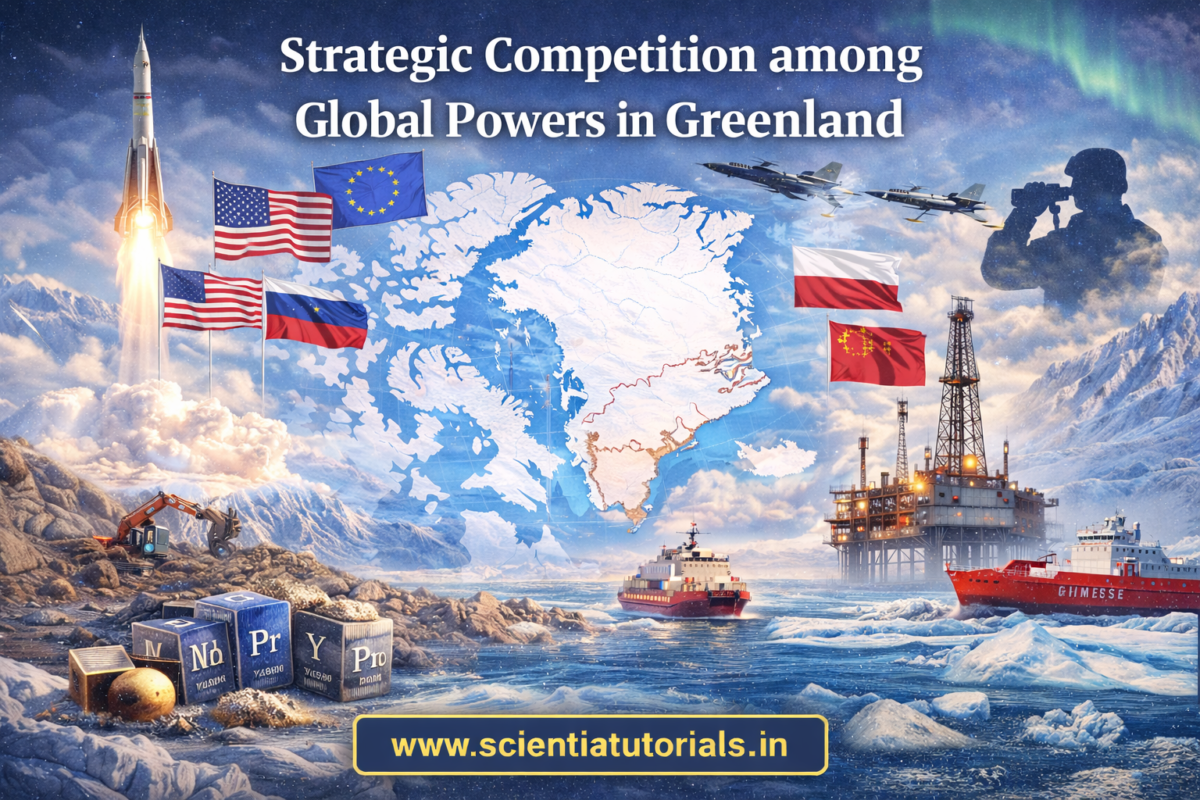

Strategic Competition among Global Powers in Greenland | Arctic Geopolitics
Module 5: Contemporary Greenland and Global Strategic Importance
Era Framework: Late 20th Century – 21st Century
(Globalization, Climate Change, Arctic Geopolitics)
Lesson: Strategic Competition among Global Powers
This lesson is systematically organized into four clearly structured sections, as detailed below:
- Chronologically Structured Study Module
- Short-Answer Type Questions
- Long-Answer Type Questions
- Multiple-Choice Questions (MCQs) with Answers and Detailed Explanations
Chronologically Structured Study Module
Introduction: Strategic Competition and the Changing Arctic Order
In the late twentieth and early twenty-first centuries, global geopolitics has entered a phase of renewed strategic competition. Unlike the bipolar rivalry of the Cold War, contemporary competition is multipolar, technologically driven, and deeply intertwined with economic and environmental change. One of the most striking arenas of this competition is the Arctic.
At the center of this emerging geopolitical theatre lies Greenland. Once perceived as a remote and frozen periphery, Greenland has become strategically significant due to climate change, natural resource potential, and its critical geographic position between North America and Europe. Strategic competition among global powers in Greenland reflects broader shifts in world politics, where environmental transformation reshapes power calculations and global influence.
This lesson examines how strategic competition has evolved from the late Cold War period to the present, focusing on Greenland’s role within rivalries among major global powers.
1. Strategic Competition at the End of the Cold War (Late 20th Century)
1.1 Bipolar Rivalry and Arctic Security
During the Cold War, strategic competition in the Arctic was dominated by rivalry between the United States and the Soviet Union. Greenland’s significance during this era was primarily military. Its geographic position made it a crucial link in early-warning missile detection systems and trans-Atlantic defense networks.
Although Greenland was administered by Denmark, its territory played a vital role in alliance security planning, particularly within Western defense structures.
1.2 Decline of Overt Militarization after 1991
With the collapse of the Soviet Union, overt military competition in the Arctic appeared to decline. The late 1990s witnessed optimism about cooperation, arms reduction, and scientific collaboration. Strategic competition did not disappear but entered a latent phase, temporarily overshadowed by globalization and economic integration.
2. Globalization and the Shifting Nature of Power
2.1 Economic Globalization and Strategic Interests
Globalization reshaped strategic competition by expanding economic interdependence and global supply chains. Strategic power increasingly depended not only on military strength but also on control over resources, trade routes, and technology.
In this context, Greenland’s resource potential—especially minerals and energy—began attracting attention from global powers seeking long-term economic and strategic advantages.
2.2 Arctic as an Emerging Strategic Frontier
As globalization expanded, the Arctic emerged as one of the last relatively untapped regions. Greenland’s geographic position and resource base placed it at the intersection of economic globalization and geopolitical competition.
3. Climate Change as a Catalyst for Strategic Competition
3.1 Environmental Transformation and Accessibility
Climate change fundamentally altered strategic calculations in the Arctic. Melting ice reduced physical barriers, opening access to shipping routes, minerals, and energy reserves. This environmental transformation turned the Arctic from a defensive buffer into a zone of strategic opportunity.
For Greenland, climate change enhanced accessibility and visibility, making it a focal point of renewed global interest.
3.2 From Environmental Issue to Strategic Concern
What began as an environmental challenge soon became a strategic issue. Climate change now directly influences national security planning, economic policy, and international diplomacy. Greenland’s experience illustrates how environmental change can accelerate strategic competition.
4. The United States and Strategic Interests in Greenland
4.1 Historical Foundations of U.S. Involvement
The United States has long viewed Greenland as strategically indispensable. During the Cold War, U.S. military installations in Greenland supported missile detection and Arctic surveillance.
4.2 Renewed Strategic Attention in the 21st Century
In the twenty-first century, U.S. interest has intensified due to concerns over missile defense, Arctic security, and competition with rival powers. Greenland’s location enhances U.S. capabilities in monitoring Arctic airspace and emerging sea routes.
U.S. engagement in Greenland reflects a broader strategy of maintaining influence in the Arctic amid growing global competition.
5. Russia and the Reassertion of Arctic Power
5.1 Arctic as a Core Strategic Region
For Russia, the Arctic is central to national security and economic development. Russia possesses the longest Arctic coastline and has invested heavily in military infrastructure, icebreakers, and energy projects.
5.2 Impact on Greenland’s Strategic Environment
Although Greenland lies outside Russia’s immediate Arctic sphere, Russian actions have reshaped the broader strategic environment. Increased Russian military activity has prompted Western powers to re-evaluate Arctic security, indirectly increasing Greenland’s strategic importance.
6. China as a New Strategic Actor
6.1 China’s Entry into Arctic Affairs
China has emerged as a significant non-Arctic actor, describing itself as a “near-Arctic state.” China’s interests include Arctic shipping routes, scientific research, and access to resources.
6.2 Strategic Concerns and Greenland
Chinese interest in Greenland’s minerals and infrastructure has raised concerns among Western states about strategic influence and dependency. This has added a new dimension to strategic competition, transforming Greenland into a site of economic-strategic rivalry, not merely military competition.
7. Denmark, Greenland, and Strategic Constraints
7.1 Constitutional Framework and Strategic Authority
Despite extensive self-government, Greenland’s defense and foreign policy remain under Danish authority. This creates a unique situation where Greenland is strategically vital but lacks full control over its external relations.
7.2 Strategic Tensions within the Danish Realm
As Greenland’s strategic value increases, tensions arise between local aspirations for autonomy and the realities of alliance politics. Denmark must balance Greenlandic interests with broader security commitments.
8. NATO and Alliance-Based Competition
8.1 Greenland within Alliance Structures
Greenland’s strategic relevance is closely tied to Denmark’s membership in NATO. Although Greenland itself is not a sovereign member, its territory is essential for alliance surveillance and Arctic monitoring.
8.2 Deterrence and Strategic Stability
NATO’s interest in the Arctic is shaped by deterrence and stability rather than territorial expansion. Greenland plays a supporting role in maintaining balance amid rising competition.
9. Strategic Competition beyond the Military Domain
9.1 Resources, Technology, and Supply Chains
Contemporary strategic competition extends beyond military power. Control over critical minerals, energy resources, and technological supply chains has become central to global rivalry.
Greenland’s mineral resources, especially rare earth elements, connect it directly to these strategic economic contests.
9.2 Infrastructure and Influence
Infrastructure investment—ports, airports, communication systems—has become a tool of strategic influence. Competing investments in Greenland illustrate how economic engagement can carry geopolitical implications.
10. Indigenous Communities and Strategic Competition
10.1 Local Impacts of Global Rivalry
Strategic competition affects Greenland’s Inuit population through infrastructure development, military presence, and environmental risks. Decisions driven by global rivalry often have local consequences.
10.2 Human Security Perspective
Modern strategic analysis increasingly incorporates human security, emphasizing livelihoods, cultural preservation, and environmental protection. Greenland exemplifies the need to balance strategic interests with social responsibility.
11. The Arctic Council and Limits of Cooperation
11.1 Cooperative Governance Framework
The Arctic Council represents an effort to manage Arctic affairs cooperatively, focusing on environmental protection and sustainable development.
11.2 Strategic Competition beyond Institutional Control
However, the Arctic Council excludes military security from its mandate. As strategic competition intensifies, cooperative institutions face limitations in managing power rivalries affecting Greenland.
12. Greenland as a Strategic Pivot in the 21st Century
Greenland’s transformation from a marginal territory to a strategic pivot reflects broader changes in global geopolitics. Climate change, globalization, and multipolar rivalry have combined to elevate its importance.
Greenland now stands at the intersection of military security, economic competition, environmental change, and political autonomy.
Conclusion: Strategic Competition and Greenland’s Global Significance
Strategic competition among global powers in the late twentieth and early twenty-first centuries has reshaped the Arctic and elevated Greenland’s global importance. From Cold War defense outpost to contemporary geopolitical pivot, Greenland illustrates how environmental transformation and global rivalry interact in shaping world politics.
Understanding Greenland’s role in strategic competition requires an integrated perspective that connects military strategy, economic interests, climate change, indigenous rights, and evolving governance structures. As global power competition intensifies, Greenland will remain a critical arena where the future of Arctic geopolitics—and broader international relations—will be negotiated.
Key Examination Takeaway
Strategic competition in Greenland reflects the convergence of climate change, globalization, multipolar rivalry, and evolving political autonomy, making it a vital case study of 21st-century global geopolitics.
Short Answer Type Questions with Answers
Lesson: Strategic Competition among Global Powers
1. What is meant by strategic competition in contemporary geopolitics?
Answer:
Strategic competition refers to rivalry among major powers to gain political, military, economic, and technological advantage globally.
2. Why has the Arctic become an arena of strategic competition in the 21st century?
Answer:
Because climate change has opened access to resources, shipping routes, and strategic locations.
3. Why is Greenland central to global strategic competition?
Answer:
Due to its strategic location between North America and Europe and its role in Arctic security and surveillance.
4. How did the Cold War shape strategic competition in Greenland?
Answer:
Greenland hosted key early-warning and missile detection systems during U.S.–Soviet rivalry.
5. Which country administered Greenland during the Cold War?
Answer:
Denmark.
6. What change occurred in Arctic geopolitics after the Cold War?
Answer:
Overt military rivalry declined temporarily, giving way to cooperation and scientific engagement.
7. How has globalization altered the nature of strategic competition?
Answer:
It expanded competition into economic, technological, and resource-based domains.
8. Why are natural resources important in contemporary strategic rivalry?
Answer:
They are essential for energy security, industrial production, and technological leadership.
9. How has climate change acted as a catalyst for strategic competition?
Answer:
By reducing ice cover and making Arctic regions more accessible for economic and military activity.
10. Why has U.S. interest in Greenland increased in the 21st century?
Answer:
Due to missile defense needs, Arctic surveillance, and rivalry with other global powers.
11. Name the global power that has reasserted military strength in the Arctic.
Answer:
Russia.
12. How does Russian Arctic activity affect Greenland’s strategic environment?
Answer:
It heightens security concerns and increases Western strategic focus on Greenland.
13. Why is China considered a new strategic actor in the Arctic?
Answer:
Because it seeks involvement in Arctic shipping routes, research, and resource access.
14. What concerns arise from Chinese interest in Greenland?
Answer:
Concerns over strategic influence, economic dependency, and geopolitical rivalry.
15. Why does Greenland lack full control over strategic decision-making?
Answer:
Because defense and foreign policy remain under Danish authority.
16. Which military alliance indirectly links Greenland to Western strategic competition?
Answer:
NATO.
17. How does NATO view Greenland’s strategic role?
Answer:
As vital for surveillance, deterrence, and Arctic security.
18. What role do supply chains play in modern strategic competition?
Answer:
Control over supply chains ensures economic resilience and technological advantage.
19. Why are rare earth elements strategically important?
Answer:
They are critical for renewable energy technologies, electronics, and defense systems.
20. How does infrastructure investment relate to strategic competition?
Answer:
Infrastructure projects can enhance influence and long-term strategic presence.
21. How does strategic competition affect indigenous communities in Greenland?
Answer:
Through land-use changes, infrastructure development, and environmental risks.
22. What is meant by “human security” in the context of strategic rivalry?
Answer:
Security that includes environmental safety, livelihoods, and cultural preservation.
23. Why is the Arctic Council limited in managing strategic competition?
Answer:
Because military security issues fall outside its mandate.
24. How has Greenland’s autonomy influenced its role in strategic competition?
Answer:
Greater autonomy has increased Greenland’s awareness of and interest in strategic affairs.
25. What best summarizes Greenland’s role in global strategic competition today?
Answer:
A strategically vital Arctic territory shaped by climate change, multipolar rivalry, and globalization.
Examination Tip
For short answers, focus on Cold War legacy, climate change, U.S.–Russia–China rivalry, NATO, and Greenland’s strategic location—these are high-yield themes.
Long Answer Type Questions with Answers
Lesson: Strategic Competition among Global Powers
1. Explain the concept of strategic competition in the contemporary global order.
Answer:
Strategic competition in the contemporary world refers to sustained rivalry among major powers to secure military, economic, technological, and geopolitical advantages. Unlike the Cold War’s bipolar rivalry, modern strategic competition is multipolar and extends beyond military power to include control over resources, supply chains, infrastructure, and strategic regions such as the Arctic.
2. Why has the Arctic emerged as a key arena of strategic competition in the 21st century?
Answer:
The Arctic has emerged as a major arena due to climate change, which has reduced ice cover and opened access to natural resources and shipping routes. Technological advancements and renewed great-power rivalry have transformed the region from a frozen barrier into a strategic frontier of global competition.
3. Analyze the strategic importance of Greenland in global power rivalry.
Answer:
Greenland’s strategic importance lies in its geographic position between North America and Europe, making it crucial for Arctic surveillance, missile detection, and trans-Atlantic security. Climate change and resource potential have further elevated its value, positioning Greenland as a pivotal territory in global strategic competition.
4. Trace the Cold War origins of strategic competition in Greenland.
Answer:
During the Cold War, Greenland played a vital role in U.S.–Soviet rivalry. Its territory hosted early-warning missile detection systems and air surveillance facilities essential for Western defense. Although administered by Denmark, Greenland’s strategic use was driven by alliance security needs rather than local governance.
5. How did the end of the Cold War alter strategic competition in the Arctic?
Answer:
After the Cold War, overt militarization in the Arctic declined, and attention shifted toward cooperation, environmental protection, and scientific research. Strategic rivalry did not disappear but entered a latent phase, temporarily overshadowed by globalization and economic integration.
6. Examine the role of globalization in reshaping strategic competition.
Answer:
Globalization expanded strategic competition beyond military rivalry into economic and technological domains. Control over trade routes, global supply chains, and critical resources became central to power projection, drawing attention to regions like Greenland that occupy strategic economic and geographic positions.
7. Discuss climate change as a catalyst for renewed strategic rivalry.
Answer:
Climate change reduced Arctic ice cover, transforming the region’s accessibility. This environmental shift opened shipping routes and resource frontiers, converting climate change from an environmental issue into a strategic concern that intensified competition among global powers.
8. Evaluate the strategic interests of the United States in Greenland.
Answer:
The United States views Greenland as essential for missile defense, Arctic surveillance, and maintaining strategic dominance in the North Atlantic. Renewed U.S. interest reflects concerns over great-power rivalry and the need to secure Arctic approaches to North America.
9. How has Russia reasserted itself as a major Arctic power?
Answer:
Russia has expanded military infrastructure, reopened Arctic bases, and invested heavily in icebreakers and energy projects. These actions emphasize the Arctic’s role in Russian national security and economic strategy.
10. Assess the impact of Russian Arctic strategy on Greenland’s security environment.
Answer:
Although Greenland lies outside Russia’s immediate Arctic zone, increased Russian military activity has heightened security concerns among Western powers. This has indirectly increased Greenland’s strategic importance within alliance-based defense planning.
11. Why is China considered a new strategic actor in the Arctic?
Answer:
China identifies itself as a “near-Arctic state” and seeks access to Arctic shipping routes, scientific research, and natural resources. Its growing presence has added an economic and strategic dimension to Arctic competition.
12. Examine the strategic concerns surrounding Chinese involvement in Greenland.
Answer:
Chinese interest in mining, infrastructure, and investment in Greenland has raised concerns over strategic influence, economic dependency, and long-term geopolitical leverage, particularly among Western allies.
13. Analyze the constitutional constraints on Greenland’s strategic autonomy.
Answer:
Despite extensive self-government, Greenland’s defense and foreign policy remain under Danish control. This creates a paradox in which Greenland is strategically central but lacks full authority over strategic decision-making.
14. Discuss the role of NATO in Arctic strategic competition.
Answer:
NATO plays a stabilizing role in Arctic security by emphasizing deterrence and surveillance. Greenland’s strategic relevance is closely linked to Denmark’s NATO membership, making its territory essential for alliance monitoring and defense coordination.
15. How does strategic competition extend beyond the military sphere in Greenland?
Answer:
Modern strategic competition includes control over resources, technology, and infrastructure. In Greenland, competition over critical minerals, ports, and transportation facilities illustrates how economic engagement can carry geopolitical implications.
16. Why are rare earth elements strategically important in global competition?
Answer:
Rare earth elements are vital for renewable energy systems, electronics, and defense technologies. Control over their supply influences technological leadership and national security, increasing Greenland’s strategic value.
17. Examine the role of infrastructure development in strategic rivalry.
Answer:
Infrastructure projects such as ports, airports, and communication networks can enhance strategic presence and influence. Competing investment interests in Greenland highlight how infrastructure becomes a tool of geopolitical competition.
18. Discuss the implications of strategic competition for indigenous communities in Greenland.
Answer:
Strategic rivalry affects Inuit communities through land-use changes, infrastructure development, and environmental risks. Decisions driven by global power competition often have direct social and cultural consequences.
19. Explain the concept of human security in the context of strategic competition.
Answer:
Human security broadens the concept of security to include environmental protection, livelihoods, health, and cultural survival. In Greenland, climate change and strategic activity directly impact these dimensions.
20. Evaluate the role of the Arctic Council in managing strategic competition.
Answer:
The Arctic Council promotes cooperation on environmental and scientific issues but excludes military security from its mandate. As strategic rivalry intensifies, this limits its effectiveness in managing geopolitical tensions.
21. How does climate change blur the line between environmental and strategic issues?
Answer:
Environmental change increases accessibility, triggering security planning, economic competition, and diplomatic engagement. Climate change thus functions as both an environmental and strategic driver.
22. Analyze Greenland’s transformation from a peripheral territory to a strategic pivot.
Answer:
Once marginal to global politics, Greenland has become strategically central due to climate change, resource demand, and great-power rivalry. This transformation reflects the growing importance of the Arctic in world affairs.
23. Discuss the balance between cooperation and competition in contemporary Arctic geopolitics.
Answer:
While institutions promote cooperation on environmental issues, strategic competition persists in military and economic domains. Greenland lies at the intersection of these opposing dynamics.
24. Examine the risks of replacing Danish dependency with new external dependencies.
Answer:
Reliance on foreign investment and strategic partnerships may create new forms of dependency, potentially limiting Greenland’s long-term autonomy despite increased strategic importance.
25. Critically assess Greenland’s role in 21st-century strategic competition among global powers.
Answer:
Greenland serves as a strategic hub where climate change, globalization, and multipolar rivalry converge. Its role illustrates how environmental transformation reshapes global power relations while raising challenges of governance, autonomy, and sustainability.
Concluding Examination Insight
Strategic competition among global powers in Greenland reflects the interaction of climate change, globalization, alliance politics, and evolving autonomy—making Greenland a critical case study in contemporary geopolitics.
Multiple Choice Questions (MCQs) with Answers and Explanations
Lesson: Strategic Competition among Global Powers
1. What best defines strategic competition in the contemporary global order?
A. Purely military rivalry between two states
B. Short-term diplomatic disputes
C. Multidimensional rivalry for power and influence
D. Cultural competition among civilizations
Correct Answer: C
Explanation:
Modern strategic competition is multidimensional, involving military strength, economic power, technology, resources, and geopolitical positioning.
2. Why has the Arctic become a major arena of strategic competition in the 21st century?
A. Increase in Arctic population
B. Climate change opening access to routes and resources
C. Decline of global trade
D. Religious conflicts
Correct Answer: B
Explanation:
Climate change has reduced ice cover, transforming the Arctic into a zone of opportunity and competition.
3. Why is Greenland strategically significant in global power rivalry?
A. Large industrial base
B. Dense population
C. Strategic location between North America and Europe
D. Membership in the European Union
Correct Answer: C
Explanation:
Greenland’s geographic position makes it vital for Arctic surveillance, missile detection, and trans-Atlantic security.
4. Greenland’s strategic importance during the Cold War was mainly due to:
A. Resource extraction
B. Agricultural production
C. Early-warning missile detection systems
D. Trade regulation
Correct Answer: C
Explanation:
During the Cold War, Greenland hosted critical installations for monitoring missile threats and airspace.
5. Which country administered Greenland during the Cold War?
A. United States
B. Norway
C. Denmark
D. Canada
Correct Answer: C
Explanation:
Greenland was and remains part of the Danish Realm, though with extensive self-government today.
6. What happened to overt strategic competition in the Arctic immediately after the Cold War?
A. It intensified
B. It disappeared permanently
C. It temporarily declined
D. It shifted to Antarctica
Correct Answer: C
Explanation:
After 1991, Arctic militarization declined temporarily as cooperation and scientific engagement increased.
7. How did globalization reshape strategic competition?
A. By eliminating military rivalry
B. By shifting focus to cultural exchanges
C. By expanding rivalry into economic and technological domains
D. By isolating remote regions
Correct Answer: C
Explanation:
Globalization made control over trade routes, resources, and supply chains central to strategic power.
8. Why are natural resources central to modern strategic competition?
A. They are symbolic assets
B. They determine cultural dominance
C. They support energy security and industrial power
D. They reduce global inequality
Correct Answer: C
Explanation:
Access to resources underpins economic growth, technological leadership, and national security.
9. How has climate change acted as a catalyst for strategic competition?
A. By reducing global temperatures
B. By isolating the Arctic
C. By improving accessibility to strategic regions
D. By ending military interest
Correct Answer: C
Explanation:
Melting ice has increased access to Arctic regions, intensifying strategic rivalry.
10. Why has the United States renewed its strategic focus on Greenland?
A. Tourism potential
B. Agricultural expansion
C. Missile defense and Arctic surveillance
D. Cultural diplomacy
Correct Answer: C
Explanation:
Greenland is critical for U.S. missile warning systems and Arctic security planning.
11. Which global power has significantly expanded its Arctic military presence?
A. Japan
B. Germany
C. Russia
D. India
Correct Answer: C
Explanation:
Russia has reopened Arctic bases and strengthened military infrastructure in the region.
12. How does Russian Arctic strategy affect Greenland?
A. It reduces Greenland’s relevance
B. It ends Arctic cooperation
C. It heightens Western security concerns
D. It isolates Greenland diplomatically
Correct Answer: C
Explanation:
Russian military expansion increases strategic attention on Greenland within Western defense planning.
13. Why is China considered a new strategic actor in the Arctic?
A. It controls Arctic territory
B. It claims sovereignty over Greenland
C. It seeks access to routes, resources, and research
D. It leads Arctic institutions
Correct Answer: C
Explanation:
China defines itself as a “near-Arctic state” with interests in shipping, science, and resources.
14. Chinese involvement in Greenland has raised concerns mainly because of:
A. Cultural differences
B. Environmental standards
C. Strategic influence and dependency risks
D. Language barriers
Correct Answer: C
Explanation:
Western states worry about long-term strategic leverage through economic involvement.
15. Why does Greenland lack full strategic autonomy?
A. Small population
B. Limited natural resources
C. Defense and foreign policy controlled by Denmark
D. Lack of international recognition
Correct Answer: C
Explanation:
Despite self-government, Greenland’s defense and foreign affairs remain under Danish authority.
16. Greenland’s strategic relevance to Western security is linked to Denmark’s membership in:
A. European Union
B. United Nations
C. NATO
D. Arctic Council
Correct Answer: C
Explanation:
Through Denmark, Greenland plays a key role in NATO’s Arctic surveillance and deterrence framework.
17. Which aspect best distinguishes contemporary strategic competition from the Cold War?
A. Absence of military power
B. Role of climate change and globalization
C. Complete demilitarization
D. Focus only on ideology
Correct Answer: B
Explanation:
Modern competition is shaped by environmental change, economics, and technology, not just ideology.
18. Why are rare earth elements strategically important?
A. They are used mainly in agriculture
B. They are abundant everywhere
C. They are essential for high-tech and defense industries
D. They reduce energy consumption
Correct Answer: C
Explanation:
Rare earths are critical for electronics, renewable energy systems, and advanced weapons.
19. How does infrastructure investment relate to strategic competition?
A. It has no political impact
B. It is purely commercial
C. It can increase long-term strategic influence
D. It reduces geopolitical rivalry
Correct Answer: C
Explanation:
Ports, airports, and communication networks can strengthen strategic presence and influence.
20. Strategic competition today extends beyond the military into:
A. Sports and culture only
B. Resources, technology, and supply chains
C. Tourism and entertainment
D. Education exchanges
Correct Answer: B
Explanation:
Economic and technological dominance is now central to global strategic rivalry.
21. How does strategic competition affect indigenous communities in Greenland?
A. Only through taxation
B. Through infrastructure, land-use change, and environmental risk
C. By eliminating traditional culture
D. By increasing population growth
Correct Answer: B
Explanation:
Global rivalry often produces local social, cultural, and environmental impacts.
22. What does the concept of “human security” emphasize?
A. Military strength only
B. Territorial expansion
C. Livelihoods, environment, and cultural survival
D. Nuclear deterrence
Correct Answer: C
Explanation:
Human security broadens security beyond the military to include people’s well-being.
23. Why is the Arctic Council limited in managing strategic competition?
A. It lacks scientific expertise
B. It excludes economic issues
C. It excludes military security from its mandate
D. It has too many members
Correct Answer: C
Explanation:
The Arctic Council focuses on cooperation, not military or security rivalry.
24. Greenland’s transformation from periphery to strategic pivot reflects:
A. Declining global interest
B. Collapse of globalization
C. Rising importance of the Arctic in global politics
D. End of military alliances
Correct Answer: C
Explanation:
As the Arctic gains importance, Greenland’s strategic value has risen sharply.
25. Strategic competition in Greenland is best understood as:
A. A purely military struggle
B. A temporary regional issue
C. An interaction of climate change, globalization, and multipolar rivalry
D. A cultural conflict
Correct Answer: C
Explanation:
Greenland’s strategic role emerges from the intersection of environmental change, global power rivalry, and economic interests.
Examination Insight
For MCQs, prioritize Cold War legacy, climate change, U.S.–Russia–China rivalry, NATO, resource security, and Greenland’s strategic location—these are high-yield objective exam areas.