
Greenland in Medieval European Trade Networks
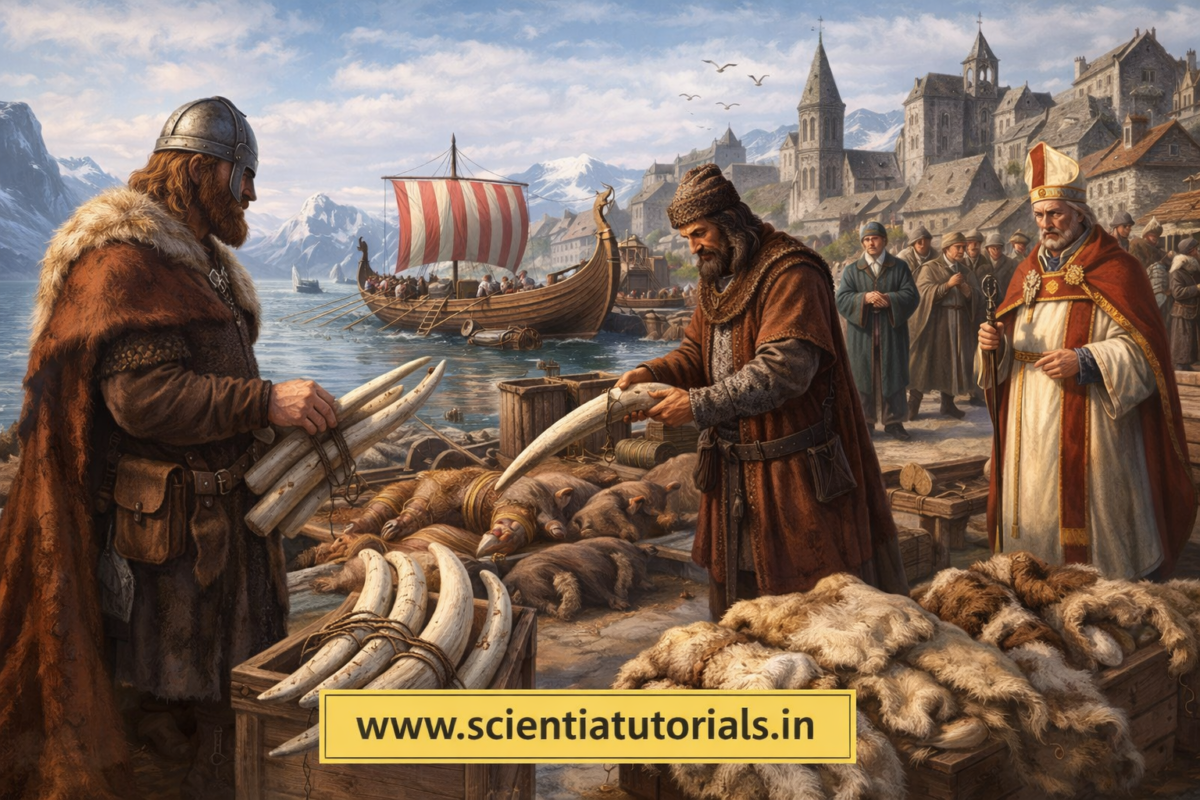

Greenland in Medieval European Trade Networks: Norse Economy and Decline
Module 2: Norse Expansion and Medieval Greenland
Lesson: Greenland in Medieval European Trade Networks
Era Framework: c. 10th Century – 15th Century
(Viking Expansion, Medieval Europe, Trans-Atlantic Contacts)
This lesson is systematically organized into four clearly structured sections, as detailed below:
- Chronologically Structured Study Module
- Short-Answer Type Questions
- Long-Answer Type Questions
- Multiple-Choice Questions (MCQs) with Answers and Detailed Explanations
Chronologically Structured Study Module
Introduction: Greenland and the Medieval World Economy
Although geographically remote and environmentally challenging, Greenland was not an isolated outpost during the Middle Ages. From its Norse settlement in the late tenth century until its disappearance from European records in the fifteenth century, Greenland functioned as a peripheral yet meaningful participant in medieval European trade networks. Its economy, survival, and cultural continuity depended heavily on maritime connections linking the Arctic to Scandinavia, the British Isles, and continental Europe.
This lesson examines how Greenland was integrated into medieval European trade systems, the commodities it supplied, the institutions that sustained its connectivity, and the structural weaknesses that eventually led to its economic isolation and decline. Chronologically structured, the study places Greenland within broader developments such as Viking expansion, Christian Europe, changing luxury markets, and climatic transformation.
I. Origins of Greenland’s Trade Connections (Late 10th Century)
Trade as a Motive for Norse Expansion
Norse expansion across the North Atlantic was driven not only by settlement needs but also by trade. Scandinavian societies were deeply embedded in exchange networks that linked Northern Europe with the wider medieval economy. Iceland, settled in the late ninth century, quickly became integrated into trade routes supplying wool, fish, and falcons to Europe.
Greenland emerged as the westernmost extension of this Norse commercial world. From its foundation around 985–986 CE, Greenland was envisioned not merely as an agricultural colony but as a resource frontier supplying rare Arctic goods to European markets.
Early Maritime Routes
Trade routes connected Greenland to Iceland, Norway, and beyond. These routes were seasonal and risky, dependent on favorable weather and sea ice conditions. Nevertheless, regular voyages during the early centuries of settlement ensured Greenland’s inclusion in the Norse economic sphere.
II. Key Trade Commodities of Medieval Greenland
Walrus Ivory: The Core Export
The most important Greenlandic export was walrus ivory. Walrus tusks were highly prized in medieval Europe for the production of luxury items such as chess pieces, reliquaries, knife handles, and ecclesiastical objects. Ivory from Greenland became particularly valuable as European demand for prestige goods expanded between the 11th and 13th centuries.
This commodity positioned Greenland as a supplier of elite goods rather than bulk agricultural products, making its economy vulnerable to shifts in elite consumption patterns.
Other Export Goods
In addition to walrus ivory, Greenland exported:
- Walrus hides and ropes
- Seal skins
- Polar bear pelts
- Falconry birds (occasionally)
These products catered to aristocratic and royal consumers in Europe, reinforcing Greenland’s niche role within medieval luxury trade.
III. Imports and Greenland’s Economic Dependence
Essential Imported Goods
Greenland lacked several essential resources, making imports crucial for survival. These included:
- Iron for tools and weapons
- Timber for ship repair and construction
- Grain and flour
- Cloth and manufactured goods
The inability to produce these locally created structural dependency on overseas trade, especially with Norway and Iceland.
The Role of Norway as a Trade Hub
Norway served as Greenland’s principal commercial gateway. Bergen, a major Norwegian port, connected Greenlandic exports to wider European markets. Over time, Greenland became increasingly dependent on Norwegian shipping and political oversight.
IV. Institutional Frameworks Supporting Trade
The Christian Church and Economic Integration
The establishment of Christianity in Greenland in the early eleventh century strengthened its integration into medieval Europe. The bishopric at Garðar tied Greenland to the wider ecclesiastical system of the Roman Catholic Church, facilitating not only religious exchange but also administrative and economic connections.
Church officials often traveled between Greenland and Europe, carrying goods, letters, and payments. Tithes and ecclesiastical obligations further linked Greenland to European economic circuits.
Royal Authority and Trade Regulation
By the thirteenth century, Greenland came under stronger Norwegian royal authority. The Norwegian crown increasingly sought to regulate trade, viewing Greenland as a royal dependency. While this offered some protection, it also limited Greenland’s access to alternative trading partners.
V. Greenland within Medieval European Trade Networks (12th–13th Century)
Integration into North European Commerce
During its peak, Greenland was indirectly connected to broader North European trade systems, including those dominated by emerging merchant networks such as the Hanseatic League. Although Greenland did not trade directly with Hanseatic cities, Norwegian intermediaries facilitated the movement of Greenlandic goods into continental markets.
Luxury Goods and Social Status
Greenland’s exports catered to elite demand. Walrus ivory, in particular, symbolized wealth, power, and religious authority. This positioned Greenland within a prestige-driven economic model rather than a diversified trade economy, increasing long-term vulnerability.
VI. Trans-Atlantic Trade and Exploration
Greenland as a Western Trade Outpost
Greenland was not only a recipient of European goods but also a base for westward exploration. Norse voyages to Helluland, Markland, and Vinland were partially motivated by resource acquisition, especially timber.
Although these regions did not become permanent trade partners, they highlight Greenland’s role as a trans-Atlantic node linking Europe to the American continents centuries before later European expansion.
VII. Challenges to Trade: Environment and Climate (13th–14th Century)
Climatic Deterioration
From the late thirteenth century, Greenland experienced colder conditions associated with the Little Ice Age. Increased sea ice made navigation more dangerous and shortened the sailing season. This directly disrupted trade, as fewer ships could reach Greenland reliably.
Decline in Agricultural Output
Reduced agricultural productivity forced Greenlanders to rely even more heavily on trade at the very moment when maritime connections were weakening. This imbalance accelerated economic decline.
VIII. Shifting European Markets and Economic Marginalization
Decline of Walrus Ivory Demand
By the fourteenth century, European access to elephant ivory from Africa and Asia expanded, reducing demand for walrus ivory. As Greenland’s primary export lost value, its economic relevance diminished.
Reduced Shipping and Isolation
Fewer ships from Norway reached Greenland. Trade became irregular, and essential imports declined. Greenland’s peripheral position transformed from strategic frontier to economic liability.
IX. Collapse of Trade Networks and Settlement Decline
The Western Settlement and Trade Failure
The Western Settlement, more remote and environmentally vulnerable, disappeared by the mid-fourteenth century. Its collapse reflects the consequences of trade breakdown, climatic stress, and demographic decline.
The Eastern Settlement’s Final Isolation
The Eastern Settlement survived longer due to better resources and stronger ecclesiastical ties. However, by the fifteenth century, even this settlement ceased to function within European trade networks. Written records end, and archaeological evidence indicates abandonment rather than sudden destruction.
X. Historical Significance of Greenland’s Medieval Trade Role
Greenland as a Peripheral Trade Economy
Greenland exemplifies a peripheral economy dependent on a narrow export base and distant markets. Its history illustrates the risks faced by frontier societies integrated into global systems without economic diversification.
Early Globalization and Its Limits
Greenland’s participation in medieval trade networks represents an early form of globalization. Goods, people, and ideas moved across vast distances, but environmental constraints and market shifts exposed the fragility of such connections.
Lessons for World History
The Greenlandic case demonstrates how climate, trade, and political control interact to shape historical outcomes. It provides valuable insight into medieval economic systems and the limits of expansion in extreme environments.
Conclusion
Between the tenth and fifteenth centuries, Greenland was an active participant in medieval European trade networks despite its Arctic location. Through the export of walrus ivory and other luxury goods, it maintained economic, religious, and cultural ties with Europe. However, its dependence on a narrow trade base, combined with climatic deterioration and shifting European markets, gradually undermined these connections.
The decline of Greenland’s trade networks ultimately led to the disappearance of Norse settlements, making this episode a crucial case study in understanding medieval globalization, environmental vulnerability, and economic dependency within world history.
Short Answer Type Questions with Answers
(Greenland in Medieval European Trade Networks)
1. When did Greenland become part of medieval European trade networks?
Answer: Greenland became part of medieval European trade networks from the late 10th century, following Norse settlement around 985–986 CE.
2. Why was trade essential for Norse Greenland?
Answer: Trade was essential because Greenland lacked key resources such as iron, timber, and grain, making imports necessary for survival.
3. Which region acted as Greenland’s primary trading intermediary?
Answer: Norway acted as Greenland’s primary trading intermediary, especially through ports like Bergen.
4. What was Greenland’s most important export commodity?
Answer: Walrus ivory was Greenland’s most important export in medieval Europe.
5. Why was walrus ivory highly valued in medieval Europe?
Answer: Walrus ivory was prized for making luxury goods such as religious artifacts, chess pieces, and elite household items.
6. Name two other exports from Greenland besides walrus ivory.
Answer: Seal skins and polar bear pelts were also exported from Greenland.
7. What types of goods did Greenland import from Europe?
Answer: Greenland imported iron tools, timber, grain, cloth, and manufactured goods.
8. How did geography affect Greenland’s trade?
Answer: Greenland’s remote Arctic location and harsh climate made trade seasonal, risky, and dependent on favorable sea conditions.
9. Which institution helped integrate Greenland into European networks?
Answer: The Roman Catholic Church helped integrate Greenland through religious administration and communication.
10. What was the role of the bishopric at Garðar?
Answer: The bishopric at Garðar connected Greenland religiously and economically to medieval Europe.
11. How did Christianity influence Greenland’s trade relations?
Answer: Christianity strengthened ties with Europe by linking Greenland to ecclesiastical networks and regular contact with Norway.
12. What was Greenland’s position in medieval trade systems?
Answer: Greenland functioned as a peripheral frontier economy supplying luxury Arctic goods.
13. Which medieval merchant network indirectly handled Greenlandic goods?
Answer: Greenlandic goods entered wider European markets through networks linked to the Hanseatic League via Norwegian intermediaries.
14. Why was Greenland economically vulnerable?
Answer: Greenland depended on a narrow range of exports and distant markets, making it sensitive to trade disruptions.
15. How did climate change affect Greenland’s trade?
Answer: Increased sea ice during the Little Ice Age made navigation dangerous and reduced the frequency of trading voyages.
16. What climatic phase initially supported Greenland’s trade activity?
Answer: The Medieval Warm Period initially supported trade by allowing easier navigation and limited agriculture.
17. Why did European demand for walrus ivory decline?
Answer: Demand declined due to increased availability of elephant ivory from Africa and Asia.
18. How did declining trade affect Greenland’s settlements?
Answer: Declining trade reduced access to essential imports, weakening economic stability and daily life.
19. Which settlement disappeared first due to economic and climatic stress?
Answer: The Western Settlement disappeared first, by the mid-14th century.
20. Why did Greenland not develop a diversified economy?
Answer: Environmental constraints limited agriculture and manufacturing, forcing reliance on a few export commodities.
21. How was Greenland connected to trans-Atlantic exploration?
Answer: Greenland served as a base for westward Norse voyages to regions like Markland and Vinland.
22. What role did shipping play in Greenland’s survival?
Answer: Regular shipping was vital for maintaining trade, communication, and supply of essential goods.
23. How did political control by Norway affect Greenland’s trade?
Answer: Norwegian control regulated trade but also restricted Greenland’s access to alternative markets.
24. What happened to Greenland’s trade networks by the 15th century?
Answer: By the 15th century, trade networks collapsed, and Greenland became economically isolated.
25. Why is Greenland’s medieval trade history historically significant?
Answer: It illustrates early globalization, climate-trade interaction, and the vulnerability of frontier economies.
Long Answer Type Questions with Answers
(Greenland in Medieval European Trade Networks)
1. Examine the emergence of Greenland as part of medieval European trade networks.
Answer:
Greenland emerged as part of medieval European trade networks following its Norse settlement around 985–986 CE. From the beginning, Greenland was not a self-sufficient agrarian colony but a resource frontier integrated into Scandinavian maritime trade. Norse settlers maintained sea routes connecting Greenland with Iceland and Norway, enabling the exchange of Arctic luxury goods for essential imports. This integration placed Greenland within the wider North Atlantic economic system of medieval Europe.
2. Discuss the importance of trade in sustaining Norse Greenland.
Answer:
Trade was essential for the survival of Norse Greenland because the island lacked critical natural resources such as iron, timber, and sufficient grain. Greenlandic society depended on imported tools, construction materials, and food supplies. Without sustained maritime trade, agricultural and social life could not be maintained, making trade a structural necessity rather than an economic option.
3. Analyze Greenland’s role as a peripheral economy in medieval Europe.
Answer:
Greenland functioned as a peripheral economy supplying rare luxury goods rather than bulk commodities. Its economic role was limited to niche Arctic products, especially walrus ivory. While this brought temporary prosperity, dependence on a narrow export base increased vulnerability to market fluctuations and declining demand, a common feature of peripheral economies in pre-modern global systems.
4. Explain the significance of walrus ivory in Greenland’s medieval trade.
Answer:
Walrus ivory was Greenland’s most valuable export and central to its trade relations. Highly prized in medieval Europe for religious artifacts, luxury objects, and symbols of status, walrus ivory connected Greenland to elite consumption networks. The prosperity of Norse Greenland depended heavily on sustained European demand for this commodity.
5. What other goods did Greenland export, and who consumed them?
Answer:
Besides walrus ivory, Greenland exported seal skins, walrus hides, ropes, and polar bear pelts. These goods were primarily consumed by European elites, royal courts, and ecclesiastical institutions. The aristocratic nature of this demand limited the scale and stability of Greenland’s trade.
6. Describe the imports that Greenland relied upon from Europe.
Answer:
Greenland relied on imports such as iron tools, timber for ship repair, grain, cloth, and manufactured goods. These imports were essential for agriculture, construction, and daily life. The inability to produce these resources locally made Greenland highly dependent on external trade connections.
7. Assess the role of Norway in Greenland’s trade networks.
Answer:
Norway acted as Greenland’s primary commercial and political intermediary. Norwegian ports, especially Bergen, linked Greenlandic exports to European markets. Over time, the Norwegian crown regulated Greenland’s trade, which provided some protection but also restricted access to alternative markets, increasing dependence on a single trade route.
8. How did the Christian Church strengthen Greenland’s integration with Europe?
Answer:
The establishment of Christianity connected Greenland institutionally to medieval Europe through the Roman Catholic Church. The bishopric at Garðar facilitated communication, movement of clergy, and economic exchange. Church obligations such as tithes and correspondence reinforced Greenland’s participation in European networks beyond purely commercial trade.
9. Examine the relationship between religion and trade in medieval Greenland.
Answer:
Religion and trade were closely linked. Ecclesiastical connections encouraged regular contact with Europe, while church officials often acted as carriers of goods and information. Religious legitimacy also reinforced Greenland’s identity as part of Christian Europe, sustaining its integration into continental economic systems.
10. Discuss Greenland’s indirect links to wider European trade networks.
Answer:
Although Greenland did not trade directly with most European regions, its goods entered broader markets through intermediaries. Norwegian merchants connected Greenlandic exports to trading systems influenced by the Hanseatic League, allowing Arctic commodities to circulate across Northern Europe.
11. Analyze Greenland’s role in trans-Atlantic trade and exploration.
Answer:
Greenland served as a western outpost for Norse exploration toward North America. Voyages to Markland and Vinland were partly motivated by the search for timber and other resources. Although these regions did not become permanent trade partners, Greenland’s position highlights its role in early trans-Atlantic connectivity.
12. How did climate affect Greenland’s trade networks?
Answer:
Climate played a decisive role in shaping trade. During the Medieval Warm Period, navigation was relatively easier, supporting regular voyages. From the 13th century onward, colder conditions associated with the Little Ice Age increased sea ice, shortened sailing seasons, and made trade routes unreliable.
13. Explain how environmental change intensified Greenland’s economic vulnerability.
Answer:
Environmental deterioration reduced agricultural productivity and increased reliance on imports. At the same time, worsening sea conditions disrupted trade. This imbalance—greater dependence on trade combined with declining connectivity—accelerated economic decline.
14. Discuss the impact of shifting European markets on Greenland’s economy.
Answer:
By the 14th century, European access to elephant ivory from Africa and Asia reduced demand for walrus ivory. As Greenland’s primary export lost value, its economic relevance diminished. The colony struggled to adapt due to the lack of alternative export commodities.
15. Why did Greenland fail to diversify its trade economy?
Answer:
Environmental constraints limited agricultural expansion and manufacturing. Greenland’s Arctic conditions made diversification difficult, forcing continued reliance on a few high-value exports. This lack of economic flexibility increased vulnerability to market and climatic changes.
16. Analyze the decline of trade and the disappearance of the Western Settlement.
Answer:
The Western Settlement, more remote and environmentally fragile, collapsed by the mid-14th century. Reduced trade, harsher climate, and demographic decline undermined its sustainability. The loss of trade connections made survival impossible.
17. Why did the Eastern Settlement survive longer?
Answer:
The Eastern Settlement benefited from better grazing land, stronger ecclesiastical institutions, and closer ties to trade routes. These advantages allowed it to persist longer, though it ultimately faced similar economic and environmental pressures.
18. Examine the role of political control in Greenland’s trade decline.
Answer:
Norwegian royal control regulated trade but limited Greenland’s access to alternative partners. When Norwegian shipping declined, Greenland lacked the autonomy to seek new markets, intensifying isolation.
19. What evidence suggests the collapse of Greenland’s trade networks?
Answer:
Written records from Europe cease by the 15th century, and archaeological evidence shows abandoned farms and reduced material culture. These indicators point to gradual economic isolation rather than sudden catastrophe.
20. Evaluate Greenland’s medieval trade experience as an example of early globalization.
Answer:
Greenland’s integration into distant trade networks represents an early form of globalization. Goods, people, and institutions connected the Arctic to Europe, demonstrating both the possibilities and fragility of long-distance economic integration.
21. How does Greenland’s trade history contribute to world historical understanding?
Answer:
Greenland’s experience highlights the interaction between climate, trade, and political control. It illustrates how peripheral regions can be deeply connected to global systems yet remain highly vulnerable to change.
22. Conclude with an assessment of why Greenland’s medieval trade system collapsed.
Answer:
Greenland’s trade system collapsed due to climatic cooling, declining demand for key exports, political restrictions, and geographic isolation. Its dependence on a narrow luxury-goods economy made adaptation difficult, leading ultimately to the disappearance of Norse Greenland.
MCQs with Answers and Explanations
(Greenland in Medieval European Trade Networks)
1. Greenland became part of medieval European trade networks primarily after:
A. The Roman expansion
B. Norse settlement in the late 10th century
C. The Crusades
D. The rise of Atlantic empires
Correct Answer: B
Explanation:
Greenland entered European trade networks after Norse settlers arrived around 985–986 CE, linking it to Iceland and Norway through maritime routes.
2. Which factor made trade essential for Norse Greenland’s survival?
A. Excess population
B. Military expansion
C. Lack of essential natural resources
D. Religious obligations
Correct Answer: C
Explanation:
Greenland lacked iron, timber, and sufficient grain, making overseas trade vital for basic survival.
3. Which region acted as Greenland’s main commercial intermediary?
A. England
B. Denmark
C. Iceland
D. Norway
Correct Answer: D
Explanation:
Norway, especially ports like Bergen, served as the primary gateway linking Greenland to wider European markets.
4. What was the most important export commodity of medieval Greenland?
A. Timber
B. Wool
C. Walrus ivory
D. Fish
Correct Answer: C
Explanation:
Walrus ivory was highly valued in medieval Europe for luxury and religious objects, forming the backbone of Greenland’s export economy.
5. Walrus ivory was mainly used in medieval Europe to produce:
A. Weapons
B. Agricultural tools
C. Luxury and religious items
D. Ship components
Correct Answer: C
Explanation:
Ivory was used for chess pieces, reliquaries, and elite household objects, linking Greenland to aristocratic consumption.
6. Which of the following was NOT a major Greenlandic export?
A. Seal skins
B. Polar bear pelts
C. Walrus hides
D. Wine
Correct Answer: D
Explanation:
Wine was an imported European product; Greenland exported Arctic animal-based goods.
7. Greenland depended on imports mainly for:
A. Gold and silver
B. Iron, timber, and grain
C. Salt and spices
D. Silk and porcelain
Correct Answer: B
Explanation:
Essential materials for tools, construction, and food had to be imported due to Greenland’s environment.
8. Which institution strengthened Greenland’s integration with Europe beyond trade?
A. Viking assemblies
B. Royal courts
C. The Roman Catholic Church
D. Merchant guilds
Correct Answer: C
Explanation:
The Church linked Greenland to Europe through bishops, clergy, tithes, and regular communication.
9. The bishopric at Garðar primarily symbolized:
A. Military power
B. Urban development
C. Ecclesiastical and economic integration
D. Independence from Europe
Correct Answer: C
Explanation:
Garðar connected Greenland institutionally and economically to medieval Christian Europe.
10. Greenland’s position in medieval trade is best described as:
A. A core manufacturing center
B. A self-sufficient economy
C. A peripheral luxury-goods supplier
D. A commercial empire
Correct Answer: C
Explanation:
Greenland supplied rare luxury commodities rather than mass goods, making it a peripheral economy.
11. Which trading system indirectly handled Greenlandic goods in Europe?
A. Mediterranean trade network
B. Silk Road
C. Hanseatic League
D. Indian Ocean trade
Correct Answer: C
Explanation:
Greenlandic goods reached European markets through Norwegian intermediaries linked to Hanseatic commerce.
12. Why was Greenland’s trade economy structurally weak?
A. Overpopulation
B. Political instability
C. Dependence on a narrow export base
D. Excessive taxation
Correct Answer: C
Explanation:
Reliance on walrus ivory made Greenland vulnerable to market changes.
13. Which climatic phase initially supported Greenland’s trade activity?
A. Ice Age
B. Medieval Warm Period
C. Little Ice Age
D. Modern warming
Correct Answer: B
Explanation:
Milder conditions allowed navigation and limited agriculture during Greenland’s early prosperity.
14. The Little Ice Age primarily affected Greenland’s trade by:
A. Increasing exports
B. Reducing sea ice
C. Making navigation dangerous
D. Expanding farming
Correct Answer: C
Explanation:
Colder conditions increased sea ice and shortened sailing seasons, disrupting trade routes.
15. Which European development reduced demand for walrus ivory?
A. Decline of Christianity
B. Increased access to elephant ivory
C. Rise of coinage
D. Trade embargoes
Correct Answer: B
Explanation:
African and Asian elephant ivory became more accessible, reducing Greenland’s economic relevance.
16. How did declining trade affect daily life in Greenland?
A. Improved self-sufficiency
B. Increased wealth
C. Shortage of essential imports
D. Political independence
Correct Answer: C
Explanation:
Reduced trade meant fewer tools, materials, and food supplies, weakening settlement stability.
17. Which settlement was most affected by trade decline?
A. Eastern Settlement
B. Central Settlement
C. Northern Settlement
D. Western Settlement
Correct Answer: D
Explanation:
The Western Settlement, more remote and vulnerable, disappeared by the mid-14th century.
18. Why did Greenland fail to diversify its economy?
A. Lack of labor
B. Environmental constraints
C. Religious restrictions
D. Political rebellion
Correct Answer: B
Explanation:
Harsh climate and limited resources restricted agricultural and industrial diversification.
19. Greenland’s trade history best illustrates which broader theme?
A. Industrial capitalism
B. Climate–economy interaction
C. Imperial conquest
D. Nationalism
Correct Answer: B
Explanation:
Environmental change directly shaped economic connectivity and decline.
20. Which political factor contributed to Greenland’s isolation?
A. Danish invasion
B. Norwegian trade regulation
C. Papal bans
D. Viking civil wars
Correct Answer: B
Explanation:
Norwegian control limited Greenland’s access to alternative trade partners.
21. Greenland’s role in medieval trade can be seen as an example of:
A. Mercantilism
B. Colonial exploitation
C. Early globalization
D. Industrial exchange
Correct Answer: C
Explanation:
Despite distance, Greenland was integrated into long-distance economic and institutional networks.
22. By which century did Greenland largely drop out of European trade networks?
A. 12th century
B. 13th century
C. 14th century
D. 15th century
Correct Answer: D
Explanation:
By the 15th century, written records and regular trade connections ceased.
23. Which factor most directly linked Greenland’s trade to elite European demand?
A. Grain exports
B. Walrus ivory
C. Wool production
D. Shipbuilding
Correct Answer: B
Explanation:
Ivory catered to elite and ecclesiastical consumption, not mass markets.
24. Greenland’s medieval trade experience shows that frontier economies are:
A. Always resilient
B. Immune to climate
C. Highly vulnerable to change
D. Politically dominant
Correct Answer: C
Explanation:
Dependence on distant markets and fragile environments increased vulnerability.
25. Why is Greenland’s medieval trade history important for world history?
A. It led to modern capitalism
B. It shows limits of early global integration
C. It created permanent colonies in America
D. It caused European industrialization
Correct Answer: B
Explanation:
Greenland demonstrates both the reach and fragility of medieval global connections.