
Indigenous Resistance, Adaptation, and Continuity
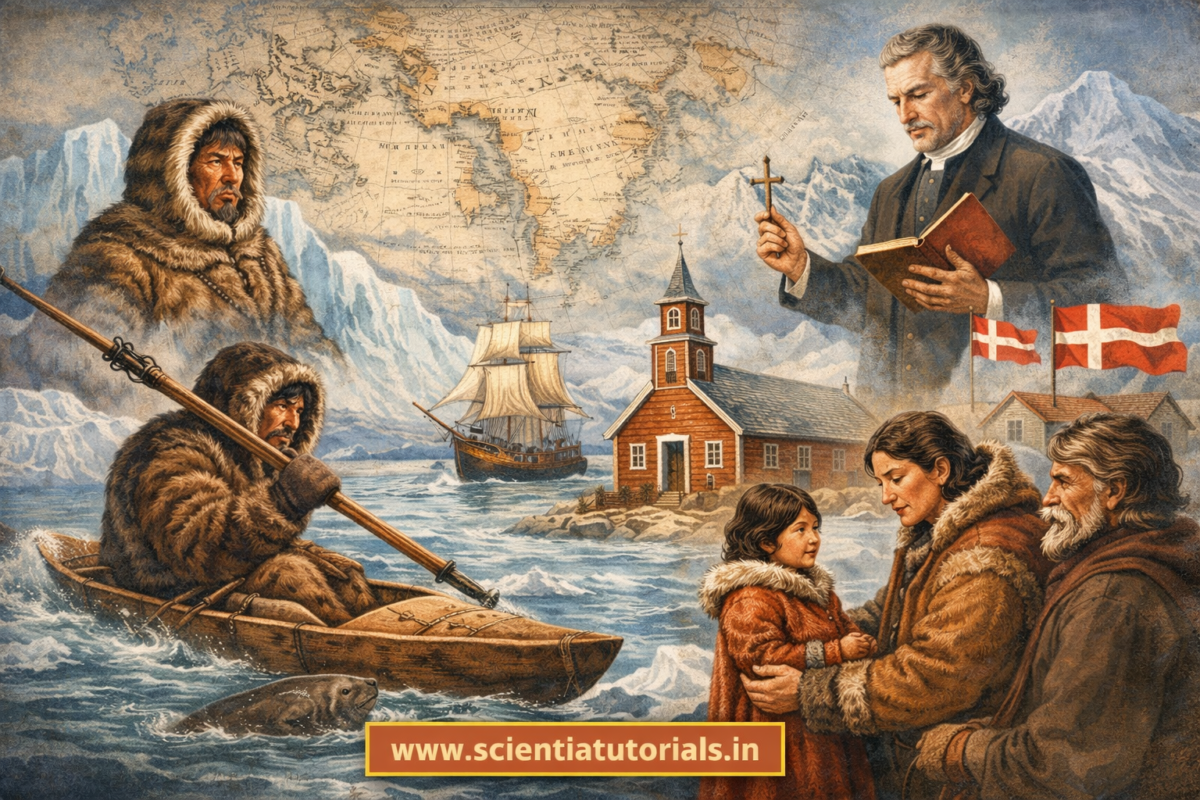

Indigenous Resistance and Adaptation in Greenland (16th–19th Century)
Course: Greenland: Historical Evolution and Its Global Strategic Importance
Module 3: Colonial Encounters and Early Modern Transformations
Era Framework: 16th Century – 19th Century
(European expansion, mercantilism, missionary activity)
This lesson is systematically organized into four clearly structured sections, as detailed below:
- Chronologically Structured Study Module
- Short-Answer Type Questions
- Long-Answer Type Questions
- Multiple-Choice Questions (MCQs) with Answers and Detailed Explanations
Chronologically Structured Study Module
Lesson Objectives
This lesson seeks to enable learners to:
- Examine Indigenous (Inuit) responses to European expansion in Greenland
- Understand forms of resistance beyond armed conflict, including cultural and economic strategies
- Analyze Indigenous adaptation to colonial trade, missions, and mercantilist systems
- Trace long-term continuities in Inuit social organization, subsistence practices, and knowledge systems
- Situate Indigenous agency at the center of Greenland’s early modern historical experience
Introduction: Re-centering Indigenous Agency in Early Modern Greenland
Early modern Greenland is often described through the lens of European expansion, whaling, trade monopolies, and missionary activity. However, such narratives risk portraying Indigenous Inuit communities as passive recipients of colonial change. In reality, Inuit societies were active historical agents who resisted, adapted to, and selectively engaged with European economic, religious, and political pressures.
Between the 16th and 19th centuries, Inuit communities demonstrated remarkable resilience. They negotiated new trade relationships, absorbed foreign technologies into traditional lifeways, resisted cultural domination, and preserved core social and ecological knowledge. This lesson places Indigenous experience at the center of Greenland’s early modern transformation, emphasizing resistance, adaptation, and continuity rather than displacement or collapse.
I. Indigenous Greenland on the Eve of European Re-engagement
1. Inuit Society Before Sustained European Contact
Prior to sustained early modern European contact, Greenland was inhabited by Inuit societies whose ancestors had migrated across the Arctic over centuries. These communities possessed sophisticated ecological knowledge and survival strategies adapted to extreme polar environments.
Key characteristics included:
- Subsistence based on hunting (seals, whales, caribou), fishing, and gathering
- Seasonal mobility aligned with animal migration and ice conditions
- Strong kinship networks and communal resource sharing
- Oral traditions as the primary means of cultural transmission
This social and economic organization prioritized sustainability, flexibility, and collective survival.
2. Legacy of Earlier External Contacts
Inuit societies were not entirely unfamiliar with outsiders. Memories and material traces of earlier Norse presence persisted in some regions. These indirect encounters shaped Inuit perceptions of foreigners and informed later responses to Europeans.
II. First Encounters and Indigenous Responses (16th–17th Century)
1. Nature of Early Encounters
When European whalers and explorers reappeared along Greenland’s coasts in the 16th and 17th centuries, contact was sporadic and seasonal. Europeans were primarily interested in marine resources, not territorial conquest.
Inuit responses varied by region and circumstance:
- Cautious observation and avoidance
- Selective trade and exchange
- Strategic cooperation when beneficial
2. Indigenous Control of Interaction
Crucially, Inuit communities initially retained control over the terms of interaction. Europeans depended on Indigenous knowledge for navigation, hunting grounds, and survival in Arctic conditions. This asymmetry limited early colonial domination.
III. Resistance Without War: Indigenous Strategies
1. Cultural Resistance
Unlike many colonial contexts, resistance in Greenland rarely took the form of organized armed conflict. Instead, Inuit resistance was expressed culturally and socially.
Forms of cultural resistance included:
- Retention of Indigenous languages despite missionary education
- Continuation of traditional spiritual beliefs alongside nominal Christian conversion
- Preservation of oral storytelling, ritual practices, and communal norms
Conversion to Christianity was often selective and pragmatic rather than total.
2. Spatial and Social Autonomy
Inuit communities maintained autonomy by:
- Continuing seasonal mobility beyond direct colonial oversight
- Living outside permanent European settlements when possible
- Limiting dependence on colonial institutions
This spatial flexibility reduced colonial control over daily life.
IV. Economic Adaptation and Selective Engagement
1. Integration into Colonial Trade
As mercantilist trade systems expanded in the 18th century under Denmark-Norway, Inuit communities increasingly engaged in trade. Animal products such as sealskins and fox pelts gained exchange value.
However, this integration was selective:
- Subsistence hunting remained central
- Trade supplemented, rather than replaced, traditional economies
- Inuit hunters controlled production through Indigenous ecological knowledge
2. Technology Transfer and Adaptation
Inuit communities adopted European tools—metal knives, firearms, boats—while adapting them to existing practices. Rather than transforming Inuit lifeways into European models, technology was absorbed into Indigenous systems.
Kayak design, hunting techniques, and clothing styles continued to reflect Indigenous innovation.
V. Missionary Encounters and Indigenous Negotiation
1. Missions as Sites of Cultural Tension
Missionary activity intensified in the 18th century, aiming to Christianize Inuit populations and reshape social behavior. Missions sought to:
- Promote sedentary settlement
- Encourage European moral norms
- Restructure family and labor systems
2. Indigenous Responses to Missionary Pressure
Inuit reactions ranged from acceptance to quiet resistance:
- Some embraced literacy and education for practical advantages
- Others blended Christian teachings with Indigenous beliefs
- Many maintained traditional practices privately
Christianity often became layered onto, rather than replacing, Indigenous worldviews.
VI. Continuity of Indigenous Knowledge Systems
1. Environmental Knowledge and Survival
Despite colonial pressures, Inuit environmental knowledge remained intact and essential. Europeans frequently depended on Indigenous expertise for:
- Ice navigation
- Weather interpretation
- Sustainable hunting practices
This knowledge ensured Inuit cultural continuity and ecological resilience.
2. Oral Tradition and Social Memory
Oral histories preserved collective memory, reinforcing identity and continuity. Stories, songs, and rituals transmitted values and historical experience across generations, even as written culture expanded.
VII. Gender, Family, and Social Continuity
1. Stability of Family Structures
Colonial influence had limited impact on core Inuit family organization. Kinship, mutual support, and intergenerational cooperation remained central to survival.
2. Gender Roles and Adaptation
While European observers often misunderstood Inuit gender roles, Indigenous divisions of labor persisted. Both men and women played essential economic and cultural roles, particularly in sustaining households and community cohesion.
VIII. The 19th Century: Transformation Without Disappearance
1. Intensified Colonial Administration
By the 19th century, colonial governance became more structured. Trade monopolies and missions exerted greater influence, but Inuit society did not collapse.
2. Adaptive Resilience
Inuit communities continued to adapt:
- Balancing wage labor with subsistence activities
- Participating in colonial systems while preserving identity
- Transmitting language, customs, and ecological knowledge
Continuity, not eradication, defined the Indigenous experience.
IX. Indigenous Experience and Greenland’s Global Significance
1. Challenging Colonial Narratives
Greenland’s early modern history challenges assumptions that colonial encounters inevitably resulted in Indigenous displacement. Instead, it highlights negotiation, adaptation, and resilience.
2. Foundations for Modern Greenlandic Identity
The persistence of Inuit culture during the early modern period laid the foundations for modern Greenlandic identity, political consciousness, and cultural revival movements in later centuries.
Conclusion
Between the 16th and 19th centuries, Inuit communities in Greenland faced expanding European economic, religious, and political influence. Yet they were never passive victims of colonial transformation. Through cultural resistance, selective economic adaptation, and the preservation of Indigenous knowledge systems, Inuit societies maintained continuity amid change.
The history of Indigenous resistance and adaptation in early modern Greenland reveals a powerful narrative of resilience. It underscores the importance of Indigenous agency in shaping Greenland’s past and provides essential context for understanding its present and future within global systems.
Short Answer Type Questions with Answers
Lesson: Indigenous Resistance, Adaptation, and Continuity (16th–19th Century)
1. Who were the Indigenous inhabitants of Greenland during the early modern period?
The Indigenous inhabitants of Greenland were the Inuit, whose ancestors had migrated across the Arctic over centuries.
2. What is meant by Indigenous “agency” in the context of early modern Greenland?
Indigenous agency refers to the active role played by Inuit communities in shaping their responses to European expansion rather than passively accepting colonial change.
3. Describe the basis of the traditional Inuit subsistence economy.
It was based on hunting, fishing, gathering, seasonal mobility, and communal sharing of resources adapted to Arctic environments.
4. How did Inuit communities respond to early European encounters in the 16th century?
Responses included cautious observation, selective trade, avoidance, and strategic cooperation depending on circumstances.
5. Why did Europeans initially depend on Inuit knowledge?
Europeans relied on Inuit expertise for navigation, hunting grounds, ice conditions, and survival in the Arctic.
6. What forms of resistance did Inuit communities commonly practice?
Resistance was mainly cultural and social rather than military, including language retention and preservation of traditions.
7. Why was armed resistance uncommon in early modern Greenland?
European presence was limited and seasonal, and Inuit strategies emphasized autonomy, avoidance, and adaptation over conflict.
8. How did Inuit communities maintain spatial autonomy?
They continued seasonal migration and lived beyond permanent colonial settlements whenever possible.
9. What role did trade play in Inuit adaptation to colonial systems?
Trade supplemented traditional subsistence activities and allowed Inuit to engage selectively with European markets.
10. Under which colonial authority did Greenland’s trade expand in the 18th century?
Greenland’s trade expanded under Denmark-Norway, which established monopolized trade systems.
11. Name two animal products commonly traded by Inuit communities.
Sealskins and fox pelts were commonly traded.
12. How did Inuit hunters adapt European tools to their lifeways?
They integrated metal tools and firearms into traditional hunting practices without abandoning Indigenous techniques.
13. What was selective engagement in the context of Inuit–European relations?
It meant adopting useful foreign elements while rejecting those that threatened cultural autonomy.
14. How did missionary activity affect Inuit society?
Missionaries promoted Christianity and sedentary life but had limited success in erasing traditional beliefs.
15. Why did some Inuit accept missionary education?
Education provided literacy and practical advantages in dealing with colonial authorities and trade systems.
16. How did Inuit communities resist full religious conversion?
They blended Christian practices with Indigenous beliefs and maintained traditional rituals privately.
17. What role did oral tradition play in Inuit continuity?
Oral traditions preserved history, values, and cultural knowledge across generations.
18. Why was Indigenous environmental knowledge crucial during this period?
It ensured survival in extreme Arctic conditions and remained essential even to European settlers and traders.
19. How did Inuit family structures respond to colonial pressures?
Core kinship systems and communal cooperation remained largely intact.
20. What role did women play in sustaining Inuit continuity?
Women contributed to household stability, food processing, clothing production, and cultural transmission.
21. What does “adaptation without assimilation” mean in Greenland’s context?
It refers to Inuit adoption of new practices while preserving core cultural identity.
22. How did colonial administration intensify in the 19th century?
Through expanded trade regulation, missionary oversight, and formal governance structures.
23. Did increased colonial control lead to the disappearance of Inuit culture?
No, Inuit culture persisted through adaptation, resilience, and continuity.
24. Why is Inuit resistance described as subtle rather than confrontational?
Because it relied on cultural persistence, selective participation, and autonomy rather than open conflict.
25. Why is Indigenous continuity central to understanding modern Greenland?
It laid the foundation for modern Greenlandic identity, cultural revival, and political consciousness.
Long Answer Type Questions with Answers
Lesson: Indigenous Resistance, Adaptation, and Continuity (16th–19th Century)
1. Examine the nature of Indigenous Inuit society in Greenland before sustained European contact.
Before sustained European contact, Inuit society in Greenland was highly adapted to Arctic ecological conditions. The economy was based on hunting, fishing, and seasonal mobility, particularly focused on marine mammals such as seals and whales. Social organization emphasized kinship networks, communal sharing of resources, and collective survival. Knowledge was transmitted orally through stories, rituals, and lived experience, ensuring continuity and resilience in a harsh environment.
2. Why is it important to emphasize Indigenous agency in the study of early modern Greenland?
Emphasizing Indigenous agency corrects colonial narratives that portray Inuit communities as passive victims of European expansion. Inuit societies actively shaped their historical experiences through resistance, adaptation, negotiation, and selective engagement. Recognizing agency highlights Indigenous decision-making, resilience, and continuity, offering a more balanced and accurate understanding of Greenland’s past.
3. Analyze the nature of early encounters between Inuit communities and Europeans in the 16th and 17th centuries.
Early encounters were sporadic, seasonal, and primarily economic. European explorers and whalers were interested in Arctic resources rather than territorial conquest. Inuit responses varied, including cautious observation, avoidance, limited trade, and strategic cooperation. During this phase, Inuit communities largely controlled the terms of interaction due to European dependence on Indigenous knowledge.
4. How did Indigenous environmental knowledge shape power relations during early encounters?
Inuit knowledge of ice conditions, weather patterns, hunting techniques, and Arctic navigation was essential for European survival. This dependency limited European dominance and allowed Inuit communities to retain significant autonomy. Environmental expertise functioned as a form of power, reinforcing Indigenous control in early interactions.
5. Discuss why resistance in early modern Greenland rarely took the form of armed conflict.
Armed resistance was uncommon because European presence was limited and not initially focused on land seizure. Inuit strategies prioritized survival, flexibility, and autonomy rather than confrontation. Cultural persistence, avoidance, and selective cooperation proved more effective than military resistance in the Arctic context.
6. Examine the concept of cultural resistance as practiced by Inuit communities.
Cultural resistance involved the preservation of language, beliefs, rituals, and social norms despite missionary and colonial pressure. Inuit communities often adopted outward forms of Christianity while privately maintaining Indigenous spiritual practices. Oral traditions and communal values remained strong, ensuring cultural continuity.
7. How did spatial mobility function as a form of Indigenous resistance?
Seasonal migration allowed Inuit communities to avoid direct colonial oversight. By living beyond permanent trading posts and missions, Inuit maintained autonomy over daily life and resource use. Spatial flexibility reduced the effectiveness of colonial control mechanisms.
8. Analyze Inuit participation in colonial trade systems during the 18th century.
Inuit communities increasingly engaged in trade by exchanging animal products such as sealskins and pelts for European goods. However, participation was selective. Subsistence hunting remained central, and trade served as a supplement rather than a replacement. Indigenous ecological knowledge continued to guide production.
9. Assess the impact of mercantilist trade policies on Indigenous economic life.
Mercantilist policies sought to regulate trade and control Indigenous production, particularly under Denmark-Norway. While these policies increased economic dependency, they did not eliminate traditional subsistence systems. Inuit communities adapted by balancing colonial trade with Indigenous practices.
10. Discuss how Inuit communities adapted European technologies without losing cultural identity.
European tools such as metal knives and firearms were incorporated into traditional hunting systems. Rather than transforming Inuit society into a European model, technology was adapted to Indigenous needs. Kayaks, clothing, and hunting strategies remained rooted in Inuit innovation.
11. Examine the role of missionary activity in reshaping Inuit society.
Missionaries aimed to Christianize Inuit communities, promote sedentary life, and restructure social behavior. Missions also served as centers of education and trade. While missionaries influenced social practices, their ability to erase Indigenous culture was limited.
12. How did Inuit communities negotiate missionary pressure and religious change?
Inuit responses ranged from partial acceptance to quiet resistance. Many adopted Christian practices pragmatically while blending them with Indigenous beliefs. Traditional rituals often continued privately, demonstrating selective religious adaptation rather than full conversion.
13. Analyze the significance of oral tradition in maintaining Indigenous continuity.
Oral traditions preserved history, environmental knowledge, moral values, and collective memory. They reinforced identity and ensured intergenerational transmission of culture even as literacy and missionary education expanded.
14. Discuss the continuity of Inuit family and kinship systems under colonial influence.
Despite colonial pressures, Inuit kinship structures remained stable. Extended family networks, communal cooperation, and shared responsibilities continued to form the foundation of social life. These structures enhanced resilience during periods of economic and cultural change.
15. Evaluate the role of gender in sustaining Inuit society during the early modern period.
Both men and women played essential roles. Men often focused on hunting and navigation, while women managed food processing, clothing production, child-rearing, and cultural transmission. Gender cooperation was central to community survival and continuity.
16. Explain the concept of “adaptation without assimilation” in Greenland’s Indigenous history.
Adaptation without assimilation refers to Inuit adoption of selected European practices while preserving core cultural identity. This approach allowed Inuit communities to benefit from new opportunities without abandoning traditional lifeways.
17. Analyze changes in colonial administration in the 19th century and their impact on Inuit society.
Colonial governance became more structured, with increased regulation of trade and expanded missionary oversight. While colonial influence intensified, Inuit communities continued to adapt and preserve cultural practices rather than disappearing.
18. Did increased colonial control result in cultural collapse? Justify your answer.
No, increased colonial control did not result in cultural collapse. Inuit societies demonstrated resilience by integrating new elements selectively while maintaining language, social organization, and environmental knowledge.
19. Compare Indigenous resistance in Greenland with armed resistance in other colonial contexts.
Unlike regions where land seizure and forced labor provoked armed resistance, Greenland’s Arctic environment favored subtle strategies. Cultural persistence, avoidance, and negotiation were more effective than warfare in maintaining autonomy.
20. Discuss the long-term consequences of Indigenous adaptation for Greenland’s modern identity.
Indigenous adaptation ensured cultural survival and laid the foundation for modern Greenlandic identity. Language, traditions, and historical memory continue to shape political consciousness and cultural revival movements.
21. How does the Greenlandic case challenge conventional models of colonial domination?
Greenland demonstrates that colonial encounters did not always lead to Indigenous displacement or total assimilation. Instead, negotiation, adaptation, and continuity played central roles, challenging linear models of colonial domination.
22. Examine the relationship between economic engagement and cultural resistance in Inuit society.
Economic engagement did not automatically lead to cultural loss. Inuit communities used trade strategically while maintaining cultural practices, showing that economic adaptation and cultural resistance could coexist.
23. Analyze the importance of Indigenous knowledge systems in shaping Greenland’s early modern history.
Indigenous knowledge was essential for survival, trade, and navigation. It influenced European success in the Arctic and ensured Inuit resilience, making it central to Greenland’s historical development.
24. Why is continuity a key theme in understanding Indigenous history in Greenland?
Continuity highlights survival rather than disappearance. Despite centuries of change, Inuit culture, language, and social structures persisted, shaping Greenland’s long-term historical trajectory.
25. Why is the study of Indigenous resistance and adaptation essential for understanding Greenland’s global strategic importance today?
Modern Greenland’s identity, political status, and global significance are rooted in Indigenous continuity. Understanding early modern resistance and adaptation provides context for contemporary debates on sovereignty, culture, and strategic importance.
MCQs with Answers and Explanations
Lesson: Indigenous Resistance, Adaptation, and Continuity (16th–19th Century)
1. The Indigenous inhabitants of Greenland during the early modern period were the
A. Sami
B. Norse settlers
C. Inuit
D. Aleut
Correct Answer: C
Explanation:
The Inuit were the Indigenous peoples of Greenland, with ancestors migrating across the Arctic over centuries.
2. Indigenous “agency” refers to
A. European administrative control
B. Indigenous passivity under colonialism
C. Active Indigenous decision-making and responses
D. Missionary influence
Correct Answer: C
Explanation:
Agency highlights that Inuit actively shaped their responses through resistance, adaptation, and negotiation.
3. The traditional Inuit economy before sustained European contact was primarily based on
A. Agriculture and trade
B. Hunting, fishing, and seasonal mobility
C. Industrial production
D. Mining and metallurgy
Correct Answer: B
Explanation:
Inuit subsistence systems were adapted to Arctic ecology, relying on hunting, fishing, and migration.
4. Early Inuit responses to European contact included
A. Immediate armed rebellion
B. Forced conversion
C. Selective trade and cautious observation
D. Complete isolation
Correct Answer: C
Explanation:
Inuit communities cautiously observed Europeans and engaged selectively in trade and cooperation.
5. Europeans initially depended on Inuit knowledge mainly for
A. Agricultural techniques
B. Arctic navigation and survival
C. Industrial production
D. Political administration
Correct Answer: B
Explanation:
Inuit knowledge of ice, weather, and hunting was crucial for European survival in the Arctic.
6. Resistance in early modern Greenland was mainly expressed through
A. Large-scale warfare
B. Industrial strikes
C. Cultural and social persistence
D. Political revolutions
Correct Answer: C
Explanation:
Inuit resistance was largely cultural—preserving language, traditions, and social practices.
7. Why was armed resistance uncommon in Greenland?
A. Inuit lacked weapons
B. Europeans controlled the interior
C. European presence was limited and seasonal
D. Inuit were forced into peace treaties
Correct Answer: C
Explanation:
Europeans were mostly seasonal visitors, and Inuit strategies emphasized autonomy and adaptation.
8. Spatial mobility helped Inuit communities to
A. Join European cities
B. Avoid colonial oversight
C. Establish plantations
D. Centralize administration
Correct Answer: B
Explanation:
Seasonal movement allowed Inuit to live beyond permanent colonial control.
9. Trade with Europeans led Inuit communities to
A. Abandon subsistence hunting
B. Focus only on wage labor
C. Supplement subsistence with market production
D. Shift to agriculture
Correct Answer: C
Explanation:
Trade added new economic opportunities but did not replace traditional subsistence systems.
10. Greenland’s 18th-century trade expansion was controlled by
A. Britain
B. France
C. Denmark-Norway
D. Spain
Correct Answer: C
Explanation:
Denmark-Norway established monopolized trade systems and colonial governance in Greenland.
11. Which animal products were commonly traded by Inuit communities?
A. Cotton and sugar
B. Timber and coal
C. Sealskins and fox pelts
D. Spices and silk
Correct Answer: C
Explanation:
Sealskins and pelts were valuable commodities in European markets.
12. Inuit adaptation of European technology is best described as
A. Complete technological rejection
B. Total Europeanization
C. Selective integration into Indigenous practices
D. Forced industrialization
Correct Answer: C
Explanation:
Inuit adopted useful tools but retained traditional techniques and designs.
13. “Selective engagement” means
A. Total acceptance of European culture
B. Rejection of all foreign influences
C. Adopting useful elements while preserving Indigenous identity
D. Isolation from trade
Correct Answer: C
Explanation:
Inuit communities selectively adopted foreign practices without losing cultural autonomy.
14. Missionaries in Greenland primarily aimed to
A. Promote mining
B. Christianize and reshape social behavior
C. Establish plantations
D. Build military bases
Correct Answer: B
Explanation:
Missionaries sought religious conversion and social restructuring toward European norms.
15. Inuit responses to Christianity were best characterized as
A. Complete rejection
B. Violent opposition
C. Selective acceptance and syncretism
D. Immediate full conversion
Correct Answer: C
Explanation:
Many Inuit blended Christian practices with Indigenous beliefs rather than fully abandoning traditions.
16. Oral tradition among Inuit communities served to
A. Replace hunting
B. Preserve cultural knowledge and history
C. Promote European education
D. Record trade contracts
Correct Answer: B
Explanation:
Oral traditions transmitted knowledge, values, and historical memory across generations.
17. Indigenous environmental knowledge was important because it
A. Promoted agriculture
B. Was irrelevant to Europeans
C. Ensured survival in extreme Arctic conditions
D. Replaced scientific knowledge
Correct Answer: C
Explanation:
Inuit ecological expertise was essential for survival and even guided Europeans in the Arctic.
18. Inuit kinship systems under colonial pressure
A. Collapsed completely
B. Were replaced by European family models
C. Remained largely intact
D. Became industrial labor units
Correct Answer: C
Explanation:
Kinship and communal cooperation remained central to Inuit social organization.
19. Inuit gender roles were characterized by
A. Complete inequality
B. Irrelevance of women
C. Complementary roles essential for survival
D. European-style patriarchy
Correct Answer: C
Explanation:
Both men and women contributed crucially to economic and cultural continuity.
20. “Adaptation without assimilation” means
A. Rejecting all change
B. Adopting foreign culture entirely
C. Integrating new practices while preserving identity
D. Forced Europeanization
Correct Answer: C
Explanation:
Inuit adapted selectively while maintaining core cultural identity.
21. Colonial administration intensified in the 19th century through
A. Complete decolonization
B. Trade regulation and missionary expansion
C. Industrialization
D. Military conquest
Correct Answer: B
Explanation:
Colonial governance became more structured with regulated trade and missionary oversight.
22. Increased colonial control led to
A. Total disappearance of Inuit culture
B. Complete assimilation
C. Continued adaptation and cultural persistence
D. Immediate independence
Correct Answer: C
Explanation:
Despite increased control, Inuit culture persisted through resilience and adaptation.
23. Compared to other colonial regions, Indigenous resistance in Greenland was
A. More militarized
B. Less significant
C. More subtle and culturally based
D. Non-existent
Correct Answer: C
Explanation:
Greenlandic resistance relied on cultural persistence, avoidance, and negotiation rather than warfare.
24. Indigenous continuity in Greenland contributed to
A. Loss of identity
B. Modern Greenlandic cultural and political identity
C. European dominance
D. Economic collapse
Correct Answer: B
Explanation:
Cultural survival laid the foundation for modern Greenlandic identity and political consciousness.
25. The Greenlandic case challenges colonial models by showing that
A. Colonialism always caused cultural extinction
B. Indigenous peoples never adapted
C. Negotiation and continuity were possible
D. Europeans avoided the Arctic
Correct Answer: C
Explanation:
Greenland demonstrates that colonial encounters could involve negotiation, adaptation, and long-term Indigenous continuity.