
Natural Resources and Global Economic Interests
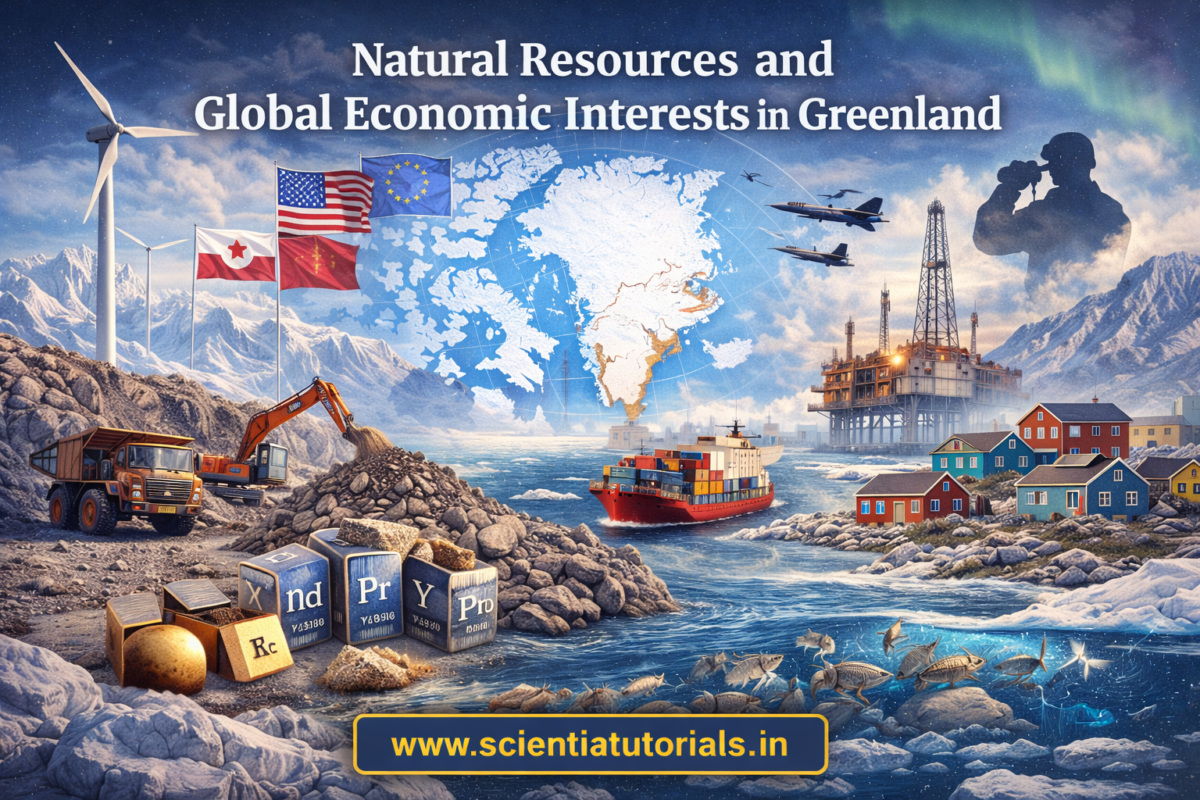

Natural Resources and Global Economic Interests in Greenland | Arctic Economy
Module 5: Contemporary Greenland and Global Strategic Importance
Era Framework: Late 20th Century – 21st Century
(Globalization, Climate Change, Arctic Geopolitics)
Lesson: Natural Resources and Global Economic Interests
This lesson is systematically organized into four clearly structured sections, as detailed below:
- Chronologically Structured Study Module
- Short-Answer Type Questions
- Long-Answer Type Questions
- Multiple-Choice Questions (MCQs) with Answers and Detailed Explanations
Chronologically Structured Study Module
Introduction: Natural Resources and the Re-Emergence of Greenland
In the contemporary era, natural resources have become one of the most decisive factors shaping global economic and geopolitical relations. As climate change accelerates Arctic ice melt, regions once considered inaccessible have moved to the center of international economic attention. Greenland, long viewed as a peripheral Arctic landmass, has emerged as a key arena where natural resource potential, global economic interests, and political transformation intersect.
From the late twentieth century onwards, Greenland’s vast reserves of minerals, hydrocarbons, and living marine resources have redefined its strategic relevance. This lesson examines how Greenland’s natural resources have attracted global interest, reshaped its economy, influenced its political status, and embedded the island within wider structures of Arctic and global geopolitics.
1. Historical Background: Greenland’s Resource Economy before the Late 20th Century
1.1 Subsistence and Colonial Resource Use
Before the modern era, Greenland’s economy was dominated by subsistence activities such as hunting, fishing, and sealing, practiced primarily by Inuit communities. Under Danish colonial administration, economic activity was tightly regulated, with limited industrial development and heavy reliance on marine resources.
Resource extraction during this period was minimal, constrained by technological limitations, harsh climatic conditions, and limited global demand.
1.2 Late Cold War Shifts
By the late Cold War period, scientific surveys and exploratory studies began identifying Greenland’s mineral potential. However, geopolitical priorities focused more on military strategy than economic exploitation. It was only after the Cold War that Greenland’s natural resources became central to global economic calculations.
2. Climate Change and the Opening of Resource Frontiers
2.1 Melting Ice and Accessibility
The late twentieth and early twenty-first centuries witnessed unprecedented Arctic warming. Retreating glaciers and sea ice dramatically improved access to Greenland’s subsoil resources. What had once been locked beneath ice became increasingly reachable for exploration and extraction.
This environmental transformation fundamentally altered the economic geography of Greenland.
2.2 Resource Frontiers in the Arctic
Greenland emerged as part of a broader Arctic resource frontier, alongside northern Canada, Russia, and Alaska. Unlike earlier eras of colonial extraction, contemporary resource interest is shaped by global markets, multinational corporations, and environmental regulation.
3. Mineral Resources: Foundations of Global Interest
3.1 Rare Earth Elements and Strategic Minerals
Greenland possesses significant deposits of rare earth elements (REEs), uranium, iron ore, zinc, and other critical minerals essential for modern technologies such as renewable energy systems, electronics, and defense equipment.
In a world increasingly dependent on clean energy transitions and advanced technologies, these minerals have immense strategic value.
3.2 Global Supply Chains and Strategic Competition
The concentration of global REE supply in a few countries has made Greenland’s deposits especially attractive. States seeking to diversify supply chains view Greenland as a potential alternative source, linking its geology directly to global industrial strategy.
This has transformed Greenland from a local mining prospect into a node of international economic competition.
4. Hydrocarbons and Energy Resources
4.1 Offshore Oil and Gas Potential
Geological surveys suggest that Greenland’s offshore areas may contain significant oil and natural gas reserves. During the early twenty-first century, exploratory drilling attracted multinational energy companies.
Although commercial extraction remains uncertain due to environmental risks and high costs, hydrocarbons have played a crucial role in shaping Greenland’s economic imagination.
4.2 Energy, Sovereignty, and Risk
Hydrocarbon resources represent both opportunity and danger. While revenues could strengthen economic autonomy, oil spills or environmental damage could devastate fragile Arctic ecosystems. This tension has made energy resources one of the most politically sensitive issues in Greenland.
5. Living Resources: Fisheries and the Arctic Economy
5.1 Fisheries as the Economic Backbone
Fisheries remain Greenland’s most important economic sector. Shrimp, halibut, and other marine species form the backbone of exports and employment.
Climate change has altered fish migration patterns, sometimes expanding opportunities but also creating uncertainty.
5.2 Global Markets and Dependency
Greenland’s fisheries are deeply integrated into global markets. Price fluctuations, international regulations, and sustainability standards link local livelihoods to global economic systems, reinforcing Greenland’s exposure to globalization.
6. The Self-Government Act and Resource Control (2009)
6.1 Political Transformation through Resource Rights
A critical milestone in Greenland’s contemporary history was the Self-Government Act of 2009, which transferred control over natural resources from Denmark to Greenland.
This shift directly connected natural resource governance with political self-determination, making economic independence a realistic—though challenging—goal.
6.2 Revenue and Responsibility
While Greenland gained rights to resource revenues, it also assumed responsibility for regulation, environmental protection, and social impact management. Resource wealth thus became both an opportunity and a governance burden.
7. Global Economic Actors and Greenland
7.1 Interest from Major Powers
Greenland’s resources have attracted interest from major global economies, including the United States, European states, and Asian powers. Resource security, supply chain resilience, and strategic positioning drive this engagement.
7.2 Chinese Investment and Controversy
The growing interest of China in Arctic resources has generated debate. Chinese companies have shown interest in mining projects, raising questions about economic dependency, strategic influence, and political alignment.
These debates highlight how resource extraction intersects with geopolitics rather than remaining a purely economic activity.
8. Environmental Constraints and Sustainability
8.1 Fragile Arctic Ecosystems
Greenland’s ecosystems are highly sensitive. Mining and drilling pose risks to wildlife, water systems, and coastal communities. Environmental protection is therefore a central concern in resource debates.
8.2 Sustainable Development Dilemma
Greenland faces a fundamental dilemma: how to use natural resources to support economic independence without undermining environmental integrity or indigenous livelihoods. This dilemma reflects a broader global challenge of sustainable development.
9. Resource Politics and Indigenous Rights
9.1 Inuit Perspectives on Resource Use
For Greenland’s Inuit population, natural resources are not merely commodities but part of cultural landscapes. Mining projects often raise concerns about land use, cultural heritage, and social disruption.
9.2 Participation and Consent
Contemporary governance increasingly emphasizes consultation and participation of local communities. Resource development in Greenland thus involves negotiations between economic ambition, cultural preservation, and democratic accountability.
10. Greenland in the Global Political Economy
10.1 Integration into Global Capitalism
Greenland’s resource sector connects it directly to global capitalism. Investment flows, commodity prices, and geopolitical competition shape domestic policy choices.
This integration increases both opportunity and vulnerability.
10.2 Strategic Autonomy and Dependence
While resource development could reduce dependence on Danish subsidies, reliance on foreign capital and expertise introduces new forms of dependency. Greenland’s challenge is to convert resource wealth into long-term strategic autonomy.
11. Arctic Governance and Economic Regulation
11.1 Multilateral Frameworks
Institutions such as the Arctic Council provide platforms for cooperation on environmental protection and sustainable development, even as economic competition intensifies.
11.2 National vs Global Interests
Greenland must balance national priorities with international norms and agreements. Resource governance is therefore shaped by both domestic political goals and global regulatory regimes.
12. Future Prospects: Resources and Greenland’s Political Trajectory
Natural resources will play a decisive role in Greenland’s future. Successful, sustainable exploitation could support economic self-sufficiency and strengthen claims for full independence. Conversely, environmental damage or geopolitical entanglement could undermine long-term stability.
The outcome will depend on governance capacity, international cooperation, and the ability to align economic development with environmental and social responsibility.
Conclusion: Natural Resources as a Strategic Turning Point
In the late twentieth and twenty-first centuries, natural resources have transformed Greenland’s position in the world. Climate change has opened access to minerals, energy, and marine resources, drawing global economic interest and reshaping Arctic geopolitics.
For Greenland, resources are not merely economic assets but instruments of political transformation. They link local aspirations for autonomy with global systems of power, trade, and environmental governance. Understanding Greenland’s natural resources is therefore essential to understanding its contemporary strategic importance in a rapidly changing world.
Short Answer Type Questions with Answers
Lesson: Natural Resources and Global Economic Interests
1. Why have natural resources become central to Greenland’s global importance in the 21st century?
Answer:
Climate change has improved access to Greenland’s minerals and energy resources, increasing its economic and strategic significance globally.
2. Name the territory whose natural resources are the focus of contemporary Arctic economic interest.
Answer:
Greenland.
3. What was the dominant form of economic activity in Greenland before large-scale resource exploration?
Answer:
Subsistence activities such as fishing, hunting, and sealing.
4. How did climate change affect access to Greenland’s natural resources?
Answer:
Melting ice reduced physical barriers, making mineral and offshore areas more accessible.
5. Which type of minerals in Greenland are considered strategically important globally?
Answer:
Rare earth elements and critical minerals.
6. Why are rare earth elements geopolitically significant?
Answer:
They are essential for renewable energy technologies, electronics, and defense industries.
7. How has Greenland become linked to global supply chains?
Answer:
Through international demand for its minerals and marine resources.
8. What role do hydrocarbons play in Greenland’s economic debates?
Answer:
They represent potential revenue and autonomy but also pose environmental risks.
9. Why is offshore oil and gas extraction controversial in Greenland?
Answer:
Because of high environmental risks in fragile Arctic ecosystems.
10. Which sector remains the backbone of Greenland’s economy?
Answer:
The fisheries sector.
11. How has climate change affected Greenland’s fisheries?
Answer:
By altering fish migration patterns, creating both opportunities and uncertainties.
12. What major political change occurred in 2009 regarding natural resources?
Answer:
The Self-Government Act transferred control of natural resources from Denmark to Greenland.
13. Why is resource control important for Greenland’s political autonomy?
Answer:
It links economic self-sufficiency with the possibility of political independence.
14. What responsibility accompanied Greenland’s control over resources after 2009?
Answer:
Regulation, environmental protection, and social impact management.
15. Which global power has shown strong interest in Greenland’s mineral resources?
Answer:
The United States.
16. Why has Chinese interest in Greenlandic mining raised concerns?
Answer:
Due to fears of strategic influence and economic dependency.
17. How do natural resources link Greenland to Arctic geopolitics?
Answer:
They attract global powers, increasing competition and strategic attention in the Arctic.
18. Why are Arctic ecosystems especially vulnerable to resource extraction?
Answer:
They recover slowly from environmental damage and are highly sensitive to disturbance.
19. What is the key sustainability dilemma facing Greenland?
Answer:
Balancing economic development with environmental protection and indigenous rights.
20. How do indigenous Inuit communities view natural resources?
Answer:
As part of cultural and ancestral landscapes, not merely economic commodities.
21. Why is community consultation important in resource projects?
Answer:
To ensure democratic participation and protect cultural and social interests.
22. How does globalization affect Greenland’s resource economy?
Answer:
It exposes Greenland to global market fluctuations and foreign investment.
23. What new form of dependency might resource development create?
Answer:
Dependence on foreign capital, technology, and multinational corporations.
24. Which Arctic institution supports sustainable resource governance?
Answer:
The Arctic Council.
25. How do natural resources influence Greenland’s future political trajectory?
Answer:
They may enable economic independence but also carry environmental and geopolitical risks.
Long Answer Type Questions with Answers
Lesson: Natural Resources and Global Economic Interests
1. Examine the significance of natural resources in shaping Greenland’s contemporary global importance.
Answer:
In the late 20th and 21st centuries, natural resources have transformed Greenland from a peripheral Arctic territory into a region of global economic and strategic interest. Climate change has improved access to minerals, hydrocarbons, and marine resources, attracting international attention. These resources link Greenland to global supply chains, Arctic geopolitics, and debates on political autonomy, making natural resources a central pillar of its contemporary relevance.
2. Trace the evolution of Greenland’s resource economy from subsistence to global integration.
Answer:
Historically, Greenland’s economy relied on subsistence activities such as fishing, hunting, and sealing. Under Danish colonial administration, large-scale extraction was limited. From the late 20th century onward, technological advances, climate change, and global demand enabled exploration of minerals and hydrocarbons. This marked Greenland’s integration into the global political economy.
3. Analyze how climate change has opened new resource frontiers in Greenland.
Answer:
Climate change has reduced ice cover and improved physical access to Greenland’s subsoil resources. Retreating glaciers and longer ice-free seasons have enabled mineral exploration, offshore surveys, and expanded fishing. Thus, environmental change has directly reshaped Greenland’s economic geography and global importance.
4. Discuss the global importance of Greenland’s rare earth elements and critical minerals.
Answer:
Greenland possesses significant deposits of rare earth elements and critical minerals essential for renewable energy, electronics, and defense technologies. As global demand for clean energy and high-tech manufacturing grows, these minerals give Greenland strategic value in global supply chain diversification.
5. Examine the geopolitical implications of Greenland’s mineral wealth.
Answer:
Greenland’s mineral resources have attracted interest from major powers seeking supply security. This has embedded Greenland within Arctic geopolitical competition, where economic investment intersects with strategic influence and diplomatic alignment.
6. Evaluate the role of hydrocarbons in Greenland’s economic aspirations.
Answer:
Potential offshore oil and gas reserves have been viewed as a pathway to economic self-sufficiency. However, high extraction costs, environmental risks, and market uncertainty make hydrocarbons a controversial element of Greenland’s development strategy.
7. Why is offshore oil and gas extraction environmentally sensitive in Greenland?
Answer:
Greenland’s Arctic ecosystems are fragile and slow to recover from damage. Oil spills or drilling accidents could have irreversible impacts on marine life, coastal communities, and fisheries, making environmental protection a major concern.
8. Discuss the importance of fisheries in Greenland’s resource economy.
Answer:
Fisheries remain the backbone of Greenland’s economy, providing employment and export revenue. Shrimp and halibut dominate exports, linking Greenland closely to global food markets and sustainability regimes.
9. How has climate change affected Greenland’s fisheries sector?
Answer:
Warming waters have altered fish migration patterns, sometimes expanding fishing opportunities but also increasing uncertainty. This illustrates how climate change reshapes traditional resource sectors.
10. Analyze the significance of the Self-Government Act of 2009 in resource governance.
Answer:
The Self-Government Act transferred control over natural resources from Denmark to Greenland, linking economic management directly to political self-determination. Resource revenues became central to debates on autonomy and potential independence.
11. Discuss how natural resource control strengthens Greenland’s autonomy aspirations.
Answer:
Control over resources allows Greenland to envision economic independence from Danish subsidies. Resource revenue is seen as a foundation for political sovereignty, although realization remains challenging.
12. Examine the responsibilities that accompany Greenland’s control over natural resources.
Answer:
Along with rights, Greenland assumed responsibility for regulation, environmental protection, and social impact management. Effective governance and institutional capacity are essential to manage these responsibilities.
13. Assess the role of foreign investment in Greenland’s resource sector.
Answer:
Foreign investment provides capital and technology but also raises concerns about dependency and strategic influence. Greenland must balance attracting investment with safeguarding political and economic autonomy.
14. Why has Chinese interest in Greenlandic mining generated controversy?
Answer:
Interest from China has raised fears of geopolitical influence, economic dependency, and strategic vulnerability, highlighting the intersection of resources and global power politics.
15. Examine the interest of the United States in Greenland’s natural resources.
Answer:
The United States views Greenland’s resources as strategically important for supply chain security and Arctic influence, linking economic interests with defense and geopolitical considerations.
16. Discuss the relationship between natural resources and Arctic geopolitics.
Answer:
Resource availability has intensified global competition in the Arctic. Economic interests drive strategic engagement, making Greenland a focal point of Arctic geopolitics.
17. Analyze the environmental sustainability dilemma facing Greenland.
Answer:
Greenland faces the challenge of using natural resources to support development while preserving fragile ecosystems. Unsustainable extraction could undermine long-term economic and social stability.
18. Examine the role of indigenous Inuit communities in resource debates.
Answer:
For Inuit communities, resources are tied to cultural identity and ancestral land. Mining projects raise concerns about displacement, cultural loss, and social disruption, making participation and consent essential.
19. How does globalization shape Greenland’s natural resource economy?
Answer:
Global markets determine prices, investment flows, and demand. This integration offers opportunities but also exposes Greenland to external economic shocks and dependencies.
20. Discuss Greenland’s position within the global political economy.
Answer:
Greenland’s resources link it to global capitalism, multinational corporations, and strategic competition, positioning it as a small but significant actor in the world economy.
21. Evaluate the role of the Arctic Council in resource governance.
Answer:
The Arctic Council promotes cooperation on sustainable development and environmental protection, providing a multilateral framework amid growing economic competition.
22. Examine how natural resources influence Greenland’s relationship with Denmark.
Answer:
Resource control has reduced Danish authority over Greenland’s economy, strengthening political autonomy while maintaining economic and constitutional links.
23. Discuss the risks of replacing Danish dependency with new external dependencies.
Answer:
Reliance on foreign capital and expertise could create new forms of dependency, potentially limiting Greenland’s strategic autonomy despite increased resource control.
24. Analyze natural resources as instruments of political transformation in Greenland.
Answer:
Resources are not merely economic assets but tools that reshape governance, autonomy debates, and international positioning, making them central to Greenland’s political evolution.
25. Critically assess the future role of natural resources in Greenland’s path toward independence.
Answer:
If managed sustainably, resources could support economic self-sufficiency and strengthen independence claims. However, environmental risks, governance challenges, and geopolitical pressures may constrain this trajectory.
Multiple Choice Questions (MCQs) with Answers and Explanations
Lesson: Natural Resources and Global Economic Interests
1. Why have Greenland’s natural resources gained global importance in the 21st century?
A. Increase in population
B. Technological backwardness
C. Climate change improving accessibility
D. Decline in global mineral demand
Correct Answer: C
Explanation:
Climate change has reduced ice cover, making Greenland’s minerals and energy resources more accessible and economically viable.
2. Which territory is central to Arctic resource-based geopolitical interest?
A. Iceland
B. Greenland
C. Finland
D. Svalbard
Correct Answer: B
Explanation:
Greenland’s vast resource potential and strategic location have made it a focal point of Arctic geopolitics.
3. What was Greenland’s dominant economic activity before modern resource exploration?
A. Mining
B. Manufacturing
C. Subsistence hunting and fishing
D. Oil extraction
Correct Answer: C
Explanation:
Before large-scale extraction, Greenland’s economy relied mainly on subsistence activities and fisheries.
4. Which global process has most directly opened Greenland’s resource frontiers?
A. Industrial revolution
B. Colonialism
C. Climate change
D. Urbanization
Correct Answer: C
Explanation:
Melting ice due to climate change has exposed Greenland’s mineral and offshore energy resources.
5. Which mineral group in Greenland is considered strategically critical worldwide?
A. Coal
B. Bauxite
C. Rare earth elements
D. Limestone
Correct Answer: C
Explanation:
Rare earth elements are essential for renewable energy, electronics, and defense technologies.
6. Why are rare earth elements geopolitically significant?
A. They are used in agriculture
B. They are easily recyclable
C. They are vital for modern technologies
D. They are abundant worldwide
Correct Answer: C
Explanation:
Rare earths are crucial for high-tech industries, making their supply a strategic concern for major powers.
7. Greenland’s resource economy became globally integrated mainly due to:
A. Cultural exchange
B. International demand and investment
C. Tourism growth
D. Population migration
Correct Answer: B
Explanation:
Global demand for minerals and marine resources connected Greenland to international markets.
8. Which energy resource has been explored offshore in Greenland?
A. Coal
B. Shale gas
C. Oil and natural gas
D. Nuclear fuel
Correct Answer: C
Explanation:
Geological surveys suggest the presence of offshore oil and gas, though extraction remains uncertain.
9. Why is hydrocarbon extraction in Greenland controversial?
A. Low profitability
B. Lack of technology
C. Environmental risks
D. Cultural opposition only
Correct Answer: C
Explanation:
Oil and gas extraction pose severe risks to fragile Arctic ecosystems.
10. Which sector remains the backbone of Greenland’s economy?
A. Tourism
B. Manufacturing
C. Fisheries
D. Mining
Correct Answer: C
Explanation:
Despite new interests, fisheries remain Greenland’s most important economic sector.
11. How has climate change influenced Greenland’s fisheries?
A. Eliminated fishing
B. Increased ice cover
C. Altered fish migration patterns
D. Reduced global demand
Correct Answer: C
Explanation:
Warming waters have shifted fish distribution, creating both opportunities and uncertainty.
12. Which Act transferred control of natural resources to Greenland in 2009?
A. Home Rule Act
B. Arctic Resources Act
C. Self-Government Act
D. Greenland Economic Act
Correct Answer: C
Explanation:
The Self-Government Act of 2009 gave Greenland authority over its natural resources.
13. Why is resource control crucial for Greenland’s political aspirations?
A. It reduces population pressure
B. It enables economic self-sufficiency
C. It eliminates climate change
D. It guarantees EU membership
Correct Answer: B
Explanation:
Economic independence from Danish subsidies depends largely on resource revenues.
14. What responsibility accompanied Greenland’s new resource control?
A. Military defense
B. Monetary policy
C. Environmental regulation
D. Immigration control
Correct Answer: C
Explanation:
Greenland assumed responsibility for regulating extraction and protecting the environment.
15. Which country has shown strategic interest in Greenland’s resources for supply security?
A. Japan
B. Brazil
C. United States
D. Australia
Correct Answer: C
Explanation:
The United States views Greenland as strategically important for Arctic security and resource diversification.
16. Why has Chinese involvement in Greenland’s mining sector raised concern?
A. Cultural differences
B. Environmental standards
C. Geopolitical influence fears
D. Language barriers
Correct Answer: C
Explanation:
Chinese investment has raised concerns about strategic dependency and political influence.
17. How do natural resources link Greenland to Arctic geopolitics?
A. Through cultural exchanges
B. By attracting global powers
C. By increasing tourism
D. By reducing military interest
Correct Answer: B
Explanation:
Resource potential has drawn major powers, intensifying geopolitical competition in the Arctic.
18. Why are Arctic ecosystems highly vulnerable to extraction activities?
A. High population density
B. Rapid regeneration
C. Slow recovery rates
D. Lack of biodiversity
Correct Answer: C
Explanation:
Arctic ecosystems recover very slowly from environmental damage.
19. What is Greenland’s key sustainability dilemma?
A. Industrialization versus urbanization
B. Economic growth versus environmental protection
C. Tourism versus agriculture
D. Trade versus migration
Correct Answer: B
Explanation:
Greenland must balance economic development with protection of fragile ecosystems.
20. How do Inuit communities generally view natural resources?
A. As purely commercial assets
B. As cultural and ancestral landscapes
C. As foreign property
D. As temporary economic tools
Correct Answer: B
Explanation:
For Inuit communities, resources are closely tied to culture, land, and identity.
21. Why is community consultation important in resource development?
A. To increase foreign investment
B. To speed up extraction
C. To protect cultural and social interests
D. To avoid international law
Correct Answer: C
Explanation:
Consultation ensures democratic participation and safeguards indigenous rights.
22. How does globalization affect Greenland’s resource economy?
A. Isolates Greenland
B. Reduces export dependence
C. Integrates Greenland into global markets
D. Eliminates price fluctuations
Correct Answer: C
Explanation:
Globalization links Greenland to international demand, prices, and investment flows.
23. What new dependency risk may arise from resource development?
A. Cultural isolation
B. Dependence on foreign capital and technology
C. Dependence on fisheries alone
D. Dependence on tourism
Correct Answer: B
Explanation:
Heavy reliance on foreign investors can create new forms of economic dependency.
24. Which Arctic body promotes sustainable economic and environmental cooperation?
A. NATO
B. European Union
C. United Nations Security Council
D. Arctic Council
Correct Answer: D
Explanation:
The Arctic Council facilitates cooperation on sustainable development and environmental protection.
25. Natural resources in Greenland are best understood as:
A. Purely economic assets
B. Temporary climate benefits
C. Instruments of political and strategic transformation
D. Isolated environmental features
Correct Answer: C
Explanation:
Resources influence Greenland’s economy, autonomy aspirations, and global strategic position.