
Cold War Arctic Strategy and Military Installations
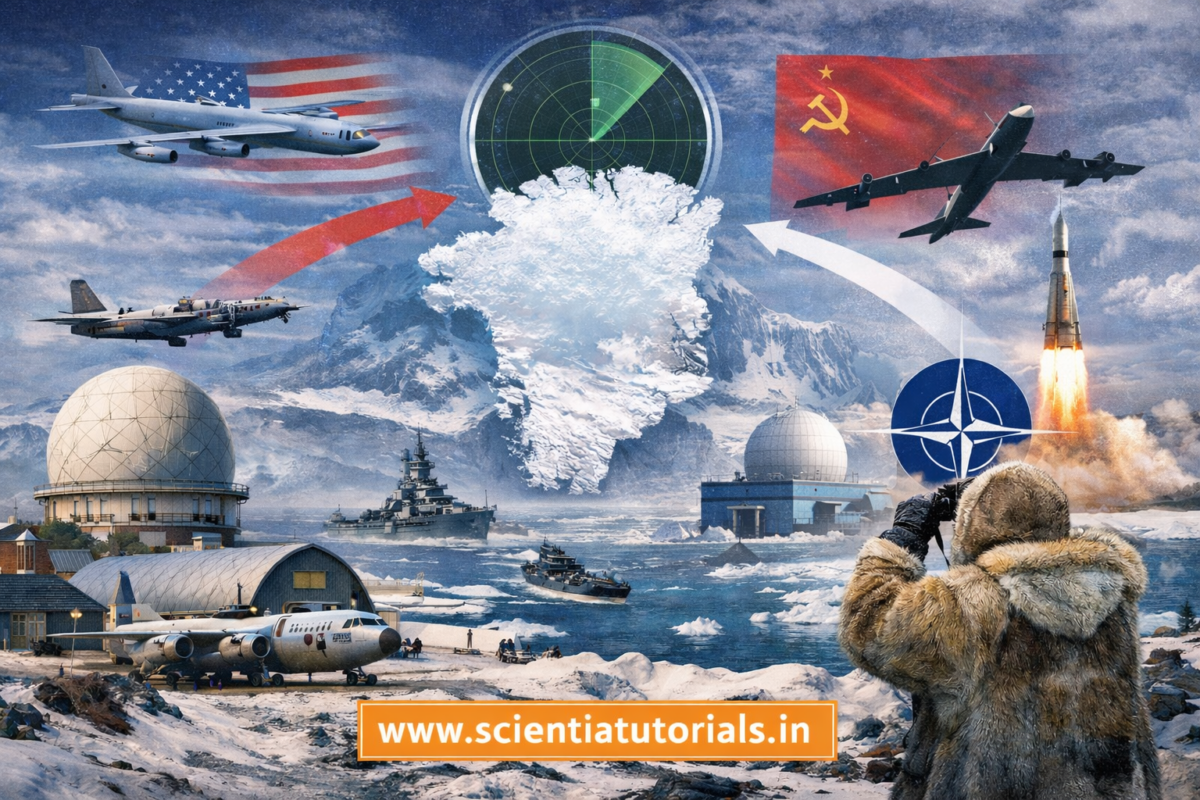

Cold War Arctic Strategy in Greenland | Military Installations & NATO
Greenland: Historical Evolution and Its Global Strategic Importance
Module 4: Greenland in the Age of World Wars and the Cold War
Era Framework: Early 20th Century – Late 20th Century
(World Wars, Cold War geopolitics, militarization of the Arctic)
Lesson: Cold War Arctic Strategy and Military Installations
Introduction: The Arctic in the Cold War World
The Cold War fundamentally redefined the global strategic map, transforming previously peripheral regions into critical zones of military and geopolitical competition. Among these regions, the Arctic assumed unprecedented importance. Greenland, due to its geographic position, political status, and physical environment, became one of the most strategically significant territories in the Cold War era.
This lesson examines how Greenland emerged as a central pillar of Cold War Arctic strategy, focusing on military installations, defense planning, and the broader geopolitical context from the late 1940s to the end of the 20th century. Structured chronologically, it explores how technological change, superpower rivalry, and alliance politics militarized the Arctic and reshaped Greenland’s role in global affairs.
I. The Arctic and the Emergence of Cold War Strategy (Late 1940s)
1. From World War II to Cold War Rivalry
The conclusion of World War II did not lead to demilitarization in the Arctic. Instead, the collapse of wartime alliances and the rise of ideological confrontation between the United States and the Soviet Union shifted strategic attention northward. The Arctic represented the shortest route for long-range bombers and, later, intercontinental ballistic missiles (ICBMs).
2. Greenland’s Strategic Geography
Greenland’s location between North America and Europe, combined with its proximity to the Soviet Arctic, placed it directly along potential attack and defense corridors. Control of Greenland meant control over:
- Early warning against surprise attacks
- Transpolar air routes
- Arctic surveillance and communication systems
II. Denmark, Sovereignty, and Alliance Politics
1. Greenland’s Political Status
Greenland remained a territory of Denmark throughout the Cold War. However, its strategic importance meant that decisions affecting Greenland were increasingly shaped by international security concerns rather than colonial administration alone.
2. NATO Membership and Strategic Integration
In 1949, Denmark became a founding member of the North Atlantic Treaty Organization. This decision had profound implications for Greenland:
- Greenland was incorporated into Western collective defense
- U.S. military presence was legitimized under alliance frameworks
- Arctic defense became a shared transatlantic responsibility
Despite Denmark’s general policy against nuclear weapons on its soil, exceptions were effectively made for Greenland under Cold War pressures.
III. The United States and Arctic Defense Planning
1. American Strategic Interests
For the United States, Greenland was indispensable to continental defense. The threat of Soviet bombers and missiles approaching over the Arctic made early detection essential.
2. Bilateral Defense Agreements
A series of agreements between Denmark and the United States allowed the construction and operation of American military installations in Greenland. These arrangements reflected a balance between Danish sovereignty and American strategic necessity.
IV. Thule Air Base: Cornerstone of Arctic Militarization
1. Establishment and Location
The most significant military installation in Greenland was Thule Air Base, constructed in the early 1950s in northwest Greenland. Its remote location offered both strategic advantage and operational security.
2. Strategic Functions
Thule Air Base served multiple Cold War purposes:
- Hosting strategic bomber operations
- Operating early-warning radar systems
- Supporting ballistic missile detection
- Tracking satellites and space objects
Its position along polar routes made it central to U.S. nuclear deterrence strategy.
3. Social Consequences
The construction of Thule Air Base led to the relocation of Inuit communities, particularly the Inughuit population. This displacement created long-lasting social and political grievances, later influencing Greenlandic debates on rights, compensation, and self-governance.
V. The DEW Line and Arctic Radar Networks
1. The Distant Early Warning (DEW) Line
One of the most important elements of Cold War Arctic strategy was the establishment of the Distant Early Warning Line. This network of radar stations stretched across the Arctic, including installations in Greenland.
2. Purpose and Function
The DEW Line was designed to:
- Detect incoming Soviet bombers or missiles
- Provide early warning to North American defense systems
- Reduce the risk of surprise nuclear attack
Greenland’s radar sites formed a critical segment of this continental shield.
3. Technological Innovation
The harsh Arctic environment required significant technological adaptation, including:
- Cold-resistant electronics
- Remote supply systems
- Advanced communication links
These innovations later contributed to civilian Arctic research and infrastructure.
VI. Nuclear Strategy and the Arctic Dimension (1960s)
1. Greenland in the Nuclear Age
As the Cold War entered its nuclear phase, Greenland became part of a global system of deterrence. Radar and tracking installations in Greenland fed data into integrated command systems designed to respond within minutes to potential attacks.
2. The 1968 Thule Incident
In 1968, a U.S. B-52 bomber carrying nuclear weapons crashed near Thule Air Base. Although no nuclear detonation occurred, the accident revealed:
- The risks associated with nuclear deployments
- Environmental vulnerabilities of the Arctic
- Political tensions between Denmark, Greenland, and the United States
The incident intensified public scrutiny of military activities in Greenland.
VII. Environmental and Ethical Dimensions of Militarization
1. Environmental Impact
Military installations introduced pollution, infrastructure disruption, and long-term environmental risks. Nuclear-related accidents and abandoned equipment raised concerns about contamination in fragile Arctic ecosystems.
2. Ethical and Political Debates
The Cold War presence sparked debates over:
- Indigenous rights
- Informed consent of local populations
- Transparency in defense policy
These issues became central to Greenland’s political discourse in later decades.
VIII. Greenlandic Political Transformation and Strategic Awareness
1. Rise of Political Consciousness
Cold War militarization exposed Greenlanders to global politics and highlighted the strategic value of their homeland. This awareness contributed to growing demands for political reform.
2. Home Rule in 1979
Greenland achieved Home Rule in 1979, gaining control over internal affairs while defense and foreign policy remained under Danish authority. Strategic installations, however, continued to operate, reflecting Greenland’s enduring military relevance.
IX. Late Cold War Adjustments (1970s–1980s)
1. Technological Shifts
Advances in satellite surveillance and missile technology reduced reliance on some ground-based systems. Nevertheless, Greenland remained important for:
- Redundant early-warning capabilities
- Space monitoring
- Arctic research
2. Strategic Continuity
Despite reduced tensions during détente, Greenland’s military installations were maintained, underscoring the persistence of Cold War security thinking.
X. End of the Cold War and Strategic Reassessment
1. Decline of Superpower Confrontation
The late 1980s and early 1990s marked the end of the Cold War. Some military installations in Greenland were downsized or repurposed.
2. Enduring Strategic Value
Although the immediate threat diminished, Greenland retained importance due to:
- Arctic navigation routes
- Climate monitoring
- Continued relevance in transatlantic security
XI. Long-Term Legacy of Cold War Arctic Strategy
1. Infrastructure and Modernization
Cold War investments left Greenland with modern airports, communication systems, and research facilities that continue to support civilian use.
2. Political and Global Implications
Greenland’s Cold War experience reshaped its relationship with Denmark, strengthened its international visibility, and influenced ongoing debates about autonomy and independence.
Conclusion
The Cold War transformed Greenland from a remote Arctic territory into a central pillar of global military strategy. Through installations such as Thule Air Base and the DEW Line, Greenland became embedded in the defense systems of the Western alliance. While militarization brought infrastructure and global attention, it also generated social disruption, environmental risks, and political tensions.
Understanding Cold War Arctic strategy and military installations in Greenland is essential for grasping the island’s modern geopolitical significance. The legacy of this era continues to shape Greenland’s strategic role in the 21st century, as the Arctic once again emerges as a key arena in global affairs.
Short Answer Type Questions (with Answers)
1. Why did the Arctic become strategically important during the Cold War?
The Arctic became important because it offered the shortest routes for bombers and missiles between North America and the Soviet Union, making it central to early-warning and defense strategies.
2. What made Greenland central to Cold War Arctic strategy?
Greenland’s location between North America and Europe and along polar flight paths made it ideal for surveillance, radar installations, and military bases.
3. Which country exercised sovereignty over Greenland during the Cold War?
Greenland remained under the sovereignty of Denmark throughout the Cold War.
4. How did World War II influence Cold War military planning in Greenland?
World War II demonstrated Greenland’s strategic value, leading to the permanent integration of the island into Cold War defense planning.
5. What was Denmark’s role in Greenland’s Cold War militarization?
Denmark retained sovereignty while allowing allied military installations, balancing national control with alliance obligations.
6. Why was Denmark’s entry into NATO significant for Greenland?
Denmark’s membership in the North Atlantic Treaty Organization integrated Greenland into Western collective defense systems.
7. Which country played the leading role in building military installations in Greenland?
The United States played the leading role in constructing and operating military facilities in Greenland.
8. What was the primary purpose of U.S. military presence in Greenland?
The primary purpose was early detection of Soviet bombers and missiles approaching North America via Arctic routes.
9. What was Thule Air Base?
Thule Air Base was a major U.S. military installation established in northwest Greenland during the early Cold War.
10. When was Thule Air Base established?
Thule Air Base was established in the early 1950s.
11. What strategic functions did Thule Air Base serve?
It supported strategic bombers, missile early-warning radar, and space and satellite surveillance systems.
12. Why was Thule Air Base important to nuclear deterrence?
Its location along polar missile routes allowed early detection of intercontinental ballistic missiles.
13. What was the DEW Line?
The Distant Early Warning Line was a network of Arctic radar stations designed to detect incoming Soviet attacks.
14. How did Greenland contribute to the DEW Line?
Radar stations in Greenland formed a critical segment of the Arctic early-warning system protecting North America.
15. What technological challenges did Arctic radar installations face?
Extreme cold, isolation, and supply difficulties required specially adapted equipment and logistics systems.
16. What was the 1968 Thule incident?
It was the crash of a U.S. B-52 bomber carrying nuclear weapons near Thule Air Base.
17. Why was the 1968 Thule incident significant?
It highlighted the environmental, political, and safety risks of nuclear militarization in the Arctic.
18. How did Cold War militarization affect Greenlandic society?
It caused population displacement, cultural disruption, and increased political awareness among Greenlanders.
19. Which indigenous group was affected by the construction of Thule Air Base?
The Inughuit (Inuit) population of northwest Greenland was relocated.
20. How did Cold War strategy influence Greenland’s political development?
Strategic importance strengthened demands for greater self-governance and political autonomy.
21. What political change occurred in Greenland in 1979?
Greenland achieved Home Rule, gaining control over internal affairs.
22. Did Greenland control defense policy after Home Rule?
No, defense and foreign policy remained under Danish authority.
23. How did satellite technology affect Arctic military strategy?
It reduced reliance on some ground installations but did not eliminate Greenland’s strategic importance.
24. What happened to Greenland’s military role at the end of the Cold War?
Some installations were downsized, but Greenland retained strategic relevance.
25. Why does Greenland remain important in Arctic strategy today?
Its location supports surveillance, climate research, and emerging Arctic navigation routes.
Long Answer Type Questions (with Answers)
1. Explain why the Arctic emerged as a major strategic region during the Cold War.
The Arctic emerged as a major strategic region during the Cold War because technological advances transformed it from a geographic barrier into a strategic corridor. Long-range bombers and intercontinental ballistic missiles (ICBMs) followed polar routes, making the Arctic the shortest path between North America and the Soviet Union. Control of the Arctic was therefore essential for early warning, rapid response, and nuclear deterrence. As a result, Arctic territories such as Greenland became integral to superpower defense planning.
2. Analyze the geographical factors that made Greenland central to Cold War Arctic strategy.
Greenland’s location between North America and Europe placed it directly along transpolar air and missile routes. Its vast landmass allowed the construction of large military installations, radar stations, and air bases. Proximity to the Soviet Arctic enabled early detection of potential attacks, while its ice-covered terrain provided operational security. These geographic advantages made Greenland indispensable to Arctic defense systems.
3. Discuss Greenland’s political status during the Cold War and its strategic implications.
Throughout the Cold War, Greenland remained under the sovereignty of Denmark. However, its strategic importance meant that Greenland’s defense was shaped largely by international alliance politics rather than colonial administration. Danish control coexisted with extensive U.S. military presence, creating a unique situation where sovereignty, security, and alliance obligations overlapped.
4. Examine the significance of Denmark’s membership in NATO for Greenland.
Denmark’s decision to join the North Atlantic Treaty Organization in 1949 integrated Greenland into the Western collective defense system. This legitimized the continued presence of U.S. military installations in Greenland and ensured that Arctic defense became a transatlantic responsibility. NATO membership thus transformed Greenland into a permanent component of Cold War security planning.
5. Evaluate the role of the United States in shaping Cold War military strategy in Greenland.
The United States played the leading role in Greenland’s militarization during the Cold War. Concerned about Soviet attacks across the Arctic, the U.S. invested heavily in air bases, radar networks, and early-warning systems. Through bilateral agreements with Denmark, the United States operated installations that became central to continental defense and nuclear deterrence.
6. Discuss the establishment and strategic importance of Thule Air Base.
Thule Air Base was established in the early 1950s in northwest Greenland as a cornerstone of U.S. Arctic strategy. Its location along polar routes made it ideal for hosting strategic bombers, missile early-warning radar, and space surveillance systems. Thule became one of the most important military installations in the Arctic, directly supporting nuclear deterrence.
7. Analyze the role of Thule Air Base in Cold War nuclear strategy.
Thule Air Base played a critical role in Cold War nuclear strategy by providing early detection of Soviet missile launches and supporting strategic bomber operations. Radar systems at Thule fed data into integrated command networks, reducing the risk of surprise nuclear attacks. The base thus strengthened deterrence by enhancing response time and situational awareness.
8. Examine the social consequences of the construction of Thule Air Base.
The construction of Thule Air Base resulted in the forced relocation of the Inughuit Inuit population from their traditional lands. This displacement disrupted livelihoods, cultural practices, and settlement patterns. Over time, it generated political activism and demands for compensation and recognition, contributing to broader debates about indigenous rights and self-governance in Greenland.
9. Explain the purpose and significance of the Distant Early Warning (DEW) Line.
The Distant Early Warning Line was a chain of radar stations stretching across the Arctic, including Greenland. Its purpose was to detect incoming Soviet bombers or missiles at the earliest possible moment. By providing advance warning, the DEW Line reduced the likelihood of a surprise nuclear attack and became a vital element of North American defense.
10. Discuss the technological challenges of Arctic military installations.
Operating military installations in the Arctic required overcoming extreme cold, isolation, and logistical difficulties. Equipment had to be adapted to function in sub-zero temperatures, while supply lines depended on air and seasonal sea routes. These challenges drove technological innovation in cold-weather engineering, communications, and remote operations.
11. Analyze Greenland’s role in Cold War surveillance and early-warning systems.
Greenland functioned as a key surveillance platform within Cold War defense networks. Radar stations, air bases, and tracking facilities monitored Arctic airspace and missile trajectories. This surveillance capability made Greenland an essential link between North American and European defense systems.
12. Examine the significance of the 1968 Thule B-52 crash.
The 1968 crash of a U.S. B-52 bomber carrying nuclear weapons near Thule Air Base exposed the risks of nuclear militarization in the Arctic. Although no nuclear explosion occurred, the incident raised concerns about environmental contamination, secrecy, and political accountability. It intensified debate in Denmark and Greenland over nuclear policy and military transparency.
13. Discuss the environmental impact of Cold War military installations in Greenland.
Military activities introduced pollution, abandoned infrastructure, and long-term environmental risks into fragile Arctic ecosystems. Accidents involving nuclear materials heightened concerns about contamination. These impacts contributed to later demands for environmental protection and stricter oversight of military activities.
14. Analyze how Cold War militarization influenced Greenlandic political consciousness.
Exposure to global military strategy and foreign military presence increased political awareness among Greenlanders. Social disruption and environmental risks highlighted the need for greater local control over decision-making. This growing consciousness played a role in Greenland’s movement toward political autonomy.
15. Explain the significance of Greenland achieving Home Rule in 1979 in the Cold War context.
Home Rule in 1979 marked a turning point in Greenland’s political development. While defense and foreign policy remained under Danish control, Greenland gained authority over internal affairs. The Cold War context ensured continued strategic relevance, even as Greenland sought greater self-determination.
16. Assess Greenland’s strategic role during the late Cold War period.
During the late Cold War, advances in missile and satellite technology reduced reliance on some ground installations. However, Greenland remained important for redundancy in early-warning systems, space monitoring, and Arctic research. Its role evolved rather than declined.
17. Discuss the relationship between technological change and Arctic military strategy.
Technological developments such as satellite surveillance and advanced radar reshaped Arctic strategy by complementing ground-based systems. While technology reduced some operational constraints, Arctic installations like those in Greenland continued to provide strategic depth and reliability.
18. Examine the impact of détente on military installations in Greenland.
Periods of détente reduced immediate tensions but did not eliminate Arctic militarization. Installations were maintained as a precaution against renewed confrontation, reflecting the persistence of Cold War security thinking.
19. Analyze the decline and continuity of Greenland’s military role after the Cold War.
With the end of the Cold War, some military installations were downsized or repurposed. Nevertheless, Greenland retained strategic relevance due to Arctic navigation, climate monitoring, and renewed geopolitical interest in the region.
20. Conclude by evaluating the long-term legacy of Cold War Arctic strategy in Greenland.
The Cold War left Greenland with modern infrastructure, heightened global visibility, and lasting political change. At the same time, it generated social displacement and environmental challenges. Overall, Cold War Arctic strategy transformed Greenland from a peripheral territory into a central actor in global geopolitics, a legacy that continues to shape its strategic importance today.
Multiple Choice Questions (MCQs) with Answers and Explanations
1. Why did the Arctic gain major strategic importance during the Cold War?
A. It contained large industrial centers
B. It offered the shortest routes for bombers and missiles
C. It had dense populations
D. It was rich in agricultural land
Correct Answer: B
Explanation:
During the Cold War, long-range bombers and ICBMs followed polar routes. The Arctic therefore became central to early-warning and defense systems.
2. Greenland’s Cold War importance was mainly due to its:
A. Mineral wealth
B. Cultural connections
C. Geographic location
D. Population size
Correct Answer: C
Explanation:
Greenland lies between North America and Europe along transpolar routes, making it ideal for surveillance and military installations.
3. During the Cold War, Greenland was under the sovereignty of:
A. United States
B. United Kingdom
C. Denmark
D. Canada
Correct Answer: C
Explanation:
Greenland remained a Danish territory, although its defense was shaped by alliance politics and U.S. strategic interests.
4. Denmark’s decision to join NATO in 1949 resulted in Greenland becoming part of:
A. Soviet defense planning
B. Neutral Arctic zone
C. Western collective defense
D. United Nations peacekeeping
Correct Answer: C
Explanation:
By joining the North Atlantic Treaty Organization, Denmark integrated Greenland into Western security structures.
5. Which country played the dominant role in Greenland’s Cold War militarization?
A. France
B. Canada
C. Norway
D. United States
Correct Answer: D
Explanation:
The United States built and operated most military installations to protect North America from Soviet attacks.
6. The primary objective of U.S. military installations in Greenland was to:
A. Control Arctic trade
B. Support colonial administration
C. Detect Soviet attacks early
D. Promote tourism
Correct Answer: C
Explanation:
Early detection of bombers and missiles was essential to nuclear deterrence and continental defense.
7. Thule Air Base was established during the:
A. Interwar period
B. World War II
C. Early Cold War
D. Late Cold War
Correct Answer: C
Explanation:
Thule Air Base was constructed in the early 1950s as Cold War tensions intensified.
8. Thule Air Base was strategically important because it:
A. Hosted naval fleets
B. Controlled Arctic fishing
C. Supported early-warning and missile detection
D. Trained infantry units
Correct Answer: C
Explanation:
Thule Air Base supported radar, bomber operations, and missile early-warning systems.
9. Which factor made Greenland suitable for nuclear deterrence strategy?
A. Dense infrastructure
B. Tropical climate
C. Proximity to missile flight paths
D. Large workforce
Correct Answer: C
Explanation:
Missiles between superpowers traveled over the Arctic, making Greenland ideal for detection and tracking.
10. The Distant Early Warning (DEW) Line was designed to:
A. Support Arctic agriculture
B. Detect incoming Soviet attacks
C. Promote scientific research
D. Monitor fishing zones
Correct Answer: B
Explanation:
The Distant Early Warning Line provided advance warning of bombers or missiles approaching North America.
11. Greenland’s role in the DEW Line was to:
A. House nuclear missiles
B. Provide radar coverage in the Arctic
C. Train military personnel
D. Supply raw materials
Correct Answer: B
Explanation:
Radar stations in Greenland formed a critical link in the Arctic early-warning network.
12. One major challenge of operating military installations in Greenland was:
A. Political instability
B. Extreme climate and isolation
C. Lack of funding
D. Hostile population
Correct Answer: B
Explanation:
Harsh Arctic conditions required specialized technology, logistics, and infrastructure.
13. Which group was directly affected by the construction of Thule Air Base?
A. European settlers
B. Canadian traders
C. Inughuit Inuit population
D. American civilians
Correct Answer: C
Explanation:
Local Inuit communities were relocated, causing long-term social and political consequences.
14. The 1968 Thule incident involved:
A. A missile launch
B. A naval collision
C. A nuclear bomber crash
D. A radar malfunction
Correct Answer: C
Explanation:
A U.S. B-52 bomber carrying nuclear weapons crashed near Thule, raising safety and environmental concerns.
15. Why was the 1968 Thule accident politically significant?
A. It ended NATO
B. It revealed risks of Arctic nuclear deployment
C. It led to Greenland’s independence
D. It caused military withdrawal
Correct Answer: B
Explanation:
The accident highlighted nuclear dangers and intensified debates over transparency and environmental safety.
16. Cold War militarization increased Greenlandic political awareness by:
A. Ending Danish control
B. Eliminating traditional culture
C. Exposing Greenland to global politics
D. Reducing foreign influence
Correct Answer: C
Explanation:
Foreign military presence made Greenlanders more conscious of their strategic importance and rights.
17. Greenland achieved Home Rule in:
A. 1953
B. 1968
C. 1979
D. 1991
Correct Answer: C
Explanation:
Home Rule allowed Greenland to manage internal affairs while defense remained with Denmark.
18. After Home Rule, control of defense policy remained with:
A. Greenland government
B. NATO
C. Denmark
D. United Nations
Correct Answer: C
Explanation:
Defense and foreign affairs continued to be handled by Denmark.
19. Which technological development reduced reliance on some Arctic bases?
A. Jet engines
B. Satellite surveillance
C. Submarines
D. Icebreakers
Correct Answer: B
Explanation:
Satellites complemented ground installations but did not eliminate Greenland’s strategic value.
20. During détente, military installations in Greenland were:
A. Completely dismantled
B. Abandoned
C. Maintained with adjustments
D. Converted to civilian towns
Correct Answer: C
Explanation:
Despite reduced tensions, Arctic defense systems were preserved as precautionary measures.
21. The end of the Cold War led to Greenland’s military role being:
A. Expanded
B. Eliminated
C. Reduced but not ended
D. Shifted to agriculture
Correct Answer: C
Explanation:
Some installations were downsized, but Greenland remained strategically relevant.
22. Cold War military investments left Greenland with:
A. Permanent pollution only
B. Modern infrastructure and connectivity
C. Cultural isolation
D. Economic collapse
Correct Answer: B
Explanation:
Airports, communications, and research facilities had long-term civilian benefits.
23. Greenland’s continued strategic relevance today is linked to:
A. Arctic navigation and climate research
B. Heavy industry
C. Population growth
D. Tourism alone
Correct Answer: A
Explanation:
Changing Arctic conditions and security concerns have renewed Greenland’s importance.
24. The Cold War demonstrated that Greenland’s importance was primarily shaped by:
A. Cultural heritage
B. Colonial policy
C. Geography and technology
D. Agricultural development
Correct Answer: C
Explanation:
Geography combined with military technology turned Greenland into a strategic asset.
25. Greenland’s Cold War experience best illustrates that:
A. Arctic regions remain isolated
B. Military strategy ignores local populations
C. Global conflicts can reshape remote regions
D. Colonies avoid geopolitical rivalry
Correct Answer: C
Explanation:
The Cold War transformed Greenland from a peripheral territory into a central node of global strategy.