
Greenland in the Early Modern Arctic Economy
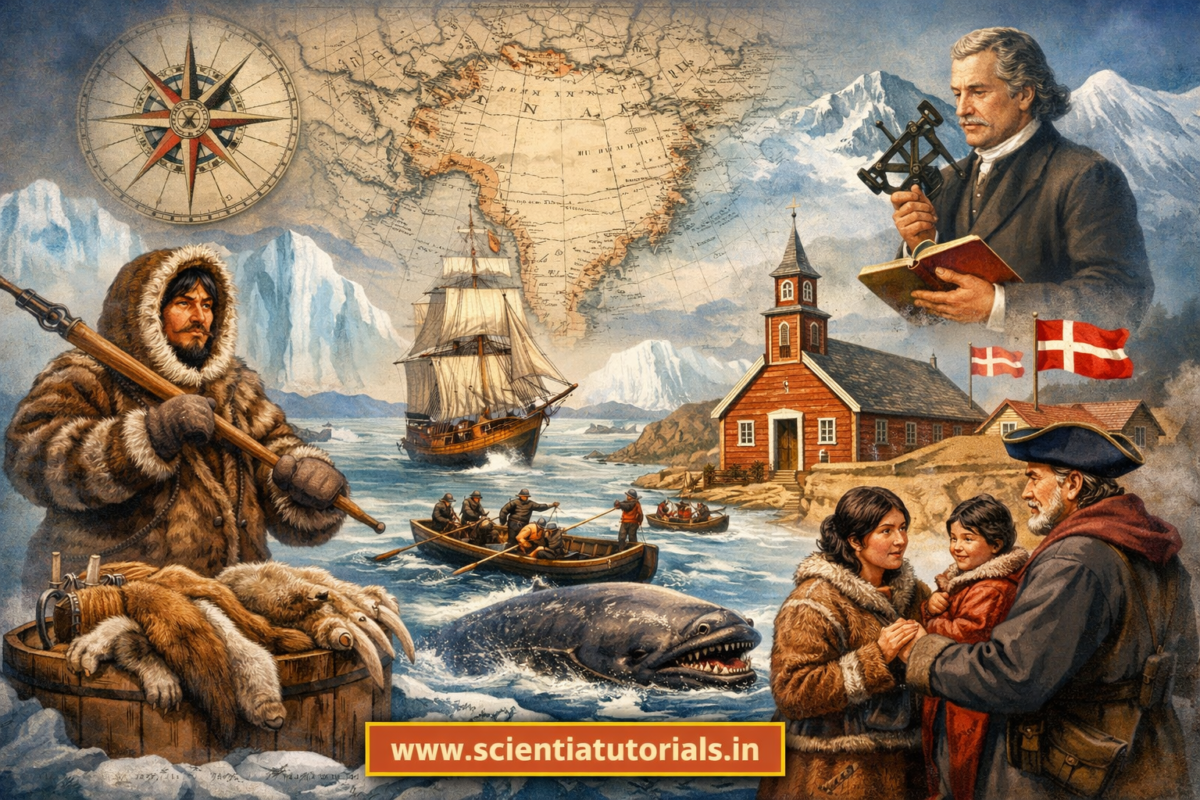

Greenland in the Early Modern Arctic Economy (16th–19th Century)
Course: Greenland: Historical Evolution and Its Global Strategic Importance
Module 3: Colonial Encounters and Early Modern Transformations
Era Framework: 16th Century – 19th Century
(European expansion, mercantilism, missionary activity)
This lesson is systematically organized into four clearly structured sections, as detailed below:
- Chronologically Structured Study Module
- Short-Answer Type Questions
- Long-Answer Type Questions
- Multiple-Choice Questions (MCQs) with Answers and Detailed Explanations
Chronologically Structured Study Module
Lesson Objectives
This lesson aims to enable learners to:
- Understand Greenland’s integration into the early modern Arctic and global economy
- Analyze the impact of European expansion and mercantilist policies on Greenland
- Examine the transformation of Inuit subsistence systems under colonial trade pressures
- Evaluate the role of whaling, trade monopolies, and missionary activity in shaping Greenland’s early modern history
- Situate Greenland within broader North Atlantic and global economic networks from the 16th to the 19th century
Introduction: Greenland and the Early Modern World
The early modern period marked a profound transformation in Greenland’s historical trajectory. After centuries of relative isolation following the decline of Norse settlements, Greenland re-emerged into global consciousness as European maritime powers expanded into the Arctic. From the 16th to the 19th centuries, Greenland became embedded in an evolving Arctic economy shaped by mercantilism, whaling, missionary enterprises, and imperial competition.
Rather than being a passive periphery, Greenland functioned as a resource frontier—supplying valuable commodities such as whale oil, sealskins, walrus ivory, and fish—while also becoming a laboratory for European colonial governance in extreme environments. This lesson explores Greenland’s changing role within the early modern Arctic economy and its long-term consequences.
I. Rediscovery and European Re-engagement (16th Century)
1. Post-Medieval Rediscovery of Greenland
By the late medieval period, knowledge of Greenland’s Norse colonies had faded from European awareness. However, the 16th century—defined by European maritime expansion—renewed interest in the North Atlantic. English, Dutch, Portuguese, and Danish navigators encountered Greenland while searching for new trade routes and fishing grounds.
Cartographic advancements and improved navigation technologies brought Greenland back into European maps, not as a settlement colony but as a strategic and economic frontier.
2. Greenland in the Context of Arctic Exploration
Greenland became linked to broader efforts to locate the Northwest Passage. Explorers viewed its coastlines as potential gateways to Asia, while merchants recognized its surrounding waters as rich fishing and whaling zones. This period laid the foundations for Greenland’s integration into the early modern Arctic economy.
II. Whaling and the Rise of the Arctic Resource Economy (17th Century)
1. The Whaling Boom
The 17th century witnessed the rapid expansion of commercial whaling in Arctic waters. European demand for whale oil—used for lighting, lubrication, and soap-making—transformed the Arctic into a zone of intense economic activity.
Waters around Greenland attracted Dutch, English, and later Danish whalers. Seasonal whaling stations emerged along coastal areas, linking Greenland indirectly to European urban markets.
2. Economic Significance of Whale Products
Whale oil and baleen became critical commodities in early modern economies. Profits from Arctic whaling financed further exploration, shipbuilding, and commercial expansion. Greenland’s marine environment thus contributed to the industrial and urban development of Europe.
3. Impact on Inuit Communities
While Inuit communities did not initially participate directly in large-scale commercial whaling, European activities altered marine ecosystems and introduced new trade dynamics. Inuit knowledge of Arctic waters made them valuable intermediaries, guides, and traders.
III. Mercantilism and Colonial Control (18th Century)
1. Mercantilist Ideology and Arctic Policy
The 18th century marked the consolidation of mercantilist economic systems in Europe. States sought to control trade, monopolize resources, and regulate colonial economies for national benefit. Greenland became incorporated into this system under the authority of Denmark-Norway.
2. Establishment of Trade Monopolies
Danish authorities established royal trading monopolies to regulate all commerce with Greenland. These monopolies controlled the export of Arctic goods and the import of European manufactured items such as metal tools, firearms, textiles, and grain.
The monopoly system limited private competition but ensured state oversight of economic activities, reinforcing Greenland’s role as a controlled colonial economy.
3. Greenland as a Peripheral Mercantilist Colony
Unlike plantation colonies or mining regions, Greenland’s economy was not based on settler agriculture. Instead, it functioned as a specialized extraction zone focused on marine resources and trade mediation with Inuit communities.
IV. Missionary Activity and Economic Transformation
1. The Role of Christian Missions
Missionary enterprises played a central role in Greenland’s early modern transformation. Lutheran and Moravian missionaries arrived not only to convert Inuit populations but also to reshape social and economic practices.
Missions often operated alongside trading posts, reinforcing colonial authority and integrating religious conversion with economic dependency.
2. Missions as Economic Institutions
Mission settlements introduced new labor routines, trade habits, and consumption patterns. Inuit converts increasingly relied on European goods distributed through mission-controlled trade networks, subtly transforming subsistence economies.
3. Cultural and Economic Consequences
While missions provided education, literacy, and healthcare, they also disrupted traditional belief systems and seasonal economic cycles. Over time, Inuit participation in trade intensified, tying local livelihoods to European demand and market fluctuations.
V. Inuit Economy and Adaptation
1. Traditional Subsistence Systems
Before sustained European contact, Inuit economic life was based on hunting, fishing, and seasonal mobility. These systems were finely adapted to Arctic ecological conditions and ensured community resilience.
2. Integration into Trade Networks
European trade introduced new incentives. Sealskins, fox pelts, and other animal products gained monetary value, encouraging intensified hunting for exchange rather than subsistence alone.
3. Dual Economic Structures
By the late 18th century, Inuit communities operated within dual systems—maintaining traditional practices while engaging in colonial trade. This hybrid economy reflected both adaptation and vulnerability.
VI. Greenland in the North Atlantic World (18th–Early 19th Century)
1. Strategic Location
Greenland’s position between Europe and North America gave it growing strategic importance. It served as a logistical waypoint for Arctic navigation and a symbol of sovereignty in northern waters.
2. Integration into Atlantic Trade Networks
Though limited in scale, Greenland’s exports fed into broader Atlantic trade circuits. Whale oil illuminated European cities, while Arctic pelts entered global luxury markets.
3. Scientific and Economic Exploration
The Enlightenment era brought scientific expeditions to Greenland, blending economic interests with cartography, natural history, and climate observation. Knowledge production became another form of Arctic extraction.
VII. Economic Decline and Transformation (19th Century)
1. Decline of Whaling
By the early 19th century, overexploitation led to declining whale populations. This reduced the profitability of Arctic whaling and weakened Greenland’s role in that sector.
2. Shifts in Colonial Policy
Colonial authorities emphasized administrative stability, missionary expansion, and regulated trade rather than aggressive resource extraction. Greenland became a managed colonial society rather than a booming frontier.
3. Long-Term Economic Consequences
Economic dependency on external markets persisted, shaping Greenland’s later colonial and post-colonial challenges. However, Inuit resilience and adaptation ensured cultural survival despite economic restructuring.
VIII. Greenland’s Global Strategic Significance in the Early Modern Era
1. Arctic Economy as a Precursor to Modern Geopolitics
Greenland’s early modern economic role laid foundations for its later strategic importance in global geopolitics, science, and resource debates.
2. From Resource Frontier to Strategic Asset
The experience of mercantilist control, missionary governance, and Arctic trade positioned Greenland as a critical northern territory within imperial systems.
Conclusion
From the 16th to the 19th centuries, Greenland transitioned from obscurity to integration within the early modern Arctic economy. European expansion, mercantilist trade policies, whaling industries, and missionary enterprises transformed Greenland into a regulated colonial resource frontier.
While European powers extracted economic value from Greenland’s environment, Inuit communities demonstrated remarkable adaptability, negotiating new economic realities while preserving core cultural practices. The early modern Arctic economy thus reshaped Greenland’s historical path and embedded it within global systems whose legacies continue to influence its strategic importance today.
Short Answer Type Questions with Answers
Lesson: Greenland in the Early Modern Arctic Economy (16th–19th Century)
1. What is meant by the “early modern Arctic economy”?
The early modern Arctic economy refers to economic activities in the Arctic region between the 16th and 19th centuries, driven by European expansion, mercantilism, whaling, trade monopolies, and missionary enterprises.
2. Why did Greenland regain European attention in the 16th century?
Greenland regained attention due to European maritime expansion, improved navigation, renewed cartographic knowledge, and the search for new trade routes such as the Northwest Passage.
3. How did European exploration integrate Greenland into global trade networks?
Exploration linked Greenland to North Atlantic routes, making it a resource frontier supplying whale oil, furs, and marine products to European markets.
4. What role did whaling play in Greenland’s early modern economy?
Whaling was the most important economic activity, providing whale oil and baleen that were essential for lighting, lubrication, and manufacturing in Europe.
5. Which European powers were most active in Arctic whaling near Greenland?
Dutch, English, and later Danish whalers were most active in Greenlandic waters during the 17th century.
6. Why was whale oil economically significant in early modern Europe?
Whale oil was widely used for street lighting, domestic lamps, soap-making, and industrial lubrication, making it a highly valuable commodity.
7. How did Arctic whaling affect Greenland’s marine environment?
Intensive whaling led to declining whale populations, ecological imbalance, and long-term economic decline by the early 19th century.
8. What is mercantilism, and how did it shape Greenland’s economy?
Mercantilism was an economic system focused on state-controlled trade and monopolies. It shaped Greenland’s economy by placing all trade under strict colonial regulation.
9. Under which political authority was Greenland controlled in the 18th century?
Greenland was controlled by Denmark-Norway, which established trade monopolies and colonial administration.
10. What was the purpose of Danish trade monopolies in Greenland?
The monopolies aimed to regulate commerce, prevent foreign competition, ensure state profits, and maintain political control over Greenland.
11. Why was Greenland considered a peripheral mercantilist colony?
Greenland lacked plantation agriculture or mining and instead functioned as a specialized extraction zone focused on marine and fur resources.
12. What goods did Greenland export during the early modern period?
Key exports included whale oil, sealskins, walrus ivory, fox pelts, and fish products.
13. What goods were imported into Greenland through colonial trade?
Imports included metal tools, firearms, textiles, grain, alcohol, and other European manufactured goods.
14. What role did missionaries play in Greenland’s economy?
Missionaries supported colonial trade, encouraged sedentary life, reshaped labor routines, and increased Inuit dependence on European goods.
15. How did missionary settlements function as economic centers?
They acted as hubs for trade distribution, labor organization, education, and religious conversion, reinforcing colonial authority.
16. Describe the traditional Inuit subsistence economy before European contact.
It was based on hunting, fishing, seasonal migration, and communal resource sharing adapted to Arctic ecological conditions.
17. How did trade alter Inuit economic practices?
Trade encouraged intensified hunting for market exchange rather than subsistence, leading to partial economic dependency on European demand.
18. What is meant by a “dual economy” in Greenland?
It refers to the coexistence of traditional Inuit subsistence activities alongside participation in colonial trade networks.
19. Why was Greenland strategically important in the North Atlantic world?
Its location between Europe and North America made it valuable for navigation, Arctic sovereignty, and access to northern sea routes.
20. How did Enlightenment science influence Greenland’s early modern role?
Scientific expeditions promoted mapping, climate observation, and natural history research, linking knowledge production with economic interests.
21. What factors led to the decline of Greenland’s whaling economy?
Overexploitation of whale populations, rising costs, and the emergence of alternative energy sources reduced profitability.
22. How did colonial policy change in Greenland during the 19th century?
Authorities shifted from aggressive extraction to regulated trade, missionary expansion, and administrative stability.
23. What long-term economic challenge emerged from Greenland’s colonial experience?
Persistent dependence on external markets and limited economic diversification became major long-term challenges.
24. How did Inuit communities demonstrate resilience during economic transformation?
They adapted to new trade systems while maintaining cultural traditions, knowledge systems, and social structures.
25. Why is Greenland’s early modern economic history globally significant?
It illustrates how Arctic regions were integrated into global capitalism and laid foundations for Greenland’s modern strategic importance.
Long Answer Type Questions with Answers
Lesson: Greenland in the Early Modern Arctic Economy (16th–19th Century)
1. Examine the factors that led to Greenland’s reintegration into the global economy during the early modern period.
Greenland’s reintegration into the global economy was driven by European maritime expansion, advancements in navigation and cartography, and rising demand for Arctic resources. From the 16th century onward, European explorers searching for new trade routes and fishing grounds rediscovered Greenland. The growth of whaling, mercantilist trade systems, and imperial rivalry further integrated Greenland into North Atlantic economic networks. Although sparsely settled by Europeans, Greenland became economically significant as a resource frontier supplying whale oil, skins, and ivory to European markets.
2. Analyze the role of European maritime expansion in shaping Greenland’s early modern economic significance.
European maritime expansion transformed Greenland from a forgotten medieval land into a strategic Arctic frontier. Improved shipbuilding, navigation instruments, and cartographic knowledge allowed European powers to operate in polar waters. Greenland’s proximity to trans-Atlantic routes made it an important point in Arctic exploration and commerce. Maritime expansion connected Greenland’s marine resources to European urban and industrial demand, embedding it within global economic circuits.
3. Discuss the development of whaling around Greenland and its importance in the early modern Arctic economy.
Whaling became the cornerstone of Greenland’s early modern economy, especially during the 17th century. European whalers—primarily Dutch and English—exploited the rich whale populations of Greenlandic waters. Whale oil was vital for lighting, soap production, and industrial lubrication, while baleen was used in manufacturing. Profits from whaling financed further exploration and trade, making Greenland a key contributor to Europe’s early industrial growth.
4. Evaluate the environmental consequences of intensive whaling in Greenlandic waters.
Intensive whaling led to severe depletion of whale populations by the late 18th and early 19th centuries. This overexploitation disrupted Arctic marine ecosystems and undermined the sustainability of the whaling industry itself. The decline in whale stocks reduced economic returns and forced colonial authorities to rethink Greenland’s economic role. Environmental degradation thus directly contributed to the long-term economic decline of Greenland’s whaling sector.
5. Explain mercantilism and assess its influence on Greenland’s colonial economy.
Mercantilism was an economic doctrine emphasizing state control of trade, accumulation of wealth, and colonial monopolies. In Greenland, mercantilism manifested through strict regulation of commerce and exclusive trading rights granted by the state. The system limited free trade but ensured that Arctic resources benefited the imperial economy. Greenland became a controlled extraction zone rather than a settlement colony, reflecting mercantilist priorities.
6. Examine the role of Denmark-Norway in shaping Greenland’s early modern economy.
Denmark-Norway asserted sovereignty over Greenland and established trade monopolies to control all economic activities. The state regulated exports such as whale oil and furs while supplying European manufactured goods. This centralized system ensured political control and economic extraction but limited local economic diversification. Danish authority also supported missionary activity, integrating religion with colonial governance.
7. Analyze the functioning and objectives of trade monopolies in Greenland.
Trade monopolies aimed to eliminate foreign competition, regulate prices, and maintain imperial control. They dictated what goods could be traded, with whom, and at what terms. While monopolies ensured stable administration and limited exploitation by private traders, they also restricted economic growth and fostered dependency among Inuit communities on European goods.
8. Why was Greenland classified as a peripheral mercantilist colony rather than a settler colony?
Greenland lacked conditions suitable for large-scale European settlement, plantation agriculture, or mining. Its harsh climate and geography made permanent European settlement difficult. Instead, it functioned as a peripheral colony focused on extracting specific Arctic resources, especially marine products, under state supervision.
9. Discuss the role of missionary activity in transforming Greenland’s early modern economy.
Missionary activity played a dual religious and economic role. Missions were often located near trading posts and helped stabilize colonial presence. They encouraged sedentary lifestyles, altered labor patterns, and introduced new consumption habits. By integrating Inuit communities into mission-controlled trade networks, missionaries indirectly supported colonial economic objectives.
10. Assess the social and economic impact of Christian missions on Inuit communities.
Christian missions provided education, literacy, and limited healthcare, but they also disrupted traditional belief systems and social structures. Economically, missions increased Inuit dependence on European goods and trade systems. While offering certain social benefits, missionary influence weakened traditional economic autonomy.
11. Describe the traditional Inuit subsistence economy before sustained European contact.
The Inuit subsistence economy was based on hunting, fishing, seasonal migration, and communal sharing of resources. It was highly adapted to Arctic ecological conditions and emphasized sustainability, flexibility, and collective survival rather than surplus production or trade.
12. Analyze how European trade altered Inuit economic practices.
European trade introduced monetary value to animal products, encouraging intensified hunting for exchange rather than subsistence. Inuit hunters increasingly produced sealskins and furs for trade, which tied their livelihoods to fluctuating European demand and colonial supply systems.
13. Explain the concept of a “dual economy” in early modern Greenland.
A dual economy refers to the coexistence of traditional Inuit subsistence practices alongside participation in colonial trade networks. Inuit communities continued hunting and fishing for survival while also engaging in market-oriented production for European traders, balancing adaptation with continuity.
14. Discuss Greenland’s position within the broader North Atlantic trading system.
Greenland was integrated into North Atlantic trade as a supplier of Arctic commodities rather than a major commercial hub. Its exports fed into European industrial and urban markets, linking remote Arctic regions to global economic systems despite limited local infrastructure.
15. Examine the strategic importance of Greenland in early modern imperial rivalries.
Greenland’s location between Europe and North America made it strategically valuable for navigation, Arctic sovereignty, and control over northern sea routes. Possession of Greenland symbolized imperial presence in the Arctic and reinforced claims over surrounding waters.
16. Analyze the role of Enlightenment science in Greenland’s early modern history.
During the Enlightenment, scientific expeditions focused on mapping, natural history, and climate observation. These activities supported navigation, economic exploitation, and imperial administration. Knowledge production became another form of resource extraction, enhancing Europe’s understanding of the Arctic.
17. Assess the causes of the decline of Greenland’s whaling economy in the 19th century.
The decline resulted from overexploitation of whale populations, rising operational costs, and the emergence of alternative energy sources. Reduced profitability led to a shift away from intensive whaling toward administrative and missionary priorities.
18. How did colonial economic policies change in Greenland during the 19th century?
Colonial authorities moved from aggressive extraction to regulated trade and social management. Emphasis shifted toward maintaining stability, missionary expansion, and controlled economic activity rather than profit maximization.
19. Discuss the long-term economic consequences of early modern colonialism in Greenland.
Early modern colonialism created long-lasting economic dependency on external markets and limited diversification. Greenland’s economy remained vulnerable to global market changes, shaping later colonial and post-colonial challenges.
20. Evaluate Inuit resilience and adaptation during the early modern economic transformation.
Despite colonial pressures, Inuit communities adapted creatively by combining traditional knowledge with new trade opportunities. Cultural continuity, ecological expertise, and social cohesion enabled survival amid economic restructuring.
21. Compare Greenland’s colonial economic model with plantation colonies of the same era.
Unlike plantation colonies reliant on agriculture and enslaved labor, Greenland’s economy focused on marine extraction and trade mediation. It lacked large settler populations and operated under strict state control rather than private enterprise.
22. Explain how Greenland’s early modern economy contributed to European industrial development.
Greenland supplied raw materials such as whale oil and baleen that supported lighting, manufacturing, and maritime industries. These resources indirectly fueled urban growth and early industrial processes in Europe.
23. Analyze Greenland’s transformation from an isolated Arctic region to a global economic frontier.
European expansion integrated Greenland into global capitalism by linking its natural resources to international markets. This transformation reshaped local economies and positioned Greenland within imperial and global systems.
24. Discuss the relationship between economic exploitation and cultural change in Greenland.
Economic exploitation went hand in hand with cultural transformation through missions, trade, and colonial governance. While economic integration brought material changes, it also challenged traditional cultural practices and belief systems.
25. Why is the study of Greenland’s early modern Arctic economy important for understanding its modern strategic role?
The early modern period established patterns of external control, resource extraction, and strategic valuation that continue to shape Greenland’s geopolitical and economic significance in the modern world.
MCQs with Answers and Explanations
Lesson: Greenland in the Early Modern Arctic Economy (16th–19th Century)
1. The early modern Arctic economy developed primarily due to
A. Industrial revolution in Greenland
B. European maritime expansion and mercantilism
C. Agricultural colonization
D. Inuit urbanization
Correct Answer: B
Explanation:
The early modern Arctic economy emerged as European powers expanded maritime activity, pursued mercantilist policies, and sought control over resources like whale oil and furs. Greenland became integrated as a resource frontier, not an industrial or agricultural center.
2. Which factor brought Greenland back into European awareness in the 16th century?
A. Discovery of gold
B. Rediscovery of Norse ruins
C. Search for Arctic trade routes and fishing grounds
D. Missionary expansion
Correct Answer: C
Explanation:
European explorers rediscovered Greenland while searching for new trade routes such as the Northwest Passage and rich fishing and whaling zones in the North Atlantic.
3. Greenland’s early modern economic importance was mainly based on
A. Plantation agriculture
B. Mineral extraction
C. Marine resource exploitation
D. Manufacturing industries
Correct Answer: C
Explanation:
Greenland functioned as a marine resource frontier, supplying whale oil, sealskins, walrus ivory, and fish to European markets.
4. Which commodity was most significant in integrating Greenland into the global economy?
A. Timber
B. Whale oil
C. Grain
D. Iron ore
Correct Answer: B
Explanation:
Whale oil was essential for lighting, lubrication, and soap-making in Europe, making it the most valuable Arctic commodity during the early modern period.
5. Arctic whaling around Greenland expanded most rapidly during the
A. 15th century
B. 16th century
C. 17th century
D. 19th century
Correct Answer: C
Explanation:
The 17th century marked the height of commercial whaling activity, driven by strong European demand and improved maritime capabilities.
6. Which European groups were most active in whaling near Greenland?
A. Spanish and Portuguese
B. Dutch and English
C. French and Italian
D. Russian and Swedish
Correct Answer: B
Explanation:
Dutch and English whalers dominated Arctic whaling in Greenlandic waters, later joined by Danish interests.
7. Whale oil was important in early modern Europe mainly because it
A. Was used as food
B. Powered steam engines
C. Provided lighting and industrial lubrication
D. Was used as currency
Correct Answer: C
Explanation:
Before modern fuels, whale oil was vital for lamps, street lighting, soap production, and mechanical lubrication.
8. What environmental impact resulted from intensive whaling?
A. Expansion of marine biodiversity
B. Sustainable resource use
C. Decline in whale populations
D. Increased agricultural output
Correct Answer: C
Explanation:
Overexploitation led to declining whale stocks, contributing to ecological imbalance and economic decline by the 19th century.
9. Mercantilism emphasized
A. Free trade and open markets
B. Agricultural self-sufficiency
C. State-controlled trade and monopolies
D. Industrial labor reforms
Correct Answer: C
Explanation:
Mercantilism aimed to increase state wealth by controlling trade, limiting foreign competition, and exploiting colonial resources.
10. Greenland was controlled in the 18th century by
A. Britain
B. France
C. Denmark-Norway
D. The Netherlands
Correct Answer: C
Explanation:
Denmark-Norway asserted sovereignty over Greenland and organized its economy through state-run trade monopolies.
11. The main purpose of Danish trade monopolies in Greenland was to
A. Encourage free enterprise
B. Promote Inuit self-rule
C. Regulate trade and secure state profits
D. Expand agricultural settlement
Correct Answer: C
Explanation:
Trade monopolies ensured economic control, prevented foreign competition, and integrated Greenland into the mercantilist system.
12. Greenland is best described as a
A. Plantation colony
B. Mining colony
C. Peripheral mercantilist colony
D. Settler colony
Correct Answer: C
Explanation:
Greenland lacked plantations or mining and instead functioned as a peripheral extraction zone under strict state control.
13. Which goods were commonly exported from Greenland?
A. Sugar and tobacco
B. Timber and iron
C. Whale oil and sealskins
D. Cotton and spices
Correct Answer: C
Explanation:
Greenland exported marine products such as whale oil, walrus ivory, and sealskins to European markets.
14. Missionary activity in Greenland primarily aimed to
A. Promote industrial labor
B. Convert Inuit populations and support colonial order
C. Discover mineral wealth
D. Encourage military recruitment
Correct Answer: B
Explanation:
Missionaries combined religious conversion with social discipline, reinforcing colonial authority and economic integration.
15. Mission settlements often functioned as
A. Military bases
B. Independent villages
C. Trade and administrative centers
D. Agricultural estates
Correct Answer: C
Explanation:
Missions operated alongside trading posts, distributing goods and reshaping economic and social life.
16. The traditional Inuit economy before European contact was based on
A. Market trade
B. Wage labor
C. Hunting, fishing, and seasonal mobility
D. Cash cropping
Correct Answer: C
Explanation:
Inuit subsistence systems were adapted to Arctic ecology, emphasizing sustainability and communal resource use.
17. European trade altered Inuit economic life by
A. Eliminating subsistence practices
B. Encouraging hunting for market exchange
C. Ending seasonal migration
D. Introducing industrial production
Correct Answer: B
Explanation:
Trade assigned monetary value to animal products, leading Inuit hunters to produce goods for exchange.
18. The term “dual economy” in Greenland refers to
A. Agriculture and industry
B. State and private trade
C. Subsistence activities alongside colonial trade
D. Urban and rural economies
Correct Answer: C
Explanation:
Inuit communities combined traditional subsistence practices with participation in colonial trade networks.
19. Greenland’s strategic importance in the North Atlantic was due to its
A. Fertile land
B. Dense population
C. Location between Europe and North America
D. Industrial capacity
Correct Answer: C
Explanation:
Greenland’s geographic position made it significant for navigation, sovereignty claims, and Arctic exploration.
20. Enlightenment scientific expeditions to Greenland focused on
A. Industrial planning
B. Agricultural reform
C. Mapping and natural history
D. Military conquest
Correct Answer: C
Explanation:
Scientific exploration supported navigation, economic exploitation, and imperial administration.
21. The decline of Greenland’s whaling economy occurred mainly due to
A. Increased competition from Asia
B. Overexploitation of whale stocks
C. Political revolutions
D. Inuit resistance
Correct Answer: B
Explanation:
Unsustainable whaling practices led to ecological and economic decline by the early 19th century.
22. In the 19th century, colonial policy in Greenland shifted toward
A. Plantation agriculture
B. Aggressive resource extraction
C. Regulated trade and administration
D. Industrial development
Correct Answer: C
Explanation:
Authorities emphasized stability, missionary expansion, and controlled economic management.
23. A long-term consequence of early modern colonialism in Greenland was
A. Economic self-sufficiency
B. Industrial dominance
C. Dependence on external markets
D. Rapid urbanization
Correct Answer: C
Explanation:
Colonial trade structures limited diversification and created lasting economic dependency.
24. Inuit resilience during economic change was shown through
A. Complete rejection of trade
B. Cultural adaptation and survival
C. Urban migration
D. Military resistance
Correct Answer: B
Explanation:
Inuit communities adapted to new economic realities while preserving cultural knowledge and traditions.
25. Greenland’s early modern Arctic economy is historically significant because it
A. Was Europe’s main industrial base
B. Demonstrates Arctic integration into global capitalism
C. Ended European mercantilism
D. Eliminated indigenous economies
Correct Answer: B
Explanation:
Greenland illustrates how even remote Arctic regions became part of global economic systems during the early modern era.