
Danish Colonial Expansion and Administration
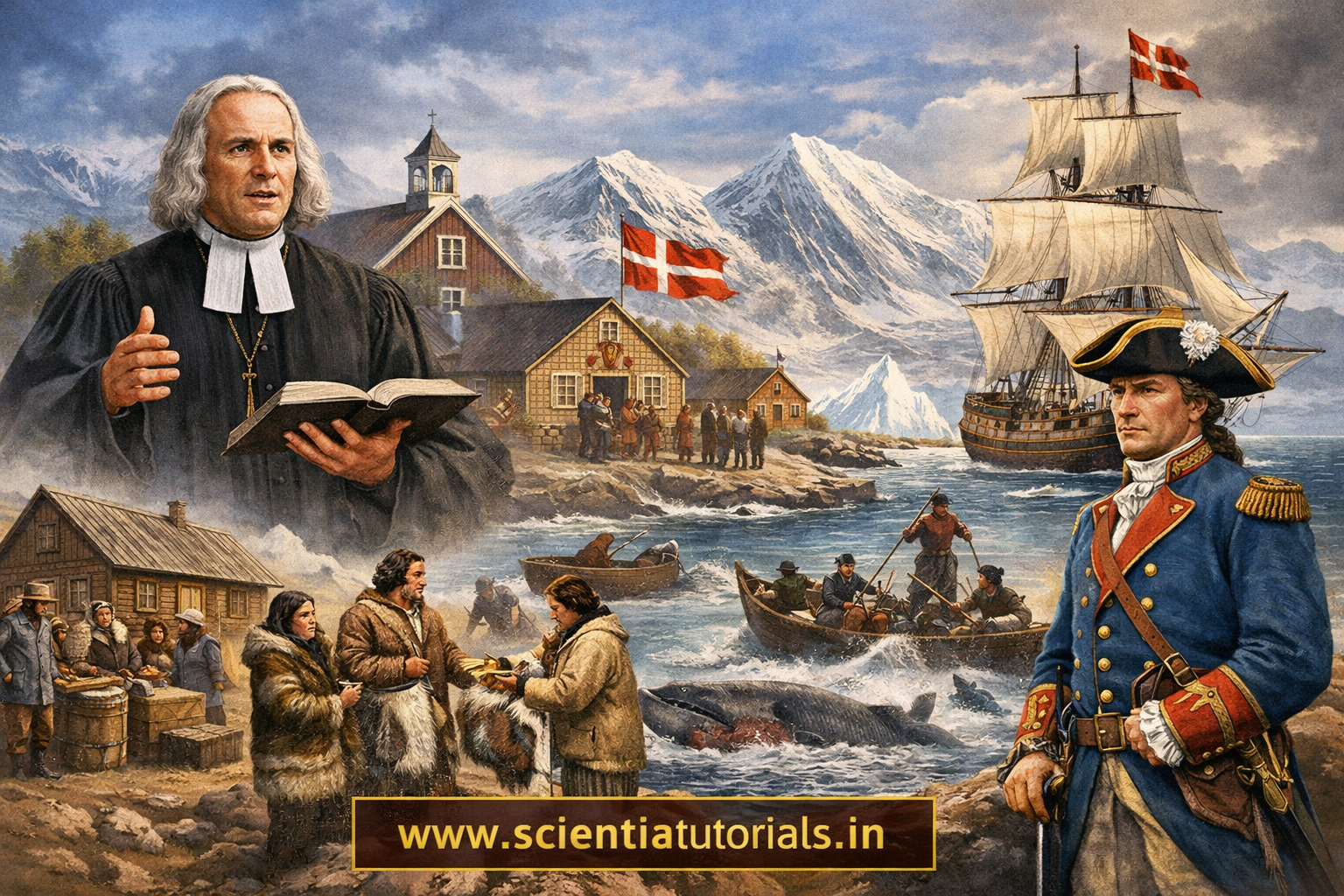
Danish Colonial Expansion and Administration in Greenland (16th–19th Century)
Course: Greenland: Historical Evolution and Its Global Strategic Importance
Module 3: Colonial Encounters and Early Modern Transformations
Era Framework: 16th Century – 19th Century
(European expansion, mercantilism, missionary activity)
Lesson: Danish Colonial Expansion and Administration
This lesson is systematically organized into four clearly structured sections, as detailed below:
- Chronologically Structured Study Module
- Short-Answer Type Questions
- Long-Answer Type Questions
- Multiple-Choice Questions (MCQs) with Answers and Detailed Explanations
Chronologically Structured Study Module
Lesson Objectives
By the end of this lesson, learners should be able to:
- Understand the historical context that enabled Danish colonial expansion in Greenland
- Trace the chronological evolution of Danish political, economic, and religious control
- Examine the administrative structures and governance mechanisms imposed by Denmark
- Analyze colonial–Indigenous interactions, especially with the Inuit (Kalaallit) population
- Evaluate the long-term consequences of Danish colonial administration on Greenland’s society, economy, and global strategic role
I. Introduction: Greenland in the Early Modern World (16th–17th Centuries)
The transition from the medieval to the early modern period marked a profound transformation in Greenland’s global position. Following the decline of Norse settlements by the 15th century, Greenland largely disappeared from European political consciousness. However, the Age of European Expansion (16th–18th centuries) revived interest in the Arctic as European powers sought new trade routes, missionary fields, and imperial possessions.
Greenland’s significance during this period was shaped by:
- European mercantilist competition
- Expanding Christian missionary ambitions
- Strategic concerns related to North Atlantic navigation
- The desire to reassert claims based on medieval Norse precedents
Denmark–Norway emerged as the dominant claimant, asserting continuity from medieval Scandinavian authority and transforming Greenland into a colonial possession.
II. Early European Contacts and the Reassertion of Danish Claims (16th–Early 18th Century)
1. Post-Norse Vacuum and European Exploration
After the disappearance of Norse settlements, Greenland was inhabited exclusively by Inuit societies, whose subsistence economy relied on hunting, fishing, and seasonal mobility. European contact during the 16th and 17th centuries was limited and sporadic:
- English and Dutch whalers operated offshore
- Explorers sought Northwest Passage routes
- Trade contacts remained informal and uncontrolled
Despite limited engagement, Greenland became part of Europe’s cartographic imagination, increasingly depicted as a territorial extension of Scandinavia.
2. Denmark–Norway’s Legal and Historical Claims
Denmark–Norway based its claims on:
- Medieval Norse colonization
- The historical jurisdiction of the Norwegian Crown
- The idea of Greenland as a “lost Christian land” requiring spiritual recovery
These claims would later justify direct colonial intervention and missionary activity.
III. Missionary Impulse and the Beginning of Formal Colonization (1721–Mid-18th Century)
1. The Mission of Hans Egede (1721)
The decisive moment in Danish colonial expansion occurred in 1721 with the expedition led by Hans Egede, a Lutheran missionary driven by religious and political objectives.
Egede’s mission aimed to:
- Re-Christianize Greenland’s supposed Norse descendants
- Establish permanent Danish presence
- Secure Danish sovereignty against rival European powers
Although no Norse survivors were found, Egede initiated sustained contact with Inuit communities and laid the foundations of colonial administration.
2. Establishment of Colonial Settlements
Early colonial settlements such as:
- Godthåb (modern Nuuk)
- Other coastal trading and mission stations
These functioned as:
- Religious centers
- Administrative hubs
- Trade collection points
Colonial authority was still fragile, heavily dependent on missionaries and limited state support.
IV. Mercantilism and the Rise of Trade Monopoly (Mid–Late 18th Century)
1. Mercantilist Framework of Danish Colonial Policy
Danish colonial expansion in Greenland followed mercantilist principles:
- Exclusive trade rights
- State-regulated commerce
- Prevention of foreign economic interference
Greenland was not intended for settler colonization but as a controlled extraction colony supplying valuable Arctic products.
2. Royal Greenland Trading Company
The establishment of the Royal Greenland Trading Company institutionalized Danish economic control.
Its functions included:
- Monopoly over trade with Inuit communities
- Regulation of prices and goods
- Provision of supplies to colonial stations
- Enforcement of Danish sovereignty
Trade items exported from Greenland included:
- Seal skins
- Whale oil
- Ivory (walrus tusks)
- Fish products
This monopoly reduced Indigenous autonomy and reshaped Inuit economic life, integrating it into European commercial networks.
V. Administrative Structures and Colonial Governance (18th–19th Century)
1. Centralized Colonial Administration
Danish administration in Greenland was highly centralized and paternalistic:
- Governors and inspectors appointed from Copenhagen
- Local administrators often combined commercial and judicial roles
- Missionaries wielded significant influence
Greenland was administered as a royal possession rather than a settler colony, emphasizing control and regulation over assimilation through migration.
2. Legal and Judicial Framework
Colonial law reflected Danish interests:
- Danish legal norms applied to trade and governance
- Inuit customary practices were tolerated only when compatible with colonial objectives
- Punitive authority rested with colonial officials
The absence of representative institutions reinforced authoritarian governance.
VI. Missionary Activity and Cultural Transformation
1. Christianization of the Inuit
Missionary work expanded throughout the 18th century:
- Translation of religious texts into Greenlandic
- Establishment of schools
- Promotion of Lutheran moral values
Christianization altered Inuit spiritual life, social organization, and worldview.
2. Language and Education
While missionary education promoted literacy, it also:
- Reinforced colonial hierarchies
- Discouraged traditional belief systems
- Encouraged dependence on Danish institutions
Ironically, the use of the Greenlandic language in religious instruction helped preserve linguistic identity even as cultural autonomy declined.
VII. Social and Economic Impact on Inuit Society
1. Economic Restructuring
Traditional subsistence economies were reshaped:
- Increased reliance on trade goods
- Monetization of hunting products
- Declining economic independence
While some Inuit benefited from trade, others became vulnerable to market fluctuations and colonial exploitation.
2. Demographic and Health Consequences
Colonial contact introduced:
- New diseases
- Altered settlement patterns
- Food insecurity during trade disruptions
Population decline and social stress marked the darker consequences of colonial integration.
VIII. Greenland in 19th-Century Imperial Context
By the 19th century, Greenland had become:
- A firmly controlled Danish colony
- An Arctic outpost insulated from direct European rivalry
- A strategically valuable territory in North Atlantic geopolitics
Denmark adopted a policy of isolation and protectionism, limiting foreign access to Greenland to preserve its monopoly and Indigenous population.
IX. Long-Term Consequences of Danish Colonial Administration
1. Political Legacy
Danish colonial governance:
- Delayed political self-representation
- Centralized authority in Copenhagen
- Established administrative frameworks that persisted into the 20th century
2. Cultural and Identity Formation
Colonial rule contributed to:
- A hybrid Inuit-Christian identity
- Preservation of language under missionary influence
- Emerging Indigenous awareness shaped by colonial experience
3. Strategic Significance
Greenland’s colonial incorporation ensured its role as:
- A North Atlantic strategic asset
- A bridge between Europe and the Arctic
- A territory of growing importance in later global power politics
X. Conclusion: Danish Colonial Expansion in Historical Perspective
Danish colonial expansion in Greenland from the 18th to 19th centuries represented a distinctive model of imperialism—marked by missionary leadership, mercantilist monopolies, and administrative paternalism rather than mass settlement. While it secured Danish sovereignty and integrated Greenland into global economic systems, it profoundly reshaped Indigenous society and constrained political autonomy.
Understanding this colonial phase is essential for interpreting:
- Greenland’s modern political status
- Its relationship with Denmark
- Its enduring global strategic importance
The legacy of Danish colonial administration continues to influence Greenland’s path toward self-determination and its position within international geopolitics.
Short Answer Type Questions and Answers
1. Why did Greenland regain importance in European geopolitics during the early modern period?
Greenland regained importance due to European expansion, mercantilism, missionary ambitions, and strategic interest in North Atlantic navigation during the 16th–18th centuries.
2. Which European state asserted colonial sovereignty over Greenland in the early modern era?
Denmark–Norway asserted colonial sovereignty over Greenland, claiming continuity from medieval Norse rule.
3. What historical justification did Denmark–Norway use to claim Greenland?
Denmark–Norway justified its claim based on medieval Norse settlements and the historical authority of the Norwegian Crown over Greenland.
4. Who initiated the formal Danish colonial presence in Greenland in 1721?
Hans Egede initiated the formal Danish colonial presence in Greenland in 1721.
5. What were the primary objectives of Hans Egede’s Greenland mission?
The mission aimed to re-Christianize Greenland, establish Danish sovereignty, and counter foreign European influence.
6. Which settlement became the earliest center of Danish colonial administration?
Godthåb (modern Nuuk) became the earliest center of Danish colonial administration.
7. Why did Danish colonization in Greenland differ from settler colonialism?
Danish colonization focused on trade, mission activity, and control rather than large-scale European settlement due to Greenland’s harsh environment.
8. What economic ideology shaped Danish colonial policy in Greenland?
Mercantilism shaped Danish colonial policy, emphasizing state-controlled trade and exclusive economic rights.
9. What was the primary purpose of the Royal Greenland Trading Company?
Royal Greenland Trading Company controlled all trade in Greenland and enforced Denmark’s mercantilist monopoly.
10. Which commodities were central to Greenland’s colonial trade economy?
Seal skins, whale oil, walrus ivory, and fish products formed the core of Greenland’s colonial exports.
11. How did the trade monopoly affect Inuit economic life?
The monopoly reduced Inuit economic autonomy and integrated traditional hunting into European-controlled commercial networks.
12. Describe the nature of Danish colonial administration in Greenland.
Administration was centralized, paternalistic, and controlled directly from Copenhagen through appointed officials.
13. What role did missionaries play in colonial governance?
Missionaries acted as religious leaders, educators, and influential intermediaries in colonial administration.
14. How was law administered under Danish colonial rule?
Danish legal norms governed trade and authority, while Inuit customs were tolerated only if they did not conflict with colonial interests.
15. What impact did Christianization have on Inuit society?
Christianization transformed spiritual beliefs, social organization, and cultural practices among Inuit communities.
16. How did missionary education influence Greenlandic language use?
Missionary education promoted literacy in the Greenlandic language, unintentionally supporting its long-term survival.
17. What were the demographic consequences of Danish colonial contact?
Colonial contact introduced diseases, altered settlement patterns, and contributed to population decline.
18. Why did Denmark restrict foreign access to Greenland in the 19th century?
Denmark restricted access to protect its trade monopoly and maintain control over the Indigenous population.
19. How did Danish colonial policy affect Inuit political participation?
Colonial rule denied Inuit political representation and centralized authority in Danish hands.
20. What was the strategic importance of Greenland for Denmark in the 19th century?
Greenland served as a secure Arctic outpost and strengthened Denmark’s position in the North Atlantic.
21. In what ways did colonialism reshape Inuit subsistence practices?
Traditional subsistence activities became increasingly tied to market demands and European trade goods.
22. What long-term political legacy did Danish colonial administration leave?
It delayed self-governance while establishing administrative systems that continued into the modern era.
23. How did colonial rule contribute to cultural hybridity in Greenland?
Colonialism produced a hybrid Inuit-Christian identity blending Indigenous traditions with Lutheran influence.
24. Why is Danish colonialism in Greenland considered a distinctive imperial model?
It emphasized missionary activity, trade monopolies, and administrative control rather than settler expansion.
25. Why is understanding Danish colonial expansion essential to Greenland’s modern history?
It explains Greenland’s political relationship with Denmark, cultural transformations, and ongoing strategic importance.
Long Answer Type Questions and Answers
1. Examine the historical circumstances that led to Danish colonial expansion in Greenland.
Danish colonial expansion in Greenland was shaped by early modern European imperial competition, mercantilist economic thinking, and missionary zeal. After the collapse of Norse settlements in the 15th century, Greenland remained outside direct European control. However, the 16th–18th centuries saw renewed European interest in the Arctic due to trade routes, whaling, and strategic positioning in the North Atlantic. Denmark–Norway asserted historical continuity from medieval Norse rule and sought to re-establish sovereignty, culminating in formal colonization in the early 18th century.
2. Discuss the significance of medieval Norse legacy in legitimizing Danish colonial claims.
Denmark–Norway relied heavily on the legacy of medieval Norse settlements to justify its claims over Greenland. The Danish Crown argued that Greenland had never legally ceased to be part of the Scandinavian realm, even after the disappearance of Norse communities. This historical argument provided legal and ideological legitimacy against rival European powers and formed the basis for Denmark’s assertion of exclusive sovereignty during the colonial period.
3. Analyze the role of missionary activity in initiating Danish colonial rule in Greenland.
Missionary activity was the primary catalyst for Danish colonization. The 1721 expedition led by Hans Egede aimed to re-Christianize Greenland and restore a supposed lost Christian population. Although no Norse descendants were found, missionary work established permanent settlements, created administrative centers, and provided Denmark with moral and political justification for colonial rule.
4. Evaluate the objectives and outcomes of Hans Egede’s Greenland mission.
Hans Egede’s mission had three main objectives: religious conversion, political sovereignty, and protection against foreign intrusion. While the goal of rediscovering Norse Christians failed, the mission succeeded in establishing Danish presence, initiating Christianization of the Inuit, and laying the foundations of colonial administration. Egede’s efforts transformed Greenland from a loosely claimed territory into an organized Danish colony.
5. Describe the nature of Danish colonial settlements in Greenland during the 18th century.
Danish colonial settlements were coastal, small-scale, and multifunctional. They served as missionary stations, trading posts, and administrative centers rather than agricultural colonies. Settlements such as Godthåb (Nuuk) became hubs for governance and trade. The absence of large-scale European settlement reflected Greenland’s harsh environment and Denmark’s economic priorities.
6. Explain the mercantilist foundations of Danish colonial economic policy in Greenland.
Danish colonial policy was shaped by mercantilism, emphasizing state-controlled trade and exclusive economic rights. Greenland was viewed as a source of raw materials rather than a settlement colony. Economic activities were tightly regulated to ensure profits flowed to the Danish Crown while preventing foreign competition and limiting Indigenous autonomy.
7. Assess the role of the Royal Greenland Trading Company in colonial administration.
The Royal Greenland Trading Company played a central role in enforcing Danish authority. It controlled all trade, regulated prices, supplied colonial stations, and acted as an extension of the colonial state. The monopoly integrated Inuit hunting into European markets while restricting economic freedom and reinforcing Danish dominance.
8. Discuss the impact of trade monopolies on Inuit economic life.
Trade monopolies transformed Inuit subsistence practices by linking hunting and fishing to European demand. Inuit hunters became dependent on trade goods such as tools and food supplies. While some gained economic benefits, the system reduced autonomy, exposed communities to market instability, and altered traditional economic relationships.
9. Analyze the structure and characteristics of Danish colonial administration in Greenland.
Danish administration was centralized, authoritarian, and paternalistic. Governors and inspectors were appointed from Copenhagen, and local officials often combined judicial, commercial, and administrative roles. Inuit participation in governance was minimal, reflecting colonial priorities of control rather than representation.
10. Examine the legal framework imposed by Danish colonial authorities.
Colonial law prioritized Danish interests in trade and governance. Danish legal norms governed economic activities and criminal justice, while Inuit customary practices were tolerated only when they did not conflict with colonial objectives. The absence of representative legal institutions reinforced colonial domination.
11. Evaluate the role of missionaries beyond religious conversion.
Missionaries acted as educators, cultural intermediaries, and administrative advisors. They introduced literacy, schooling, and written Greenlandic language, while also promoting European moral values. Their influence extended beyond religion, shaping social norms and reinforcing colonial authority.
12. Discuss the cultural consequences of Christianization in Greenland.
Christianization transformed Inuit spiritual beliefs, social structures, and rituals. Traditional belief systems were discouraged, while Lutheran ethics reshaped community life. However, the use of the Greenlandic language in religious instruction allowed aspects of Indigenous identity to survive within a colonial framework.
13. Analyze the demographic and health effects of Danish colonial contact.
Colonial contact introduced new diseases, disrupted traditional food systems, and altered settlement patterns. These changes contributed to population decline and increased vulnerability. Dependency on trade supplies also intensified the impact of famine and economic disruption.
14. Explain Denmark’s policy of isolation and protectionism in the 19th century.
Denmark restricted foreign access to Greenland to protect its trade monopoly and prevent exploitation by rival powers. This isolationist policy aimed to preserve economic control and limit external cultural influence while maintaining colonial authority.
15. Assess Greenland’s strategic importance to Denmark during the 19th century.
Greenland became a strategic Arctic outpost, securing Denmark’s presence in the North Atlantic. Its location enhanced maritime security and reinforced Denmark’s imperial status, even as its economic value remained limited.
16. Compare Danish colonialism in Greenland with other European colonial models.
Unlike settler colonies, Danish colonialism emphasized missionary activity, trade monopolies, and administrative control. There was minimal European migration, and Indigenous populations remained the demographic majority, making Greenland a distinctive example of Arctic imperialism.
17. Discuss the social restructuring of Inuit society under Danish rule.
Colonial rule altered social hierarchies, encouraged sedentary settlement, and introduced new forms of authority linked to missionaries and traders. Traditional leadership structures weakened as colonial institutions gained dominance.
18. Examine the long-term political legacy of Danish colonial administration.
Danish rule delayed political self-representation and centralized authority in Copenhagen. However, it also established administrative frameworks that later influenced Greenland’s gradual transition toward autonomy in the modern era.
19. Analyze the role of language in colonial governance and cultural survival.
While Danish authorities promoted European norms, missionaries used Greenlandic for religious instruction. This paradoxically strengthened linguistic preservation even as cultural autonomy declined.
20. Critically evaluate the overall impact of Danish colonial expansion on Greenland’s historical trajectory.
Danish colonial expansion integrated Greenland into global economic and political systems while profoundly reshaping Indigenous society. It secured sovereignty and strategic control but imposed economic dependency, cultural transformation, and political marginalization. The legacy of this period continues to shape Greenland’s modern identity and strategic significance.
MCQs with Answers and Explanations
1. The renewed European interest in Greenland during the early modern period was primarily linked to:
A. Agricultural expansion
B. Industrial manufacturing
C. European expansion and mercantilism
D. Population migration
Correct Answer: C
Explanation:
Greenland gained renewed importance during the 16th–18th centuries due to European expansion, mercantilist trade policies, missionary ambitions, and strategic North Atlantic interests—not agriculture or industrial settlement.
2. Which political entity asserted colonial sovereignty over Greenland in the early modern era?
A. Sweden
B. England
C. Denmark–Norway
D. The Netherlands
Correct Answer: C
Explanation:
Denmark–Norway claimed Greenland based on medieval Norse connections and formally established colonial control in the 18th century.
3. Denmark–Norway justified its claim over Greenland mainly by referring to:
A. Inuit alliances
B. Viking raids
C. Medieval Norse settlements
D. Whaling dominance
Correct Answer: C
Explanation:
The Danish Crown claimed historical continuity from medieval Norse rule, arguing that Greenland remained legally part of the Scandinavian realm.
4. The formal beginning of Danish colonial presence in Greenland is associated with the year:
A. 1607
B. 1683
C. 1721
D. 1801
Correct Answer: C
Explanation:
In 1721, Denmark initiated permanent colonial presence through missionary and administrative settlement.
5. Who led the 1721 expedition that marked the start of Danish colonization?
A. Erik the Red
B. Hans Egede
C. Vitus Bering
D. Jens Munk
Correct Answer: B
Explanation:
Hans Egede, a Lutheran missionary, led the expedition aiming to re-Christianize Greenland and assert Danish sovereignty.
6. The initial purpose of Hans Egede’s mission was to:
A. Discover gold deposits
B. Establish agricultural colonies
C. Re-Christianize Norse descendants
D. Promote whaling enterprises
Correct Answer: C
Explanation:
Egede believed Norse Christians still lived in Greenland and aimed to restore Christianity, which later justified colonial administration.
7. Which settlement emerged as the first major Danish colonial center?
A. Sisimiut
B. Ilulissat
C. Godthåb (Nuuk)
D. Thule
Correct Answer: C
Explanation:
Godthåb (modern Nuuk) became the administrative, missionary, and trading hub of Danish Greenland.
8. Danish colonialism in Greenland differed from settler colonialism because it:
A. Encouraged mass European migration
B. Focused on plantation agriculture
C. Emphasized trade and missionary activity
D. Eliminated Indigenous populations
Correct Answer: C
Explanation:
Danish colonialism prioritized trade monopolies and religious conversion rather than large-scale European settlement.
9. Which economic ideology guided Danish colonial policy in Greenland?
A. Capitalism
B. Socialism
C. Mercantilism
D. Free trade liberalism
Correct Answer: C
Explanation:
Mercantilism emphasized state control of trade, exclusive rights, and prevention of foreign competition.
10. The Royal Greenland Trading Company primarily functioned to:
A. Encourage private trade
B. Enforce free-market policies
C. Control all trade with Greenland
D. Promote industrial production
Correct Answer: C
Explanation:
The Royal Greenland Trading Company maintained a state monopoly over Greenland’s trade to serve Danish economic interests.
11. Which of the following was NOT a major Greenland export under Danish colonial rule?
A. Seal skins
B. Whale oil
C. Walrus ivory
D. Cotton textiles
Correct Answer: D
Explanation:
Greenland exported Arctic products, not agricultural or industrial goods like cotton textiles.
12. The trade monopoly most directly affected Inuit society by:
A. Eliminating hunting
B. Encouraging independence
C. Increasing economic autonomy
D. Creating dependency on European trade goods
Correct Answer: D
Explanation:
The monopoly integrated Inuit hunting into European markets, reducing autonomy and increasing dependence.
13. Danish colonial administration in Greenland can best be described as:
A. Democratic and representative
B. Decentralized
C. Centralized and paternalistic
D. Military-dominated
Correct Answer: C
Explanation:
Colonial governance was controlled from Copenhagen and characterized by paternalistic oversight.
14. Who held significant influence alongside colonial administrators in Greenland?
A. Military generals
B. Plantation owners
C. Missionaries
D. Inuit chiefs
Correct Answer: C
Explanation:
Missionaries played major roles in education, governance, and cultural transformation.
15. Under Danish rule, Inuit customary law was:
A. Fully recognized
B. Replaced entirely by Danish law
C. Allowed only if compatible with colonial interests
D. Codified into European legal systems
Correct Answer: C
Explanation:
Colonial authorities tolerated Inuit customs selectively, subordinating them to Danish legal priorities.
16. Christianization in Greenland primarily resulted in:
A. Complete cultural destruction
B. Total resistance by Inuit society
C. Cultural transformation and hybridity
D. Immediate political autonomy
Correct Answer: C
Explanation:
Christianization reshaped belief systems while creating a hybrid Inuit-Christian cultural identity.
17. Missionary education had which unintended consequence?
A. Loss of Greenlandic language
B. Strengthening of oral traditions only
C. Preservation of Greenlandic language through literacy
D. Abolition of Inuit culture
Correct Answer: C
Explanation:
Religious instruction in Greenlandic helped preserve the language despite colonial domination.
18. Which factor contributed most to demographic decline in colonial Greenland?
A. Warfare
B. European diseases
C. Forced migration
D. Industrial accidents
Correct Answer: B
Explanation:
Exposure to European diseases significantly affected Inuit population levels.
19. Denmark restricted foreign access to Greenland in the 19th century mainly to:
A. Encourage tourism
B. Promote international trade
C. Protect its trade monopoly
D. Facilitate missionary competition
Correct Answer: C
Explanation:
Isolation policies safeguarded Danish economic and political control.
20. Greenland’s strategic importance for Denmark lay primarily in its:
A. Agricultural potential
B. Industrial capacity
C. Arctic location in the North Atlantic
D. Population size
Correct Answer: C
Explanation:
Greenland’s location enhanced Denmark’s strategic presence in Arctic and North Atlantic geopolitics.
21. Which feature best characterizes Danish colonial imperialism in Greenland?
A. Plantation slavery
B. Large settler population
C. Missionary–trade–administration nexus
D. Industrial exploitation
Correct Answer: C
Explanation:
Danish colonialism relied on missionaries, trade monopolies, and administrative control.
22. Inuit political participation under Danish rule was:
A. Actively encouraged
B. Gradually expanded
C. Largely absent
D. Fully institutionalized
Correct Answer: C
Explanation:
Colonial governance excluded Inuit from decision-making processes.
23. The long-term political legacy of Danish colonial rule included:
A. Immediate independence
B. Early democratic institutions
C. Delayed self-governance
D. Complete political isolation
Correct Answer: C
Explanation:
Colonial administration postponed political autonomy while creating lasting governance structures.
24. Danish colonial rule contributed to Greenland’s modern identity by:
A. Erasing Indigenous culture
B. Creating a hybrid cultural framework
C. Preventing language development
D. Eliminating religion
Correct Answer: B
Explanation:
Colonialism reshaped Inuit society while allowing cultural blending and adaptation.
25. Understanding Danish colonial expansion is essential because it explains:
A. Greenland’s prehistoric past
B. Greenland’s climate patterns
C. Greenland’s modern political and strategic status
D. Viking ship technology
Correct Answer: C
Explanation:
Colonial history explains Greenland’s contemporary relationship with Denmark and its global strategic importance.