
European Rediscovery of Greenland in the Early Modern Era
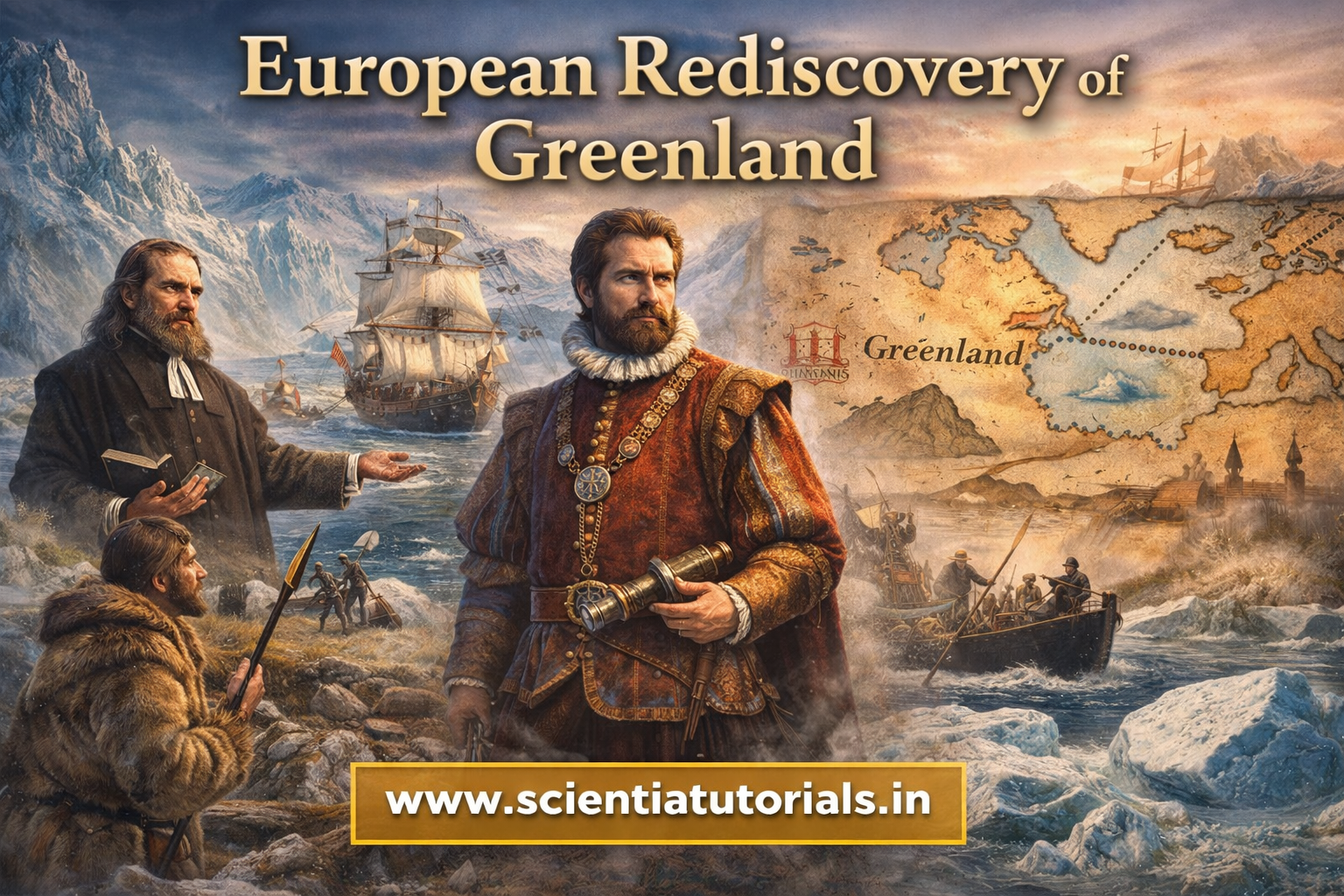
European Rediscovery of Greenland | Colonial Encounters & Early Modern Era
Module 3: Colonial Encounters and Early Modern Transformations
Lesson: European Rediscovery of Greenland in the Early Modern Era
Era Framework: 16th Century – 19th Century
This lesson is systematically organized into four clearly structured sections, as detailed below:
- Chronologically Structured Study Module
- Short-Answer Type Questions
- Long-Answer Type Questions
- Multiple-Choice Questions (MCQs) with Answers and Detailed Explanations
Chronologically Structured Study Module
Introduction: From Medieval Absence to Early Modern Rediscovery
The period between the 16th and 19th centuries marked a decisive transformation in Greenland’s historical trajectory. After the disappearance of the medieval Norse settlements by the 15th century, Greenland faded from direct European engagement for several generations. However, the onset of the Early Modern era—characterized by European maritime expansion, mercantilist economic systems, missionary zeal, and imperial competition—brought Greenland back into global consciousness.
This lesson examines how Greenland was “rediscovered” by European powers, not as a lost medieval colony, but as a strategically located Arctic territory with economic, religious, and geopolitical significance. Chronologically structured, the module situates Greenland within broader early modern global processes, including the Age of Exploration, colonial rivalry, missionary expansion, and the consolidation of imperial authority.
I. Greenland after the Medieval Period: A Historical Interlude (c. 15th–16th Century)
1. Disappearance of the Norse and European Amnesia
By the 15th century, Norse Greenland had vanished from the European world. Written references declined, trade links ceased, and Greenland survived mainly as a semi-mythical land mentioned in medieval maps and sagas. European awareness of Greenland persisted, but direct contact did not.
This absence coincided with major changes in Europe: the Renaissance, the rise of centralized monarchies, and expanding maritime technologies. Greenland’s reappearance in European history was therefore shaped not by medieval continuity but by early modern ambitions.
2. Cartography and Memory
Early modern maps often depicted Greenland inaccurately, sometimes attaching it to North America or exaggerating its size. These cartographic errors reflect the partial survival of medieval knowledge combined with speculative geography, a hallmark of early modern exploration.
II. The Age of Exploration and Arctic Rediscovery (16th Century)
1. Greenland in the Context of European Expansion
The 16th century marked the beginning of sustained European oceanic expansion. While southern routes to Asia captured immediate attention, northern routes also gained importance due to competition and the search for alternative passages.
Greenland re-entered European strategic thinking primarily as:
- A potential gateway to the Northwest Passage
- A base for Arctic exploration
- A zone of imperial influence in the North Atlantic
2. English and Dutch Expeditions
Among the earliest documented rediscovery efforts were English voyages led by Martin Frobisher in the 1570s. Although primarily searching for a Northwest Passage, Frobisher’s expeditions re-established direct European contact with Greenland’s coasts.
These expeditions were motivated by:
- Commercial ambitions
- Strategic rivalry with Spain
- Curiosity about Arctic resources
While they did not result in colonization, they marked Greenland’s re-entry into European geopolitical awareness.
III. Mercantilism and Arctic Resources (17th Century)
1. The Mercantilist Worldview
By the 17th century, European states increasingly operated under mercantilist principles, emphasizing:
- State control of trade
- Accumulation of resources
- Overseas territorial claims
Greenland’s Arctic resources—whale oil, sealskins, and fish—gained renewed importance within this framework.
2. Whaling and Commercial Activity
Dutch, English, and later Danish traders exploited the waters around Greenland for whaling. Although most operations were seasonal and offshore, they integrated Greenland into the early modern global economy.
This phase differed from medieval trade:
- It involved capitalist enterprises rather than subsistence exchange
- It linked Greenland indirectly to global markets
- Indigenous Greenlanders were increasingly drawn into commercial relationships
IV. Danish-Norwegian Claims and Colonial Reassertion (18th Century)
1. Denmark-Norway and Historical Claims
The most decisive shift in Greenland’s early modern history occurred in the 18th century. The kingdom of Denmark-Norway claimed Greenland as a former Norse territory, asserting historical continuity between medieval settlement and early modern sovereignty.
These claims were both ideological and strategic, aimed at preventing rival European powers from establishing a foothold in the Arctic.
2. The Mission of Hans Egede
In 1721, Hans Egede led a mission to Greenland that marked the beginning of sustained Danish colonization. Initially motivated by the belief that Norse settlers might still exist, Egede’s mission quickly transformed into a colonial and missionary project focused on the Inuit population.
Egede’s arrival symbolizes:
- The fusion of religion and empire
- The transition from exploration to colonization
- The institutionalization of European authority in Greenland
V. Missionary Activity and Cultural Transformation
1. Christianity and Colonial Control
Missionary activity became a central pillar of early modern colonial governance in Greenland. Lutheran missionaries sought to convert Inuit communities, establish schools, and reshape indigenous belief systems.
Christianization served dual purposes:
- Religious conversion
- Cultural assimilation and social control
2. Role of Protestant Missions
Alongside Danish Lutheran efforts, groups such as the Moravian Church played a significant role in Greenland. Moravian missionaries emphasized education, language learning, and community organization.
These missions:
- Introduced written Greenlandic
- Altered indigenous social structures
- Created new forms of cultural hybridity
VI. Colonial Administration and Economic Restructuring (18th–19th Century)
1. Trade Monopolies and State Control
Denmark established trade monopolies in Greenland to regulate economic activity. Indigenous populations were incorporated into colonial trade systems, supplying furs and other resources in exchange for European goods.
This system reflected broader colonial patterns:
- Economic dependency
- Limited local autonomy
- State-managed commerce
2. Impact on Inuit Society
Colonial trade altered traditional Inuit economies based on hunting and seasonal movement. Dependence on European goods increased, while exposure to foreign diseases and social disruption caused demographic stress.
Despite these pressures, Inuit communities demonstrated resilience and adaptation, preserving key elements of language and culture.
VII. Greenland in the Early Modern Global System
1. Strategic Importance
By the 19th century, Greenland’s importance extended beyond economics and religion. Its location in the North Atlantic made it strategically valuable for navigation, communication, and imperial competition.
Greenland was increasingly viewed as:
- A territorial buffer
- A symbol of Arctic sovereignty
- A component of emerging global geopolitics
2. Scientific Exploration
The late early modern period also saw scientific interest in Greenland’s geography, climate, and peoples. Expeditions contributed to European knowledge production, reinforcing Greenland’s integration into global intellectual networks.
VIII. Continuities and Changes from the Medieval to Early Modern Period
1. Continuities
- Continued European interest in Greenland’s strategic location
- Persistent external control over Greenland’s economic life
- Ongoing marginalization of indigenous voices
2. Changes
- Shift from Norse agrarian settlement to colonial administration
- Replacement of medieval trade with mercantilist monopolies
- Expansion of missionary-driven cultural transformation
This comparison highlights how early modern globalization differed in scale, intensity, and institutional power from medieval networks.
IX. Analytical Perspectives: Colonialism and Rediscovery
1. Rediscovery as Reinterpretation
European “rediscovery” of Greenland was not a neutral act. It involved reinterpreting the land through colonial frameworks, often ignoring indigenous histories and agency.
2. Greenland as a Colonial Periphery
Greenland functioned as a colonial periphery—economically useful, strategically important, but politically subordinate. Its experience mirrors broader patterns of early modern colonialism in marginal environments.
Conclusion: Greenland’s Early Modern Transformation
Between the 16th and 19th centuries, Greenland underwent a profound transformation from a forgotten medieval frontier to a structured colonial possession within the early modern global order. European rediscovery, driven by exploration, mercantilism, missionary zeal, and imperial competition, re-integrated Greenland into global systems under fundamentally different terms than before.
This period laid the foundations for modern Greenlandic history. Colonial administration, cultural change, and economic dependency reshaped society, while indigenous resilience ensured cultural continuity. Greenland’s early modern experience thus offers critical insights into the nature of European expansion, the dynamics of colonial encounters, and the global significance of Arctic regions.
Short Answer Type Questions (with Answers)
1. What is meant by the “European rediscovery” of Greenland?
European rediscovery refers to the renewed European contact with Greenland from the 16th century onward, after the disappearance of medieval Norse settlements.
2. Which historical period does the early modern rediscovery of Greenland belong to?
It belongs to the Early Modern period (16th–19th centuries).
3. Why did Greenland disappear from direct European contact after the medieval period?
The collapse of Norse settlements, climatic change, and declining trade links led to Greenland’s disappearance from European engagement.
4. How was Greenland represented in early modern European maps?
It was often inaccurately depicted, sometimes attached to North America or shown in exaggerated size.
5. Which global process brought Greenland back into European attention?
The Age of Exploration and European maritime expansion.
6. What strategic importance did Greenland hold during the 16th century?
Greenland was viewed as a gateway to the Northwest Passage and a key Arctic location.
7. Name one English explorer associated with Greenland’s rediscovery.
Martin Frobisher.
8. What was the primary objective of early English Arctic expeditions?
The search for a Northwest Passage to Asia.
9. Why did early rediscovery voyages not lead to immediate colonization?
Because of harsh climatic conditions, limited resources, and lack of sustained economic incentives.
10. Which economic ideology influenced European interest in Greenland during the 17th century?
Mercantilism.
11. What Arctic resources attracted European traders to Greenland?
Whale oil, sealskins, fish, and other marine resources.
12. Which European power established long-term colonial control over Greenland?
Denmark-Norway.
13. On what basis did Denmark-Norway claim Greenland?
On the basis of historical continuity from medieval Norse settlements.
14. Who led the Danish missionary initiative to Greenland in 1721?
Hans Egede.
15. What was the original aim of Hans Egede’s mission?
To locate surviving Norse Christians and re-establish Christianity.
16. How did missionary activity support colonial control in Greenland?
By promoting religious conversion, cultural change, and social regulation.
17. Which Protestant group played a key missionary role alongside Danish Lutherans?
The Moravian Church.
18. What cultural impact did missionaries have on Inuit society?
They introduced Christianity, formal education, and written Greenlandic.
19. How did Danish trade monopolies function in Greenland?
They regulated trade, controlled prices, and limited foreign competition.
20. What was the economic effect of colonial trade on Inuit communities?
It created dependency on European goods and disrupted traditional economies.
21. What role did Greenland play in early modern imperial competition?
It served as a strategic Arctic territory in North Atlantic geopolitics.
22. How did early modern globalization differ from medieval connections with Greenland?
It was more institutionalized, state-controlled, and imperial in nature.
23. Why is Greenland described as a colonial periphery?
Because it was economically useful but politically subordinate to European powers.
24. What new form of exploration emerged in Greenland by the 19th century?
Scientific and geographic exploration.
25. What is the historical significance of Greenland’s early modern rediscovery?
It marked Greenland’s integration into European colonial, economic, and religious systems, shaping its modern history.
Long Answer Type Questions with Answers
1. Explain the concept of “European rediscovery” of Greenland in the Early Modern era.
The “European rediscovery” of Greenland refers to the renewed European engagement with the island from the 16th century onward, after the disappearance of medieval Norse settlements. Unlike medieval contact, early modern rediscovery occurred within the context of European maritime expansion, imperial rivalry, and mercantilism. Greenland was no longer viewed as a Norse agrarian colony but as an Arctic territory of strategic, economic, and missionary importance. This rediscovery reinserted Greenland into global systems under colonial frameworks.
2. Why did Greenland disappear from direct European contact after the medieval period?
Greenland disappeared from European contact due to the collapse of Norse settlements by the 15th century, driven by climate deterioration, economic isolation, and declining trade. As maritime routes shifted and European priorities focused on southern oceans, Greenland faded into semi-mythical status. Knowledge survived mainly through sagas and maps, but sustained contact ceased until early modern exploration revived interest.
3. Discuss the role of early modern cartography in shaping European perceptions of Greenland.
Early modern cartography preserved fragmented medieval knowledge while introducing speculation. Greenland was often inaccurately depicted—sometimes connected to North America or vastly oversized. These maps reflect both limited empirical knowledge and imaginative geography. Cartography thus shaped European curiosity and justified exploration, reinforcing Greenland’s perceived strategic importance despite incomplete understanding.
4. Analyze how the Age of Exploration contributed to Greenland’s rediscovery.
The Age of Exploration expanded European maritime horizons beyond traditional routes. While southern voyages dominated, northern exploration gained significance due to competition and the search for alternative passages to Asia. Greenland emerged as a potential gateway to the Northwest Passage and a base for Arctic navigation. Exploration transformed Greenland from a forgotten land into a strategic space within early modern global expansion.
5. Examine the significance of English Arctic expeditions to Greenland in the 16th century.
English expeditions, particularly those led by Martin Frobisher, marked Greenland’s re-entry into European awareness. Although primarily searching for a Northwest Passage, these voyages established renewed contact with Greenland’s coasts. While they failed to create permanent settlements, they demonstrated Europe’s growing interest in Arctic regions as part of imperial competition.
6. Why did early rediscovery voyages fail to establish permanent European colonies in Greenland?
Early expeditions faced harsh climatic conditions, navigational challenges, and limited economic returns. Greenland offered no immediate wealth comparable to tropical colonies. Seasonal exploitation proved more viable than settlement, delaying colonization until stronger imperial and missionary motivations emerged in the 18th century.
7. Discuss the influence of mercantilism on European interest in Greenland during the 17th century.
Mercantilism emphasized state-controlled trade, resource accumulation, and territorial claims. Greenland’s Arctic resources—whale oil, sealskins, and fish—fit well within mercantilist objectives. European powers exploited Greenland’s surrounding waters through commercial enterprises, integrating it indirectly into the global economy without establishing extensive inland colonies.
8. Evaluate the role of Arctic whaling in Greenland’s early modern economic integration.
Arctic whaling linked Greenland to early capitalist markets in Europe. Dutch and English whalers operated seasonally, extracting marine resources for global trade. While Greenland itself remained lightly settled, these activities reinforced its economic relevance and highlighted the shift from medieval subsistence exchange to profit-driven exploitation.
9. Explain why Denmark-Norway emerged as the dominant colonial power in Greenland.
Denmark-Norway asserted sovereignty over Greenland by invoking historical continuity with medieval Norse settlements. Strategic concerns, competition with other European powers, and imperial consolidation motivated Danish reassertion. Unlike other states, Denmark-Norway pursued long-term control through missions, administration, and trade monopolies, ensuring lasting colonial authority.
10. Analyze the significance of the 1721 mission led by Hans Egede.
The mission led by Hans Egede marked the beginning of sustained European colonization in Greenland. Initially aimed at locating surviving Norse Christians, it quickly evolved into a missionary and colonial project targeting Inuit communities. Egede’s mission symbolized the fusion of religion and empire in early modern colonialism.
11. Discuss how missionary activity functioned as an instrument of colonial control in Greenland.
Missionary activity promoted Christianity while reshaping indigenous culture, education, and social organization. Conversion efforts supported colonial governance by fostering cultural assimilation and loyalty to European authority. Religion thus became a key mechanism for integrating Greenland into European imperial systems.
12. Examine the role of the Moravian Church in Greenland’s cultural transformation.
The Moravian Church played a significant role in missionary work alongside Danish Lutherans. Moravians emphasized education, language learning, and community life. Their work contributed to literacy in Greenlandic and facilitated cultural hybridity, blending indigenous traditions with Christian practices.
13. Analyze the impact of Danish trade monopolies on Greenland’s economy.
Danish trade monopolies regulated economic activity, restricted foreign access, and controlled prices. While they ensured steady profits for the colonial state, they also limited local autonomy and reinforced dependency. Indigenous Greenlanders became tied to European goods, reshaping traditional economic practices.
14. Discuss the effects of colonial trade on Inuit society.
Colonial trade disrupted traditional Inuit economies based on hunting and seasonal movement. Dependence on imported goods increased, while exposure to new diseases and social change caused demographic stress. Despite these challenges, Inuit communities adapted and preserved core cultural elements, demonstrating resilience under colonial pressure.
15. How did Greenland’s strategic importance evolve during the early modern period?
Initially valued for exploration and resources, Greenland gained increasing strategic importance by the 18th and 19th centuries. Its North Atlantic location made it significant for navigation, imperial rivalry, and territorial claims. Greenland became a symbol of Arctic sovereignty within expanding global geopolitics.
16. Examine the role of scientific exploration in Greenland during the 19th century.
By the 19th century, Greenland attracted scientific interest in geography, climate, and ethnography. Expeditions contributed to European knowledge systems and reinforced colonial authority. Scientific exploration reflected the intellectual dimension of early modern and modern imperialism.
17. Compare Greenland’s early modern experience with its medieval history.
Medieval Greenland was a Norse agrarian frontier integrated through trade and religion. Early modern Greenland, by contrast, was a colonial possession governed through state monopolies and missionary institutions. This shift highlights the increasing power and institutional reach of early modern empires.
18. Why is the term “rediscovery” problematic when applied to Greenland?
The term “rediscovery” ignores continuous Inuit presence and agency. From a European perspective, Greenland was rediscovered; for indigenous peoples, it was never lost. The concept reflects colonial viewpoints that marginalized indigenous histories.
19. In what ways does Greenland exemplify early modern colonial peripheries?
Greenland functioned as a peripheral colony—strategically important but economically limited and politically subordinate. Its experience mirrors broader colonial patterns in marginal environments, where control outweighed settlement density.
20. Evaluate the overall significance of Greenland’s early modern transformation.
Greenland’s early modern transformation redefined its place in world history. European rediscovery integrated the island into colonial, economic, religious, and scientific networks. This period laid the foundations of modern Greenlandic history while illustrating the dynamics of European expansion, colonialism, and global connectivity in the Arctic.
Multiple Choice Questions (MCQs) with Answers and Explanations
1. The “European rediscovery” of Greenland refers to renewed contact during the:
A. 10th–12th centuries
B. 13th–15th centuries
C. 16th–19th centuries
D. 20th century
Correct Answer: C
Explanation:
After medieval Norse collapse, Greenland re-entered European awareness during the Early Modern period (16th–19th centuries).
2. Greenland faded from European contact after the medieval period mainly because:
A. It was conquered by rival empires
B. Norse settlements collapsed and trade links declined
C. It was deliberately abandoned by Europe
D. Indigenous resistance blocked access
Correct Answer: B
Explanation:
Climate change, isolation, and economic decline led to the disappearance of Norse Greenland, ending sustained European contact.
3. Early modern European maps often depicted Greenland inaccurately because:
A. Cartographers avoided Arctic regions
B. Knowledge was fragmentary and speculative
C. Greenland refused exploration
D. Printing technology was limited
Correct Answer: B
Explanation:
Early modern cartography blended medieval memory with speculation, producing distorted representations of Greenland.
4. Greenland regained European attention mainly due to:
A. Crusades
B. Industrialization
C. The Age of Exploration
D. Nationalist movements
Correct Answer: C
Explanation:
The Age of Exploration encouraged Europeans to search new routes, including northern Arctic pathways.
5. In the 16th century, Greenland was strategically valued as a:
A. Plantation colony
B. Mining center
C. Gateway to the Northwest Passage
D. Military stronghold
Correct Answer: C
Explanation:
European powers hoped Greenland could facilitate a northern sea route to Asia.
6. Which English explorer is closely associated with Greenland’s early modern rediscovery?
A. Francis Drake
B. John Cabot
C. Martin Frobisher
D. James Cook
Correct Answer: C
Explanation:
Martin Frobisher’s Arctic voyages in the 1570s renewed direct European contact with Greenland.
7. The main goal of Frobisher’s expeditions was to:
A. Establish colonies
B. Spread Christianity
C. Find a Northwest Passage
D. Exploit farmland
Correct Answer: C
Explanation:
Frobisher’s voyages were motivated by trade and strategic competition rather than settlement.
8. Early modern expeditions did not immediately colonize Greenland because:
A. Indigenous armies were strong
B. Economic returns were limited and climate was harsh
C. Europe lacked ships
D. Greenland was unknown
Correct Answer: B
Explanation:
Greenland offered no quick profits comparable to tropical colonies, delaying permanent settlement.
9. Which economic ideology shaped European interest in Greenland during the 17th century?
A. Feudalism
B. Capitalism
C. Socialism
D. Mercantilism
Correct Answer: D
Explanation:
Mercantilism emphasized state-controlled trade and resource accumulation, influencing Arctic exploitation.
10. Which activity most closely linked Greenland to early modern global markets?
A. Agriculture
B. Mining
C. Arctic whaling
D. Textile production
Correct Answer: C
Explanation:
Whaling connected Greenland indirectly to European industries and global trade networks.
11. Which European state asserted long-term sovereignty over Greenland?
A. England
B. Netherlands
C. Spain
D. Denmark-Norway
Correct Answer: D
Explanation:
Denmark-Norway claimed Greenland based on medieval Norse continuity and strategic interests.
12. Denmark-Norway justified its claim to Greenland mainly through:
A. Military conquest
B. Papal decree
C. Historical Norse connection
D. Commercial dominance
Correct Answer: C
Explanation:
Danish rulers argued Greenland was a former Norse territory under their ancestral authority.
13. The year 1721 is significant in Greenland’s early modern history because:
A. Whaling began
B. Cartography improved
C. Permanent Danish presence was established
D. Greenland gained autonomy
Correct Answer: C
Explanation:
1721 marked the start of sustained Danish colonial activity.
14. Who led the 1721 missionary expedition to Greenland?
A. Martin Luther
B. Olaf Tryggvason
C. Hans Egede
D. Erik the Red
Correct Answer: C
Explanation:
Hans Egede’s mission initiated formal Danish colonization and Christianization.
15. The original aim of Hans Egede’s mission was to:
A. Exploit resources
B. Find surviving Norse Christians
C. Establish plantations
D. Conduct scientific research
Correct Answer: B
Explanation:
Egede believed medieval Norse Christians might still exist in Greenland.
16. Missionary activity in Greenland primarily served to:
A. Promote isolation
B. Encourage resistance
C. Support colonial governance
D. End trade
Correct Answer: C
Explanation:
Christian missions reinforced cultural assimilation and political control.
17. Which Protestant group played an important missionary role alongside Danish Lutherans?
A. Jesuits
B. Dominicans
C. Franciscans
D. Moravian Church
Correct Answer: D
Explanation:
The Moravian Church emphasized education, language, and community life.
18. One major cultural impact of missionary work was the:
A. Elimination of Inuit culture
B. Expansion of warfare
C. Introduction of written Greenlandic
D. Complete European migration
Correct Answer: C
Explanation:
Missionaries helped develop written forms of the Greenlandic language.
19. Danish colonial administration relied economically on:
A. Free trade
B. Local self-rule
C. State-controlled trade monopolies
D. Plantation labor
Correct Answer: C
Explanation:
Trade monopolies regulated commerce and ensured profits for the colonial state.
20. A major consequence of colonial trade for Inuit society was:
A. Total economic collapse
B. Immediate prosperity
C. Increased dependence on European goods
D. Complete isolation
Correct Answer: C
Explanation:
European trade goods reshaped traditional Inuit economic practices.
21. By the 19th century, Greenland’s importance increasingly included:
A. Industrial manufacturing
B. Scientific and geographic research
C. Agricultural exports
D. Urban development
Correct Answer: B
Explanation:
Greenland became a site of scientific exploration within imperial knowledge systems.
22. Greenland in the early modern era is best described as a:
A. Core imperial region
B. Industrial colony
C. Colonial periphery
D. Independent state
Correct Answer: C
Explanation:
Greenland was strategically valuable but politically and economically subordinate.
23. The term “rediscovery” is problematic because it:
A. Is scientifically inaccurate
B. Ignores continuous Inuit presence
C. Exaggerates European power
D. Applies only to maps
Correct Answer: B
Explanation:
From an indigenous perspective, Greenland was never “lost.”
24. Early modern globalization differed from medieval connections with Greenland because it was:
A. Less organized
B. Non-religious
C. State-driven and imperial
D. Entirely local
Correct Answer: C
Explanation:
Early modern globalization relied on centralized states and colonial institutions.
25. Greenland’s early modern transformation is historically significant because it:
A. Ended Arctic exploration
B. Created a European nation
C. Integrated Greenland into colonial global systems
D. Eliminated indigenous society
Correct Answer: C
Explanation:
European rediscovery reshaped Greenland’s political, economic, and cultural trajectory within global history.