
Climate Change and the Melting Arctic
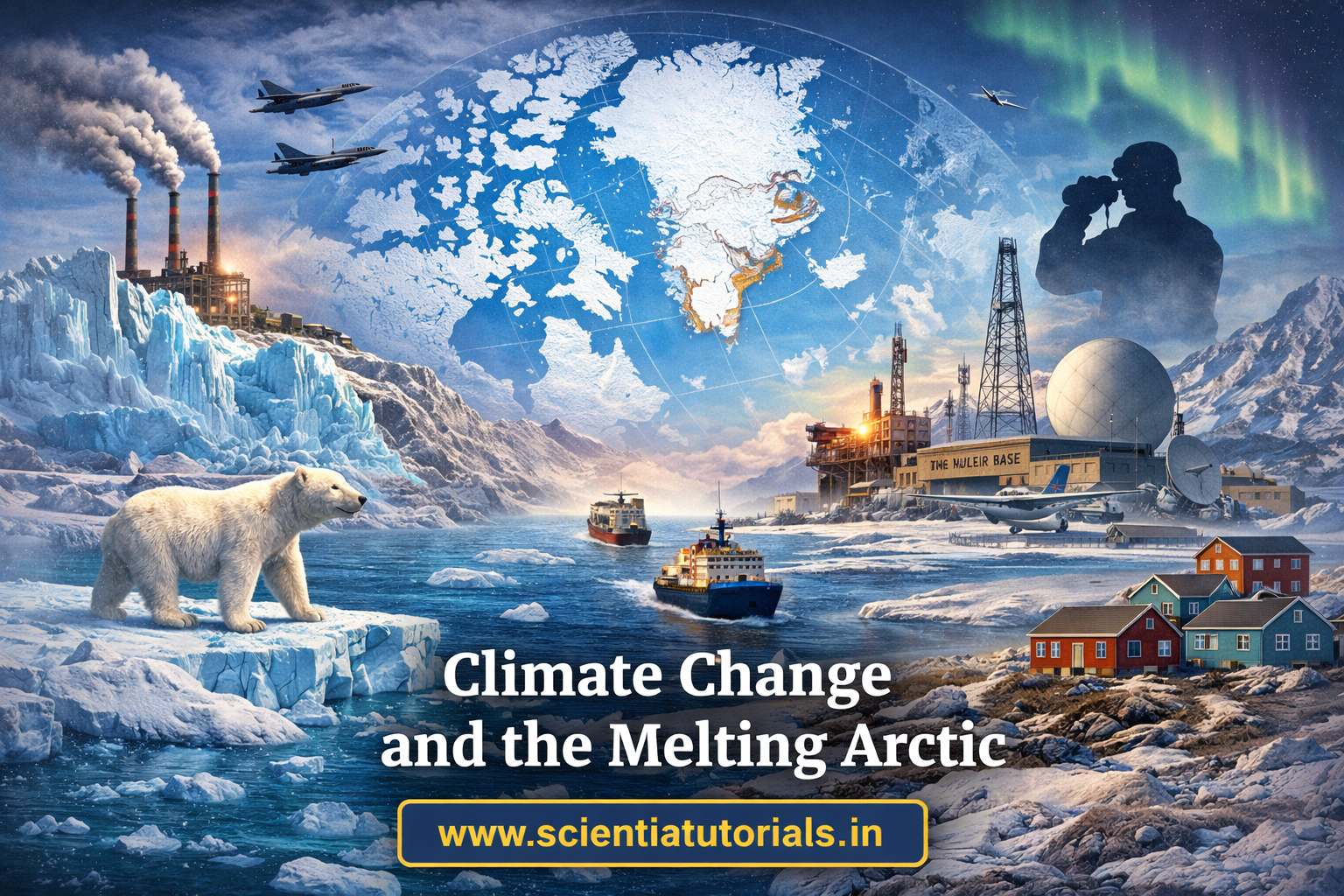
Climate Change and the Melting Arctic | Greenland & Arctic Geopolitics
Module 5: Contemporary Greenland and Global Strategic Importance
Era Framework: Late 20th Century – 21st Century
(Globalization, Climate Change, Arctic Geopolitics)
Lesson: Climate Change and the Melting Arctic
This lesson is systematically organized into four clearly structured sections, as detailed below:
- Chronologically Structured Study Module
- Short-Answer Type Questions
- Long-Answer Type Questions
- Multiple-Choice Questions (MCQs) with Answers and Detailed Explanations
Chronologically Structured Study Module
Introduction: Climate Change and the Arctic as a Global Turning Point
In the late twentieth and early twenty-first centuries, climate change has transformed the Arctic from a remote, frozen frontier into a central arena of global concern. The Arctic is warming at more than twice the global average, a phenomenon known as Arctic amplification. This rapid environmental transformation has far-reaching consequences for ecosystems, indigenous societies, global climate systems, and international geopolitics.
For Greenland, climate change is not merely an environmental issue but a profound political, economic, and strategic force. The melting Arctic reshapes Greenland’s development prospects, strengthens its geopolitical importance, and intensifies debates over sovereignty, sustainability, and global responsibility. This lesson examines climate change and Arctic melting through a chronological and thematic framework, situating Greenland at the heart of contemporary global change.
1. Scientific Understanding of Arctic Climate Change (Late 20th Century)
1.1 Early Climate Observations
By the late twentieth century, scientists began documenting unusual warming trends in the Arctic. Satellite imagery, ice-core samples, and ocean temperature data revealed shrinking sea ice, retreating glaciers, and thinning ice sheets. These observations marked a departure from earlier perceptions of the Arctic as a stable, timeless environment.
In Greenland, long-term glaciological studies showed that the Greenland Ice Sheet—one of the largest reservoirs of freshwater on Earth—was losing mass at an accelerating rate.
1.2 Arctic Amplification Explained
Arctic amplification occurs because melting ice reduces surface reflectivity (albedo). As white ice gives way to darker ocean water or land, more solar radiation is absorbed, accelerating warming. This feedback loop makes the Arctic especially sensitive to global temperature rise.
By the end of the twentieth century, scientists warned that Arctic melting could trigger global consequences, including sea-level rise and disruptions to atmospheric circulation.
2. Greenland Ice Sheet and Global Sea-Level Rise
2.1 Significance of the Greenland Ice Sheet
The Greenland Ice Sheet contains enough frozen water to raise global sea levels by over seven meters if completely melted. Although total melting is unlikely in the near future, even partial ice loss poses serious risks to coastal regions worldwide.
During the late twentieth and early twenty-first centuries, Greenland’s ice loss accelerated dramatically, driven by rising air temperatures and warmer ocean currents.
2.2 Global Implications
Melting in Greenland contributes directly to sea-level rise, threatening low-lying island states, coastal megacities, and delta regions. This has elevated Greenland from a regional concern to a global climate priority, placing it at the center of international climate discourse.
3. Impact on Arctic Ecosystems and Indigenous Societies
3.1 Ecological Transformation
Climate change has disrupted Arctic ecosystems. Shrinking sea ice affects polar bears, seals, and marine food chains, while warming waters alter fish migration patterns. These changes undermine ecological stability and biodiversity.
3.2 Indigenous Livelihoods
For Greenland’s Inuit population, environmental change directly affects traditional hunting, fishing, and travel routes. Thinner ice and unpredictable weather increase risks and challenge cultural continuity.
Thus, Arctic melting is not only an environmental issue but also a human and cultural crisis, linking climate change to indigenous rights and social justice.
4. Climate Change as a Driver of Economic Transformation
4.1 New Economic Opportunities
As ice retreats, previously inaccessible natural resources—minerals, rare earth elements, and hydrocarbons—become more reachable. This has sparked interest in mining and resource development in Greenland.
Additionally, longer ice-free seasons improve access to fishing grounds and support emerging tourism industries.
4.2 Economic Risks and Sustainability
However, economic opportunities come with significant risks. Resource extraction threatens fragile ecosystems and raises concerns about long-term sustainability. Greenland faces the challenge of balancing economic development with environmental protection, a central theme in contemporary Arctic governance.
5. Melting Sea Ice and Arctic Shipping Routes
5.1 Emergence of New Maritime Pathways
Climate change has opened Arctic sea routes that were historically impassable. Shorter shipping routes between Europe, Asia, and North America are increasingly navigable during summer months.
Greenland’s geographic position places it near emerging trans-Arctic corridors, enhancing its strategic and economic relevance.
5.2 Strategic and Environmental Concerns
While new routes reduce shipping distances and costs, they also increase risks of pollution, accidents, and geopolitical competition. Governance of Arctic shipping has become a key issue in international relations.
6. Climate Change and Arctic Geopolitics
6.1 Renewed Global Interest in the Arctic
The melting Arctic has intensified interest from major powers seeking access to resources, shipping lanes, and strategic positions. Climate change has thus transformed the Arctic into a zone of geopolitical competition.
Greenland’s location between North America and Europe makes it particularly significant in this evolving geopolitical landscape.
6.2 Multilateral Governance and Cooperation
Institutions such as the Arctic Council play a crucial role in managing climate-related challenges. The Arctic Council promotes cooperation on environmental protection, scientific research, and sustainable development, emphasizing peaceful governance despite rising strategic interests.
7. Climate Change and Greenland’s Political Status
7.1 Strengthening Autonomy Aspirations
Climate change has indirectly strengthened Greenland’s autonomy movement. Control over natural resources and climate-related decision-making enhances Greenland’s bargaining power within the Danish Realm.
Environmental change thus intersects with political transformation, reinforcing Greenland’s claim to greater self-determination.
7.2 Responsibility and Governance Capacity
At the same time, climate change imposes heavy governance responsibilities. Managing environmental risks, adapting infrastructure, and protecting communities require strong institutions and international cooperation.
8. International Climate Politics and Greenland
8.1 Global Climate Negotiations
Although Greenland is not a sovereign state, it plays an important role in global climate research and policy debates. Data from Greenland’s ice cores and climate monitoring stations inform international climate models and negotiations.
8.2 Moral and Symbolic Significance
Greenland has become a powerful symbol of climate change. Images of melting glaciers and retreating ice sheets underscore the urgency of global climate action, giving Greenland moral influence disproportionate to its population size.
9. Adaptation and Mitigation Strategies in the Arctic
9.1 Adaptation Measures
Greenland and other Arctic regions are investing in adaptation strategies, including climate-resilient infrastructure, improved weather forecasting, and community-based planning. These efforts aim to reduce vulnerability to climate impacts.
9.2 Mitigation Challenges
Mitigation—reducing greenhouse gas emissions—is largely dependent on global action beyond the Arctic. This highlights a fundamental injustice: Arctic communities face the most severe impacts despite contributing minimally to global emissions.
10. Climate Change as a Catalyst for a New Arctic Order
The melting Arctic represents a profound shift in global environmental and political systems. Climate change has transformed the Arctic from a peripheral region into a central arena where environmental science, geopolitics, indigenous rights, and global governance intersect.
For Greenland, climate change is both a challenge and an opportunity—reshaping economic prospects, strengthening political autonomy, and redefining its role in the world.
Conclusion: The Melting Arctic and Greenland’s Global Relevance
Climate change and the melting Arctic constitute one of the defining issues of the contemporary era. From the late twentieth century onward, rising temperatures have transformed Greenland’s environment, economy, and political significance.
Greenland stands at the frontline of global climate change, illustrating the interconnectedness of environmental processes and human systems. Its experience demonstrates how climate change reshapes not only landscapes but also power relations, governance structures, and global priorities.
Short Answer Type Questions with Answers
Lesson: Climate Change and the Melting Arctic
1. What is meant by Arctic amplification?
Answer:
Arctic amplification refers to the phenomenon where the Arctic warms at more than twice the global average due to feedback mechanisms like ice–albedo loss.
2. Why is the Arctic considered highly sensitive to climate change?
Answer:
Because melting ice reduces reflectivity, causing increased heat absorption and accelerated warming.
3. Name the large ice mass whose melting significantly affects global sea levels.
Answer:
The Greenland Ice Sheet.
4. Why is Greenland central to global climate discussions?
Answer:
Because ice loss in Greenland directly contributes to global sea-level rise and climate system changes.
5. How does Arctic ice melting contribute to sea-level rise?
Answer:
Meltwater from land-based ice sheets flows into oceans, increasing global sea levels.
6. What scientific tools helped identify Arctic warming trends in the late 20th century?
Answer:
Satellite imagery, ice-core analysis, and ocean temperature measurements.
7. How has climate change affected Arctic ecosystems?
Answer:
It has disrupted food chains, altered species distribution, and reduced biodiversity.
8. Which animal species is often cited as vulnerable due to sea ice loss?
Answer:
Polar bears.
9. How does climate change affect Inuit livelihoods in Greenland?
Answer:
It disrupts traditional hunting, fishing, and travel due to thinning and unstable ice.
10. Why is Arctic melting considered a social and cultural issue?
Answer:
Because it threatens indigenous ways of life, traditions, and community safety.
11. What new economic opportunities arise from Arctic ice melt?
Answer:
Access to minerals, rare earth elements, hydrocarbons, fishing grounds, and tourism.
12. Why do these economic opportunities pose environmental risks?
Answer:
Resource extraction can damage fragile ecosystems and increase pollution.
13. How has climate change influenced Arctic shipping routes?
Answer:
Melting sea ice has opened shorter maritime routes between major global markets.
14. Why are Arctic shipping routes geopolitically important?
Answer:
They reduce travel time, lower costs, and increase strategic competition among states.
15. How does climate change affect Greenland’s strategic importance?
Answer:
It increases Greenland’s relevance in global trade, security, and resource politics.
16. Which international body promotes cooperation on Arctic climate issues?
Answer:
The Arctic Council.
17. What role does scientific research in Greenland play globally?
Answer:
It provides critical climate data used in global climate models and policy decisions.
18. How does Arctic climate change influence global weather systems?
Answer:
It alters atmospheric circulation, affecting weather patterns far beyond the Arctic.
19. Why is climate change linked to Arctic geopolitics?
Answer:
Because melting ice increases access to resources and strategic routes, attracting global powers.
20. How has climate change strengthened Greenland’s autonomy aspirations?
Answer:
By increasing control over resources and enhancing Greenland’s political leverage.
21. What is meant by climate adaptation in the Arctic context?
Answer:
Measures taken to reduce vulnerability, such as resilient infrastructure and planning.
22. Why is climate mitigation challenging for Arctic regions?
Answer:
Because emissions reduction depends largely on global action beyond the Arctic.
23. What injustice is highlighted by Arctic climate change?
Answer:
Arctic communities suffer severe impacts despite contributing minimally to global emissions.
24. How has the Arctic’s global image changed due to climate change?
Answer:
It has shifted from a remote frontier to a central symbol of global climate crisis.
25. Why is the melting Arctic considered a catalyst for a new global order?
Answer:
Because it reshapes environmental systems, economic opportunities, and geopolitical power relations.
Long Answer Type Questions with Answers
Lesson: Climate Change and the Melting Arctic
1. Explain the concept of Arctic amplification and its significance in global climate change.
Answer:
Arctic amplification refers to the phenomenon whereby the Arctic region warms at more than twice the global average rate. This occurs mainly due to feedback mechanisms such as the ice–albedo effect, where melting ice exposes darker surfaces that absorb more heat. Arctic amplification accelerates glacier retreat, disrupts atmospheric circulation, and intensifies global climate instability, making the Arctic a critical driver of planetary climate change.
2. Examine the role of the Greenland Ice Sheet in global sea-level rise.
Answer:
The Greenland Ice Sheet is one of the largest freshwater reserves on Earth. Accelerated melting since the late 20th century has contributed significantly to global sea-level rise. Even partial melting threatens low-lying coastal regions worldwide, highlighting Greenland’s central role in global climate systems.
3. Trace the scientific understanding of Arctic climate change since the late 20th century.
Answer:
From the late 20th century, satellite imagery, ice-core analysis, and oceanographic data revealed rising Arctic temperatures and shrinking ice cover. Over time, scientific consensus confirmed that human-induced greenhouse gas emissions were the primary drivers. These findings reshaped global climate models and policy debates.
4. Discuss how climate change has transformed the Arctic ecosystem.
Answer:
Climate change has altered Arctic ecosystems by reducing sea ice, disrupting food chains, and shifting species distributions. Iconic species such as polar bears and seals face habitat loss, while warming waters affect fish stocks. These ecological disruptions threaten biodiversity and long-term environmental balance.
5. Analyze the impact of Arctic climate change on indigenous communities in Greenland.
Answer:
For Inuit communities in Greenland, climate change undermines traditional livelihoods such as hunting and fishing. Thinner ice and unpredictable weather increase safety risks and erode cultural practices, making climate change a social and cultural crisis as well as an environmental one.
6. Explain why Arctic climate change is considered a global issue rather than a regional one.
Answer:
Arctic climate change influences global sea levels, ocean circulation, and atmospheric systems. Melting ice contributes to coastal flooding worldwide, while altered jet streams affect weather patterns across continents. Thus, Arctic changes have planetary consequences.
7. Examine the relationship between climate change and emerging economic opportunities in the Arctic.
Answer:
Melting ice has exposed mineral resources, hydrocarbons, and expanded fishing zones, creating new economic opportunities. However, these prospects also raise concerns about environmental degradation and sustainable development in fragile Arctic ecosystems.
8. How has climate change influenced the opening of Arctic shipping routes?
Answer:
Declining sea ice has made Arctic shipping routes increasingly navigable during summer months. These routes reduce travel distance between major global markets, enhancing economic efficiency while raising environmental and security concerns.
9. Discuss the geopolitical implications of a melting Arctic.
Answer:
The melting Arctic has intensified global interest in the region’s resources and strategic routes. Major powers seek influence over Arctic governance, increasing geopolitical competition and making climate change a catalyst for strategic realignment.
10. Evaluate the strategic importance of Greenland in the context of Arctic climate change.
Answer:
Greenland’s location between North America and Europe, combined with climate-driven accessibility, enhances its strategic relevance. Climate change has transformed Greenland from a peripheral region into a focal point of global environmental and geopolitical interest.
11. Analyze the role of international institutions in addressing Arctic climate change.
Answer:
Institutions such as the Arctic Council promote cooperation on environmental protection, scientific research, and sustainable development. They provide platforms for dialogue amid growing geopolitical competition.
12. Discuss how climate change has influenced Greenland’s political autonomy aspirations.
Answer:
Climate change has increased Greenland’s control over natural resources and strengthened its bargaining power. As environmental change reshapes economic prospects, it indirectly supports Greenland’s pursuit of greater political self-determination.
13. Examine the ethical dimension of Arctic climate change.
Answer:
Arctic communities contribute minimally to global emissions yet suffer disproportionately from climate impacts. This highlights global climate injustice and raises ethical questions about responsibility, equity, and climate finance.
14. Explain the role of Greenland in global climate research.
Answer:
Greenland hosts critical climate research infrastructure, including ice-core drilling and long-term monitoring stations. Data from Greenland inform global climate models and international policy decisions.
15. Assess the challenges of balancing economic development and environmental protection in the Arctic.
Answer:
While climate change opens economic opportunities, unregulated exploitation threatens ecosystems. Sustainable governance is essential to balance economic growth with long-term environmental preservation.
16. How does Arctic climate change affect global weather patterns?
Answer:
Warming in the Arctic weakens temperature gradients, disrupting jet streams and leading to extreme weather events such as heatwaves, cold spells, and altered precipitation patterns globally.
17. Discuss adaptation strategies adopted in Arctic regions.
Answer:
Adaptation strategies include climate-resilient infrastructure, improved forecasting systems, and community-based planning. These measures aim to reduce vulnerability to climate impacts.
18. Why is climate mitigation particularly challenging in the Arctic?
Answer:
Mitigation depends on global emissions reductions beyond Arctic control. Local efforts alone cannot halt warming, underscoring the need for international cooperation.
19. Examine how climate change has altered the global perception of the Arctic.
Answer:
The Arctic is no longer viewed as a static frozen frontier but as a dynamic region central to climate science, geopolitics, and global sustainability debates.
20. Critically analyze climate change as a catalyst for a new Arctic order.
Answer:
Climate change has redefined the Arctic’s environmental, economic, and strategic significance. It has reshaped power relations, intensified governance challenges, and positioned the Arctic—especially Greenland—at the center of contemporary global change.
Multiple Choice Questions (MCQs) with Answers and Explanations
Lesson: Climate Change and the Melting Arctic
1. What does the term Arctic amplification refer to?
A. Seasonal freezing of the Arctic Ocean
B. Faster warming of the Arctic compared to the global average
C. Expansion of Arctic glaciers
D. Increased snowfall in polar regions
Correct Answer: B
Explanation:
Arctic amplification describes the phenomenon where the Arctic warms at more than twice the global average due to feedback effects like ice–albedo loss.
2. Which factor most strongly contributes to Arctic amplification?
A. Increased volcanic activity
B. Ice–albedo feedback
C. Earth’s rotation
D. Ocean salinity
Correct Answer: B
Explanation:
As ice melts, darker surfaces absorb more solar radiation, accelerating warming—this is the ice–albedo feedback.
3. Why is Greenland crucial in global climate discussions?
A. It hosts large forests
B. It controls Arctic airspace
C. Its ice sheet affects global sea levels
D. It has the largest population in the Arctic
Correct Answer: C
Explanation:
Melting of the Greenland Ice Sheet directly contributes to global sea-level rise, making Greenland central to climate concerns.
4. The Greenland Ice Sheet is significant because it:
A. Regulates monsoon systems
B. Contains enough ice to raise sea levels substantially
C. Covers most of the Arctic Ocean
D. Prevents earthquakes
Correct Answer: B
Explanation:
Even partial melting of the Greenland Ice Sheet can raise global sea levels, threatening coastal regions worldwide.
5. Which scientific method helped confirm Arctic warming trends since the late 20th century?
A. Archaeological surveys
B. Satellite imagery
C. Census records
D. Fossil fuel data
Correct Answer: B
Explanation:
Satellite observations provided clear evidence of shrinking sea ice and rising temperatures.
6. Which ecosystem impact is directly linked to Arctic ice loss?
A. Expansion of rainforests
B. Habitat loss for polar species
C. Increase in coral reefs
D. Growth of deserts
Correct Answer: B
Explanation:
Loss of sea ice affects species such as polar bears and seals that depend on ice-based habitats.
7. How has climate change affected Inuit livelihoods in Greenland?
A. Improved agricultural output
B. Reduced dependence on fishing
C. Disruption of traditional hunting and travel
D. Elimination of seasonal risks
Correct Answer: C
Explanation:
Unstable ice and unpredictable weather threaten traditional hunting, fishing, and mobility.
8. Why is Arctic climate change considered a cultural issue?
A. It alters religious beliefs
B. It affects indigenous traditions and ways of life
C. It reduces tourism
D. It increases migration to cities
Correct Answer: B
Explanation:
Climate change undermines indigenous cultural practices closely tied to the Arctic environment.
9. What new economic opportunity has emerged due to Arctic ice melt?
A. Expansion of agriculture
B. Increased forestry
C. Access to minerals and hydrocarbons
D. Growth of manufacturing hubs
Correct Answer: C
Explanation:
Melting ice exposes previously inaccessible natural resources, attracting economic interest.
10. Why do these new economic opportunities pose risks?
A. They reduce employment
B. They threaten fragile Arctic ecosystems
C. They discourage international trade
D. They limit autonomy
Correct Answer: B
Explanation:
Resource extraction can cause pollution and long-term ecological damage in sensitive environments.
11. What change has melting sea ice caused in global transportation?
A. Closure of maritime routes
B. Expansion of land trade routes
C. Opening of Arctic shipping routes
D. Decline in air travel
Correct Answer: C
Explanation:
Reduced ice cover allows ships to use shorter Arctic routes between continents.
12. Why are Arctic shipping routes geopolitically important?
A. They increase military isolation
B. They reduce global trade
C. They shorten distances between major markets
D. They eliminate shipping costs
Correct Answer: C
Explanation:
Shorter routes reduce time and fuel costs, increasing strategic and economic value.
13. Climate change has increased global interest in the Arctic mainly because of:
A. Population growth
B. Cultural diversity
C. Resources and strategic access
D. Agricultural potential
Correct Answer: C
Explanation:
Melting ice increases access to resources and strategic maritime corridors.
14. Which institution promotes cooperation on Arctic climate and environmental issues?
A. NATO
B. World Bank
C. Arctic Council
D. European Union
Correct Answer: C
Explanation:
The Arctic Council facilitates cooperation on environmental protection, science, and sustainable development.
15. How does Arctic climate change affect global weather patterns?
A. It stabilizes monsoons
B. It disrupts atmospheric circulation
C. It increases earthquakes
D. It prevents storms
Correct Answer: B
Explanation:
Warming in the Arctic alters jet streams, influencing extreme weather worldwide.
16. Why is Arctic climate change described as a global problem?
A. It affects only polar nations
B. It influences sea levels and climate systems globally
C. It increases tourism everywhere
D. It changes global languages
Correct Answer: B
Explanation:
Sea-level rise and atmospheric changes have worldwide impacts.
17. How has climate change strengthened Greenland’s strategic importance?
A. By reducing its population
B. By increasing isolation
C. By enhancing its role in geopolitics and trade
D. By ending foreign interest
Correct Answer: C
Explanation:
Greenland’s location and accessibility make it increasingly important in Arctic geopolitics.
18. What is meant by climate adaptation in the Arctic?
A. Reducing global emissions
B. Adjusting infrastructure and practices to cope with impacts
C. Preventing all warming
D. Ending traditional livelihoods
Correct Answer: B
Explanation:
Adaptation focuses on reducing vulnerability to unavoidable climate impacts.
19. Why is climate mitigation difficult for Arctic regions?
A. Lack of scientific data
B. Dependence on global emission reductions
C. Excessive industrialization
D. Strong local opposition
Correct Answer: B
Explanation:
Arctic warming depends largely on emissions produced outside the region.
20. What injustice is highlighted by Arctic climate change?
A. Unequal access to education
B. Arctic communities emit most greenhouse gases
C. Those least responsible face the greatest impacts
D. Climate change affects only rich nations
Correct Answer: C
Explanation:
Indigenous Arctic communities contribute little to emissions but suffer severe consequences.
21. How has the global image of the Arctic changed due to climate change?
A. From cultural center to political capital
B. From remote frontier to climate crisis hotspot
C. From frozen region to agricultural zone
D. From strategic region to irrelevant area
Correct Answer: B
Explanation:
The Arctic is now seen as a frontline of global climate change.
22. Climate change has turned the Arctic into a zone of:
A. Complete isolation
B. Reduced cooperation
C. Increased geopolitical competition
D. Agricultural expansion
Correct Answer: C
Explanation:
Melting ice has intensified strategic interest and competition among global powers.
23. Why is scientific research in Greenland globally important?
A. It supports tourism
B. It improves local agriculture
C. It informs global climate models
D. It replaces international negotiations
Correct Answer: C
Explanation:
Data from Greenland is vital for understanding global climate systems.
24. What best describes climate change as a driver of Arctic transformation?
A. A purely environmental issue
B. A temporary seasonal change
C. A multidimensional global force
D. A local economic problem
Correct Answer: C
Explanation:
Climate change reshapes environmental, economic, political, and geopolitical dynamics.
25. The melting Arctic is best understood as:
A. An isolated environmental event
B. A regional weather anomaly
C. A catalyst for global environmental and political change
D. A short-term natural cycle
Correct Answer: C
Explanation:
Arctic melting influences global systems and power relations, making it a catalyst for worldwide change.