
Greenland during the First and Second World Wars
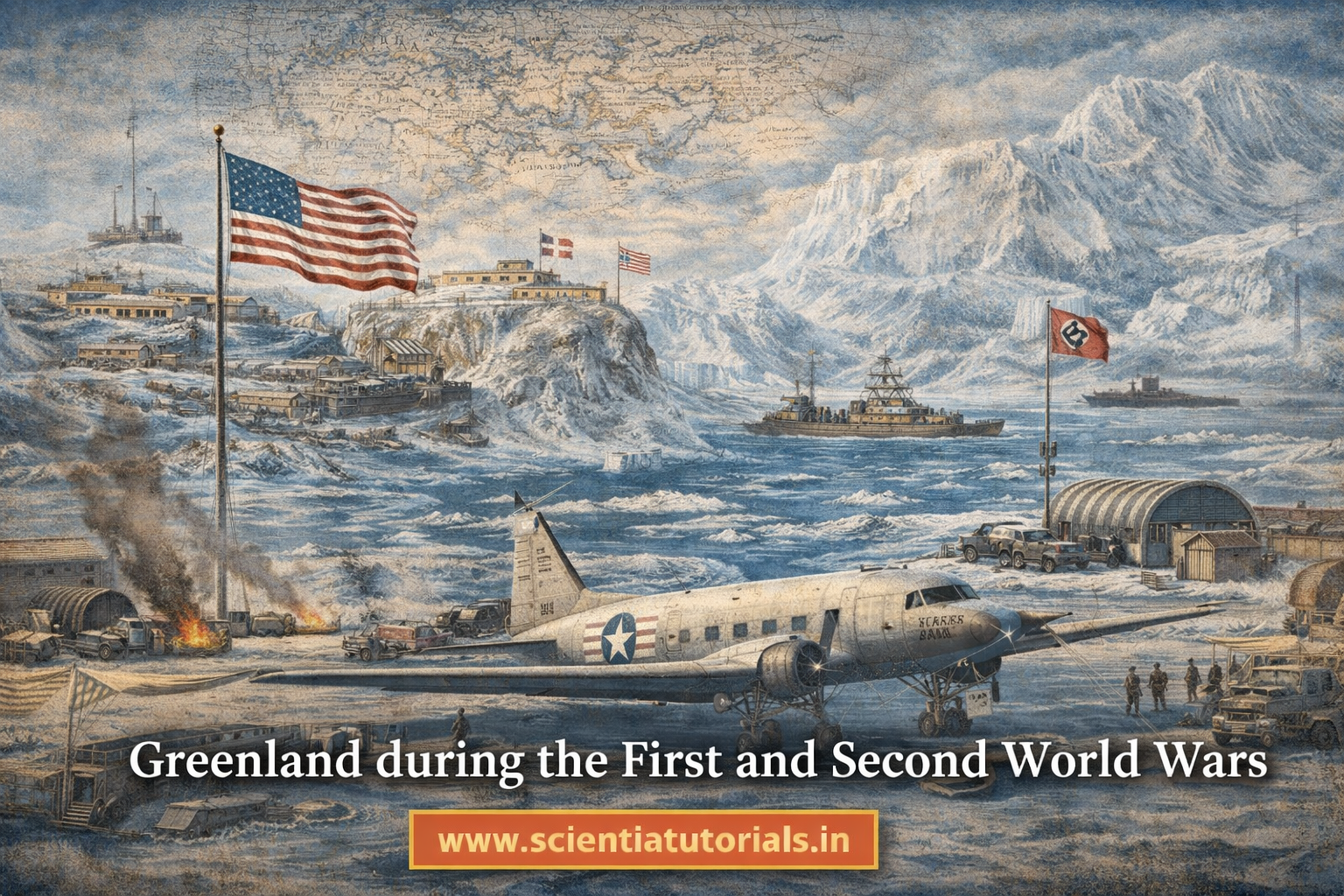
Greenland during the First and Second World Wars
Course: Greenland: Historical Evolution and Its Global Strategic Importance
Module 4: Greenland in the Age of World Wars and the Cold War
Era Framework: Early 20th Century – Late 20th Century
(World Wars, Cold War geopolitics, militarization of the Arctic)
This lesson is systematically organized into four clearly structured sections, as detailed below:
- Chronologically Structured Study Module
- Short-Answer Type Questions
- Long-Answer Type Questions
- Multiple-Choice Questions (MCQs) with Answers and Detailed Explanations
Chronologically Structured Study Module
Lesson Objectives
This lesson is designed to help learners:
- Understand Greenland’s strategic transformation during the First and Second World Wars
- Examine how global conflicts altered Greenland’s political, economic, and military importance
- Analyze Greenland’s role in Arctic geopolitics, logistics, and resource supply
- Assess the impact of wartime developments on Greenland’s colonial status and postwar trajectory
- Situate Greenland within the broader transition from European colonialism to Cold War geopolitics
Introduction: Greenland Enters the Age of Global War
At the dawn of the 20th century, Greenland remained a remote Arctic colony under Danish rule, marginal to global affairs and lightly administered. However, the outbreak of the First World War and, more decisively, the Second World War transformed Greenland from a peripheral colonial possession into a strategically vital territory within global military and geopolitical systems.
Advances in warfare, aviation, communications, and resource dependency elevated the Arctic from a remote frontier to a crucial strategic zone. Greenland’s geographic position between North America and Europe, combined with its mineral resources and suitability for military infrastructure, ensured that global conflicts reshaped its historical trajectory. This lesson examines Greenland’s evolving role during both world wars and explains how these experiences laid the foundations for its Cold War significance.
I. Greenland on the Eve of the First World War
1. Political Status and Colonial Administration
In the early 20th century, Greenland functioned as a Danish colony governed through centralized trade monopolies and missionary administration. Political authority rested with Denmark, while Inuit communities maintained local autonomy in daily life.
Greenland was:
- Economically dependent on Denmark
- Politically isolated from international diplomacy
- Militarily undefended and lightly administered
Its strategic value was not yet fully recognized.
2. Global Perceptions of the Arctic
Before 1914, the Arctic was viewed primarily as a scientific and exploratory region rather than a military space. Greenland’s role in global affairs was limited to trade, administration, and exploration.
II. Greenland and the First World War (1914–1918)
1. Denmark’s Neutrality and Greenland’s Indirect Involvement
During the First World War, Denmark remained neutral. As a result, Greenland was not directly involved in combat operations. However, the war demonstrated how global conflict could disrupt colonial supply chains and expose the vulnerability of distant territories.
Shipping disruptions affected:
- Supplies to Greenland
- Export of Greenlandic products
- Communication with Europe
2. Early Strategic Lessons
Although Greenland was not militarized during the First World War, the conflict revealed several important realities:
- Global wars could reach even remote colonies
- Arctic sea routes and resources mattered in industrial warfare
- Greenland’s geographic position had latent strategic value
These lessons became decisive during the Second World War.
III. Interwar Period: Strategic Awareness Grows (1919–1939)
1. Technological Change and Arctic Relevance
Between the wars, advances in aviation, radio communication, and meteorology transformed strategic thinking. Greenland’s location became increasingly important for:
- Transatlantic aviation routes
- Weather forecasting
- Arctic navigation
2. International Recognition of Danish Sovereignty
In 1933, international legal rulings reaffirmed Denmark’s sovereignty over Greenland, limiting foreign claims. However, this legal recognition did not prevent Greenland from becoming strategically exposed during the next global conflict.
IV. Greenland during the Second World War: A Strategic Turning Point
1. German Occupation of Denmark and Greenland’s Isolation
In 1940, Germany occupied Denmark, severing Greenland’s administrative connection with its colonial ruler. This event transformed Greenland’s political situation overnight.
With Denmark unable to govern effectively:
- Greenland was cut off from Europe
- Colonial administration became autonomous by necessity
- External powers took strategic interest
2. Strategic Interest of the United States
The isolation of Greenland raised concerns in North America about potential German access to the Arctic. The United States viewed Greenland as critical to:
- Defending the North Atlantic
- Securing transatlantic shipping lanes
- Preventing Axis expansion into the Western Hemisphere
Greenland thus became central to Allied strategic planning.
V. The Cryolite Factor and Wartime Economics
1. Importance of Cryolite
One of Greenland’s most significant wartime assets was cryolite, mined at Ivittuut in southwestern Greenland. Cryolite was essential for aluminum production, a critical material for aircraft manufacturing.
Without Greenlandic cryolite:
- Aircraft production would have been severely constrained
- Allied air power would have suffered
2. Greenland as a Strategic Resource Supplier
The protection of cryolite mines became a priority for the Allies. Greenland’s economy, previously marginal, was now directly tied to global war production and industrial warfare.
VI. U.S. Military Presence in Greenland during World War II
1. Establishment of American Bases
In 1941, Greenland entered into agreements allowing the United States to establish military bases on the island. This marked the first major foreign military presence in Greenland.
American activities included:
- Construction of airfields
- Establishment of weather stations
- Coastal patrols and surveillance
2. Greenland as an Arctic Military Hub
Greenland became a logistical stepping stone for aircraft ferrying between North America and Europe. It also played a crucial role in Arctic weather forecasting, which was vital for planning military operations in Europe.
VII. Greenland and German Strategic Concerns
1. German Weather Stations
Nazi Germany attempted to establish secret weather stations in Greenland to support submarine and air operations in the North Atlantic. Accurate weather data was essential for military planning.
2. Arctic Conflict without Mass Warfare
Although Greenland did not experience large-scale battles, it was an active theater of strategic competition. Patrols, surveillance, and intelligence operations defined Greenland’s wartime experience.
VIII. Impact of World War II on Greenlandic Society
1. Social and Economic Changes
The war introduced Greenland to:
- Wage labor on a larger scale
- Increased contact with Americans
- Exposure to modern infrastructure and technology
These changes accelerated social transformation and weakened older colonial structures.
2. Political Awakening
Greenlandic leaders and communities experienced greater autonomy during the war years. This fostered political awareness and later demands for reform within the Danish realm.
IX. Postwar Transition: From World War to Cold War
1. Greenland’s Strategic Legacy
By 1945, Greenland was no longer a peripheral colony. It had proven its strategic value in:
- Air defense
- Resource supply
- Arctic surveillance
This ensured its continued importance in postwar geopolitics.
2. Denmark’s Changed Relationship with Greenland
After the war, Denmark reassessed its colonial relationship with Greenland. Wartime autonomy and strategic importance encouraged political integration and modernization.
X. Greenland as a Prelude to Cold War Militarization
1. Arctic Militarization Begins
The wartime infrastructure built in Greenland became the foundation for Cold War military expansion. Air bases, weather stations, and logistical networks were repurposed for new geopolitical rivalries.
2. From Colonial Outpost to Strategic Asset
Greenland transitioned from a colonial possession to a central strategic asset within Western defense systems, foreshadowing its pivotal role during the Cold War.
XI. Comparative Perspective: World Wars and Greenland’s Global Role
1. First World War vs. Second World War
- First World War: Limited involvement, indirect effects, strategic lessons
- Second World War: Direct strategic integration, military presence, economic importance
The contrast highlights how global warfare reshaped Arctic geopolitics.
2. Greenland in the Global Order
Greenland’s experience demonstrates how technological change and global conflict can rapidly elevate the importance of previously marginal regions.
Conclusion
Greenland’s experience during the First and Second World Wars marked a decisive turning point in its history. While the First World War revealed Greenland’s vulnerability to global disruptions, the Second World War transformed it into a strategic linchpin of Arctic and transatlantic defense.
Through its geographic position, vital cryolite resources, and suitability for military infrastructure, Greenland became deeply embedded in global conflict. The wartime period weakened traditional colonial structures, encouraged political awakening, and set Greenland firmly on the path toward Cold War militarization and modern strategic relevance.
Understanding Greenland during the world wars is essential for grasping its later role in Cold War geopolitics and its continuing global strategic importance in the Arctic world.
Short Answer Type Questions with Answers
Lesson: Greenland during the First and Second World Wars (Early–Mid 20th Century)
1. What was Greenland’s political status at the beginning of the 20th century?
Greenland was a colonial possession administered by Denmark through centralized trade and administrative control.
2. Why was Greenland considered strategically marginal before the First World War?
Because it was remote, lightly populated, militarily undefended, and viewed mainly as a site of trade and exploration.
3. How did the First World War affect Greenland directly?
Greenland was not directly involved in combat but experienced supply disruptions and isolation due to global shipping disruptions.
4. What role did Denmark’s neutrality play in Greenland during World War I?
Denmark’s neutrality kept Greenland out of direct military conflict during the First World War.
5. What key strategic lesson did World War I reveal about Greenland?
It showed that even remote Arctic colonies could be affected by global wars and had latent strategic value.
6. How did technological developments between the wars increase Greenland’s importance?
Advances in aviation, radio communication, and meteorology made Greenland important for transatlantic routes and weather forecasting.
7. What event in 1940 radically changed Greenland’s political situation?
The German occupation of Denmark severed Greenland’s direct administrative noting link with Europe.
8. Why did Greenland become strategically important to the Allies during World War II?
Its location was vital for North Atlantic defense, air routes, and preventing Axis access to the Western Hemisphere.
9. Which country established military bases in Greenland during World War II?
The United States established military bases in Greenland.
10. What type of military facilities were built in Greenland during World War II?
Airfields, weather stations, coastal patrol bases, and logistics installations.
11. What was cryolite, and why was it important during World War II?
Cryolite was a mineral essential for aluminum production, which was critical for aircraft manufacturing.
12. Where was Greenland’s cryolite mined?
At Ivittuut in southwestern Greenland.
13. How did Greenland contribute economically to the Allied war effort?
By supplying cryolite and hosting strategic infrastructure essential to military logistics.
14. Why were weather stations in Greenland strategically important?
They provided vital weather data needed for planning air and naval operations in Europe.
15. Did Germany attempt to operate in Greenland during World War II?
Yes, Germany attempted to establish secret weather stations for military intelligence.
16. Why was Greenland described as a “strategic hub” rather than a battlefield?
Because its role focused on logistics, surveillance, and intelligence rather than large-scale fighting.
17. How did the U.S. military presence affect Greenlandic society?
It introduced wage labor, infrastructure, and increased contact with modern technology.
18. What social changes did Greenland experience during World War II?
Increased economic activity, exposure to foreign culture, and weakening of traditional colonial controls.
19. How did World War II influence Greenlandic political awareness?
Greater wartime autonomy encouraged political consciousness and later demands for reform.
20. How did Greenland’s role differ between World War I and World War II?
World War I involved indirect effects, while World War II brought direct strategic and military involvement.
21. Why did Greenland remain strategically important after 1945?
Its wartime infrastructure and Arctic location made it valuable for postwar defense planning.
22. How did World War II affect Denmark’s relationship with Greenland?
It led Denmark to reconsider colonial governance and pursue closer political integration.
23. In what way did World War II prepare Greenland for the Cold War?
Military bases, surveillance systems, and Arctic defense roles carried over into Cold War geopolitics.
24. What broader historical shift does Greenland’s wartime experience illustrate?
The transformation of the Arctic from a peripheral region into a core strategic zone.
25. Why is Greenland’s wartime history important for understanding its modern global role?
Because it explains Greenland’s enduring strategic importance in Arctic defense and global geopolitics.
Long Answer Type Questions with Answers
Lesson: Greenland during the First and Second World Wars
(Early 20th Century – Mid 20th Century)
1. Examine Greenland’s political and strategic position on the eve of the First World War.
At the beginning of the 20th century, Greenland was a remote Arctic colony administered by Denmark. It was politically isolated, economically dependent on Denmark, and militarily undefended. Internationally, Greenland was viewed primarily as a scientific and commercial territory rather than a strategic one. Its geographic position between Europe and North America was not yet fully appreciated in military terms, making it marginal to global geopolitics before 1914.
2. Why did the First World War have only a limited direct impact on Greenland?
The First World War had limited direct impact because Denmark remained neutral throughout the conflict. As a result, Greenland was not drawn into military operations. However, the war disrupted shipping routes, delayed supplies, and exposed Greenland’s vulnerability to global economic and political shocks, even without direct warfare.
3. Analyze the strategic lessons revealed by Greenland’s experience during World War I.
World War I demonstrated that global conflicts could affect even remote regions. Greenland’s dependence on overseas supplies and communications highlighted its vulnerability. The war also revealed the latent strategic value of Arctic territories in industrial warfare, foreshadowing Greenland’s later military importance.
4. Discuss how technological changes during the interwar period increased Greenland’s strategic relevance.
Between the wars, advances in aviation, radio communication, and meteorology transformed military strategy. Greenland’s location became important for transatlantic flight routes and weather forecasting. Accurate Arctic weather data was increasingly vital for planning military operations, making Greenland strategically significant even before World War II began.
5. Explain the importance of international recognition of Danish sovereignty over Greenland in the interwar years.
In 1933, international legal rulings reaffirmed Danish sovereignty over Greenland, limiting competing claims. While this strengthened Denmark’s legal position, it did not protect Greenland from strategic exposure during World War II, when Denmark itself was occupied.
6. How did the German occupation of Denmark in 1940 alter Greenland’s political situation?
The German occupation severed Greenland’s administrative connection with Denmark. Greenland became isolated from its colonial authority and was forced into a position of de facto autonomy. This sudden shift opened the door for other powers, particularly the United States, to take strategic responsibility for Greenland’s defense.
7. Why did Greenland become strategically vital to the Allies during World War II?
Greenland’s geographic position made it crucial for North Atlantic defense, transatlantic air routes, and preventing Axis expansion into the Western Hemisphere. Control of Greenland ensured secure shipping lanes, air ferry routes, and early warning systems essential to Allied victory.
8. Examine the significance of cryolite in Greenland during World War II.
Cryolite, mined at Ivittuut, was essential for aluminum production, a key material for aircraft manufacturing. Without Greenlandic cryolite, Allied air power would have been severely constrained. Protecting the cryolite mines became a major strategic priority, directly linking Greenland to global war production.
9. Discuss Greenland’s role as a resource supplier in the Allied war effort.
Beyond cryolite, Greenland contributed indirectly by hosting infrastructure critical to military logistics. Its resources and geographic position supported industrial warfare and reinforced the interconnectedness of remote territories and global conflict.
10. Analyze the establishment of U.S. military bases in Greenland during World War II.
In 1941, agreements allowed the United States to establish military bases in Greenland. These bases included airfields, weather stations, and patrol installations. This marked Greenland’s first large-scale foreign military presence and transformed it into an Arctic military hub.
11. How did Greenland function as a logistical bridge between North America and Europe?
Greenland served as a stepping stone for aircraft ferrying across the Atlantic. Its airfields enabled shorter flight segments and safer navigation, making it indispensable to Allied air transport and supply chains.
12. Evaluate the strategic importance of weather stations in Greenland during World War II.
Arctic weather patterns strongly influenced military operations in Europe. Greenlandic weather stations provided critical data for planning air raids, naval movements, and amphibious operations. Control over weather information became a decisive strategic advantage.
13. Examine German strategic interests in Greenland during World War II.
Germany attempted to establish secret weather stations in Greenland to support submarine and air operations in the North Atlantic. Although these efforts were limited, they demonstrate Greenland’s strategic importance even to the Axis powers.
14. Why did Greenland not become a conventional battlefield during World War II?
Harsh climate, sparse population, and logistical difficulties made large-scale combat impractical. Instead, Greenland functioned as a strategic and logistical theater, characterized by patrols, surveillance, and intelligence operations rather than mass warfare.
15. Analyze the social and economic effects of World War II on Greenlandic society.
The war introduced wage labor, modern infrastructure, and sustained contact with Americans. Greenlandic society experienced accelerated social change, exposure to new technologies, and weakening of traditional colonial economic controls.
16. Discuss how wartime autonomy influenced Greenlandic political consciousness.
Isolation from Denmark and increased responsibility during the war fostered political awareness among Greenlanders. This experience contributed to later demands for reform, modernization, and greater integration within the Danish state.
17. Compare Greenland’s experience in the First World War and the Second World War.
During World War I, Greenland experienced indirect economic effects but no military involvement. In contrast, World War II transformed Greenland into a strategic asset with military bases, resource extraction, and geopolitical importance, marking a decisive shift in its global role.
18. How did World War II change Denmark’s approach to governing Greenland after 1945?
Denmark recognized that Greenland was no longer a peripheral colony. Wartime developments encouraged administrative reform, modernization, and eventual political integration, culminating in Greenland’s changed constitutional status in the postwar period.
19. Examine the role of Greenland in the transition from European colonialism to Cold War geopolitics.
World War II weakened traditional colonial structures and shifted strategic influence toward the United States. Greenland’s wartime role positioned it firmly within Western defense systems, marking a transition from European colonial governance to Cold War strategic alignment.
20. Why did Greenland remain strategically important after the end of World War II?
Its Arctic location, existing military infrastructure, and role in air defense ensured continued strategic value. Greenland became central to early warning systems and Arctic surveillance during the Cold War.
21. Discuss how Greenland’s wartime experience contributed to Arctic militarization.
World War II introduced permanent military infrastructure to Greenland. These installations formed the foundation for later Cold War militarization, including air bases and radar networks.
22. Analyze Greenland’s role in reshaping perceptions of the Arctic in global strategy.
Greenland demonstrated that the Arctic was no longer a remote frontier but a central strategic zone. Warfare, technology, and geopolitics transformed Arctic space into a key arena of global security.
23. How does Greenland’s World War experience illustrate the global nature of modern warfare?
Greenland shows how industrial warfare depends on resources, logistics, and geography far from battlefields. Even remote Arctic territories became vital to global conflict.
24. Evaluate the long-term consequences of World War II for Greenland’s political development.
The war accelerated modernization, increased political awareness, and weakened colonial isolation. These changes contributed to Greenland’s later constitutional reforms and evolving self-government.
25. Why is the study of Greenland during the world wars essential for understanding its modern strategic importance?
Greenland’s wartime transformation explains its enduring role in Arctic defense, transatlantic security, and global geopolitics. The foundations of its Cold War and contemporary strategic significance were laid during the First and Second World Wars.
MCQs with Answers and Explanations
Lesson: Greenland during the First and Second World Wars
(Early 20th Century – Mid 20th Century)
1. At the beginning of the 20th century, Greenland was administered by
A. Britain
B. Germany
C. Denmark
D. Norway
Correct Answer: C
Explanation:
Greenland was a Danish colony governed through centralized administration and trade monopolies, with minimal international involvement before World War I.
2. Why was Greenland considered strategically marginal before World War I?
A. It lacked mineral resources
B. It had no Indigenous population
C. It was remote and lightly defended
D. It was already militarized
Correct Answer: C
Explanation:
Before 1914, Greenland was remote, sparsely populated, and militarily undefended, making it seem insignificant in global strategic planning.
3. Denmark’s position during the First World War can best be described as
A. Allied
B. Axis
C. Neutral
D. Occupied
Correct Answer: C
Explanation:
Denmark remained neutral during World War I, keeping Greenland out of direct military conflict.
4. Greenland’s involvement in World War I was mainly
A. Military
B. Diplomatic
C. Indirect and economic
D. Industrial
Correct Answer: C
Explanation:
Although not a battlefield, Greenland experienced supply disruptions and isolation due to global wartime conditions.
5. Which major lesson did World War I reveal about Greenland?
A. It was economically independent
B. Remote regions were immune to war
C. Arctic territories could gain strategic value
D. Greenland required immediate militarization
Correct Answer: C
Explanation:
The war showed that even distant regions like Greenland could be affected by global conflicts and had latent strategic importance.
6. Which technological development increased Greenland’s importance in the interwar period?
A. Steam engines
B. Railways
C. Aviation and radio communication
D. Submarine warfare
Correct Answer: C
Explanation:
Aviation, radio, and meteorology made Greenland valuable for transatlantic routes and weather forecasting.
7. What event in 1940 drastically changed Greenland’s political situation?
A. Allied invasion
B. German occupation of Denmark
C. Greenlandic independence
D. Soviet expansion
Correct Answer: B
Explanation:
Germany’s occupation of Denmark cut Greenland off from its colonial authority, forcing a new political arrangement.
8. After 1940, Greenland effectively experienced
A. Full independence
B. Continued direct Danish rule
C. De facto autonomy
D. Axis control
Correct Answer: C
Explanation:
With Denmark occupied, Greenland operated with significant autonomy while aligning with Allied interests.
9. Why did Greenland become strategically important to the Allies during World War II?
A. Its large population
B. Its agricultural output
C. Its Arctic location and air routes
D. Its naval fleet
Correct Answer: C
Explanation:
Greenland’s position between North America and Europe made it vital for defense, air transport, and surveillance.
10. Which country established military bases in Greenland during World War II?
A. Britain
B. Canada
C. United States
D. France
Correct Answer: C
Explanation:
The United States built bases, airfields, and weather stations to secure the North Atlantic and Arctic routes.
11. The primary purpose of U.S. military bases in Greenland was to
A. Launch ground offensives
B. Support plantation agriculture
C. Secure air routes and weather data
D. Train naval infantry
Correct Answer: C
Explanation:
Greenland served as a logistical hub for aircraft ferrying and meteorological intelligence.
12. Which mineral made Greenland economically vital during World War II?
A. Coal
B. Iron ore
C. Cryolite
D. Uranium
Correct Answer: C
Explanation:
Cryolite was essential for aluminum production, which was critical for aircraft manufacturing.
13. Cryolite mined in Greenland was primarily used for
A. Steel production
B. Shipbuilding
C. Aluminum smelting
D. Ammunition filling
Correct Answer: C
Explanation:
Aluminum, derived using cryolite, was indispensable for aircraft construction.
14. Why was the protection of cryolite mines strategically important?
A. They funded Danish neutrality
B. They supplied Axis powers
C. They supported Allied air power
D. They ensured food security
Correct Answer: C
Explanation:
Without cryolite, Allied aircraft production would have been severely limited.
15. Weather stations in Greenland were crucial because
A. Arctic weather was predictable
B. Weather had little effect on warfare
C. Weather data influenced European operations
D. They replaced intelligence networks
Correct Answer: C
Explanation:
Accurate Arctic weather data was vital for planning air raids and naval operations in Europe.
16. Germany attempted to establish weather stations in Greenland mainly to
A. Study climate change
B. Support submarine and air operations
C. Begin colonization
D. Mine resources
Correct Answer: B
Explanation:
Weather intelligence helped German U-boat and air operations in the North Atlantic.
17. Greenland during World War II can best be described as
A. A major battlefield
B. A neutral trading zone
C. A strategic and logistical hub
D. An occupied colony
Correct Answer: C
Explanation:
Greenland was strategically important without experiencing large-scale combat.
18. Which social change occurred in Greenland during World War II?
A. Decline of wage labor
B. Increased isolation
C. Greater contact with Americans
D. Population collapse
Correct Answer: C
Explanation:
U.S. presence introduced wage labor, infrastructure, and exposure to modern technology.
19. How did World War II influence Greenlandic political awareness?
A. It reduced local autonomy
B. It strengthened colonial isolation
C. It encouraged demands for reform
D. It ended Danish rule immediately
Correct Answer: C
Explanation:
Wartime autonomy and new experiences fostered political consciousness among Greenlanders.
20. Greenland’s role in World War I differed from World War II because
A. It was occupied in World War I
B. It was economically irrelevant in World War II
C. World War II involved direct strategic integration
D. World War I involved heavy militarization
Correct Answer: C
Explanation:
World War II marked Greenland’s full strategic integration, unlike the limited impact of World War I.
21. After 1945, Greenland remained strategically important due to
A. Declining global tensions
B. Existing Arctic infrastructure
C. Loss of Danish sovereignty
D. Abandonment of military bases
Correct Answer: B
Explanation:
Wartime airfields and surveillance systems laid the groundwork for Cold War defense.
22. Greenland’s World War experience contributed most directly to
A. Agricultural expansion
B. Arctic demilitarization
C. Cold War militarization
D. Economic isolation
Correct Answer: C
Explanation:
Military infrastructure and strategic awareness carried directly into Cold War geopolitics.
23. Greenland’s wartime transformation illustrates
A. The decline of global warfare
B. The immunity of colonies
C. The global reach of modern war
D. The irrelevance of geography
Correct Answer: C
Explanation:
Even remote Arctic regions became vital to global conflict due to technology and resources.
24. Which broader historical shift does Greenland’s wartime role reflect?
A. From mercantilism to feudalism
B. From exploration to isolation
C. From colonial periphery to strategic core
D. From independence to occupation
Correct Answer: C
Explanation:
World wars elevated Greenland from a marginal colony to a key strategic territory.
25. Studying Greenland during the world wars is important because it
A. Explains early Inuit migration
B. Clarifies medieval trade routes
C. Reveals foundations of modern Arctic geopolitics
D. Ends European colonialism
Correct Answer: C
Explanation:
Greenland’s wartime role laid the foundations for its Cold War and contemporary strategic significance.