
Early Human Migration into the Arctic World
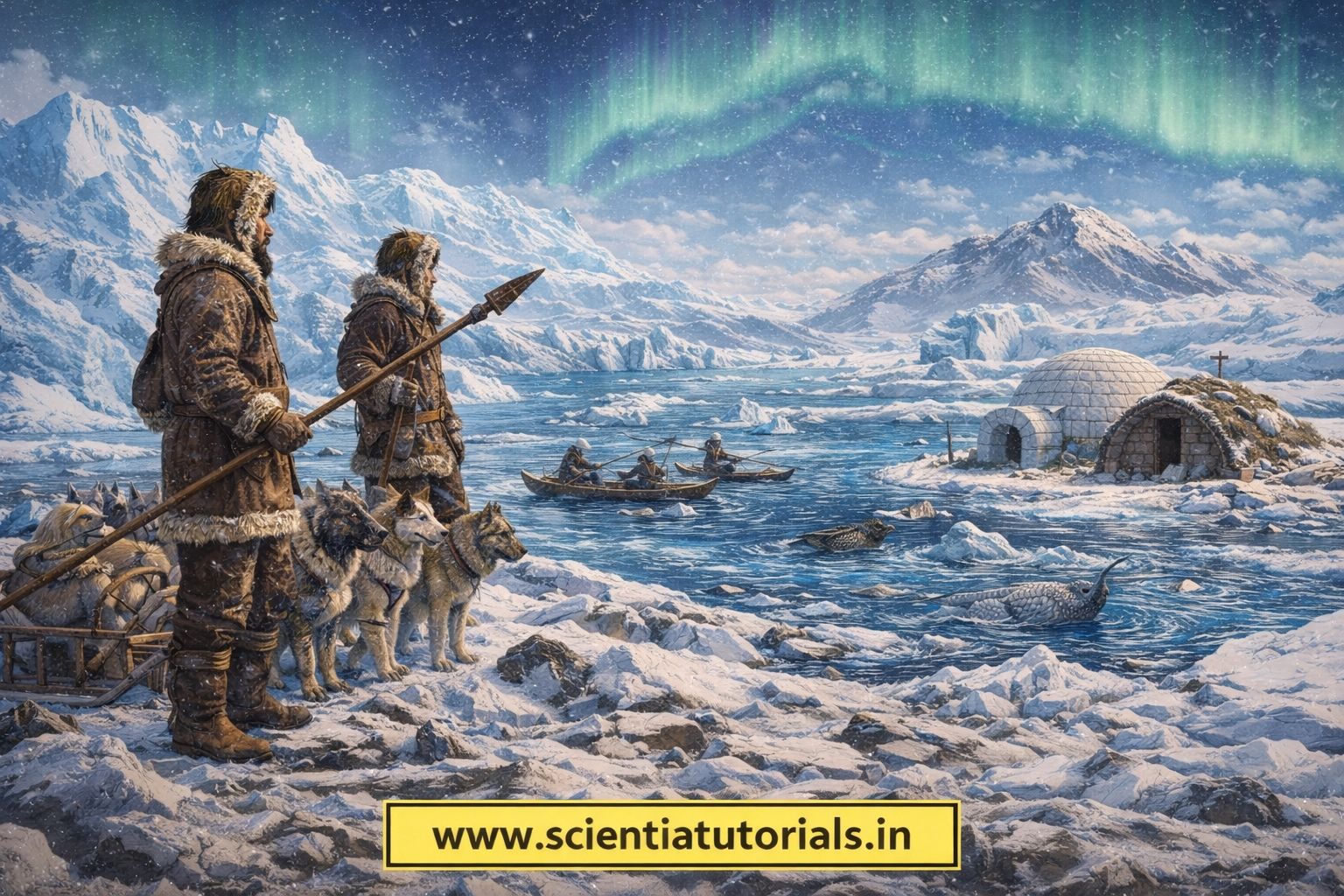
Early Human Migration into the Arctic World | Prehistoric History Greenland
Module 1: Greenland in the Prehistoric and Indigenous World
Lesson: Early Human Migration into the Arctic World
Era Framework: Prehistoric Period to c. 10th Century CE
This lesson is systematically organized into four clearly structured sections, as detailed below:
- Chronologically Structured Study Module
- Short-Answer Type Questions
- Long-Answer Type Questions
- Multiple-Choice Questions (MCQs) with Answers and Detailed Explanations
Chronologically Structured Study Module
Introduction: Understanding Early Human Migration into the Arctic World
The early human migration into the Arctic world represents one of the most remarkable chapters in global prehistory. The movement of human populations into extreme cold environments challenged biological limits, technological capacities, and social organization. Among Arctic regions, Greenland occupies a distinctive position due to its geographical isolation, harsh climate, and dependence on marine ecosystems.
This lesson examines how humans first entered the Arctic world and gradually expanded into Greenland during the prehistoric period. It traces migration chronologically, focusing on environmental drivers, technological adaptation, cultural systems, and survival strategies. By situating Greenland within broader Arctic migration patterns, the lesson highlights how Indigenous societies successfully adapted to one of the planet’s most extreme environments long before recorded history.
I. The Arctic World in Prehistoric Context
1. Defining the Arctic World
The Arctic world refers to regions surrounding the Arctic Circle characterized by:
- Extremely low temperatures
- Seasonal light extremes (polar day and polar night)
- Permafrost landscapes
- Limited terrestrial vegetation
These conditions made the Arctic one of the last major regions inhabited by humans. Migration into this zone required not only physical endurance but also complex cultural and technological adaptation.
2. Climatic Background: Ice Age Cycles
Human entry into the Arctic occurred against the backdrop of repeated Ice Age cycles. Glacial and interglacial periods reshaped landscapes, sea levels, and migration corridors. During colder phases, ice expanded and restricted movement; during warmer phases, retreating ice opened coastal routes and resource-rich zones.
These climatic oscillations were central to determining when, where, and how early humans could migrate into Arctic regions.
II. Origins of Arctic Human Migration
1. Early Human Expansion into Northern Latitudes
The migration into the Arctic was part of a broader human expansion out of temperate zones into marginal environments. As hunter-gatherer populations followed animal herds northward, they gradually adapted to colder climates.
Rather than a single migration event, Arctic settlement occurred through multiple waves over thousands of years, reflecting experimentation, adaptation, and retreat in response to environmental change.
2. Role of Subsistence Strategies
Early Arctic migrants were highly dependent on hunting. The availability of large mammals such as caribou, seals, and later marine species encouraged northward movement. This subsistence focus distinguished Arctic migration from agricultural expansions elsewhere in the world.
III. Migration Routes into the Arctic World
1. The North American Arctic Corridor
The primary route into the Arctic world was through northern North America. Human groups moved gradually from sub-Arctic regions into Arctic tundra, following seasonal animal migrations.
This corridor eventually extended eastward toward the Canadian Arctic Archipelago, forming the gateway to Greenland.
2. Environmental Windows of Opportunity
Migration was possible only during specific climatic windows. Warmer interglacial periods reduced ice coverage, exposed coastlines, and improved access to marine resources. These periods enabled temporary or permanent occupation of Arctic zones.
The Arctic world, therefore, was not continuously inhabited but experienced cycles of settlement and abandonment.
IV. Entry into Greenland: A Distinct Arctic Frontier
1. Greenland’s Geographic Isolation
Greenland posed unique challenges compared to other Arctic regions. Surrounded by icy seas and dominated by an ice-covered interior, Greenland offered limited entry points and narrow habitable coastal zones.
Crossing from the Canadian Arctic into Greenland required advanced navigation skills, environmental knowledge, and maritime adaptation.
2. Timing of Initial Human Presence
Archaeological evidence suggests that humans reached Greenland in the prehistoric period through small, mobile groups. These early settlers belonged to Paleo-Inuit cultural traditions rather than agricultural or pastoral societies.
Their presence was often temporary, reflecting the fragile balance between survival and environmental stress.
V. Paleo-Inuit Migration and Early Settlement Patterns
1. Characteristics of Paleo-Inuit Migration
Paleo-Inuit migrants were:
- Highly mobile hunter-gatherers
- Dependent on stone, bone, and ivory tools
- Skilled in adapting to extreme cold
Their migration into Greenland was not driven by conquest or population pressure but by ecological opportunity and survival needs.
2. Settlement Distribution
Early settlements were concentrated along Greenland’s western and northern coasts. These regions offered:
- Access to marine mammals
- Seasonal ice-free waters
- Relatively milder climatic conditions
Permanent inland settlement was impossible due to ice coverage and lack of resources.
VI. Environmental Challenges Faced by Early Migrants
1. Climate Extremes
Early migrants faced:
- Severe cold
- Prolonged darkness during winter
- Unpredictable weather patterns
These conditions limited food availability and increased mortality risks.
2. Resource Uncertainty
Unlike temperate regions, Arctic ecosystems provided limited and seasonal resources. Survival depended on precise timing, environmental knowledge, and cooperative behavior.
Failures in hunting or misjudgment of seasonal change could lead to starvation or abandonment of settlements.
VII. Technological Adaptation as a Migration Enabler
1. Tool Development
Migration into the Arctic was made possible by technological innovation. Early Arctic tools included:
- Harpoons for marine hunting
- Stone blades for processing animal skins
- Bone needles for clothing production
These tools allowed humans to exploit Arctic resources efficiently.
2. Transportation Technologies
Watercraft such as kayaks and skin boats enabled coastal travel and hunting. Dog sleds later enhanced mobility across snow-covered landscapes, reducing isolation and improving survival chances.
VIII. Social Organization and Migration Survival
1. Small Group Migration
Migration into Greenland occurred in small kin-based groups. Large populations could not be supported due to limited resources.
These small groups emphasized cooperation, shared labor, and collective decision-making.
2. Knowledge Transmission
Survival knowledge—such as ice conditions, animal behavior, and weather patterns—was transmitted orally across generations. This cultural memory was essential for long-term occupation of Arctic environments.
IX. Cultural Systems Emerging from Migration
1. Environmental Worldviews
Arctic migrants developed belief systems that emphasized harmony with nature. Animals were often regarded as sentient or spiritually significant, reinforcing ethical hunting practices.
These worldviews helped regulate resource use and ensured sustainability in fragile ecosystems.
2. Identity Formation
Migration into the Arctic shaped a distinct cultural identity centered on endurance, adaptability, and environmental mastery. These identities later evolved into complex Indigenous traditions.
X. Migration, Climate Change, and Cultural Continuity
1. Impact of Climatic Fluctuations
Changes in temperature and ice conditions repeatedly affected human presence in Greenland. Some migration waves ended in abandonment, while others established longer cultural continuity.
This pattern demonstrates that Arctic migration was dynamic rather than linear.
2. Foundations for Later Indigenous Societies
Despite interruptions, early migrations laid the foundation for later Indigenous cultures. Technological knowledge, subsistence strategies, and environmental understanding accumulated over time.
By the end of the prehistoric period, Arctic societies had developed sophisticated systems capable of long-term survival.
XI. Greenland in the Broader History of Arctic Migration
1. Comparative Perspective
Compared to other Arctic regions, Greenland represented the extreme frontier of human migration. Its isolation intensified adaptive pressures and limited external contact.
This made Greenland a critical case study for understanding the limits of human adaptation.
2. Long-Term Historical Significance
Early migration patterns shaped Greenland’s later historical trajectory. The skills developed during prehistoric migrations enabled later interactions with external groups and contributed to Greenland’s enduring strategic importance.
Conclusion: Migration as the Foundation of Arctic Civilization
Early human migration into the Arctic world was one of humanity’s greatest adaptive achievements. In Greenland, this process involved careful timing, technological innovation, and deep environmental knowledge. Migration was not a single event but a long-term interaction between humans and an extreme environment.
By tracing migration chronologically from broader Arctic expansion to settlement in Greenland, this lesson demonstrates that human history in the Arctic was shaped as much by resilience and cooperation as by geography and climate. These early migrations formed the cultural and ecological foundations of Indigenous Greenlandic societies up to the 10th century CE and beyond.
Short Answer Type Questions
Module 1 – Lesson: Early Human Migration into the Arctic World
1. What is meant by the “Arctic world” in historical studies?
The Arctic world refers to regions around the Arctic Circle characterized by extreme cold, permafrost, and seasonal light variation.
2. Why was the Arctic one of the last regions settled by humans?
Harsh climatic conditions, extreme cold, and limited resources made long-term survival difficult.
3. How did Ice Age cycles influence Arctic human migration?
Glacial and interglacial cycles alternately restricted and opened migration routes and habitable zones.
4. What role did climate warming play in early Arctic settlement?
Warming phases reduced ice cover and enabled access to coastal and resource-rich areas.
5. From which broad region did humans first migrate into the Arctic?
Humans migrated into the Arctic from northern temperate and sub-Arctic regions of North America.
6. What subsistence strategy encouraged migration into Arctic regions?
Hunting-based subsistence, especially following animal herds, encouraged northward migration.
7. Why was migration into the Arctic a gradual process?
It required long-term adaptation, technological innovation, and environmental learning.
8. What is meant by “environmental windows of opportunity”?
Periods when climatic conditions allowed temporary or permanent human settlement.
9. Why is Greenland considered a distinct Arctic frontier?
Its isolation, ice-covered interior, and limited coastal access made settlement especially challenging.
10. How did humans likely reach Greenland during prehistoric times?
By moving eastward from the Canadian Arctic through coastal and island-hopping routes.
11. Who were the Paleo-Inuit?
Prehistoric Arctic hunter-gatherers who were among the earliest human settlers of Greenland.
12. Why were early Greenlandic settlements often temporary?
Extreme climate and resource uncertainty made sustained habitation difficult.
13. Which coastal regions were most favorable for early settlement?
Western and northern coastal zones with access to marine resources.
14. What environmental challenges did early Arctic migrants face?
Severe cold, long winters, limited daylight, and unpredictable weather.
15. Why were marine resources crucial for survival?
They provided reliable food, fuel, clothing materials, and tools.
16. Name two key technologies that enabled Arctic migration.
Harpoons and skin boats (kayaks).
17. How did technological innovation support Arctic survival?
It allowed efficient hunting, insulation, transportation, and resource processing.
18. Why did early migrants travel in small groups?
Limited resources could not sustain large populations.
19. What type of social organization supported survival in the Arctic?
Kin-based groups emphasizing cooperation and shared labor.
20. How was survival knowledge preserved across generations?
Through oral traditions and practical learning.
21. What role did animal migration patterns play in human movement?
They determined seasonal travel, hunting locations, and settlement timing.
22. How did belief systems reflect Arctic environmental conditions?
They emphasized respect for animals and balance with nature.
23. Why was agriculture absent in early Arctic societies?
Permafrost, cold climate, and short growing seasons prevented farming.
24. How did climatic fluctuations affect migration continuity?
They caused cycles of settlement, retreat, and reoccupation.
25. Why is early Arctic migration considered a major human achievement?
It demonstrates exceptional adaptability, resilience, and environmental mastery.
Long Answer Type Questions
Module 1 – Lesson: Early Human Migration into the Arctic World
1. Explain the concept of early human migration into the Arctic world and its historical significance.
Answer:
Early human migration into the Arctic world refers to the gradual movement of prehistoric hunter-gatherer populations into regions characterized by extreme cold, permafrost, and seasonal light variation. This migration was historically significant because it marked one of humanity’s greatest adaptive achievements. Humans learned to survive in environments previously considered uninhabitable, developing new technologies, social systems, and belief structures. The Arctic migration expanded the geographical limits of human settlement and laid the foundations for later Indigenous Arctic civilizations.
2. Analyze the role of Ice Age climatic cycles in shaping Arctic human migration.
Answer:
Ice Age cycles played a decisive role in Arctic migration. During glacial periods, expanding ice sheets restricted movement and reduced habitable land. In contrast, interglacial warming phases opened coastal corridors, exposed hunting grounds, and allowed temporary or permanent settlement. These climatic fluctuations resulted in repeated cycles of migration, settlement, and abandonment. Arctic human migration was therefore dynamic and closely tied to long-term environmental change rather than continuous expansion.
3. Discuss why the Arctic world was among the last regions to be settled by humans.
Answer:
The Arctic was settled late due to its extreme environmental conditions. Severe cold, long periods of darkness, limited vegetation, and scarce resources posed immense survival challenges. Unlike temperate regions where agriculture later developed, the Arctic demanded advanced hunting skills and technological innovation. Only after humans developed effective cold-weather clothing, hunting tools, and social cooperation could they successfully inhabit Arctic regions.
4. Examine the subsistence strategies that enabled early humans to migrate into the Arctic.
Answer:
Early Arctic migrants relied primarily on hunting and gathering rather than agriculture. Large terrestrial animals such as caribou and later marine mammals like seals and whales formed the basis of subsistence. This reliance encouraged mobility and close observation of animal migration patterns. Efficient use of every part of hunted animals—for food, fuel, clothing, and tools—made survival possible in resource-scarce environments.
5. Describe the main migration routes into the Arctic world.
Answer:
The primary migration routes into the Arctic passed through northern North America. Human groups gradually moved from sub-Arctic regions into the Arctic tundra, following animal herds. From the Canadian Arctic Archipelago, some groups eventually crossed into Greenland using coastal and island-hopping routes during favorable climatic conditions.
6. Why is Greenland considered a unique and challenging Arctic frontier?
Answer:
Greenland is unique due to its extreme isolation, ice-covered interior, and narrow habitable coastal zones. Unlike other Arctic regions connected by land, Greenland is separated by icy seas, making migration difficult. Its interior ice sheet rendered most of the island uninhabitable, forcing settlers to rely entirely on coastal ecosystems. These factors made Greenland one of the most challenging environments humans ever attempted to inhabit.
7. Trace the timing and nature of early human presence in Greenland.
Answer:
Early human presence in Greenland dates back to prehistoric times and occurred in multiple waves rather than a single migration. These early settlers were Paleo-Inuit hunter-gatherers who established small, often temporary settlements along the coast. Their presence depended heavily on climate conditions, with colder periods leading to abandonment and warmer phases enabling renewed settlement.
8. Explain the characteristics of Paleo-Inuit migration into Greenland.
Answer:
Paleo-Inuit migration was characterized by high mobility, small group size, and dependence on hunting. These groups used stone, bone, and ivory tools and possessed detailed environmental knowledge. Their migration was motivated by survival opportunities rather than territorial expansion, reflecting ecological adaptation rather than conquest.
9. Analyze the environmental challenges faced by early Arctic migrants.
Answer:
Early Arctic migrants faced extreme cold, prolonged winter darkness, unpredictable weather, and limited food availability. Seasonal scarcity meant that survival depended on precise timing and cooperation. A single failed hunting season could lead to starvation, forcing groups to relocate or abandon settlements.
10. Discuss the importance of technological innovation in Arctic migration.
Answer:
Technological innovation was essential for Arctic migration. Harpoons enabled efficient marine hunting, while insulated clothing made from animal skins protected against cold. Watercraft such as kayaks allowed coastal travel, and later dog sleds improved mobility across snow and ice. These innovations transformed hostile environments into habitable spaces.
11. Examine how transportation technologies supported Arctic settlement.
Answer:
Transportation technologies reduced isolation and expanded access to resources. Kayaks and skin boats enabled hunting at sea and movement between coastal sites. Sleds facilitated overland travel during winter. These technologies allowed flexible movement in response to seasonal and environmental changes.
12. Evaluate the role of social organization in ensuring survival.
Answer:
Social organization in small kin-based groups was vital for survival. Cooperation in hunting, shared distribution of resources, and mutual protection minimized risk. Leadership was often situational and based on experience. This flexible social structure enhanced group resilience in unpredictable environments.
13. Discuss how knowledge transmission sustained Arctic migration.
Answer:
Survival knowledge was transmitted orally across generations. Skills such as reading ice conditions, understanding animal behavior, and predicting weather patterns were learned through experience. This accumulated cultural knowledge was essential for long-term occupation of Arctic environments.
14. Explain how belief systems were shaped by migration into the Arctic.
Answer:
Belief systems emphasized harmony between humans and nature. Animals were often viewed as spiritually significant, reinforcing respectful hunting practices. These beliefs helped regulate resource use and maintained ecological balance, ensuring community survival.
15. Analyze the relationship between climate change and migration continuity.
Answer:
Climate change directly influenced migration continuity. Warming periods encouraged settlement and expansion, while cooling phases forced retreat. This resulted in intermittent occupation rather than permanent settlement, highlighting the fragile balance between humans and the Arctic environment.
16. Compare Arctic migration with migrations into temperate regions.
Answer:
Unlike temperate migrations that later relied on agriculture, Arctic migration depended entirely on hunting and gathering. Adaptation focused on mobility, insulation, and cooperation rather than land cultivation. This made Arctic societies more environmentally responsive and less population-dense.
17. Discuss why early Arctic settlements were often temporary.
Answer:
Temporary settlements reflected environmental uncertainty. Resource availability varied seasonally, and climatic shifts could rapidly make regions uninhabitable. Flexibility and mobility were therefore essential survival strategies.
18. Examine the long-term cultural impact of early Arctic migration.
Answer:
Early migration laid the foundation for enduring Indigenous cultures. Technologies, subsistence patterns, and environmental knowledge accumulated over time, enabling later societies to survive more effectively. These early adaptations shaped Arctic cultural identity.
19. Assess Greenland’s role in the broader history of Arctic human migration.
Answer:
Greenland represents the extreme frontier of Arctic migration. Its settlement demonstrates the limits of human adaptability and highlights the complexity of Arctic survival strategies. Greenland’s experience provides valuable insight into prehistoric human resilience.
20. Conclude by explaining why early human migration into the Arctic world is historically important.
Answer:
Early Arctic migration is historically important because it illustrates humanity’s capacity for innovation, cooperation, and adaptation. In regions like Greenland, migration transformed extreme environments into spaces of cultural development. These early movements shaped Indigenous societies and influenced Greenland’s long-term historical trajectory.
MCQs with Answers and Detailed Explanations
Module 1 – Lesson: Early Human Migration into the Arctic World
1. Early human migration into the Arctic world is best understood as:
A. A sudden mass movement of populations
B. A gradual and adaptive process
C. A result of agricultural expansion
D. A consequence of political conquest
Correct Answer: B
Explanation:
Migration into the Arctic occurred gradually over thousands of years, shaped by climate, resource availability, and technological adaptation rather than sudden expansion or conquest.
2. Why was the Arctic one of the last regions to be inhabited by humans?
A. Lack of political organization
B. Extreme environmental conditions
C. Absence of trade routes
D. Frequent volcanic activity
Correct Answer: B
Explanation:
Severe cold, permafrost, limited vegetation, and seasonal darkness made Arctic survival extremely difficult, delaying human settlement.
3. Ice Age climatic cycles influenced Arctic migration mainly by:
A. Creating fertile agricultural land
B. Determining availability of migration corridors
C. Encouraging permanent inland settlement
D. Eliminating seasonal movement
Correct Answer: B
Explanation:
Glacial and interglacial cycles alternately blocked and opened routes, allowing settlement only during favorable climatic windows.
4. Which climatic phase most encouraged human migration into the Arctic?
A. Glacial maximum
B. Interglacial warming phase
C. Volcanic winter
D. Monsoon phase
Correct Answer: B
Explanation:
Interglacial warming reduced ice coverage, exposed coastlines, and improved access to food resources.
5. Early Arctic migrants primarily depended on:
A. Agriculture
B. Pastoralism
C. Hunting and gathering
D. Plantation systems
Correct Answer: C
Explanation:
Agriculture was impossible in Arctic conditions, making hunting and gathering the primary subsistence strategy.
6. The earliest Arctic migration routes developed mainly through:
A. Desert interiors
B. Mountain passes
C. Northern North America
D. Southern Europe
Correct Answer: C
Explanation:
Humans entered the Arctic through northern North America, following animal herds into colder regions.
7. What factor most strongly encouraged northward human movement?
A. Political expansion
B. Religious missions
C. Animal migration patterns
D. Trade competition
Correct Answer: C
Explanation:
Hunter-gatherers followed animal herds, which gradually drew them into Arctic regions.
8. Migration into the Arctic occurred in multiple waves because:
A. Populations preferred isolation
B. Climate conditions fluctuated
C. Resources were unlimited
D. Agriculture spread rapidly
Correct Answer: B
Explanation:
Changing climatic conditions caused cycles of settlement, retreat, and reoccupation.
9. Why is Greenland considered a unique Arctic frontier?
A. It has fertile plains
B. It is connected to Europe by land
C. It is isolated with an ice-covered interior
D. It has dense forests
Correct Answer: C
Explanation:
Greenland’s isolation, surrounding icy seas, and vast ice sheet made migration and settlement especially challenging.
10. Early humans reached Greenland mainly through:
A. Direct ocean voyages from Europe
B. Southern Atlantic routes
C. Coastal and island-hopping routes from the Canadian Arctic
D. Overland routes from Asia
Correct Answer: C
Explanation:
Migration into Greenland occurred from the Canadian Arctic during favorable climatic periods.
11. The earliest settlers of Greenland belonged primarily to:
A. Agricultural communities
B. Pastoral societies
C. Paleo-Inuit hunter-gatherers
D. Norse farming groups
Correct Answer: C
Explanation:
Paleo-Inuit groups were prehistoric Arctic hunter-gatherers adapted to extreme cold environments.
12. Early Greenlandic settlements were often temporary because:
A. Political instability forced migration
B. Resource availability was unpredictable
C. Warfare was common
D. Trade routes shifted frequently
Correct Answer: B
Explanation:
Extreme climate and seasonal resource scarcity made permanent settlement difficult.
13. Which region of Greenland was most suitable for early settlement?
A. Ice-covered interior
B. Eastern mountain zones
C. Western and northern coasts
D. Central plateau
Correct Answer: C
Explanation:
Coastal areas provided access to marine resources and relatively milder conditions.
14. Which environmental challenge most threatened early Arctic migrants?
A. Flooding
B. Earthquakes
C. Extreme cold and darkness
D. Soil erosion
Correct Answer: C
Explanation:
Severe cold and long winter darkness directly affected survival and food procurement.
15. Marine resources were crucial because they provided:
A. Only food
B. Only trade goods
C. Food, fuel, clothing, and tools
D. Agricultural surplus
Correct Answer: C
Explanation:
Marine animals supplied multiple essentials, making them central to Arctic survival.
16. Which technology was most important for Arctic marine hunting?
A. Iron plough
B. Bow and arrow
C. Harpoon
D. Wheel
Correct Answer: C
Explanation:
Harpoons allowed efficient hunting of seals and whales in icy waters.
17. Transportation technologies such as kayaks were important because they:
A. Enabled long-distance trade
B. Supported coastal mobility and hunting
C. Encouraged agriculture
D. Reduced seasonal movement
Correct Answer: B
Explanation:
Kayaks allowed movement along coastlines and access to marine hunting grounds.
18. Why did early migrants travel in small groups?
A. Cultural preference for isolation
B. Limited food resources
C. Fear of large animals
D. Political leadership constraints
Correct Answer: B
Explanation:
The Arctic environment could not sustain large populations.
19. Social organization among early Arctic migrants emphasized:
A. Rigid class hierarchy
B. Individual competition
C. Cooperation and shared survival
D. Military discipline
Correct Answer: C
Explanation:
Cooperation in hunting and resource sharing was essential for survival.
20. Survival knowledge in Arctic societies was transmitted mainly through:
A. Written records
B. Formal institutions
C. Oral tradition and practice
D. Religious texts
Correct Answer: C
Explanation:
Knowledge was passed orally and through hands-on experience.
21. Indigenous belief systems often emphasized:
A. Human dominance over nature
B. Industrial development
C. Respect for animals and environment
D. Agricultural fertility
Correct Answer: C
Explanation:
Spiritual respect for animals encouraged sustainable resource use.
22. Why did agriculture fail to develop in early Arctic societies?
A. Lack of seeds
B. Political resistance
C. Permafrost and short growing seasons
D. Cultural opposition
Correct Answer: C
Explanation:
Frozen ground and extreme cold made farming impossible.
23. Climatic cooling phases generally resulted in:
A. Permanent settlement expansion
B. Agricultural intensification
C. Abandonment or migration
D. Urban growth
Correct Answer: C
Explanation:
Cooling reduced resource availability and forced groups to retreat.
24. Compared to temperate migrations, Arctic migration required greater emphasis on:
A. Land ownership
B. Environmental adaptation
C. Trade specialization
D. Political institutions
Correct Answer: B
Explanation:
Survival depended on precise environmental knowledge and adaptation.
25. The historical importance of early Arctic migration lies in:
A. Creation of early states
B. Expansion of agriculture
C. Demonstration of human adaptability
D. Establishment of trade empires
Correct Answer: C
Explanation:
Arctic migration shows humanity’s capacity to survive and innovate in extreme environments.