
Introduction to Greenland’s Geography and Arctic Environment
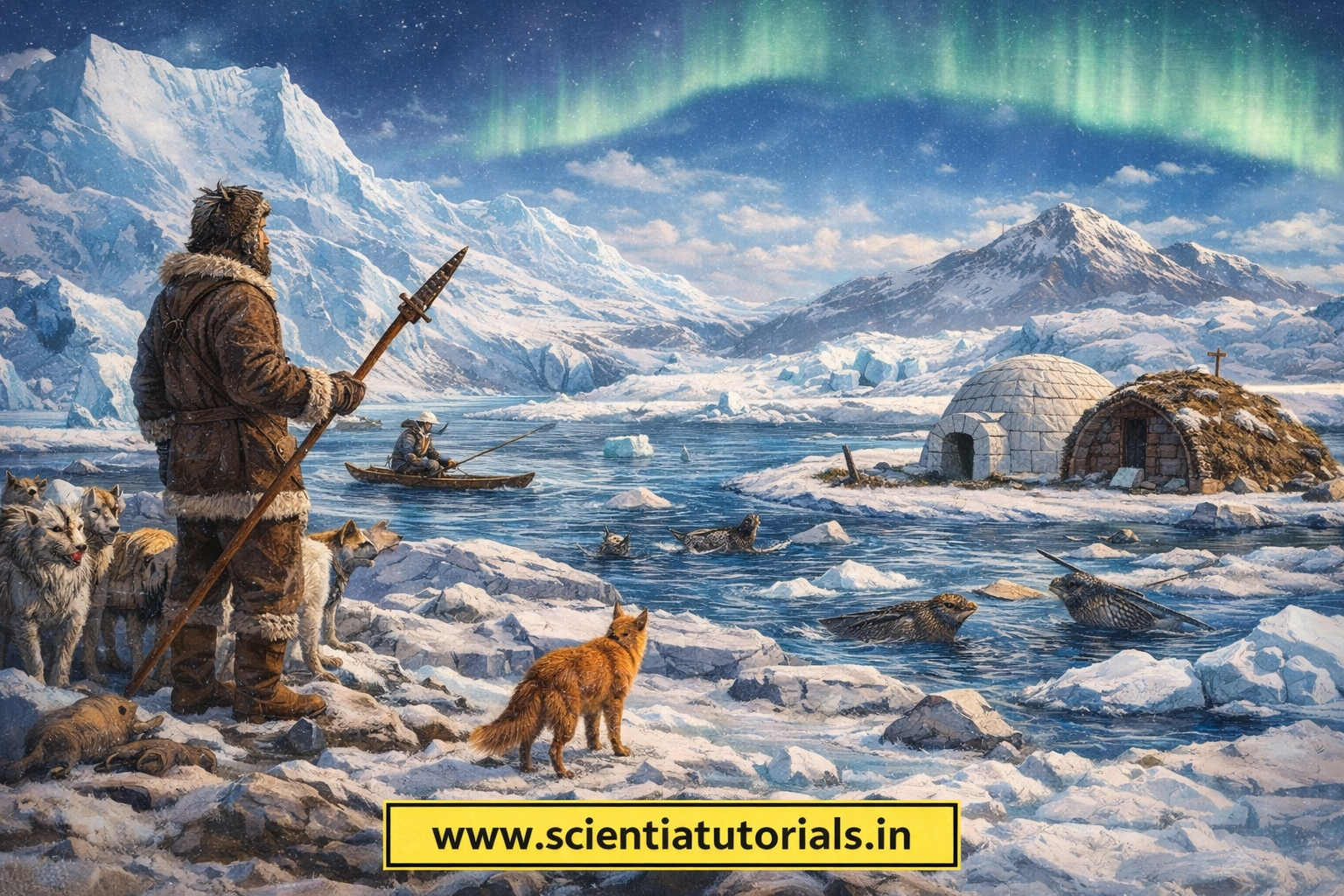
Greenland’s Geography and Arctic Environment | Prehistoric Foundations
Module 1: Greenland in the Prehistoric and Indigenous World
Lesson: Introduction to Greenland’s Geography and Arctic Environment
Era Framework: Prehistoric Period to c. 10th Century CE
This lesson is systematically organized into four clearly structured sections, as detailed below:
- Chronologically Structured Study Module
- Short-Answer Type Questions
- Long-Answer Type Questions
- Multiple-Choice Questions (MCQs) with Answers and Detailed Explanations
Chronologically Structured Study Module
Introduction: Geography as the Foundation of Greenland’s Historical Development
The historical evolution of Greenland cannot be understood without first examining its unique geography and Arctic environment. Unlike most regions studied in world history, Greenland’s physical setting is not merely a background condition but the primary force shaping patterns of human migration, settlement, survival strategies, and cultural development. From the earliest prehistoric settlers to the emergence of complex Indigenous societies by the early medieval period, Greenland’s icy terrain, extreme climate, and strategic Arctic location fundamentally structured human life.
This lesson introduces Greenland’s geography and Arctic environment as the essential framework within which prehistoric and Indigenous histories unfolded. Chronologically tracing environmental conditions and human adaptations from the earliest human presence to approximately the 10th century CE, the study emphasizes how geography conditioned economic practices, social organization, belief systems, and long-term cultural continuity.
I. Geological Formation and Physical Structure of Greenland (Prehistoric Foundations)
1. Formation of the World’s Largest Island
Greenland is the world’s largest island, situated between the Arctic and North Atlantic Oceans. Geologically, it is part of the ancient Canadian Shield, one of the oldest rock formations on Earth, dating back billions of years. This stable geological foundation shaped Greenland’s mountainous interior, rugged coastline, and limited arable land.
Over successive Ice Ages, massive glaciation sculpted Greenland’s landscape. Thick ice sheets—some exceeding three kilometers in depth—covered nearly 80 percent of the island. These ice sheets carved fjords along the coast, creating narrow habitable zones where later human settlement became possible.
2. Ice Sheets and Their Historical Significance
The Greenland Ice Sheet played a decisive role in shaping prehistoric habitation patterns. During colder climatic phases, expanding ice restricted movement and settlement, while warmer interglacial periods opened migration routes and coastal living spaces. These fluctuations determined when and how early humans could enter and survive in Greenland.
The ice sheet also functioned as a natural barrier, isolating populations and contributing to the development of distinct Arctic cultures with limited external contact for long periods.
II. Arctic Climate and Environmental Conditions
1. Climatic Characteristics
Greenland’s Arctic climate is characterized by:
- Extremely low temperatures
- Long, dark winters and short summers
- Permafrost conditions
- Limited vegetation growth
These conditions created one of the harshest environments inhabited by humans in world history. Seasonal variation in light, rather than temperature alone, profoundly shaped daily life, economic activity, and social rhythms.
2. Environmental Zones
Greenland can be broadly divided into:
- Interior Ice Sheet Zone: Completely uninhabitable
- Coastal Lowlands: Primary zones of prehistoric settlement
- High Arctic North: Extreme cold, seasonal occupation only
The coastal regions, especially in western and southwestern Greenland, offered access to marine resources, relatively milder conditions, and seasonal animal migrations, making them central to human survival.
III. Arctic Ecosystems and Natural Resources
1. Faunal Resources
Despite its harsh climate, Greenland supported rich Arctic ecosystems. Key animal species included:
- Seals (ringed, harp, and bearded)
- Whales (bowhead and narwhal)
- Walrus
- Arctic fox
- Polar bear
- Caribou (reindeer)
Marine mammals, in particular, formed the backbone of prehistoric subsistence economies. Their availability dictated settlement locations, seasonal movement, and technological innovation.
2. Floral Resources
Vegetation was sparse but significant:
- Mosses and lichens
- Arctic grasses
- Dwarf shrubs
These plants supported grazing animals and provided limited resources for fuel, medicine, and tool-making.
IV. Human Migration into Greenland: Prehistoric Era
1. Arctic Human Migration Routes
Human settlement in Greenland began through Arctic migration routes from North America rather than Europe. During warmer climatic phases, small groups crossed from the Canadian Arctic using coastal and island-hopping routes.
The earliest known settlers belong to the Paleo-Inuit traditions, arriving thousands of years before the Common Era. These migrations were not single events but occurred in multiple waves, reflecting climatic shifts and technological adaptation.
2. Environmental Pressures and Mobility
Migration into Greenland was driven by:
- Changing ice conditions
- Animal migration patterns
- Resource scarcity in neighboring regions
Early settlers were highly mobile, following seasonal cycles rather than establishing permanent settlements.
V. Indigenous Adaptation to the Arctic Environment
1. Technological Innovations
Survival in Greenland required advanced technological adaptation:
- Stone, bone, and ivory tools
- Harpoons for marine hunting
- Kayaks and umiaks for sea travel
- Snow houses (igloos) and semi-subterranean dwellings
These technologies reveal deep environmental knowledge and engineering skill, developed through long-term interaction with Arctic conditions.
2. Clothing and Shelter
Indigenous peoples crafted insulated clothing from animal skins, particularly sealskin and caribou hide. Layering techniques ensured warmth while maintaining mobility. Shelters were designed to conserve heat and withstand extreme weather.
VI. Cultural Systems and Social Organization
1. Kinship and Community Structures
Harsh environmental conditions encouraged cooperative social structures. Small kin-based groups formed the basic social units, emphasizing:
- Resource sharing
- Collective hunting
- Mutual survival obligations
Social cohesion was essential, as isolation or conflict could threaten group survival.
2. Belief Systems and Environmental Worldviews
Indigenous belief systems reflected deep respect for nature. Animals were often viewed as spiritual beings, and hunting rituals emphasized balance between humans and the environment. This worldview reinforced sustainable resource use and cultural continuity.
VII. Chronological Phases of Indigenous Greenland (Prehistoric to c. 10th Century CE)
1. Early Paleo-Inuit Period
The earliest settlers adapted to extreme cold with limited technology. Their presence was often temporary, reflecting fluctuating climate conditions.
2. Later Indigenous Cultural Developments
Subsequent cultural traditions showed:
- Improved hunting techniques
- More stable settlement patterns
- Greater specialization in marine resource exploitation
These developments laid the groundwork for later Inuit cultural systems that would dominate Greenland by the end of the first millennium CE.
VIII. Geography and Isolation: Greenland in the Wider World
1. Natural Isolation
Greenland’s distance from major landmasses and its ice-covered interior limited sustained contact with other regions. This isolation fostered unique cultural development but also made populations vulnerable to climatic change.
2. Strategic Arctic Position (Early Foundations)
Even in the prehistoric period, Greenland’s location between North America and the Arctic Ocean gave it long-term strategic significance. Migration routes, animal movement corridors, and later trans-Arctic connections all depended on this geography.
IX. Transition Toward the 10th Century CE
By the late prehistoric period, Indigenous societies in Greenland had developed sophisticated survival strategies finely tuned to Arctic conditions. These societies demonstrated:
- Environmental resilience
- Cultural continuity
- Technological adaptability
This Indigenous foundation formed the historical base upon which later external contacts—most notably Norse exploration—would build after the 10th century CE.
Conclusion: Geography as Historical Determinant
From the earliest human migrations to the emergence of complex Indigenous cultures, Greenland’s geography and Arctic environment decisively shaped historical outcomes. The interplay between ice, climate, resources, and human ingenuity produced one of the most remarkable examples of environmental adaptation in world history.
Understanding Greenland’s prehistoric and Indigenous world is essential for appreciating its later historical trajectory and modern global strategic importance. Geography was not merely a setting—it was the central historical actor guiding human life in Greenland from prehistory to the threshold of recorded history.
Short Answer Type Questions
Module 1 – Lesson: Introduction to Greenland’s Geography and Arctic Environment
1. Where is Greenland geographically located?
Greenland is located between the Arctic Ocean and the North Atlantic Ocean, lying northeast of North America and northwest of Europe.
2. Why is Greenland considered the world’s largest island?
Greenland is the world’s largest island because it has a vast land area but is not classified as a continent.
3. What major geological feature dominates Greenland’s interior?
The Greenland Ice Sheet dominates the interior, covering nearly 80 percent of the island’s surface.
4. How did repeated Ice Ages shape Greenland’s physical landscape?
Repeated Ice Ages carved deep fjords, mountains, and valleys while expanding ice sheets that reshaped coastal regions.
5. What type of climate characterizes Greenland?
Greenland has an Arctic climate marked by extremely low temperatures, long winters, short summers, and permafrost.
6. Why are Greenland’s coastal areas more suitable for human settlement than the interior?
Coastal areas offer access to marine resources, relatively milder temperatures, and ice-free zones during certain seasons.
7. What role did the Arctic environment play in shaping human life in Greenland?
The Arctic environment dictated settlement patterns, subsistence strategies, social cooperation, and technological innovation.
8. Name two key marine resources essential to prehistoric Greenlandic societies.
Seals and whales were two crucial marine resources for food, fuel, tools, and clothing.
9. What is permafrost, and why is it significant in Greenland?
Permafrost is permanently frozen ground that limits agriculture, construction, and vegetation growth.
10. From where did the earliest human migrants to Greenland originate?
The earliest migrants came from the North American Arctic regions via coastal and island-hopping routes.
11. What is meant by the term “Paleo-Inuit”?
Paleo-Inuit refers to the earliest prehistoric Arctic peoples who migrated into Greenland thousands of years ago.
12. Why was human mobility important in prehistoric Greenland?
Mobility allowed groups to follow animal migrations and adapt to seasonal environmental changes.
13. How did Indigenous peoples adapt technologically to Arctic conditions?
They developed tools made of stone, bone, and ivory, along with harpoons, kayaks, and insulated clothing.
14. What types of dwellings were used by Indigenous communities in Greenland?
They used igloos, skin tents, and semi-subterranean houses designed to conserve heat.
15. Why was cooperative social organization essential in Greenland’s prehistoric societies?
Harsh environmental conditions required resource sharing, collective hunting, and mutual survival support.
16. How did belief systems reflect the Arctic environment?
Indigenous belief systems emphasized respect for animals and nature, promoting sustainable resource use.
17. What animals formed the backbone of Greenland’s subsistence economy?
Seals, whales, walrus, and caribou formed the backbone of subsistence activities.
18. Why was agriculture nearly impossible in prehistoric Greenland?
Extreme cold, permafrost, short growing seasons, and poor soil made agriculture unfeasible.
19. How did Greenland’s isolation influence its cultural development?
Isolation encouraged the development of distinct Indigenous cultures with limited external influence.
20. What role did seasonal light variation play in daily life?
Seasonal light variation structured hunting cycles, movement patterns, and social activities.
21. Why were fjords important for human settlement?
Fjords provided sheltered waters, abundant marine life, and access routes along the coast.
22. What materials were commonly used for clothing in prehistoric Greenland?
Animal skins, especially sealskin and caribou hide, were commonly used due to their insulation properties.
23. How did climatic fluctuations affect settlement continuity?
Colder phases reduced habitation, while warmer phases allowed renewed migration and settlement.
24. In what way did geography shape Greenland’s long-term historical trajectory?
Geography influenced survival strategies, cultural continuity, isolation, and later strategic importance.
25. Why is understanding Greenland’s geography essential for studying its history?
Geography acted as the primary determinant of migration, settlement, economy, and culture throughout Greenland’s history.
Long Answer Type Questions
Module 1 – Greenland in the Prehistoric and Indigenous World
1. Examine how the geography of Greenland shaped its prehistoric human settlement patterns.
Answer:
Greenland’s geography fundamentally determined its prehistoric settlement patterns. The island’s vast ice-covered interior rendered it uninhabitable, confining human populations to narrow coastal zones. Fjord-lined coastlines provided sheltered waters, access to marine mammals, and seasonal ice-free areas essential for survival. The Arctic climate restricted agriculture, compelling communities to rely on hunting and fishing. Consequently, settlements were small, dispersed, and highly mobile, reflecting environmental constraints rather than political or economic expansion. Geography thus acted as the primary determinant of where and how humans could live in Greenland during the prehistoric era.
2. Discuss the role of the Greenland Ice Sheet in shaping historical continuity and change.
Answer:
The Greenland Ice Sheet shaped both continuity and change by controlling access to habitable land. During colder climatic phases, expanding ice reduced settlement opportunities and forced population decline or migration. Warmer interglacial periods allowed limited reoccupation of coastal zones. Over time, this cyclical pattern produced cultural continuity through adaptive survival strategies while also causing breaks in habitation. The ice sheet functioned as both a barrier and a regulator of human presence, deeply influencing Greenland’s long-term historical development.
3. Analyze the significance of Greenland’s Arctic climate for Indigenous survival strategies.
Answer:
Greenland’s Arctic climate demanded highly specialized survival strategies. Extreme cold, long winters, and limited sunlight necessitated efficient insulation, seasonal planning, and cooperative living. Indigenous societies developed layered clothing from animal skins, energy-efficient dwellings, and seasonal hunting cycles. The climate also shaped social structures based on cooperation and resource sharing. Survival depended on intimate environmental knowledge, making climate adaptation central to Indigenous cultural identity.
4. Explain how marine ecosystems supported prehistoric societies in Greenland.
Answer:
Marine ecosystems formed the economic foundation of prehistoric Greenlandic societies. Seals, whales, walrus, and fish provided food, oil for heating and lighting, materials for tools, and skins for clothing. Marine hunting encouraged coastal settlement and technological innovation such as harpoons and watercraft. Dependence on the sea created a maritime culture in which seasonal animal migrations dictated movement, labor organization, and social cooperation.
5. Evaluate the importance of fjords in the development of Indigenous Greenlandic communities.
Answer:
Fjords were crucial for survival and settlement. They offered sheltered waters, abundant marine life, and relatively stable microclimates. Fjords also served as natural transportation routes, enabling movement along the coast. Their geographic features allowed Indigenous groups to exploit resources efficiently while remaining protected from harsh open-ocean conditions. Thus, fjords became focal points of habitation and economic activity.
6. Trace the prehistoric human migration routes into Greenland.
Answer:
Human migration into Greenland occurred from the North American Arctic rather than Europe. During warmer periods, small groups crossed via island-hopping routes from present-day Canada. These migrations were gradual and episodic, driven by climate fluctuations and resource availability. The movement reflects adaptive expansion rather than conquest, emphasizing survival in marginal environments.
7. Describe the technological adaptations developed by Indigenous peoples to survive in Greenland.
Answer:
Indigenous peoples developed advanced Arctic technologies, including stone, bone, and ivory tools; harpoons for marine hunting; kayaks and umiaks for sea travel; and insulated clothing. Dwellings such as igloos and semi-subterranean houses conserved heat. These technologies reflect sophisticated environmental knowledge and long-term adaptation rather than primitive survival.
8. Discuss the role of seasonal cycles in shaping economic activities.
Answer:
Seasonal cycles structured all economic activities. Summer allowed fishing and limited travel, while winter emphasized seal hunting and indoor tool production. Migration patterns followed animal movements, ensuring resource availability throughout the year. Seasonal planning was essential for survival and reinforced collective cooperation.
9. Analyze the social organization of prehistoric Greenlandic societies.
Answer:
Social organization was based on small kinship groups emphasizing cooperation. Collective hunting, shared resources, and mutual responsibility were essential. Leadership was situational, often based on experience rather than hierarchy. This social structure minimized conflict and maximized survival under extreme conditions.
10. Explain how belief systems reflected environmental realities in Greenland.
Answer:
Belief systems emphasized harmony between humans and nature. Animals were often viewed as spiritual entities deserving respect. Rituals surrounding hunting reinforced sustainable practices and moral responsibility. These beliefs supported ecological balance and social cohesion in an unpredictable environment.
11. Assess the impact of permafrost on settlement and economy.
Answer:
Permafrost prevented agriculture and permanent construction, limiting economic diversification. Settlements relied on temporary or adaptable structures. Economic activities focused on hunting and gathering rather than land-based production, reinforcing mobility and environmental dependence.
12. Discuss the challenges faced by early settlers in Greenland.
Answer:
Early settlers faced extreme cold, food scarcity, isolation, and unpredictable weather. Survival required technological innovation, environmental knowledge, and social cooperation. Failure to adapt often resulted in abandonment of settlements during unfavorable climatic phases.
13. Examine the relationship between isolation and cultural uniqueness in Greenland.
Answer:
Geographic isolation limited sustained external contact, allowing distinct Indigenous cultures to develop. This isolation preserved unique technologies, social systems, and belief structures. However, it also increased vulnerability to environmental change due to limited external support.
14. Explain why agriculture did not develop in prehistoric Greenland.
Answer:
Agriculture was impossible due to extreme cold, permafrost, short growing seasons, and poor soil quality. These conditions forced reliance on hunting and fishing rather than crop cultivation or animal domestication.
15. Analyze how climatic fluctuations affected population continuity.
Answer:
Climatic fluctuations caused cycles of settlement expansion and contraction. Warmer periods encouraged migration and habitation, while colder phases led to population decline or withdrawal. These shifts shaped cultural resilience and adaptation.
16. Discuss the significance of animal migration patterns.
Answer:
Animal migrations determined hunting seasons, settlement locations, and mobility. Indigenous groups closely followed these patterns, integrating ecological knowledge into economic planning and cultural traditions.
17. Evaluate Greenland’s early strategic importance from a geographical perspective.
Answer:
Even in prehistoric times, Greenland’s position between the Arctic Ocean and North America made it significant for migration routes and ecological systems. This early geographic importance laid the foundation for its later strategic value.
18. Compare Greenland’s prehistoric adaptation strategies with those of temperate regions.
Answer:
Unlike temperate regions where agriculture dominated, Greenland relied on marine-based subsistence. Adaptation focused on mobility, insulation, and cooperation rather than land ownership or surplus production.
19. Explain how geography shaped Greenland’s long-term historical trajectory.
Answer:
Geography constrained population size, economic activities, and external interaction. These constraints fostered resilience, cultural continuity, and unique adaptation, influencing Greenland’s historical path into the medieval and modern eras.
20. Conclude by assessing why geography is central to understanding Greenland’s early history.
Answer:
Geography was the defining force in Greenland’s early history. Climate, ice, and resources dictated migration, settlement, economy, and culture. Without understanding these geographic realities, the historical evolution of Greenland cannot be accurately interpreted.
MCQs with Answers and Detailed Explanations
Module 1 – Greenland in the Prehistoric and Indigenous World
1. Greenland is best described geographically as:
A. A continental landmass
B. The world’s largest island
C. A peninsula of Europe
D. A chain of Arctic islands
Correct Answer: B
Explanation:
Greenland is classified as the world’s largest island because, despite its size, it does not meet the criteria of a continent. It is geographically distinct and surrounded by oceans.
2. Approximately what percentage of Greenland is covered by ice?
A. 40%
B. 55%
C. 70%
D. 80%
Correct Answer: D
Explanation:
Nearly 80 percent of Greenland is covered by the Greenland Ice Sheet, which dominates its interior and limits human habitation.
3. The Greenland Ice Sheet is historically significant primarily because it:
A. Encouraged agricultural expansion
B. Created tropical climatic conditions
C. Restricted settlement to coastal regions
D. Supported dense urban populations
Correct Answer: C
Explanation:
The massive ice sheet made the interior uninhabitable, forcing human settlement to narrow coastal areas where resources were accessible.
4. Which climatic characteristic most strongly shaped human adaptation in Greenland?
A. Heavy monsoon rainfall
B. Extreme seasonal light variation
C. High humidity
D. Frequent volcanic activity
Correct Answer: B
Explanation:
Long periods of darkness in winter and continuous daylight in summer profoundly affected daily life, hunting cycles, and social organization.
5. Why were Greenland’s coastal zones more suitable for settlement than the interior?
A. Fertile soil availability
B. Access to marine resources
C. Dense forest cover
D. Permanent warm temperatures
Correct Answer: B
Explanation:
Coastal areas provided marine mammals, fish, and relatively milder conditions, making survival possible despite the Arctic climate.
6. Which of the following best describes Greenland’s prehistoric subsistence economy?
A. Agriculture-based
B. Pastoral nomadism
C. Marine hunting and gathering
D. Plantation-based economy
Correct Answer: C
Explanation:
Due to permafrost and cold climate, agriculture was impossible, making marine hunting and gathering the primary economic activity.
7. The earliest human settlers in Greenland migrated mainly from:
A. Northern Europe
B. Central Asia
C. North American Arctic regions
D. Siberia via the Bering Strait
Correct Answer: C
Explanation:
Archaeological evidence shows migration into Greenland from the Canadian Arctic through coastal and island-hopping routes.
8. The term “Paleo-Inuit” refers to:
A. Medieval Norse settlers
B. Early European explorers
C. Prehistoric Arctic peoples
D. Modern Inuit communities
Correct Answer: C
Explanation:
Paleo-Inuit were the earliest prehistoric Arctic inhabitants who adapted to Greenland’s extreme environment.
9. What factor most strongly encouraged mobility among prehistoric Greenlandic societies?
A. Political conflict
B. Trade opportunities
C. Seasonal animal migrations
D. Religious pilgrimages
Correct Answer: C
Explanation:
Following animal migrations was essential for food security, making seasonal mobility a survival necessity.
10. Which animal formed the backbone of prehistoric Greenland’s subsistence economy?
A. Cattle
B. Seals
C. Horses
D. Sheep
Correct Answer: B
Explanation:
Seals provided food, oil, skins, and materials for tools, making them central to survival.
11. Which technological innovation was crucial for Arctic marine hunting?
A. Iron ploughs
B. Harpoons
C. Firearms
D. Wheeled carts
Correct Answer: B
Explanation:
Harpoons enabled efficient hunting of seals and whales, forming a key survival technology.
12. Indigenous Arctic clothing was primarily designed to:
A. Display social status
B. Enable ceremonial performance
C. Provide insulation and mobility
D. Encourage trade relations
Correct Answer: C
Explanation:
Clothing made from animal skins provided warmth while allowing movement in extreme cold.
13. What type of dwelling best reflects adaptation to Arctic conditions?
A. Mud-brick houses
B. Stone castles
C. Igloos and semi-subterranean houses
D. Wooden cottages
Correct Answer: C
Explanation:
These dwellings conserved heat and used locally available materials, making them ideal for Arctic survival.
14. Permafrost affected Greenlandic societies primarily by:
A. Increasing soil fertility
B. Preventing permanent agriculture
C. Supporting dense vegetation
D. Encouraging urbanization
Correct Answer: B
Explanation:
Permafrost made farming impossible, reinforcing dependence on hunting and gathering.
15. Why was cooperation essential in prehistoric Greenlandic societies?
A. To build monuments
B. To expand territory
C. To survive extreme environmental conditions
D. To accumulate surplus wealth
Correct Answer: C
Explanation:
Resource sharing and collective hunting were necessary to survive unpredictable Arctic conditions.
16. Indigenous belief systems often emphasized:
A. Human dominance over nature
B. Industrial progress
C. Spiritual respect for animals
D. Agricultural fertility rituals
Correct Answer: C
Explanation:
Animals were seen as spiritually significant, reinforcing sustainable hunting practices.
17. Fjords were important to settlement because they:
A. Contained fertile farmland
B. Offered sheltered waters and marine life
C. Had abundant forests
D. Provided mineral wealth
Correct Answer: B
Explanation:
Fjords provided protection, food resources, and transportation routes along the coast.
18. Which factor most limited population growth in prehistoric Greenland?
A. Political instability
B. Limited natural resources
C. Excessive trade competition
D. Overpopulation
Correct Answer: B
Explanation:
Harsh climate and limited resources restricted population size.
19. Climatic fluctuations in Greenland led to:
A. Continuous settlement growth
B. Cycles of habitation and abandonment
C. Stable agricultural production
D. Urban development
Correct Answer: B
Explanation:
Colder periods reduced habitation, while warmer phases allowed renewed settlement.
20. Which feature most contributed to Greenland’s cultural isolation?
A. Mountain ranges
B. Dense forests
C. Ice-covered interior and oceans
D. Desert barriers
Correct Answer: C
Explanation:
Ice and surrounding seas limited sustained contact with other regions.
21. Greenland’s early strategic importance was rooted in its:
A. Agricultural productivity
B. Industrial output
C. Geographic position in the Arctic
D. Population density
Correct Answer: C
Explanation:
Its location influenced migration routes and later global strategic considerations.
22. Compared to temperate societies, Greenlandic societies relied more on:
A. Farming and storage
B. Marine ecosystems
C. Monetary trade
D. Metal tools
Correct Answer: B
Explanation:
Marine resources replaced agriculture as the foundation of survival.
23. Seasonal light variation affected Indigenous societies mainly by:
A. Determining religious calendars
B. Structuring economic and social life
C. Encouraging permanent settlement
D. Eliminating mobility
Correct Answer: B
Explanation:
Light cycles influenced hunting seasons, movement, and daily activities.
24. Which statement best explains why Greenland’s interior remained uninhabited?
A. Lack of political control
B. Continuous volcanic eruptions
C. Thick ice sheet and extreme cold
D. Absence of rivers
Correct Answer: C
Explanation:
The ice-covered interior was unsuitable for human life.
25. Understanding Greenland’s geography is essential because it:
A. Explains only modern politics
B. Has little relevance to history
C. Determines migration, economy, and culture
D. Influences trade routes alone
Correct Answer: C
Explanation:
Geography acted as the primary historical determinant shaping all aspects of Greenland’s early development.