
Greenland’s Political Status in the Contemporary World
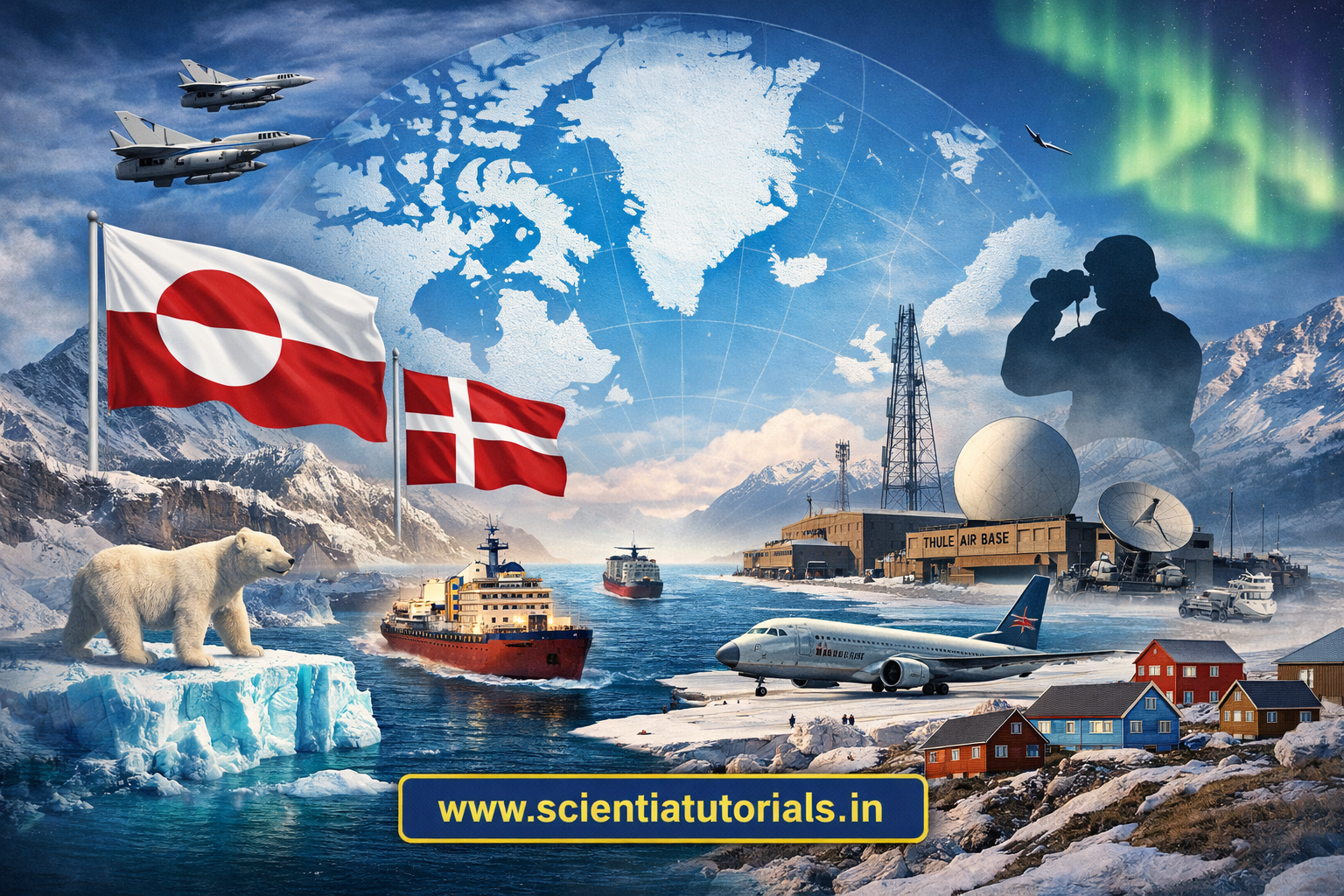
Greenland’s Political Status in the Contemporary World | Arctic Geopolitics
Module 5: Contemporary Greenland and Global Strategic Importance
Era Framework: Late 20th Century – 21st Century
(Globalization, Climate Change, Arctic Geopolitics)
Lesson: Greenland’s Political Status in the Contemporary World
This lesson is systematically organized into four clearly structured sections, as detailed below:
- Chronologically Structured Study Module
- Short-Answer Type Questions
- Long-Answer Type Questions
- Multiple-Choice Questions (MCQs) with Answers and Detailed Explanations
Chronologically Structured Study Module
Introduction: Contemporary Greenland in a Transforming Global Order
In the late twentieth and early twenty-first centuries, Greenland has emerged as one of the most strategically significant regions in global geopolitics. Once viewed largely as a remote Arctic territory under Danish control, Greenland today occupies a central position in discussions on self-determination, climate change, resource politics, and Arctic security. Its evolving political status reflects broader global transformations driven by decolonization, globalization, and environmental change.
This lesson examines Greenland’s contemporary political status in a chronological and analytical manner, tracing its evolution from Home Rule to Self-Government and situating it within modern Arctic geopolitics. The discussion aligns Greenland’s internal political development with its growing international importance.
1. Historical Context at the End of the Cold War (Late 20th Century)
1.1 Greenland within the Danish Realm
Until the mid-twentieth century, Greenland functioned primarily as a colonial possession of Denmark. Although Denmark began integrating Greenland administratively after World War II, political decision-making remained centralized in Copenhagen. Greenland’s Inuit population had limited influence over governance, economic planning, and foreign affairs.
By the late Cold War period, however, global decolonization movements and indigenous rights campaigns reshaped political discourse. Greenland’s strategic location between North America and Europe, coupled with its Cold War military role, amplified demands for greater autonomy.
1.2 Cold War Strategic Significance
Greenland’s geopolitical relevance increased dramatically during the Cold War due to its proximity to the Soviet Union and its value in early-warning defense systems. The establishment of Thule Air Base reinforced Greenland’s importance within NATO’s security architecture, though decisions concerning defense were made without local consultation. This disconnect fueled Greenlandic political awareness and nationalist sentiment.
2. The Home Rule Act of 1979: A Turning Point
2.1 Introduction of Home Rule
The Home Rule Act of 1979 marked the first major transformation in Greenland’s political status. Following a referendum, Greenland gained authority over internal matters such as education, health, fisheries, and local taxation. Denmark retained control over defense, foreign policy, and monetary affairs.
This development reflected broader global trends of post-colonial restructuring rather than outright independence. Greenland remained within the Danish Realm but acquired substantial administrative autonomy.
2.2 Political Consequences of Home Rule
Home Rule fostered the growth of local political institutions and parties, strengthening democratic participation. Importantly, it allowed Greenlanders to articulate policies reflecting indigenous priorities rather than metropolitan interests. However, economic dependency on Danish subsidies continued, shaping debates over future sovereignty.
3. Greenland and European Integration: Withdrawal from the EEC
3.1 The 1985 Referendum and Exit
In 1985, Greenland withdrew from the European Economic Community (EEC) following a popular referendum. This decision demonstrated Greenland’s growing political agency and highlighted tensions between European integration and local economic interests—particularly fisheries.
3.2 Implications for Political Status
Greenland’s exit established a precedent: it showed that Greenland could pursue distinct international preferences despite remaining within the Danish Realm. This episode strengthened the argument that Greenland possessed a unique political identity separate from Denmark.
4. The Self-Government Act of 2009: Expanding Sovereignty
4.1 Legal and Constitutional Significance
The Self-Government Act of 2009 represented a decisive step toward political self-determination. It recognized Greenlanders as a distinct people under international law and transferred additional powers, including control over natural resources, the judiciary, and policing.
Crucially, the Act acknowledged Greenland’s right to independence should its population choose to pursue it through a referendum.
4.2 Economic and Political Implications
While Denmark continued to provide an annual block grant, Greenland gained the right to benefit directly from mineral and hydrocarbon revenues. This shift linked political autonomy with economic sustainability, making resource governance central to Greenland’s future status.
5. Climate Change and Political Transformation (21st Century)
5.1 Environmental Change as a Political Catalyst
Climate change has dramatically altered Greenland’s strategic relevance. Melting ice sheets have exposed mineral deposits and opened new Arctic shipping routes. These environmental shifts transformed Greenland from a peripheral territory into a focal point of global environmental and economic interest.
5.2 Resource Governance and Autonomy
Control over natural resources strengthened Greenland’s negotiating position internationally. However, debates persist over environmental protection, indigenous rights, and sustainable development. Political status in the contemporary era thus involves balancing sovereignty aspirations with ecological responsibility.
6. Greenland in Arctic Geopolitics
6.1 Regional Governance and the Arctic Council
Greenland participates actively in Arctic governance through institutions such as the Arctic Council, where indigenous voices play a significant role. Although Denmark represents Greenland formally in foreign policy, Greenlandic leaders increasingly engage in diplomatic initiatives related to Arctic cooperation.
6.2 Renewed Great Power Interest
The twenty-first century has witnessed renewed strategic interest in Greenland by major powers, including the United States, Russia, and China. Greenland’s location along trans-Arctic routes and its role in missile defense systems have once again elevated its global importance.
This renewed attention has reinforced Greenland’s desire for greater diplomatic autonomy, even while remaining formally linked to Denmark.
7. Contemporary Political Debates: Autonomy vs Independence
7.1 Internal Political Dynamics
Greenlandic politics today revolve around a central question: Is full independence feasible and desirable? Supporters emphasize national identity and self-determination, while critics highlight economic dependency and administrative challenges.
Political parties differ in their timelines and strategies, but there is broad consensus on preserving cultural identity and expanding political agency.
7.2 Economic Constraints and Opportunities
Despite increased autonomy, Greenland remains economically dependent on Danish financial support. The success of future independence hinges on sustainable resource development, diversification of the economy, and effective governance institutions.
8. Greenland’s Political Status in International Law
From an international legal perspective, Greenland occupies a unique position: it is neither a sovereign state nor a traditional colony. Instead, it represents a modern model of autonomous self-government within a larger state framework. This status allows Greenland to exercise significant domestic authority while benefiting from Danish diplomatic and defense structures.
Conclusion: Greenland in the Contemporary World
Greenland’s political status in the contemporary world is best understood as dynamic and evolving rather than fixed. Since the late twentieth century, Greenland has transitioned from colonial dependency to a high degree of self-government, shaped by global decolonization, climate change, and Arctic geopolitics.
In the twenty-first century, Greenland stands at a crossroads. Its future political trajectory—whether enhanced autonomy or full independence—will depend on economic sustainability, environmental stewardship, and strategic diplomacy. As climate change reshapes the Arctic, Greenland’s political choices will have implications not only for its own people but for global geopolitics as a whole.
Short Answer Type Questions with Answers
Lesson: Greenland’s Political Status in the Contemporary World
1. What is the present political status of Greenland?
Answer:
Greenland is a self-governing autonomous territory within the Kingdom of Denmark, exercising extensive control over domestic affairs while Denmark retains authority over defense and foreign policy.
2. Which Act formally expanded Greenland’s autonomy in 2009?
Answer:
The Self-Government Act of 2009 significantly expanded Greenland’s political autonomy and recognized Greenlanders as a distinct people under international law.
3. What major political change occurred in Greenland in 1979?
Answer:
In 1979, Greenland adopted the Home Rule system, granting it control over internal administrative matters.
4. Why is Greenland considered strategically important in the 21st century?
Answer:
Greenland’s importance stems from its Arctic location, military relevance, climate change impacts, and access to natural resources.
5. How does climate change affect Greenland’s political status?
Answer:
Climate change enhances Greenland’s strategic and economic significance by exposing resources and opening Arctic sea routes, strengthening its push for autonomy.
6. What role does Denmark play in Greenland’s governance today?
Answer:
Denmark manages Greenland’s foreign affairs, defense, and monetary policy, while Greenland controls domestic governance.
7. Name one international organization relevant to Greenland’s Arctic role.
Answer:
The Arctic Council is central to Greenland’s engagement in Arctic governance.
8. Why did Greenland leave the European Economic Community in 1985?
Answer:
Greenland withdrew to protect its fishing rights and maintain control over local economic resources.
9. What is the significance of the Self-Government Act regarding independence?
Answer:
The Act recognizes Greenland’s right to pursue full independence through a democratic referendum.
10. How does economic dependency affect Greenland’s political future?
Answer:
Continued reliance on Danish financial support limits Greenland’s immediate prospects for full independence.
11. What Cold War factor increased Greenland’s global importance?
Answer:
Greenland’s role in North Atlantic defense and hosting of U.S. military installations elevated its strategic importance.
12. Name a major U.S. military installation in Greenland.
Answer:
Thule Air Base is a key American military installation in Greenland.
13. What aspect of governance did Greenland gain control over after 2009?
Answer:
Greenland gained authority over natural resources, policing, and the judicial system.
14. How is Greenland represented in international diplomacy?
Answer:
Greenland is formally represented by Denmark but increasingly conducts its own diplomatic engagements in Arctic-related matters.
15. What role do natural resources play in Greenland’s autonomy debate?
Answer:
Natural resources are viewed as essential for economic self-sufficiency and eventual political independence.
16. Why is Greenland not considered a fully sovereign state?
Answer:
Because defense, foreign policy, and currency remain under Danish control.
17. How has globalization influenced Greenland’s political relevance?
Answer:
Globalization has integrated Greenland into international trade, climate governance, and geopolitical competition.
18. What internal political debate dominates contemporary Greenland?
Answer:
The debate centers on whether Greenland should pursue full independence or maintain enhanced autonomy.
19. How does indigenous identity shape Greenland’s political status?
Answer:
Inuit identity strengthens claims to self-determination and culturally informed governance.
20. What is Greenland’s role in Arctic geopolitics?
Answer:
Greenland acts as a strategic hub for security, environmental research, and Arctic cooperation.
21. Why is Greenland significant for global climate research?
Answer:
Its ice sheets are critical indicators of global climate change and sea-level rise.
22. What limits Greenland’s foreign policy autonomy?
Answer:
Foreign policy decisions are constitutionally managed by Denmark.
23. How has renewed great power interest affected Greenland?
Answer:
It has increased Greenland’s diplomatic importance and bargaining power internationally.
24. What makes Greenland a unique case in international politics?
Answer:
It represents a modern model of extensive self-government without full sovereignty.
25. What is the long-term political trajectory of Greenland?
Answer:
Greenland is moving gradually toward greater autonomy, with potential independence dependent on economic sustainability.
Long Answer Type Questions with Answers
Lesson: Greenland’s Political Status in the Contemporary World
1. Trace the evolution of Greenland’s political status from the late 20th century to the present.
Answer:
Since the late twentieth century, Greenland has undergone a gradual yet significant transformation in its political status. Initially administered as a dependency of Denmark, Greenland moved toward autonomy with the Home Rule Act of 1979. This was followed by deeper constitutional recognition through the Self-Government Act of 2009, which expanded legislative powers and acknowledged the Greenlandic people’s right to self-determination. In the 21st century, climate change and Arctic geopolitics have further elevated Greenland’s international relevance, reshaping debates over sovereignty and independence.
2. Examine the significance of the Home Rule Act of 1979 in Greenland’s political development.
Answer:
The Home Rule Act of 1979 marked Greenland’s first major step away from centralized Danish administration. It transferred authority over internal affairs such as education, fisheries, and healthcare to Greenlandic institutions. Politically, it strengthened democratic participation and fostered local political leadership. While Denmark retained control over defense and foreign policy, the Act laid the institutional foundation for later self-government and nurtured Greenlandic national consciousness.
3. Analyze the constitutional importance of the Self-Government Act of 2009.
Answer:
The Self-Government Act of 2009 was constitutionally transformative. It recognized Greenlanders as a distinct people under international law and transferred control over natural resources, policing, and judicial affairs. Crucially, it acknowledged Greenland’s right to independence through a democratic referendum. This Act redefined Greenland’s relationship with Denmark from administrative autonomy to near-sovereign self-rule.
4. Discuss the impact of climate change on Greenland’s contemporary political status.
Answer:
Climate change has dramatically altered Greenland’s political relevance. Melting ice sheets have exposed mineral resources and opened Arctic sea routes, increasing international interest in the region. These changes have strengthened Greenland’s economic potential and bargaining power, reinforcing autonomy aspirations. At the same time, environmental risks have intensified debates over sustainable governance and responsible resource exploitation.
5. Explain Greenland’s strategic importance in Arctic geopolitics.
Answer:
Greenland occupies a critical geopolitical position between North America and Europe. Its Arctic location makes it central to military surveillance, climate research, and emerging shipping routes. Renewed interest from major powers underscores Greenland’s role in Arctic security frameworks and reinforces its significance in global strategic planning.
6. Evaluate the role of Denmark in Greenland’s contemporary governance structure.
Answer:
Denmark continues to manage Greenland’s defense, foreign affairs, and monetary policy, while Greenland governs domestic matters. This arrangement provides security and diplomatic support but limits Greenland’s full sovereignty. The relationship reflects a balance between autonomy and dependency, shaping ongoing debates over independence.
7. Assess the significance of Greenland’s withdrawal from the European Economic Community in 1985.
Answer:
Greenland’s withdrawal from the EEC highlighted its emerging political agency. Motivated largely by fisheries concerns, the decision demonstrated Greenland’s capacity to pursue independent economic preferences despite remaining within the Danish Realm. This event strengthened Greenland’s self-identity and autonomy claims.
8. Examine how natural resource governance influences Greenland’s political aspirations.
Answer:
Control over natural resources is central to Greenland’s autonomy debate. The Self-Government Act enabled Greenland to benefit directly from mineral and hydrocarbon revenues, linking economic sustainability with political independence. However, environmental concerns and global market volatility complicate this path.
9. Discuss the role of the Arctic Council in shaping Greenland’s international engagement.
Answer:
The Arctic Council provides Greenland a platform to participate in regional governance, environmental cooperation, and indigenous advocacy. Though Denmark formally represents Greenland, Greenlandic leaders increasingly influence Arctic diplomacy, enhancing international visibility.
10. Analyze the impact of Cold War military infrastructure on Greenland’s political consciousness.
Answer:
Cold War defense installations, including Thule Air Base, increased Greenland’s strategic value but excluded local participation in decision-making. This marginalization contributed to nationalist sentiment and demands for political autonomy.
11. Explain the relationship between indigenous identity and Greenland’s self-determination movement.
Answer:
Inuit identity plays a foundational role in Greenlandic politics. Recognition of indigenous culture, language, and traditions strengthens claims to self-governance and shapes policy priorities aligned with community values rather than external interests.
12. Evaluate the economic challenges facing Greenland’s path to independence.
Answer:
Despite increased autonomy, Greenland remains dependent on Danish financial support. Limited economic diversification, infrastructure constraints, and environmental risks pose challenges to achieving full independence. Sustainable development remains a prerequisite for sovereignty.
13. Discuss globalization’s influence on Greenland’s political relevance.
Answer:
Globalization has integrated Greenland into international networks of trade, climate governance, and geopolitics. This integration has amplified Greenland’s strategic value while exposing it to global economic and environmental pressures.
14. Examine Greenland’s position in international law.
Answer:
Greenland occupies a unique legal position as a self-governing territory within a sovereign state. While not fully independent, it exercises extensive domestic authority and holds a recognized right to self-determination under international norms.
15. Analyze the renewed interest of global powers in Greenland during the 21st century.
Answer:
Renewed interest from major powers reflects Greenland’s strategic location, resource potential, and Arctic relevance. This attention has increased Greenland’s diplomatic leverage but also raised concerns about external influence.
16. Discuss the balance between environmental protection and political autonomy in Greenland.
Answer:
Greenland faces the challenge of reconciling autonomy aspirations with environmental stewardship. Resource exploitation promises economic independence but risks ecological damage, making sustainable governance essential.
17. Examine the role of democratic institutions in Greenland’s contemporary politics.
Answer:
Democratic institutions developed under Home Rule and Self-Government have strengthened political participation and accountability. They serve as essential mechanisms for managing autonomy and potential independence.
18. Assess the significance of Arctic shipping routes for Greenland’s political future.
Answer:
Emerging Arctic shipping routes enhance Greenland’s strategic importance and economic prospects. Control over these routes could strengthen Greenland’s global position but also necessitates international cooperation.
19. Explain how Greenland’s political status reflects broader post-colonial trends.
Answer:
Greenland’s gradual transition from colonial administration to self-government mirrors global post-colonial movements emphasizing autonomy, indigenous rights, and negotiated sovereignty.
20. Critically examine the debate between autonomy and full independence in Greenland.
Answer:
While independence symbolizes national self-determination, economic dependency and administrative challenges temper immediate prospects. Many Greenlanders favor gradual autonomy expansion over abrupt separation.
Multiple Choice Questions (MCQs) with Answers and Explanations
Lesson: Greenland’s Political Status in the Contemporary World
1. What is the present political status of Greenland?
A. Fully independent sovereign state
B. Colony under Denmark
C. Self-governing territory within the Kingdom of Denmark
D. Overseas territory of the European Union
Correct Answer: C
Explanation:
Greenland is a self-governing territory within the Kingdom of Denmark. While it controls most domestic affairs, Denmark retains authority over defense and foreign policy.
2. Which Act granted Greenland extensive self-rule in 2009?
A. Home Rule Act
B. Arctic Governance Act
C. Self-Government Act
D. Autonomy Charter
Correct Answer: C
Explanation:
The Self-Government Act of 2009 expanded Greenland’s autonomy, transferring control over natural resources and recognizing Greenlanders as a distinct people under international law.
3. The Home Rule system in Greenland was introduced in:
A. 1965
B. 1979
C. 1985
D. 1991
Correct Answer: B
Explanation:
The Home Rule Act came into force in 1979, marking Greenland’s first major step toward political autonomy.
4. Which area remains under Danish control even after Self-Government?
A. Fisheries
B. Education
C. Health
D. Defense
Correct Answer: D
Explanation:
Defense and foreign policy remain under Danish jurisdiction, limiting Greenland’s full sovereignty.
5. Why did Greenland withdraw from the European Economic Community in 1985?
A. Political independence movement
B. Cultural differences
C. Control over fisheries
D. Military obligations
Correct Answer: C
Explanation:
Greenland exited the EEC primarily to safeguard its fishing industry, demonstrating its growing political autonomy.
6. Which global phenomenon has most increased Greenland’s strategic importance in the 21st century?
A. Industrialization
B. Globalization
C. Climate change
D. Urbanization
Correct Answer: C
Explanation:
Climate change has exposed resources and opened Arctic sea routes, making Greenland strategically vital.
7. Which organization plays a key role in Arctic governance involving Greenland?
A. NATO
B. United Nations
C. European Union
D. Arctic Council
Correct Answer: D
Explanation:
The Arctic Council facilitates cooperation on environmental protection, indigenous rights, and Arctic development.
8. Which military installation highlights Greenland’s Cold War strategic importance?
A. Pituffik Research Station
B. Thule Air Base
C. Keflavik Base
D. Arctic Command
Correct Answer: B
Explanation:
Thule Air Base played a critical role in U.S. missile defense and early-warning systems during the Cold War.
9. What right does the Self-Government Act explicitly recognize?
A. Right to European Union membership
B. Right to military neutrality
C. Right to independence through referendum
D. Right to permanent Danish subsidies
Correct Answer: C
Explanation:
The Act affirms Greenland’s right to pursue independence through a democratic process.
10. Which factor limits Greenland’s immediate prospects for independence?
A. Cultural diversity
B. Economic dependency
C. Geographic isolation
D. Population growth
Correct Answer: B
Explanation:
Greenland remains financially dependent on Danish block grants, constraining full sovereignty.
11. Greenland’s political transformation reflects which broader global trend?
A. Industrial capitalism
B. Mercantilism
C. Post-colonial self-determination
D. Imperial expansion
Correct Answer: C
Explanation:
Greenland’s gradual autonomy aligns with global post-colonial movements emphasizing self-governance.
12. Control over which sector became crucial after the 2009 Act?
A. Tourism
B. Natural resources
C. Transportation
D. Banking
Correct Answer: B
Explanation:
Natural resource control linked economic sustainability with political autonomy.
13. Which country retains formal responsibility for Greenland’s foreign policy?
A. Canada
B. United States
C. Denmark
D. Norway
Correct Answer: C
Explanation:
Foreign affairs remain constitutionally managed by Denmark.
14. Which group’s identity strongly influences Greenland’s autonomy movement?
A. European settlers
B. Nordic migrants
C. Inuit population
D. Arctic traders
Correct Answer: C
Explanation:
Inuit cultural and political identity underpins Greenland’s self-determination movement.
15. Greenland’s Arctic location is significant mainly because it:
A. Lies near major deserts
B. Controls global air traffic
C. Connects North America and Europe
D. Hosts dense populations
Correct Answer: C
Explanation:
Greenland’s position between continents enhances its strategic and military relevance.
16. What is Greenland’s status in international law?
A. Fully sovereign state
B. Colony without rights
C. Self-governing territory within a sovereign state
D. United Nations trust territory
Correct Answer: C
Explanation:
Greenland is a self-governing territory with recognized self-determination rights but not full sovereignty.
17. Which development has increased Greenland’s bargaining power globally?
A. Urban expansion
B. Arctic shipping routes
C. Declining population
D. Agricultural growth
Correct Answer: B
Explanation:
Melting ice has opened new Arctic shipping routes, enhancing Greenland’s strategic leverage.
18. What is the main political debate in contemporary Greenland?
A. Monarchy versus republic
B. Federalism versus unitary system
C. Autonomy versus independence
D. Capitalism versus socialism
Correct Answer: C
Explanation:
Greenlandic politics centers on whether to pursue full independence or enhanced autonomy.
19. Greenland’s growing diplomatic engagement mainly concerns:
A. African trade
B. Antarctic exploration
C. Arctic governance
D. Pacific alliances
Correct Answer: C
Explanation:
Greenland increasingly participates in Arctic-focused diplomacy and cooperation.
20. Which factor most distinguishes Greenland from traditional colonies today?
A. Absence of elections
B. External military control
C. Extensive self-government
D. Cultural homogeneity
Correct Answer: C
Explanation:
Greenland exercises extensive self-rule, unlike traditional colonies.
21. Why is environmental protection politically significant for Greenland?
A. It limits tourism
B. It affects resource extraction debates
C. It reduces autonomy
D. It discourages international interest
Correct Answer: B
Explanation:
Balancing economic development with environmental sustainability is central to Greenland’s political future.
22. Which power has renewed strategic interest in Greenland in the 21st century?
A. Brazil
B. South Africa
C. United States
D. Australia
Correct Answer: C
Explanation:
The United States has renewed interest due to Arctic security and strategic positioning.
23. Greenland’s autonomy has been achieved primarily through:
A. Violent revolution
B. International intervention
C. Negotiated constitutional reform
D. Economic sanctions
Correct Answer: C
Explanation:
Greenland’s political evolution has occurred through peaceful constitutional negotiations.
24. What best describes Greenland’s political trajectory?
A. Sudden independence
B. Declining autonomy
C. Gradual expansion of self-rule
D. Recolonization
Correct Answer: C
Explanation:
Greenland has followed a gradual, step-by-step path toward greater autonomy.
25. Greenland is best studied as an example of:
A. Failed state formation
B. Cold War militarization
C. Modern indigenous self-governance
D. European federalism
Correct Answer: C
Explanation:
Greenland exemplifies contemporary indigenous self-governance within a globalized political system.