
Norse Exploration of the North Atlantic World
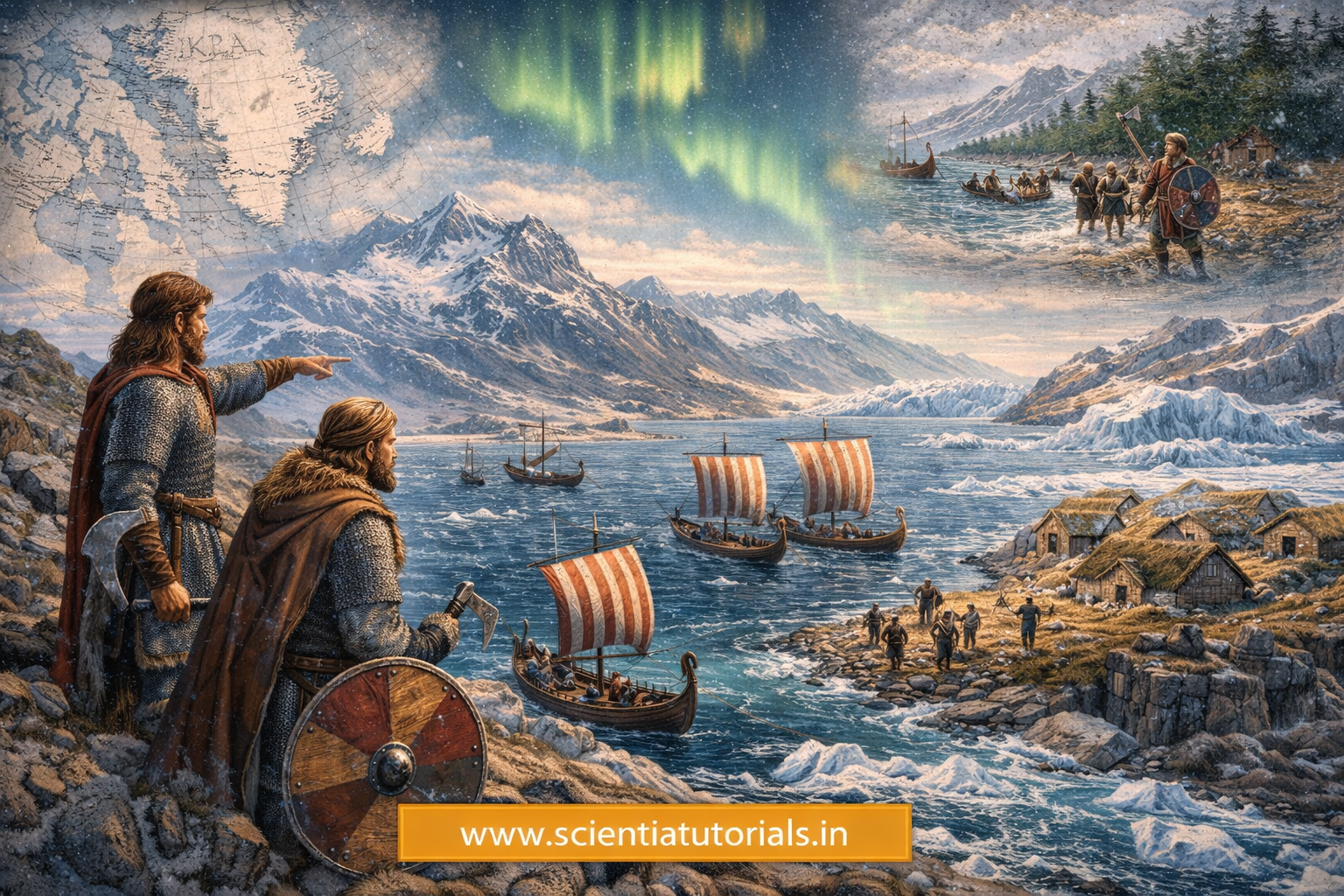
Norse Exploration of the North Atlantic World | Greenland & Viking Expansion
Module 2: Norse Expansion and Medieval Greenland
Lesson: Norse Exploration of the North Atlantic World
Era Framework: c. 10th Century – 15th Century CE
This lesson is systematically organized into four clearly structured sections, as detailed below:
- Chronologically Structured Study Module
- Short-Answer Type Questions
- Long-Answer Type Questions
- Multiple-Choice Questions (MCQs) with Answers and Detailed Explanations
Chronologically Structured Study Module
Introduction: Norse Expansion and the Medieval North Atlantic World
The Norse exploration of the North Atlantic world represents one of the most remarkable episodes of medieval maritime expansion. Between the late 9th century and the 15th century, Scandinavian seafarers extended their reach from continental Europe to the far edges of the Arctic and the North American continent. Greenland emerged as a crucial frontier in this trans-Atlantic network, linking Europe, Iceland, and the western Atlantic in a dynamic system of migration, trade, and cultural exchange.
This lesson situates Greenland within the broader context of Norse expansion, examining how Viking exploration, medieval European dynamics, and environmental conditions shaped the Norse presence in the North Atlantic. The chronological approach allows learners to trace the origins, development, and eventual decline of Norse Greenland while assessing its wider historical significance.
I. Background to Norse Expansion (c. 8th–10th Century CE)
A. Scandinavia and the Viking World
The roots of Norse exploration lay in the social, economic, and political transformations of early medieval Scandinavia. Population growth, limited arable land, and evolving systems of chieftainship encouraged outward expansion.
Key characteristics of the Viking world included:
- Advanced shipbuilding technology, particularly the longship
- A warrior ethos combined with mercantile ambitions
- Strong oral traditions and kin-based social organization
From the late 8th century onward, Norse activity expanded across Europe, affecting the British Isles, the Frankish kingdoms, and the Baltic region.
B. Maritime Technology and Navigation
Norse expansion was made possible by exceptional maritime capabilities. Viking ships were:
- Lightweight and flexible
- Capable of oceanic voyages and river navigation
- Designed for speed, endurance, and cargo transport
Navigation relied on:
- Celestial observation
- Coastal landmarks
- Environmental cues such as bird migration and ocean currents
These innovations enabled Norse sailors to venture far beyond familiar waters.
II. Iceland as a Stepping Stone (c. 870–930 CE)
A. Settlement of Iceland
The settlement of Iceland marked a critical phase in westward Norse expansion. Beginning around 870 CE, settlers—many fleeing political consolidation in Norway—established farming communities across the island.
Key developments included:
- Formation of the Althing (c. 930 CE), one of the world’s earliest assemblies
- Adaptation of European agrarian practices to sub-Arctic conditions
- Development of a distinct Norse-Icelandic cultural identity
Iceland became both a demographic pressure valve and a launching point for further exploration.
B. Exploration Beyond Iceland
As Iceland’s population stabilized, ambitious leaders looked further west. Oral traditions preserved in the sagas recount exploratory voyages motivated by:
- Land scarcity
- Prestige and leadership ambitions
- Reports of land glimpsed beyond the western horizon
III. Discovery and Settlement of Greenland (c. 980–1000 CE)
A. Erik the Red and the Discovery of Greenland
The formal Norse discovery of Greenland is traditionally attributed to Erik the Red, who was exiled from Iceland around 982 CE. Sailing westward, he encountered the southwestern coast of Greenland.
Erik strategically named the land “Greenland” to attract settlers, highlighting its relatively fertile coastal areas.
B. Establishment of Norse Settlements
By c. 985–1000 CE, Norse settlers established two main colonies:
- The Eastern Settlement
- The Western Settlement
These communities practiced:
- Pastoral farming (cattle, sheep, goats)
- Seasonal hunting and fishing
- Limited trade with Europe and Iceland
Greenland became the westernmost extension of medieval European society.
IV. Greenland in the Trans-Atlantic Norse World (c. 1000–1200 CE)
A. Trade and Economic Networks
Greenland’s integration into the Norse world depended heavily on trade. Key exports included:
- Walrus ivory
- Polar bear pelts
- Sealskins and rope
These goods were highly valued in medieval Europe, especially for luxury and ecclesiastical purposes. Greenland relied on imports such as:
- Iron tools
- Timber
- Grain
This economic dependency tied Greenland firmly to the North Atlantic trade network.
B. Christianity and Medieval Institutions
By the early 11th century, Christianity spread to Greenland under Icelandic and Norwegian influence. Key developments included:
- Establishment of churches
- Creation of the Bishopric of Gardar in the 12th century
- Integration into the ecclesiastical hierarchy of medieval Europe
The Christianization of Greenland reinforced cultural continuity with Europe and strengthened political ties with the Norwegian crown.
V. Norse Exploration Beyond Greenland: Vinland (c. 1000–1020 CE)
A. Voyages to North America
Greenland served as the base for further westward exploration. Norse sagas describe voyages to lands known as:
- Helluland (likely Baffin Island)
- Markland (likely Labrador)
- Vinland (likely Newfoundland)
The Vinland voyages represent the earliest known European contact with North America, centuries before Columbus.
B. Significance of Vinland Exploration
Although permanent settlement in Vinland failed, these voyages demonstrate:
- The global reach of Norse maritime networks
- Greenland’s role as a strategic gateway between Europe and the Americas
- Early trans-Atlantic interactions, including contact with Indigenous peoples
VI. Environmental Challenges and Cultural Adaptation (c. 1200–1400 CE)
A. Climate Change and the Little Ice Age
From the late 13th century onward, climatic conditions deteriorated with the onset of the Little Ice Age. Consequences included:
- Shorter growing seasons
- Sea ice blocking trade routes
- Increased livestock mortality
The Norse struggled to adapt their European farming model to increasingly harsh Arctic conditions.
B. Interaction with Indigenous Peoples
The Norse encountered Inuit populations migrating southward. These groups possessed:
- Superior Arctic hunting technologies
- Flexible subsistence strategies
- Deep environmental knowledge
Despite proximity, cultural exchange was limited. The Norse largely failed to adopt Inuit survival techniques, which contributed to their vulnerability.
VII. Decline of Norse Greenland (c. 14th–15th Century CE)
A. Economic Isolation and Political Shifts
By the 14th century:
- Demand for walrus ivory declined
- Norway’s political influence weakened
- Maritime connections became irregular
Greenland’s colonies became increasingly isolated from Europe.
B. Abandonment of the Settlements
By the mid-15th century, Norse settlements had disappeared. Likely causes include:
- Climate deterioration
- Economic collapse
- Inflexible social structures
- Possible conflict or competition with Inuit groups
The disappearance of Norse Greenland remains one of medieval history’s enduring mysteries.
VIII. Historical Significance of Norse North Atlantic Exploration
A. Greenland in World History
The Norse experience in Greenland highlights:
- The limits of medieval European expansion
- The importance of environmental adaptation
- The interconnected nature of the medieval Atlantic world
Greenland was not a peripheral outpost but an active participant in trans-Atlantic networks.
B. Long-Term Global Relevance
The Norse exploration of the North Atlantic:
- Prefigured later European maritime empires
- Demonstrated early globalization processes
- Reinforced Greenland’s enduring strategic importance
These medieval developments laid the historical foundation for Greenland’s modern geopolitical relevance.
Conclusion
The Norse exploration of the North Atlantic world represents a critical chapter in global history, combining technological innovation, environmental challenge, and cultural interaction. Greenland stood at the heart of this expansion, serving as both a frontier of medieval Europe and a bridge to the wider Atlantic world. Through a chronological study of Norse exploration, settlement, and decline, this lesson illustrates how geography, climate, and human decision-making shaped one of history’s most ambitious maritime ventures.
Short Answer Type Questions and Answers
Lesson: Norse Exploration of the North Atlantic World
Era Framework: c. 10th Century – 15th Century CE
1. What factors encouraged Norse expansion beyond Scandinavia?
Answer:
Population pressure, limited arable land, political centralization, and a strong maritime culture encouraged Norse expansion beyond Scandinavia.
2. Why was Iceland important in Norse westward expansion?
Answer:
Iceland served as a settlement base and stepping stone for further exploration toward Greenland and the western Atlantic.
3. Who is credited with the discovery of Greenland?
Answer:
Erik the Red is traditionally credited with discovering Greenland during his exile from Iceland.
4. Why did Erik the Red name the land “Greenland”?
Answer:
He named it “Greenland” to attract settlers by emphasizing its relatively fertile coastal regions.
5. When were the main Norse settlements established in Greenland?
Answer:
The main Norse settlements were established around the late 10th century, c. 985–1000 CE.
6. Name the two major Norse settlements in Greenland.
Answer:
The Eastern Settlement and the Western Settlement.
7. What economic activities sustained Norse Greenland?
Answer:
Pastoral farming, hunting, fishing, and long-distance trade sustained the Norse Greenlandic economy.
8. What was the most valuable export from Norse Greenland?
Answer:
Walrus ivory was the most valuable export from Norse Greenland.
9. How was Greenland connected to medieval Europe?
Answer:
Greenland was connected through maritime trade routes linking it with Iceland, Norway, and other parts of Europe.
10. What role did Christianity play in Norse Greenland?
Answer:
Christianity integrated Greenland into medieval European religious structures through churches and the bishopric.
11. What was the Bishopric of Gardar?
Answer:
It was the ecclesiastical center of Norse Greenland established in the 12th century.
12. What lands were explored west of Greenland by the Norse?
Answer:
The Norse explored Helluland, Markland, and Vinland west of Greenland.
13. Why is Vinland historically significant?
Answer:
Vinland represents the earliest known European contact with North America.
14. What environmental challenge affected Norse Greenland after the 13th century?
Answer:
The onset of the Little Ice Age caused harsher climatic conditions and reduced agricultural productivity.
15. How did climate change affect Greenland’s trade?
Answer:
Increased sea ice made navigation difficult, reducing contact and trade with Europe.
16. Who were the Indigenous peoples encountered by the Norse in Greenland?
Answer:
The Norse encountered Inuit populations migrating southward.
17. Why did Norse Greenland struggle to adapt to Arctic conditions?
Answer:
The Norse relied on European-style farming and failed to fully adopt Inuit survival strategies.
18. What factors led to the decline of Norse Greenland?
Answer:
Climate deterioration, economic isolation, declining trade, and social rigidity contributed to its decline.
19. When did Norse settlements in Greenland disappear?
Answer:
The settlements disappeared by the mid-15th century.
20. How did changing European markets affect Greenland?
Answer:
Declining demand for walrus ivory reduced Greenland’s economic importance.
21. What was Greenland’s role in the Norse trans-Atlantic network?
Answer:
Greenland acted as a bridge linking Europe, Iceland, and North America.
22. Why was maritime technology crucial for Norse expansion?
Answer:
Advanced shipbuilding enabled long-distance ocean voyages and sustained settlement.
23. What does the decline of Norse Greenland reveal about medieval expansion?
Answer:
It reveals the limits of medieval European adaptation in extreme environments.
24. How did Greenland contribute to early globalization?
Answer:
Greenland participated in long-distance trade and cultural exchange across the Atlantic world.
25. Why is Norse exploration of Greenland important in world history?
Answer:
It demonstrates early trans-Atlantic connections and the strategic importance of the Arctic region.
Long Answer Type Questions with Answers
Lesson: Norse Exploration of the North Atlantic World
Era Framework: c. 10th Century – 15th Century CE
1. Examine the causes behind Norse expansion across the North Atlantic world.
Answer:
Norse expansion across the North Atlantic was driven by a combination of demographic, economic, political, and technological factors. Population growth in Scandinavia created pressure on limited agricultural land, while political consolidation pushed many chieftains and farmers to seek opportunities elsewhere. Economic motivations, including access to trade goods and new resources, also played a significant role. Most importantly, advanced maritime technology—especially the longship—enabled Norse seafarers to undertake long-distance oceanic voyages. Together, these factors facilitated the Norse movement from Scandinavia to Iceland, Greenland, and beyond.
2. Discuss the role of Iceland as a stepping stone in Norse westward expansion.
Answer:
Iceland played a crucial intermediary role in Norse westward expansion. Settled from the late 9th century, it provided arable land, social stability, and a base for further exploration. Iceland’s geographic position allowed Norse sailors to extend their maritime routes into the western Atlantic. Politically, Icelandic society encouraged independent leadership and exploration. Economically and culturally, Iceland acted as the bridge between Scandinavia and Greenland, making it essential to the broader North Atlantic network.
3. Analyse the discovery and settlement of Greenland in the context of Norse expansion.
Answer:
Greenland’s discovery around 982 CE marked the westernmost extension of medieval European settlement. The island was settled primarily along its southwestern coast, where climatic conditions allowed limited agriculture. Settlement was part of a broader Norse expansion strategy that combined exploration, colonization, and trade. Greenland was not merely a frontier but an integrated component of the Norse Atlantic world, dependent on trade with Iceland and Europe while exporting valuable Arctic resources.
4. Assess the historical significance of Erik the Red in Norse exploration.
Answer:
Erik the Red was instrumental in transforming Greenland from an unknown land into a settled Norse colony. His leadership, promotional skills, and organizational role enabled large-scale migration from Iceland. By naming the land “Greenland,” he strategically encouraged settlement. Erik’s actions illustrate how individual leadership and ambition contributed to the success of Norse expansion during the medieval period.
5. Describe the settlement pattern and economic life of Norse Greenland.
Answer:
Norse Greenland consisted mainly of two settlements—the Eastern and Western Settlements. The economy was based on pastoral farming, supplemented by hunting and fishing. However, agriculture alone was insufficient; long-distance trade was essential. Exports such as walrus ivory and animal pelts connected Greenland to European markets, while imports like iron and timber were vital for survival. This economic model made Greenland heavily dependent on external trade networks.
6. Explain the importance of trade in sustaining Norse Greenland.
Answer:
Trade was the backbone of Norse Greenland’s survival. Walrus ivory, highly valued in medieval Europe, served as Greenland’s principal export. Through trade, Greenland remained integrated into European economic systems. However, this dependence also created vulnerability, as shifts in European demand or disruptions in maritime routes directly affected Greenland’s stability.
7. Analyse the role of Christianity and medieval institutions in Greenland.
Answer:
Christianity strengthened Greenland’s ties to medieval Europe by integrating it into the ecclesiastical structure of the Norse world. The establishment of churches and a bishopric symbolized political legitimacy and cultural continuity. These institutions reinforced European identity in Greenland but also tied it more closely to distant authorities, increasing dependence on external support.
8. Discuss Greenland’s role in Norse exploration of North America.
Answer:
Greenland served as the base for Norse voyages to North America, including regions known as Helluland, Markland, and Vinland. These explorations demonstrate the extraordinary reach of Norse maritime networks. Although permanent settlement failed, these voyages represent the earliest known European contact with the Americas and highlight Greenland’s strategic position in trans-Atlantic exploration.
9. Why did permanent Norse settlement fail in Vinland?
Answer:
Permanent settlement in Vinland failed due to a combination of hostile relations with Indigenous peoples, logistical difficulties, and limited economic incentives. Vinland lacked the high-value resources, such as walrus ivory, that justified Greenland’s survival. The distance from core Norse settlements also made sustained occupation impractical.
10. Examine the environmental challenges faced by Norse Greenland.
Answer:
Greenland’s harsh Arctic environment posed constant challenges, including short growing seasons, limited arable land, and dependence on imported resources. From the 13th century onward, climate deterioration intensified these difficulties, making farming and trade increasingly unreliable.
11. Assess the impact of the Little Ice Age on Norse Greenland.
Answer:
The onset of the Little Ice Age led to colder temperatures, increased sea ice, and declining agricultural productivity. Trade routes became hazardous, reducing contact with Europe. These environmental pressures severely weakened the Norse economy and accelerated the decline of Greenlandic settlements.
12. Compare Norse and Inuit adaptation strategies in Greenland.
Answer:
The Inuit relied on flexible hunting-based subsistence strategies suited to Arctic conditions, while the Norse depended on European-style pastoral farming. The Norse were slow to adopt Inuit technologies such as advanced hunting tools and clothing, which limited their ability to adapt. This contrast highlights the importance of environmental adaptation for survival.
13. Analyse Norse–Indigenous interactions in medieval Greenland.
Answer:
Interactions between Norse settlers and Inuit groups were limited and often marked by tension. Cultural barriers and competing resource use prevented meaningful cooperation. The Norse failure to integrate Indigenous knowledge contributed to their vulnerability in the Arctic environment.
14. Discuss the economic reasons for the decline of Norse Greenland.
Answer:
Declining European demand for walrus ivory, combined with reduced trade connections, undermined Greenland’s economy. As trade became irregular, essential imports became scarce, weakening settlement sustainability.
15. Examine the political factors contributing to Greenland’s isolation.
Answer:
Greenland’s political ties to Norway weakened as Scandinavian priorities shifted. Reduced royal attention and declining maritime capacity left Greenland increasingly isolated, exacerbating economic and social decline.
16. Why did Norse Greenland fail to survive beyond the 15th century?
Answer:
Norse Greenland failed due to a combination of climatic deterioration, economic collapse, political isolation, and cultural inflexibility. The inability to adapt to changing environmental and economic conditions proved decisive.
17. Evaluate Greenland’s importance in the medieval North Atlantic world.
Answer:
Greenland was a critical node in the Norse Atlantic network, linking Europe, Iceland, and North America. It demonstrates how even remote regions could play central roles in medieval globalization.
18. What does the decline of Norse Greenland reveal about medieval expansion?
Answer:
The decline reveals the limits of medieval European expansion, especially in extreme environments. Success depended not only on exploration and technology but also on adaptability and sustainable economic models.
19. Analyse Norse exploration as an early form of globalization.
Answer:
Norse exploration connected distant regions through trade, migration, and cultural exchange. Greenland’s integration into European markets exemplifies early globalization processes operating across the Atlantic world.
20. Assess the long-term historical significance of Norse exploration of the North Atlantic.
Answer:
Norse exploration reshaped medieval world history by expanding European horizons and establishing trans-Atlantic connections. Greenland’s role underscores the enduring strategic importance of the Arctic and foreshadows later phases of European global expansion.
MCQs with Answers and Explanations
Lesson: Norse Exploration of the North Atlantic World
Era Framework: c. 10th Century – 15th Century CE
1. Which factor most directly enabled Norse expansion across the North Atlantic?
A. Development of gunpowder
B. Advanced maritime technology
C. Growth of urban centers
D. Spread of feudalism
Correct Answer: B
Explanation:
Norse expansion depended primarily on advanced shipbuilding and navigation skills. Viking longships allowed long-distance ocean travel and coastal exploration, making trans-Atlantic voyages possible.
2. Which region served as the primary stepping stone for Norse expansion toward Greenland?
A. Ireland
B. Scotland
C. Iceland
D. Faroe Islands
Correct Answer: C
Explanation:
Iceland provided land, population base, and strategic location, enabling Norse explorers to move further west toward Greenland and beyond.
3. Who is traditionally credited with the discovery of Greenland?
A. Leif Erikson
B. Harald Fairhair
C. Erik the Red
D. Olaf Tryggvason
Correct Answer: C
Explanation:
Erik the Red discovered Greenland during his exile from Iceland and later led settlers to establish Norse colonies there.
4. Why was the name “Greenland” chosen?
A. It reflected dense forests
B. It described the island’s climate
C. It was a religious reference
D. It was meant to attract settlers
Correct Answer: D
Explanation:
The name “Greenland” was deliberately chosen to encourage settlement by emphasizing the island’s relatively habitable coastal regions.
5. When were the main Norse settlements in Greenland established?
A. c. 800–850 CE
B. c. 900–930 CE
C. c. 985–1000 CE
D. c. 1050–1100 CE
Correct Answer: C
Explanation:
Norse settlement began around 985 CE following Erik the Red’s return to Iceland and recruitment of settlers.
6. Which were the two principal Norse settlements in Greenland?
A. Northern and Southern Settlements
B. Coastal and Inland Settlements
C. Eastern and Western Settlements
D. Icelandic and Norwegian Settlements
Correct Answer: C
Explanation:
The Eastern and Western Settlements formed the core of Norse Greenlandic society.
7. What was the main economic base of Norse Greenland?
A. Mining
B. Pastoral farming and trade
C. Large-scale fishing industry
D. Urban craftsmanship
Correct Answer: B
Explanation:
Norse Greenland relied on livestock farming supplemented by hunting and trade with Europe.
8. Which commodity was most valuable in Greenland’s trade with Europe?
A. Timber
B. Grain
C. Iron
D. Walrus ivory
Correct Answer: D
Explanation:
Walrus ivory was highly prized in medieval Europe and formed the backbone of Greenland’s export economy.
9. Why was Greenland heavily dependent on external trade?
A. It lacked political autonomy
B. It had no maritime technology
C. It lacked essential resources like iron and timber
D. It was isolated by law
Correct Answer: C
Explanation:
Greenland lacked key materials such as iron and wood, making imports vital for survival.
10. How did Christianity influence Norse Greenland?
A. It weakened local leadership
B. It isolated Greenland culturally
C. It integrated Greenland into medieval Europe
D. It replaced farming with trade
Correct Answer: C
Explanation:
Christian institutions connected Greenland to European religious and political systems, strengthening cultural ties.
11. What was the Bishopric of Gardar?
A. A Viking fortress
B. A trading hub
C. An ecclesiastical center
D. A military outpost
Correct Answer: C
Explanation:
The Bishopric of Gardar symbolized Greenland’s integration into the medieval Christian world.
12. Greenland served as a base for Norse voyages to which regions?
A. West Africa
B. Mediterranean Europe
C. North America
D. Central Asia
Correct Answer: C
Explanation:
From Greenland, Norse explorers reached Helluland, Markland, and Vinland in North America.
13. Vinland is historically significant because it represents:
A. The first Asian settlement in Europe
B. Permanent Norse colonization of America
C. Earliest known European contact with North America
D. A major medieval trading empire
Correct Answer: C
Explanation:
Vinland marks the earliest recorded European contact with North America, centuries before Columbus.
14. Why did Norse settlements in Vinland fail to endure?
A. Religious conflicts
B. Lack of arable land
C. Hostility, distance, and limited economic gain
D. European political bans
Correct Answer: C
Explanation:
Conflict with Indigenous peoples and logistical challenges made long-term settlement unsustainable.
15. Which environmental change most affected Norse Greenland after the 13th century?
A. Volcanic eruptions
B. Desertification
C. The Little Ice Age
D. Earthquakes
Correct Answer: C
Explanation:
The Little Ice Age caused colder temperatures, reducing agriculture and increasing sea ice.
16. How did climate deterioration affect Greenland’s trade?
A. It increased trade volume
B. It shifted trade to Asia
C. It made sea routes more dangerous
D. It improved navigation
Correct Answer: C
Explanation:
Expanded sea ice made maritime travel hazardous, reducing contact with Europe.
17. Which Indigenous group lived in Greenland during Norse settlement?
A. Sami
B. Inuit
C. Aleut
D. Algonquin
Correct Answer: B
Explanation:
The Inuit were Arctic-adapted Indigenous peoples who migrated into Greenland during this period.
18. Why did Norse settlers struggle to survive compared to the Inuit?
A. Lack of weapons
B. Religious restrictions
C. Failure to adapt subsistence strategies
D. Absence of leadership
Correct Answer: C
Explanation:
The Norse relied on European farming methods rather than adopting Inuit hunting-based adaptations.
19. Which factor weakened Greenland’s economy in the late medieval period?
A. Increased piracy
B. Decline in walrus ivory demand
C. Overpopulation
D. Expansion of cities
Correct Answer: B
Explanation:
As walrus ivory lost value in European markets, Greenland’s primary export declined.
20. By when had Norse settlements in Greenland disappeared?
A. 12th century
B. Early 13th century
C. Mid-15th century
D. Early 16th century
Correct Answer: C
Explanation:
Archaeological and documentary evidence suggests abandonment by the mid-1400s.
21. Which political factor contributed to Greenland’s isolation?
A. Strong royal control
B. Decline of Norwegian influence
C. Papal sanctions
D. Expansion of Icelandic power
Correct Answer: B
Explanation:
Weakened Norwegian authority reduced political and economic support for Greenland.
22. What does the decline of Norse Greenland illustrate?
A. Failure of maritime technology
B. Limits of medieval environmental adaptation
C. Superiority of urban economies
D. Inevitability of colonial success
Correct Answer: B
Explanation:
The Norse struggled to adapt socially and economically to Arctic conditions.
23. Greenland’s role in the medieval Atlantic world can best be described as:
A. Isolated and irrelevant
B. Militarily dominant
C. A strategic trans-Atlantic node
D. A religious center only
Correct Answer: C
Explanation:
Greenland connected Europe, Iceland, and North America within Norse maritime networks.
24. Norse exploration is considered an early form of globalization because it:
A. Established empires
B. Connected distant regions through trade and migration
C. Created industrial economies
D. Spread democracy
Correct Answer: B
Explanation:
Norse networks linked far-flung regions long before modern globalization.
25. Why is Norse exploration of the North Atlantic historically important?
A. It ended Viking culture
B. It established modern Arctic states
C. It expanded medieval European geographical knowledge
D. It caused the Crusades
Correct Answer: C
Explanation:
Norse exploration broadened medieval understanding of the world and laid foundations for later trans-Atlantic expansion.