
Settlement of Greenland by the Norse
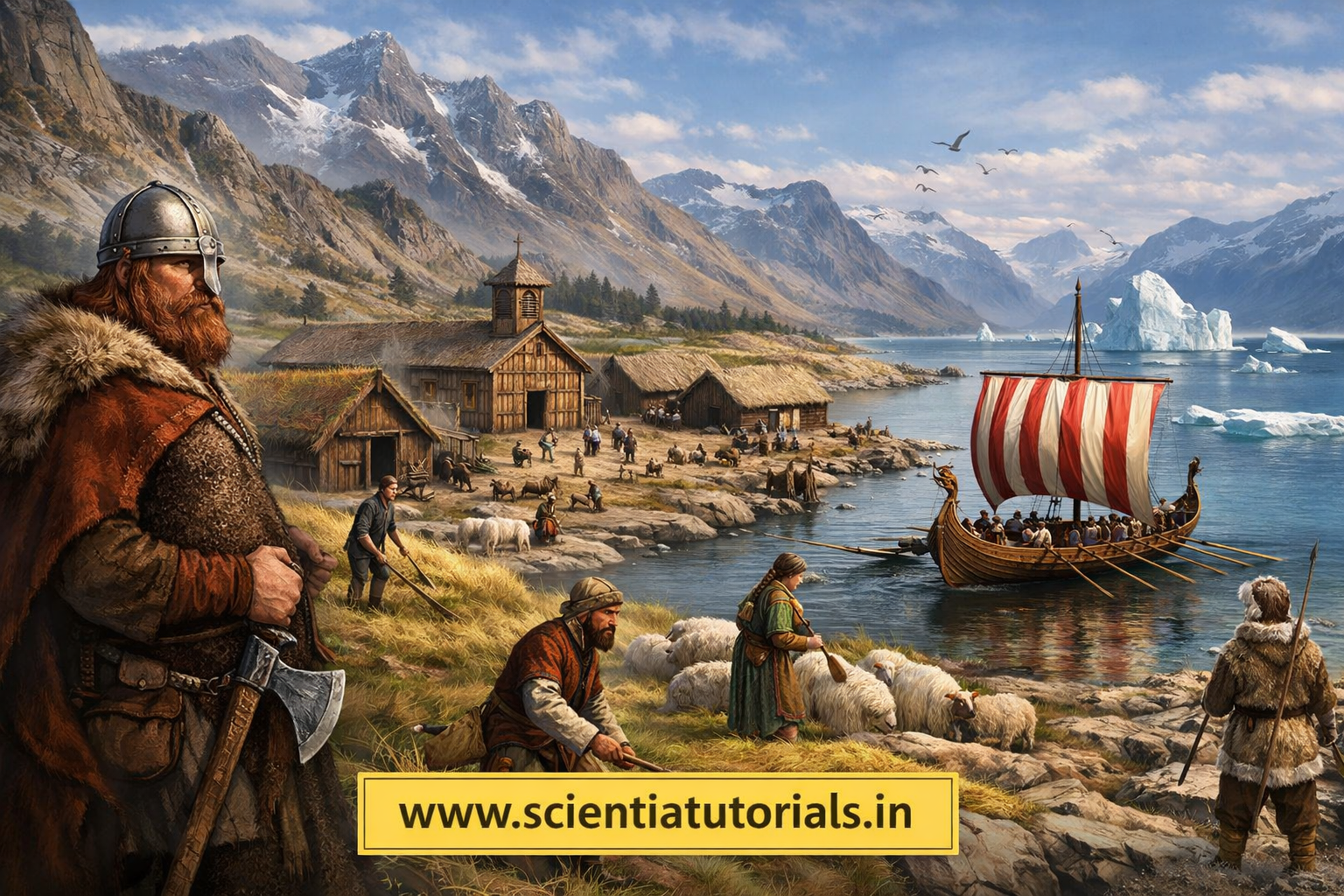
Norse Settlement of Greenland: Viking Expansion in the Medieval Arctic
Module 2: Norse Expansion and Medieval Greenland
Lesson: Settlement of Greenland by the Norse
Era Framework: c. 10th Century – 15th Century
(Viking Expansion, Medieval Europe, Trans-Atlantic Contacts)
This lesson is systematically organized into four clearly structured sections, as detailed below:
- Chronologically Structured Study Module
- Short-Answer Type Questions
- Long-Answer Type Questions
- Multiple-Choice Questions (MCQs) with Answers and Detailed Explanations
Chronologically Structured Study Module
Introduction: Greenland within the Age of Viking Expansion
The settlement of Greenland by the Norse represents one of the most remarkable episodes of medieval trans-Atlantic expansion. Occurring during the wider era of Viking exploration and European medieval growth, Norse Greenland was both a product of Scandinavian maritime culture and a frontier experiment at the edge of the known European world. From its establishment in the late tenth century to its decline by the fifteenth century, Norse Greenland reflected the interaction of environment, economy, religion, and global connectivity.
This lesson examines how Norse settlers arrived in Greenland, how their colonies were organized, how they sustained themselves in a harsh Arctic environment, and why these settlements ultimately disappeared. Chronologically structured, the study situates Norse Greenland within broader medieval developments such as Christianization, European trade networks, and climatic change.
I. Background to Norse Expansion (c. 8th – 10th Century)
The Viking Age and Scandinavian Mobility
The Viking Age (c. 8th–11th centuries) was characterized by large-scale Scandinavian expansion across Europe and beyond. Norse seafarers, commonly known as Vikings, developed advanced shipbuilding techniques, especially the longship, which allowed rapid travel across open seas and shallow rivers. Their activities included raiding, trading, exploration, and settlement.
Scandinavian societies were driven by multiple factors: population pressure, political consolidation in Scandinavia, the search for arable land, and access to trade goods such as furs, walrus ivory, and silver. This outward movement laid the foundations for Norse settlements in the British Isles, Iceland, and eventually Greenland.
Iceland as a Stepping Stone
The settlement of Iceland in the late ninth century became a crucial intermediary stage in the Norse westward expansion. Iceland provided valuable experience in colonizing marginal environments with limited agricultural potential. It also served as a launching point for further exploration westward into the North Atlantic.
II. Discovery of Greenland (Late 10th Century)
Erik the Red and the Naming of Greenland
Greenland’s Norse settlement began with the exile of Erik the Red, a Norwegian-born Icelander banished from Iceland around 982 CE due to violent disputes. During his exile, Erik sailed west and explored the coasts of Greenland, an island previously sighted but not settled permanently by Norse explorers.
Upon returning to Iceland after his exile, Erik promoted Greenland as a desirable land for settlement, famously naming it “Green Land” to attract colonists. This strategic naming highlights the importance of perception and recruitment in medieval colonization.
Initial Migration (c. 985–986 CE)
Around 985–986 CE, Erik the Red led a fleet of approximately 25 ships from Iceland to Greenland. Only about 14 ships successfully completed the journey, underscoring the dangers of North Atlantic navigation. These settlers formed the nucleus of Norse Greenlandic society.
III. Establishment of Norse Settlements (Late 10th – Early 11th Century)
Eastern Settlement and Western Settlement
The Norse established two main colonies:
- Eastern Settlement (near modern southern Greenland): The larger and more prosperous colony, hosting the majority of the population.
- Western Settlement (farther north): Smaller and more vulnerable to environmental stress.
These settlements were located in fjord regions with relatively mild microclimates, short growing seasons, and access to grazing land.
Social and Political Organization
Norse Greenland replicated Scandinavian social structures. Settlements consisted of individual farmsteads rather than towns. Society was hierarchical, dominated by chieftains who controlled land and resources. Law and order were maintained through assemblies (things), similar to those in Iceland.
Despite geographic isolation, Norse Greenland maintained strong cultural ties with Iceland and Norway.
IV. Economic Foundations of Norse Greenland
Agriculture and Animal Husbandry
The Norse economy in Greenland relied on mixed subsistence strategies:
- Cattle, sheep, and goats formed the backbone of agriculture.
- Hay production during summer was essential for winter survival.
- Limited barley cultivation existed but was marginal.
Hunting and Trade
Due to environmental constraints, hunting played a critical role. Norse Greenlanders hunted seals, caribou, and especially walrus. Walrus ivory became Greenland’s most valuable export, highly prized in medieval Europe for luxury items and ecclesiastical artifacts.
Greenland was integrated into medieval European trade networks, exporting ivory, furs, and hides in exchange for iron, timber, grain, and luxury goods.
V. Christianity and Cultural Transformation (11th – 12th Century)
Christianization of Norse Greenland
Following broader Scandinavian trends, Norse Greenland adopted Christianity in the early eleventh century. Churches were constructed, including the famous cathedral at Garðar in the Eastern Settlement. The establishment of a bishopric linked Greenland formally to the Roman Catholic Church and medieval Christendom.
Christian institutions reinforced European cultural identity and legitimized Norse presence in Greenland as part of a Christian world order.
Literacy and Historical Memory
Written sources about Norse Greenland come primarily from Icelandic sagas, church records, and later European accounts. These texts provide valuable but sometimes romanticized insights into daily life and exploration.
VI. Greenland and Trans-Atlantic Contacts
Exploration Beyond Greenland
Norse Greenland served as a base for further exploration westward. Expeditions reached regions referred to as Helluland, Markland, and Vinland—generally associated with parts of modern Arctic Canada and Newfoundland.
Although Vinland did not result in permanent settlement, these voyages demonstrate Greenland’s role as a trans-Atlantic hub in medieval exploration.
Relations with Indigenous Peoples
The Norse encountered Indigenous Arctic peoples, often referred to in Norse sources as the Skrælings (ancestors of the Inuit). Interaction included limited trade, competition for resources, and occasional conflict. Cultural misunderstandings and demographic imbalance prevented long-term coexistence.
VII. Environmental Challenges and Climatic Change (13th – 14th Century)
The Medieval Warm Period to the Little Ice Age
Norse settlement coincided with the Medieval Warm Period, which allowed marginal farming in southern Greenland. However, from the thirteenth century onward, the onset of cooler conditions associated with the Little Ice Age reduced agricultural productivity.
Longer winters, shorter summers, and increased sea ice made farming, hunting, and navigation increasingly difficult.
Ecological Vulnerability
Overgrazing and deforestation further strained fragile ecosystems. Soil erosion reduced hay yields, while declining walrus populations affected trade.
VIII. Decline of Norse Greenland (14th – 15th Century)
Economic Isolation
By the fourteenth century, Greenland became increasingly isolated. European demand for walrus ivory declined due to alternative sources such as elephant ivory. Trade ships from Norway became less frequent, reducing access to essential imports.
Demographic and Social Stress
The Western Settlement disappeared by the mid-fourteenth century, likely due to a combination of climate stress, emigration, and conflict. The Eastern Settlement survived longer but showed signs of decline, including reduced church activity and abandoned farms.
Final Disappearance
By the fifteenth century, Norse Greenland vanished from historical records. The exact causes remain debated, but scholars agree that environmental change, economic isolation, rigid cultural practices, and failure to adapt to Inuit subsistence strategies played decisive roles.
IX. Historical Significance of Norse Settlement in Greenland
Greenland as a Medieval Frontier
Norse Greenland represents one of the outermost frontiers of medieval European civilization. Its history illustrates both the strengths and limitations of Viking expansion.
Lessons in Adaptation and Resilience
The Norse experience highlights the importance of environmental adaptation in sustaining human societies. Their reluctance to adopt Inuit technologies such as kayaks and harpoons contributed to their vulnerability.
Greenland in World History
The settlement and decline of Norse Greenland connect local Arctic history with global medieval processes: European expansion, Christianization, climate change, and early globalization.
Conclusion
The settlement of Greenland by the Norse between the tenth and fifteenth centuries stands as a powerful example of medieval exploration and human resilience at the edge of habitability. Founded during the height of Viking expansion, Norse Greenland thrived for centuries through agriculture, trade, and strong cultural ties to Europe. Yet, environmental shifts, economic isolation, and limited adaptability eventually led to its disappearance.
For students of world history, Norse Greenland offers critical insights into how societies interact with climate, economy, and global networks—making it a foundational case study in understanding the historical evolution and strategic significance of Greenland.
Short Answer Type Questions with Answers
(Norse Settlement of Greenland)
1. Who led the first permanent Norse settlement of Greenland?
Answer: The first permanent Norse settlement of Greenland was led by Erik the Red around 985–986 CE after his exile from Iceland.
2. Why was Greenland named “Green Land” by the Norse?
Answer: Greenland was named “Green Land” to attract settlers by presenting it as fertile and appealing, despite its harsh climate.
3. From where did the Norse settlers migrate to Greenland?
Answer: The Norse settlers migrated mainly from Iceland, with earlier roots in Norway.
4. Name the two main Norse settlements in Greenland.
Answer: The two main Norse settlements were the Eastern Settlement and the Western Settlement.
5. Which settlement was larger and more prosperous?
Answer: The Eastern Settlement was larger, more populated, and economically stronger than the Western Settlement.
6. What type of society did the Norse establish in Greenland?
Answer: The Norse established a rural, farm-based society organized around chieftains and small agricultural communities.
7. What were the main economic activities of the Norse Greenlanders?
Answer: Their main economic activities included animal husbandry, limited farming, hunting, and trade.
8. Which animal product was Greenland’s most valuable export?
Answer: Walrus ivory was Greenland’s most valuable export and was highly demanded in medieval Europe.
9. Why was agriculture difficult in Greenland?
Answer: Agriculture was difficult due to a short growing season, cold climate, poor soil, and long winters.
10. What role did hunting play in Norse Greenland?
Answer: Hunting supplemented agriculture and provided meat, hides, and trade goods, especially from seals and walruses.
11. How was Norse Greenland connected to medieval Europe?
Answer: Norse Greenland was connected through trade networks and the Christian Church, particularly via Iceland and Norway.
12. When did Christianity reach Greenland?
Answer: Christianity reached Greenland in the early 11th century.
13. What was Garðar known for in medieval Greenland?
Answer: Garðar was the religious center of Greenland and the seat of the bishopric.
14. What sources provide information about Norse Greenland?
Answer: Icelandic sagas, church records, and later European accounts provide information about Norse Greenland.
15. Name the lands explored west of Greenland by the Norse.
Answer: The Norse explored Helluland, Markland, and Vinland west of Greenland.
16. Who were the “Skrælings” mentioned in Norse sources?
Answer: The “Skrælings” were Indigenous Arctic peoples, ancestors of the Inuit.
17. How did the Norse interact with Indigenous peoples?
Answer: Interaction included limited trade, competition for resources, and occasional conflict.
18. What climatic phase supported early Norse settlement?
Answer: The Medieval Warm Period supported early Norse settlement by allowing limited farming.
19. What climatic change affected Greenland after the 13th century?
Answer: The onset of the Little Ice Age brought colder conditions and environmental stress.
20. How did climate change affect Norse agriculture?
Answer: Cooler temperatures shortened growing seasons, reduced hay production, and increased livestock mortality.
21. Why did trade with Europe decline over time?
Answer: Trade declined due to reduced demand for walrus ivory and fewer ships reaching Greenland.
22. When did the Western Settlement disappear?
Answer: The Western Settlement disappeared by the mid-14th century.
23. What factors contributed to the decline of Norse Greenland?
Answer: Climate change, economic isolation, environmental degradation, and cultural rigidity contributed to decline.
24. Why did the Norse struggle to adapt to Arctic conditions?
Answer: They largely retained European farming practices and did not fully adopt Inuit survival technologies.
25. When did Norse Greenland disappear from historical records?
Answer: Norse Greenland disappeared from historical records by the 15th century.
26. What does Norse Greenland represent in medieval history?
Answer: It represents the westernmost frontier of medieval European expansion.
27. Why is Norse Greenland significant in world history?
Answer: It highlights early trans-Atlantic contact, climate–society interaction, and limits of medieval expansion.
28. What lesson does the Norse experience in Greenland provide?
Answer: It demonstrates the importance of environmental adaptation and flexible economic strategies for survival.
29. How did religion strengthen European identity in Greenland?
Answer: Christianity connected Greenland culturally and institutionally to medieval Europe.
30. Why is Norse Greenland studied today?
Answer: It is studied to understand climate change, human resilience, and early globalization processes.
Long Answer Type Questions with Answers
(Norse Settlement of Greenland)
1. Examine the historical background of Norse expansion that led to the settlement of Greenland.
Answer:
The settlement of Greenland was part of the wider Viking Age expansion that began in Scandinavia around the eighth century. Population pressure, political consolidation in Norway, and the search for new land and trade opportunities encouraged Norse migration. Advanced shipbuilding and navigation enabled long-distance sea travel. Iceland, settled in the late ninth century, became a crucial stepping stone, providing experience in colonizing marginal lands. From Iceland, Norse explorers moved further west, ultimately leading to the discovery and settlement of Greenland in the late tenth century.
2. Discuss the role of Erik the Red in the settlement of Greenland.
Answer:
Erik the Red played a decisive role in the settlement of Greenland. Exiled from Iceland due to violent disputes, he explored Greenland’s coastline during the 980s CE. Recognizing its settlement potential, he later returned to Iceland and promoted Greenland as a fertile land to attract settlers. Around 985–986 CE, he led a migration of Norse families to Greenland, establishing the first permanent colonies. His leadership and promotional strategy laid the foundation for Norse Greenlandic society.
3. Analyze the significance of Greenland’s geographic location for Norse settlement.
Answer:
Greenland’s location in the North Atlantic made it both isolated and strategically significant. While its harsh climate posed challenges, its fjords provided sheltered harbors and limited grazing land. Greenland also functioned as a bridge between Europe and North America, facilitating exploration toward Vinland. However, its remoteness made trade and communication dependent on long sea routes, increasing vulnerability to climatic and economic disruptions.
4. Describe the establishment and structure of the Eastern and Western Settlements.
Answer:
The Norse established two primary settlements: the Eastern Settlement and the Western Settlement. The Eastern Settlement, located in southern Greenland, was larger, more fertile, and economically stronger. It contained most of the population, farms, churches, and the bishopric. The Western Settlement, farther north, was smaller and more environmentally vulnerable. Both settlements consisted of dispersed farmsteads rather than urban centers, reflecting Norse rural traditions.
5. Explain the social and political organization of Norse Greenland.
Answer:
Norse Greenland followed Scandinavian social structures. Society was organized around chieftains who controlled land and resources. Farmsteads were the basic unit of settlement, and law was maintained through assemblies similar to Icelandic “things.” Despite Greenland’s isolation, political authority and legal traditions reflected European norms, reinforcing cultural continuity with Iceland and Norway.
6. Assess the economic foundations of Norse Greenland.
Answer:
The economy of Norse Greenland was based on mixed subsistence. Animal husbandry, particularly cattle, sheep, and goats, formed the core of agriculture. Hay production was vital for winter survival. Hunting supplemented farming, providing meat and valuable trade goods. Trade with Europe, especially in walrus ivory, connected Greenland to medieval markets and sustained its economy.
7. Why was walrus ivory crucial to Greenland’s survival in the medieval period?
Answer:
Walrus ivory was Greenland’s most valuable export and a key link to European trade networks. It was highly prized for luxury items and religious artifacts. Ivory trade enabled Greenlanders to import essential goods such as iron, timber, and grain, which were unavailable locally. The decline of ivory demand significantly weakened Greenland’s economy.
8. Discuss the impact of Christianity on Norse Greenlandic society.
Answer:
Christianity reached Greenland in the early eleventh century, integrating it into medieval Christendom. Churches were built, and a bishopric was established at Garðar. Christian institutions reinforced European cultural identity, literacy, and connections with Norway and Rome. Religion also legitimized Norse settlement and strengthened social cohesion.
9. Examine the role of Greenland in Norse trans-Atlantic exploration.
Answer:
Greenland served as a base for further exploration westward. From Greenland, Norse explorers reached Helluland, Markland, and Vinland. Although permanent settlement in Vinland failed, these voyages demonstrate Greenland’s role as a gateway to North America and an early center of trans-Atlantic contact.
10. Analyze Norse interactions with Indigenous Arctic peoples.
Answer:
The Norse encountered Indigenous peoples, referred to as Skrælings in Norse sources, who were ancestors of the Inuit. Interactions included limited trade, competition for resources, and occasional conflict. Cultural differences and demographic imbalance prevented sustained cooperation, contributing to Norse vulnerability in the Arctic environment.
11. How did environmental conditions initially support Norse settlement?
Answer:
The early phase of settlement coincided with the Medieval Warm Period, which brought relatively mild temperatures. This allowed limited farming and grazing in southern Greenland. Reduced sea ice also facilitated navigation and trade, supporting the growth of Norse colonies during their initial centuries.
12. Explain the impact of the Little Ice Age on Norse Greenland.
Answer:
From the thirteenth century onward, the onset of the Little Ice Age brought colder temperatures, longer winters, and increased sea ice. Agricultural productivity declined, livestock mortality increased, and sea travel became more dangerous. These changes undermined the economic and social foundations of Norse Greenland.
13. Evaluate the ecological challenges faced by Norse settlers.
Answer:
Greenland’s fragile environment was vulnerable to overgrazing and deforestation. Soil erosion reduced hay yields, while reliance on limited resources intensified ecological stress. Combined with climatic cooling, environmental degradation weakened the sustainability of Norse settlement.
14. Discuss the reasons for the decline of trade with Europe.
Answer:
Trade declined due to changing European markets, particularly reduced demand for walrus ivory, and increased difficulty of sea travel. Fewer ships from Norway reached Greenland, leading to shortages of essential imports. Economic isolation intensified Greenland’s decline.
15. Analyze the disappearance of the Western Settlement.
Answer:
The Western Settlement disappeared by the mid-fourteenth century. Likely causes include harsher climate, reduced trade, declining population, and possible conflict with Indigenous groups. Its location made it more vulnerable to environmental stress than the Eastern Settlement.
16. Why did the Eastern Settlement survive longer than the Western Settlement?
Answer:
The Eastern Settlement benefited from a milder climate, better grazing land, and stronger trade and religious institutions. These advantages allowed it to survive longer, though it eventually faced similar challenges leading to decline.
17. Examine cultural rigidity as a factor in Norse decline.
Answer:
The Norse largely retained European farming practices and social norms. Their limited adoption of Inuit technologies such as kayaks, harpoons, and fur clothing reduced their ability to adapt to Arctic conditions. Cultural rigidity hindered long-term survival.
18. Discuss demographic challenges in medieval Greenland.
Answer:
Greenland’s small population made it vulnerable to disease, emigration, and labor shortages. As conditions worsened, younger generations likely migrated back to Iceland or Norway, accelerating demographic decline.
19. What evidence exists for the final disappearance of Norse Greenland?
Answer:
By the fifteenth century, church records and European accounts cease to mention Greenland. Archaeological evidence shows abandoned farms and declining material culture, indicating gradual rather than sudden collapse.
20. Evaluate the historical significance of Norse Greenland in world history.
Answer:
Norse Greenland represents the westernmost frontier of medieval Europe. It illustrates early trans-Atlantic exploration, climate-society interaction, and the limits of expansion. Its history connects Arctic regions to global medieval processes.
21. How does Norse Greenland contribute to understanding climate change and human adaptation?
Answer:
The rise and fall of Norse Greenland highlight how climate change can affect human societies. The inability to adapt economically and culturally to environmental shifts offers lessons relevant to modern climate challenges.
22. Compare Norse subsistence strategies with Inuit practices.
Answer:
While the Norse relied on farming and livestock, Inuit societies emphasized hunting and marine resources. Inuit technologies were better suited to Arctic conditions, giving them greater resilience compared to Norse settlers.
23. Assess Greenland’s role in medieval European imagination.
Answer:
Greenland symbolized both opportunity and isolation in medieval Europe. It was viewed as a distant frontier rich in exotic resources, reinforcing Europe’s expanding worldview during the Middle Ages.
24. Why is Norse Greenland considered an early experiment in globalization?
Answer:
Through trade, religion, and exploration, Greenland was connected to Europe despite extreme distance. These links demonstrate early forms of global interaction and economic integration.
25. Conclude with an assessment of why Norse Greenland ultimately failed.
Answer:
Norse Greenland failed due to a combination of climatic cooling, economic isolation, ecological stress, demographic decline, and cultural rigidity. Its history demonstrates that successful expansion requires adaptability to environmental and social conditions.
Multiple Choice Questions (MCQs) with Answers and Explanations
(Norse Settlement of Greenland)
1. Who is credited with leading the first permanent Norse settlement of Greenland?
A. Leif Erikson
B. Harald Fairhair
C. Erik the Red
D. Olaf Tryggvason
Correct Answer: C
Explanation:
Erik the Red led the first permanent Norse settlement of Greenland around 985–986 CE after his exile from Iceland. He explored the region and later encouraged colonization.
2. The Norse settlement of Greenland began during which broader historical phase?
A. Roman Imperial Expansion
B. Early Modern Exploration
C. Viking Age Expansion
D. Industrial Revolution
Correct Answer: C
Explanation:
The Norse settlement of Greenland was part of the Viking Age (c. 8th–11th centuries), marked by Scandinavian exploration, trade, and colonization across the North Atlantic.
3. From which region did most Greenland settlers originate?
A. Denmark
B. Sweden
C. Norway directly
D. Iceland
Correct Answer: D
Explanation:
Most settlers came from Iceland, which itself had been colonized earlier by Norse migrants from Norway and served as a stepping stone to Greenland.
4. Why was the name “Greenland” strategically chosen?
A. It reflected dense forests
B. It described fertile plains
C. It was meant to attract settlers
D. It was named after Norse gods
Correct Answer: C
Explanation:
The name “Greenland” was deliberately chosen to present the land as attractive and fertile, encouraging migration despite its harsh climate.
5. Which settlement was the larger and more prosperous in Norse Greenland?
A. Western Settlement
B. Northern Settlement
C. Eastern Settlement
D. Central Settlement
Correct Answer: C
Explanation:
The Eastern Settlement had better grazing land, larger population, churches, and the bishopric, making it the most prosperous Norse colony.
6. Norse Greenlandic society was primarily organized around:
A. Urban centers
B. Trading towns
C. Military forts
D. Rural farmsteads
Correct Answer: D
Explanation:
Norse society in Greenland was rural and decentralized, based on individual farmsteads rather than towns or cities.
7. What was the backbone of Norse Greenland’s economy?
A. Mining
B. Fishing alone
C. Animal husbandry and hunting
D. Craft production
Correct Answer: C
Explanation:
Livestock farming combined with hunting formed the economic foundation, supplemented by trade.
8. Which export was most crucial for Greenland’s medieval trade?
A. Timber
B. Grain
C. Walrus ivory
D. Silver
Correct Answer: C
Explanation:
Walrus ivory was highly valued in medieval Europe and was Greenland’s most important trade commodity.
9. Why did Greenland depend heavily on trade with Europe?
A. Lack of manpower
B. Absence of metal and timber
C. Religious obligations
D. Political dependence
Correct Answer: B
Explanation:
Greenland lacked essential resources like iron and timber, making imports from Europe vital for survival.
10. Christianity reached Greenland primarily through:
A. Missionaries from Rome
B. Trade with England
C. Scandinavian conversion movements
D. Crusader influence
Correct Answer: C
Explanation:
Greenland’s Christianization followed broader Scandinavian conversion trends in the early 11th century.
11. What was Garðar best known for?
A. Military fortifications
B. Trading harbor
C. Seat of the bishopric
D. Royal residence
Correct Answer: C
Explanation:
Garðar was the religious center of Norse Greenland and housed the bishopric, linking Greenland to medieval Christendom.
12. Which regions were explored west of Greenland by the Norse?
A. Iberia and Gaul
B. Helluland, Markland, Vinland
C. Ireland and Scotland
D. Siberia
Correct Answer: B
Explanation:
Norse explorers reached Helluland, Markland, and Vinland—areas associated with Arctic Canada and Newfoundland.
13. The Indigenous peoples encountered by the Norse were referred to as:
A. Skalds
B. Goths
C. Skrælings
D. Celts
Correct Answer: C
Explanation:
“Skrælings” was the Norse term used for Indigenous Arctic peoples, ancestors of the Inuit.
14. Which climatic phase initially favored Norse settlement?
A. Ice Age
B. Holocene Maximum
C. Medieval Warm Period
D. Modern Warm Period
Correct Answer: C
Explanation:
The Medieval Warm Period provided relatively mild conditions that supported farming and navigation.
15. The Little Ice Age primarily affected Greenland by:
A. Increasing crop yields
B. Shortening winters
C. Reducing agricultural productivity
D. Expanding trade
Correct Answer: C
Explanation:
Colder temperatures and longer winters reduced farming viability and increased environmental stress.
16. What ecological problem weakened Norse farming?
A. Volcanic eruptions
B. Overgrazing and soil erosion
C. Flooding
D. Desertification
Correct Answer: B
Explanation:
Overgrazing damaged fragile soils, reducing hay production essential for livestock survival.
17. Why did European demand for walrus ivory decline?
A. Trade bans
B. Cultural rejection
C. Availability of elephant ivory
D. Religious reforms
Correct Answer: C
Explanation:
Alternative ivory sources reduced Greenland’s economic importance in European markets.
18. Which settlement disappeared first?
A. Eastern Settlement
B. Central Settlement
C. Southern Settlement
D. Western Settlement
Correct Answer: D
Explanation:
The Western Settlement vanished by the mid-14th century due to harsher conditions and isolation.
19. One major weakness of Norse society in Greenland was:
A. Excessive warfare
B. Cultural rigidity
C. Lack of religion
D. Overpopulation
Correct Answer: B
Explanation:
The Norse largely failed to adopt Inuit technologies and survival strategies suited to Arctic conditions.
20. Which technology did the Norse largely fail to adopt?
A. Iron tools
B. Longships
C. Kayaks and harpoons
D. Stone houses
Correct Answer: C
Explanation:
Inuit marine technologies were better adapted to Arctic life, but Norse settlers retained European methods.
21. What demographic challenge affected Norse Greenland?
A. Rapid population growth
B. Large-scale immigration
C. Small and declining population
D. Urban overcrowding
Correct Answer: C
Explanation:
Small population size increased vulnerability to emigration, labor shortages, and social collapse.
22. By which century did Norse Greenland disappear from records?
A. 12th century
B. 13th century
C. 14th century
D. 15th century
Correct Answer: D
Explanation:
By the 15th century, written records cease, indicating the end of Norse Greenlandic society.
23. Norse Greenland is best described as:
A. A colonial empire
B. A medieval Arctic frontier
C. A military outpost
D. A trading republic
Correct Answer: B
Explanation:
Greenland represented the westernmost frontier of medieval European civilization.
24. What broader historical theme does Norse Greenland best illustrate?
A. Industrialization
B. Imperial conquest
C. Climate–society interaction
D. Nationalism
Correct Answer: C
Explanation:
The rise and fall of Norse Greenland demonstrates how climate and environment shape human societies.
25. Why is Norse Greenland important in world history?
A. It led to permanent American colonization
B. It pioneered democracy
C. It shows limits of medieval expansion
D. It created global empires
Correct Answer: C
Explanation:
Norse Greenland highlights both the achievements and limitations of medieval European expansion and adaptation.