
Strategic Importance of Greenland in the North Atlantic
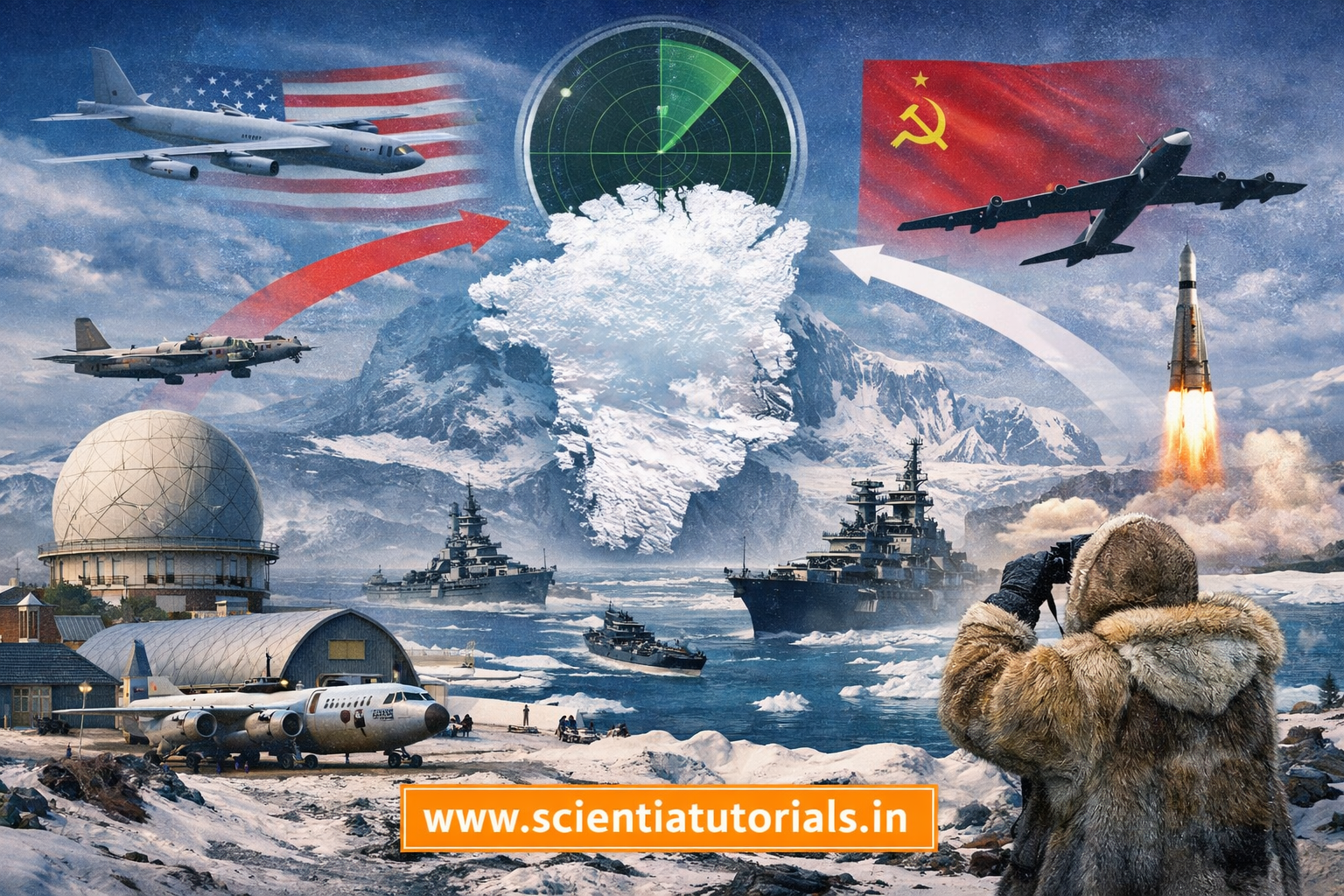
Strategic Importance of Greenland in the North Atlantic | World Wars & Cold War
Greenland: Historical Evolution and Its Global Strategic Importance
Module 4: Greenland in the Age of World Wars and the Cold War
Era Framework: Early 20th Century – Late 20th Century
(World Wars, Cold War geopolitics, militarization of the Arctic)
Lesson: Strategic Importance of Greenland in the North Atlantic
This lesson is systematically organized into four clearly structured sections, as detailed below:
- Chronologically Structured Study Module
- Short-Answer Type Questions
- Long-Answer Type Questions
- Multiple-Choice Questions (MCQs) with Answers and Detailed Explanations
Chronologically Structured Study Module
Introduction: Greenland and the Twentieth-Century Global Order
The twentieth century transformed Greenland from a remote Arctic territory into a key strategic node in global geopolitics. Its vast ice-covered landmass, central position between North America and Europe, and proximity to the Arctic Ocean made it indispensable during both World Wars and the Cold War. This lesson examines how Greenland’s geography, political status, and evolving international environment shaped its strategic importance in the North Atlantic world from the early 1900s to the late twentieth century.
Chronologically structured, this study module traces Greenland’s transition from a marginal colonial possession of Denmark to a linchpin of Allied defense systems, Cold War deterrence strategies, and Arctic militarization. It also highlights how global strategic pressures influenced Greenland’s internal development, governance, and international standing.
I. Geographic Foundations of Strategic Importance (Pre–World War Context)
1. Location and Natural Features
Greenland lies astride the shortest air and sea routes between North America and Europe, making it a natural bridge across the North Atlantic. Its coastline provides access to key maritime passages, while its interior ice cap offers ideal conditions for long-range aviation infrastructure.
2. Arctic Environment and Military Value
By the early twentieth century, advances in aviation and radio communication elevated the Arctic from a barrier into a corridor. Greenland’s weather patterns, though harsh, became essential for forecasting North Atlantic conditions, crucial for transatlantic navigation and military planning.
II. Greenland and World War I (1914–1918)
1. Neutrality and Peripheral Involvement
During World War I, Greenland remained largely outside direct military conflict. As a Danish colony, it was indirectly affected by Denmark’s neutrality. However, the war highlighted the vulnerability of Arctic supply routes and colonial dependencies.
2. Early Strategic Awareness
Although no major bases were established, Allied planners began to recognize Greenland’s potential value in monitoring North Atlantic shipping lanes and safeguarding communication routes, setting the stage for greater involvement in future conflicts.
III. Greenland in World War II (1939–1945)
1. Denmark’s Occupation and Greenland’s Unique Status
In 1940, Nazi Germany occupied Denmark, abruptly severing Greenland’s administrative ties with Copenhagen. This created a geopolitical vacuum. Greenland’s local authorities, with tacit Allied support, assumed responsibility for governance and external relations.
2. Allied Interest and the United States
The strategic importance of Greenland surged during World War II. The United States, concerned about German expansion into the North Atlantic, moved to secure Greenland’s defense. In 1941, an agreement with the Danish government-in-exile allowed the U.S. to establish military installations on Greenlandic soil.
3. Military Installations and Weather Stations
Airfields, weather stations, and radio posts were built across Greenland. These facilities played a critical role in:
- Monitoring German naval and submarine movements
- Providing meteorological data essential for Allied operations in the North Atlantic and Europe
- Supporting ferrying routes for aircraft traveling between North America and Europe
4. Impact on Greenlandic Society
World War II marked Greenland’s first sustained exposure to large-scale foreign military presence. Infrastructure development accelerated, wage labor expanded, and Greenlanders encountered new technologies and cultural influences.
IV. Transition from World War to Cold War (Late 1940s)
1. Changing Global Power Structures
The end of World War II did not diminish Greenland’s strategic value. Instead, the emergence of the Cold War between the United States and the Soviet Union transformed the Arctic into a frontline of ideological and military competition.
2. Greenland’s Reintegration into Denmark
In 1945, Denmark resumed control over Greenland. However, the wartime experience demonstrated that Greenland’s security could no longer be treated as a purely Danish concern. Its defense became intertwined with broader Western alliance systems.
V. Greenland and NATO (1949 onwards)
1. Denmark’s Entry into NATO
In 1949, Denmark became a founding member of the North Atlantic Treaty Organization. This decision formally embedded Greenland within the Western defense framework, despite Greenland’s geographic distance from Europe.
2. Strategic Role within the Alliance
Greenland served as:
- An early-warning outpost against potential Soviet attacks
- A logistical hub for transatlantic military operations
- A key element in Arctic surveillance and air defense systems
VI. Thule Air Base and Cold War Militarization (1950s–1960s)
1. Establishment of Thule Air Base
One of the most significant Cold War developments was the construction of Thule Air Base in northwest Greenland in the early 1950s. Operated by the United States, Thule became a cornerstone of American Arctic strategy.
2. Strategic Functions
Thule Air Base supported:
- Strategic bomber operations
- Ballistic missile early-warning systems
- Space surveillance and satellite tracking
Its location placed it directly along the shortest route for intercontinental missiles between the U.S. and the Soviet Union.
3. Social and Political Consequences
The construction of Thule involved the relocation of local Inuit communities, raising long-term issues of displacement, compensation, and political representation. These events later influenced Greenlandic demands for greater autonomy and recognition of indigenous rights.
VII. Greenland in the Era of Nuclear Strategy (1960s–1970s)
1. Nuclear Deterrence and the Arctic
During the height of the Cold War, Greenland was integrated into the nuclear deterrence strategies of the Western bloc. Radar installations and surveillance networks formed part of a global system designed to detect and deter Soviet missile launches.
2. The 1968 Thule B-52 Incident
A U.S. B-52 bomber carrying nuclear weapons crashed near Thule Air Base in 1968, highlighting the risks associated with Greenland’s militarization. The incident sparked political debate in Denmark and Greenland over nuclear policy and transparency.
VIII. Political Transformation and Strategic Reassessment (1970s–1980s)
1. Home Rule and Strategic Awareness
In 1979, Greenland achieved Home Rule within the Kingdom of Denmark. While defense and foreign policy remained under Danish control, Greenlandic leaders increasingly engaged with questions of military presence, environmental protection, and international cooperation.
2. Balancing Security and Sovereignty
Greenland’s strategic importance gave it leverage in negotiations with Denmark and allied powers. The Cold War context ensured continued military relevance, even as Greenland sought to assert greater control over its internal affairs.
IX. Late Cold War Developments (1980s–Late 20th Century)
1. Technological Change
Advances in satellite surveillance, missile technology, and global communication slightly reduced Greenland’s exclusivity as a strategic location. Nevertheless, its Arctic position remained vital for early-warning systems and scientific research.
2. End of the Cold War
The late 1980s and early 1990s saw a gradual reduction in military tensions. While some installations were downsized, Greenland retained long-term strategic relevance due to emerging concerns over Arctic navigation, resources, and climate monitoring.
X. Long-Term Strategic Significance
1. Military Legacy
The World Wars and Cold War firmly embedded Greenland into global security architectures. Infrastructure built during this period laid the foundation for modern airports, communication networks, and research facilities.
2. Political and Global Implications
Greenland’s strategic role reshaped its relationship with Denmark, strengthened its international visibility, and influenced later debates on autonomy and independence.
3. Continuity into the Post–Cold War World
By the end of the twentieth century, Greenland had evolved from a peripheral colony into a strategically indispensable Arctic territory, linking North Atlantic defense, global security, and emerging Arctic geopolitics.
Conclusion
The strategic importance of Greenland in the North Atlantic during the early to late twentieth century was not accidental but the result of geographic reality meeting global conflict. World Wars I and II revealed Greenland’s potential military value, while the Cold War transformed it into a critical node in global defense systems. Through air bases, radar networks, and alliance politics, Greenland became deeply embedded in the geopolitical struggles of the modern world.
Understanding this historical trajectory is essential for appreciating Greenland’s contemporary global significance and its continuing role in Arctic and North Atlantic strategic affairs.
Short Answer Type Questions (with Answers)
1. Why was Greenland strategically important in the North Atlantic during the 20th century?
Greenland’s strategic importance stemmed from its location between North America and Europe, its proximity to Arctic sea and air routes, and its suitability for military bases, weather stations, and early-warning systems.
2. How did Greenland’s geography influence global military planning?
Greenland lies along the shortest air and missile routes between North America and Europe, making it crucial for transatlantic aviation, Arctic surveillance, and Cold War missile detection.
3. What was Greenland’s political status at the beginning of the 20th century?
At the beginning of the 20th century, Greenland was a colonial territory under the control of Denmark.
4. What role did Greenland play during World War I?
Greenland played a limited and indirect role during World War I, remaining outside active conflict but gaining attention for its position along North Atlantic shipping and communication routes.
5. How did World War II change Greenland’s global significance?
World War II transformed Greenland from a peripheral colony into a strategic asset due to its importance for weather forecasting, air ferry routes, and North Atlantic defense.
6. What event in 1940 altered Greenland’s administrative situation?
The German occupation of Denmark in 1940 severed Greenland’s direct administrative links with Copenhagen, forcing local authorities to assume greater responsibility.
7. Why did the United States become involved in Greenland during World War II?
The United States became involved to prevent German expansion in the North Atlantic and to secure Greenland as part of Allied defense and supply networks.
8. What types of military facilities were built in Greenland during World War II?
Airfields, weather stations, radio posts, and coastal defense installations were established to support Allied operations.
9. How did weather stations in Greenland contribute to Allied victory?
Greenlandic weather stations provided crucial meteorological data that improved navigation and planning for military operations across the North Atlantic and Europe.
10. What was Greenland’s strategic position after World War II?
After World War II, Greenland became a permanent component of Western security planning, especially as Cold War tensions emerged.
11. How did the Cold War redefine Greenland’s importance?
The Cold War turned Greenland into a frontline Arctic outpost for surveillance, early warning, and deterrence against potential Soviet attacks.
12. What was the significance of Denmark joining NATO in 1949?
Denmark’s membership in the North Atlantic Treaty Organization formally integrated Greenland into the Western defense system.
13. Why was Greenland valuable to NATO strategy?
Greenland served as an early-warning location, a transatlantic logistics hub, and a key site for Arctic radar and air defense systems.
14. What was Thule Air Base, and when was it established?
Thule Air Base was a major U.S. military installation established in the early 1950s in northwest Greenland.
15. What strategic functions did Thule Air Base perform?
Thule supported strategic bomber operations, ballistic missile early-warning systems, and space and satellite tracking during the Cold War.
16. How did Thule Air Base affect Greenlandic society?
Its construction led to the relocation of Inuit communities and raised social, political, and ethical issues related to land rights and sovereignty.
17. What was the 1968 Thule incident?
It was the crash of a U.S. B-52 bomber carrying nuclear weapons near Thule Air Base, which raised concerns about nuclear safety and secrecy.
18. Why was Greenland important in nuclear deterrence strategy?
Greenland’s Arctic position made it ideal for detecting incoming intercontinental ballistic missiles, strengthening early-warning capabilities.
19. How did Cold War militarization influence Greenland’s political development?
Military presence and strategic importance encouraged debates on autonomy, environmental protection, and political self-determination.
20. What was the significance of Greenland’s Home Rule in 1979?
Home Rule gave Greenland control over internal affairs while defense and foreign policy remained with Denmark, reflecting growing political maturity.
21. Did Greenland control its defense policy after Home Rule?
No, defense and foreign affairs continued to be managed by Denmark, though Greenland gained greater influence in related discussions.
22. How did technological advances affect Greenland’s strategic role in the late Cold War?
Satellite technology reduced dependence on fixed Arctic bases, but Greenland remained important for surveillance, research, and communication.
23. What happened to Greenland’s military importance after the Cold War ended?
Military activity declined, but Greenland retained strategic relevance due to Arctic security, navigation, and scientific research.
24. How did global conflicts reshape Greenland’s relationship with Denmark?
Global conflicts increased Greenland’s international importance and contributed to political reforms that strengthened autonomy within the Danish kingdom.
25. Why is Greenland still strategically important in the modern world?
Greenland remains vital due to its Arctic location, climate research role, emerging sea routes, and continued relevance in North Atlantic security.
Long Answer Type Questions (with Answers)
1. Examine the geographical factors that made Greenland strategically important in the North Atlantic during the 20th century.
Greenland’s strategic importance was fundamentally rooted in its geography. Positioned between North America and Europe, Greenland lies along the shortest air and missile routes connecting the two continents. Its vast landmass and Arctic coastline provided ideal locations for airfields, naval monitoring stations, and early-warning radar systems. During the 20th century, advancements in aviation and missile technology transformed the Arctic from a remote frontier into a vital military corridor. Greenland’s ice cap also supported long-range aviation infrastructure, while its location enabled effective surveillance of North Atlantic sea lanes, making it indispensable to global military planning.
2. Discuss Greenland’s political status before World War II and its implications for strategic planning.
Before World War II, Greenland was a colonial possession of Denmark, governed primarily for economic and administrative purposes rather than strategic ones. Its remoteness meant that defense planning was minimal. However, as global tensions increased in the 1930s, military planners began recognizing that Greenland’s lack of defenses posed a vulnerability in the North Atlantic. This colonial status meant that Greenland’s fate during wartime would be closely tied to Denmark’s geopolitical position, a reality dramatically exposed during World War II.
3. Analyze Greenland’s role during World War I and explain why its strategic value remained limited at the time.
During World War I, Greenland played only a marginal role in global conflict. Denmark’s neutrality kept Greenland outside direct military engagement, and the technology of the time limited large-scale Arctic operations. Nonetheless, the war highlighted the importance of secure shipping lanes and communication routes in the North Atlantic. Although Greenland was not militarized, the conflict laid the groundwork for later recognition of its strategic potential as technology advanced.
4. Explain how the German occupation of Denmark in 1940 altered Greenland’s strategic situation.
The German occupation of Denmark in 1940 abruptly severed Greenland’s administrative ties with Copenhagen. This created a unique political situation in which Greenland’s local authorities assumed greater responsibility for governance. Strategically, the occupation raised Allied fears that Greenland could be exploited by Germany as a base for weather stations or naval operations. As a result, Greenland gained immediate strategic significance, prompting Allied intervention to secure the island and prevent Axis expansion in the North Atlantic.
5. Evaluate the role of the United States in Greenland during World War II.
The United States played a decisive role in Greenland during World War II by assuming responsibility for its defense. Through agreements with the Danish government-in-exile, the U.S. established airfields, weather stations, and military installations. These facilities supported transatlantic aircraft ferry routes, provided crucial meteorological data, and strengthened Allied control over the North Atlantic. U.S. involvement marked Greenland’s first large-scale integration into global military systems.
6. Assess the importance of weather stations in Greenland during World War II.
Weather forecasting was critical to World War II military operations, especially in the North Atlantic. Greenland’s weather stations supplied vital data that influenced naval movements, air missions, and amphibious operations in Europe. Control of meteorological information provided a strategic advantage, as accurate forecasts improved operational timing and reduced losses. Greenland thus became a key node in the Allied intelligence and planning network.
7. Discuss the impact of World War II on Greenlandic society and economy.
World War II brought profound social and economic changes to Greenland. The construction of military infrastructure introduced wage labor, modern transportation, and new technologies. Greenlanders interacted with foreign military personnel, leading to cultural exchange and increased awareness of global affairs. Although the changes were disruptive, they accelerated Greenland’s modernization and weakened the isolation that had defined colonial life.
8. Explain how the onset of the Cold War transformed Greenland’s strategic role.
The Cold War transformed Greenland into a frontline territory in the global struggle between the Western bloc and the Soviet Union. The Arctic became a strategic corridor for bombers and ballistic missiles, and Greenland’s location made it essential for early-warning systems. Unlike World War II, when Greenland’s role was largely defensive, the Cold War integrated it into long-term deterrence and surveillance strategies.
9. Analyze the significance of Denmark’s membership in NATO for Greenland.
Denmark’s entry into the North Atlantic Treaty Organization in 1949 formally placed Greenland within the Western security framework. This decision ensured continued U.S. military presence and infrastructure development in Greenland. While Denmark retained sovereignty, NATO membership meant that Greenland’s defense was now tied to collective security arrangements, reinforcing its long-term strategic importance.
10. Examine the establishment and strategic functions of Thule Air Base.
Thule Air Base was established in the early 1950s as part of U.S. Cold War strategy. Located in northwest Greenland, it served as a base for strategic bombers, missile early-warning radar, and space surveillance systems. Its position along polar routes made it crucial for detecting potential Soviet attacks and supporting nuclear deterrence.
11. Discuss the social consequences of the construction of Thule Air Base.
The construction of Thule Air Base led to the forced relocation of local Inuit communities, disrupting traditional livelihoods and settlement patterns. These displacements generated long-term social grievances and contributed to political mobilization around indigenous rights. The episode exposed tensions between global military priorities and local populations, shaping later demands for political autonomy.
12. Analyze Greenland’s role in Cold War nuclear deterrence strategies.
Greenland was integral to nuclear deterrence due to its position along the shortest missile trajectories between the superpowers. Radar installations and monitoring systems in Greenland enhanced early-warning capabilities, reducing the risk of surprise attacks. This role made Greenland a critical component of the balance of terror that defined Cold War security.
13. Examine the significance of the 1968 Thule B-52 crash.
The 1968 crash of a U.S. B-52 bomber carrying nuclear weapons near Thule Air Base exposed the dangers of nuclear militarization in the Arctic. The incident sparked political controversy in Denmark and Greenland, raising questions about nuclear policy, environmental safety, and transparency. It intensified public debate over the costs of Greenland’s strategic role.
14. Discuss how Cold War militarization influenced Greenland’s political development.
Cold War militarization heightened Greenland’s strategic visibility and strengthened arguments for greater political control over local affairs. Awareness of environmental risks, social disruptions, and foreign military presence encouraged demands for self-government. These pressures contributed to Greenland’s eventual move toward Home Rule.
15. Explain the significance of Greenland achieving Home Rule in 1979.
Home Rule in 1979 marked a major milestone in Greenland’s political evolution. While Denmark retained control over defense and foreign policy, Greenland gained authority over internal matters. Strategic importance played a key role in this transition, as Greenland sought a stronger voice in decisions affecting its land and people.
16. Assess Greenland’s strategic importance during the late Cold War.
During the late Cold War, technological advancements reduced reliance on some Arctic bases, but Greenland remained vital for surveillance, communication, and scientific research. Its role evolved rather than declined, adapting to new security needs and global technologies.
17. Analyze how technological change affected Greenland’s military role.
Satellite surveillance, advanced radar, and missile systems altered the nature of Arctic defense. While these technologies reduced the need for extensive ground installations, Greenland continued to host critical infrastructure supporting early-warning and space monitoring systems.
18. Discuss the decline and continuity of Greenland’s strategic role after the Cold War.
With the end of the Cold War, military tensions eased and some installations were downsized. However, Greenland retained long-term strategic relevance due to Arctic navigation routes, climate research, and emerging security concerns.
19. Evaluate the long-term legacy of World War and Cold War militarization in Greenland.
The legacy includes modern infrastructure, enhanced global visibility, and lasting political changes. At the same time, it left social challenges related to displacement, environmental impact, and sovereignty debates.
20. Conclude by assessing Greenland’s strategic importance in the broader context of 20th-century global history.
Greenland’s transformation from a remote colony to a strategic linchpin reflects the broader dynamics of 20th-century global conflict. World Wars and the Cold War elevated its importance, reshaped its political development, and embedded it within international security systems. Greenland’s experience illustrates how geography can drive historical significance in an interconnected world.
Multiple Choice Questions (MCQs) with Answers and Explanations
1. Greenland’s strategic importance in the 20th century was primarily due to its:
A. Rich agricultural resources
B. Central location between North America and Europe
C. Large population
D. Industrial development
Correct Answer: B
Explanation:
Greenland’s significance lay in its geographic position along the shortest air and missile routes between North America and Europe, making it vital for transatlantic defense and surveillance.
2. At the beginning of the 20th century, Greenland was under the control of:
A. United States
B. United Kingdom
C. Denmark
D. Norway
Correct Answer: C
Explanation:
Greenland was a Danish colony, administered mainly for economic and administrative purposes rather than strategic defense.
3. Why did Greenland play a limited role during World War I?
A. It was already heavily militarized
B. Arctic warfare was technologically advanced
C. Denmark remained neutral
D. Greenland was economically insignificant
Correct Answer: C
Explanation:
Denmark’s neutrality kept Greenland outside direct conflict, and limited technology reduced the feasibility of Arctic military operations at the time.
4. Which event in 1940 dramatically altered Greenland’s strategic situation?
A. U.S. declaration of war
B. German occupation of Denmark
C. Formation of NATO
D. Construction of Thule Air Base
Correct Answer: B
Explanation:
The German occupation of Denmark severed Greenland’s administrative links, raising fears that it could fall under Axis influence.
5. Which country assumed responsibility for Greenland’s defense during World War II?
A. Canada
B. United Kingdom
C. Norway
D. United States
Correct Answer: D
Explanation:
The United States secured Greenland to prevent German expansion and to protect North Atlantic supply and communication routes.
6. One major reason Greenland was valuable during World War II was its role in:
A. Tank production
B. Arctic agriculture
C. Weather forecasting
D. Naval shipbuilding
Correct Answer: C
Explanation:
Greenland’s weather stations provided crucial meteorological data that shaped Allied air and naval operations across the Atlantic.
7. Which type of facilities were established in Greenland during World War II?
A. Industrial factories
B. Cultural centers
C. Airfields and weather stations
D. Mining complexes
Correct Answer: C
Explanation:
Airfields, radio posts, and weather stations supported Allied logistics and surveillance.
8. After World War II, Greenland’s importance increased mainly because of the:
A. Decline of European empires
B. Rise of Arctic tourism
C. Beginning of the Cold War
D. Discovery of oil
Correct Answer: C
Explanation:
Cold War tensions turned the Arctic into a frontline region, elevating Greenland’s strategic value.
9. Denmark’s entry into NATO in 1949 resulted in Greenland becoming part of:
A. Soviet defense planning
B. Neutral Arctic zone
C. Western collective security
D. United Nations peacekeeping
Correct Answer: C
Explanation:
By joining the North Atlantic Treaty Organization, Denmark integrated Greenland into Western defense systems.
10. Greenland was important to NATO primarily because it served as a:
A. Training ground for infantry
B. Early-warning and surveillance outpost
C. Manufacturing hub
D. Refugee settlement
Correct Answer: B
Explanation:
Greenland’s location enabled early detection of potential attacks across the Arctic and North Atlantic.
11. Thule Air Base was established during the:
A. World War I era
B. Interwar period
C. Early Cold War
D. Late Cold War
Correct Answer: C
Explanation:
The base was constructed in the early 1950s as part of Cold War defense planning.
12. The primary function of Thule Air Base was to support:
A. Naval warfare
B. Strategic bombing and missile warning
C. Commercial aviation
D. Scientific tourism
Correct Answer: B
Explanation:
Thule Air Base supported nuclear deterrence, radar surveillance, and space monitoring.
13. Why was Greenland vital to Cold War nuclear deterrence?
A. It housed nuclear reactors
B. It controlled oil supplies
C. It lay along missile flight paths
D. It hosted peace negotiations
Correct Answer: C
Explanation:
Missiles and bombers between the superpowers followed polar routes, making Greenland ideal for early-warning systems.
14. The construction of Thule Air Base had which social consequence?
A. Expansion of farming
B. Forced relocation of Inuit communities
C. Population explosion
D. Complete urbanization
Correct Answer: B
Explanation:
Local Inuit populations were relocated, causing long-term social and political tensions.
15. The 1968 Thule incident involved:
A. A naval collision
B. A nuclear reactor leak
C. A bomber crash carrying nuclear weapons
D. A missile launch failure
Correct Answer: C
Explanation:
A U.S. B-52 bomber crashed near Thule, highlighting the dangers of Arctic nuclear militarization.
16. The Thule accident led to debates primarily about:
A. Climate change
B. Tourism development
C. Nuclear safety and transparency
D. Fishing rights
Correct Answer: C
Explanation:
The incident raised concerns over nuclear risks, environmental damage, and political accountability.
17. How did Cold War militarization affect Greenland politically?
A. It delayed modernization
B. It reduced international attention
C. It encouraged demands for self-rule
D. It eliminated Danish authority
Correct Answer: C
Explanation:
Foreign military presence increased political awareness and demands for greater autonomy.
18. Greenland achieved Home Rule in:
A. 1953
B. 1968
C. 1979
D. 1991
Correct Answer: C
Explanation:
Home Rule allowed Greenland control over internal affairs while defense remained with Denmark.
19. After Home Rule, defense policy remained under the control of:
A. Greenland government
B. NATO headquarters
C. Denmark
D. United Nations
Correct Answer: C
Explanation:
Defense and foreign policy were retained by Denmark despite Greenland’s internal autonomy.
20. Which technological development reduced—but did not eliminate—Greenland’s strategic role?
A. Jet engines
B. Satellite surveillance
C. Nuclear submarines
D. Icebreakers
Correct Answer: B
Explanation:
Satellites reduced dependence on ground installations but did not replace Greenland’s strategic value.
21. During the late Cold War, Greenland remained important mainly for:
A. Industrial production
B. Arctic surveillance and research
C. Population resettlement
D. Agricultural expansion
Correct Answer: B
Explanation:
Surveillance, communication, and scientific research kept Greenland relevant.
22. After the Cold War, Greenland’s military activity:
A. Expanded rapidly
B. Completely disappeared
C. Declined but did not vanish
D. Shifted to naval warfare
Correct Answer: C
Explanation:
Military presence was reduced, but strategic relevance continued.
23. Greenland’s post–Cold War importance is increasingly linked to:
A. Coal mining
B. Arctic shipping routes and climate research
C. Mass migration
D. Space colonization
Correct Answer: B
Explanation:
Melting ice and Arctic navigation have renewed Greenland’s global relevance.
24. The long-term legacy of Cold War militarization in Greenland includes:
A. Isolation
B. Modern infrastructure and political awareness
C. Economic decline
D. Cultural disappearance
Correct Answer: B
Explanation:
Military infrastructure and global exposure contributed to modernization and political development.
25. Greenland’s 20th-century history best illustrates how:
A. Colonies avoid global conflicts
B. Geography shapes global strategy
C. Military bases end colonialism
D. Arctic regions lack political change
Correct Answer: B
Explanation:
Greenland demonstrates how geographic location can transform a remote region into a global strategic asset.