
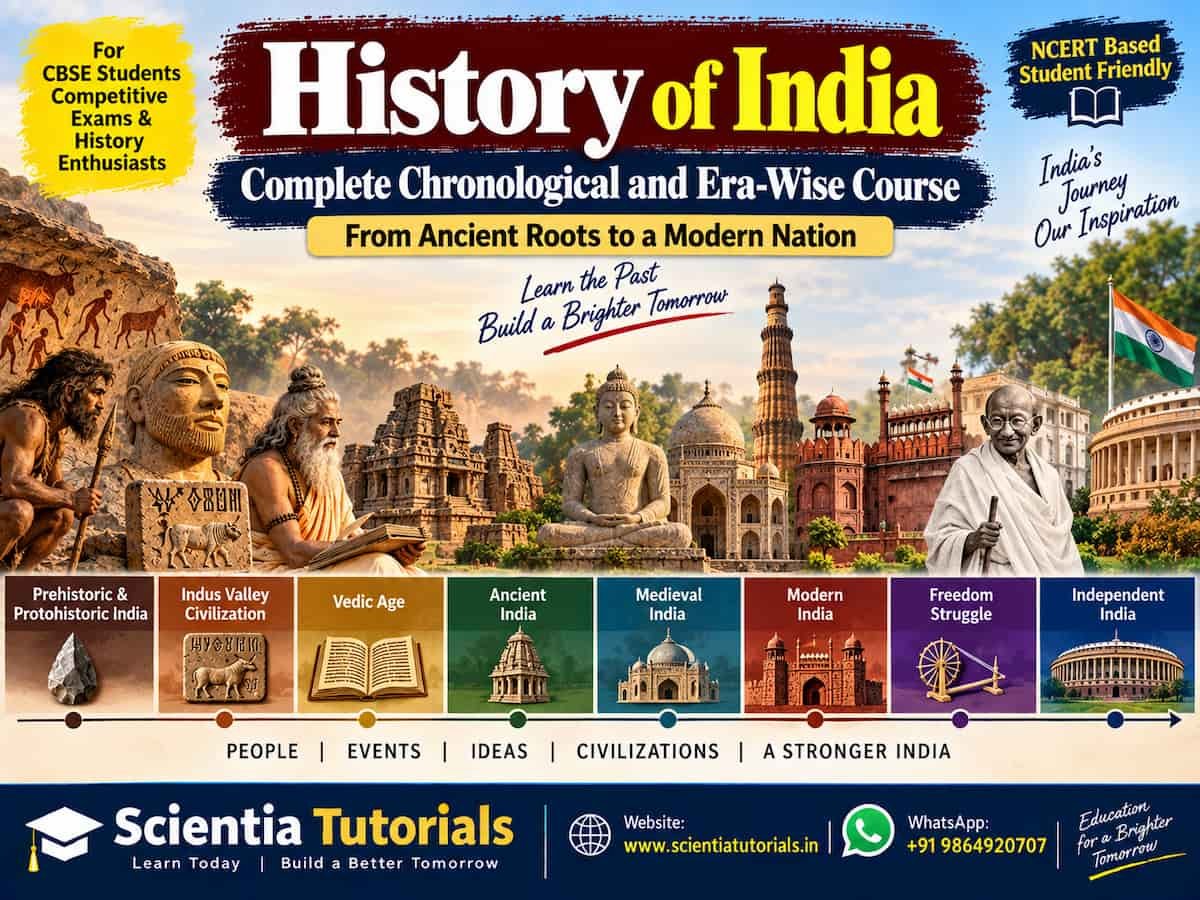
History of India – Complete Chronological and Era-Wise Course
History of India – Complete Chronological & Era-Wise Course (Indian History Timeline from Prehistoric Age to Contemporary India) In this Course, each Lesson under the Modules is divided into 4 Sections, as mentioned below: Study Module with Revision Notes, Questions with Answers, MCQs with Answers and detailed explanations. This online …

Overview
History of India – Complete Chronological & Era-Wise Course
(Indian History Timeline from Prehistoric Age to Contemporary India)
In this Course, each Lesson under the Modules is divided into 4 Sections, as mentioned below:
- Study Module with Revision Notes,
- Questions with Answers,
- MCQs with Answers and detailed explanations.
This online learning course offers a comprehensive, chronological, and evidence-based understanding of the History of India, with special focus on controversial events, debates, and critical interpretations. Designed for both conceptual clarity and exam readiness, the course strengthens analytical thinking, source evaluation, and answer-writing skills required in competitive examinations.
The content is highly relevant for aspirants preparing for UPSC (CSE), State PSCs (APSC, UPPSC, BPSC, MPPSC, MPSC, WBCS, RPSC, TNPSC, etc.), UGC-NET/JRF, CUET (UG/PG), SSC, NDA, CDS, CAPF, as well as CBSE, ICSE, State Board examinations, and college/university undergraduate and postgraduate courses where History of India is a core subject.
SECTION 1: Prehistoric & Protohistoric India
Timeline: c. 2 million BCE – c. 2500 BCE
(Ancient Indian History – Early Human Evolution)
Lessons:
- Introduction to the History of India & Indian History Timeline
- Sources for Studying Prehistoric India
- Paleolithic Age in India: Tools, Lifestyle & Sites
- Mesolithic Age: Transition & Microlithic Cultures
- Neolithic Age: Agriculture, Domestication & Settlements
- Chalcolithic Cultures & Protohistoric Developments
- Significance of Prehistoric India in Ancient Indian History
SECTION 2: Indus Valley Civilization (Harappan Civilization)
Timeline: c. 2500 BCE – c. 1750 BCE
(Ancient Indian History – Urban Civilization Phase)
Lessons:
- Discovery & Geographical Extent of Indus Valley Civilization
- Town Planning & Urban Architecture
- Economic Life: Agriculture, Trade & Crafts
- Social Structure & Daily Life of Harappans
- Religion, Art & Cultural Practices
- Script, Science & Technology
- Decline of Indus Valley Civilization & Legacy
SECTION 3: Vedic Age & Religious-Philosophical Developments
Timeline: c. 1500 BCE – c. 600 BCE
(Ancient Indian History – Early Aryan Phase)
Lessons:
- Early Vedic Period: Society, Polity & Economy
- Later Vedic Period: Social Stratification & Ritualism
- Vedic Literature: Samhitas, Brahmanas, Aranyakas & Upanishads
- Political Institutions & Tribal Assemblies
- Religious Thought & Philosophical Ideas
- Transition from Rigvedic to Later Vedic Society
SECTION 4: Mahajanapadas & Rise of New Religious Movements
Timeline: c. 600 BCE – c. 322 BCE
(Ancient Indian History – Second Urbanisation)
Lessons:
- Emergence of Mahajanapadas
- Political Structures & Republics in Ancient India
- Economic Expansion & Urban Growth
- Life & Teachings of Gautama Buddha
- Jainism: Mahavira & Core Philosophies
- Impact of Buddhism & Jainism on Indian Society
SECTION 5: Mauryan Empire & Post-Mauryan India
Timeline: c. 322 BCE – c. 185 BCE
(Ancient Indian History – Imperial Phase)
Lessons:
- Rise of the Mauryan Empire
- Administration of Chandragupta Maurya
- Ashoka: Dhamma, Administration & Inscriptions
- Mauryan Economy, Art & Architecture
- Decline of Mauryas
- Post-Mauryan Dynasties: Shungas, Kushanas & Satavahanas
SECTION 6: Gupta Age & Post-Gupta Developments
Timeline: c. 320 CE – c. 600 CE
(Ancient Indian History – Classical Age)
Lessons:
- Foundation of the Gupta Empire
- Administration & Political Institutions
- Economy, Trade & Urban Life
- Science, Mathematics & Literature
- Art, Architecture & Religion in Gupta Period
- Decline of Gupta Empire & Its Impact
SECTION 7: Early Medieval India & Regional Kingdoms
Timeline: c. 600 CE – c. 1200 CE
(Early Medieval Indian History)
Lessons:
- Transition from Ancient to Medieval India
- Chalukyas, Pallavas & Rashtrakutas
- Cholas: Administration, Navy & Temple Architecture
- Rajput Kingdoms of North India
- Agrarian Expansion & Feudal Trends
- Cultural Synthesis in Early Medieval India
SECTION 8: Delhi Sultanate
Timeline: 1206 CE – 1526 CE
(Medieval Indian History – Sultanate Phase)
Lessons:
- Establishment of Delhi Sultanate
- Slave, Khalji, Tughlaq, Sayyid & Lodi Dynasties
- Administration & Revenue Systems
- Military Reforms & Expansion
- Social, Economic & Religious Policies
- Art, Architecture & Cultural Contributions
SECTION 9: Mughal Empire in India
Timeline: 1526 CE – 1707 CE
(Medieval Indian History – Mughal Phase)
Lessons:
- Foundation of Mughal Rule in India
- Akbar’s Administration & Policy of Sulh-i-Kul
- Mughal Administration & Mansabdari System
- Economy, Trade & Agrarian Structure
- Mughal Art, Architecture & Literature
- Aurangzeb & Decline of the Mughal Empire
SECTION 10: Cultural & Social Developments in Medieval India
Timeline: c. 1200 CE – 1700 CE
Lessons:
- Bhakti Movement: Saints & Teachings
- Sufi Movement & Mysticism
- Composite Culture & Indo-Islamic Traditions
- Language, Literature & Education
- Social Life & Religious Interactions
SECTION 11: Advent of Europeans & Colonial Expansion
Timeline: 1498 CE – 1757 CE
(Modern Indian History – Early Colonial Phase)
Lessons:
- Arrival of Portuguese, Dutch, French & British
- Trading Companies & Commercial Rivalries
- Battle of Plassey & British Political Control
- Economic Motives Behind Colonial Expansion
SECTION 12: British Rule & Administrative Systems
Timeline: 1757 CE – 1857 CE
(Modern Indian History – Company Rule)
Lessons:
- East India Company Administration
- Land Revenue Systems: Permanent, Ryotwari & Mahalwari
- Judicial, Police & Military Reforms
- Economic Impact of British Rule
- Tribal & Peasant Resistance Movements
SECTION 13: Socio-Religious Reform Movements
Timeline: 19th Century CE
Lessons:
- Causes of Social Reform in Modern India
- Brahmo Samaj & Arya Samaj
- Aligarh Movement & Muslim Reform
- Role of Reformers in Women’s Upliftment
- Impact on Indian Society & Nationalism
SECTION 14: Indian National Movement
Timeline: 1885 CE – 1947 CE
(Indian Freedom Struggle)
Lessons:
- Foundation of Indian National Congress
- Moderate & Extremist Phases
- Gandhian Era: Non-Cooperation & Civil Disobedience
- Revolutionary Movements in India
- Quit India Movement
- Role of Peasants, Workers & Women
SECTION 15: Constitutional Developments & Independence
Timeline: 1909 CE – 1950 CE
Lessons:
- British Constitutional Reforms
- Government of India Acts
- Cabinet Mission Plan & Partition
- Indian Independence & Integration of Princely States
- Framing of the Indian Constitution
SECTION 16: Post-Independence & Contemporary India
Timeline: 1947 CE – Present
(Post-Independence Indian History)
Lessons:
- Challenges of Nation-Building in Independent India
- Indian Constitution: Features & Amendments
- Political Developments & Foreign Policy
- Economic Planning & Reforms
- Social Change & Contemporary Issues
- India in the 21st Century
✅ Course Utility
This History of India course structure is ideal for:
- Competitive exam preparation (UPSC, PSCs, SSC, Banking, Teaching exams)
- School, College and University syllabus frameworks
Curriculum
- 16 Sections
- 92 Lessons
- Lifetime
- SECTION 1: Prehistoric & Protohistoric IndiaSECTION 1: Prehistoric & Protohistoric India Timeline: c. 2 million BCE – c. 2500 BCE (Ancient Indian History – Early Human Evolution)7
- 1.1Introduction to the History of India & Indian History Timeline
- 1.2Sources for Studying Prehistoric India
- 1.3Paleolithic Age in India: Tools, Lifestyle & Sites
- 1.4Mesolithic Age: Transition & Microlithic Cultures
- 1.5Neolithic Age: Agriculture, Domestication & Settlements
- 1.6Chalcolithic Cultures & Protohistoric Developments
- 1.7Significance of Prehistoric India in Ancient Indian History
- SECTION 2: Indus Valley Civilization (Harappan Civilization)SECTION 2: Indus Valley Civilization (Harappan Civilization) Timeline: c. 2500 BCE – c. 1750 BCE (Ancient Indian History – Urban Civilization Phase)7
- 2.1Discovery & Geographical Extent of Indus Valley Civilization
- 2.2Town Planning & Urban Architecture
- 2.3Economic Life: Agriculture, Trade & Crafts
- 2.4Social Structure & Daily Life of Harappans
- 2.5Religion, Art & Cultural Practices
- 2.6Script, Science & Technology
- 2.7Decline of Indus Valley Civilization & Legacy
- SECTION 3: Vedic Age & Religious-Philosophical DevelopmentsSECTION 3: Vedic Age & Religious-Philosophical Developments Timeline: c. 1500 BCE – c. 600 BCE (Ancient Indian History – Early Aryan Phase)6
- 3.1Early Vedic Period: Society, Polity & Economy
- 3.2Later Vedic Period: Social Stratification & Ritualism
- 3.3Vedic Literature: Samhitas, Brahmanas, Aranyakas & Upanishads
- 3.4Political Institutions & Tribal Assemblies
- 3.5Religious Thought & Philosophical Ideas
- 3.6Transition from Rigvedic to Later Vedic Society
- SECTION 4: Mahajanapadas & Rise of New Religious MovementsSECTION 4: Mahajanapadas & Rise of New Religious Movements Timeline: c. 600 BCE – c. 322 BCE (Ancient Indian History – Second Urbanisation)6
- SECTION 5: Mauryan Empire & Post-Mauryan IndiaSECTION 5: Mauryan Empire & Post-Mauryan India Timeline: c. 322 BCE – c. 185 BCE (Ancient Indian History – Imperial Phase)6
- SECTION 6: Gupta Age & Post-Gupta DevelopmentsSECTION 6: Gupta Age & Post-Gupta Developments Timeline: c. 320 CE – c. 600 CE (Ancient Indian History – Classical Age)6
- SECTION 7: Early Medieval India & Regional KingdomsSECTION 7: Early Medieval India & Regional Kingdoms Timeline: c. 600 CE – c. 1200 CE (Early Medieval Indian History)6
- SECTION 8: Delhi SultanateSECTION 8: Delhi Sultanate Timeline: 1206 CE – 1526 CE (Medieval Indian History – Sultanate Phase)6
- SECTION 9: Mughal Empire in IndiaSECTION 9: Mughal Empire in India Timeline: 1526 CE – 1707 CE (Medieval Indian History – Mughal Phase)6
- SECTION 10: Cultural & Social Developments in Medieval IndiaSECTION 10: Cultural & Social Developments in Medieval India Timeline: c. 1200 CE – 1700 CE5
- SECTION 11: Advent of Europeans & Colonial ExpansionSECTION 11: Advent of Europeans & Colonial Expansion Timeline: 1498 CE – 1757 CE (Modern Indian History – Early Colonial Phase)4
- SECTION 12: British Rule & Administrative SystemsSECTION 12: British Rule & Administrative Systems Timeline: 1757 CE – 1857 CE (Modern Indian History – Company Rule)5
- SECTION 13: Socio-Religious Reform MovementsSECTION 13: Socio-Religious Reform Movements Timeline: 19th Century CE5
- SECTION 14: Indian National MovementSECTION 14: Indian National Movement Timeline: 1885 CE – 1947 CE (Indian Freedom Struggle)6
- SECTION 15: Constitutional Developments & IndependenceSECTION 15: Constitutional Developments & Independence Timeline: 1909 CE – 1950 CE5
- SECTION 16: Post-Independence & Contemporary IndiaSECTION 16: Post-Independence & Contemporary India Timeline: 1947 CE – Present (Post-Independence Indian History)6
You May Like
Most Controversial and Conspiracy Cases in Indian History – A Chronological, Evidence-Based Analysis
📘 Most Controversial & Conspiracy Cases in Indian History Chronological Era-Wise Module-Wise Course Structure Below is a systematically organised, academically balanced, lesson-wise and module-wise course,...
Post-Independence and Contemporary India – History of India
Post-Independence and Contemporary India – History of India Module-wise | Chronological | Era-Wise Framework Chronological Era-Wise Module-Wise Course Structure In this Course, each Lesson under...
Course Features
- Lectures 92
- Quiz 0
- Duration Lifetime access
- Skill level All levels
- Language English
- Students 0
- Assessments Yes