
Trading Companies & Commercial Rivalries
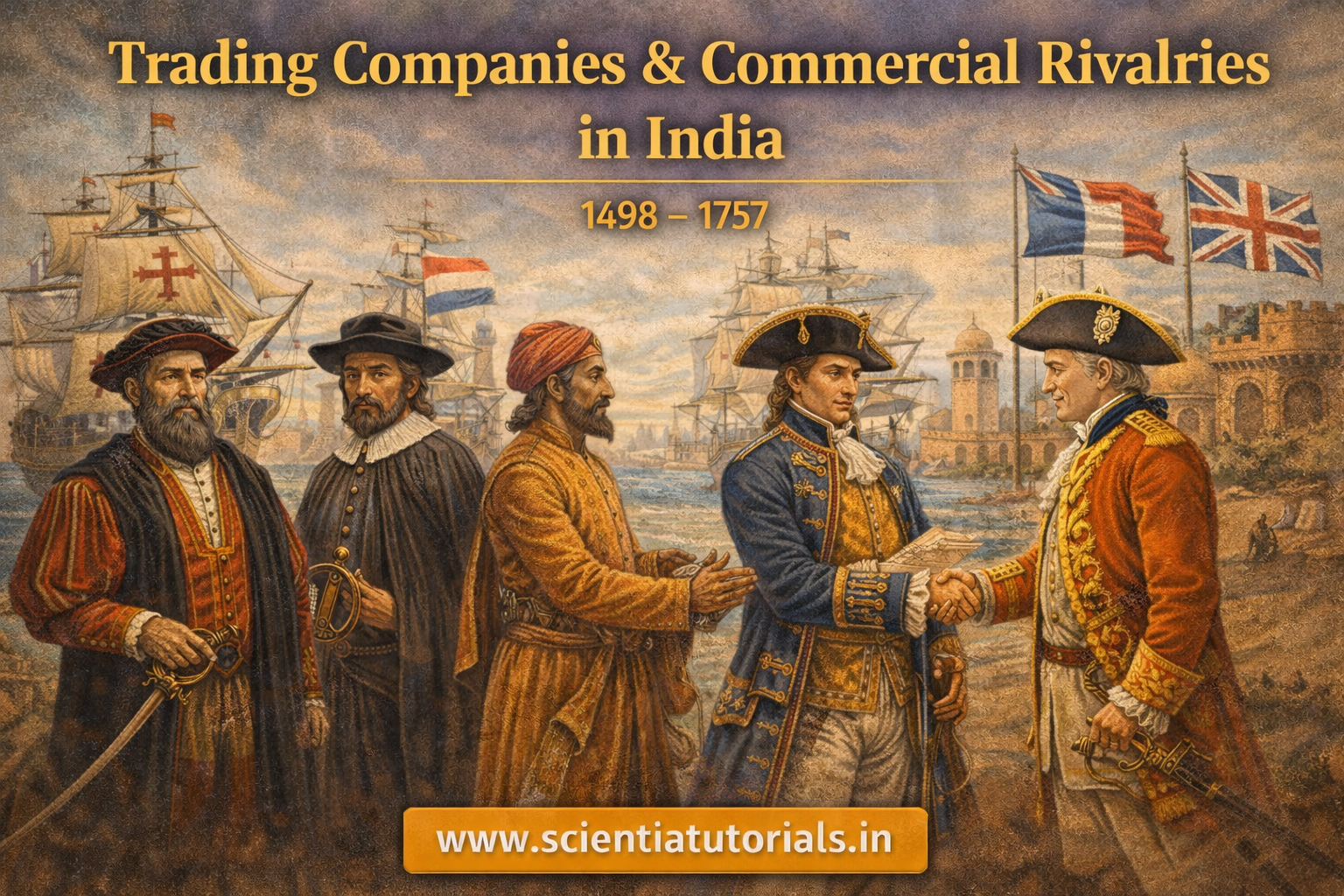

Trading Companies & Commercial Rivalries | History of India (1498–1757)
Advent of Europeans & Colonial Expansion
Timeline: 1498 CE – 1757 CE
(Modern Indian History – Early Colonial Phase)
Lesson: Trading Companies & Commercial Rivalries
1. Introduction: From Maritime Trade to Commercial Competition
The period 1498 CE to 1757 CE represents a crucial phase in Indian history when European trading companies emerged as dominant actors in the Indian Ocean economy. Unlike earlier traders such as Arabs and Persians, European merchants arrived with state backing, naval power, joint-stock capital, and military technology, allowing them to gradually transform commercial competition into political domination.
Trading companies were not merely commercial bodies. They were semi-sovereign institutions, exercising powers of war, diplomacy, taxation, and administration. The intense rivalry among these companies shaped India’s economic structure and laid the foundation for colonial rule.
This lesson analyses the origin, organisation, strategies, and rivalries of European trading companies, tracing how commercial competition ultimately resulted in British supremacy by 1757 CE.
2. India and Global Trade before European Companies
Before European intervention:
- India was a major hub of Asian and Indian Ocean trade
- Indian merchants dominated textile, spice, and luxury goods markets
- Trade networks were regulated by regional rulers
- Foreign traders operated under Indian political authority
European trading companies entered an already vibrant economy and sought to monopolise existing trade routes rather than create new ones.
3. Rise of the Trading Company System in Europe
3.1 Causes Behind the Formation of Trading Companies
European states encouraged trading companies due to:
- Growing demand for Asian spices and textiles
- High profits from overseas trade
- Need to reduce dependence on Arab intermediaries
- Mercantilist ideology emphasising bullion accumulation
To reduce risk and mobilise capital, Europeans developed the joint-stock company system, where multiple investors shared profits and losses.
3.2 Characteristics of European Trading Companies
Key features:
- Monopoly trading rights granted by the state
- Large capital investment
- Armed ships and private armies
- Authority to negotiate treaties and wage war
- Long-term commercial objectives
These characteristics made trading companies economic and political actors simultaneously.
4. Portuguese Trading Monopoly (16th Century)
The Portuguese were the first Europeans to establish a trading empire in India.
4.1 Commercial Strategy
- Control of sea routes through naval dominance
- Monopoly over spice trade
- Fortified trading centres
- Enforcement of cartaz (naval pass) system
Their trading empire was closely linked with religious and military objectives.
4.2 Limitations of Portuguese Trade
Despite early success, Portuguese commercial power declined due to:
- Limited capital base
- Corruption and inefficiency
- Rigid administration
- Competition from better-organised companies
Their failure highlighted the need for corporate trading models, later perfected by the Dutch and British.
5. Dutch East India Company (VOC): Commercial Supremacy without Empire
The Dutch East India Company, founded in 1602 CE, was the world’s first multinational corporation.
5.1 Organisation and Strength
- State-backed monopoly
- Large capital and professional management
- Strong navy
- Efficient bureaucracy
5.2 Dutch Commercial Strategy in India
- Focus on spices and textiles
- Establishment of trading factories on the Coromandel Coast
- Avoidance of territorial conquest in India
- Greater focus on Indonesia (East Indies)
5.3 Decline of Dutch Commercial Influence
The Dutch declined in India due to:
- Shift of interest to Southeast Asia
- Rising British competition
- Limited political ambitions in the subcontinent
Their experience demonstrated that commercial success alone was insufficient without political backing in India.
6. English (British) East India Company: From Trade to Power
The British East India Company, founded in 1600 CE, proved to be the most successful trading company in India.
6.1 Early Commercial Objectives
Initially, the Company focused on:
- Import of Indian textiles, spices, indigo, and saltpetre
- Establishment of factories with permission of Indian rulers
- Peaceful trade and diplomacy
This phase is often described as “trade before territory.”
6.2 Organisational Advantages
The British Company benefited from:
- Stable financial institutions
- Parliamentary support
- Advanced shipping and insurance
- Strong naval protection
These advantages allowed it to withstand competition and losses better than rivals.
6.3 Transition from Commerce to Control
Over time, the Company:
- Built fortified settlements
- Maintained private armies
- Interfered in local politics
- Used commercial disputes as justification for military action
This transformation was gradual but decisive.
7. French East India Company: Commercial Rivalry with Political Ambition
The French East India Company, founded in 1664 CE, was the last major European trading company to enter India.
7.1 French Commercial Policy
- Strong state backing
- Close alliance with Indian rulers
- Willingness to intervene in succession disputes
- Military protection of trade
The French combined commerce with open political ambition, especially in South India.
7.2 Strengths and Weaknesses
Strengths:
- Capable leadership
- Strong military involvement
Weaknesses:
- Weak financial base
- Political instability in France
- Dependence on state support
These weaknesses proved fatal during prolonged rivalry with the British.
8. Commercial Rivalries among European Companies
8.1 Nature of Rivalry
Rivalry among trading companies involved:
- Competition for ports and markets
- Naval battles
- Trade monopolies
- Political alliances with Indian rulers
Commercial rivalry gradually evolved into military and political conflict.
8.2 Anglo-Dutch Rivalry
- Dominated early 17th century
- Ended with British gaining dominance in Indian trade
- Dutch withdrew focus to Indonesia
8.3 Anglo-French Rivalry and the Carnatic Wars
The most decisive rivalry was between the British and French.
Features:
- Use of Indian troops trained in European warfare
- Interference in succession disputes
- Transformation of Indian politics
Outcome:
- British victory
- Elimination of French political ambitions in India
9. Role of Indian Rulers and Merchants
9.1 Indian Rulers
- Initially welcomed trading companies for revenue
- Granted concessions and privileges
- Failed to anticipate long-term consequences
- Political fragmentation weakened resistance
9.2 Indian Merchants
- Acted as intermediaries
- Supplied goods and credit
- Benefited initially from expanded trade
- Later suffered due to monopolistic practices
10. Economic Consequences of Commercial Rivalries
10.1 Positive Effects (Early Phase)
- Expansion of overseas trade
- Growth of port cities
- Increased demand for Indian textiles
- Inflow of silver and bullion
10.2 Negative Effects (Later Phase)
- Trade monopolies
- Suppression of Indian merchants
- Use of force in commerce
- Beginning of economic exploitation
Commercial rivalry thus transformed into economic domination.
11. Why Did the British Trading Company Succeed?
Key reasons:
- Strong naval superiority
- Better financial management
- Political stability in Britain
- Diplomatic skill
- Ability to exploit Indian political divisions
- Successful integration of commerce and military power
The British Company adapted more effectively than its rivals.
12. 1757 CE: End of Commercial Rivalry Phase
The Battle of Plassey (1757 CE) marked:
- End of trading-company rivalry
- Beginning of Company rule
- Transition from commercial enterprise to colonial administration
After 1757, competition was replaced by British monopoly control.
13. Historical Significance of Trading Companies
Trading companies:
- Introduced corporate capitalism to India
- Integrated India into global trade networks
- Destroyed indigenous commercial autonomy
- Paved the way for colonial exploitation
They represent the economic foundation of colonialism.
14. Examination Relevance
This topic is essential for:
- UPSC Prelims & Mains
- State PSC exams
- Understanding colonial foundations
- Analysing economic causes of imperialism
Key themes:
- Trade to empire
- Mercantilism
- Company rule
- European rivalries
15. Conclusion
Between 1498 CE and 1757 CE, European trading companies reshaped India’s economic and political landscape. What began as commercial competition gradually evolved into military conflict and political control. Among all rivals, the British East India Company emerged victorious due to superior organisation, finance, naval power, and political strategy.
The history of trading companies and commercial rivalries explains how colonial rule in India was built on commerce rather than conquest alone, making this phase a critical bridge between medieval trade networks and modern imperialism.
Questions with Answers
Lesson: Trading Companies & Commercial Rivalries
1. Why are European trading companies considered a turning point in Indian history?
Answer:
European trading companies introduced corporate capitalism, naval power, and state-backed commerce, transforming India from a participant in global trade into a target of colonial economic domination.
2. How was Indian overseas trade organised before the arrival of European trading companies?
Answer:
Indian trade was dominated by Indian, Arab, and Persian merchants, regulated by local rulers, and integrated into Indian Ocean networks without political interference by foreign traders.
3. What factors led to the rise of European trading companies?
Answer:
Key factors included:
- High demand for spices and textiles
- Mercantilist policies of European states
- Desire to bypass Arab intermediaries
- Need to reduce risks through joint-stock investment
4. What is meant by a joint-stock trading company?
Answer:
A joint-stock company pooled capital from multiple investors, allowing shared risk and profit, enabling large-scale and long-term overseas trade.
5. Mention two characteristics that distinguished European trading companies from earlier traders.
Answer:
They possessed:
- State-granted monopoly rights
- Armed ships and private armies
6. Why are trading companies described as “semi-sovereign powers”?
Answer:
They could wage war, negotiate treaties, mint coins, and administer territories, functioning like states while remaining commercial bodies.
7. Which European power first attempted to monopolise Indian Ocean trade?
Answer:
The Portuguese were the first to attempt maritime monopoly using naval power and fortified trading posts.
8. What commercial methods did the Portuguese use to dominate trade?
Answer:
They used:
- Naval superiority
- Fortified ports
- The cartaz (naval pass) system
9. Why did Portuguese commercial dominance decline in India?
Answer:
Their decline was due to limited capital, corruption, rigid administration, and competition from better-organised trading companies.
10. Which trading company is regarded as the world’s first multinational corporation?
Answer:
The Dutch East India Company, founded in 1602 CE.
11. What were the main features of Dutch commercial policy in India?
Answer:
The Dutch focused on:
- Trade rather than territory
- Textile and spice commerce
- Limited political intervention
12. Why did the Dutch fail to emerge as a dominant power in India?
Answer:
They prioritised Indonesia over India, avoided territorial ambitions, and were eventually outcompeted by the British.
13. When was the English (British) East India Company founded?
Answer:
The British East India Company was founded in 1600 CE.
14. What was meant by the British policy of “trade before territory”?
Answer:
The British initially avoided political control, focusing on peaceful commerce, diplomacy, and factory establishment under Indian rulers’ permission.
15. What organisational advantages did the British East India Company enjoy?
Answer:
Advantages included:
- Strong naval protection
- Access to finance and insurance
- Parliamentary backing
- Stable political conditions in Britain
16. How did the British trading company gradually transform into a political power?
Answer:
By:
- Maintaining private armies
- Fortifying settlements
- Intervening in local disputes
- Using trade conflicts to justify military action
17. Which European company entered India last but showed strong political ambition?
Answer:
The French East India Company, established in 1664 CE.
18. What distinguished French commercial policy from that of the Dutch?
Answer:
The French actively intervened in Indian politics and succession disputes, combining trade with military power.
19. What is meant by commercial rivalry among European companies?
Answer:
Commercial rivalry involved competition for markets, ports, trade monopolies, and political influence, often leading to armed conflict.
20. How did Anglo-Dutch rivalry affect India?
Answer:
It led to British dominance in Indian trade, while the Dutch withdrew their focus to Southeast Asia.
21. Why was Anglo-French rivalry more decisive than other rivalries?
Answer:
Because it directly involved Indian politics, military conflicts, and territorial ambitions, culminating in British supremacy.
22. How did Indian rulers initially respond to European trading companies?
Answer:
They welcomed them as sources of revenue and trade, underestimating their long-term political intentions.
23. What role did Indian merchants play in company trade?
Answer:
Indian merchants acted as suppliers, financiers, and intermediaries, benefiting initially but later suffering under monopoly practices.
24. Mention one positive and one negative economic impact of early company trade.
Answer:
Positive: Expansion of overseas trade and port cities
Negative: Growth of monopolies and suppression of indigenous merchants
25. Why is 1757 CE considered the end of the commercial rivalry phase?
Answer:
The Battle of Plassey (1757 CE) marked the end of European trading rivalry and the beginning of British political domination, replacing competition with monopoly rule.
MCQs with Answers & Explanations
Lesson: Trading Companies & Commercial Rivalries
MCQ 1
European trading companies differed from earlier traders mainly because they:
A. Avoided state support
B. Operated only as merchants
C. Combined commerce with political and military power
D. Rejected monopoly trade
Correct Answer: C
Explanation:
European trading companies were semi-sovereign bodies. Unlike Arab or Indian merchants, they possessed armed ships, private armies, and state-granted authority to wage war and sign treaties.
MCQ 2
Before the arrival of European trading companies, Indian overseas trade was:
A. Controlled by European merchants
B. Weak and underdeveloped
C. Dominated by Indian, Arab, and Persian traders
D. Completely land-based
Correct Answer: C
Explanation:
India was a major hub of the Indian Ocean trade network, dominated by indigenous and West Asian merchants long before European intervention.
MCQ 3
The rise of trading companies in Europe was closely linked to:
A. Feudalism
B. Mercantilism
C. Socialism
D. Industrial capitalism
Correct Answer: B
Explanation:
Mercantilist thinking emphasised bullion accumulation, monopoly trade, and state-supported commerce, encouraging the formation of trading companies.
MCQ 4
A joint-stock company was important because it:
A. Eliminated trade risks
B. Allowed individual merchants to trade alone
C. Shared risks and profits among many investors
D. Prevented overseas expansion
Correct Answer: C
Explanation:
Joint-stock companies pooled capital, enabling large-scale, long-term overseas trade by spreading financial risks.
MCQ 5
Why are European trading companies described as “semi-sovereign powers”?
A. They controlled only ports
B. They replaced European governments
C. They exercised political, military, and judicial powers
D. They ruled entire continents
Correct Answer: C
Explanation:
Trading companies could raise armies, mint coins, wage wars, and administer territories, functioning like states while remaining commercial bodies.
MCQ 6
Which European power first attempted to establish a maritime monopoly in Indian Ocean trade?
A. Dutch
B. French
C. Portuguese
D. British
Correct Answer: C
Explanation:
The Portuguese pioneered naval dominance and trade control, using force to monopolise sea routes in the 16th century.
MCQ 7
The cartaz system was associated with:
A. Dutch trade regulation
B. Portuguese maritime control
C. British customs policy
D. French commercial treaties
Correct Answer: B
Explanation:
The cartaz system required ships to carry Portuguese passes, enabling them to control and tax Indian Ocean trade.
MCQ 8
The main weakness of Portuguese commercial power in India was:
A. Absence of naval power
B. Limited capital and inefficient administration
C. Hostility of Indian merchants
D. Strong Mughal navy
Correct Answer: B
Explanation:
Portuguese decline resulted from small population base, corruption, rigid administration, and rising competition.
MCQ 9
Which trading company is regarded as the world’s first multinational corporation?
A. British East India Company
B. French East India Company
C. Dutch East India Company
D. Levant Company
Correct Answer: C
Explanation:
The VOC (1602 CE) had state backing, professional management, and global operations, making it the first true multinational company.
MCQ 10
The Dutch in India mainly focused on:
A. Territorial conquest
B. Religious expansion
C. Commercial profits without political control
D. Administrative reforms
Correct Answer: C
Explanation:
The Dutch avoided territorial ambitions in India and focused on trade, especially textiles and spices.
MCQ 11
Why did the Dutch fail to establish dominance in India?
A. Weak navy
B. Lack of Indian allies
C. Greater focus on Indonesia than India
D. Opposition from Mughal emperors
Correct Answer: C
Explanation:
The Dutch concentrated on the East Indies (Indonesia), where spice profits were higher, limiting their involvement in India.
MCQ 12
The English (British) East India Company was founded in:
A. 1498 CE
B. 1556 CE
C. 1600 CE
D. 1664 CE
Correct Answer: C
Explanation:
The British East India Company was established in 1600 CE by royal charter.
MCQ 13
The early British policy in India is best described as:
A. Territorial conquest
B. Trade before territory
C. Religious domination
D. Military expansion
Correct Answer: B
Explanation:
Initially, the British focused on commerce and diplomacy, avoiding direct political control.
MCQ 14
Which factor most strengthened the British trading company compared to rivals?
A. Missionary activity
B. Strong naval power and financial stability
C. Cultural assimilation
D. Smaller administrative structure
Correct Answer: B
Explanation:
British success rested on naval superiority, access to capital, insurance, and parliamentary support.
MCQ 15
How did the British East India Company gradually become a political power?
A. Through religious conversion
B. By purchasing land peacefully
C. By maintaining private armies and intervening in politics
D. By eliminating trade
Correct Answer: C
Explanation:
Commercial disputes increasingly led to military intervention and political control by the Company.
MCQ 16
Which trading company entered India later but pursued strong political ambitions?
A. Portuguese
B. Dutch
C. British
D. French East India Company
Correct Answer: D
Explanation:
The French combined trade with military and political intervention, especially in South India.
MCQ 17
What distinguished French commercial policy from Dutch policy?
A. Avoidance of conflict
B. Strict trade focus
C. Active involvement in Indian politics
D. Lack of state support
Correct Answer: C
Explanation:
The French actively intervened in succession disputes to expand political influence.
MCQ 18
Commercial rivalry among European companies eventually led to:
A. Peaceful coexistence
B. Cultural exchange only
C. Military and political conflict
D. Decline of trade
Correct Answer: C
Explanation:
Competition for markets and profits transformed commercial rivalry into armed conflict, especially in the 18th century.
MCQ 19
The most decisive rivalry in India was between:
A. Portuguese and Dutch
B. Dutch and British
C. British and French
D. Portuguese and British
Correct Answer: C
Explanation:
The Anglo-French rivalry directly shaped Indian politics and determined colonial supremacy.
MCQ 20
Indian rulers initially welcomed trading companies because they:
A. Wanted foreign rule
B. Needed military protection
C. Viewed them as sources of revenue and trade
D. Feared European power
Correct Answer: C
Explanation:
European companies were seen as commercial partners, not political threats, in the early phase.
MCQ 21
Indian merchants in early company trade generally:
A. Were eliminated immediately
B. Acted as intermediaries and financiers
C. Refused cooperation
D. Controlled European companies
Correct Answer: B
Explanation:
Indian merchants supplied goods and credit, benefiting initially before monopolies restricted them.
MCQ 22
An early positive economic effect of company trade was:
A. Deindustrialisation
B. Expansion of port cities
C. Decline of textile exports
D. Isolation of Indian economy
Correct Answer: B
Explanation:
Company trade stimulated port towns, exports, and global trade links in the early phase.
MCQ 23
A major negative economic consequence of company rivalry was:
A. Free competition
B. End of foreign trade
C. Monopoly control and exploitation
D. Increase in indigenous autonomy
Correct Answer: C
Explanation:
European companies gradually imposed trade monopolies, undermining Indian merchants.
MCQ 24
Why did the British trading company outlast its European rivals?
A. Religious tolerance
B. Superior diplomacy alone
C. Integration of commerce, military, and politics
D. Smaller territorial ambitions
Correct Answer: C
Explanation:
The British successfully combined trade, armed force, and political strategy, unlike their rivals.
MCQ 25
The year 1757 CE marks the end of the commercial rivalry phase because:
A. Trade declined
B. All European powers withdrew
C. British monopoly replaced competition
D. Mughal rule collapsed completely
Correct Answer: C
Explanation:
After 1757, rivalry ended as the British East India Company emerged as a political and commercial monopolist in India.
🔹 Targeting Exams
This content is optimised and structured for the following examinations:
-
UPSC Civil Services Examination (Prelims & Mains)
-
State Public Service Commission Exams (APSC, BPSC, WBCS, etc.)
-
UGC NET (History)
-
CUET (UG & PG – History)
-
University Semester & Final Examinations
-
Class 11–12 (Modern Indian History – CBSE & State Boards)
🔹 Related Keyphrases
-
Trading companies in India
-
Commercial rivalries in early colonial India
-
European trading companies History of India
-
Portuguese, Dutch, French and British trade rivalry
-
East India Company commercial expansion
-
Mercantilism and colonial trade in India
-
Early colonial economy of India
-
Advent of Europeans commercial competition
-
Modern Indian history trading companies notes
-
UPSC notes on trading companies in India