
Sources for Studying Prehistoric India
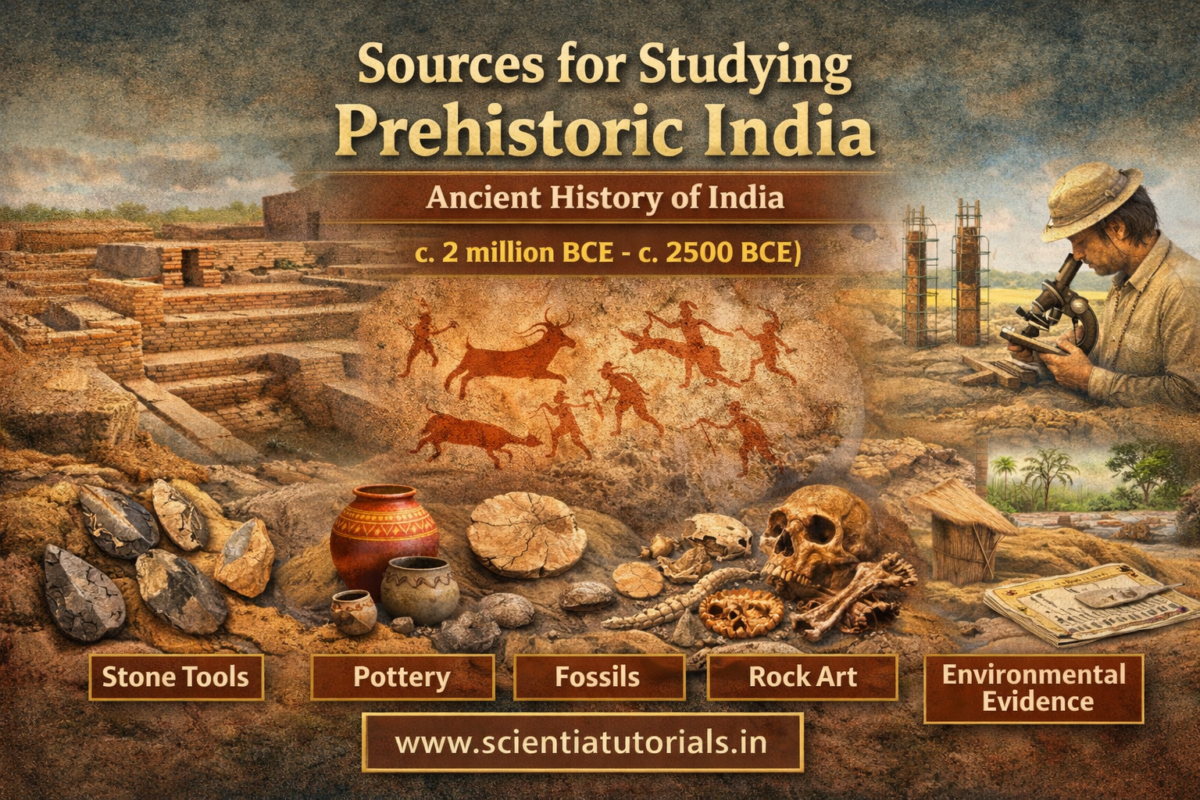

Sources for Studying Prehistoric India | Ancient History of India
Course: History of India – Complete Chronological and Era-Wise Course
Section 1: Prehistoric & Protohistoric India
Timeline: c. 2 million BCE – c. 2500 BCE
(Ancient Indian History – Early Human Evolution)
1. Introduction: Why Sources Matter in Prehistoric History
The study of prehistoric India poses a unique challenge for historians because it deals with a period before the invention of writing. Unlike later historical phases, where inscriptions, manuscripts, and literary texts guide reconstruction, prehistoric history must be understood almost entirely through material evidence.
Therefore, the concept of “sources” in prehistoric history refers to archaeological, anthropological, geological, and environmental remains that help scholars reconstruct the life, culture, technology, and environment of early humans.
This lesson focuses on the sources for studying prehistoric India, explaining their nature, classification, significance, and limitations in a chronologically structured and examination-oriented manner, fully aligned with the objectives of Section 1 of the History of India course.
2. Nature of Sources for Prehistoric India
2.1 Absence of Written Records
Prehistoric India is defined precisely by the absence of writing. As a result:
- No inscriptions
- No manuscripts
- No contemporary literary narratives
All interpretations are therefore indirect, based on physical remains left behind by early humans.
2.2 Multidisciplinary Approach
To reconstruct prehistoric life, historians rely on a multidisciplinary approach, drawing upon:
- Archaeology
- Anthropology
- Paleontology
- Geology
- Environmental science
This makes prehistoric studies more scientific but also more interpretative in nature.
3. Classification of Sources for Studying Prehistoric India
The sources for prehistoric India can be broadly classified into the following categories:
- Archaeological sources
- Anthropological and fossil evidence
- Environmental and geological sources
- Artistic and cultural remains
Each category provides specific insights into early human evolution and lifestyle.
4. Archaeological Sources: The Primary Evidence
Archaeological sources form the most important foundation for studying prehistoric India.
4.1 Stone Tools
Nature and Types
Stone tools are the earliest and most abundant evidence of prehistoric human activity. They vary across different phases:
- Paleolithic tools: Hand axes, cleavers, choppers, flakes
- Mesolithic tools: Microliths (small, sharp tools)
- Neolithic tools: Polished stone axes, adzes, celts
Historical Significance
Stone tools help historians understand:
- Level of technological development
- Hunting and subsistence strategies
- Cognitive and motor skills of early humans
- Chronological classification of prehistoric phases
Tool typology and manufacturing techniques are crucial for dating prehistoric sites.
4.2 Pottery and Ceramics
Pottery appears mainly in the Neolithic and Chalcolithic phases.
Characteristics
- Hand-made or wheel-made pottery
- Sometimes painted with simple designs
- Varies regionally in style and form
Importance
Pottery provides evidence of:
- Sedentary village life
- Food storage and cooking practices
- Cultural identity of prehistoric communities
The presence of pottery often indicates a shift from nomadic to settled life.
4.3 Structural and Habitation Remains
Archaeological excavations have revealed:
- Hut floors
- Hearths (fireplaces)
- Storage pits
- Post-holes
These remains help reconstruct:
- Settlement patterns
- Domestic architecture
- Social organization
The emergence of permanent structures marks a key transition in prehistoric history.
5. Anthropological and Fossil Evidence
5.1 Human Fossils
Human fossils are rare but extremely significant sources.
Types of Evidence
- Skeletal remains
- Skull fragments
- Teeth
Historical Value
Fossils help scholars understand:
- Physical evolution of early humans
- Migration patterns
- Biological adaptation to environment
They connect Indian prehistory to global human evolution.
5.2 Animal Bones and Faunal Remains
Animal remains found at prehistoric sites include:
- Bones of hunted animals
- Remains of domesticated species
Significance
These remains reveal:
- Dietary habits
- Hunting practices
- Domestication of animals
- Relationship between humans and fauna
Changes in faunal remains often reflect climatic and ecological shifts.
6. Environmental and Geological Sources
6.1 Geological Stratification
The study of soil layers (stratigraphy) is essential in prehistoric archaeology.
Importance
- Helps determine relative chronology
- Shows sequence of human occupation
- Links tools and remains to specific time periods
Lower layers are generally older, while upper layers are more recent.
6.2 Climatic and Environmental Evidence
Environmental sources include:
- Pollen analysis
- Sediment studies
- Evidence of river courses and glaciation
Historical Insights
These sources help historians understand:
- Climatic conditions faced by early humans
- Availability of natural resources
- Impact of environmental change on human adaptation
They explain why humans shifted from hunting to agriculture.
7. Artistic and Cultural Sources
7.1 Rock Art and Cave Paintings
One of the most vivid sources of prehistoric culture is rock art, especially from sites like cave shelters.
Features
- Depictions of animals, humans, hunting scenes
- Use of natural pigments
- Simple yet expressive forms
Significance
Rock paintings provide insight into:
- Religious beliefs
- Social activities
- Artistic sensibilities
- Daily life of prehistoric communities
They also reflect early symbolic thinking.
7.2 Burial Practices
Burial remains are found mainly in the later prehistoric phases.
Evidence Includes
- Human skeletons in graves
- Grave goods such as tools or ornaments
Historical Value
Burial practices indicate:
- Belief in life after death
- Social differentiation
- Ritualistic behavior
They mark an important development in human thought and culture.
8. Chronological Relevance of Sources
Different sources dominate different phases of prehistoric India:
- Paleolithic Age: Stone tools, animal bones, fossils
- Mesolithic Age: Microliths, rock art, semi-permanent camps
- Neolithic Age: Pottery, polished tools, settlements, burials
- Chalcolithic Age: Copper tools, painted pottery, village remains
This chronological distribution helps historians classify and date prehistoric cultures.
9. Scientific Methods Used with Prehistoric Sources
To interpret prehistoric sources accurately, historians use scientific techniques such as:
- Carbon dating
- Stratigraphic analysis
- Comparative typology
- Environmental reconstruction
These methods increase the reliability and accuracy of historical conclusions.
10. Limitations of Prehistoric Sources
Despite their importance, prehistoric sources have limitations:
- Absence of written explanation
- Fragmentary nature of evidence
- Dependence on interpretation
- Difficulty in precise dating
As a result, prehistoric history often involves probability rather than certainty.
11. Importance of Archaeology in Indian Prehistory
Archaeology is the backbone of prehistoric studies in India because:
- It provides the only direct evidence
- It helps trace long-term cultural evolution
- It connects Indian developments with global prehistoric trends
Without archaeology, the earliest chapters of Indian history would remain unknown.
12. Examination Relevance of Prehistoric Sources
For competitive examinations, this topic is crucial because:
- Questions often test source-based understanding
- MCQs focus on tools, pottery, and fossils
- Mains answers require analytical explanation of sources
Clear understanding of sources helps students score well in Ancient Indian History.
13. Position of This Lesson in the Course Structure
This lesson builds upon the introductory timeline lesson and prepares learners for:
- Detailed study of Paleolithic, Mesolithic, and Neolithic cultures
- Understanding protohistoric transitions
- Interpreting archaeological evidence critically
It forms a methodological foundation for the entire course.
14. Conclusion
The sources for studying prehistoric India are the silent witnesses of humanity’s earliest journey. Though they do not speak through words, stone tools, fossils, pottery, and paintings together narrate a powerful story of human survival, adaptation, creativity, and progress.
By understanding these sources and their limitations, students gain not only factual knowledge but also a scientific historical perspective, essential for mastering the early chapters of Indian history and for appreciating the deep roots of civilization on the Indian subcontinent.
Below is a well-structured, examination-oriented set of 25 Questions with Answers, carefully developed from the lesson “Sources for Studying Prehistoric India”, and fully aligned with Section 1: Prehistoric & Protohistoric India of the History of India – Complete Chronological and Era-Wise Course.
Questions with Answers
Lesson: Sources for Studying Prehistoric India
Section 1: Prehistoric & Protohistoric India
Timeline: c. 2 million BCE – c. 2500 BCE
1. What is meant by “sources” in the study of prehistoric India?
Answer:
Sources in prehistoric India refer to material, environmental, and biological remains such as stone tools, fossils, pottery, and cave paintings used to reconstruct human life before the invention of writing.
2. Why are written sources absent for prehistoric India?
Answer:
Prehistoric India predates the invention of writing; therefore, no inscriptions, manuscripts, or contemporary texts exist for this period.
3. Which discipline forms the backbone of studying prehistoric India?
Answer:
Archaeology forms the backbone of prehistoric studies, as it provides direct evidence through material remains left by early humans.
4. Why is a multidisciplinary approach necessary for studying prehistoric history?
Answer:
A multidisciplinary approach is necessary because prehistoric reconstruction depends on archaeology, anthropology, geology, paleontology, and environmental science for a complete understanding of early human life.
5. What are the main categories of sources for studying prehistoric India?
Answer:
The main categories are:
- Archaeological sources
- Anthropological and fossil evidence
- Environmental and geological sources
- Artistic and cultural remains
6. Why are stone tools considered the most important prehistoric source?
Answer:
Stone tools are abundant, durable, and chronologically distinctive, helping historians classify prehistoric phases and understand technological development.
7. How do stone tools help in periodizing prehistoric India?
Answer:
Differences in tool types and manufacturing techniques allow historians to distinguish Paleolithic, Mesolithic, and Neolithic phases.
8. What kinds of stone tools are associated with the Paleolithic Age?
Answer:
Hand axes, cleavers, choppers, and flakes made through rough stone chipping are associated with the Paleolithic Age.
9. What are microliths, and what do they signify?
Answer:
Microliths are small stone tools of the Mesolithic Age, signifying technological refinement and adaptation to diverse environments.
10. What is the historical importance of polished stone tools?
Answer:
Polished stone tools indicate the Neolithic Age and reflect advanced craftsmanship, agricultural practices, and settled village life.
11. During which phases does pottery appear in prehistoric India?
Answer:
Pottery appears mainly during the Neolithic and Chalcolithic phases of prehistoric India.
12. What does pottery reveal about prehistoric societies?
Answer:
Pottery reveals sedentary life, food storage, cooking practices, and cultural identity of prehistoric communities.
13. What are habitation remains, and why are they important?
Answer:
Habitation remains include hut floors, hearths, and storage pits; they help reconstruct settlement patterns and domestic life.
14. Why are human fossils considered rare but significant sources?
Answer:
Human fossils are rare but crucial because they provide direct evidence of physical evolution, migration, and biological adaptation.
15. What information do animal bones provide to historians?
Answer:
Animal bones reveal dietary habits, hunting practices, domestication of animals, and environmental conditions.
16. How do faunal remains reflect environmental change?
Answer:
Changes in animal species found at sites indicate shifts in climate, vegetation, and ecological conditions over time.
17. What is stratigraphy, and why is it important in prehistoric studies?
Answer:
Stratigraphy is the study of soil layers; it helps establish relative chronology and sequence of human occupation.
18. How do environmental sources contribute to prehistoric reconstruction?
Answer:
Environmental sources such as pollen and sediment studies help understand climate, vegetation, and resource availability faced by early humans.
19. What is the significance of rock art in prehistoric India?
Answer:
Rock art provides insight into social life, hunting practices, beliefs, artistic expression, and symbolic thinking of prehistoric humans.
20. What do burial practices indicate about prehistoric societies?
Answer:
Burial practices indicate ritual behavior, belief in life after death, and emerging social differentiation.
21. How do sources vary across different prehistoric phases?
Answer:
Paleolithic phases emphasize tools and fossils; Mesolithic phases include microliths and rock art; Neolithic phases show pottery, settlements, and burials.
22. What scientific methods are used to study prehistoric sources?
Answer:
Methods include stratigraphic analysis, carbon dating, typological comparison, and environmental reconstruction.
23. What are the main limitations of prehistoric sources?
Answer:
Limitations include lack of written explanation, fragmentary evidence, interpretative uncertainty, and difficulty in precise dating.
24. Why is archaeology crucial for understanding early history of India?
Answer:
Archaeology provides the only direct evidence of early human life and long-term cultural evolution in the Indian subcontinent.
25. Why is the study of prehistoric sources important for competitive examinations?
Answer:
It builds conceptual clarity, helps answer source-based questions, and strengthens understanding of early human evolution and chronology.
Below is a well-structured, examination-oriented set of 25 MCQs with correct answers and detailed, concept-clearing explanations, strictly based on the lesson “Sources for Studying Prehistoric India”, and aligned with Section 1: Prehistoric & Protohistoric India of the History of India – Complete Chronological and Era-Wise Course.
MCQs with Answers and Explanations
Lesson: Sources for Studying Prehistoric India
Section 1: Prehistoric & Protohistoric India
Timeline: c. 2 million BCE – c. 2500 BCE
1. Prehistoric history is primarily reconstructed with the help of:
A. Literary texts
B. Coins and inscriptions
C. Material remains
D. Oral traditions
Correct Answer: C
Explanation:
Prehistoric history predates writing; therefore, material remains such as tools, fossils, pottery, and cave paintings form the primary sources of reconstruction.
2. Why are written sources completely absent for prehistoric India?
A. Writing existed but was lost
B. Writing was restricted to elites
C. Writing had not yet been invented
D. Writing was forbidden
Correct Answer: C
Explanation:
Prehistory is defined as the period before the invention of writing, making written records unavailable by definition.
3. Which discipline provides the most direct evidence for prehistoric India?
A. Sociology
B. Archaeology
C. Philology
D. Numismatics
Correct Answer: B
Explanation:
Archaeology studies material remains such as tools, habitation sites, and burials, making it the most direct source for prehistoric reconstruction.
4. The multidisciplinary nature of prehistoric studies is required mainly because:
A. Evidence is abundant
B. Sources are written in many languages
C. Evidence is limited and indirect
D. Political history dominates
Correct Answer: C
Explanation:
Since prehistoric evidence is fragmentary and non-written, multiple disciplines are needed to interpret human life accurately.
5. Which of the following is the most abundant prehistoric source?
A. Pottery
B. Human fossils
C. Stone tools
D. Metal objects
Correct Answer: C
Explanation:
Stone tools are durable and widely found across prehistoric sites, making them the most common source.
6. Stone tools are especially important because they help in:
A. Understanding religious beliefs
B. Dating prehistoric phases
C. Identifying rulers
D. Studying language
Correct Answer: B
Explanation:
Variations in stone tool types and techniques help classify and date Paleolithic, Mesolithic, and Neolithic phases.
7. Hand axes and cleavers are mainly associated with the:
A. Mesolithic Age
B. Neolithic Age
C. Chalcolithic Age
D. Paleolithic Age
Correct Answer: D
Explanation:
Hand axes and cleavers are typical tools of the Paleolithic Age, reflecting early stone technology.
8. Microliths indicate which important historical development?
A. Decline of stone tools
B. Urbanization
C. Technological refinement and adaptation
D. Use of iron
Correct Answer: C
Explanation:
Microliths show advanced craftsmanship and adaptability, especially during the Mesolithic Age.
9. Polished stone tools are a defining feature of the:
A. Paleolithic Age
B. Mesolithic Age
C. Neolithic Age
D. Protohistoric period
Correct Answer: C
Explanation:
Polished tools represent advanced technology and are closely linked with agriculture and settled life in the Neolithic Age.
10. Pottery in prehistoric India is mainly associated with:
A. Paleolithic culture
B. Mesolithic camps
C. Neolithic and Chalcolithic phases
D. Protohistoric urban centers
Correct Answer: C
Explanation:
Pottery emerges with settled life and food storage, which became common in Neolithic and Chalcolithic societies.
11. The presence of pottery usually indicates:
A. Nomadic hunting life
B. Advanced metallurgy
C. Sedentary settlements
D. Urban administration
Correct Answer: C
Explanation:
Pottery suggests cooking, storage, and permanent habitation, pointing toward settled village life.
12. Habitation remains such as hearths and hut floors help historians understand:
A. Religious texts
B. Settlement patterns
C. Trade routes
D. Political authority
Correct Answer: B
Explanation:
Such remains reveal how and where people lived, their domestic life, and social organization.
13. Why are human fossils considered rare but crucial sources?
A. They are easily destroyed
B. They provide political history
C. They reveal biological evolution
D. They indicate written traditions
Correct Answer: C
Explanation:
Human fossils offer direct evidence of physical evolution, migration, and adaptation of early humans.
14. Animal bones found at prehistoric sites mainly help in understanding:
A. Script development
B. Dietary habits and environment
C. Administrative systems
D. Trade taxation
Correct Answer: B
Explanation:
Faunal remains reveal hunting patterns, domestication, food preferences, and environmental conditions.
15. Which source helps historians study climate and vegetation of prehistoric times?
A. Coins
B. Pollen and sediment analysis
C. Manuscripts
D. Inscriptions
Correct Answer: B
Explanation:
Environmental studies like pollen analysis provide insight into ancient climate and ecological conditions.
16. Stratigraphy is important in prehistoric archaeology because it helps in:
A. Deciphering scripts
B. Relative dating of remains
C. Identifying dynasties
D. Studying religion
Correct Answer: B
Explanation:
Stratigraphy studies soil layers, where deeper layers are older, helping establish a chronological sequence.
17. Rock art is an important source because it reflects:
A. Written communication
B. Political propaganda
C. Symbolic and cultural life
D. Economic taxation
Correct Answer: C
Explanation:
Rock paintings depict hunting, rituals, and social activities, revealing symbolic thinking and cultural expression.
18. Burial practices in prehistoric India suggest:
A. Absence of belief systems
B. Purely economic life
C. Rituals and belief in afterlife
D. Urban planning
Correct Answer: C
Explanation:
Graves with goods indicate ritual behavior and early spiritual beliefs.
19. Which source dominates the Paleolithic phase?
A. Pottery
B. Metal tools
C. Stone tools and animal bones
D. Coins
Correct Answer: C
Explanation:
The Paleolithic Age is characterized mainly by stone tools and hunting-related faunal remains.
20. The Chalcolithic Age is identified archaeologically by the presence of:
A. Only stone tools
B. Iron implements
C. Copper along with stone tools
D. Fully urban structures
Correct Answer: C
Explanation:
Chalcolithic cultures used copper tools along with stone, marking a technological transition.
21. Carbon dating is mainly used to:
A. Study inscriptions
B. Determine absolute age of remains
C. Classify pottery styles
D. Identify tool types
Correct Answer: B
Explanation:
Carbon dating helps estimate the absolute age of organic materials such as bones and charcoal.
22. A major limitation of prehistoric sources is that they:
A. Are written in unknown languages
B. Are too abundant
C. Lack direct explanations
D. Are unreliable
Correct Answer: C
Explanation:
Prehistoric sources do not explain themselves; historians must interpret them, which introduces uncertainty.
23. Why does prehistoric history involve more interpretation than certainty?
A. Evidence is forged
B. Sources are religious
C. Written records are absent
D. Dates are always exact
Correct Answer: C
Explanation:
Without written explanations, historians rely on interpretation of material evidence.
24. Archaeology is crucial for understanding early history of India because:
A. It preserves ancient texts
B. It studies medieval monuments
C. It provides the only direct prehistoric evidence
D. It explains modern politics
Correct Answer: C
Explanation:
Archaeology alone reveals the earliest stages of human life and culture in the Indian subcontinent.
25. For competitive examinations, the study of prehistoric sources is important mainly because:
A. It focuses on mythology
B. It explains colonial history
C. It strengthens conceptual and source-based understanding
D. It avoids chronology
Correct Answer: C
Explanation:
Exams frequently test understanding of tools, fossils, pottery, and methods used in reconstructing early history.
🎯 Targeting Exams Section
This post is carefully designed to meet the syllabus and analytical demands of major competitive and academic examinations, including:
-
UPSC Civil Services Examination (Prelims & Mains)
-
State PSC Examinations (APSC, BPSC, WBCS, etc.)
-
SSC (CGL, CHSL, MTS)
-
UGC NET / SET (History)
-
CUET (UG & PG – History)
-
Teaching Eligibility Tests (CTET, TETs)
-
University Semester & Ancient History Optional Papers
Special emphasis is placed on source-based understanding, archaeological terminology, and chronological relevance, which are frequently tested through MCQs and analytical questions in Ancient Indian History.
🔍 Related / Secondary Keyphrases
-
Archaeological sources of prehistoric India
-
Stone tools in prehistoric India
-
Paleolithic Mesolithic Neolithic sources
-
Prehistoric India archaeology notes
-
Fossil evidence of early humans in India
-
Rock art and cave paintings in India
-
Environmental sources of ancient Indian history
-
Prehistoric India sources for UPSC
-
Ancient Indian history study material
-
History of India prehistoric sources