
Introduction to the History of India & Indian History Timeline
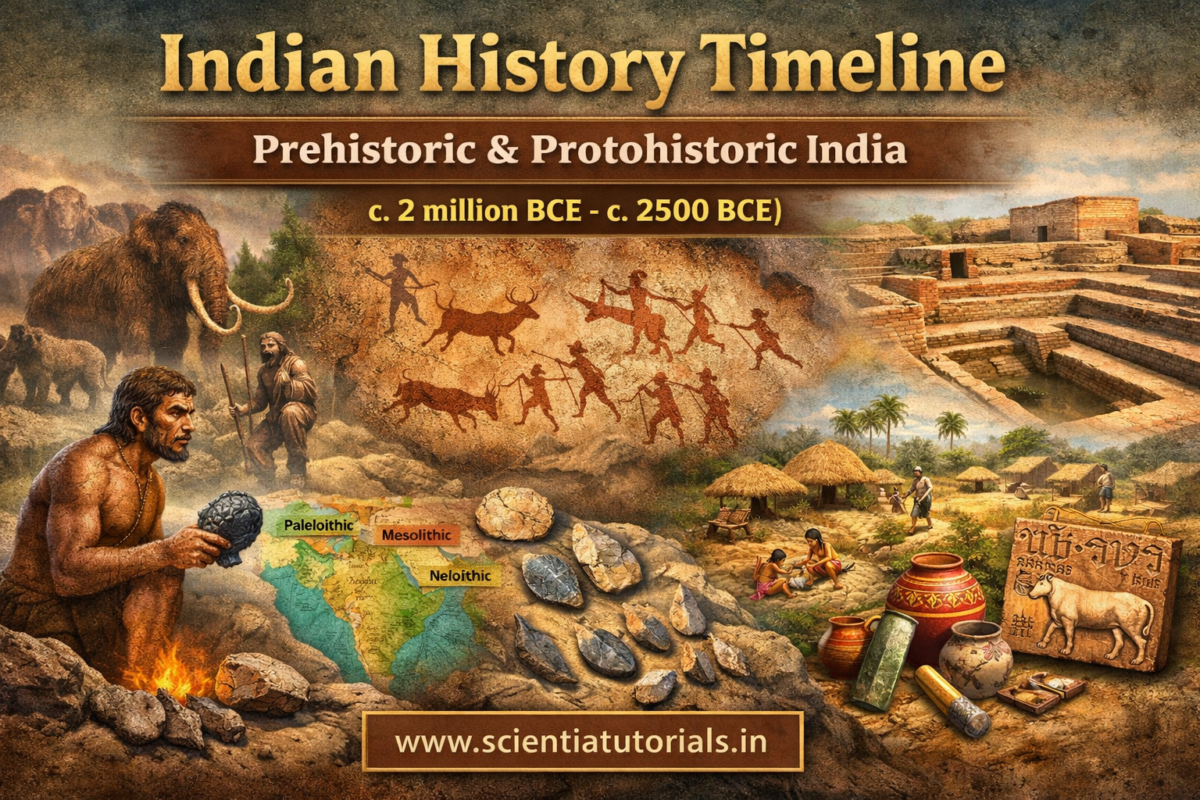

Indian History Timeline: Prehistoric & Protohistoric India | History of India
Course: History of India – Complete Chronological and Era-Wise Course
Section 1: Prehistoric & Protohistoric India (c. 2 million BCE – c. 2500 BCE)
1. Understanding History and the Scope of Indian History
History is the systematic study of the human past based on evidence, interpretation, and chronological arrangement of events. In the Indian context, history is not merely a political narrative of rulers and dynasties but a continuous civilizational process encompassing social life, culture, economy, technology, beliefs, and human interaction with the environment.
The History of India is among the longest and most complex in the world, stretching from early human evolution to the modern nation-state. Its richness lies in:
- Extraordinary chronological depth
- Cultural continuity and diversity
- Interaction between indigenous developments and external influences
- Regional variations within a broadly shared civilizational framework
This lesson introduces learners to the overall timeline of Indian history, with special emphasis on the earliest phase—Prehistoric and Protohistoric India, which forms the foundation for all subsequent historical developments.
2. Importance of a Chronological and Era-Wise Approach
A chronological framework is essential for understanding:
- Sequence and causation of historical events
- Evolution of technology, society, and culture over time
- Transitions between different historical phases
- Continuity and change in institutions and practices
An era-wise classification allows historians and students to:
- Study similar patterns within a defined time span
- Compare developments across regions and periods
- Analyze long-term processes such as urbanization, state formation, and cultural synthesis
For examination-oriented preparation, a chronological approach ensures clarity, precision, and coherence, making it easier to answer analytical and factual questions.
3. Broad Periodization of Indian History
Indian history is conventionally divided into three major phases:
A. Prehistoric Period
- Based on archaeological evidence
- No written records
- Covers the period of early human evolution and tool-making
B. Protohistoric Period
- Transitional phase between prehistory and history
- Existence of undeciphered scripts
- Most notable example: Harappan (Indus Valley) Civilization
C. Historic Period
- Availability of written sources
- Begins with the Vedic Age and continues to the present
This lesson focuses on the first two phases, which together constitute Section 1 of the Course.
4. Prehistoric India: Meaning and Chronological Framework
4.1 Definition of Prehistory
Prehistory refers to the long span of human past before the invention of writing. Knowledge of this period comes from:
- Stone tools
- Fossils
- Cave paintings
- Environmental remains (bones, pollen, ash)
4.2 Chronological Span
Prehistoric India extends from approximately:
- c. 2 million BCE (appearance of early humans)
- To c. 2500 BCE (emergence of urban civilization)
4.3 Basis of Classification
The prehistoric period is classified mainly on the technology of tools, particularly stone tools.
5. Phases of Prehistoric India
5.1 Paleolithic Age (Old Stone Age)
Chronology: c. 2 million BCE – c. 10,000 BCE
Key Features:
- Earliest phase of human existence
- Use of roughly chipped stone tools
- Nomadic hunter-gatherer lifestyle
- Dependence on nature
Sub-Phases:
- Lower Paleolithic
- Hand axes, cleavers
- Early humans like Homo erectus
- Sites: Soan Valley, Narmada Valley
- Middle Paleolithic
- Flake tools
- Improved hunting techniques
- Upper Paleolithic
- Fine blades and burins
- Beginning of artistic expression
5.2 Mesolithic Age (Middle Stone Age)
Chronology: c. 10,000 BCE – c. 6000 BCE
Key Features:
- Transitional phase between hunting-gathering and farming
- Use of microliths (small stone tools)
- Semi-nomadic lifestyle
- Domestication of animals
- Earliest evidence of rock art
Significance:
- Marks increasing control over environment
- Foundation for agricultural practices
5.3 Neolithic Age (New Stone Age)
Chronology: c. 6000 BCE – c. 2500 BCE
Key Features:
- Introduction of agriculture
- Polished stone tools
- Permanent settlements
- Pottery production
- Domestication of plants and animals
Major Developments:
- Food production economy
- Village life
- Social differentiation
- Beginning of property concepts
6. Chalcolithic Age: The Stone-Copper Phase
Chronology: c. 3000 BCE – c. 1500 BCE (overlaps with Neolithic in some regions)
Key Features:
- Use of copper tools along with stone
- Rural settlements
- Painted pottery
- Early metallurgy
Importance:
- Technological transition
- Precursor to urban civilization
7. Protohistoric India: Meaning and Significance
7.1 Definition
Protohistory refers to the phase where:
- Writing exists but is not fully deciphered
- Archaeology is the primary source of information
7.2 Major Example
- Harappan (Indus Valley) Civilization (c. 2600 BCE – c. 1900 BCE)
7.3 Characteristics
- Planned urban centers
- Standardized bricks
- Advanced drainage systems
- Trade networks
- Undeciphered script
Protohistory represents the threshold between prehistory and history, marking the emergence of complex societies.
8. Sources for Studying Early Indian History
8.1 Archaeological Sources
- Stone tools
- Pottery
- Structural remains
- Burials
8.2 Anthropological and Environmental Evidence
- Fossils
- Animal bones
- Climatic data
8.3 Limitations of Sources
- Absence of written records in prehistory
- Dependence on material culture
- Interpretative challenges
Despite these limitations, archaeological methods have provided a scientific and reliable reconstruction of early Indian history.
9. Evolution of Human Life in the Indian Subcontinent
The Indian subcontinent played a significant role in:
- Early human migration routes
- Adaptation to diverse environments
- Development of regional cultures
From hunter-gatherers to settled agricultural communities, early humans in India demonstrated:
- Technological innovation
- Social cooperation
- Cultural creativity
These developments laid the groundwork for later urban and historical civilizations.
10. Significance of Prehistoric and Protohistoric Studies
Studying these early phases helps us understand:
- Origins of human society
- Evolution of technology
- Relationship between humans and nature
- Roots of Indian civilization
For competitive examinations, this section is crucial for:
- Conceptual clarity
- Chronological accuracy
- Analytical understanding of long-term historical processes
11. Position of This Lesson within the Course Structure
This introductory lesson serves as:
- A conceptual foundation for the entire course
- A chronological roadmap for Indian history
- A bridge between human evolution and historical times
It prepares learners to engage systematically with:
- Ancient India
- Medieval India
- Modern India
12. Concluding Perspective
The History of India is not a fragmented narrative but a continuous, evolving story spanning millions of years. The Prehistoric and Protohistoric phases represent humanity’s earliest attempts to understand, adapt to, and transform the environment.
By adopting a chronologically structured and era-wise approach, this lesson equips students with the tools needed to:
- Analyze historical developments logically
- Appreciate cultural continuity and change
- Build a strong foundation for advanced historical study
This marks the beginning of a comprehensive journey through Indian history—rooted in deep time, enriched by diversity, and essential for understanding the present.
Below is a well-structured, examination-oriented set of 25 Questions with Answers, fully aligned with the lesson “Introduction to the History of India & Indian History Timeline”, and developed according to Section 1: Prehistoric & Protohistoric India of the History of India – Complete Chronological and Era-Wise Course.
Questions with Answers
Lesson: Introduction to the History of India & Indian History Timeline
Section 1: Prehistoric & Protohistoric India
1. What is history, and how is it defined in the Indian context?
Answer:
History is the systematic study of the human past based on evidence and chronological interpretation. In the Indian context, history includes not only political events but also social, economic, cultural, technological, and environmental developments across time.
2. Why is the study of Indian history considered unique among world civilizations?
Answer:
The history of India is unique due to its exceptional chronological depth, cultural continuity, regional diversity, and the coexistence of indigenous developments with external influences over several millennia.
3. What is meant by a chronological approach to history?
Answer:
A chronological approach involves studying historical events in the order in which they occurred over time, helping to understand sequence, causation, continuity, and change.
4. Why is an era-wise classification important in historical studies?
Answer:
Era-wise classification helps in grouping similar developments within a time frame, enabling comparative analysis, clarity in understanding transitions, and systematic preparation for examinations.
5. Name the three broad phases of Indian history.
Answer:
The three broad phases of Indian history are:
- Prehistoric Period
- Protohistoric Period
- Historic Period
6. What is prehistory?
Answer:
Prehistory refers to the period of human past before the invention of writing, known primarily through archaeological and anthropological evidence.
7. What is the chronological span of prehistoric India?
Answer:
Prehistoric India spans approximately from c. 2 million BCE to c. 2500 BCE.
8. On what basis is the prehistoric period classified?
Answer:
The prehistoric period is mainly classified on the basis of stone tool technology and the stages of human cultural and technological development.
9. What are the main stages of the Paleolithic Age?
Answer:
The Paleolithic Age is divided into:
- Lower Paleolithic
- Middle Paleolithic
- Upper Paleolithic
10. What were the key features of the Paleolithic Age?
Answer:
Key features include the use of roughly chipped stone tools, a hunter-gatherer lifestyle, nomadic movement, and complete dependence on nature.
11. Why is the Mesolithic Age considered a transitional phase?
Answer:
The Mesolithic Age is considered transitional because it marks the shift from hunting-gathering to early farming, with the use of microliths, semi-nomadic life, and beginnings of animal domestication.
12. What are microliths, and in which period were they used?
Answer:
Microliths are small, finely made stone tools primarily used during the Mesolithic Age for hunting and other daily activities.
13. What major changes occurred during the Neolithic Age?
Answer:
Major changes included the introduction of agriculture, domestication of animals, permanent settlements, polished stone tools, pottery, and the beginning of village life.
14. Why is the Neolithic Age described as a “food-producing stage”?
Answer:
It is called a food-producing stage because humans began cultivating crops and rearing animals instead of relying solely on hunting and gathering.
15. What is the Chalcolithic Age?
Answer:
The Chalcolithic Age is the period when copper tools were used along with stone tools, representing a technological transition between the Stone Age and the Bronze Age.
16. Why is the Chalcolithic Age significant in Indian history?
Answer:
It is significant because it marks early metallurgy, rural settlements, painted pottery, and sets the stage for the emergence of urban civilizations.
17. What is meant by protohistory?
Answer:
Protohistory refers to the transitional phase between prehistory and history where writing exists but is undeciphered, and archaeological evidence remains the primary source.
18. Which civilization is the most important example of protohistoric India?
Answer:
The Harappan (Indus Valley) Civilization is the most important example of protohistoric India.
19. Why is the Harappan Civilization classified as protohistoric?
Answer:
It is classified as protohistoric because it had a script that has not yet been fully deciphered, limiting direct historical interpretation.
20. What types of sources are used to study prehistoric India?
Answer:
Sources include stone tools, pottery, fossils, cave paintings, habitation sites, and environmental remains such as animal bones and ash.
21. What are the limitations of studying prehistoric history?
Answer:
Limitations include the absence of written records, dependence on material remains, and the interpretative nature of archaeological evidence.
22. How did early humans adapt to the Indian subcontinent?
Answer:
Early humans adapted by developing region-specific tools, exploiting diverse ecological zones, and gradually transitioning from nomadic to settled lifestyles.
23. Why is the study of prehistoric and protohistoric periods important?
Answer:
It helps in understanding the origins of human society, technological evolution, human–environment interaction, and the foundations of Indian civilization.
24. How does this lesson contribute to the overall course on Indian history?
Answer:
This lesson provides a chronological roadmap and conceptual foundation for understanding ancient, medieval, and modern phases of Indian history.
25. How does a chronological study aid examination preparation?
Answer:
Chronological study improves clarity, accuracy, and analytical ability, enabling students to structure answers logically and handle both factual and conceptual questions effectively.
Below is a comprehensive, examination-oriented set of 25 Multiple Choice Questions (MCQs) with correct answers and detailed concept-clearing explanations, strictly developed from the lesson “Introduction to the History of India & Indian History Timeline” under Section 1: Prehistoric & Protohistoric India of the course History of India – Complete Chronological and Era-Wise Course.
MCQs with Answers and Explanations
Lesson: Introduction to the History of India & Indian History Timeline
Section 1: Prehistoric & Protohistoric India
1. History is best defined as the study of:
A. Only political events of the past
B. Myths and legends of ancient societies
C. Human past based on evidence and chronological interpretation
D. Religious traditions alone
Correct Answer: C
Explanation:
History is a scientific and systematic study of the human past based on evidence such as archaeological remains, inscriptions, and texts, arranged chronologically to understand continuity and change.
2. In the Indian context, history primarily emphasizes:
A. Dynastic successions
B. Military conquests
C. A holistic view of society and culture
D. European interpretations
Correct Answer: C
Explanation:
Indian history goes beyond rulers and wars to include social life, economy, culture, technology, beliefs, and human–environment interaction.
3. The chronological span of prehistoric India is approximately:
A. c. 10,000 BCE – 2500 BCE
B. c. 2 million BCE – 2500 BCE
C. c. 6000 BCE – 1500 BCE
D. c. 3000 BCE – 1000 BCE
Correct Answer: B
Explanation:
Prehistoric India begins with early human evolution around 2 million BCE and ends with the rise of urban civilization around 2500 BCE.
4. Which of the following periods is based entirely on archaeological evidence due to the absence of writing?
A. Historic period
B. Medieval period
C. Protohistoric period
D. Prehistoric period
Correct Answer: D
Explanation:
Prehistory is the phase before the invention of writing, so knowledge depends entirely on material remains such as tools, fossils, and cave art.
5. The main basis for classifying the prehistoric period is:
A. Religious beliefs
B. Tool technology
C. Political organization
D. Trade relations
Correct Answer: B
Explanation:
Prehistoric periods are classified mainly according to the type and technology of tools used, especially stone tools.
6. The Paleolithic Age is also known as the:
A. New Stone Age
B. Middle Stone Age
C. Old Stone Age
D. Copper Age
Correct Answer: C
Explanation:
The Paleolithic Age is called the Old Stone Age because it represents the earliest stage of stone tool technology.
7. Which of the following is NOT a feature of the Paleolithic Age?
A. Nomadic lifestyle
B. Use of polished stone tools
C. Hunting and gathering
D. Roughly chipped stone tools
Correct Answer: B
Explanation:
Polished stone tools are a characteristic of the Neolithic Age, not the Paleolithic Age.
8. The Paleolithic Age is divided into Lower, Middle, and Upper phases mainly on the basis of:
A. Climate change
B. Artistic development
C. Tool typology and refinement
D. Religious practices
Correct Answer: C
Explanation:
The division reflects increasing sophistication and refinement in stone tool-making techniques.
9. The Mesolithic Age is considered a transitional phase because it shows:
A. Complete urbanization
B. Decline of stone tools
C. Transition from food gathering to food production
D. Use of iron tools
Correct Answer: C
Explanation:
The Mesolithic Age bridges the Paleolithic and Neolithic ages, marking gradual movement toward agriculture and domestication.
10. Microliths are associated mainly with the:
A. Paleolithic Age
B. Mesolithic Age
C. Neolithic Age
D. Chalcolithic Age
Correct Answer: B
Explanation:
Microliths are small, sharp stone tools characteristic of the Mesolithic Age, used for hunting and daily activities.
11. Which of the following developments is a key feature of the Neolithic Age?
A. Nomadic hunting
B. Absence of pottery
C. Agriculture and permanent settlements
D. Use of only copper tools
Correct Answer: C
Explanation:
The Neolithic Age marks the beginning of agriculture, village life, pottery, and domestication of animals.
12. The Neolithic Age is often referred to as the “food-producing stage” because:
A. Humans stopped hunting completely
B. Agriculture and animal domestication began
C. Food was imported from other regions
D. Surplus food was unknown
Correct Answer: B
Explanation:
For the first time, humans produced their own food through farming and animal husbandry rather than depending solely on nature.
13. Which technological feature distinguishes the Neolithic Age from earlier phases?
A. Chipped stone tools
B. Microliths
C. Polished stone tools
D. Iron implements
Correct Answer: C
Explanation:
Polished stone tools indicate advanced craftsmanship and are a hallmark of the Neolithic Age.
14. The Chalcolithic Age is characterized by the use of:
A. Only stone tools
B. Stone and copper tools
C. Bronze tools exclusively
D. Iron tools
Correct Answer: B
Explanation:
The Chalcolithic Age represents a transitional phase where copper tools were used alongside stone tools.
15. Which of the following best describes the Chalcolithic Age in India?
A. Fully urban civilization
B. Pure hunting-gathering economy
C. Rural settlements with early metallurgy
D. Industrial economy
Correct Answer: C
Explanation:
Chalcolithic cultures were largely rural, with agriculture, painted pottery, and early use of metals.
16. Protohistory refers to a period where:
A. Writing is completely absent
B. Written records are fully available
C. Writing exists but is undeciphered
D. Only oral traditions exist
Correct Answer: C
Explanation:
Protohistoric societies had writing systems that are not fully deciphered, limiting direct historical interpretation.
17. The most important example of protohistoric India is the:
A. Vedic civilization
B. Mauryan Empire
C. Harappan Civilization
D. Gupta Empire
Correct Answer: C
Explanation:
The Harappan (Indus Valley) Civilization had an undeciphered script and advanced urban features, making it protohistoric.
18. Why is the Harappan Civilization not considered fully historic?
A. Absence of cities
B. Lack of agriculture
C. Undeciphered script
D. Absence of trade
Correct Answer: C
Explanation:
Since the Harappan script has not been deciphered, historians rely mainly on archaeology rather than written records.
19. Which of the following is NOT a source for studying prehistoric India?
A. Stone tools
B. Cave paintings
C. Coins with inscriptions
D. Fossil remains
Correct Answer: C
Explanation:
Coins with inscriptions belong to historic periods; prehistoric studies rely on material remains without writing.
20. Archaeology is especially important for studying early Indian history because:
A. Written texts are abundant
B. Political records are detailed
C. Material evidence is the primary source
D. Oral traditions are sufficient
Correct Answer: C
Explanation:
For prehistoric and protohistoric periods, archaeology provides the main evidence through tools, structures, and environmental remains.
21. Which factor most influenced early human adaptation in the Indian subcontinent?
A. Uniform geography
B. Diverse ecological conditions
C. Overseas trade
D. Centralized political authority
Correct Answer: B
Explanation:
India’s varied geography encouraged diverse adaptations in tool-making, subsistence, and settlement patterns.
22. The study of prehistory helps historians mainly to understand:
A. Dynastic politics
B. Religious texts
C. Origins of human society and technology
D. Colonial administration
Correct Answer: C
Explanation:
Prehistory reveals how early humans evolved socially, technologically, and economically.
23. A chronological approach to Indian history helps in:
A. Ignoring cultural changes
B. Understanding sequence and causation
C. Studying only rulers
D. Memorizing isolated facts
Correct Answer: B
Explanation:
Chronology allows historians and students to see how developments followed one another and influenced later changes.
24. Which of the following best explains the importance of era-wise classification?
A. It shortens history
B. It avoids comparisons
C. It groups similar developments for analysis
D. It removes regional diversity
Correct Answer: C
Explanation:
Era-wise classification helps in systematic study and comparison of similar features within a time period.
25. The ultimate significance of studying prehistoric and protohistoric India lies in understanding:
A. Modern political boundaries
B. Colonial policies
C. Foundations of Indian civilization
D. Medieval religious movements
Correct Answer: C
Explanation:
These early phases explain the roots of settlement, agriculture, technology, and culture that shaped later Indian civilization, including the long historical continuity of India.
🎯 Targeting Exams Section
This post is specifically designed to support aspirants preparing for:
-
UPSC Civil Services Examination (Prelims & Mains)
-
State Public Service Commission (PSC) Examinations
-
SSC (CGL, CHSL, GD, etc.)
-
UGC NET (History)
-
Teaching Eligibility Tests (TET, CTET)
-
University Semester & Competitive History Exams
The content emphasizes chronology, conceptual clarity, and terminology, which are frequently tested in objective and analytical questions related to Ancient Indian History and Human Evolution in the Indian Subcontinent.
🔍 Related / Secondary Keyphrases
-
Prehistoric India timeline
-
Protohistoric India explained
-
Stone Age in India
-
Paleolithic Mesolithic Neolithic India
-
Chalcolithic Age in India
-
Early human evolution in India
-
Archaeological sources of Indian history
-
Indian history chronology for UPSC
-
Ancient Indian history foundation
-
History of India timeline notes