
Early Vedic Period: Society, Polity & Economy
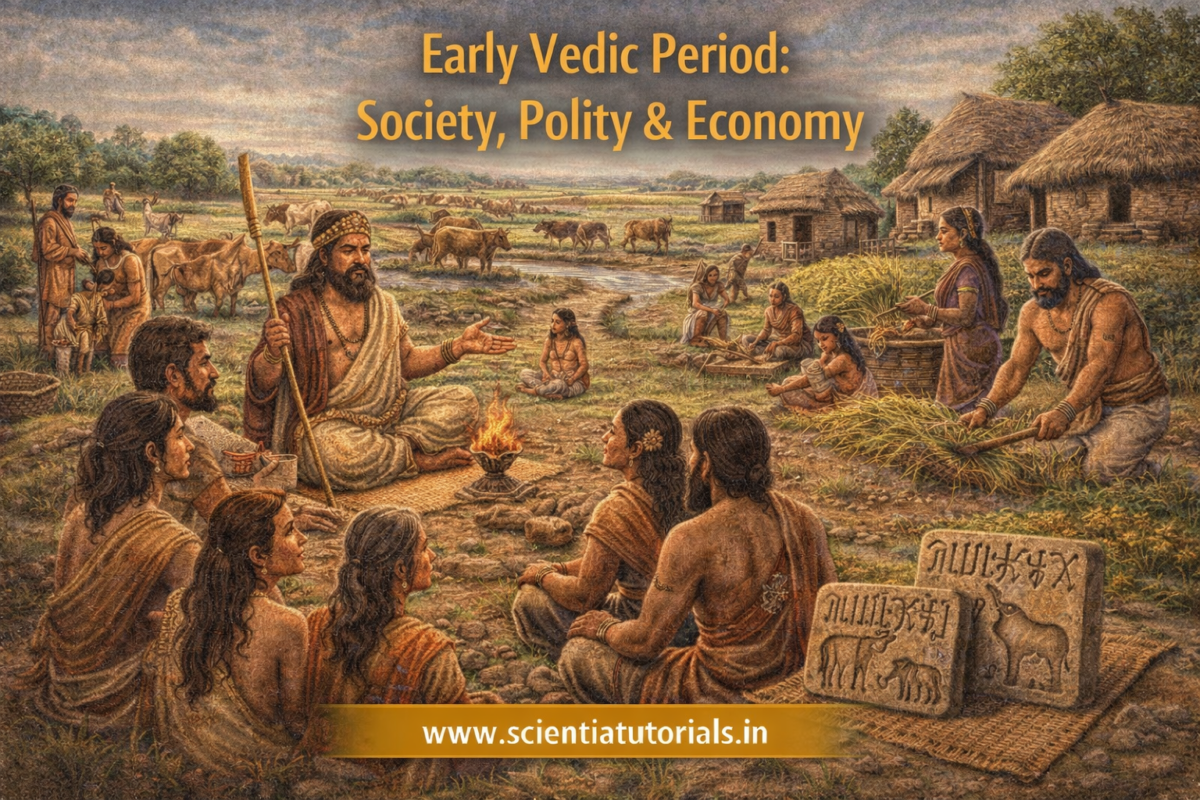

Early Vedic Period: Society, Polity & Economy | History of India
SECTION 3: Vedic Age & Religious–Philosophical Developments
Timeline: c. 1500 BCE – c. 600 BCE
(Ancient Indian History – Early Aryan Phase)
Lesson: Early Vedic Period – Society, Polity & Economy
(c. 1500 BCE – c. 1000 BCE)
Introduction: Transition from Harappan to Vedic World
The Early Vedic Period marks a crucial transitional phase in Indian history, following the decline of the Indus Valley Civilization and preceding the complex socio-political developments of the Later Vedic age. Spanning roughly from 1500 BCE to 1000 BCE, this period is associated with the early Indo-Aryans, whose life, beliefs, and institutions are primarily known through the Rigveda.
Unlike the urban, highly planned Harappan civilization, Early Vedic society was semi-nomadic, pastoral, and rural in character. The Early Vedic people gradually settled in the north-western parts of the Indian subcontinent, particularly in the Sapta Sindhu region (land of seven rivers). Their society, polity, and economy were simple, flexible, and clan-based, reflecting an early stage of social evolution.
This lesson provides a chronologically structured, examination-oriented analysis of Early Vedic society, political organization, and economic life, highlighting its distinctive features and historical significance.
Chronological Context of the Early Vedic Period
Early Vedic Period (c. 1500–1000 BCE)
- Composition of the Rigveda
- Pastoral and semi-nomadic economy
- Tribal political organization
- Flexible social structure
Later Vedic Period (c. 1000–600 BCE) (for comparison)
- Agrarian expansion
- Territorial states
- Complex varna system
- Ritualism and philosophy
I. Sources for the Study of Early Vedic Period
1. The Rigveda
The primary source of information for the Early Vedic period is the Rigveda, the oldest Indo-Aryan text.
Key Features:
- Composed in Vedic Sanskrit
- Consists of 1028 hymns arranged in 10 Mandalas
- Hymns dedicated to natural deities like Indra, Agni, Varuna, and Soma
The Rigveda provides insights into:
- Social relations
- Political institutions
- Economic activities
- Religious beliefs
II. Early Vedic Society
1. Tribal and Kinship-Based Society
Early Vedic society was tribal in nature, organized around kinship ties rather than territory.
- The basic social unit was the kula (family)
- Several families formed a grama (clan or settlement)
- Groups of gramas constituted a vis (tribe)
- The largest unit was the jana (tribal community)
There was no concept of a territorial state during this phase.
2. Family System
- Family was patriarchal
- Father was the head of the household
- Descent was traced through the male line
However, women enjoyed a relatively high status compared to later periods.
3. Position of Women
Women in Early Vedic society:
- Participated in religious rituals
- Had access to education
- Composed hymns (e.g., Gargi, Lopamudra, Apala)
- Could attend assemblies like sabha and samiti
Practices such as sati, child marriage, and purdah were unknown in the Early Vedic period.
4. Varna System (Early Form)
The varna system was:
- Fluid and occupational, not birth-based
- Four varnas mentioned: Brahmana, Kshatriya, Vaishya, Shudra
Key Points:
- No rigid hierarchy
- Social mobility was possible
- Shudras were not excluded from rituals
This contrasts sharply with the rigid caste system of later times.
5. Social Life and Culture
- Simple lifestyle
- Strong sense of equality within the tribe
- Absence of social untouchability
- Emphasis on bravery, generosity, and hospitality
III. Early Vedic Polity (Political Organization)
1. Nature of Early Vedic Polity
Early Vedic polity was:
- Tribal and decentralized
- Based on kinship, not territory
- Largely democratic in spirit
2. The King (Rajan)
The chief political authority was the rajan.
Characteristics:
- Tribal chief, not an absolute monarch
- Selected from leading clan families
- Dependent on popular assemblies
Functions of the King:
- Protection of tribe
- Leadership in wars
- Distribution of booty
- Maintenance of social order
The king did not maintain a standing army or bureaucracy.
3. Popular Assemblies
Two important assemblies played a crucial role in governance:
a) Sabha
- Smaller, elite council
- Judicial and administrative functions
b) Samiti
- General assembly of the tribe
- Discussed political matters
- Could elect or depose the king
These assemblies reflect the participatory nature of Early Vedic politics.
4. Officials and Administration
- No complex administrative machinery
- Officials included:
- Purohita (priest)
- Senani (military leader)
- Gramini (head of a grama)
Administration was simple and informal.
5. Law and Justice
- No written laws
- Justice based on customs and traditions
- King acted as judge with the help of elders
Punishments were mild and focused on compensation rather than coercion.
IV. Early Vedic Economy
1. Pastoral Economy
The Early Vedic economy was primarily pastoral.
- Cattle (go) were the main form of wealth
- Wealth measured in number of cows
- Terms like gavishti (search for cows) indicate cattle raids
Cattle played a central role in:
- Economy
- Social prestige
- Religious rituals
2. Agriculture
- Agriculture existed but was secondary
- Use of wooden ploughs
- Cultivation of barley (yava)
- Limited knowledge of iron tools
Agriculture gained prominence only in the Later Vedic period.
3. Trade and Exchange
- No coinage
- Barter system prevailed
- Limited trade within tribes
Trade was not a dominant economic activity.
4. Crafts and Occupations
- Limited craft specialization
- Artisans included:
- Potters
- Carpenters
- Blacksmiths (using copper/bronze)
Crafts were mostly for local consumption.
5. Concept of Property
- Land was generally owned by the tribe
- Private ownership was minimal
- Cattle were privately owned
There was no concept of land revenue or taxation.
6. Gifts and Booty
- Kings received bali (voluntary offerings), not regular taxes
- Wealth gained through:
- War booty
- Cattle raids
- Gifts during sacrifices
V. Religion and Its Influence on Society & Economy
Though religion is studied in detail separately, its impact on society and economy must be noted:
- Rituals centered on nature gods
- Sacrifices involved cattle and soma
- Priests received gifts, enhancing their social position
Religion reinforced the pastoral and tribal character of the economy.
VI. Comparison with Harappan Civilization
| Aspect | Harappan Civilization | Early Vedic Period |
|---|---|---|
| Economy | Urban, trade-based | Pastoral, rural |
| Society | Urban, regulated | Tribal, kin-based |
| Polity | Civic administration | Tribal chiefdom |
| Religion | Symbolic, non-textual | Hymn-based, ritualistic |
This contrast highlights a major civilizational shift in Indian history.
VII. Historical Significance of the Early Vedic Period
The Early Vedic period is significant because:
- It introduced Vedic culture and language
- Laid foundations of:
- Varna system
- Political institutions
- Religious traditions
- Represents the earliest phase of Indo-Aryan civilization in India
Despite its simplicity, this period shaped the future course of Indian society.
Examination-Oriented Key Points
- Source: Rigveda
- Economy: Pastoral, cattle-based
- Society: Tribal, patriarchal, flexible varna
- Women: High status compared to later periods
- Polity: Sabha & Samiti
- King: Tribal chief, not absolute ruler
Conclusion
The Early Vedic Period represents a formative stage in the history of ancient India, characterized by tribal social organization, participatory political institutions, and a pastoral economy. Though simple in structure, Early Vedic society was dynamic, flexible, and relatively egalitarian. Many institutions that later became complex—such as the varna system, kingship, and ritual practices—had their humble beginnings during this phase.
Understanding the Early Vedic Period is essential for appreciating the long-term evolution of Indian civilization, as it forms the bridge between prehistoric cultures and the later philosophical, political, and social developments of ancient India.
Below is a well-structured, examination-oriented set of 25 Questions with clear and accurate Answers based strictly on the lesson
“Early Vedic Period: Society, Polity & Economy” under
SECTION 3: Vedic Age & Religious-Philosophical Developments.
The questions move from basic conceptual understanding to analytical clarity, making them suitable for UPSC, State PSCs, SSC, NET, and university examinations.
Early Vedic Period – Society, Polity & Economy
Questions with Answers (25 Q&A Set)
1. What is the chronological span of the Early Vedic Period?
Answer:
The Early Vedic Period roughly spans from c. 1500 BCE to c. 1000 BCE.
2. What is the main literary source for the Early Vedic Period?
Answer:
The primary source is the Rigveda, the oldest Vedic text.
3. What type of society existed during the Early Vedic Period?
Answer:
Early Vedic society was tribal, pastoral, and kinship-based, not territorial or urban.
4. What was the basic social unit in Early Vedic society?
Answer:
The basic social unit was the kula (family).
5. Explain the hierarchical social units of Early Vedic society.
Answer:
Several families formed a grama; multiple gramas formed a vis (tribe); several vis together constituted a jana.
6. Was Early Vedic society patriarchal or matriarchal?
Answer:
Early Vedic society was patriarchal, with descent traced through the male line.
7. What was the position of women in Early Vedic society?
Answer:
Women enjoyed a relatively high status: they participated in rituals, received education, composed hymns, and attended assemblies.
8. Name two women scholars mentioned in the Rigveda.
Answer:
Gargi and Lopamudra are two well-known women scholars mentioned in the Rigveda.
9. What social practices common in later periods were absent in Early Vedic society?
Answer:
Practices such as sati, child marriage, purdah, and untouchability were absent.
10. Describe the nature of the varna system in the Early Vedic Period.
Answer:
The varna system was flexible and occupation-based, not rigid or birth-based.
11. Name the four varnas mentioned in the Early Vedic texts.
Answer:
Brahmana, Kshatriya, Vaishya, and Shudra.
12. How was Early Vedic polity organized?
Answer:
Early Vedic polity was tribal, decentralized, and kinship-based, without a territorial state.
13. Who was the rajan in Early Vedic polity?
Answer:
The rajan was the tribal chief who led the tribe in war and maintained order.
14. Was the Early Vedic king an absolute monarch?
Answer:
No, the king was not absolute; his authority was limited by popular assemblies.
15. Name the two important popular assemblies of the Early Vedic Period.
Answer:
The sabha and the samiti.
16. What were the functions of the sabha?
Answer:
The sabha functioned as a smaller council, dealing with judicial and administrative matters.
17. What role did the samiti play in Early Vedic polity?
Answer:
The samiti was a general tribal assembly that discussed political matters and could even elect or depose the king.
18. Mention two important officials of the Early Vedic administration.
Answer:
The purohita (priest) and senani (military leader).
19. What was the nature of the Early Vedic economy?
Answer:
The Early Vedic economy was primarily pastoral, with cattle as the main form of wealth.
20. Why were cattle important in Early Vedic society?
Answer:
Cattle were a symbol of wealth, social status, religious offerings, and economic security.
21. What does the term ‘gavishti’ signify?
Answer:
Gavishti means search for cows, often referring to cattle raids or conflicts.
22. What was the role of agriculture in the Early Vedic economy?
Answer:
Agriculture existed but played a secondary role; barley was the main crop.
23. What system of exchange existed in the Early Vedic Period?
Answer:
The barter system prevailed; coinage was unknown.
24. What was ‘bali’ in the Early Vedic context?
Answer:
Bali was a voluntary offering or gift given to the king, not a regular tax.
25. Why is the Early Vedic Period historically significant?
Answer:
It laid the foundations of Vedic culture, social institutions, political assemblies, and economic practices that shaped later Indian civilization.
Below is a well-structured, examination-oriented set of 25 Multiple Choice Questions (MCQs) with correct answers and detailed, concept-clearing explanations, based strictly on the lesson
“Early Vedic Period: Society, Polity & Economy” under
SECTION 3: Vedic Age & Religious-Philosophical Developments.
These MCQs are designed for UPSC Prelims, State PSCs, SSC, UGC-NET, and university examinations, covering factual recall, conceptual clarity, and analytical understanding.
Early Vedic Period – Society, Polity & Economy
MCQs with Answers & Explanations (25 Questions)
1. The Early Vedic Period is generally dated between:
A. c. 2500–1750 BCE
B. c. 2000–1500 BCE
C. c. 1500–1000 BCE
D. c. 1000–600 BCE
Correct Answer: C
Explanation:
The Early Vedic Period corresponds to the composition of the Rigveda and is dated roughly from 1500 BCE to 1000 BCE.
2. The principal source of information for the Early Vedic Period is the:
A. Atharvaveda
B. Yajurveda
C. Samaveda
D. Rigveda
Correct Answer: D
Explanation:
The Rigveda is the earliest Vedic text and provides detailed insights into Early Vedic society, polity, and economy.
3. Early Vedic society was primarily:
A. Urban and mercantile
B. Agrarian and feudal
C. Pastoral and tribal
D. Industrial and commercial
Correct Answer: C
Explanation:
Early Vedic society was largely pastoral, semi-nomadic, and organized on tribal and kinship lines.
4. The basic social unit of Early Vedic society was the:
A. Vis
B. Jana
C. Grama
D. Kula
Correct Answer: D
Explanation:
The kula (family) formed the fundamental unit of social organization.
5. Which sequence correctly represents the social organization of Early Vedic society?
A. Jana → Vis → Grama → Kula
B. Kula → Grama → Vis → Jana
C. Grama → Kula → Jana → Vis
D. Vis → Jana → Grama → Kula
Correct Answer: B
Explanation:
Families (kula) formed gramas, several gramas formed a vis, and multiple vis constituted a jana.
6. The nature of Early Vedic society can best be described as:
A. Highly stratified and rigid
B. Egalitarian and flexible
C. Feudal and hierarchical
D. Urban and centralized
Correct Answer: B
Explanation:
Social divisions were fluid, and rigid caste hierarchy had not yet developed.
7. Which statement best describes the position of women in the Early Vedic Period?
A. Completely excluded from rituals
B. Confined to domestic life
C. Enjoyed relatively high status
D. Considered socially inferior
Correct Answer: C
Explanation:
Women participated in rituals, education, and even composed hymns, indicating a relatively high status.
8. Which of the following practices was NOT prevalent in Early Vedic society?
A. Patriarchy
B. Participation of women in rituals
C. Child marriage
D. Tribal assemblies
Correct Answer: C
Explanation:
Child marriage, sati, and purdah were unknown during the Early Vedic period.
9. The varna system in the Early Vedic Period was:
A. Rigid and birth-based
B. Fluid and occupation-based
C. Caste-based with untouchability
D. Fully developed and hierarchical
Correct Answer: B
Explanation:
Varna divisions were flexible and based on occupation rather than birth.
10. Which varna appeared last in Early Vedic society?
A. Brahmana
B. Kshatriya
C. Vaishya
D. Shudra
Correct Answer: D
Explanation:
The Shudra varna appears later in the Rigvedic hymns and was not rigidly marginalized.
11. Early Vedic polity was primarily:
A. Territorial and centralized
B. Tribal and kinship-based
C. Imperial and bureaucratic
D. Urban and municipal
Correct Answer: B
Explanation:
Political organization revolved around tribes rather than fixed territories.
12. The Early Vedic king was known as the:
A. Samrat
B. Chakravartin
C. Raja (Rajan)
D. Maharaja
Correct Answer: C
Explanation:
The rajan was the tribal chief and not an absolute monarch.
13. Which statement correctly describes the power of the Early Vedic king?
A. Absolute and hereditary
B. Divinely ordained ruler
C. Limited by tribal assemblies
D. Head of a bureaucratic state
Correct Answer: C
Explanation:
The king’s authority was checked by assemblies like sabha and samiti.
14. The sabha and samiti in the Early Vedic Period were:
A. Religious councils only
B. Judicial courts alone
C. Popular tribal assemblies
D. Bureaucratic departments
Correct Answer: C
Explanation:
They represented early forms of participatory governance.
15. Which assembly was more representative of the general tribal population?
A. Sabha
B. Samiti
C. Parishad
D. Vidatha
Correct Answer: B
Explanation:
The samiti was the general assembly and had wider participation.
16. The chief source of wealth in the Early Vedic economy was:
A. Land
B. Gold
C. Cattle
D. Coins
Correct Answer: C
Explanation:
Cattle (go) were the primary measure of wealth, status, and economic power.
17. The term ‘gavishti’ in the Rigveda refers to:
A. Agricultural surplus
B. Horse sacrifice
C. Cattle raids
D. Land grants
Correct Answer: C
Explanation:
Gavishti literally means “search for cows,” often implying cattle raids.
18. Agriculture in the Early Vedic Period was:
A. Dominant and intensive
B. Completely absent
C. Secondary to pastoralism
D. Based on iron tools
Correct Answer: C
Explanation:
Agriculture existed but pastoralism remained the main economic activity.
19. Which crop is most commonly mentioned in Early Vedic texts?
A. Rice
B. Wheat
C. Barley
D. Cotton
Correct Answer: C
Explanation:
Barley (yava) was the chief cultivated crop in the Early Vedic period.
20. The system of exchange in the Early Vedic economy was based on:
A. Coinage
B. Credit system
C. Barter
D. State taxation
Correct Answer: C
Explanation:
Coinage was unknown; goods were exchanged through barter.
21. What was ‘bali’ in the Early Vedic context?
A. Compulsory land tax
B. Voluntary gift to the king
C. Religious penalty
D. Military tribute
Correct Answer: B
Explanation:
Bali was a voluntary offering, not a regular tax.
22. Craft specialization in the Early Vedic Period was:
A. Highly developed
B. State-controlled
C. Limited and local
D. Export-oriented
Correct Answer: C
Explanation:
Crafts existed but were simple and mainly for local needs.
23. Which metal was commonly used during the Early Vedic Period?
A. Iron
B. Steel
C. Copper and bronze
D. Gold only
Correct Answer: C
Explanation:
Iron technology became widespread only in the Later Vedic period.
24. Compared to the Harappan Civilization, the Early Vedic economy was:
A. More urbanized
B. More trade-oriented
C. More pastoral and rural
D. More industrial
Correct Answer: C
Explanation:
Early Vedic economy marked a shift from urban Harappan life to pastoral tribal life.
25. The historical significance of the Early Vedic Period lies in the fact that it:
A. Marked the peak of urban civilization
B. Introduced iron technology
C. Laid foundations of later Indian institutions
D. Established a centralized empire
Correct Answer: C
Explanation:
Institutions like varna, kingship, assemblies, and Vedic culture originated in this period.
Targeting Exams
Highly useful for:
-
UPSC Civil Services Examination (Prelims & Mains – Ancient History)
-
State Public Service Commission (PSC) Examinations
-
SSC (CGL, CHSL – History)
-
UGC NET / SET (History)
-
University Semester Exams (Ancient Indian History)
-
TET & Teaching Eligibility Examinations
Related / Supporting Keyphrases
-
Early Vedic society features
-
Rigvedic polity sabha samiti
-
Early Vedic economy pastoral cattle
-
Varna system in Early Vedic period
-
Position of women in Rigvedic age
-
Raja and tribal polity Early Vedic
-
Rigvedic social organization notes
-
Early Vedic Period UPSC notes