
Foundation of Mughal Rule in India
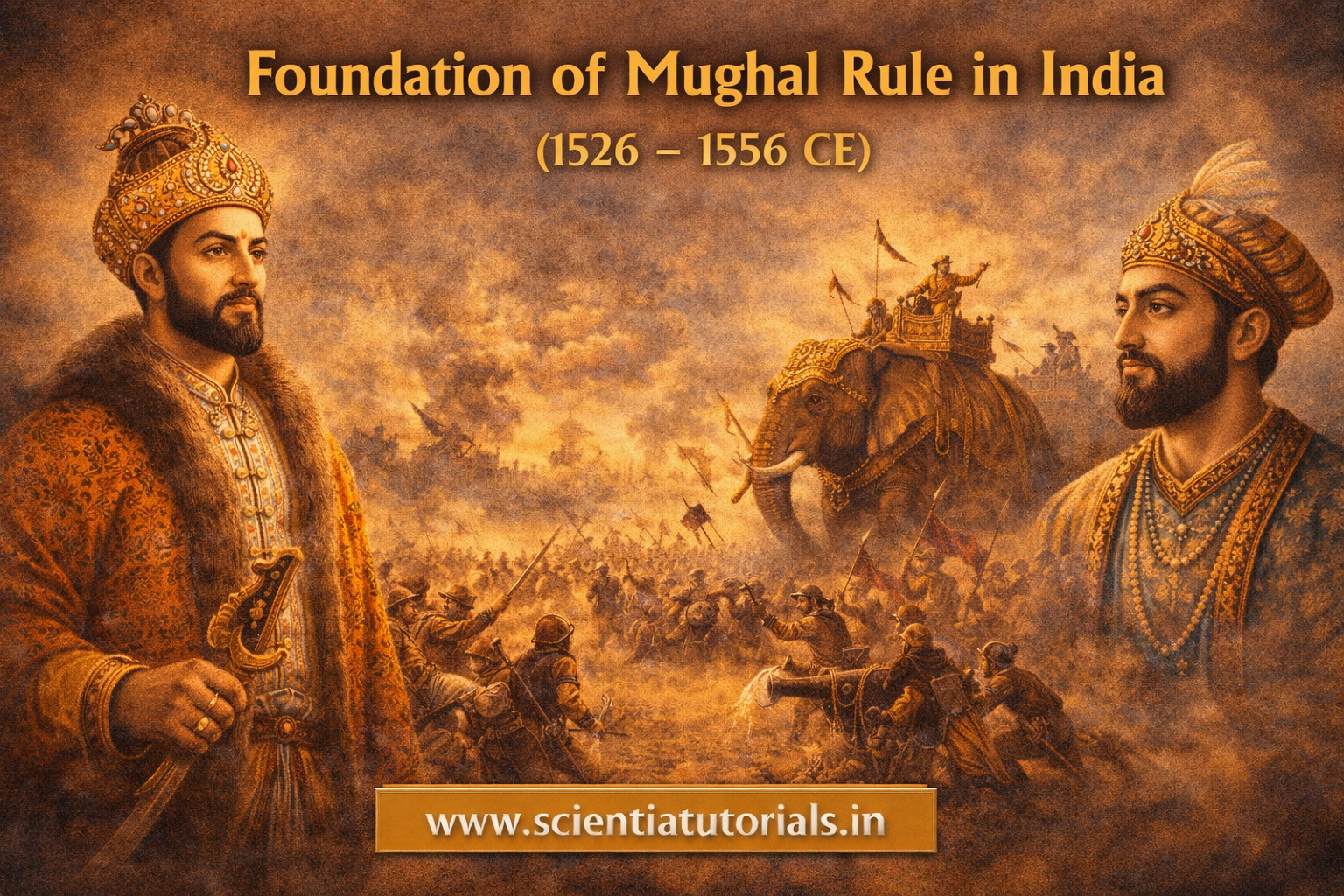

Foundation of Mughal Rule in India (1526–1556 CE)
SECTION 9: Mughal Empire in India – Medieval Indian History (Mughal Phase)
1. Introduction: Transition from Sultanate to Mughal Rule
The establishment of the Mughal Empire in India marks a decisive turning point in Indian history. The year 1526 CE, when Babur defeated the Lodi ruler at the First Battle of Panipat, represents not merely a dynastic change but the beginning of a new imperial system distinguished by superior military technology, administrative innovation, and cultural synthesis.
Unlike earlier invaders, the Mughals succeeded in laying the foundations of a durable, centralised empire, which lasted for nearly two centuries and profoundly shaped India’s political, social, and cultural landscape.
2. Background: Political Conditions in India on the Eve of Mughal Conquest
2.1 Decline of the Delhi Sultanate
By the early 16th century, the Delhi Sultanate had weakened significantly due to:
- Weak central authority under the Lodi rulers
- Afghan tribal dissensions
- Rebellion of provincial governors
- Failure to adapt to gunpowder warfare
The Sultanate had become vulnerable to external invasion.
2.2 Disintegration of Regional Powers
India was politically fragmented:
- Rajput states were divided and lacked unity
- Afghan chiefs were internally divided
- Provincial kingdoms were more concerned with local power
This fragmentation created favourable conditions for a foreign conqueror with superior military organisation.
3. Babur: Ancestry, Early Life, and Ambitions
3.1 Lineage and Early Career
Babur was a descendant of:
- Timur on his father’s side
- Genghis Khan on his mother’s side
Born in 1483 CE at Fergana, Babur inherited a small principality but spent much of his early life struggling against powerful Uzbek rivals.
3.2 Shift of Ambition towards India
After losing his Central Asian territories:
- Babur captured Kabul (1504 CE)
- Looked towards India for expansion
- Attracted by India’s wealth and political instability
India offered Babur both economic resources and political opportunity.
4. Causes of Babur’s Invasion of India
4.1 Political Weakness of the Lodi Dynasty
Ibrahim Lodi faced:
- Revolts from Afghan nobles
- Opposition from Rajput chiefs
- Loss of loyalty among governors
His autocratic behaviour alienated both nobles and relatives.
4.2 Invitation from Indian Nobles
Disaffected nobles such as Daulat Khan Lodi and Alam Khan Lodi invited Babur to invade India to overthrow Ibrahim Lodi.
4.3 Economic Motivation
India’s fertile plains, prosperous cities, and thriving trade attracted Babur, especially compared to the limited resources of Kabul.
4.4 Military Superiority
Babur possessed:
- Field artillery
- Matchlockmen
- Ottoman-style military organisation
This technological advantage played a decisive role.
5. First Battle of Panipat (1526 CE): Foundation of Mughal Rule
5.1 Background
The decisive battle between Babur and Ibrahim Lodi took place on 21 April 1526 near Panipat.
5.2 Forces Involved
| Babur | Ibrahim Lodi |
|---|---|
| Smaller army | Large but disorganised army |
| Artillery and firearms | Traditional cavalry and elephants |
| Disciplined troops | Afghan tribal forces |
5.3 Military Strategy
Babur used:
- Tulughma (division of forces)
- Rumi method (use of carts and artillery)
These techniques neutralised the numerical superiority of the Lodi army.
5.4 Outcome and Significance
- Ibrahim Lodi was killed
- Delhi and Agra fell to Babur
- The Delhi Sultanate came to an end
🔹 Historical Significance:
This battle laid the foundation of Mughal rule in India.
6. Consolidation of Mughal Power under Babur
6.1 Battle of Khanwa (1527 CE)
Babur faced a formidable Rajput confederacy led by Rana Sanga.
Significance:
- Defeat of Rajputs ended the possibility of a Rajput-led empire
- Established Mughal supremacy in North India
6.2 Battle of Chanderi (1528 CE)
- Defeat of Rajput resistance
- Strengthened Mughal control over Central India
6.3 Battle of Ghagra (1529 CE)
- Defeated Afghan chiefs in eastern India
- Eliminated Afghan challenge to Mughal authority
7. Nature of Babur’s Rule in India
7.1 Administrative Approach
- Babur ruled as a conqueror, not a fully settled emperor
- Retained many existing administrative practices
- Focused primarily on military consolidation
7.2 Revenue and Governance
- No major administrative reforms
- Revenue system remained largely unchanged
- Relied on military commanders and loyal nobles
7.3 Cultural Contributions
Babur introduced:
- Persian cultural traditions
- Garden architecture (Charbagh style)
- Memoirs (Baburnama)
8. Humayun and the Struggle for Mughal Survival (1530–1556 CE)
8.1 Accession of Humayun
After Babur’s death in 1530 CE, Humayun inherited an unstable empire.
8.2 Weaknesses of Early Mughal Rule
- Afghan resurgence
- Lack of administrative consolidation
- Inexperience of the new ruler
8.3 Rise of Sher Shah Suri
Sher Shah Suri emerged as a powerful Afghan leader.
8.4 Battles of Chausa (1539 CE) and Kannauj (1540 CE)
- Humayun suffered decisive defeats
- Mughal rule collapsed temporarily
- Humayun fled to Persia
9. Sur Interregnum and Its Impact
Although brief, the Sur period:
- Introduced administrative and revenue reforms
- Demonstrated the importance of strong governance
- Influenced later Mughal administration
This phase indirectly strengthened Mughal foundations.
10. Restoration of Mughal Rule (1555–1556 CE)
With Persian support:
- Humayun recaptured Kabul and Kandahar
- Reoccupied Delhi in 1555 CE
His sudden death in 1556 CE ended the fragile restoration.
11. Accession of Akbar and Final Consolidation
The accession of Akbar in 1556 CE marked the true consolidation of Mughal rule.
Although young, Akbar:
- Defeated Hemu at the Second Battle of Panipat (1556 CE)
- Laid administrative foundations
- Transformed the Mughal state into a stable empire
12. Nature and Significance of the Foundation of Mughal Rule
Key Features
- Use of gunpowder technology
- Centralised military power
- Adaptation to Indian conditions
- Cultural accommodation
Historical Significance
- Ended Afghan dominance in North India
- Introduced a new imperial system
- Laid the basis for Mughal administrative brilliance
- Shaped medieval Indian polity for centuries
13. Conclusion
The foundation of Mughal rule in India was not a sudden or accidental event but the result of a combination of political weakness of the Delhi Sultanate, Babur’s military genius, and technological superiority. While Babur established Mughal authority through conquest, it was tested under Humayun and finally stabilised under Akbar.
Thus, the Mughal Empire emerged as a strong, centralised, and enduring imperial structure, marking the beginning of a new era in Indian history.
Below is a well-structured, examination-oriented set of 25 Questions with Clear and Accurate Answers based strictly on the lesson
“Foundation of Mughal Rule in India”, aligned with
SECTION 9: Mughal Empire in India (1526–1707 CE).
✔️ Chronological and cause–effect based
✔️ Suitable for UPSC, State PSC, UGC NET, CUET & University exams
Foundation of Mughal Rule in India – Questions & Answers
Q1. What is meant by the ‘Foundation of Mughal Rule in India’?
Answer:
It refers to the process beginning with the defeat of the Lodi dynasty in 1526 CE and ending with the consolidation of Mughal authority under Akbar by 1556 CE.
Q2. Which event marks the beginning of Mughal rule in India?
Answer:
The First Battle of Panipat (1526 CE) marks the beginning of Mughal rule.
Q3. Who founded the Mughal Empire in India?
Answer:
Babur founded the Mughal Empire in India.
Q4. What was Babur’s ancestral background?
Answer:
Babur was a descendant of Timur from his father’s side and Genghis Khan from his mother’s side.
Q5. Why did Babur turn his attention towards India?
Answer:
After losing his Central Asian territories, Babur was attracted by India’s political instability, economic wealth, and strategic opportunities.
Q6. What was the political condition of India on the eve of Babur’s invasion?
Answer:
India was politically fragmented, with a weak Delhi Sultanate, divided Afghan nobility, and disunited regional powers.
Q7. Who was the ruler of Delhi defeated by Babur in 1526 CE?
Answer:
Babur defeated Ibrahim Lodi, the last Lodi ruler of Delhi.
Q8. What were the main causes of Babur’s invasion of India?
Answer:
- Weakness of the Lodi dynasty
- Invitation from discontented Afghan nobles
- Economic attraction of India
- Babur’s military and technological superiority
Q9. Which Indian nobles invited Babur to invade India?
Answer:
Daulat Khan Lodi and Alam Khan Lodi invited Babur to overthrow Ibrahim Lodi.
Q10. Why was Babur’s army superior to that of the Lodis?
Answer:
Babur used artillery, firearms, disciplined troops, and modern military tactics, unlike the traditional cavalry-based Lodi army.
Q11. What military strategies did Babur use at the First Battle of Panipat?
Answer:
Babur employed the Tulughma system (division of forces) and the Rumi method (use of carts and artillery).
Q12. What was the outcome of the First Battle of Panipat?
Answer:
Ibrahim Lodi was killed, Delhi and Agra were captured, and the Delhi Sultanate came to an end.
Q13. Why is the First Battle of Panipat historically significant?
Answer:
It laid the foundation of Mughal rule and introduced gunpowder warfare in Indian politics.
Q14. Which battle established Mughal supremacy over the Rajputs?
Answer:
The Battle of Khanwa (1527 CE) established Mughal supremacy over the Rajputs.
Q15. Who led the Rajput confederacy against Babur at Khanwa?
Answer:
Rana Sanga led the Rajput confederacy.
Q16. What was the significance of the Battle of Khanwa?
Answer:
It eliminated the possibility of a Rajput-led empire and firmly established Mughal dominance in North India.
Q17. Which battles further strengthened Babur’s position after Khanwa?
Answer:
The Battle of Chanderi (1528 CE) and the Battle of Ghagra (1529 CE).
Q18. What was the nature of Babur’s rule in India?
Answer:
Babur ruled primarily as a conqueror, focusing on military consolidation rather than administrative reforms.
Q19. What cultural contributions did Babur make in India?
Answer:
Babur introduced Persian cultural traditions, garden architecture (Charbagh style), and wrote his autobiography, Baburnama.
Q20. Who succeeded Babur after his death in 1530 CE?
Answer:
Humayun succeeded Babur.
Q21. Why was Humayun unable to consolidate Mughal rule initially?
Answer:
Due to Afghan resurgence, administrative weakness, and his own inexperience as a ruler.
Q22. Who was the Afghan ruler responsible for temporarily overthrowing Mughal rule?
Answer:
Sher Shah Suri temporarily displaced the Mughals.
Q23. Which battles led to Humayun’s defeat and exile?
Answer:
The Battle of Chausa (1539 CE) and the Battle of Kannauj (1540 CE).
Q24. How and when was Mughal rule restored in India?
Answer:
Humayun restored Mughal rule in 1555 CE with Persian support by recapturing Delhi.
Q25. Why is Akbar’s accession considered crucial to the foundation of Mughal rule?
Answer:
The accession of Akbar marked the final consolidation of Mughal rule through military success and administrative stability.
Below is a well-structured, examination-oriented set of 25 Multiple Choice Questions (MCQs) with correct answers and detailed, concept-clearing explanations, developed strictly from the lesson
“Foundation of Mughal Rule in India” under
SECTION 9: Mughal Empire in India (1526–1707 CE).
✔️ UPSC / State PSC / UGC NET / CUET / University-ready
Foundation of Mughal Rule in India – MCQs with Answers & Explanations
MCQ 1
The foundation of Mughal rule in India is generally dated to:
A. 1504 CE
B. 1519 CE
C. 1526 CE
D. 1556 CE
Correct Answer: C
Explanation:
The year 1526 CE marks the First Battle of Panipat, which established Mughal political authority in India.
MCQ 2
Who founded the Mughal Empire in India?
A. Humayun
B. Akbar
C. Sher Shah Suri
D. Babur
Correct Answer: D
Explanation:
Babur founded the Mughal Empire after defeating the Lodi ruler in 1526 CE.
MCQ 3
Babur was a descendant of:
A. Ashoka and Chandragupta
B. Timur and Genghis Khan
C. Mahmud of Ghazni and Muhammad Ghori
D. Alauddin Khalji and Balban
Correct Answer: B
Explanation:
Babur traced his lineage to Timur (father’s side) and Genghis Khan (mother’s side), enhancing his political prestige.
MCQ 4
Which battle laid the foundation of Mughal rule in India?
A. Battle of Khanwa
B. Battle of Ghagra
C. First Battle of Panipat
D. Battle of Chausa
Correct Answer: C
Explanation:
The First Battle of Panipat (1526 CE) decisively ended Lodi rule and initiated Mughal dominance.
MCQ 5
The ruler defeated by Babur at the First Battle of Panipat was:
A. Sikandar Lodi
B. Daulat Khan Lodi
C. Ibrahim Lodi
D. Alam Khan Lodi
Correct Answer: C
Explanation:
Ibrahim Lodi was the last Lodi ruler of Delhi and was killed in the battle.
MCQ 6
Which factor most weakened the Delhi Sultanate before Babur’s invasion?
A. Strong Rajput unity
B. Afghan tribal dissensions
C. Excessive trade control
D. Religious revolts
Correct Answer: B
Explanation:
Internal Afghan rivalries and noble rebellions severely weakened the Lodi administration.
MCQ 7
Which Indian nobles invited Babur to invade India?
A. Rana Sanga and Medini Rai
B. Daulat Khan Lodi and Alam Khan Lodi
C. Sher Shah Suri and Islam Shah
D. Humayun and Kamran
Correct Answer: B
Explanation:
Disaffected Afghan nobles sought Babur’s help to overthrow Ibrahim Lodi.
MCQ 8
Babur’s military superiority was mainly due to:
A. Larger army size
B. Elephant warfare
C. Use of artillery and firearms
D. Naval strength
Correct Answer: C
Explanation:
Babur introduced gunpowder warfare, including cannons and matchlockmen, unfamiliar to Indian armies.
MCQ 9
The military tactics used by Babur at Panipat included:
A. Guerrilla warfare only
B. Naval blockade
C. Tulughma and Rumi methods
D. Rajput-style cavalry charge
Correct Answer: C
Explanation:
Tulughma involved flanking movements, while the Rumi method used carts and artillery defensively.
MCQ 10
Which city became the first Mughal capital after Panipat?
A. Lahore
B. Agra
C. Delhi
D. Kabul
Correct Answer: B
Explanation:
Babur captured Agra, which served as an early Mughal administrative centre.
MCQ 11
Which battle established Mughal supremacy over the Rajputs?
A. Battle of Chanderi
B. Battle of Panipat
C. Battle of Khanwa
D. Battle of Ghagra
Correct Answer: C
Explanation:
The Battle of Khanwa (1527 CE) crushed the Rajput confederacy.
MCQ 12
The Rajput confederacy at Khanwa was led by:
A. Medini Rai
B. Rana Pratap
C. Rana Sanga
D. Maldev Rathore
Correct Answer: C
Explanation:
Rana Sanga led the strongest Rajput challenge to early Mughal power.
MCQ 13
The defeat of Rana Sanga at Khanwa was significant because it:
A. Ended Afghan resistance
B. Destroyed Mughal artillery
C. Eliminated the possibility of Rajput imperial dominance
D. Strengthened the Lodi dynasty
Correct Answer: C
Explanation:
After Khanwa, Rajputs could no longer challenge Mughal supremacy at the imperial level.
MCQ 14
Which battle eliminated Afghan resistance in eastern India?
A. Battle of Khanwa
B. Battle of Chausa
C. Battle of Ghagra
D. Battle of Kannauj
Correct Answer: C
Explanation:
The Battle of Ghagra (1529 CE) ended Afghan hopes of restoring their power.
MCQ 15
The nature of Babur’s rule in India can best be described as:
A. Fully administrative and reformist
B. Religious and missionary
C. Military and exploratory
D. Democratic and decentralised
Correct Answer: C
Explanation:
Babur ruled mainly as a conqueror, focusing on military control rather than systematic administration.
MCQ 16
Which literary work provides insights into Babur’s life and conquests?
A. Akbarnama
B. Tuzuk-i-Baburi
C. Humayunnama
D. Tarikh-i-Firozshahi
Correct Answer: B
Explanation:
The Baburnama (Tuzuk-i-Baburi) is Babur’s autobiography and a valuable historical source.
MCQ 17
Who succeeded Babur after his death in 1530 CE?
A. Akbar
B. Kamran
C. Humayun
D. Sher Shah
Correct Answer: C
Explanation:
Humayun inherited an unstable Mughal empire.
MCQ 18
Humayun’s early reign was weakened mainly due to:
A. Strong Rajput unity
B. Afghan resurgence
C. Portuguese interference
D. Economic collapse
Correct Answer: B
Explanation:
Afghan leaders regrouped quickly and challenged Mughal authority.
MCQ 19
Who temporarily overthrew Mughal rule in North India?
A. Rana Sanga
B. Ibrahim Lodi
C. Sher Shah Suri
D. Islam Shah
Correct Answer: C
Explanation:
Sher Shah Suri defeated Humayun and established the Sur Empire.
MCQ 20
Which battles forced Humayun into exile?
A. Panipat and Khanwa
B. Chanderi and Ghagra
C. Chausa and Kannauj
D. Tarain and Chandwar
Correct Answer: C
Explanation:
Humayun’s defeats at Chausa (1539 CE) and Kannauj (1540 CE) led to Mughal collapse.
MCQ 21
The Sur Interregnum is historically important because it:
A. Destroyed Mughal administration permanently
B. Introduced efficient administrative reforms
C. Ended Afghan resistance forever
D. Prevented Mughal restoration
Correct Answer: B
Explanation:
Sher Shah’s reforms later influenced Mughal administration under Akbar.
MCQ 22
When was Mughal rule restored in India?
A. 1540 CE
B. 1545 CE
C. 1555 CE
D. 1556 CE
Correct Answer: C
Explanation:
Humayun recaptured Delhi in 1555 CE with Persian support.
MCQ 23
Who ascended the Mughal throne after Humayun’s death?
A. Jahangir
B. Akbar
C. Kamran
D. Islam Shah
Correct Answer: B
Explanation:
Akbar ascended the throne in 1556 CE.
MCQ 24
Which event finally consolidated Mughal rule after years of instability?
A. Battle of Khanwa
B. Battle of Ghagra
C. Second Battle of Panipat
D. Battle of Chausa
Correct Answer: C
Explanation:
The Second Battle of Panipat (1556 CE) eliminated Hemu and secured Mughal authority.
MCQ 25
Historically, the foundation of Mughal rule is significant because it:
A. Ended all regional kingdoms
B. Introduced gunpowder warfare and a new imperial system
C. Eliminated Persian influence
D. Reduced cultural interaction
Correct Answer: B
Explanation:
The Mughal foundation combined military technology, centralisation, and cultural accommodation, reshaping Indian polity.
Targeting Exams
This content is designed to support preparation for:
-
UPSC Civil Services Examination (Prelims & Mains)
-
State Public Service Commissions (PSC)
-
UGC NET (History)
-
CUET-UG & CUET-PG (History)
-
University Semester Exams (BA/MA History)
-
SSC & other Government Recruitment Exams
-
Class 7–12 Board Exams (Medieval Indian History)
High-frequency exam areas covered:
-
Causes of Mughal invasion of India
-
First Battle of Panipat (1526 CE)
-
Military tactics and gunpowder technology
-
Role of Babur and early consolidation
-
Humayun, Sur Interregnum, and restoration
-
Transition from Delhi Sultanate to Mughal Empire
Related Keyphrases
-
Foundation of Mughal Empire in India History of India
-
Babur invasion of India UPSC
-
First Battle of Panipat 1526 CE notes
-
Causes of Mughal conquest of India
-
Establishment of Mughal rule UPSC History
-
Babur Humayun Akbar early Mughal period
-
Medieval Indian History Mughal foundation notes