
Sufi Movement & Mysticism
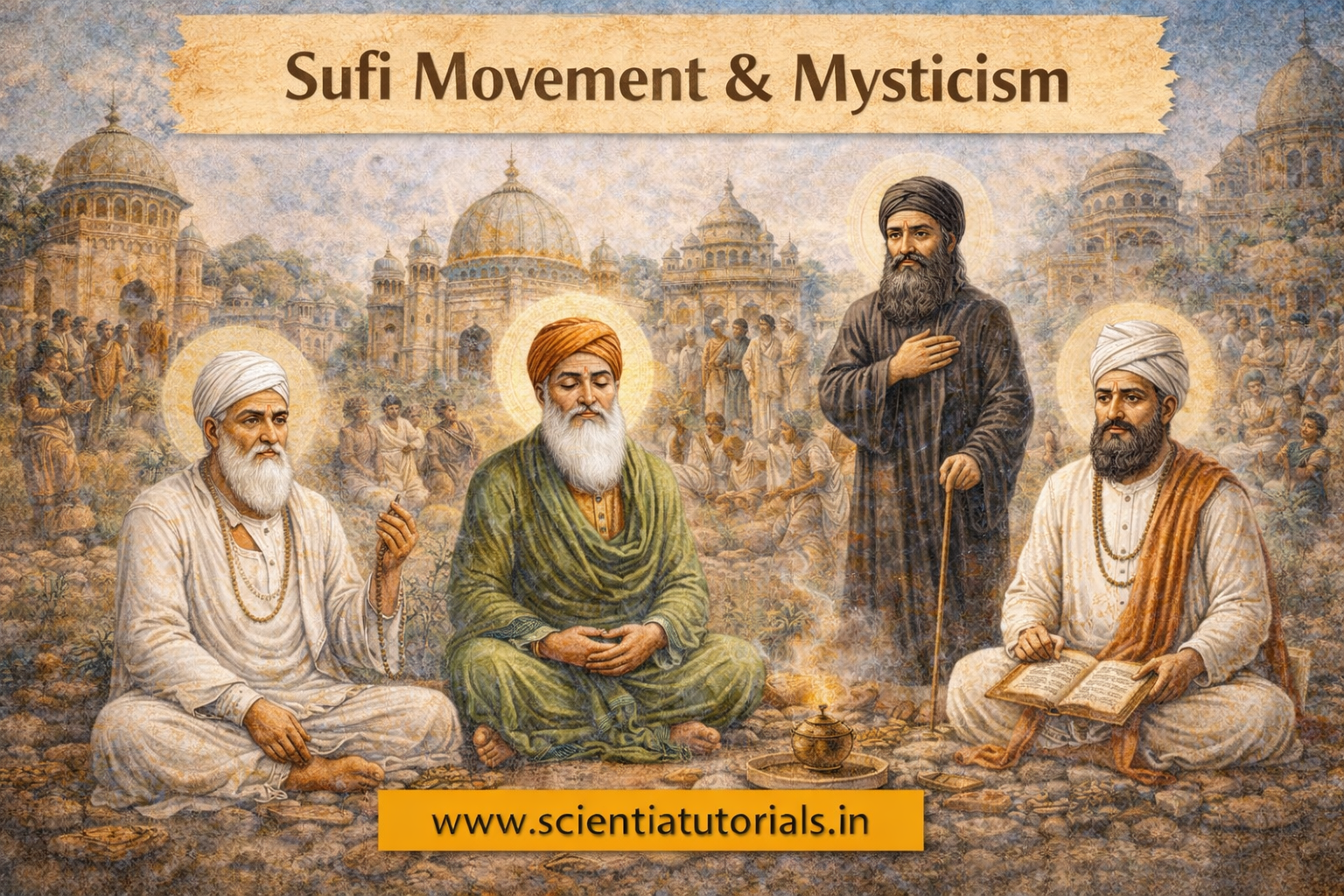

Sufi Movement & Mysticism
SECTION 10: Cultural & Social Developments in Medieval India
Timeline: c. 1200 CE – 1700 CE
Introduction: Understanding Sufism in Medieval India
The Sufi Movement represents the mystical dimension of Islam, emphasising inner spirituality, love for God, devotion, tolerance, and service to humanity. In medieval India, Sufism emerged as a powerful spiritual and social force that deeply influenced religious thought, popular culture, inter-religious relations, and social life.
Between the 12th and 17th centuries, Sufi saints spread their message across the Indian subcontinent, interacting closely with local traditions and the Bhakti movement. Sufism in India did not remain confined to Islamic theology alone; instead, it evolved into a composite spiritual tradition, contributing significantly to India’s syncretic culture.
Meaning and Core Philosophy of Sufism
What is Sufism?
Sufism is the mystical path of Islam, focusing on:
- Direct personal experience of God
- Inner purification of the soul
- Love (Ishq) and devotion (Ibadat)
- Moral discipline and self-control
The Sufis believed that external rituals and formal laws were incomplete without inner spiritual realisation.
Central Beliefs of Sufi Mysticism
The philosophical foundation of Sufism rests on:
- Tawhid – Oneness of God
- Ishq-i-Ilahi – Divine love
- Fana – Annihilation of the self in God
- Baqa – Eternal life in God
- Zuhd – Renunciation of materialism
Sufis emphasised that love, humility, and compassion were the true paths to salvation.
Historical Background: Rise of Sufism in India
Origins of Sufism
Sufism developed in West Asia between the 8th and 10th centuries as a spiritual response to:
- Excessive materialism
- Rigid legalism in Islam
- Growing political power of Islamic empires
Early Sufis stressed asceticism and devotion.
Entry of Sufism into India
Sufism entered India along with:
- Arab traders
- Turkish invasions
- Establishment of the Delhi Sultanate
By the 12th century, Sufi saints had begun settling across India, especially in:
- Punjab
- Delhi
- Rajasthan
- Bengal
- Deccan
Growth of Sufi Orders (Silsilas) in India
Sufism in India organised itself into Silsilas (spiritual orders), each with distinct practices but common spiritual goals.
Major Sufi Silsilas in India
1. Chishti Order
The Chishti order was the most influential Sufi order in India.
Key Features:
- Emphasis on love, tolerance, and humanity
- Complete detachment from political power
- Service to the poor (Langar)
- Use of music (Sama) for spiritual elevation
Prominent Saints:
- Khwaja Moinuddin Chishti – Introduced Chishti order in India (Ajmer)
- Nizamuddin Auliya – Popularised Chishti teachings in Delhi
- Sheikh Salim Chishti
The Chishtis played a major role in spreading Sufism among the masses.
2. Suhrawardi Order
The Suhrawardi order differed from the Chishtis in its approach.
Key Features:
- Acceptance of state patronage
- Closer association with political authority
- Stress on discipline and orthodox practices
Prominent Saint:
- Bahauddin Zakariya of Multan
3. Qadiri Order
The Qadiri order gained prominence during the Mughal period.
Key Features:
- Emphasis on strict Islamic practices
- Balanced approach between mysticism and Sharia
- Popular among Mughal elites
4. Naqshbandi Order
The Naqshbandi order was more orthodox and conservative.
Key Features:
- Opposition to music and dance
- Emphasis on Sharia
- Close association with Mughal rulers, especially Aurangzeb
Sufi Practices and Institutions
Khanqah
The Khanqah was the Sufi hospice and spiritual centre where:
- Disciples lived and trained
- Spiritual instruction was imparted
- Free food and shelter were provided
Khanqahs became centres of social service and spiritual learning.
Pir–Murid Relationship
The relationship between:
- Pir (spiritual guide)
- Murid (disciple)
was central to Sufism. Total surrender to the Pir was essential for spiritual progress.
Sama (Music and Devotion)
Many Sufi orders, especially the Chishtis, used music, poetry, and Qawwali to achieve spiritual ecstasy and closeness to God.
Sufi Saints and Their Teachings
Khwaja Moinuddin Chishti
- Known as Gharib Nawaz (Helper of the Poor)
- Preached love, service, and tolerance
- Attracted followers from all communities
Nizamuddin Auliya
- Believed in complete renunciation
- Opposed royal patronage
- Emphasised love for humanity as love for God
Bahauddin Zakariya
- Leader of Suhrawardi order
- Maintained cordial relations with rulers
- Spread Sufism in Punjab and Sindh
Sheikh Ahmad Sirhindi
- Advocate of Islamic orthodoxy
- Opposed syncretic religious practices
- Influenced Mughal religious policy
Sufism and Indian Society
Social Impact
- Promoted equality and brotherhood
- Reduced communal tensions
- Provided spiritual solace during political instability
Sufi saints were often seen as moral guides and protectors of society.
Sufism and the Common People
Sufis used:
- Simple language
- Folk traditions
- Local customs
This made their teachings accessible to peasants, artisans, and traders.
Sufism and Vernacular Literature
Sufi ideas enriched Indian literature.
Key Contributions
- Development of Urdu and regional languages
- Popularisation of mystical poetry
- Use of metaphors of love and devotion
Poets like Amir Khusrau popularised Indo-Persian culture through Sufi themes.
Sufism and Bhakti Movement: A Comparative Perspective
Similarities
- Emphasis on love and devotion
- Rejection of ritualism
- Stress on equality and inner spirituality
Differences
- Bhakti rooted in Hindu tradition; Sufism in Islam
- Bhakti had Saguna and Nirguna forms; Sufism followed mystical Islam
Together, they fostered composite culture.
Limitations and Criticism of Sufism
- Some orders became rigid and hierarchical
- Excessive saint worship in later periods
- Tension with orthodox Islamic scholars
Despite this, Sufism retained popular appeal.
Decline of Sufi Influence
By the late Mughal period:
- Political instability increased
- State patronage declined
- Orthodox movements gained strength
However, Sufi shrines continued to attract devotees.
Historical Significance of the Sufi Movement
The Sufi Movement:
- Promoted communal harmony
- Humanised religion
- Strengthened Indo-Islamic culture
- Influenced later reform movements
It played a vital role in shaping medieval Indian society.
Conclusion
The Sufi Movement was one of the most significant cultural and spiritual developments in medieval India. Through love, tolerance, service, and mysticism, Sufi saints transformed religious life and contributed to social harmony.
By interacting with local traditions and the Bhakti movement, Sufism helped create a shared cultural space, making it a cornerstone of India’s medieval cultural history. Its legacy continues to influence Indian society, spirituality, and culture even today.
Sufi Movement & Mysticism
Questions with Answers
Q1. What is Sufism?
Answer:
Sufism is the mystical dimension of Islam that emphasises inner spirituality, personal experience of God, love, devotion, and moral purification rather than rigid ritualism.
Q2. During which period did the Sufi Movement flourish in India?
Answer:
The Sufi Movement flourished in India mainly between c. 1200 CE and 1700 CE, especially during the Delhi Sultanate and Mughal periods.
Q3. What were the main reasons for the rise of Sufism in medieval India?
Answer:
Political instability, rigid religious practices, social inequalities, and the spiritual needs of the masses contributed to the popularity of Sufism in medieval India.
Q4. What are the core philosophical principles of Sufi mysticism?
Answer:
The core principles include belief in the oneness of God (Tawhid), divine love (Ishq-i-Ilahi), self-annihilation (Fana), eternal union with God (Baqa), and renunciation of materialism.
Q5. How did Sufism enter India?
Answer:
Sufism entered India through Arab traders, Central Asian contacts, and Turkish invasions, gaining firm roots after the establishment of the Delhi Sultanate.
Q6. What is meant by a Sufi Silsila?
Answer:
A Silsila is a Sufi spiritual order that traces its teachings through a chain of spiritual succession from master to disciple.
Q7. Name the most influential Sufi order in India.
Answer:
The Chishti order was the most influential Sufi order in India, known for its emphasis on love, tolerance, and service to humanity.
Q8. Who introduced the Chishti order in India?
Answer:
Khwaja Moinuddin Chishti introduced the Chishti order in India and established it at Ajmer.
Q9. What were the main teachings of the Chishti order?
Answer:
The Chishtis preached love, tolerance, service to the poor, detachment from political power, and devotion through music (Sama).
Q10. Who was Nizamuddin Auliya, and why is he important?
Answer:
Nizamuddin Auliya was a leading Chishti saint in Delhi who emphasised renunciation, love for humanity, and independence from royal patronage.
Q11. How did the Suhrawardi order differ from the Chishti order?
Answer:
The Suhrawardi order accepted state patronage and maintained closer relations with political authority, unlike the Chishtis who avoided it.
Q12. Who was the prominent leader of the Suhrawardi order in India?
Answer:
Bahauddin Zakariya of Multan was the leading Suhrawardi saint in India.
Q13. What were the main features of the Naqshbandi order?
Answer:
The Naqshbandi order emphasised strict adherence to Islamic law (Sharia), opposed music and dance, and maintained close ties with Mughal rulers.
Q14. Explain the concept of Khanqah in Sufism.
Answer:
A Khanqah was a Sufi hospice where disciples received spiritual training, travellers were sheltered, and the poor were fed, serving as centres of social and religious life.
Q15. What is the significance of the Pir–Murid relationship in Sufism?
Answer:
The Pir–Murid relationship formed the foundation of Sufi training, where the disciple surrendered completely to the spiritual guidance of the Pir.
Q16. What role did music (Sama) play in Sufi practice?
Answer:
Music and devotional songs were used, especially by the Chishtis, to achieve spiritual ecstasy and closeness to God.
Q17. How did Sufism influence Indian society?
Answer:
Sufism promoted social harmony, reduced communal tensions, encouraged equality, and provided spiritual solace to common people.
Q18. How did Sufi saints communicate their teachings to the masses?
Answer:
They used simple language, local customs, vernacular expressions, and folk traditions to reach peasants, artisans, and traders.
Q19. What contribution did Sufism make to Indian literature?
Answer:
Sufism enriched Persian, Urdu, and regional literatures through mystical poetry, devotional themes, and promotion of Indo-Persian culture.
Q20. How was Sufism similar to the Bhakti Movement?
Answer:
Both emphasised love and devotion to God, rejected rigid ritualism, promoted equality, and encouraged inner spiritual realisation.
Q21. In what ways did Sufism differ from the Bhakti Movement?
Answer:
Sufism originated within Islam and followed mystical Islamic theology, while Bhakti emerged from Hindu traditions with Saguna and Nirguna forms.
Q22. What limitations developed within Sufism over time?
Answer:
Some Sufi orders became rigid, excessive saint worship emerged, and tensions arose with orthodox Islamic scholars.
Q23. Why did Sufi influence decline in the later medieval period?
Answer:
Political instability, decline of state patronage, and the rise of orthodox religious movements led to a gradual decline of Sufi influence.
Q24. What is the historical significance of the Sufi Movement in India?
Answer:
The Sufi Movement promoted communal harmony, humanised religion, strengthened Indo-Islamic culture, and shaped medieval Indian society.
Q25. Assess the overall contribution of Sufism to medieval Indian culture.
Answer:
Sufism enriched India’s spiritual life by emphasising love, tolerance, and service, contributing to a composite culture and lasting religious harmony in the History of India.
Sufi Movement & Mysticism
MCQs with Answers and Explanations
MCQ 1. Sufism in Islam primarily emphasises:
A. Strict ritual observance
B. Political authority
C. Inner spirituality and love for God
D. Legal interpretation of Sharia
Correct Answer: C
Explanation:
Sufism focuses on inner purification, devotion, and a direct personal experience of God rather than external rituals alone.
MCQ 2. The Sufi Movement in India flourished mainly during:
A. 600–1000 CE
B. 800–1200 CE
C. 1200–1700 CE
D. 1700–1857 CE
Correct Answer: C
Explanation:
Sufism gained mass popularity in India during the Delhi Sultanate and Mughal periods.
MCQ 3. The concept of Ishq-i-Ilahi in Sufism refers to:
A. Fear of God
B. Divine justice
C. Divine love
D. Religious law
Correct Answer: C
Explanation:
Ishq-i-Ilahi signifies intense love and devotion to God, a central theme of Sufi mysticism.
MCQ 4. Fana in Sufi philosophy means:
A. Eternal life
B. Annihilation of the self in God
C. Worldly renunciation
D. Obedience to the Pir
Correct Answer: B
Explanation:
Fana denotes the dissolution of the individual ego in the divine presence.
MCQ 5. A Sufi spiritual order is known as a:
A. Jamaat
B. Maslak
C. Silsila
D. Madrasa
Correct Answer: C
Explanation:
A Silsila represents a chain of spiritual succession linking disciples to a founding saint.
MCQ 6. The most influential Sufi order in India was the:
A. Qadiri
B. Naqshbandi
C. Suhrawardi
D. Chishti
Correct Answer: D
Explanation:
The Chishti order played the greatest role in popularising Sufism among the masses.
MCQ 7. Who introduced the Chishti order in India?
A. Nizamuddin Auliya
B. Bahauddin Zakariya
C. Khwaja Moinuddin Chishti
D. Sheikh Ahmad Sirhindi
Correct Answer: C
Explanation:
Khwaja Moinuddin Chishti established the Chishti order at Ajmer and preached love and service to humanity.
MCQ 8. Which Sufi order avoided close association with political power?
A. Naqshbandi
B. Suhrawardi
C. Chishti
D. Qadiri
Correct Answer: C
Explanation:
Chishti saints believed political power distracted from spiritual pursuit.
MCQ 9. The Sufi saint associated with Delhi and known for renunciation was:
A. Sheikh Salim Chishti
B. Nizamuddin Auliya
C. Ahmad Sirhindi
D. Bahauddin Zakariya
Correct Answer: B
Explanation:
Nizamuddin Auliya emphasised love, humility, and distance from royal patronage.
MCQ 10. Which Sufi order accepted state patronage and official positions?
A. Chishti
B. Suhrawardi
C. Naqshbandi
D. Qadiri
Correct Answer: B
Explanation:
The Suhrawardi order maintained cordial relations with rulers.
MCQ 11. The leading Suhrawardi saint of Multan was:
A. Sheikh Salim Chishti
B. Khwaja Moinuddin Chishti
C. Bahauddin Zakariya
D. Amir Khusrau
Correct Answer: C
Explanation:
Bahauddin Zakariya led the Suhrawardi order in Punjab and Sindh.
MCQ 12. Which Sufi order opposed music and dance?
A. Chishti
B. Qadiri
C. Naqshbandi
D. Suhrawardi
Correct Answer: C
Explanation:
The Naqshbandis stressed strict adherence to Islamic law and rejected Sama.
MCQ 13. Sama in Sufi tradition refers to:
A. Silent meditation
B. Charity
C. Music and devotional singing
D. Scriptural study
Correct Answer: C
Explanation:
Music and poetry were used to induce spiritual ecstasy, especially by Chishtis.
MCQ 14. The Sufi hospice where disciples lived and trained was called a:
A. Dargah
B. Madrasa
C. Khanqah
D. Jama Masjid
Correct Answer: C
Explanation:
Khanqahs functioned as centres of spiritual learning and social service.
MCQ 15. The Pir–Murid relationship in Sufism emphasised:
A. Political loyalty
B. Complete spiritual surrender
C. Economic dependence
D. Social hierarchy
Correct Answer: B
Explanation:
Spiritual progress required absolute faith and obedience to the Pir.
MCQ 16. Which Mughal emperor was closely associated with the Naqshbandi order?
A. Akbar
B. Jahangir
C. Shah Jahan
D. Aurangzeb
Correct Answer: D
Explanation:
Aurangzeb favoured orthodox Islamic practices aligned with Naqshbandi ideals.
MCQ 17. Sufi teachings were popular among common people mainly because they:
A. Used Persian only
B. Focused on theology
C. Emphasised simplicity and compassion
D. Promoted royal authority
Correct Answer: C
Explanation:
Sufis used local languages and stressed ethical living and love.
MCQ 18. Which concept symbolises eternal life in union with God?
A. Fana
B. Baqa
C. Zuhd
D. Sharia
Correct Answer: B
Explanation:
Baqa represents spiritual permanence after union with God.
MCQ 19. Sufism contributed to Indian culture mainly by:
A. Strengthening caste hierarchy
B. Promoting communal harmony
C. Enforcing religious law
D. Encouraging isolation
Correct Answer: B
Explanation:
Sufism fostered tolerance and inter-religious understanding.
MCQ 20. Which language benefited most from Sufi literary contributions?
A. Sanskrit
B. Arabic
C. Urdu
D. Pali
Correct Answer: C
Explanation:
Sufi poetry played a major role in the development of Urdu.
MCQ 21. Amir Khusrau is remembered for:
A. Political writings
B. Orthodox theology
C. Popularising Indo-Persian culture
D. Leading a Sufi order
Correct Answer: C
Explanation:
Amir Khusrau blended Persian and Indian cultural traditions through poetry and music.
MCQ 22. The shrine of a Sufi saint is known as a:
A. Khanqah
B. Dargah
C. Madrasa
D. Jamaat
Correct Answer: B
Explanation:
Dargahs became centres of pilgrimage for people of all faiths.
MCQ 23. Which movement shared many similarities with Sufism?
A. Tantrism
B. Jainism
C. Bhakti Movement
D. Buddhism
Correct Answer: C
Explanation:
Both Bhakti and Sufism emphasised devotion, love, and equality.
MCQ 24. A limitation of Sufism in later medieval India was:
A. Complete decline of followers
B. Excessive saint worship
C. Lack of spiritual depth
D. Opposition to morality
Correct Answer: B
Explanation:
In later periods, some practices became ritualistic, attracting criticism.
MCQ 25. The historical significance of the Sufi Movement lies in its role in:
A. Establishing Islamic rule
B. Promoting mystical isolation
C. Creating a composite Indian culture
D. Eliminating religious diversity
Correct Answer: C
Explanation:
Sufism contributed to India’s composite culture by blending Islamic spirituality with local traditions.
🎯 Targeting Exams Section
This lesson-based content is carefully designed for preparation of:
-
UPSC Civil Services Examination (Prelims & Mains)
-
State Public Service Commission (PSC) Exams
-
SSC (CGL, CHSL, GD – History syllabus)
-
UGC NET / SET (History)
-
University & College Semester Examinations
-
School Board Exams (Class 7–12, Medieval Indian History)
-
Other Competitive Exams covering History of India
🔑 Related Keyphrases
-
Sufi Movement in medieval India
-
Sufi saints and Silsilas
-
Chishti Suhrawardi Naqshbandi order
-
Sufi mysticism and philosophy
-
Khanqah and Dargah system
-
Sufism and Bhakti Movement comparison
-
Indo-Islamic culture medieval India
-
Cultural developments in medieval India
-
History of India Sufi Movement notes
-
UPSC Sufi Movement study material