
Moderate & Extremist Phases
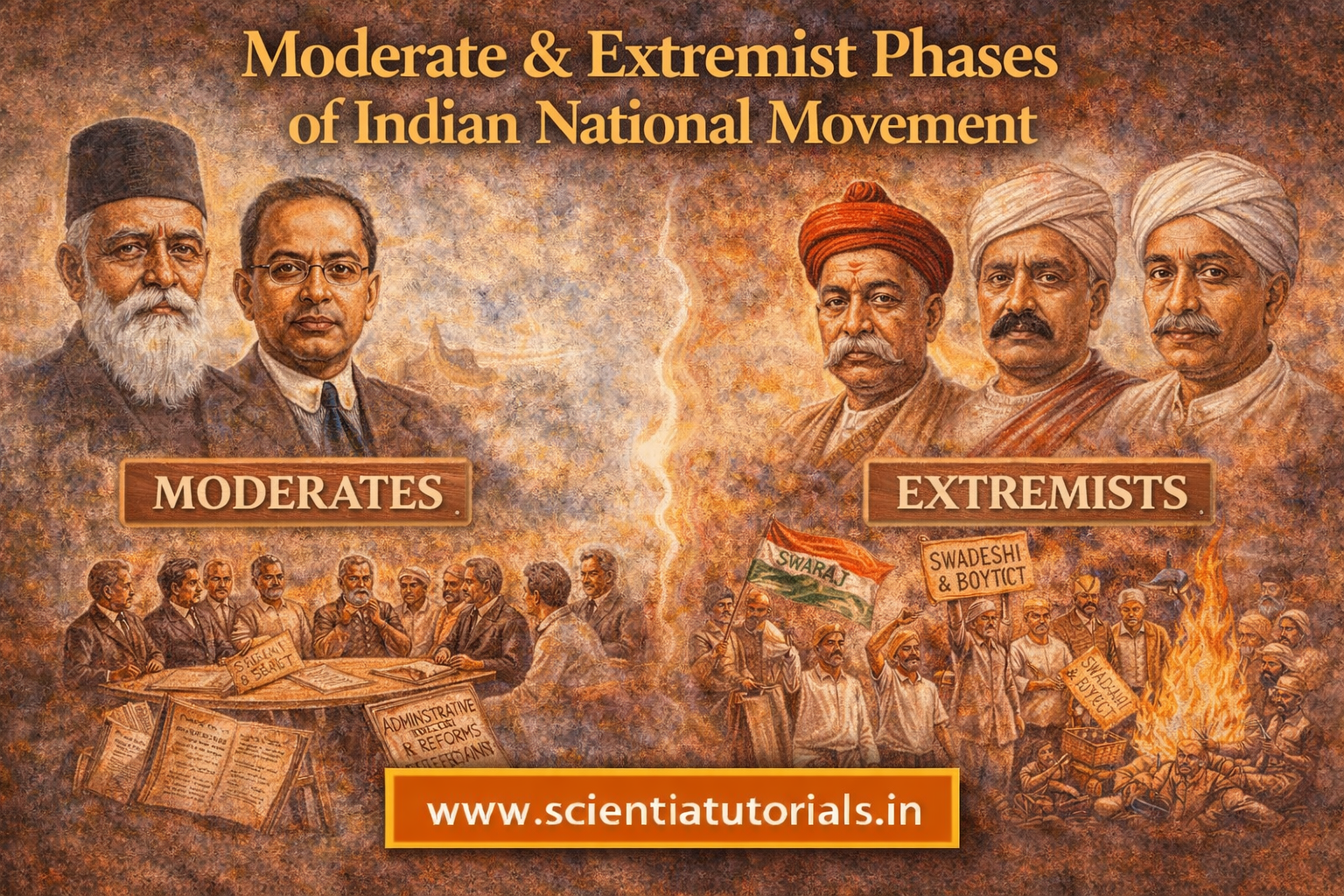

Moderate & Extremist Phases | Indian National Movement | History of India
Evolution of Indian Nationalism (1885–1918 CE)
I. Introduction: Evolution of Early Indian Nationalism
The period between 1885 and 1918 CE represents the formative phase of the Indian National Movement, during which Indian nationalism evolved from constitutional agitation to assertive mass-oriented politics. This evolution is traditionally divided into two major phases:
- Moderate Phase (1885–1905)
- Extremist Phase (1905–1918)
These phases were not mutually exclusive but reflected changing strategies, leadership styles, and political consciousness among Indians. Together, they laid the foundation for the later Gandhian mass movement.
II. Background to the Moderate Phase (Pre-1885 Context)
Before 1885, Indian political activity was:
- Localized and sporadic
- Led by educated elites
- Influenced by socio-religious reform movements
The foundation of the Indian National Congress in 1885 provided a national platform for political expression, inaugurating the Moderate Phase.
III. Moderate Phase of the Indian National Movement (1885–1905)
1. Meaning and Nature of Moderate Nationalism
The Moderates were early nationalist leaders who believed in:
- Gradual political progress
- Constitutional methods
- Loyalty to the British Crown
- Reform within the framework of British rule
They are called “Moderates” because of their cautious, reasoned, and non-confrontational approach.
2. Social Composition of the Moderates
The Moderate leadership consisted mainly of:
- Lawyers
- Teachers
- Journalists
- Government servants
They represented the educated middle class, largely urban-based.
3. Prominent Moderate Leaders
Key Moderate leaders included:
- Dadabhai Naoroji
- Gopal Krishna Gokhale
- Surendranath Banerjee
- Pherozeshah Mehta
4. Ideology and Objectives of the Moderates
The Moderates aimed to:
- Promote national unity
- Achieve administrative and constitutional reforms
- Secure Indian participation in governance
- Protect civil liberties
They did not initially demand independence, but sought self-government within the British Empire.
5. Methods of the Moderates
Moderates adopted constitutional and peaceful methods, including:
- Petitions and memorials
- Resolutions in Congress sessions
- Public meetings
- Newspapers and pamphlets
Their approach is famously described as “prayer, petition, and protest.”
6. Economic Critique of British Rule
One of the greatest contributions of the Moderates was their economic critique of colonialism.
- Dadabhai Naoroji’s Drain Theory exposed the systematic transfer of wealth from India to Britain.
- Highlighted causes of poverty, famines, and underdevelopment.
- Shifted nationalism from emotional appeal to economic reasoning.
7. Achievements of the Moderate Phase
- Created a national political consciousness
- Established the Indian National Congress as an all-India body
- Exposed the exploitative nature of British rule
- Trained Indians in political organization and debate
8. Limitations of the Moderate Phase
Despite their achievements, the Moderates faced several limitations:
- Over-reliance on British goodwill
- Slow pace of reforms
- Elite-centric leadership
- Limited mass participation
By the early 20th century, these limitations became increasingly evident.
IV. Background to the Extremist Phase
1. Changing Political and Economic Conditions
Several factors led to dissatisfaction with Moderate methods:
- Continued economic exploitation
- Failure of British government to respond positively
- Repressive policies of British officials
2. Lord Curzon’s Policies
The administration of Lord Curzon intensified Indian resentment due to:
- Partition of Bengal (1905)
- Reduction of Calcutta University autonomy
- Indian Universities Act (1904)
- Calcutta Corporation Act (1899)
3. Partition of Bengal (1905)
The Partition of Bengal became the immediate trigger for the rise of Extremism:
- Divided Bengal on communal lines
- Seen as an attempt to weaken nationalism
- Led to widespread protests and agitation
V. Extremist Phase of the Indian National Movement (1905–1918)
1. Meaning and Nature of Extremist Nationalism
The Extremists believed that:
- British rule was inherently exploitative
- Political rights could not be obtained through petitions alone
- Indians must rely on their own strength
They advocated assertive nationalism, mass mobilization, and self-reliance.
2. Prominent Extremist Leaders
Key Extremist leaders included:
- Bal Gangadhar Tilak
- Bipin Chandra Pal
- Lala Lajpat Rai
They are popularly known as Lal–Bal–Pal.
3. Ideology and Goals of the Extremists
The Extremists emphasized:
- Swaraj (self-rule) as the immediate goal
- National self-respect and pride
- Active resistance to colonial rule
- Revival of Indian culture and heritage
4. Methods of the Extremists
Extremists adopted new methods of struggle, including:
- Swadeshi and boycott of foreign goods
- Promotion of indigenous industries
- National education
- Public mobilization through festivals and symbols
- Passive resistance
Tilak famously declared:
“Swaraj is my birthright and I shall have it.”
5. Role of the Swadeshi Movement
The Swadeshi Movement:
- Encouraged economic self-reliance
- Strengthened mass participation
- Linked nationalism with daily life
- Spread nationalist ideas to students, women, and workers
VI. Differences Between Moderates and Extremists
1. Ideological Differences
- Moderates believed in reform; Extremists believed in resistance
- Moderates trusted British justice; Extremists rejected it
2. Methods and Techniques
- Moderates: petitions, speeches, constitutionalism
- Extremists: boycott, swadeshi, mass agitation
3. Social Base
- Moderates: educated urban elites
- Extremists: broader sections including students and lower middle classes
4. Goals
- Moderates: self-government within empire
- Extremists: Swaraj as a right
VII. Surat Split (1907)
The ideological conflict culminated in the Surat Split of 1907:
- Moderates and Extremists split within the Congress
- Moderates retained control of the organization
- Extremists were sidelined
This weakened the national movement temporarily.
VIII. British Repression and Decline of Extremist Phase
Following the split:
- British government adopted repressive measures
- Extremist leaders were arrested or exiled
- Tilak was imprisoned in Mandalay (1908)
By 1918, the Extremist phase declined, creating conditions for new leadership.
IX. Reunion and Transition to Gandhian Era
- Moderates and Extremists reunited in 1916 (Lucknow Pact)
- Entry of Mahatma Gandhi transformed the movement
- Shift towards mass-based, non-violent struggle
The experiences of both phases shaped Gandhian nationalism.
X. Historical Significance of Moderate & Extremist Phases
1. Contribution of Moderates
- Laid intellectual foundations of nationalism
- Introduced economic critique
- Built national political institutions
2. Contribution of Extremists
- Popularized nationalism
- Introduced mass politics
- Asserted the demand for Swaraj
3. Combined Legacy
Together, these phases:
- Represented the evolution of Indian nationalism
- Complemented each other historically
- Prepared the ground for the mass movements of the 1920s
XI. Evaluation by Historians
Historians view:
- Moderates as nation-builders
- Extremists as mobilizers of mass energy
Both were essential stages in the freedom struggle.
XII. Conclusion
The Moderate and Extremist phases of the Indian National Movement represent the gradual maturation of Indian nationalism. The Moderates provided the intellectual and organizational base, while the Extremists infused the movement with energy, self-confidence, and mass participation.
Rather than being contradictory, these phases were complementary, each responding to the needs of its time. Together, they transformed Indian nationalism from a cautious elite movement into a broad-based struggle for Swaraj, paving the way for the Gandhian era and eventual independence.
Examination Significance
- Core topic for UPSC GS-I (Modern Indian History)
- Frequently asked in State PSCs, UGC NET, CUET-PG
- Important for comparative, analytical, and essay questions
Moderate & Extremist Phases –
Questions and Answers
1. What is meant by the Moderate Phase of the Indian National Movement?
Answer:
The Moderate Phase (1885–1905) refers to the early stage of the Indian National Movement characterized by constitutional methods, gradual reform, and faith in British justice, led by educated Indian elites.
2. What period is known as the Moderate Phase?
Answer:
The period from 1885 to 1905 is known as the Moderate Phase.
3. Why were the early nationalists called Moderates?
Answer:
They were called Moderates because they adopted a cautious, reasoned, and non-violent approach, seeking reforms through dialogue and constitutional means rather than confrontation.
4. Which organization provided the main platform for Moderate politics?
Answer:
The Indian National Congress provided the main platform for Moderate political activity.
5. Name two prominent leaders of the Moderate Phase.
Answer:
Prominent Moderate leaders included Dadabhai Naoroji and Gopal Krishna Gokhale.
6. What were the main objectives of the Moderates?
Answer:
Their objectives included:
- Administrative and constitutional reforms
- Indian participation in governance
- Civil liberties
- Self-government within the British Empire
7. What methods were adopted by the Moderates to achieve their aims?
Answer:
They used petitions, resolutions, public meetings, speeches, and newspapers, popularly described as “prayer, petition, and protest.”
8. What was the greatest contribution of the Moderates to Indian nationalism?
Answer:
Their greatest contribution was the economic critique of British rule, especially exposing colonial exploitation and the causes of Indian poverty.
9. What is the Drain Theory?
Answer:
The Drain Theory explained how India’s wealth was systematically transferred to Britain, resulting in poverty and underdevelopment in India.
10. Who propounded the Drain Theory?
Answer:
The Drain Theory was propounded by Dadabhai Naoroji.
11. What were the limitations of the Moderate Phase?
Answer:
Major limitations included:
- Over-reliance on British goodwill
- Slow pace of reforms
- Elite-centric leadership
- Limited mass participation
12. Why did dissatisfaction grow against Moderate methods after 1900?
Answer:
Because British policies remained exploitative and repressive, and constitutional appeals failed to bring substantial political change.
13. What factors led to the rise of the Extremist Phase?
Answer:
Key factors included:
- Failure of Moderate methods
- Economic hardships
- Repressive policies of the British
- Partition of Bengal (1905)
- Growing national self-confidence
14. What period is known as the Extremist Phase?
Answer:
The period from 1905 to 1918 is known as the Extremist Phase.
15. What is meant by Extremist nationalism?
Answer:
Extremist nationalism emphasized assertive politics, mass mobilization, self-reliance, and direct action, rejecting faith in British justice.
16. Name the three leaders popularly associated with Extremism.
Answer:
The Extremist leaders were:
- Bal Gangadhar Tilak
- Bipin Chandra Pal
- Lala Lajpat Rai
Collectively known as Lal–Bal–Pal.
17. What was the central goal of the Extremists?
Answer:
The central goal of the Extremists was Swaraj (self-rule), viewed as the natural right of Indians.
18. What methods were adopted by the Extremists?
Answer:
They adopted:
- Swadeshi and boycott
- Promotion of indigenous industries
- National education
- Mass mobilization
- Passive resistance
19. Why is the Partition of Bengal (1905) considered a turning point?
Answer:
It exposed the divide-and-rule policy of the British and triggered mass agitation, leading to the rise of Extremist politics.
20. How did Extremism differ from Moderatism in ideology?
Answer:
Moderates believed in reform within British rule, while Extremists believed in active resistance and immediate Swaraj.
21. How did the social base of Extremists differ from that of Moderates?
Answer:
Moderates were supported mainly by urban elites, whereas Extremists mobilized students, lower middle classes, and wider sections of society.
22. What was the Surat Split of 1907?
Answer:
The Surat Split was the division of the Congress into Moderate and Extremist groups due to ideological and strategic differences.
23. What were the consequences of the Surat Split?
Answer:
It weakened the national movement temporarily and allowed the British to repress Extremist leaders more effectively.
24. Why did the Extremist Phase decline after 1908?
Answer:
Due to British repression, arrests of leaders, internal divisions, and lack of organizational unity.
25. Why are the Moderate and Extremist phases considered complementary?
Answer:
The Moderates laid the intellectual and organizational foundations, while the Extremists energized the movement through mass participation and assertive nationalism, together preparing the ground for the Gandhian era.
Moderate & Extremist Phases –
MCQs with Answers and Explanations
1. The period known as the Moderate Phase of the Indian National Movement is:
A. 1875–1890
B. 1885–1905
C. 1905–1918
D. 1919–1930
Correct Answer: B
Explanation:
The Moderate Phase extended from 1885 to 1905, beginning with the foundation of the Indian National Congress and ending with the Partition of Bengal.
2. The political platform that dominated the Moderate Phase was the:
A. Muslim League
B. Arya Samaj
C. Indian National Congress
D. Home Rule League
Correct Answer: C
Explanation:
The Indian National Congress served as the central forum for Moderate politics and constitutional agitation.
3. Which of the following leaders is most closely associated with the Moderate Phase?
A. Bal Gangadhar Tilak
B. Lala Lajpat Rai
C. Dadabhai Naoroji
D. Subhas Chandra Bose
Correct Answer: C
Explanation:
Dadabhai Naoroji was a leading Moderate and provided the earliest economic critique of British rule.
4. The Moderates believed that political progress could be achieved mainly through:
A. Armed revolution
B. Mass civil disobedience
C. Constitutional and peaceful methods
D. Secret societies
Correct Answer: C
Explanation:
Moderates relied on petitions, resolutions, public meetings, and dialogue—often summarized as “prayer, petition, and protest.”
5. Which phrase best describes the political methods of the Moderates?
A. Direct action
B. Non-cooperation
C. Prayer, petition, and protest
D. Boycott and swadeshi
Correct Answer: C
Explanation:
This phrase captures the peaceful, constitutional approach of Moderate leaders.
6. One of the greatest contributions of the Moderates was their:
A. Call for immediate independence
B. Economic critique of colonialism
C. Organization of armed struggle
D. Promotion of religious nationalism
Correct Answer: B
Explanation:
Moderates exposed the economic exploitation of India by British rule, giving nationalism a rational foundation.
7. The Drain Theory explained that:
A. British rule modernized India
B. Wealth was transferred from India to Britain
C. Indian agriculture benefited from colonialism
D. Trade policies favored India
Correct Answer: B
Explanation:
The Drain Theory showed how India’s surplus wealth was systematically drained to Britain, causing poverty.
8. Which leader propounded the Drain Theory?
A. Gopal Krishna Gokhale
B. Surendranath Banerjee
C. Dadabhai Naoroji
D. Bal Gangadhar Tilak
Correct Answer: C
Explanation:
Dadabhai Naoroji used economic data to prove the exploitative nature of British rule.
9. One major limitation of the Moderate Phase was that it:
A. Was violent in nature
B. Had limited mass participation
C. Opposed nationalism
D. Rejected reforms
Correct Answer: B
Explanation:
The Moderate movement was largely elite-centric, with minimal involvement of peasants and workers.
10. The Extremist Phase of the Indian National Movement began around:
A. 1890
B. 1900
C. 1905
D. 1919
Correct Answer: C
Explanation:
The Extremist Phase began in 1905, following the Partition of Bengal.
11. Which event is considered the immediate cause for the rise of Extremism?
A. Formation of INC
B. Ilbert Bill controversy
C. Partition of Bengal (1905)
D. First World War
Correct Answer: C
Explanation:
The Partition of Bengal exposed British divide-and-rule policy and triggered mass protest.
12. The Extremist leaders rejected Moderate faith in:
A. Indian culture
B. British justice and goodwill
C. National unity
D. Political struggle
Correct Answer: B
Explanation:
Extremists believed British rule was inherently exploitative and could not be reformed through petitions.
13. The three leaders popularly known as Lal–Bal–Pal were:
A. Lala Lajpat Rai, Bal Gangadhar Tilak, Bipin Chandra Pal
B. Lala Lajpat Rai, Gopal Krishna Gokhale, Dadabhai Naoroji
C. Bal Gangadhar Tilak, Subhas Chandra Bose, Jawaharlal Nehru
D. Bipin Chandra Pal, Mahatma Gandhi, Lala Lajpat Rai
Correct Answer: A
Explanation:
Lal–Bal–Pal symbolized the assertive nationalist leadership of the Extremist Phase.
14. Who declared, “Swaraj is my birthright and I shall have it”?
A. Bipin Chandra Pal
B. Lala Lajpat Rai
C. Bal Gangadhar Tilak
D. Mahatma Gandhi
Correct Answer: C
Explanation:
Tilak’s statement reflected the Extremist demand for self-rule as a right, not a concession.
15. The central goal of the Extremists was:
A. Administrative reforms
B. Dominion status
C. Swaraj
D. Social reform
Correct Answer: C
Explanation:
Extremists demanded Swaraj, viewing it as essential for national dignity.
16. Which of the following was NOT a method used by Extremists?
A. Swadeshi
B. Boycott
C. Mass mobilization
D. Petitions to Parliament
Correct Answer: D
Explanation:
Extremists rejected petitions and emphasized self-reliance and direct political action.
17. The Swadeshi Movement aimed primarily at:
A. Violent overthrow of British rule
B. Economic self-reliance and nationalism
C. Religious reform
D. Political negotiation
Correct Answer: B
Explanation:
Swadeshi encouraged the use of indigenous goods and linked nationalism with everyday life.
18. Which social groups were more actively mobilized by Extremists compared to Moderates?
A. Princes and landlords
B. Peasants and students
C. British officials
D. Industrial capitalists
Correct Answer: B
Explanation:
Extremists broadened the movement by mobilizing students, lower middle classes, and wider sections.
19. The Surat Split of 1907 occurred due to differences between:
A. Congress and Muslim League
B. Moderates and Extremists
C. Revolutionaries and Moderates
D. British and Indians
Correct Answer: B
Explanation:
Ideological and strategic conflicts led to a split between Moderates and Extremists within the Congress.
20. One consequence of the Surat Split was that it:
A. Strengthened the national movement immediately
B. Ended Extremist politics
C. Temporarily weakened the Congress
D. Led to immediate independence
Correct Answer: C
Explanation:
The split weakened the movement and enabled British repression of Extremist leaders.
21. Which British policy intensified Extremist resentment in the early 20th century?
A. Permanent Settlement
B. Policies of Lord Curzon
C. Morley–Minto Reforms
D. Montagu Declaration
Correct Answer: B
Explanation:
Curzon’s repressive and divisive policies, especially the Partition of Bengal, fueled Extremism.
22. The Extremist Phase declined after 1908 mainly due to:
A. Mass withdrawal of support
B. British repression and arrests
C. Economic prosperity
D. Success of Swaraj
Correct Answer: B
Explanation:
Leaders were arrested or exiled, and the movement lost organizational unity.
23. The reunion of Moderates and Extremists took place in:
A. 1907
B. 1911
C. 1916
D. 1919
Correct Answer: C
Explanation:
The Lucknow Pact (1916) marked their reunion and paved the way for the Gandhian era.
24. Historians generally view the relationship between Moderates and Extremists as:
A. Completely contradictory
B. Unrelated
C. Complementary
D. Accidental
Correct Answer: C
Explanation:
Moderates laid the intellectual foundation, while Extremists energized the movement—both were necessary stages.
25. The combined significance of the Moderate and Extremist phases lies in their role in:
A. Ending colonialism immediately
B. Preparing the ground for Gandhian mass movements
C. Establishing socialism
D. Creating communal politics
Correct Answer: B
Explanation:
Together, they transformed Indian nationalism from elite politics into a mass-based struggle, preparing the way for Gandhian leadership.
Targeting Exams
This lesson is a high-scoring and frequently tested topic in Modern Indian History, especially for questions comparing methods, ideology, leadership, and impact of nationalist phases.
Targeted Examinations:
-
UPSC Civil Services Examination
(Prelims MCQs & GS-I Mains – Indian National Movement) -
State Public Service Commissions
(APSC, BPSC, UPPSC, WBCS, RPSC, etc.) -
UGC NET / SET (History)
-
CUET-PG (History)
-
University UG & PG History Examinations
-
School Board Exams (Class 10–12: Freedom Struggle)
Related Keyphrases
-
Moderate phase of Indian National Movement
-
Extremist phase Indian freedom struggle
-
Moderates vs Extremists differences
-
Lal Bal Pal Extremist leaders
-
Dadabhai Naoroji Moderate nationalism
-
Partition of Bengal and Extremism
-
Swadeshi and boycott movement background
-
Early Indian nationalism History of India