
Political Structures & Republics in Ancient India
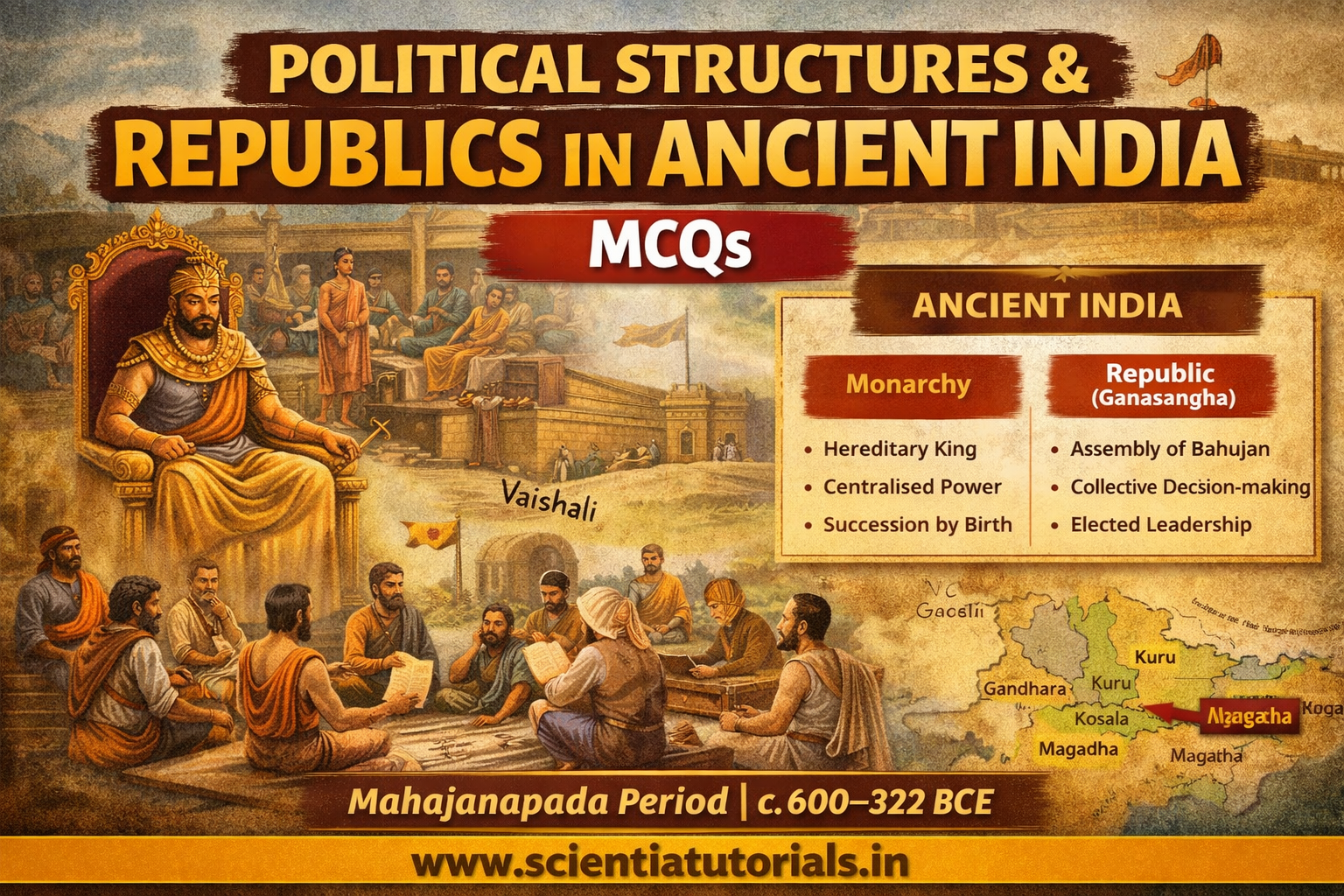

Political Structures & Republics in Ancient India | History of India
(Mahajanapada Period | c. 600 BCE – c. 322 BCE)
1. Introduction: Political Transformation in the Age of Second Urbanisation
The period between c. 600 BCE and c. 322 BCE represents a decisive turning point in ancient Indian political history. Known as the age of Second Urbanisation, this era witnessed the emergence of large territorial states called Mahajanapadas, replacing earlier clan-based tribal polities. Alongside powerful monarchies, republican political systems—unique in the ancient world—also flourished in certain regions of North India.
The study of political structures during this phase is crucial for understanding:
- The evolution from kinship to territorial governance
- The coexistence of monarchy and republicanism
- The roots of collective decision-making in Indian political thought
- The socio-political background of Buddhism and Jainism
2. From Tribal Polities to Territorial States
2.1 Early Janapadas: The Precursor Stage
Before the rise of Mahajanapadas, political organisation revolved around Janapadas, which were tribal territories named after dominant clans. Authority was often vested in tribal chiefs (rajan), supported by councils of elders.
2.2 Forces Driving Political Change
Several interconnected factors transformed these early systems:
- Agricultural expansion using iron tools
- Permanent settlements replacing pastoral mobility
- Population growth and surplus production
- Emergence of towns and trade networks
- Need for organized administration and standing armies
These changes demanded more complex political institutions, giving rise to territorial states with defined boundaries.
3. The Mahajanapada Political Landscape
By the 6th century BCE, sixteen Mahajanapadas dominated the political map of North India. These states followed two broad political models:
- Monarchical States
- Republican States (Ganasanghas)
This coexistence makes ancient India one of the earliest regions where diverse political systems functioned simultaneously.
4. Monarchical Political Structures
4.1 Nature of Kingship
Most Mahajanapadas were monarchies ruled by hereditary kings. The king:
- Exercised supreme executive authority
- Commanded the army
- Controlled taxation and justice
- Was supported by officials and ministers
Notable monarchical Mahajanapadas included Magadha, Kosala, and Avanti.
4.2 Administrative Machinery
Monarchies developed structured administrations with:
- Revenue officials for land tax collection
- Military officers for defense and expansion
- Judicial functionaries
- Urban administrators for towns
The capital cities, such as Pataliputra, became centres of governance and power.
4.3 Limitations of Monarchical Power
Despite their authority, kings were not absolute despots. Religious norms, customs (dharma), and advisory councils imposed moral and social constraints on royal power.
5. Republican Political Systems (Ganasanghas)
5.1 Meaning and Nature
Republican states were known as Ganas or Sanghas, where power was not concentrated in a single ruler but shared among a group of elite members, often from the Kshatriya class.
These republics represent one of the earliest experiments in collective governance in world history.
6. Types of Republican States
6.1 Tribal Republics
Some republics evolved directly from tribal assemblies where clan heads collectively governed.
6.2 Oligarchic Republics
In many cases, political power was restricted to a limited group of noble families. Though participatory, these systems were not fully democratic by modern standards.
7. Major Republican Mahajanapadas
7.1 The Vajji Confederacy
The most prominent republican state was Vajji, a powerful confederation of clans.
- Capital: Vaishali
- Constituent clans included the Lichchhavis
7.2 Political Institutions of Vajji
- General Assembly (Santhagara): Supreme decision-making body
- Elected officials: Chosen from among clan elites
- Collective leadership: No permanent monarch
Buddhist texts praise the Vajjian system for its adherence to rules, unity, and consultation, highlighting its political sophistication.
8. Functioning of Republican Assemblies
8.1 The Assembly (Sabha)
The assembly discussed:
- War and peace
- Foreign relations
- Legal disputes
- Administrative matters
Decisions were often taken through deliberation and consensus, not unilateral command.
8.2 Executive Committees
Day-to-day administration was handled by smaller councils or elected officers, ensuring efficiency within collective governance.
9. Comparison: Monarchies vs Republics
| Aspect | Monarchies | Republics |
|---|---|---|
| Head of State | Hereditary King | Assembly of elites |
| Decision-making | Centralised | Collective |
| Succession | Dynastic | Non-hereditary |
| Military Control | King | Assembly-appointed leaders |
| Stability | High (in strong states) | Dependent on unity |
This diversity illustrates the pluralistic political culture of ancient India.
10. Political Structures and Social Change
The rise of complex political systems led to:
- Clearer social stratification
- Emergence of ruling elites
- Growth of professional administrators and soldiers
- Increased taxation and state control
These developments affected common people, often creating dissatisfaction with rigid authority and social inequality.
11. Political Background to New Religious Movements
The political climate of the Mahajanapada period provided fertile ground for Buddhism and Jainism:
- Republican regions promoted debate and dissent
- Urban stress and state taxation encouraged ethical alternatives
- Rigid Brahmanical rituals appeared disconnected from everyday suffering
Notably, both the Buddha and Mahavira spent considerable time in republican territories like Vajji.
12. Decline of Republican Systems
Despite their early success, republics gradually declined due to:
- Military inferiority compared to monarchies
- Internal divisions among ruling elites
- Expansionist policies of Magadha
Ultimately, monarchies—especially Magadha—absorbed republican states, paving the way for empire-building.
13. Legacy and Historical Significance
The political structures of this period left a lasting legacy:
- Introduced concepts of collective governance and rule of law
- Demonstrated coexistence of multiple political models
- Influenced ethical and philosophical debates
- Prepared the administrative foundation for the Mauryan Empire
The republican traditions of ancient India remain a remarkable chapter in global political history.
14. Conclusion
The Mahajanapada period represents a crucial stage in the evolution of Indian polity, marked by innovation, diversity, and experimentation. The coexistence of powerful monarchies and vibrant republics highlights the flexibility and depth of ancient Indian political thought. Understanding these structures is essential for grasping the broader historical processes that shaped early Indian civilisation, religion, and state formation.
Below is a well-structured, examination-oriented set of 25 Questions with clear and accurate Answers based on the lesson “Political Structures & Republics in Ancient India”, fully aligned with SECTION 4: Mahajanapadas & Rise of New Religious Movements (c. 600–322 BCE) of the History of India – Complete Chronological and Era-Wise Course.
Political Structures & Republics in Ancient India
Timeline: c. 600 BCE – c. 322 BCE
Theme: Second Urbanisation
1. What is meant by political structures in ancient India during the Mahajanapada period?
Answer:
Political structures refer to the systems of governance and authority that developed in Mahajanapadas, including monarchical states ruled by kings and republican states (Ganasanghas) governed by assemblies.
2. Which historical phase witnessed the emergence of complex political structures in ancient India?
Answer:
The period of Second Urbanisation (c. 600–322 BCE) witnessed the rise of complex political structures with organised administration, taxation, and military systems.
3. What were the two main forms of political organisation among the Mahajanapadas?
Answer:
The two main forms were:
- Monarchies
- Republics or Ganasanghas
4. How did Mahajanapadas differ from earlier Janapadas in political terms?
Answer:
Mahajanapadas were territorial states with fixed boundaries, standing armies, and administrative machinery, unlike the earlier clan-based and kinship-oriented Janapadas.
5. Describe the nature of kingship in monarchical Mahajanapadas.
Answer:
Kingship was generally hereditary, with the king exercising executive, judicial, and military authority, though often guided by councils and bound by dharma and customary laws.
6. Name two important monarchical Mahajanapadas.
Answer:
Two major monarchical Mahajanapadas were Magadha and Kosala.
7. What factors strengthened monarchical states during this period?
Answer:
Fertile agricultural land, iron technology, regular taxation, standing armies, and strategic capitals strengthened monarchical states.
8. What is meant by a republican state (Ganasangha)?
Answer:
A Ganasangha was a form of republic where political power was vested in an assembly of clan heads or elites, rather than a single hereditary ruler.
9. Which Mahajanapada is the best example of a republican system?
Answer:
The Vajji Mahajanapada is the best-known example of a republican political system.
10. What was the capital of the Vajji confederacy?
Answer:
The capital of the Vajji confederacy was Vaishali.
11. Who were the Lichchhavis?
Answer:
The Lichchhavis were a prominent clan within the Vajji confederacy and played a central role in its republican administration.
12. How did republican assemblies function?
Answer:
Republican assemblies debated matters such as war, peace, law, and administration, and decisions were taken through discussion, voting, or consensus.
13. Were ancient Indian republics democratic in the modern sense?
Answer:
No. These republics were oligarchic, as political participation was generally restricted to elite Kshatriya families, excluding women, slaves, and common labourers.
14. What administrative bodies existed in republican states?
Answer:
Republics had:
- General assemblies
- Smaller executive councils
- Elected or selected officials to manage daily administration
15. How did monarchies and republics differ in succession?
Answer:
Monarchies followed hereditary succession, while republics did not have dynastic rulers and selected leaders from among the ruling elite.
16. What role did warfare play in shaping political structures?
Answer:
Frequent warfare led to territorial expansion of stronger states, favouring monarchies with large standing armies over smaller republican states.
17. Why did Magadha emerge as the most powerful monarchical state?
Answer:
Magadha benefited from fertile land, iron resources, riverine transport, efficient administration, and aggressive rulers who expanded its territory.
18. How did political centralisation affect society?
Answer:
It led to increased taxation, stronger state control, clearer social hierarchy, and the rise of professional administrators and soldiers.
19. What was the relationship between political structures and urbanisation?
Answer:
Urban centres served as administrative capitals, military bases, and trade hubs, strengthening political authority and state organisation.
20. How did republican regions encourage intellectual and religious debates?
Answer:
The tradition of assemblies and discussion in republics created an environment conducive to free inquiry, debate, and dissent.
21. Why are republican states important in Indian political history?
Answer:
They represent early experiments in collective governance, consultation, and rule-based political systems.
22. How did political conditions contribute to the rise of Buddhism and Jainism?
Answer:
State control, social inequality, and rigid rituals encouraged people to seek alternative ethical paths, aiding the spread of Buddhism and Jainism.
23. Why did republican states eventually decline?
Answer:
They declined due to internal divisions, limited military strength, and expansionist monarchies—especially Magadha.
24. What was the fate of most republican Mahajanapadas?
Answer:
Most republics were gradually annexed by powerful monarchies, leading to political consolidation.
25. What is the overall historical significance of political structures in this period?
Answer:
They laid the administrative, political, and ideological foundations for large empires like the Mauryan Empire and shaped India’s early political thought.
Below is a well-structured, examination-oriented set of 25 Multiple Choice Questions (MCQs) on the lesson “Political Structures & Republics in Ancient India”, developed strictly in line with SECTION 4: Mahajanapadas & Rise of New Religious Movements (c. 600–322 BCE) of the History of India – Complete Chronological and Era-Wise Course.
Each MCQ includes the correct answer and an elaborate, concept-clearing explanation, suitable for UPSC, State PSCs, UGC NET, CUET, and university examinations.
MCQs: Political Structures & Republics in Ancient India
Theme: Second Urbanisation (c. 600–322 BCE)
1. The term Ganasangha in ancient Indian polity refers to:
A. A monarchical state
B. A religious organisation
C. A republican political system
D. A trade guild
Correct Answer: C
Explanation:
Gana means group and Sangha means association. Ganasanghas were republican states where power was vested in an assembly rather than a hereditary king.
2. The political systems of the Mahajanapada period are best described as:
A. Uniformly monarchical
B. Theocratic
C. A mix of monarchies and republics
D. Fully democratic
Correct Answer: C
Explanation:
The Mahajanapada age was politically diverse, with powerful monarchies coexisting alongside oligarchic republics, a unique feature of ancient India.
3. Which of the following was the most prominent republican Mahajanapada?
A. Kosala
B. Avanti
C. Magadha
D. Vajji
Correct Answer: D
Explanation:
Vajji was a confederation of clans governed collectively, making it the most notable example of republican governance.
4. The capital of the Vajji confederacy was:
A. Pataliputra
B. Champa
C. Vaishali
D. Ujjain
Correct Answer: C
Explanation:
Vaishali functioned as the political and administrative centre of the Vajji republic.
5. Which clan played a dominant role in the Vajji confederacy?
A. Shakyas
B. Kurus
C. Lichchhavis
D. Mallas
Correct Answer: C
Explanation:
The Lichchhavis were the leading clan in the Vajji republic and actively participated in governance through assemblies.
6. The republican political system of ancient India was primarily:
A. Democratic in the modern sense
B. Oligarchic in nature
C. Autocratic
D. Theocratic
Correct Answer: B
Explanation:
Participation in republican assemblies was restricted to elite Kshatriya families, making these systems oligarchic rather than fully democratic.
7. Which of the following bodies was central to decision-making in republican states?
A. Royal court
B. Council of priests
C. Assembly of clan heads
D. Village panchayat
Correct Answer: C
Explanation:
Republican governance revolved around assemblies where clan leaders deliberated on political and administrative matters.
8. Which Mahajanapada emerged as the most powerful monarchical state?
A. Kosala
B. Avanti
C. Gandhara
D. Magadha
Correct Answer: D
Explanation:
Magadha’s fertile land, iron resources, strategic rivers, and aggressive rulers enabled it to dominate other states.
9. Kingship in monarchical Mahajanapadas was generally:
A. Elective
B. Temporary
C. Hereditary
D. Rotational
Correct Answer: C
Explanation:
Most monarchies followed hereditary succession, strengthening dynastic continuity and political stability.
10. Which factor most strengthened monarchical political structures?
A. Religious rituals
B. Standing armies
C. Nomadic lifestyle
D. Clan loyalty
Correct Answer: B
Explanation:
Standing armies allowed monarchies to expand territorially and suppress rivals, giving them an advantage over republics.
11. Which city later became the administrative nucleus of Magadha?
A. Rajagriha
B. Taxila
C. Kaushambi
D. Pataliputra
Correct Answer: D
Explanation:
Pataliputra’s strategic riverine location made it an ideal capital for large-scale administration and empire-building.
12. Republican states declined primarily because:
A. Religious conflicts
B. Foreign invasions
C. Military weakness and internal divisions
D. Economic collapse
Correct Answer: C
Explanation:
Lack of large standing armies and internal factionalism made republics vulnerable to expansionist monarchies.
13. Which political structure encouraged debate and collective decision-making?
A. Absolute monarchy
B. Feudal state
C. Republican assembly
D. Military dictatorship
Correct Answer: C
Explanation:
Republican assemblies institutionalised discussion, consultation, and collective decision-making.
14. The coexistence of monarchies and republics indicates:
A. Political chaos
B. Uniform governance
C. Political pluralism
D. Absence of law
Correct Answer: C
Explanation:
Ancient India displayed political pluralism, allowing different systems to function simultaneously.
15. Which Mahajanapada controlled central Indian trade routes?
A. Kosala
B. Avanti
C. Anga
D. Vajji
Correct Answer: B
Explanation:
Avanti’s strategic location enhanced its commercial and political importance.
16. Political centralisation during this period led to:
A. Decline of taxation
B. Weak administration
C. Clearer social stratification
D. End of warfare
Correct Answer: C
Explanation:
Centralised authority increased taxation and administrative control, reinforcing social hierarchies.
17. Which social group mainly participated in republican governance?
A. Vaishyas
B. Shudras
C. Brahmins
D. Kshatriyas
Correct Answer: D
Explanation:
Republican assemblies were dominated by Kshatriya elites, excluding most of the population.
18. The Mahajanapada political system is historically important because it:
A. Ended urban life
B. Introduced caste system
C. Laid foundations for empire-building
D. Eliminated warfare
Correct Answer: C
Explanation:
These political structures prepared the administrative and military base for empires like the Mauryan Empire.
19. Which political system was more conducive to imperial expansion?
A. Republican
B. Tribal
C. Monarchical
D. Pastoral
Correct Answer: C
Explanation:
Centralised monarchies with standing armies were better equipped for territorial expansion.
20. Assemblies in republican states mainly discussed:
A. Ritual sacrifices
B. War, peace, and administration
C. Agricultural techniques
D. Caste rules
Correct Answer: B
Explanation:
Assemblies handled key political and administrative decisions affecting the state.
21. Which factor linked political change with urbanisation?
A. Decline of villages
B. Rise of cities as administrative centres
C. End of trade
D. Nomadic expansion
Correct Answer: B
Explanation:
Urban centres functioned as capitals, military bases, and trade hubs, strengthening political authority.
22. The political environment of the Mahajanapada period encouraged:
A. Rigid ritualism
B. Ethical and philosophical debates
C. Decline of religion
D. Isolationism
Correct Answer: B
Explanation:
Republican traditions of debate and urban social stress encouraged new religious and philosophical ideas.
23. Which political feature distinguished Mahajanapadas from early Vedic society?
A. Pastoral economy
B. Tribal loyalty
C. Territorial sovereignty
D. Absence of rulers
Correct Answer: C
Explanation:
Mahajanapadas were territorial states with defined boundaries, unlike clan-based Vedic polities.
24. The decline of republics ultimately benefited:
A. Religious institutions
B. Village councils
C. Expansionist monarchies
D. Foreign traders
Correct Answer: C
Explanation:
Powerful monarchies, especially Magadha, absorbed republican territories during expansion.
25. In world history, ancient Indian republics are significant because they:
A. Were the first democracies
B. Represent early collective governance
C. Eliminated monarchy
D. Were purely religious bodies
Correct Answer: B
Explanation:
Although not democratic in the modern sense, they represent early experiments in collective and consultative governance.
🎯 Targeting Exams
This content is strategically designed for:
-
UPSC Civil Services Examination (Prelims & Mains)
-
State PSC Examinations (APSC, BPSC, UPPSC, WBCS, etc.)
-
UGC NET (History)
-
CUET (UG & PG – History)
-
University Semester Exams (Ancient Indian History)
-
Class 11–12 Competitive & Board-oriented Exams
🔑 Related Keyphrases
-
Ancient Indian republics MCQs
-
Ganasangha political system questions
-
Mahajanapada political structure MCQs
-
Monarchy and republics in ancient India
-
Second Urbanisation polity questions
-
UPSC Ancient India polity MCQs
-
Vajji confederacy MCQs
-
Early republican traditions in India