
Emergence of Mahajanapadas
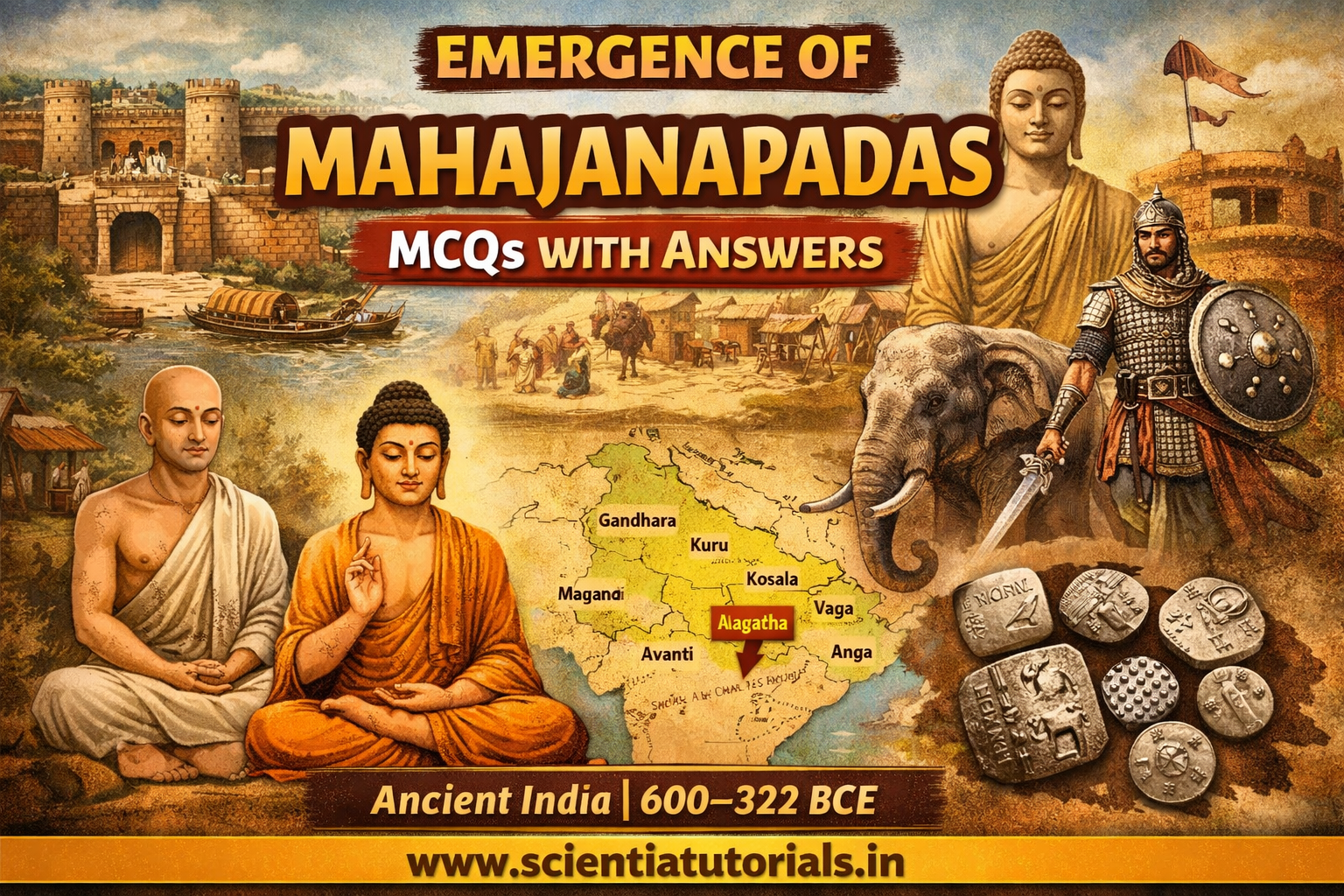

Emergence of Mahajanapadas MCQs with Answers | History of India (600–322 BCE)
Ancient Indian History – Second Urbanisation (c. 600 BCE – c. 322 BCE)
1. Introduction: Significance of the Mahajanapada Phase
The emergence of the Mahajanapadas marks a decisive turning point in ancient Indian history. It represents the transition from tribal-based political systems of the Later Vedic age to territorial states with centralized authority, professional armies, regular taxation, and urban centres. This phase coincides with the period known as the Second Urbanisation, during which towns, trade, coinage, and new socio-religious ideas flourished.
The Mahajanapada period laid the political, economic, and social foundations for the rise of powerful kingdoms such as Magadha and ultimately prepared the ground for the Mauryan Empire.
2. Historical Background: From Janapadas to Mahajanapadas
2.1 Janapadas: The Precursor States
- The term janapada literally means “foothold of a tribe (jana)”.
- Janapadas emerged during the Later Vedic period as Aryan tribes settled permanently.
- Initially, political identity was tribal, not territorial.
2.2 Transition to Mahajanapadas
By the 6th century BCE:
- Janapadas expanded in size and power.
- Agricultural surplus, population growth, and warfare led to consolidation.
- Stronger states absorbed weaker ones, giving rise to Mahajanapadas (great states).
3. Chronological Framework of the Mahajanapadas
- Period: c. 600 BCE – c. 322 BCE
- Corresponds with:
- Decline of Later Vedic tribal polities
- Rise of Buddhism and Jainism
- Growth of urban centres
- End of the period marked by Mauryan unification
4. Literary Sources for the Study of Mahajanapadas
4.1 Buddhist Sources
- The most important reference to the Mahajanapadas is found in the Anguttara Nikaya.
- It lists sixteen Mahajanapadas prevalent during the time of the Buddha.
4.2 Jain Sources
- Jain texts such as the Bhagavati Sutra also mention major kingdoms and republics.
4.3 Brahmanical Sources
- Dharmasutras, Puranas, and later Sanskrit literature provide supplementary information.
5. The Sixteen Mahajanapadas
According to the Anguttara Nikaya, the sixteen Mahajanapadas were:
- Anga
- Magadha
- Kashi
- Kosala
- Vatsa
- Avanti
- Chedi
- Matsya
- Kuru
- Panchala
- Surasena
- Assaka
- Gandhara
- Kamboja
- Vajji
- Malla
These were spread across north, central, and north-western India, indicating widespread political development.
6. Geographical Distribution and Strategic Importance
6.1 Northern and Gangetic Plains
- Magadha, Kosala, Kashi, Vajji
- Fertile alluvial soil
- Navigable rivers like Ganga and Son
- Ideal for agriculture and trade
6.2 North-Western Region
- Gandhara, Kamboja
- Connected India with Central Asia
- Centres of trade and cultural exchange
6.3 Central and Deccan Regions
- Avanti, Assaka
- Controlled trade routes linking north and south India
7. Political Nature of the Mahajanapadas
7.1 Monarchies
Most Mahajanapadas were monarchical states, ruled by hereditary kings.
Examples:
- Magadha
- Kosala
- Avanti
- Vatsa
Features:
- Centralised administration
- Standing armies
- Regular taxation
- Capital cities
7.2 Gana-Sanghas (Republics)
Some Mahajanapadas followed a republican or oligarchic system.
Examples:
- Vajji
- Malla
- Kamboja
Features:
- Rule by assemblies of nobles
- Collective decision-making
- No single hereditary monarch
Examination Insight:
Republics declined faster due to lack of centralized military power.
8. Economic Foundations of the Mahajanapadas
8.1 Agricultural Expansion
- Extensive use of iron tools
- Clearing of forests in the Gangetic plains
- High agricultural surplus
8.2 Trade and Commerce
- Growth of internal and external trade
- Trade routes connected north-west, Gangetic plains, and Deccan
- Urban markets (nigamas) flourished
8.3 Coinage
- Introduction of punch-marked coins
- Facilitated trade and tax collection
- Sign of monetised economy
9. Urbanisation and Growth of Cities
This period is called the Second Urbanisation because:
- New cities emerged after the decline of Harappan civilisation
- Capitals like Rajagriha, Vaishali, Ujjain, and Shravasti grew rapidly
Urban Features:
- Fortified cities
- Markets and craft guilds
- Administrative centres
- Religious institutions
10. Administrative Developments
- Kings maintained:
- Ministers
- Revenue officials
- Military commanders
- Taxation became systematic:
- Land tax
- Trade tax
- Toll tax
- Law and order maintained through royal authority
11. Military Organisation and Warfare
- Standing armies replaced tribal militias
- Use of iron weapons increased
- Fortifications protected cities
- Continuous warfare among Mahajanapadas for supremacy
12. Social Changes during the Mahajanapada Period
- Varna system became more rigid
- Rise of:
- Merchants (Vaishyas)
- Artisans and craftsmen
- Urban life weakened old tribal bonds
- Social tensions increased
13. Religious Context: Rise of New Religious Movements
The socio-economic changes of the Mahajanapada period created conditions for:
- Dissatisfaction with Brahmanical ritualism
- Rise of Buddhism and Jainism
- Emphasis on:
- Non-violence
- Ethical conduct
- Individual salvation
Many Mahajanapadas, especially Magadha, became centres of these new movements.
14. Rise of Magadha: A Case Study
14.1 Geographical Advantages
- Fertile land
- Abundant iron ore
- Strategic river systems
14.2 Political Leadership
- Kings like Bimbisara and Ajatashatru
- Expansion through diplomacy and conquest
14.3 Economic Strength
- Control of trade routes
- Agricultural surplus
Result:
Magadha emerged as the most powerful Mahajanapada.
15. Decline of Smaller Mahajanapadas
- Constant warfare
- Absorption by stronger kingdoms
- Weak republican structures
- Economic and military inequality
16. Transition Towards Empire
By the late 4th century BCE:
- Most Mahajanapadas were absorbed into Magadha
- Political unification intensified
- Led to the establishment of the Mauryan Empire under Chandragupta Maurya (322 BCE)
17. Historical Importance of the Mahajanapada Phase
The Mahajanapada period is crucial because it:
- Introduced territorial states
- Strengthened monarchy and administration
- Encouraged urbanisation and trade
- Gave birth to new religious philosophies
- Prepared the ground for India’s first empire
18. Conclusion
The emergence of the Mahajanapadas marks the maturation of ancient Indian political life. It reflects how economic growth, technological advancement, and social change combined to transform tribal societies into powerful states. This phase stands at the crossroads of political consolidation and spiritual transformation, making it one of the most decisive chapters in the History of India.
📌 Exam-Ready Takeaway
The Mahajanapadas represent the transition from tribe to state, from ritual economy to monetised trade, and from Vedic orthodoxy to ethical-philosophical movements.
Below is a well-structured, examination-oriented set of 25 Questions with clear and accurate Answers on the lesson “Emergence of Mahajanapadas”, fully aligned with SECTION 4: Mahajanapadas & Rise of New Religious Movements of the History of India – Complete Chronological and Era-Wise Course.
Emergence of Mahajanapadas
Timeline: c. 600 BCE – c. 322 BCE
Theme: Second Urbanisation in Ancient India
1. What does the term Mahajanapada mean?
Answer:
The term Mahajanapada means “great realm” or “large territorial state.” It refers to powerful political units that emerged from earlier tribal settlements (janapadas) during the 6th century BCE.
2. How many Mahajanapadas existed in ancient India?
Answer:
There were sixteen Mahajanapadas, as mentioned in early Buddhist texts like the Anguttara Nikaya.
3. In which period did the Mahajanapadas emerge?
Answer:
The Mahajanapadas emerged between c. 600 BCE and c. 322 BCE, marking the phase of Second Urbanisation in ancient India.
4. What historical process led to the emergence of Mahajanapadas?
Answer:
The Mahajanapadas developed due to the transition from tribal, kin-based societies to territorial states, driven by agricultural expansion, use of iron tools, population growth, and surplus production.
5. Which sources provide information about the Mahajanapadas?
Answer:
Information comes mainly from Buddhist texts (Tripitakas), Jain literature, early Dharmasutras, and later Puranic traditions.
6. Name the most powerful Mahajanapada of the period.
Answer:
Magadha was the most powerful Mahajanapada, eventually becoming the nucleus of the Mauryan Empire.
7. Why did Magadha rise to prominence among the Mahajanapadas?
Answer:
Magadha’s rise was due to fertile alluvial soil, rich iron deposits, strategic rivers like the Ganga, effective rulers, and strong military organisation.
8. What were the two major types of political systems among the Mahajanapadas?
Answer:
The Mahajanapadas had:
- Monarchies (ruled by kings)
- Republics (Ganasanghas) governed by assemblies.
9. Name an important republican Mahajanapada.
Answer:
Vajji was a prominent republican Mahajanapada, known for its confederate political structure.
10. What role did iron technology play in the emergence of Mahajanapadas?
Answer:
Iron tools improved agriculture by enabling forest clearance and deep ploughing, leading to surplus production, population growth, and the rise of large states.
11. How did urbanisation contribute to the growth of Mahajanapadas?
Answer:
Urban centres emerged as hubs of administration, trade, craft production, and religious activity, strengthening state control and economic integration.
12. Which rivers were central to the development of Mahajanapadas?
Answer:
The Ganga, Yamuna, Sarayu, and Gandak rivers provided fertile land, water transport, and trade routes, especially in the eastern Gangetic plains.
13. Name two important cities associated with Magadha.
Answer:
Important cities were Rajagriha and later Pataliputra.
14. How were Mahajanapadas administered?
Answer:
They had organized administrative systems with officials for revenue collection, justice, military affairs, and law enforcement under centralized authority.
15. What was the economic base of the Mahajanapadas?
Answer:
The economy was based on agriculture, supplemented by trade, crafts, cattle rearing, and the use of early metallic coinage.
16. What types of taxes were collected by Mahajanapada states?
Answer:
Taxes included land revenue, trade taxes, tolls, and compulsory labour (vishti), forming the financial base of the state.
17. How did warfare influence the emergence of Mahajanapadas?
Answer:
Constant warfare for territory and resources led to the decline of weaker states and the expansion of stronger ones like Magadha.
18. Name two Mahajanapadas located in north-western India.
Answer:
Gandhara and Kamboja were located in the north-west.
19. How did Mahajanapadas differ from earlier Janapadas?
Answer:
Mahajanapadas were larger, more centralized, territorial, and economically complex compared to the smaller, clan-based Janapadas.
20. What role did trade routes play in the rise of Mahajanapadas?
Answer:
Trade routes connected urban centres, facilitated exchange of goods, increased wealth, and enhanced political power of states controlling them.
21. How did social stratification change during this period?
Answer:
Society became more stratified with sharper distinctions between rulers, merchants, artisans, peasants, and labourers.
22. Which Mahajanapada was associated with the life of Buddha?
Answer:
Kosala and Magadha were closely linked to the life of Gautama Buddha.
23. Why is the period of Mahajanapadas called the Second Urbanisation?
Answer:
Because it marked the re-emergence of cities, complex economies, coinage, and state systems after the decline of the Harappan Civilization.
24. How did Mahajanapadas prepare the ground for new religious movements?
Answer:
Urbanisation, social inequality, and dissatisfaction with ritualistic Brahmanism encouraged the rise of Buddhism and Jainism.
25. What is the historical significance of the Mahajanapadas?
Answer:
The Mahajanapadas laid the political, economic, and urban foundations for empire-building in India, culminating in the Mauryan Empire.
Below is a well-structured, examination-oriented set of 25 Multiple Choice Questions (MCQs) on the lesson “Emergence of Mahajanapadas”, prepared strictly in line with SECTION 4: Mahajanapadas & Rise of New Religious Movements (c. 600–322 BCE) and the broader History of India – Complete Chronological and Era-Wise Course.
Each MCQ includes the correct answer and an elaborate concept-clearing explanation, suitable for UPSC, State PSCs, and university exams.
MCQs: Emergence of Mahajanapadas
Theme: Second Urbanisation in Ancient India
1. The term Mahajanapada refers to:
A. A religious institution
B. A large territorial state
C. A clan-based tribe
D. A trading guild
Correct Answer: B
Explanation:
Mahajanapadas were large territorial political entities that emerged from earlier tribal units (janapadas). They represented a shift from kinship-based societies to territorially defined states.
2. How many Mahajanapadas are mentioned in early Buddhist literature?
A. 12
B. 14
C. 16
D. 18
Correct Answer: C
Explanation:
Early Buddhist texts such as the Anguttara Nikaya clearly mention sixteen Mahajanapadas, forming the political landscape of North India in the 6th century BCE.
3. The emergence of Mahajanapadas is associated with which historical phase?
A. First Urbanisation
B. Vedic Pastoral Phase
C. Second Urbanisation
D. Gupta Urban Expansion
Correct Answer: C
Explanation:
The Mahajanapada period corresponds to the Second Urbanisation, marked by the growth of cities, trade, coinage, and complex administration after the Harappan decline.
4. Which of the following was the most powerful Mahajanapada?
A. Avanti
B. Kosala
C. Magadha
D. Gandhara
Correct Answer: C
Explanation:
Magadha emerged as the strongest Mahajanapada due to fertile land, iron resources, strategic rivers, and capable rulers, eventually leading to the Mauryan Empire.
5. Which factor most significantly contributed to the rise of Mahajanapadas?
A. Expansion of maritime trade
B. Use of iron tools
C. Foreign invasions
D. Growth of temples
Correct Answer: B
Explanation:
Iron tools enabled forest clearance and intensive agriculture in the Gangetic plains, generating surplus and supporting large populations and states.
6. Which political system existed alongside monarchies in the Mahajanapada period?
A. Feudalism
B. Theocracy
C. Republics (Ganasanghas)
D. Tribal chiefdoms
Correct Answer: C
Explanation:
Some Mahajanapadas followed republican systems, governed by assemblies rather than kings, reflecting an alternative political tradition.
7. Which Mahajanapada was a prominent republican state?
A. Magadha
B. Vajji
C. Avanti
D. Kosala
Correct Answer: B
Explanation:
Vajji was a confederation of clans governed through assemblies, illustrating the gana–sangha form of governance.
8. Which river system formed the core region of Mahajanapada development?
A. Indus basin
B. Godavari basin
C. Narmada basin
D. Ganga–Yamuna basin
Correct Answer: D
Explanation:
The fertile Ganga–Yamuna plains supported intensive agriculture, dense population, and early urban centres.
9. The earliest capital of Magadha was:
A. Pataliputra
B. Vaishali
C. Ujjain
D. Rajagriha
Correct Answer: D
Explanation:
Rajagriha was the initial capital of Magadha before the administrative shift to Pataliputra.
10. The later capital of Magadha that became an imperial city was:
A. Kaushambi
B. Pataliputra
C. Taxila
D. Champa
Correct Answer: B
Explanation:
Pataliputra’s strategic riverine location made it a major administrative and commercial centre.
11. Which of the following texts is a primary source for Mahajanapadas?
A. Rigveda
B. Arthashastra
C. Ramayana
D. Buddhist Tripitakas
Correct Answer: D
Explanation:
Buddhist texts provide systematic references to the sixteen Mahajanapadas and their political structures.
12. Which economic feature distinguished Mahajanapadas from earlier Janapadas?
A. Barter economy only
B. Nomadic pastoralism
C. Use of metallic coinage
D. Absence of taxation
Correct Answer: C
Explanation:
Punch-marked coins indicate monetisation and growing commercial activity during this period.
13. Which Mahajanapada was located in north-western India?
A. Kashi
B. Anga
C. Gandhara
D. Kosala
Correct Answer: C
Explanation:
Gandhara, with centres like Taxila, was a key region linking India with Central Asia.
14. The transition from Janapadas to Mahajanapadas signifies:
A. Decline of agriculture
B. Rise of territorial states
C. End of warfare
D. Decline of trade
Correct Answer: B
Explanation:
Mahajanapadas marked the emergence of territorial sovereignty instead of clan-based authority.
15. Which Mahajanapada was associated with Gautama Buddha’s life?
A. Avanti
B. Kosala
C. Gandhara
D. Kamboja
Correct Answer: B
Explanation:
Kosala, along with Magadha, played a central role in the life and patronage of the Buddha.
16. What was vishti in the Mahajanapada period?
A. Religious tax
B. Trade duty
C. Forced labour
D. Military service
Correct Answer: C
Explanation:
Vishti referred to compulsory labour imposed by the state, reflecting administrative control.
17. Why did warfare become frequent among Mahajanapadas?
A. Religious conflicts
B. Competition for fertile land and resources
C. Foreign invasions
D. Nomadic raids
Correct Answer: B
Explanation:
Territorial expansion and resource control led to constant conflicts, benefiting stronger states like Magadha.
18. Which Mahajanapada was known for its strategic central Indian location?
A. Magadha
B. Kosala
C. Avanti
D. Vajji
Correct Answer: C
Explanation:
Avanti controlled important trade routes in central India, enhancing its economic importance.
19. Which social change accompanied the rise of Mahajanapadas?
A. Decline of social hierarchy
B. Growth of rigid social stratification
C. End of varna system
D. Equal status of all professions
Correct Answer: B
Explanation:
Economic surplus and urbanisation sharpened social divisions among rulers, merchants, artisans, and labourers.
20. The Mahajanapadas laid the foundation for:
A. Gupta administration
B. Mauryan Empire
C. Mughal polity
D. Colonial governance
Correct Answer: B
Explanation:
The political consolidation during the Mahajanapada period culminated in the rise of the Mauryan Empire.
21. Which Mahajanapada was located east of Magadha?
A. Kashi
B. Kosala
C. Anga
D. Avanti
Correct Answer: C
Explanation:
Anga, with its port city Champa, was an important eastern Mahajanapada before its annexation by Magadha.
22. What role did urban centres play in Mahajanapadas?
A. Only religious centres
B. Centres of administration, trade, and crafts
C. Military camps only
D. Seasonal markets
Correct Answer: B
Explanation:
Cities functioned as hubs of governance, commerce, and production, reinforcing state power.
23. Which Mahajanapada had a confederate political structure?
A. Magadha
B. Avanti
C. Kosala
D. Vajji
Correct Answer: D
Explanation:
Vajji was a union of clans governed collectively, not by a single monarch.
24. Why is the Mahajanapada period historically significant?
A. It marked the end of urban life
B. It established the first villages
C. It prepared the ground for new religions and empires
D. It ended political conflicts
Correct Answer: C
Explanation:
Urban stress, inequality, and ritualism led to the rise of Buddhism and Jainism, while political consolidation enabled empire-building.
25. Which feature best distinguishes Mahajanapadas from earlier Vedic society?
A. Nomadic lifestyle
B. Pastoral economy
C. Territorial administration
D. Absence of kings
Correct Answer: C
Explanation:
Mahajanapadas were territorial states with defined boundaries, marking a decisive shift from earlier tribal systems.
🎯 Targeting Exams
This content is specifically designed for preparation of:
-
UPSC Civil Services (Prelims & Mains)
-
State PSC Examinations (APSC, BPSC, UPPSC, WBCS, etc.)
-
UGC NET (History)
-
CUET (UG & PG History)
-
University Semester Exams (Ancient Indian History)
-
School Level Competitive Exams (Class 11–12)
🔑 Related Keyphrases
-
Mahajanapadas MCQs with explanations
-
Second Urbanisation in Ancient India
-
History of India MCQs Ancient Period
-
Emergence of States in Ancient India
-
Magadha and Mahajanapadas questions
-
Ancient Indian polity MCQs
-
UPSC History MCQs Mahajanapadas
-
Buddhism and Mahajanapada period