
East India Company Administration
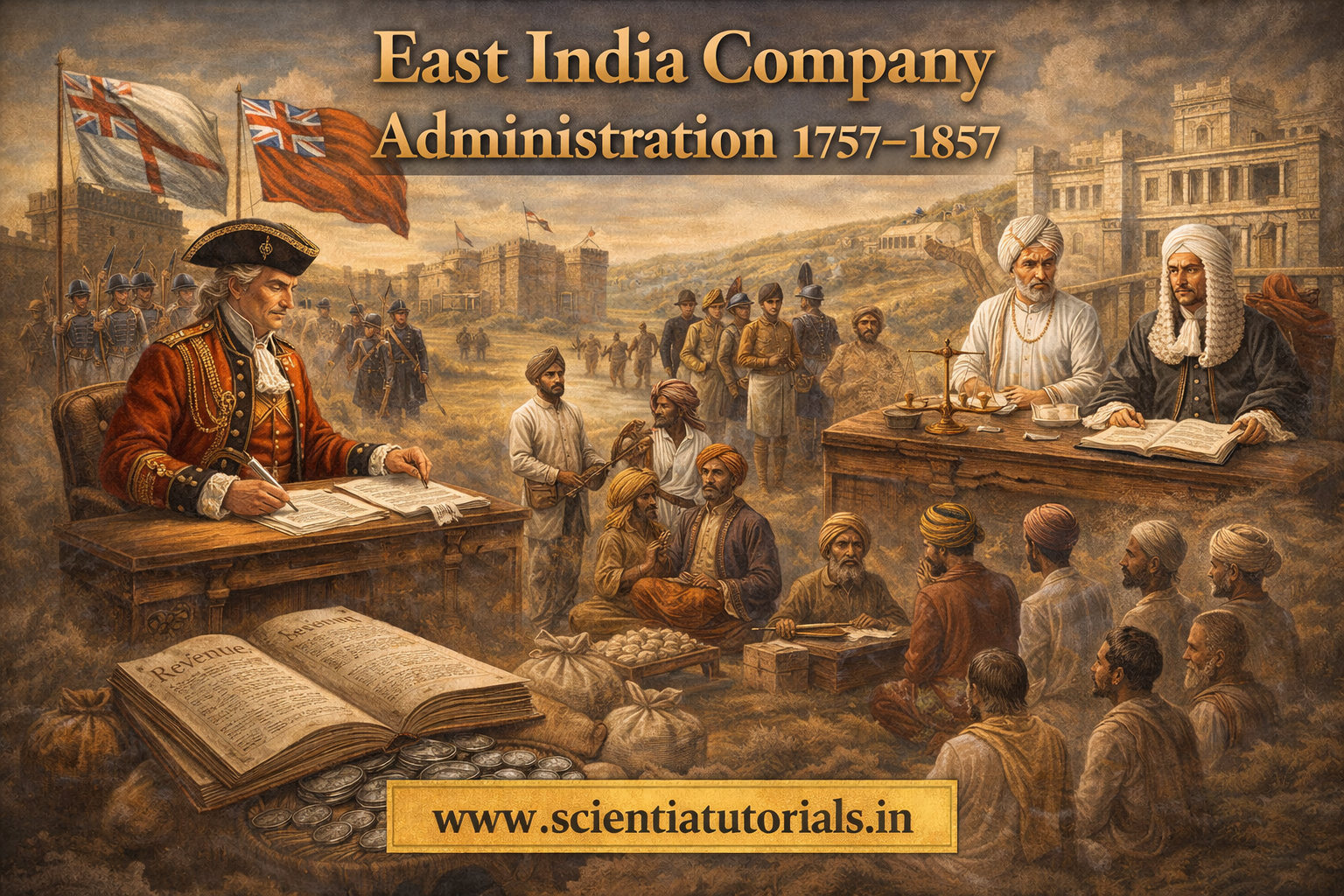

East India Company Administration (1757–1857) | History of India
SECTION 12: British Rule & Administrative Systems (1757 CE – 1857 CE)
Modern Indian History – Company Rule
1. Introduction: From Traders to Rulers (1757–1857)
The administrative system established by the British East India Company represents a crucial phase in Indian history, marking the transformation of a trading corporation into a sovereign ruling authority. After the Battle of Plassey (1757), the Company gradually assumed political, fiscal, and judicial control over large parts of India. Between 1757 and 1857, Company administration evolved through experimentation, legislative intervention, and centralisation, laying the foundations of modern colonial governance in India.
This period is known as Company Rule, characterised by revenue extraction, bureaucratic expansion, and increasing British parliamentary oversight. The administrative policies of the Company profoundly altered India’s political institutions, economy, and society.
2. Background: Establishment of Company Rule in India
2.1 Political Context after 1757
The Company’s political authority began in Bengal after Plassey (1757) and was legally confirmed following the Battle of Buxar (1764). The grant of Diwani rights in 1765 by the Mughal Emperor allowed the Company to collect revenue in Bengal, Bihar, and Orissa.
This dual role of the Company as:
- Trader, and
- Revenue administrator,
created severe administrative confusion and corruption, necessitating reforms.
2.2 Nature of Early Company Administration
Initially, the Company lacked:
- Administrative experience
- Clear separation of powers
- Accountability mechanisms
Administration was driven by profit rather than governance, leading to exploitation and misrule.
3. Dual Government in Bengal (1765–1772)
3.1 System of Dual Government
The Dual Government introduced by Robert Clive divided authority into:
- Diwani (Revenue administration) – Company
- Nizamat (Police and justice) – Nawab
In reality, the Company controlled revenue but avoided responsibility for administration.
3.2 Consequences of Dual Government
- Massive corruption
- Administrative paralysis
- Decline in law and order
- Bengal Famine of 1770
The failure of this system exposed the need for direct administrative control.
4. Regulating Act of 1773: Beginning of Parliamentary Control
The Regulating Act of 1773 marked the first attempt by the British Parliament to regulate Company administration in India.
4.1 Key Provisions
- Governor of Bengal became Governor-General of Bengal
- Creation of a Governor-General’s Council
- Establishment of Supreme Court at Calcutta
- Company officials made accountable to Parliament
4.2 Significance
- Recognised Company rule as a national concern of Britain
- Initiated centralisation of administration
- Limited Company autonomy
However, the Act suffered from ambiguities and conflicts between executive and judiciary.
5. Pitt’s India Act, 1784: Dual Control System
To remove defects of the Regulating Act, Pitt’s India Act (1784) was enacted.
5.1 Features of Dual Control
- Court of Directors – Managed commercial affairs
- Board of Control – Supervised political and administrative matters
This created a system of dual control, balancing Company management with state supervision.
5.2 Administrative Impact
- Reduced Company independence
- Strengthened British government authority
- Formalised colonial governance structure
6. Governor-Generalship and Administrative Centralisation
6.1 Role of Governor-General
The Governor-General emerged as the central authority in Company administration, responsible for:
- Policy formulation
- Military expansion
- Revenue and judicial reforms
6.2 Important Governor-Generals
- Warren Hastings – Administrative consolidation
- Lord Cornwallis – Civil service and judicial reforms
- Lord Wellesley – Subsidiary Alliance
- Lord Dalhousie – Administrative modernisation
7. Administrative Reforms under Company Rule
7.1 Revenue Administration
The Company introduced new revenue systems to maximise income:
- Permanent Settlement (1793) – Fixed land revenue with zamindars
- Ryotwari System – Direct settlement with cultivators
- Mahalwari System – Revenue settlement with village communities
These systems transformed agrarian relations and entrenched landlordism and peasant exploitation.
7.2 Judicial Administration
7.2.1 Early Judicial System
- Civil and criminal courts established
- Separation of revenue and judicial functions gradually introduced
7.2.2 Cornwallis Reforms (1793)
- Hierarchical court system
- Codification of laws
- Exclusion of Indians from higher judicial posts
Judicial administration aimed at efficiency but reinforced racial discrimination.
7.3 Civil Administration and Bureaucracy
7.3.1 Civil Services
- Introduction of covenanted civil services
- High salaries to reduce corruption
- Indians excluded from senior posts
This laid the foundation of the colonial bureaucracy.
7.3.2 Police Administration
- District-based policing system
- Superintendent of Police under British officials
- Police used mainly for revenue enforcement and law control
8. Military Administration
The Company maintained a large standing army funded by Indian revenues. Key features included:
- European officers commanding Indian soldiers
- Army used for territorial expansion
- Military expenses burdened Indian economy
The army became a critical pillar of Company administration.
9. Charter Acts and Administrative Evolution
9.1 Charter Act of 1813
- Ended Company trade monopoly (except tea and China trade)
- Emphasised administrative role of the Company
- Encouraged missionary activities
9.2 Charter Act of 1833
- Governor-General of Bengal became Governor-General of India
- Centralised legislative authority
- Company became purely administrative body
9.3 Charter Act of 1853
- Introduced open competition for civil services (in principle)
- Strengthened legislative councils
These Acts marked the gradual transfer of power from Company to British Crown.
10. Nature and Character of Company Administration
10.1 Centralised and Authoritarian
- Concentration of power in Governor-General
- Minimal Indian participation
- Emphasis on law and order over welfare
10.2 Economic Exploitation
- Revenue extraction prioritised
- Indian economy subordinated to British interests
- Administrative machinery served colonial economy
11. Limitations and Criticism of Company Administration
- Absence of Indian representation
- Racial discrimination
- Administrative rigidity
- Economic exploitation
- Social and cultural insensitivity
These weaknesses generated widespread resentment among Indians.
12. Company Administration and the Revolt of 1857
The administrative policies of the Company contributed significantly to the Revolt of 1857, due to:
- Revenue oppression
- Military grievances
- Administrative arrogance
- Cultural interference
The Revolt exposed the inadequacy of Company rule and led to its abolition.
13. End of Company Rule (1858)
Following the Revolt of 1857:
- Company rule was abolished
- Administration transferred to the British Crown
- Beginning of Crown Rule in India
This marked the end of the Company as a governing authority.
14. Historical Significance of East India Company Administration
- Laid foundations of modern Indian administration
- Introduced bureaucracy, judiciary, and revenue systems
- Created colonial state structure
- Shaped India’s political and economic trajectory
Despite its exploitative nature, Company administration deeply influenced India’s administrative framework.
15. Conclusion
The East India Company administration represents a unique historical phenomenon where a commercial corporation governed a vast territory. Between 1757 and 1857, Company rule evolved from chaotic profit-seeking to a structured colonial administration under parliamentary oversight. While it introduced administrative institutions, its primary objective remained economic exploitation, leading ultimately to resistance and its downfall.
Understanding Company administration is essential for comprehending the origins of British colonial governance and its long-term impact on India.
Exam-Oriented Summary
- 1757–1765: Company as political power
- 1765–1772: Dual Government
- 1773 onwards: Parliamentary regulation
- 1858: End of Company rule
Questions and Answers: East India Company Administration (1757–1857)
Q1. What is meant by East India Company administration in Indian history?
Answer:
East India Company administration refers to the system of governance established by the British East India Company in India between 1757 and 1857, during which the Company functioned as a political, revenue, and military authority.
Q2. Which event marked the beginning of Company rule in India?
Answer:
The Battle of Plassey in 1757 marked the beginning of Company rule by establishing British political dominance in Bengal.
Q3. How did the Battle of Buxar strengthen Company administration?
Answer:
The Battle of Buxar (1764) led to the grant of Diwani rights in 1765, allowing the Company to collect revenue in Bengal, Bihar, and Orissa, thereby giving it legal administrative authority.
Q4. What were Diwani rights?
Answer:
Diwani rights were the authority to collect land revenue and administer civil justice, granted to the Company by the Mughal Emperor in 1765.
Q5. What was the Dual Government system introduced in Bengal?
Answer:
The Dual Government (1765–1772) divided authority between the Company (revenue collection) and the Nawab (police and justice), though real power rested with the Company.
Q6. Why did the Dual Government system fail?
Answer:
It failed due to administrative confusion, corruption, lack of accountability, and neglect of public welfare, leading to lawlessness and famine.
Q7. Which famine exposed the failures of early Company administration?
Answer:
The Bengal Famine of 1770 exposed the exploitative and irresponsible nature of Company administration.
Q8. What was the significance of the Regulating Act of 1773?
Answer:
The Regulating Act of 1773 marked the first parliamentary intervention in Company affairs and aimed to regulate its administration in India.
Q9. What major administrative changes were introduced by the Regulating Act of 1773?
Answer:
It created the post of Governor-General of Bengal, established a Supreme Court at Calcutta, and made Company officials accountable to the British Parliament.
Q10. Who was the first Governor-General of Bengal?
Answer:
Warren Hastings was the first Governor-General of Bengal.
Q11. What was Pitt’s India Act of 1784?
Answer:
Pitt’s India Act established a system of dual control, dividing authority between the Company (Court of Directors) and the British government (Board of Control).
Q12. How did Pitt’s India Act reduce Company autonomy?
Answer:
It transferred political and administrative supervision to the British government, limiting the Company’s independent decision-making.
Q13. What was the role of the Governor-General in Company administration?
Answer:
The Governor-General acted as the chief executive authority, overseeing administration, military affairs, revenue, and policy-making.
Q14. Name two major administrative reforms introduced by Lord Cornwallis.
Answer:
Lord Cornwallis introduced judicial reforms, civil service reorganisation, and separation of revenue and judicial functions.
Q15. What were the main revenue systems introduced by the Company?
Answer:
The main revenue systems were the Permanent Settlement, Ryotwari System, and Mahalwari System.
Q16. What was the objective of Permanent Settlement?
Answer:
The objective was to ensure a fixed and regular revenue by making zamindars permanent landowners responsible for revenue payment.
Q17. How did Company judicial administration affect Indians?
Answer:
While it introduced a uniform legal system, it excluded Indians from higher judicial posts and reinforced racial discrimination.
Q18. What was the nature of the civil services under Company rule?
Answer:
The civil services were highly centralised, European-dominated, and designed to ensure efficient revenue collection and control.
Q19. How was the police system organised under Company administration?
Answer:
The police system was district-based, controlled by British officials, and primarily aimed at maintaining law and order and enforcing revenue collection.
Q20. What was the significance of the Charter Act of 1813?
Answer:
It ended the Company’s trade monopoly (except tea and China trade) and emphasised its administrative role.
Q21. How did the Charter Act of 1833 change Company administration?
Answer:
It centralised legislative power and made the Governor-General of Bengal the Governor-General of India, turning the Company into a purely administrative body.
Q22. Why is Company administration described as exploitative?
Answer:
Because it prioritised revenue extraction and British economic interests over Indian welfare and development.
Q23. How did Company administrative policies contribute to the Revolt of 1857?
Answer:
Revenue oppression, racial discrimination, military grievances, and administrative arrogance created widespread resentment leading to the revolt.
Q24. What happened to Company administration after the Revolt of 1857?
Answer:
Company rule was abolished, and administration was transferred to the British Crown under the Government of India Act, 1858.
Q25. State the historical significance of East India Company administration.
Answer:
It laid the foundations of modern colonial administration in India while also institutionalising economic exploitation and political domination.
MCQs with Answers & Explanations
East India Company Administration (1757–1857)
MCQ 1
The political authority of the East India Company in India began after:
A. Battle of Panipat (1761)
B. Battle of Buxar (1764)
C. Battle of Plassey (1757)
D. Charter Act of 1813
Correct Answer: C
Explanation:
The Battle of Plassey (1757) marked the beginning of Company rule by establishing British political dominance in Bengal.
MCQ 2
The East India Company obtained Diwani rights in:
A. 1757
B. 1764
C. 1765
D. 1773
Correct Answer: C
Explanation:
In 1765, the Mughal Emperor granted Diwani rights to the Company, allowing it to collect revenue in Bengal, Bihar, and Orissa.
MCQ 3
Diwani rights mainly related to:
A. Military administration
B. Revenue collection and civil justice
C. Police administration
D. Foreign relations
Correct Answer: B
Explanation:
Diwani involved revenue collection and civil administration, which became the financial backbone of Company rule.
MCQ 4
The system of Dual Government in Bengal was introduced by:
A. Warren Hastings
B. Lord Cornwallis
C. Robert Clive
D. Lord Wellesley
Correct Answer: C
Explanation:
Robert Clive introduced the Dual Government in 1765, separating revenue administration from police and judicial functions.
MCQ 5
Which of the following best describes the Dual Government system?
A. Company ruled directly
B. Nawab ruled independently
C. Company controlled revenue without responsibility
D. Shared power equally
Correct Answer: C
Explanation:
The Company collected revenue but avoided responsibility for administration, leading to corruption and misrule.
MCQ 6
The failure of Dual Government was exposed by the:
A. Anglo-Mysore Wars
B. Bengal Famine of 1770
C. Battle of Buxar
D. Regulating Act of 1773
Correct Answer: B
Explanation:
The Bengal Famine of 1770 highlighted the exploitative and irresponsible nature of early Company administration.
MCQ 7
The Regulating Act of 1773 was significant because it:
A. Ended Company rule
B. Introduced Crown rule
C. Brought Company under parliamentary control
D. Abolished the Governor-General
Correct Answer: C
Explanation:
It was the first attempt by the British Parliament to regulate Company administration in India.
MCQ 8
Who became the first Governor-General of Bengal under the Regulating Act of 1773?
A. Lord Cornwallis
B. Lord Wellesley
C. Warren Hastings
D. Lord Dalhousie
Correct Answer: C
Explanation:
Warren Hastings became the first Governor-General of Bengal, centralising Company administration.
MCQ 9
The Supreme Court at Calcutta was established under the:
A. Pitt’s India Act
B. Regulating Act of 1773
C. Charter Act of 1813
D. Charter Act of 1833
Correct Answer: B
Explanation:
The Regulating Act of 1773 created the Supreme Court to administer British law in India.
MCQ 10
Pitt’s India Act of 1784 introduced the system of:
A. Direct rule
B. Provincial autonomy
C. Dual control
D. Judicial independence
Correct Answer: C
Explanation:
It divided authority between the Court of Directors (Company) and the Board of Control (British government).
MCQ 11
Which body controlled political affairs under Pitt’s India Act?
A. Court of Directors
B. Board of Control
C. Governor-General’s Council
D. Supreme Court
Correct Answer: B
Explanation:
The Board of Control represented the British government and supervised political and administrative matters.
MCQ 12
Which Governor-General introduced major civil service and judicial reforms?
A. Lord Cornwallis
B. Lord Wellesley
C. Warren Hastings
D. Lord Dalhousie
Correct Answer: A
Explanation:
Cornwallis reorganised civil services, introduced judicial hierarchy, and separated revenue from judiciary.
MCQ 13
The Permanent Settlement was introduced in:
A. 1773
B. 1784
C. 1793
D. 1813
Correct Answer: C
Explanation:
The Permanent Settlement of 1793 fixed land revenue permanently with zamindars.
MCQ 14
The Ryotwari system involved revenue settlement directly with:
A. Zamindars
B. Village communities
C. Cultivators
D. Princes
Correct Answer: C
Explanation:
Under Ryotwari, revenue was collected directly from individual cultivators.
MCQ 15
Which revenue system was based on village communities?
A. Permanent Settlement
B. Ryotwari System
C. Mahalwari System
D. Jagirdari System
Correct Answer: C
Explanation:
Mahalwari settlement assessed revenue collectively on villages or estates.
MCQ 16
The covenanted civil service under Company rule was characterised by:
A. Indian dominance
B. Open competition
C. European monopoly
D. Local recruitment
Correct Answer: C
Explanation:
Higher administrative posts were reserved exclusively for Europeans.
MCQ 17
The police system under Company administration was mainly designed to:
A. Protect civil liberties
B. Promote social reform
C. Maintain law and order and enforce revenue
D. Train Indian officials
Correct Answer: C
Explanation:
Police primarily served colonial interests, especially revenue collection and control.
MCQ 18
The Charter Act of 1813 is important because it:
A. Ended Company administration
B. Abolished monopoly trade
C. Ended Company’s trade monopoly (except tea and China)
D. Introduced elections
Correct Answer: C
Explanation:
The Act reduced Company’s commercial role and emphasised its administrative functions.
MCQ 19
Which Act made the Governor-General of Bengal the Governor-General of India?
A. Regulating Act, 1773
B. Pitt’s India Act, 1784
C. Charter Act, 1813
D. Charter Act, 1833
Correct Answer: D
Explanation:
The Charter Act of 1833 centralised legislative authority across India.
MCQ 20
The Charter Act of 1853 is associated with:
A. End of Company rule
B. Open competition for civil services
C. Abolition of monopoly trade
D. Dual government
Correct Answer: B
Explanation:
It introduced open competition in civil services (though Indians faced practical barriers).
MCQ 21
Which Governor-General expanded British territory through Subsidiary Alliance?
A. Warren Hastings
B. Lord Wellesley
C. Lord Cornwallis
D. Lord Dalhousie
Correct Answer: B
Explanation:
Lord Wellesley used Subsidiary Alliances to expand Company control without direct annexation.
MCQ 22
Company administration can best be described as:
A. Democratic
B. Decentralised
C. Centralised and authoritarian
D. Federal
Correct Answer: C
Explanation:
Power was concentrated in the Governor-General with minimal Indian participation.
MCQ 23
Which factor most contributed to resentment against Company administration?
A. Efficient judiciary
B. Revenue exploitation
C. Educational reforms
D. Infrastructure development
Correct Answer: B
Explanation:
Heavy land revenue demand and economic exploitation angered peasants and landlords alike.
MCQ 24
The Revolt of 1857 exposed the failure of:
A. Mughal administration
B. Indian princely states
C. Company rule
D. British Parliament
Correct Answer: C
Explanation:
Administrative arrogance, racial discrimination, and economic exploitation led to widespread revolt.
MCQ 25
Company administration came to an end in:
A. 1857
B. 1858
C. 1861
D. 1909
Correct Answer: B
Explanation:
After the Revolt of 1857, Company rule was abolished and power transferred to the British Crown in 1858.
🎯 Targeting Exams
This content is carefully structured for the following examinations:
-
UPSC Civil Services Examination (Prelims & Mains)
-
State Public Service Commissions (PSC)
-
UGC NET / SET (History)
-
CUET (UG & PG – History)
-
University Semester & Competitive Examinations
🔍 Related Keyphrases
Use these related keyphrases naturally within headings, subheadings, and body content to enhance SEO performance:
-
Company rule in India administration
-
British East India Company governance
-
Regulating Act 1773 and Pitt’s India Act
-
Dual Government in Bengal
-
Revenue administration under Company rule
-
Judicial reforms of East India Company
-
Charter Acts and Company administration
-
Governor-General and colonial administration
-
Company rule 1757 to 1857
-
British administrative systems in India