
Rise of the Mauryan Empire
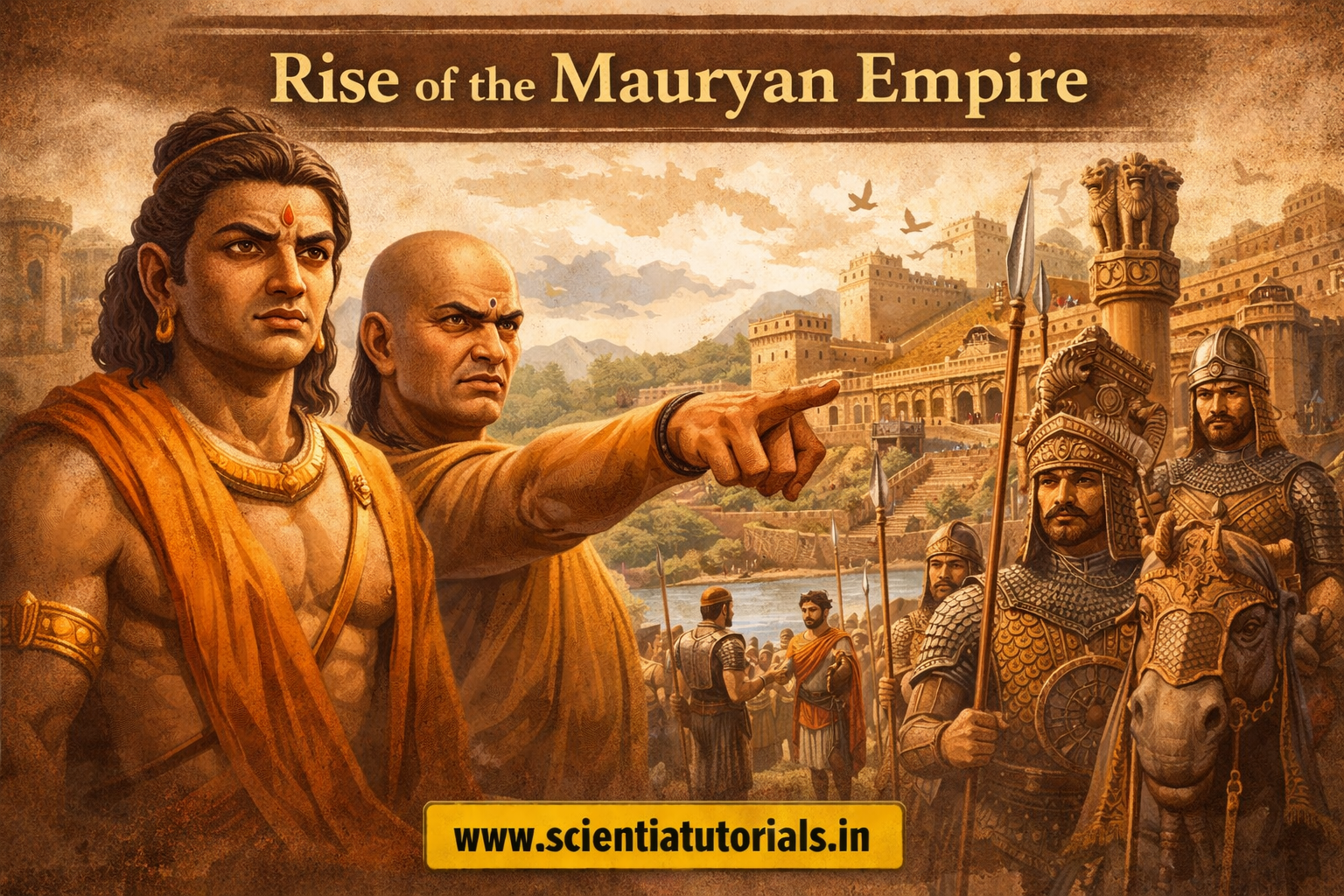

Rise of the Mauryan Empire | History of India Imperial Phase Notes
SECTION 5: Mauryan Empire & Post-Mauryan India
Timeline: c. 322 BCE – c. 185 BCE
(Ancient Indian History – Imperial Phase)
Lesson: Rise of the Mauryan Empire
1. Introduction: Significance of the Mauryan Empire
The rise of the Mauryan Empire marks the first successful attempt at political unification of a large part of the Indian subcontinent. Emerging in 322 BCE, the Mauryan state transformed India from a landscape of competing kingdoms and republics into a centralised imperial system. This transition represents a decisive shift from the Mahajanapada phase to the Imperial Phase of ancient Indian history.
The Mauryan Empire laid the foundations of:
- Centralised administration
- Imperial military organisation
- State-controlled economy
- Ethical governance
Understanding its rise is crucial for analysing the evolution of Indian polity, administration, economy, and political thought.
2. Political Background Before the Rise of the Mauryas
2.1 Decline of the Mahajanapadas
By the late 4th century BCE, most Mahajanapadas had either disappeared or been absorbed by powerful monarchies. Magadha emerged as the most dominant state due to:
- Fertile alluvial plains
- Control over iron-rich regions
- Strategic location along trade routes
However, the later rulers of the Nanda dynasty became unpopular due to:
- Heavy taxation
- Centralised economic control
- Autocratic rule
The last Nanda ruler, Dhanananda, faced widespread resentment among elites, commoners, and military commanders.
2.2 Impact of Alexander’s Invasion (326 BCE)
The invasion of north-western India by Alexander the Great had far-reaching consequences:
- It weakened existing rulers in Punjab and Sindh
- It exposed Indian rulers to new military strategies
- It created political instability in the north-west
Although Alexander did not penetrate deep into India, his withdrawal left behind a power vacuum, which later facilitated Mauryan expansion.
3. Emergence of Chandragupta Maurya
3.1 Early Life and Background
The founder of the Mauryan Empire, Chandragupta Maurya, rose from relatively humble origins. Ancient sources differ on his background, but all agree on his exceptional political ambition and military skill.
Chandragupta’s rise was guided by the political genius of Chanakya, also known as Kautilya or Vishnugupta, the author of the Arthashastra.
3.2 Role of Chanakya
Chanakya played a decisive role in:
- Training Chandragupta in politics and warfare
- Organising resistance against the Nandas
- Designing strategies for territorial expansion
The Arthashastra reflects the realpolitik principles that guided the Mauryan rise, emphasising diplomacy, espionage, warfare, and economic control.
4. Overthrow of the Nanda Dynasty (c. 322 BCE)
Chandragupta, with Chanakya’s support:
- Mobilised discontented elements of society
- Secured support from frontier tribes and mercenaries
- Launched a military campaign against Magadha
The defeat of Dhanananda around 322 BCE marked the end of the Nanda dynasty and the beginning of Mauryan rule. Pataliputra became the imperial capital.
This event is widely regarded as the formal beginning of the Mauryan Empire.
5. Expansion of the Mauryan Empire
5.1 Conquest of the North-West
After consolidating Magadha, Chandragupta moved toward the north-west:
- He defeated Greek satraps left behind by Alexander
- Extended Mauryan control over Punjab and Sindh
This brought the Mauryas into conflict with Seleucus Nicator, Alexander’s successor in West Asia.
5.2 Treaty with Seleucus (305 BCE)
A decisive treaty was concluded:
- Seleucus ceded territories in Afghanistan and Baluchistan
- Chandragupta gave 500 war elephants
- A matrimonial alliance was established
This treaty:
- Gave international legitimacy to the Mauryan Empire
- Secured India’s north-western frontier
- Enabled cultural and diplomatic exchanges
6. Administrative Foundations of Mauryan Power
6.1 Centralised Monarchy
The Mauryan state was a highly centralised monarchy with the emperor as supreme authority. The empire was divided into provinces governed by royal officials.
6.2 Bureaucracy and Espionage
Administration relied on:
- A salaried bureaucracy
- Spies (gudhapurusha)
- Strict revenue collection
The Arthashastra provides detailed descriptions of:
- State control over mines, forests, and trade
- Regulation of prices and wages
- Judicial administration
7. Military Organisation
The strength of the Mauryan Empire rested on its standing army, described by Greek sources as one of the largest in the ancient world.
The army consisted of:
- Infantry
- Cavalry
- Chariots
- War elephants
A central war office coordinated military logistics and strategy.
8. Economic Basis of the Mauryan Empire
8.1 Agriculture and Revenue
Agriculture was the backbone of the Mauryan economy. The state:
- Collected land revenue
- Constructed irrigation works
- Encouraged agricultural expansion
8.2 Trade and Urban Centres
Trade flourished due to:
- Political stability
- Standardised coinage
- Road networks
Cities like Pataliputra, Taxila, and Ujjain became major commercial hubs.
9. Succession After Chandragupta Maurya
Chandragupta was succeeded by Bindusara, who further consolidated the empire. The Mauryan state reached its greatest territorial and moral height under Ashoka, though his reign belongs to a later phase.
10. Historical Significance of the Rise of the Mauryan Empire
The rise of the Mauryan Empire:
- Established the first pan-Indian empire
- Introduced scientific statecraft
- Strengthened political unity
- Laid foundations for future empires
It marked India’s transition from regional polities to imperial governance, shaping the course of ancient Indian history.
11. Conclusion
The rise of the Mauryan Empire was not accidental but the result of favourable historical conditions, political vision, and administrative innovation. Chandragupta Maurya and Chanakya capitalised on social discontent, geopolitical instability, and economic resources to build a powerful imperial state.
This phase represents a turning point in Indian history, setting precedents in governance, military organisation, and economic administration that influenced India for centuries.
Below is a well-structured, examination-oriented set of 25 Questions with clear and accurate Answers, developed strictly from
SECTION 5: Mauryan Empire & Post-Mauryan India (c. 322–185 BCE)
Lesson: Rise of the Mauryan Empire
The questions move chronologically and conceptually—from background causes to consolidation—making them suitable for UPSC GS-I, State PSCs, UG–PG history exams, and answer-writing practice.
Questions with Answers: Rise of the Mauryan Empire
1. Why is the rise of the Mauryan Empire considered a turning point in Indian history?
Answer:
The Mauryan Empire marked the first large-scale political unification of India, replacing regional kingdoms with a centralised imperial state. It introduced systematic administration, a standing army, and scientific statecraft.
2. Describe the political condition of India on the eve of the Mauryan rise.
Answer:
India was fragmented into kingdoms and republics. Magadha was dominant, but the Nanda rulers were unpopular. In the north-west, Alexander’s invasion weakened local powers, creating instability.
3. How did Magadha emerge as the nucleus of the Mauryan Empire?
Answer:
Magadha had fertile land, control over iron resources, dense population, and strategic trade routes, enabling it to support a large army and strong administration.
4. Who was the last ruler of the Nanda dynasty, and why was he unpopular?
Answer:
The last Nanda ruler was Dhanananda. He was unpopular due to heavy taxation, autocratic governance, and accumulation of vast wealth.
5. Examine the impact of Alexander’s invasion on the rise of the Mauryas.
Answer:
Alexander’s invasion weakened north-western kingdoms and left behind political vacuum after his withdrawal, which Chandragupta later exploited to expand Mauryan control.
6. Who was Chandragupta Maurya?
Answer:
Chandragupta Maurya was the founder of the Mauryan Empire who overthrew the Nanda dynasty around 322 BCE and established a powerful imperial state.
7. Discuss the early life and background of Chandragupta Maurya.
Answer:
Ancient sources differ on his origins, but he likely came from a humble background. His rise was due to political talent, military skill, and guidance from Chanakya.
8. Who was Chanakya and what was his role in the Mauryan rise?
Answer:
Chanakya was a political thinker and strategist who trained Chandragupta, organised resistance against the Nandas, and authored the Arthashastra.
9. What is the Arthashastra, and why is it important for understanding the Mauryan Empire?
Answer:
The Arthashastra is a treatise on governance, economy, diplomacy, and warfare. It reflects the practical principles that guided Mauryan administration and expansion.
10. How was the Nanda dynasty overthrown?
Answer:
Chandragupta mobilised popular discontent, allied with frontier tribes, and launched a military campaign that defeated Dhanananda and captured Pataliputra.
11. Why was Pataliputra chosen as the Mauryan capital?
Answer:
Pataliputra was strategically located at river confluences, well-fortified, and centrally placed for administering a vast empire.
12. Describe Chandragupta Maurya’s conquest of the north-west.
Answer:
He defeated Greek satraps left behind by Alexander and brought Punjab and Sindh under Mauryan control.
13. Who was Seleucus Nicator, and why did he clash with Chandragupta?
Answer:
Seleucus Nicator was a successor of Alexander who sought to reclaim north-western Indian territories but was defeated by Chandragupta.
14. What were the main terms of the Indo-Greek treaty of 305 BCE?
Answer:
Seleucus ceded territories in Afghanistan and Baluchistan to Chandragupta, received 500 war elephants, and established a matrimonial alliance.
15. How did the treaty with Seleucus strengthen the Mauryan Empire?
Answer:
It secured the north-west frontier, enhanced Mauryan prestige, and facilitated diplomatic and cultural contacts with the Hellenistic world.
16. Explain the administrative structure established by Chandragupta Maurya.
Answer:
The empire was centrally governed by the emperor, divided into provinces, and administered by salaried officials supervised through espionage.
17. What role did spies play in the Mauryan administration?
Answer:
Spies monitored officials, collected intelligence, prevented rebellions, and ensured efficient governance.
18. Describe the organisation of the Mauryan army.
Answer:
The army consisted of infantry, cavalry, chariots, and elephants, maintained by the state and coordinated by a central war office.
19. Discuss the economic foundations of Mauryan power.
Answer:
Agriculture was the main revenue source, supported by irrigation. Trade flourished due to roads, urban centres, and standardised coinage.
20. How did state control over resources strengthen Mauryan authority?
Answer:
The state regulated mines, forests, trade, and industries, ensuring steady revenue and economic stability.
21. What role did urban centres play in the rise of the Mauryan Empire?
Answer:
Cities like Pataliputra and Taxila served as administrative, military, and commercial hubs, facilitating imperial control.
22. Who succeeded Chandragupta Maurya?
Answer:
Chandragupta was succeeded by Bindusara, who further consolidated the empire.
23. How did Chandragupta’s abdication reflect contemporary religious trends?
Answer:
According to Jain tradition, Chandragupta embraced asceticism and retired from worldly life, reflecting the influence of Śramaṇa traditions.
24. What factors explain the rapid success of the Mauryan Empire?
Answer:
Strong leadership, political strategy, administrative efficiency, military strength, and favourable historical conditions led to rapid expansion.
25. Evaluate the historical significance of the rise of the Mauryan Empire.
Answer:
The Mauryan Empire laid the foundations of imperial governance in India, influencing political thought, administration, and state formation for centuries.
Below is a well-structured, examination-oriented set of 25 MCQs with correct answers and detailed concept-clearing explanations, strictly based on
SECTION 5: Mauryan Empire & Post-Mauryan India (c. 322–185 BCE)
Lesson: Rise of the Mauryan Empire
These MCQs are framed at UPSC / State PSC Prelims standard, moving from background → personalities → expansion → administration → significance.
MCQs with Answers & Explanations
Rise of the Mauryan Empire
1. The Mauryan Empire marks the beginning of which phase in ancient Indian history?
A. Early Vedic Phase
B. Second Urbanisation
C. Imperial Phase
D. Post-Gupta Phase
Correct Answer: C
Explanation:
The Mauryan Empire (from 322 BCE) represents the Imperial Phase, characterised by large-scale political unification and centralised administration.
2. Which kingdom emerged as the nucleus of the Mauryan Empire?
A. Avanti
B. Kosala
C. Magadha
D. Gandhara
Correct Answer: C
Explanation:
Magadha’s fertile land, iron resources, dense population, and strategic location made it the power base for Mauryan expansion.
3. Who was the last ruler of the Nanda dynasty overthrown by the Mauryas?
A. Mahapadma Nanda
B. Kalashoka
C. Dhanananda
D. Ajatashatru
Correct Answer: C
Explanation:
Dhanananda was unpopular due to oppressive taxation and autocratic rule, making his overthrow easier.
4. Which factor most directly contributed to popular dissatisfaction against the Nandas?
A. Religious intolerance
B. Heavy taxation and wealth concentration
C. Weak military
D. Foreign invasions
Correct Answer: B
Explanation:
The Nandas imposed heavy taxes and accumulated immense wealth, alienating subjects and elites alike.
5. The invasion of north-western India in 326 BCE was led by:
A. Cyrus
B. Darius I
C. Alexander the Great
D. Seleucus
Correct Answer: C
Explanation:
Alexander’s invasion weakened north-western polities and created a power vacuum exploited by the Mauryas.
6. One major consequence of Alexander’s withdrawal from India was:
A. Immediate Mauryan rule
B. Strengthening of local republics
C. Political instability in the north-west
D. Decline of Magadha
Correct Answer: C
Explanation:
Greek satraps left behind were weak, creating instability and opportunity for Chandragupta’s expansion.
7. Who founded the Mauryan Empire in 322 BCE?
A. Bindusara
B. Ashoka
C. Chandragupta Maurya
D. Mahapadma Nanda
Correct Answer: C
Explanation:
Chandragupta Maurya overthrew the Nandas and established the first pan-Indian empire.
8. The political mentor and chief strategist of Chandragupta Maurya was:
A. Panini
B. Chanakya
C. Patanjali
D. Megasthenes
Correct Answer: B
Explanation:
Chanakya (Kautilya) trained Chandragupta and laid down principles of statecraft.
9. Chanakya is traditionally credited as the author of:
A. Manusmriti
B. Rigveda
C. Arthashastra
D. Tripitaka
Correct Answer: C
Explanation:
The Arthashastra outlines administration, economy, diplomacy, espionage, and warfare.
10. Which city became the capital of the Mauryan Empire?
A. Taxila
B. Ujjain
C. Pataliputra
D. Vaishali
Correct Answer: C
Explanation:
Pataliputra’s strategic riverine location made it ideal for imperial administration.
11. Chandragupta Maurya expanded his empire into the north-west by defeating:
A. Persian governors
B. Greek satraps
C. Kushana rulers
D. Scythians
Correct Answer: B
Explanation:
He eliminated Greek governors left behind after Alexander’s retreat.
12. The Mauryas came into conflict with which Hellenistic ruler?
A. Antiochus
B. Ptolemy
C. Seleucus I Nicator
D. Demetrius
Correct Answer: C
Explanation:
Seleucus tried to reclaim north-western India but failed against Chandragupta.
13. The Indo-Greek treaty of 305 BCE resulted in:
A. Defeat of the Mauryas
B. Partition of Magadha
C. Cession of territories to the Mauryas
D. Greek rule over Punjab
Correct Answer: C
Explanation:
Seleucus ceded Afghanistan and Baluchistan to Chandragupta.
14. What did Seleucus receive in return from Chandragupta Maurya?
A. Gold tribute
B. Control over Magadha
C. 500 war elephants
D. Trading monopoly
Correct Answer: C
Explanation:
The elephants later helped Seleucus in West Asian conflicts.
15. Which feature best describes Mauryan administration under Chandragupta?
A. Decentralised republic
B. Feudal monarchy
C. Highly centralised monarchy
D. Theocratic state
Correct Answer: C
Explanation:
The emperor was supreme, supported by a vast bureaucracy and intelligence network.
16. Espionage in the Mauryan Empire primarily aimed to:
A. Spread religion
B. Monitor officials and prevent rebellion
C. Control foreign trade
D. Educate the masses
Correct Answer: B
Explanation:
Spies (gudhapurushas) ensured administrative efficiency and loyalty.
17. Which sector formed the backbone of the Mauryan economy?
A. Overseas trade
B. Pastoralism
C. Agriculture
D. Handicrafts
Correct Answer: C
Explanation:
Land revenue from agriculture was the main source of state income.
18. Mauryan control over mines, forests, and trade indicates:
A. Laissez-faire economy
B. State-controlled economy
C. Guild-based economy
D. Feudal economy
Correct Answer: B
Explanation:
The state actively regulated key economic resources.
19. The Mauryan army consisted of all EXCEPT:
A. Infantry
B. Cavalry
C. Elephants
D. Naval fleets
Correct Answer: D
Explanation:
The Mauryan military was land-based; no organised navy is mentioned.
20. Which Greek ambassador visited the Mauryan court?
A. Herodotus
B. Pliny
C. Megasthenes
D. Arrian
Correct Answer: C
Explanation:
Megasthenes visited Pataliputra and wrote Indica.
21. Chandragupta Maurya is associated with which religious tradition in his later life?
A. Buddhism
B. Ajivika
C. Jainism
D. Brahmanism
Correct Answer: C
Explanation:
According to Jain tradition, he abdicated and became an ascetic.
22. Who succeeded Chandragupta Maurya on the throne?
A. Ashoka
B. Dasharatha
C. Bindusara
D. Samprati
Correct Answer: C
Explanation:
Bindusara consolidated the empire further.
23. The rapid rise of the Mauryan Empire was mainly due to:
A. Religious unity
B. Strong military and efficient administration
C. Foreign help
D. Decline of agriculture
Correct Answer: B
Explanation:
Leadership, organisation, and favourable conditions enabled rapid expansion.
24. The Mauryan Empire is historically significant because it:
A. Introduced feudalism
B. Established the first pan-Indian empire
C. Abolished monarchy
D. Ended urbanisation
Correct Answer: B
Explanation:
It was the first empire to unify most of the subcontinent under one rule.
25. Which work best helps historians understand Mauryan governance?
A. Manusmriti
B. Arthashastra
C. Vedas
D. Jatakas
Correct Answer: B
Explanation:
The Arthashastra provides detailed insight into Mauryan statecraft.
🎯 Targeting Exams
This post is carefully designed to meet the syllabus and analytical demands of:
-
UPSC Civil Services (Prelims & GS Paper I – Ancient History)
-
State Public Service Commissions (APSC, BPSC, WBCS, RPSC, etc.)
-
UG & PG History Semester Examinations
-
NET / SET (History)
-
School & College Competitive History Exams
The content supports:
-
MCQ-based Prelims preparation
-
10–15 mark Mains answer writing
-
Chronological clarity for Ancient Indian History
🔑 Related Keyphrases
-
Rise of Mauryan Empire notes
-
Mauryan Empire imperial phase
-
Chandragupta Maurya history
-
Chanakya Arthashastra notes
-
Mauryan Empire UPSC preparation
-
Ancient Indian imperial state
-
Magadha and Mauryan expansion
-
Alexander invasion and Mauryas
-
History of India Mauryan period