
Land Revenue Systems: Permanent, Ryotwari & Mahalwari
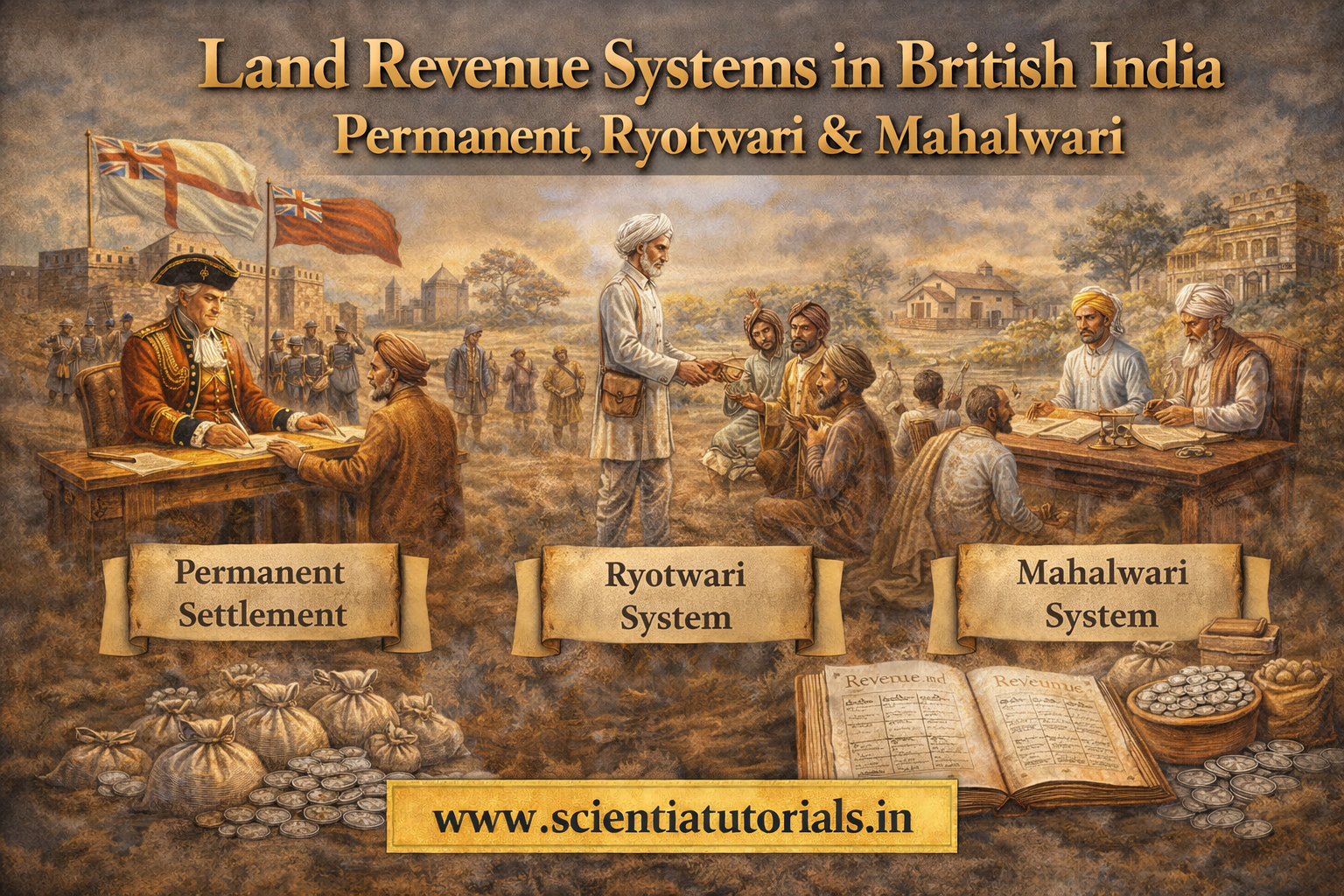

Land Revenue Systems: Permanent, Ryotwari & Mahalwari
SECTION 12: British Rule & Administrative Systems (1757 CE – 1857 CE)
Modern Indian History – Company Rule
1. Introduction: Land Revenue as the Backbone of Company Rule
Under British rule, land revenue became the principal source of income for the colonial state. The agrarian economy of India, with its vast cultivable land and peasant population, offered the British a stable and regular source of revenue to finance administration, the army, and imperial expansion.
The British East India Company, after acquiring political power in India, realised that efficient and systematic land revenue collection was essential for sustaining colonial rule. Consequently, between the late 18th and mid-19th centuries, the Company introduced three major land revenue systems:
- Permanent Settlement
- Ryotwari System
- Mahalwari System
Each system reflected different administrative philosophies but shared a common objective: maximisation of revenue for the colonial state.
2. Background: Pre-British Land Revenue Traditions
Before British intervention, land revenue in India:
- Was flexible and adjusted according to agricultural conditions
- Recognised customary rights of cultivators
- Was collected through local intermediaries
Under Mughal administration, revenue demand was not permanently fixed and often revised depending on crop yield and local conditions. British administrators, unfamiliar with Indian agrarian realities, attempted to standardise and codify land revenue, leading to profound changes in rural society.
3. Objectives of British Land Revenue Policy
The Company’s land revenue policy aimed to:
- Ensure regular and predictable income
- Create a loyal class of landholders or intermediaries
- Reduce administrative costs
- Introduce private property concepts in land
- Integrate Indian agriculture into the colonial economy
These objectives shaped the design of different revenue systems.
4. Permanent Settlement (1793)
4.1 Introduction and Authors
The Permanent Settlement was introduced in 1793 by Lord Cornwallis in Bengal, Bihar, and Orissa.
4.2 Main Features
- Land revenue was fixed permanently
- Zamindars were recognised as owners of land
- Zamindars had to pay a fixed revenue to the Company
- Failure to pay revenue resulted in auction of land
The Company believed that fixed revenue would encourage zamindars to invest in land improvement.
4.3 Objectives of Permanent Settlement
- Create a landed aristocracy loyal to British rule
- Simplify revenue administration
- Guarantee stable income to the Company
4.4 Impact on Zamindars
- Many zamindars failed to pay revenue on time
- Large-scale auction of estates occurred
- Emergence of absentee landlords
4.5 Impact on Peasants
- Peasants lost traditional rights
- Rent increased arbitrarily
- Frequent evictions and insecurity of tenure
The settlement ignored the welfare of cultivators, leading to rural distress.
4.6 Evaluation of Permanent Settlement
Merits:
- Provided administrative convenience
- Ensured fixed income to the Company
Demerits:
- Revenue remained fixed despite rising agricultural output
- Zamindars exploited peasants
- Agricultural stagnation
The system ultimately failed to promote agricultural development.
5. Ryotwari System
5.1 Introduction and Regions
The Ryotwari System was introduced in Madras and Bombay Presidencies, primarily under the influence of Thomas Munro.
5.2 Main Features
- Direct settlement between the Company and the ryot (cultivator)
- Ryot recognised as the owner of land
- Revenue assessed periodically, not permanently
- Revenue rates were often high and rigid
5.3 Objectives of Ryotwari System
- Eliminate intermediaries like zamindars
- Increase state control over revenue
- Ensure higher revenue collection
5.4 Impact on Peasants
- Heavy revenue demand (up to half of produce)
- Frequent revisions caused uncertainty
- Peasants forced into debt and land alienation
Though theoretically favourable to cultivators, in practice it became highly exploitative.
5.5 Administrative Challenges
- Detailed land surveys required
- High administrative costs
- Corruption at lower levels
Despite these issues, the system continued due to its revenue potential.
5.6 Evaluation of Ryotwari System
Merits:
- Recognised peasant proprietorship
- Eliminated zamindari exploitation
Demerits:
- Excessive revenue burden
- Peasant indebtedness
- Agricultural instability
The system undermined rural prosperity instead of strengthening it.
6. Mahalwari System
6.1 Introduction and Regions
The Mahalwari System was introduced in parts of North India, Punjab, and the United Provinces during the early 19th century.
6.2 Main Features
- Revenue settlement with village communities (mahals)
- Collective responsibility for revenue payment
- Periodic revision of revenue demand
- Village headmen responsible for collection
6.3 Objectives of Mahalwari System
- Combine advantages of Zamindari and Ryotwari systems
- Utilise traditional village institutions
- Ensure efficient revenue collection
6.4 Impact on Villages and Peasants
- Collective responsibility increased pressure on villagers
- Revenue demand remained high
- Village solidarity weakened due to fiscal stress
Though it appeared community-based, the system served colonial revenue interests.
6.5 Evaluation of Mahalwari System
Merits:
- Recognised village-level organisation
- Reduced role of absentee landlords
Demerits:
- Heavy revenue demand
- Periodic reassessment created uncertainty
- Peasants remained vulnerable
7. Comparative Analysis of the Three Systems
| Aspect | Permanent Settlement | Ryotwari System | Mahalwari System |
|---|---|---|---|
| Settlement with | Zamindars | Individual peasants | Village community |
| Revenue fixation | Permanent | Periodic | Periodic |
| Intermediaries | Yes | No | Limited |
| Peasant security | Low | Theoretical | Moderate |
| Revenue interest | High | Very High | High |
8. Economic and Social Consequences of Land Revenue Systems
8.1 Economic Consequences
- Commercialisation of agriculture
- Growth of moneylenders
- Decline of subsistence farming
- Frequent famines
8.2 Social Consequences
- Rise of landlordism
- Peasant impoverishment
- Breakdown of village community
- Increase in rural unrest
These systems deeply altered the agrarian structure of India.
9. Role of Land Revenue Systems in Colonial Exploitation
The revenue systems:
- Transferred surplus from agriculture to colonial state
- Financed British administration and wars
- Integrated Indian economy into imperial capitalism
Land revenue became the economic foundation of colonial rule.
10. Contribution to Popular Resistance
Excessive revenue demands contributed to:
- Peasant revolts
- Tribal uprisings
- Discontent leading to the Revolt of 1857
Land revenue oppression was a major source of anti-colonial resistance.
11. Historical Assessment
Historians agree that:
- Land revenue systems prioritised colonial interests
- Agricultural development was neglected
- Peasants bore the heaviest burden
Modern scholarship views these systems as instruments of systematic economic exploitation.
12. Conclusion
The land revenue systems introduced by the British between 1757 and 1857 reshaped India’s agrarian economy. While differing in structure, the Permanent Settlement, Ryotwari System, and Mahalwari System shared a common objective: extraction of maximum revenue to sustain colonial rule.
These systems:
- Disrupted traditional agrarian relations
- Created long-term rural distress
- Laid the economic foundations of British imperialism
Understanding these land revenue systems is essential to comprehending the economic, social, and political consequences of Company rule in India.
Exam-Oriented Summary
- Permanent Settlement (1793) – Zamindari system, fixed revenue
- Ryotwari System – Direct peasant settlement, high demand
- Mahalwari System – Village-based settlement, collective responsibility
Questions and Answers:
Land Revenue Systems under Company Rule
Q1. What was the importance of land revenue in the British colonial administration?
Answer:
Land revenue was the principal source of income for the colonial state. It financed administration, the army, and imperial expansion under the British East India Company.
Q2. Why did the British introduce new land revenue systems in India?
Answer:
The British aimed to ensure regular and predictable revenue, reduce administrative uncertainty, and integrate Indian agriculture into the colonial economy.
Q3. What were the three major land revenue systems introduced during Company rule?
Answer:
The three major systems were:
- Permanent Settlement
- Ryotwari System
- Mahalwari System
Q4. Who introduced the Permanent Settlement and in which year?
Answer:
The Permanent Settlement was introduced in 1793 by Lord Cornwallis.
Q5. In which regions was the Permanent Settlement implemented?
Answer:
It was implemented mainly in Bengal, Bihar, and Orissa.
Q6. What were the main features of the Permanent Settlement?
Answer:
Revenue was fixed permanently, zamindars were recognised as landowners, and failure to pay revenue led to auction of land.
Q7. What was the main objective behind introducing the Permanent Settlement?
Answer:
The objective was to create a loyal class of zamindars and ensure a stable and fixed income for the Company.
Q8. How did the Permanent Settlement affect zamindars?
Answer:
Many zamindars failed to pay revenue on time, resulting in large-scale auction of estates and the rise of absentee landlordism.
Q9. What was the impact of Permanent Settlement on peasants?
Answer:
Peasants lost traditional rights, faced high rents, insecurity of tenure, and frequent evictions.
Q10. Why is the Permanent Settlement considered a failure?
Answer:
Because it led to peasant exploitation, agricultural stagnation, and did not increase state revenue in the long run.
Q11. What is meant by the Ryotwari System?
Answer:
The Ryotwari System involved direct settlement of land revenue between the state and individual cultivators (ryots).
Q12. Who was associated with the introduction of the Ryotwari System?
Answer:
The system was introduced mainly under the influence of Thomas Munro.
Q13. In which regions was the Ryotwari System implemented?
Answer:
It was implemented in Madras and Bombay Presidencies.
Q14. What were the key features of the Ryotwari System?
Answer:
- Direct settlement with peasants
- Periodic revision of revenue
- Ryots recognised as landholders
- High revenue demand
Q15. How did the Ryotwari System affect peasants?
Answer:
Heavy revenue demands forced peasants into debt, land alienation, and dependence on moneylenders.
Q16. Why did the Ryotwari System fail to benefit cultivators?
Answer:
Despite recognising peasant ownership, excessive revenue demand and frequent reassessment made cultivation unprofitable.
Q17. What is the Mahalwari System?
Answer:
The Mahalwari System was a land revenue settlement in which revenue was assessed and collected from village communities as a whole.
Q18. In which regions was the Mahalwari System introduced?
Answer:
It was introduced in parts of North India, Punjab, and the United Provinces.
Q19. What were the main features of the Mahalwari System?
Answer:
- Settlement with village communities
- Collective responsibility for revenue
- Periodic revision of revenue demand
Q20. How did the Mahalwari System impact village life?
Answer:
Collective responsibility increased pressure on villagers and weakened traditional village solidarity.
Q21. What similarities existed among all three land revenue systems?
Answer:
All three aimed at maximising colonial revenue and largely ignored peasant welfare.
Q22. How did land revenue systems contribute to economic exploitation?
Answer:
They transferred agricultural surplus from peasants to the colonial state, financing British administration and wars.
Q23. What were the social consequences of British land revenue policies?
Answer:
They led to peasant impoverishment, rise of landlordism, growth of moneylenders, and rural unrest.
Q24. How did land revenue policies contribute to popular resistance?
Answer:
Excessive revenue demand and exploitation triggered peasant revolts and contributed to the Revolt of 1857.
Q25. State the historical significance of British land revenue systems.
Answer:
They reshaped India’s agrarian structure, institutionalised colonial exploitation, and had long-lasting economic and social consequences.
MCQs with Answers & Explanations
Land Revenue Systems: Permanent, Ryotwari & Mahalwari
MCQ 1
The primary objective of British land revenue policies in India was to:
A. Improve agricultural productivity
B. Protect peasant interests
C. Ensure regular revenue for the colonial state
D. Promote village self-government
Correct Answer: C
Explanation:
Land revenue was the main source of income for the colonial administration and was used to finance the army, bureaucracy, and imperial expansion.
MCQ 2
Which authority introduced the Permanent Settlement in India?
A. Robert Clive
B. Lord Cornwallis
C. Warren Hastings
D. Lord Wellesley
Correct Answer: B
Explanation:
Lord Cornwallis introduced the Permanent Settlement in 1793 to stabilise revenue collection and create loyal landholders.
MCQ 3
The Permanent Settlement was first implemented in:
A. Madras Presidency
B. Bombay Presidency
C. Bengal, Bihar and Orissa
D. Punjab
Correct Answer: C
Explanation:
The Permanent Settlement was mainly applied in eastern India, particularly Bengal, Bihar, and Orissa.
MCQ 4
Under the Permanent Settlement, land ownership was recognised in favour of:
A. Peasants
B. Village communities
C. Zamindars
D. State officials
Correct Answer: C
Explanation:
Zamindars were declared landowners responsible for paying a fixed revenue to the Company.
MCQ 5
A key feature of the Permanent Settlement was that land revenue was:
A. Revised annually
B. Revised periodically
C. Linked to crop yield
D. Fixed permanently
Correct Answer: D
Explanation:
Revenue demand was permanently fixed, irrespective of agricultural conditions.
MCQ 6
Which of the following was a major consequence of the Permanent Settlement?
A. Peasant prosperity
B. Decline of landlordism
C. Rise of absentee landlords
D. End of moneylenders
Correct Answer: C
Explanation:
Many zamindars failed to pay revenue and lost land, leading to absentee landlordism.
MCQ 7
The Permanent Settlement is often criticised because it:
A. Reduced Company revenue
B. Ignored peasant welfare
C. Encouraged subsistence farming
D. Eliminated intermediaries
Correct Answer: B
Explanation:
The system protected zamindars but left peasants vulnerable to exploitation.
MCQ 8
The Ryotwari System involved settlement directly with the:
A. Zamindars
B. Village headmen
C. Cultivators
D. Princes
Correct Answer: C
Explanation:
In the Ryotwari System, the ryot (individual cultivator) dealt directly with the state.
MCQ 9
The Ryotwari System was mainly introduced in:
A. Bengal Presidency
B. Madras and Bombay Presidencies
C. Punjab
D. Assam
Correct Answer: B
Explanation:
This system was widely implemented in southern and western India.
MCQ 10
Which British official is closely associated with the Ryotwari System?
A. Lord Cornwallis
B. Warren Hastings
C. Thomas Munro
D. Lord Dalhousie
Correct Answer: C
Explanation:
Thomas Munro advocated direct settlement with cultivators, eliminating intermediaries.
MCQ 11
A major drawback of the Ryotwari System was:
A. Absence of land surveys
B. Excessively high revenue demand
C. Permanent fixation of revenue
D. Zamindari exploitation
Correct Answer: B
Explanation:
Revenue demand was often very high and rigid, forcing peasants into debt.
MCQ 12
Despite recognising peasant ownership, the Ryotwari System failed because it:
A. Reduced state revenue
B. Ignored agriculture
C. Imposed heavy and frequent assessments
D. Encouraged village autonomy
Correct Answer: C
Explanation:
Frequent reassessment and high demand made cultivation unstable and unprofitable.
MCQ 13
The Mahalwari System was based on settlement with:
A. Individual peasants
B. Zamindars
C. Village communities
D. Tribal chiefs
Correct Answer: C
Explanation:
Under Mahalwari, the village (mahal) was treated as the unit of revenue assessment.
MCQ 14
The Mahalwari System was mainly introduced in:
A. Madras Presidency
B. Bombay Presidency
C. North India and Punjab
D. Bengal Presidency
Correct Answer: C
Explanation:
It was applied in parts of North India, Punjab, and the United Provinces.
MCQ 15
A key feature of the Mahalwari System was:
A. Permanent fixation of revenue
B. Collective responsibility for payment
C. Direct settlement with zamindars
D. Absence of intermediaries
Correct Answer: B
Explanation:
The entire village community was collectively responsible for revenue payment.
MCQ 16
Which of the following correctly matches the system and settlement unit?
A. Permanent – Village
B. Ryotwari – Zamindar
C. Mahalwari – Village community
D. Ryotwari – Zamindar estate
Correct Answer: C
Explanation:
Mahalwari was based on collective village settlement.
MCQ 17
Which land revenue system eliminated intermediaries completely?
A. Permanent Settlement
B. Ryotwari System
C. Mahalwari System
D. Jagirdari System
Correct Answer: B
Explanation:
Ryotwari established a direct relationship between the state and cultivator.
MCQ 18
Which system created a class of loyal landholders for the British?
A. Ryotwari
B. Mahalwari
C. Permanent Settlement
D. Village settlement
Correct Answer: C
Explanation:
The British hoped zamindars under Permanent Settlement would support colonial rule.
MCQ 19
All three land revenue systems primarily aimed at:
A. Agricultural development
B. Peasant welfare
C. Revenue maximisation
D. Village self-rule
Correct Answer: C
Explanation:
Despite structural differences, revenue extraction was the common goal.
MCQ 20
One major economic consequence of British land revenue policies was:
A. Industrial growth
B. Commercialisation of agriculture
C. End of moneylending
D. Rise of cottage industries
Correct Answer: B
Explanation:
Farmers were pushed to produce cash crops to meet revenue demands.
MCQ 21
British land revenue systems led to the growth of:
A. Cooperative farming
B. Moneylenders
C. Cottage industries
D. State welfare
Correct Answer: B
Explanation:
Peasants borrowed heavily to pay revenue, increasing moneylender influence.
MCQ 22
Which system caused maximum peasant insecurity due to eviction threats?
A. Ryotwari
B. Mahalwari
C. Permanent Settlement
D. Village settlement
Correct Answer: C
Explanation:
Zamindars often evicted peasants under Permanent Settlement.
MCQ 23
The land revenue burden contributed significantly to:
A. Industrial revolution in India
B. Decline of trade guilds
C. Peasant revolts
D. Expansion of irrigation
Correct Answer: C
Explanation:
Excessive revenue demand led to agrarian unrest and revolts.
MCQ 24
Which of the following best explains the colonial nature of land revenue systems?
A. Promotion of village autonomy
B. Protection of customary rights
C. Transfer of agrarian surplus to the colonial state
D. Reduction of taxation
Correct Answer: C
Explanation:
Revenue systems were designed to extract surplus to sustain colonial rule.
MCQ 25
Which statement correctly summarises British land revenue policies?
A. Different systems but same exploitative objective
B. Uniform system across India
C. Peasant-friendly reforms
D. Agricultural modernisation
Correct Answer: A
Explanation:
Though structurally different, all three systems served colonial exploitation.
🎯 Targeting Exams
This content is carefully structured to support preparation for:
-
UPSC Civil Services Examination (Prelims & Mains)
-
State Public Service Commissions (PSC)
-
UGC NET / SET (History)
-
CUET (UG & PG – History)
-
University Semester & Competitive Examinations (Modern Indian History)
🔍 Related Keyphrases
Use these related keyphrases naturally within headings and content to improve SEO performance:
-
Permanent Settlement land revenue system
-
Ryotwari system in British India
-
Mahalwari system village settlement
-
Land revenue policies under Company rule
-
British agrarian policies in India
-
Zamindari system and peasant exploitation
-
Colonial land revenue administration
-
Agrarian structure under British rule
-
Economic impact of land revenue systems
-
Company rule agrarian reforms