
Discovery & Geographical Extent of Indus Valley Civilization
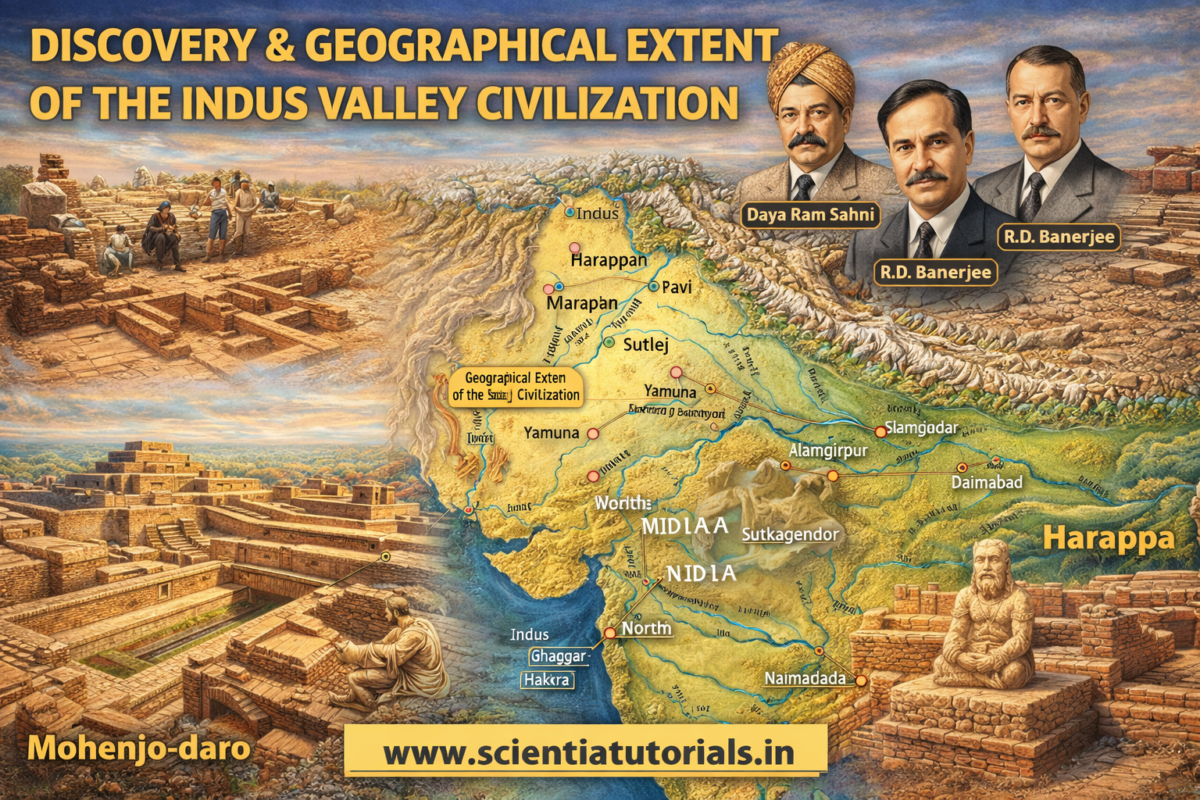

Discovery & Geographical Extent of the Indus Valley Civilization
(c. 2500 BCE – c. 1750 BCE)
Course: History of India – Complete Chronological and Era-Wise Course
Section 2: Indus Valley Civilization (Harappan Civilization)
Timeline: c. 2500 BCE – c. 1750 BCE
(Ancient Indian History – Urban Civilization Phase)
1. Introduction: Entry into India’s Urban Past
The Indus Valley Civilization (IVC), also known as the Harappan Civilization, represents the earliest and most extensive urban civilization of ancient India. Flourishing during the Bronze Age, it marks a decisive shift from prehistoric village cultures to planned urban life, characterized by advanced town planning, standardized material culture, and extensive trade networks.
Understanding the discovery and geographical extent of the Indus Valley Civilization is crucial because it:
- Revealed India’s antiquity as an urban civilization
- Challenged earlier assumptions that Indian civilization began with the Vedic period
- Demonstrated the scale, unity, and complexity of early Indian urbanism
2. Background: Knowledge of India before the Discovery
Before the 1920s, Indian history was largely understood through:
- Literary sources (Vedas, epics, Puranas)
- Archaeological remains from the Mauryan period onwards
It was widely believed that Indian civilization began around 1500 BCE. The discovery of Harappan sites pushed India’s civilizational history back by more than a thousand years, placing it alongside Mesopotamia and Egypt.
3. Discovery of the Indus Valley Civilization
3.1 Early Accidental Discoveries
The first clues of the Indus Valley Civilization emerged accidentally in the 19th century.
- In 1826, Charles Masson noticed ancient ruins near Harappa, but their significance was not understood.
- In 1856, bricks from Harappa were used for railway construction during British rule, causing extensive damage to the site.
These early encounters failed to recognize the civilizational importance of the remains.
3.2 Systematic Archaeological Discovery (1920s)
The real discovery occurred in the early 20th century, under the Archaeological Survey of India (ASI).
Key Archaeologists
- Daya Ram Sahni – excavated Harappa (1921)
- R. D. Banerjee – excavated Mohenjo-daro (1922)
- Sir John Marshall – Director-General of ASI, who announced the discovery to the world
In 1924, John Marshall officially declared the discovery of a previously unknown Bronze Age civilization in the Indus region.
3.3 Major Early Sites Discovered
- Harappa (Punjab, Pakistan)
- Mohenjo-daro (Sindh, Pakistan)
These sites displayed:
- Planned cities
- Burnt brick structures
- Drainage systems
- Seals with inscriptions
Such features clearly indicated an advanced urban civilization.
4. Naming of the Civilization
Since the earliest discovered sites lay in the Indus River basin, the civilization was initially called the Indus Valley Civilization.
Because Harappa was the first site to be excavated, historians also use the term Harappan Civilization.
Both terms are used interchangeably in historical studies and examinations.
5. Chronological Position of the Indus Valley Civilization
5.1 Broad Chronology
- Early Harappan Phase: c. 3300–2600 BCE
- Mature Harappan Phase: c. 2600–1900 BCE
- Late Harappan Phase: c. 1900–1750 BCE
The lesson mainly focuses on the Mature Harappan Phase, when urbanism reached its peak.
6. Geographical Extent of the Indus Valley Civilization
One of the most striking features of the Indus Valley Civilization is its vast geographical spread, making it the largest of all Bronze Age civilizations.
6.1 Overall Extent
The civilization extended over approximately 1.3 million square kilometers, covering parts of:
- North-Western India
- Pakistan
- Afghanistan
This immense spread shows that the Harappans maintained cultural unity across diverse ecological zones.
7. Boundaries of the Indus Valley Civilization
7.1 Northern Extent
- Manda (Jammu region)
This marks the northernmost known Harappan site.
7.2 Southern Extent
- Daimabad
Located on the Pravara River, it represents the southernmost Harappan site.
7.3 Eastern Extent
- Alamgirpur
Situated near the Hindon River, showing Harappan influence deep into the Ganga–Yamuna Doab.
7.4 Western Extent
- Sutkagendor
Located near the Makran coast, it indicates Harappan maritime contacts.
8. River Systems and the Spread of Civilization
The Indus Valley Civilization was not confined to the Indus River alone.
Major River Systems
- Indus and its tributaries (Jhelum, Chenab, Ravi, Beas, Sutlej)
- Ghaggar–Hakra (often identified with the Saraswati)
- Narmada tributaries (southern fringe)
- Coastal rivers of Gujarat
The dense concentration of sites along the Ghaggar–Hakra system suggests it was a core region of Harappan settlement.
9. Distribution of Major Harappan Sites
9.1 Urban Centers
- Harappa
- Mohenjo-daro
- Dholavira
- Rakhigarhi
These cities exhibit:
- Grid-pattern town planning
- Citadel and lower town
- Advanced drainage systems
9.2 Coastal and Port Sites
- Lothal – dockyard and maritime trade
- Sutkagendor
These sites highlight Harappan engagement in overseas trade.
9.3 Rural and Semi-Urban Settlements
Hundreds of smaller sites indicate:
- Agricultural villages
- Craft production centers
- Resource procurement zones
This shows that the civilization was not limited to cities alone.
10. Unity within Diversity
Despite its vast geographical spread, the Indus Valley Civilization maintained remarkable uniformity:
Common Cultural Features
- Standardized bricks (1:2:4 ratio)
- Uniform weights and measures
- Similar pottery styles
- Seals with undeciphered script
This cultural unity across regions reflects:
- Centralized planning or strong cultural integration
- Efficient communication networks
11. Comparison with Other Bronze Age Civilizations
| Civilization | Approx. Area |
|---|---|
| Indus Valley | ~1.3 million sq. km |
| Mesopotamian | ~0.8 million sq. km |
| Egyptian | ~0.3 million sq. km |
The Harappan Civilization was geographically the largest, highlighting its exceptional organizational capacity.
12. Historical Significance of the Discovery
The discovery of the Indus Valley Civilization is historically significant because it:
- Established India as one of the cradles of world civilization
- Provided archaeological proof of urban life before the Vedic Age
- Revolutionized the periodization of ancient Indian history
13. Significance of the Geographical Extent
The vast geographical spread indicates:
- Adaptation to varied environments (plains, deserts, coasts)
- Strong economic integration
- Advanced administrative and trade systems
It also explains the long survival and resilience of the civilization.
14. Examination Relevance (UPSC / State PSC / University)
High-Yield Focus Areas
- Discovery of Harappa and Mohenjo-daro
- Archaeologists and years
- Geographical boundaries (N-S-E-W)
- Major river systems
- Largest Bronze Age civilization
Frequently Asked Questions
- “Discuss the discovery of the Indus Valley Civilization.”
- “Explain the geographical extent and significance of the Harappan Civilization.”
- “Why is the Indus Valley Civilization considered the largest Bronze Age civilization?”
15. Conclusion
The discovery and geographical extent of the Indus Valley Civilization fundamentally transformed our understanding of ancient Indian history. It revealed a highly developed, geographically extensive, and culturally unified urban civilization, flourishing long before the rise of later historical cultures. The Harappan Civilization stands as a testament to early human ingenuity, organization, and adaptability, forming the true beginning of India’s urban historical tradition.
Below is a well-structured, examination-oriented set of 25 Questions with clear and accurate answers based strictly on the lesson “Discovery & Geographical Extent of the Indus Valley Civilization”, aligned with Section 2: Indus Valley Civilization (Harappan Civilization).
The questions progress from factual understanding → analytical interpretation, making them ideal for UPSC, State PSC, CUET, UG–PG, NET/SET.
Discovery & Geographical Extent of the Indus Valley Civilization
Questions with Answers (25 Q&A Set)
1. What is meant by the Indus Valley Civilization?
Answer:
The Indus Valley Civilization, also known as the Harappan Civilization, was a Bronze Age urban civilization that flourished in north-western India, Pakistan, and Afghanistan between c. 2500 BCE and c. 1750 BCE.
2. Why is the Indus Valley Civilization considered India’s first urban civilization?
Answer:
It is considered the first urban civilization because it shows planned cities, standardized architecture, drainage systems, craft specialization, and long-distance trade, features absent in earlier cultures.
3. What was the understanding of ancient Indian history before the discovery of the Indus Valley Civilization?
Answer:
Before its discovery, Indian civilization was believed to have begun with the Vedic period (c. 1500 BCE), with little knowledge of any earlier urban culture.
4. When was the Indus Valley Civilization formally discovered?
Answer:
The Indus Valley Civilization was formally discovered in the early 1920s, and officially announced in 1924.
5. Who excavated Harappa and in which year?
Answer:
Daya Ram Sahni excavated Harappa in 1921 under the Archaeological Survey of India.
6. Who excavated Mohenjo-daro?
Answer:
R. D. Banerjee excavated Mohenjo-daro in 1922.
7. What role did Sir John Marshall play in the discovery of the Indus Valley Civilization?
Answer:
As Director-General of the ASI, Sir John Marshall recognized the importance of the findings and announced the discovery of a new Bronze Age civilization in 1924.
8. Why is the civilization called the Indus Valley Civilization?
Answer:
It is called the Indus Valley Civilization because the earliest discovered sites were located in the Indus River basin.
9. Why is it also known as the Harappan Civilization?
Answer:
It is known as the Harappan Civilization because Harappa was the first site to be excavated and scientifically studied.
10. What are the major chronological phases of the Harappan Civilization?
Answer:
- Early Harappan Phase (c. 3300–2600 BCE)
- Mature Harappan Phase (c. 2600–1900 BCE)
- Late Harappan Phase (c. 1900–1750 BCE)
11. What is the approximate geographical area covered by the Indus Valley Civilization?
Answer:
The civilization covered approximately 1.3 million square kilometers, making it the largest Bronze Age civilization.
12. Which modern countries were included within the geographical extent of the Harappan Civilization?
Answer:
The civilization extended across Pakistan, north-western India, and parts of Afghanistan.
13. Which site marks the northernmost extent of the Indus Valley Civilization?
Answer:
Manda marks the northernmost known Harappan site.
14. Which site represents the southernmost extent of the civilization?
Answer:
Daimabad represents the southernmost extent of the Indus Valley Civilization.
15. Which site marks the easternmost extent of the Harappan Civilization?
Answer:
Alamgirpur marks the easternmost known Harappan site.
16. Which site marks the westernmost extent of the civilization?
Answer:
Sutkagendor marks the westernmost extent, near the Makran coast.
17. Besides the Indus River, which river system was crucial for Harappan settlements?
Answer:
The Ghaggar–Hakra river system (often identified with the Saraswati) was crucial, with a dense concentration of Harappan sites along its course.
18. Name four major urban centers of the Indus Valley Civilization.
Answer:
Major urban centers include Harappa, Mohenjo-daro, Dholavira, and Rakhigarhi.
19. Which Harappan site is associated with maritime trade?
Answer:
Lothal is associated with maritime trade and is famous for its dockyard.
20. What does the wide geographical spread of the Harappan Civilization indicate?
Answer:
It indicates strong cultural unity, effective administration, efficient communication, and integrated trade networks across diverse regions.
21. How did Harappan culture maintain uniformity across such a vast area?
Answer:
Uniformity was maintained through standardized bricks, weights and measures, pottery styles, seals, and town planning practices.
22. How does the geographical extent of the Indus Valley Civilization compare with other Bronze Age civilizations?
Answer:
It was larger than both Mesopotamian and Egyptian civilizations, making it the most extensive Bronze Age civilization.
23. What is the historical significance of the discovery of the Indus Valley Civilization?
Answer:
The discovery proved that urban civilization existed in India long before the Vedic Age, redefining ancient Indian history.
24. Why is the study of geographical extent important for understanding the Harappan Civilization?
Answer:
It helps explain economic integration, ecological adaptation, trade routes, and the administrative strength of the civilization.
25. State the overall significance of the Indus Valley Civilization in ancient Indian history.
Answer:
The Indus Valley Civilization represents the beginning of urban life in India, demonstrating advanced planning, economic organization, and cultural unity that laid the foundation for later Indian history.
Exam Tip (UPSC / State PSC):
👉 Questions frequently test archaeologists + years, N–S–E–W extent, major river systems, and “largest Bronze Age civilization”—memorize these with maps.
Below is a well-structured, examination-oriented set of 25 Multiple Choice Questions (MCQs) on
“Discovery & Geographical Extent of the Indus Valley Civilization”, developed strictly as per
Section 2: Indus Valley Civilization (Harappan Civilization).
Each MCQ includes the correct answer and an elaborate, concept-clearing explanation, making it ideal for UPSC, State PSC, CUET, UG–PG, NET/SET.
Discovery & Geographical Extent of the Indus Valley Civilization
MCQs with Answers and Explanations (25 Questions)
1. The Indus Valley Civilization is also known as the Harappan Civilization because:
A. Harappa was the capital city
B. Harappa was the largest city
C. Harappa was the first site to be excavated
D. Harappa had the earliest script
Correct Answer: C
Explanation:
Harappa was the first site scientifically excavated, hence the civilization is often called the Harappan Civilization.
2. The formal announcement of the Indus Valley Civilization was made in:
A. 1901
B. 1915
C. 1924
D. 1935
Correct Answer: C
Explanation:
In 1924, Sir John Marshall officially announced the discovery of a new Bronze Age civilization.
3. Who excavated Harappa in 1921?
A. R. D. Banerjee
B. Daya Ram Sahni
C. Alexander Cunningham
D. Mortimer Wheeler
Correct Answer: B
Explanation:
Daya Ram Sahni excavated Harappa under the Archaeological Survey of India.
4. Mohenjo-daro was excavated by:
A. John Marshall
B. Mortimer Wheeler
C. R. D. Banerjee
D. M. S. Vats
Correct Answer: C
Explanation:
R. D. Banerjee excavated Mohenjo-daro in 1922.
5. Before the discovery of the Indus Valley Civilization, Indian history was believed to begin with:
A. Harappan period
B. Mauryan period
C. Vedic period
D. Chalcolithic cultures
Correct Answer: C
Explanation:
Earlier historians believed Indian civilization began around 1500 BCE with the Vedic Age.
6. The Indus Valley Civilization belongs to which age?
A. Stone Age
B. Iron Age
C. Bronze Age
D. Copper Age
Correct Answer: C
Explanation:
The Harappans used bronze tools, placing the civilization in the Bronze Age.
7. The Indus Valley Civilization flourished roughly between:
A. 3000–2000 BCE
B. 2500–1750 BCE
C. 2000–1500 BCE
D. 1500–500 BCE
Correct Answer: B
Explanation:
The Mature Harappan phase broadly spans c. 2500–1750 BCE.
8. Which of the following was NOT an early Harappan site discovered in the 1920s?
A. Harappa
B. Mohenjo-daro
C. Dholavira
D. None of the above
Correct Answer: C
Explanation:
Dholavira was discovered much later (1960s), not during the initial discoveries.
9. The approximate geographical area covered by the Indus Valley Civilization was:
A. 0.5 million sq. km
B. 0.8 million sq. km
C. 1.3 million sq. km
D. 2.0 million sq. km
Correct Answer: C
Explanation:
The Harappan Civilization covered about 1.3 million square kilometers, making it the largest Bronze Age civilization.
10. Which modern countries formed part of the Indus Valley Civilization?
A. India only
B. India and Pakistan
C. India, Pakistan, and Afghanistan
D. India, Pakistan, and Iran
Correct Answer: C
Explanation:
Harappan sites are found in India, Pakistan, and Afghanistan.
11. The northernmost extent of the Harappan Civilization is marked by:
A. Rakhigarhi
B. Shortugai
C. Manda
D. Kalibangan
Correct Answer: C
Explanation:
Manda marks the northernmost known Harappan site.
12. The southernmost Harappan site is:
A. Lothal
B. Dholavira
C. Daimabad
D. Prabhas Patan
Correct Answer: C
Explanation:
Daimabad represents the southernmost extent.
13. Which site represents the easternmost extent of the Indus Valley Civilization?
A. Rakhigarhi
B. Alamgirpur
C. Kalibangan
D. Banawali
Correct Answer: B
Explanation:
Alamgirpur lies near the Hindon River in western Uttar Pradesh.
14. The westernmost Harappan site is:
A. Shortugai
B. Sutkagendor
C. Balakot
D. Dholavira
Correct Answer: B
Explanation:
Sutkagendor lies near the Makran coast.
15. Which river system had the maximum concentration of Harappan sites?
A. Indus
B. Ganga
C. Ghaggar–Hakra
D. Narmada
Correct Answer: C
Explanation:
A large number of sites are located along the Ghaggar–Hakra system, often linked with the Saraswati.
16. Which of the following cities is regarded as the largest Harappan site in India?
A. Kalibangan
B. Dholavira
C. Rakhigarhi
D. Lothal
Correct Answer: C
Explanation:
Rakhigarhi is currently considered the largest Harappan site.
17. Which Harappan site provides evidence of a dockyard and maritime trade?
A. Dholavira
B. Harappa
C. Lothal
D. Mohenjo-daro
Correct Answer: C
Explanation:
Lothal is famous for its dockyard and overseas trade links.
18. The wide geographical spread of the Harappan Civilization suggests:
A. Weak political control
B. Cultural uniformity and integration
C. Nomadic lifestyle
D. Dependence only on agriculture
Correct Answer: B
Explanation:
Uniform bricks, weights, pottery, and town planning show strong cultural integration.
19. Which feature best demonstrates cultural unity across Harappan sites?
A. Use of caves
B. Standardized brick size
C. Fortified capitals
D. Royal inscriptions
Correct Answer: B
Explanation:
Standard brick ratio (1:2:4) is seen across Harappan settlements.
20. Compared to Mesopotamian and Egyptian civilizations, the Indus Valley Civilization was:
A. Smaller in area
B. Equal in area
C. Larger in area
D. Shorter in duration
Correct Answer: C
Explanation:
The Harappan Civilization was geographically the largest Bronze Age civilization.
21. Which Harappan site is located on an island in the Rann of Kachchh?
A. Lothal
B. Rakhigarhi
C. Dholavira
D. Banawali
Correct Answer: C
Explanation:
Dholavira is located on Khadir Bet island.
22. The discovery of the Indus Valley Civilization is historically significant because it:
A. Confirmed Vedic dominance
B. Proved Indian civilization was urban before 1500 BCE
C. Established iron use
D. Explained the caste system
Correct Answer: B
Explanation:
It pushed back the origins of Indian civilization by over 1,000 years.
23. Which phase of the Harappan Civilization shows the peak of urbanization?
A. Early Harappan
B. Mature Harappan
C. Late Harappan
D. Post-Harappan
Correct Answer: B
Explanation:
The Mature Harappan Phase (c. 2600–1900 BCE) shows full urban development.
24. The Harappan Civilization was NOT confined to:
A. River valleys
B. Coastal regions
C. Desert margins
D. Gangetic plains
Correct Answer: D
Explanation:
The civilization did not significantly extend into the Gangetic plains, except marginal influence.
25. The study of geographical extent helps historians understand:
A. Dynastic history
B. Religious philosophy
C. Economic integration and trade
D. Literary development
Correct Answer: C
Explanation:
Spatial distribution reveals trade routes, resource management, and administrative efficiency.
Exam Insight (UPSC / State PSC):
👉 MCQs frequently test N–S–E–W extent, archaeologists & years, largest site, river systems, and “largest Bronze Age civilization”—map-based clarity is crucial.
Targeting Exams
-
UPSC Civil Services (Prelims & Mains – Ancient History)
-
State PSC Examinations
-
CUET (UG & PG – History)
-
University Semester Exams (BA / MA History)
-
NET / SET (History)
Related Keyphrases
-
Indus Valley Civilization discovery
-
Harappan Civilization geographical extent
-
Indus Valley Civilization map
-
Harappan sites north south east west
-
Discovery of Harappa and Mohenjo-daro
-
Indus Valley Civilization UPSC notes
-
Ancient Indian urban civilization
-
Bronze Age civilizations of India