
Later Vedic Period: Social Stratification & Ritualism
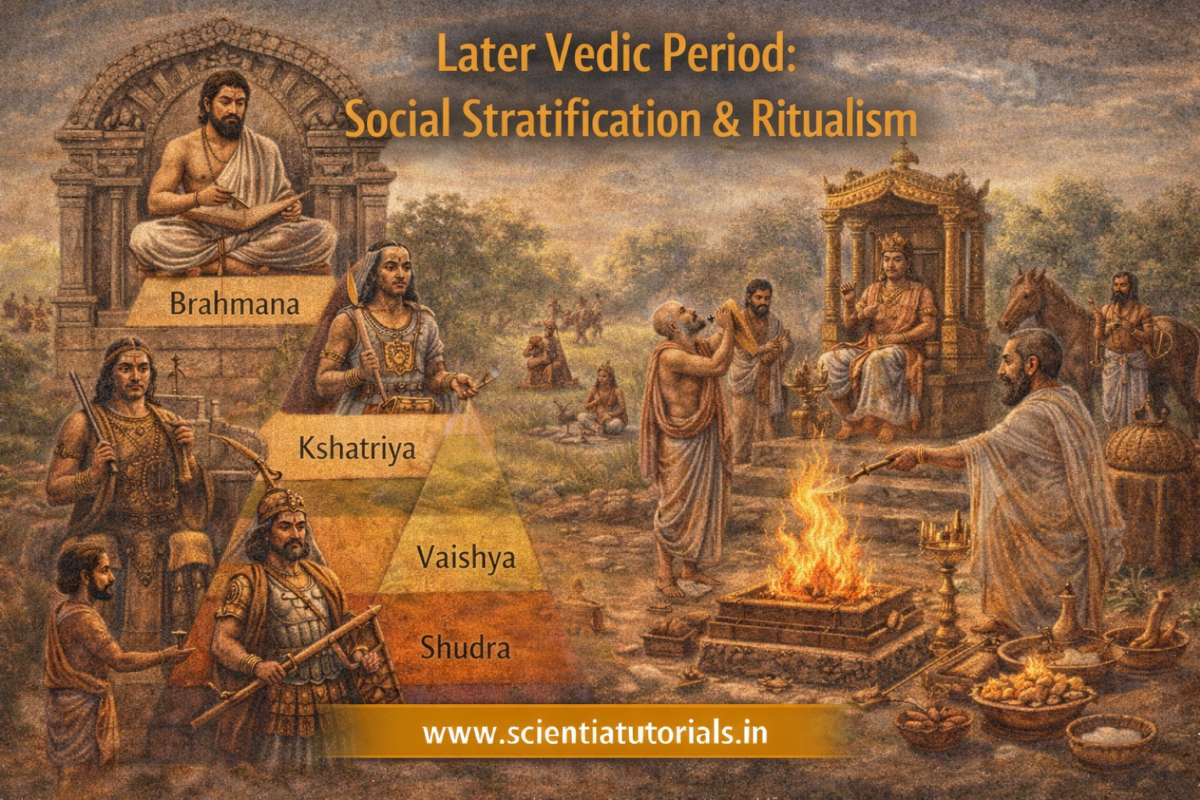

Later Vedic Period: Social Stratification & Ritualism | History of India
SECTION 3: Vedic Age & Religious–Philosophical Developments
Timeline: c. 1500 BCE – c. 600 BCE
(Ancient Indian History – Early Aryan Phase)
Lesson: Later Vedic Period – Social Stratification & Ritualism
(c. 1000 BCE – c. 600 BCE)
Introduction: From Tribal Egalitarianism to Stratified Society
The Later Vedic Period represents a decisive phase in the evolution of ancient Indian civilization. Spanning roughly from 1000 BCE to 600 BCE, this period witnessed a fundamental transformation in social organization, religious practices, and ritual life. Unlike the relatively egalitarian and pastoral Early Vedic society, the Later Vedic age was marked by agrarian expansion, territorial states, rigid social stratification, and elaborate ritualism.
This transformation is primarily known through Later Vedic texts such as the Yajurveda, Samaveda, Atharvaveda, the Brahmanas, Aranyakas, and early Upanishads. Together, these texts reveal a society moving toward hierarchy, ritual authority, and priestly dominance, laying the foundations of classical Hindu social and religious structures.
Chronological Context of the Later Vedic Period
Later Vedic Period (c. 1000–600 BCE)
- Eastward expansion into the Ganga–Yamuna plains
- Growth of agriculture and iron technology
- Emergence of territorial kingdoms
- Rigid varna system
- Elaborate rituals and sacrifices
Transition Beyond the Vedic Age
- Rise of Mahajanapadas
- Emergence of heterodox traditions (Buddhism, Jainism)
- Reaction against ritualism
I. Sources for the Study of the Later Vedic Period
1. Later Vedic Texts
Key literary sources include:
- Samhitas (later portions)
- Brahmanas – ritual manuals
- Aranyakas – forest texts
- Upanishads – philosophical speculations
These texts reflect:
- Increasing ritual complexity
- Growing social hierarchy
- Religious authority of priests
II. Social Stratification in the Later Vedic Period
1. Evolution of the Varna System
One of the most significant developments of the Later Vedic period was the rigidification of the varna system.
From Flexible to Rigid Hierarchy
- Early Vedic varna was occupational and fluid
- Later Vedic varna became birth-based and hereditary
- Social mobility declined
The Purusha Sukta provided a divine justification for social hierarchy.
2. The Four Varnas in the Later Vedic Age
a) Brahmanas
- Occupied the highest position
- Custodians of ritual knowledge
- Enjoyed immense social prestige and privileges
b) Kshatriyas
- Rulers and warriors
- Exercised political power
- Often contested Brahmanical supremacy
c) Vaishyas
- Agriculturists, traders, and cattle-rearers
- Responsible for production and taxation
d) Shudras
- Lowest varna
- Served the upper three varnas
- Excluded from Vedic rituals and education
3. Emergence of Untouchability (Proto-Form)
- Certain occupations became socially despised
- Shudras increasingly marginalized
- Early roots of untouchability visible
This marked a sharp departure from Early Vedic social equality.
4. Ashrama System
The Later Vedic period also witnessed the development of the Ashrama system, dividing human life into four stages:
- Brahmacharya – student life
- Grihastha – household life
- Vanaprastha – forest dweller
- Sannyasa – renunciation
The system aimed to integrate social duties with spiritual goals.
5. Position of Women
The status of women declined significantly during the Later Vedic age:
- Exclusion from assemblies
- Reduced access to education
- Subordination in rituals
Practices such as child marriage gained ground, while women’s ritual role diminished.
III. Later Vedic Ritualism
1. Rise of Ritual-Centric Religion
Later Vedic religion became increasingly ritualistic and mechanical:
- Performance of yajnas became central
- Correct pronunciation and procedure considered essential
- Rituals believed to compel gods
Religion shifted from devotion to ritual performance.
2. Expansion of Yajnas (Sacrifices)
Major sacrifices included:
- Rajasuya – royal consecration
- Ashvamedha – horse sacrifice asserting sovereignty
- Vajapeya – prestige ritual
These rituals:
- Were extremely costly
- Required numerous priests
- Reinforced royal authority and social hierarchy
3. Role of Brahmanas in Ritualism
- Brahmanas monopolized ritual knowledge
- Developed complex manuals (Brahmanas)
- Became socially and economically powerful
Priestly dominance transformed religion into a means of social control.
4. Ritual Economy
- Kings donated land, cattle, gold, and grain
- Sacrifices redistributed surplus wealth
- Strengthened alliance between kings and priests
Religion thus became deeply intertwined with economy and politics.
IV. Philosophical Reaction to Ritualism
Despite ritual dominance, intellectual dissent emerged:
1. Aranyakas
- Transitional texts
- Criticized excessive ritualism
- Emphasized symbolism and contemplation
2. Upanishads
Early Upanishads introduced:
- Concept of Brahman (universal reality)
- Concept of Atman (individual soul)
- Doctrine of karma and moksha
They marked a shift from ritualism to philosophy.
V. Comparison: Early vs Later Vedic Period
| Aspect | Early Vedic | Later Vedic |
|---|---|---|
| Society | Tribal, flexible | Stratified, rigid |
| Varna | Occupational | Birth-based |
| Economy | Pastoral | Agrarian |
| Religion | Simple rituals | Elaborate yajnas |
| Women | Higher status | Declining status |
VI. Historical Significance of Social Stratification & Ritualism
The Later Vedic period is historically important because:
- Laid foundations of caste system
- Institutionalized Brahmanical dominance
- Gave rise to ritual orthodoxy
- Provoked philosophical and social reform movements
The rigidity of social order eventually led to the rise of Buddhism and Jainism as protest movements.
Examination-Oriented Key Points
- Varna became hereditary
- Shudras excluded from rituals
- Brahmanas gained dominance
- Costly yajnas like Ashvamedha
- Decline in women’s status
- Emergence of Upanishadic thought
Conclusion
The Later Vedic Period marks a decisive stage in ancient Indian history, characterized by rigid social stratification and elaborate ritualism. While it strengthened political authority and religious institutions, it also created inequalities and social tensions. At the same time, this period sowed the seeds of deep philosophical inquiry, leading to the Upanishadic tradition and later reform movements.
Thus, the Later Vedic age stands as a turning point—where ritual orthodoxy and social hierarchy reached their peak, even as the foundations were laid for spiritual introspection and social transformation that would shape the future course of Indian civilization.
Below is a well-structured, examination-oriented set of 25 Questions with clear and accurate Answers based strictly on the lesson
“Later Vedic Period: Social Stratification & Ritualism” under
SECTION 3: Vedic Age & Religious-Philosophical Developments.
The questions move from conceptual understanding to analytical depth, making them suitable for UPSC, State PSCs, SSC, UGC-NET, and university examinations.
Later Vedic Period – Social Stratification & Ritualism
Questions with Answers (25 Q&A Set)
1. What is the chronological span of the Later Vedic Period?
Answer:
The Later Vedic Period is generally dated from c. 1000 BCE to c. 600 BCE.
2. Which texts are considered the main sources for the Later Vedic Period?
Answer:
The Later Vedic Period is studied mainly through the Yajurveda, Samaveda, Atharvaveda, along with the Brahmanas, Aranyakas, and early Upanishads.
3. How did Later Vedic society differ from Early Vedic society?
Answer:
Later Vedic society was agrarian, hierarchical, and stratified, whereas Early Vedic society was pastoral, tribal, and relatively egalitarian.
4. What major geographical shift occurred during the Later Vedic Period?
Answer:
The Aryans expanded eastward from the north-western regions into the Ganga–Yamuna plains, leading to settled agriculture and territorial kingdoms.
5. What was the most significant social change in the Later Vedic Period?
Answer:
The most significant change was the rigidification of the varna system, making social divisions hereditary and birth-based.
6. How did the varna system change from Early to Later Vedic times?
Answer:
In the Early Vedic period, varna was flexible and occupation-based, but in the Later Vedic period it became rigid, hereditary, and hierarchical.
7. What was the position of the Brahmanas in Later Vedic society?
Answer:
Brahmanas occupied the highest social position, controlled ritual knowledge, and enjoyed extensive privileges and authority.
8. What role did the Kshatriyas play in the Later Vedic Period?
Answer:
Kshatriyas were rulers and warriors who exercised political power and often competed with Brahmanas for supremacy.
9. What economic role was assigned to the Vaishyas?
Answer:
Vaishyas were responsible for agriculture, cattle-rearing, trade, and taxation, forming the economic backbone of society.
10. How were the Shudras treated in Later Vedic society?
Answer:
Shudras occupied the lowest position, were expected to serve the upper varnas, and were excluded from Vedic rituals and education.
11. What early signs of untouchability appeared during the Later Vedic Period?
Answer:
Certain occupations became socially degraded, and Shudras were increasingly marginalized, indicating the proto-form of untouchability.
12. What is the Ashrama system, and when did it develop?
Answer:
The Ashrama system divided life into four stages—Brahmacharya, Grihastha, Vanaprastha, and Sannyasa—and developed during the Later Vedic Period.
13. What was the purpose of the Ashrama system?
Answer:
It aimed to balance social duties with spiritual development, integrating household life with renunciation.
14. How did the position of women change in the Later Vedic Period?
Answer:
The status of women declined; they lost access to education and assemblies and became subordinate in ritual and social life.
15. Which social practices affecting women began to appear in the Later Vedic age?
Answer:
Practices such as child marriage gained ground, and women’s participation in rituals diminished.
16. What is meant by Later Vedic ritualism?
Answer:
Later Vedic ritualism refers to the growing emphasis on elaborate yajnas and sacrifices, performed according to strict rules.
17. Why did rituals become more elaborate during the Later Vedic Period?
Answer:
Rituals were believed to control cosmic forces and secure material and political benefits, increasing their complexity and cost.
18. Name two major sacrifices performed during the Later Vedic Period.
Answer:
The Ashvamedha (horse sacrifice) and Rajasuya (royal consecration) were major Later Vedic sacrifices.
19. What role did rituals play in strengthening kingship?
Answer:
Rituals legitimized royal authority, enhanced prestige, and symbolically established sovereignty over territories.
20. How did ritualism increase the power of Brahmanas?
Answer:
Only Brahmanas possessed ritual knowledge, making them indispensable to kings and society, thus increasing their social and economic power.
21. What economic impact did large sacrifices have on society?
Answer:
They led to redistribution of wealth through gifts of land, cattle, and gold to priests, reinforcing social inequality.
22. What reaction developed against excessive ritualism?
Answer:
A philosophical reaction emerged in the Aranyakas and Upanishads, emphasizing knowledge and meditation over ritual.
23. What new philosophical ideas emerged in the Upanishads?
Answer:
Ideas of Brahman, Atman, karma, rebirth, and moksha emerged, shifting focus from ritual to spiritual knowledge.
24. How did Later Vedic ritualism contribute to new religious movements?
Answer:
Rigid ritualism and social inequality led to dissatisfaction, paving the way for Buddhism and Jainism.
25. Why is the Later Vedic Period historically significant?
Answer:
It laid the foundations of the caste system, ritual-based religion, and philosophical traditions, deeply influencing later Indian civilization.
Below is a well-structured, examination-oriented set of 25 Multiple Choice Questions (MCQs) with correct answers and detailed, concept-clearing explanations, based strictly on the lesson
“Later Vedic Period: Social Stratification & Ritualism” under
SECTION 3: Vedic Age & Religious-Philosophical Developments.
These MCQs are aligned with UPSC Prelims, State PSCs, SSC, UGC-NET, and university examinations, moving from factual recall to analytical understanding.
Later Vedic Period – Social Stratification & Ritualism
MCQs with Answers & Explanations (25 Questions)
1. The Later Vedic Period is generally dated between:
A. c. 1500–1000 BCE
B. c. 1200–800 BCE
C. c. 1000–600 BCE
D. c. 800–400 BCE
Correct Answer: C
Explanation:
The Later Vedic Period spans roughly 1000 BCE to 600 BCE, marked by agrarian expansion, social stratification, and elaborate ritualism.
2. Which texts are most closely associated with the Later Vedic Period?
A. Rigveda only
B. Yajurveda, Samaveda, Atharvaveda
C. Puranas and Epics
D. Smritis only
Correct Answer: B
Explanation:
The Later Vedic Period is reflected mainly in later Samhitas, Brahmanas, Aranyakas, and early Upanishads.
3. A major geographical development of the Later Vedic Period was:
A. Westward expansion into Afghanistan
B. Settlement in coastal India
C. Eastward expansion into the Ganga–Yamuna plains
D. Migration to South India
Correct Answer: C
Explanation:
The Aryans moved eastward into the fertile Ganga–Yamuna plains, encouraging agriculture and territorial states.
4. Which economic change significantly influenced social stratification in the Later Vedic age?
A. Decline of pastoralism
B. Rise of iron-based agriculture
C. Expansion of overseas trade
D. Introduction of coinage
Correct Answer: B
Explanation:
Iron tools enabled forest clearance and intensive agriculture, producing surplus and social inequality.
5. The most important social change in the Later Vedic Period was the:
A. Decline of tribal society
B. Emergence of slavery
C. Rigidification of the varna system
D. Spread of urbanization
Correct Answer: C
Explanation:
The varna system became hereditary and birth-based, unlike the flexible Early Vedic structure.
6. In the Later Vedic Period, varna status was primarily determined by:
A. Occupation
B. Merit
C. Education
D. Birth
Correct Answer: D
Explanation:
Social position became fixed by birth, reducing mobility.
7. Which varna enjoyed the highest social and ritual status in the Later Vedic age?
A. Kshatriya
B. Vaishya
C. Shudra
D. Brahmana
Correct Answer: D
Explanation:
Brahmanas monopolized ritual knowledge and occupied the highest position.
8. The primary duty of Kshatriyas in the Later Vedic Period was to:
A. Perform rituals
B. Cultivate land
C. Rule and protect the kingdom
D. Engage in trade
Correct Answer: C
Explanation:
Kshatriyas were rulers and warriors, responsible for governance and warfare.
9. Which varna formed the economic backbone of Later Vedic society?
A. Brahmanas
B. Kshatriyas
C. Vaishyas
D. Shudras
Correct Answer: C
Explanation:
Vaishyas engaged in agriculture, cattle-rearing, and trade, generating surplus wealth.
10. Shudras in the Later Vedic Period were:
A. Equal participants in rituals
B. Excluded from Vedic education and sacrifices
C. Landowning peasants
D. Priestly assistants
Correct Answer: B
Explanation:
Shudras were placed at the bottom and denied access to Vedic rituals and learning.
11. Early forms of untouchability began to appear due to:
A. Foreign invasions
B. Urbanization
C. Degradation of certain occupations
D. Expansion of trade
Correct Answer: C
Explanation:
Certain occupations became socially despised, leading to early marginalization.
12. The Ashrama system divided human life into:
A. Three stages
B. Four stages
C. Five stages
D. Six stages
Correct Answer: B
Explanation:
The four ashramas were Brahmacharya, Grihastha, Vanaprastha, and Sannyasa.
13. Which Ashrama was considered the foundation of social life?
A. Brahmacharya
B. Vanaprastha
C. Sannyasa
D. Grihastha
Correct Answer: D
Explanation:
The Grihastha stage supported society through production, rituals, and charity.
14. The status of women in the Later Vedic Period:
A. Improved significantly
B. Remained unchanged
C. Declined compared to Early Vedic age
D. Became matriarchal
Correct Answer: C
Explanation:
Women lost ritual roles, access to education, and public participation.
15. Which practice affecting women began to gain ground in the Later Vedic age?
A. Widow remarriage
B. Child marriage
C. Sati
D. Purdah
Correct Answer: B
Explanation:
Child marriage began to appear, indicating declining female status.
16. Later Vedic religion is best described as:
A. Devotional and simple
B. Philosophical and abstract
C. Ritualistic and elaborate
D. Ethical and moralistic
Correct Answer: C
Explanation:
Religion centered on complex yajnas performed with strict procedures.
17. Which sacrifice symbolized royal sovereignty and expansion?
A. Vajapeya
B. Rajasuya
C. Ashvamedha
D. Agnihotra
Correct Answer: C
Explanation:
The Ashvamedha (horse sacrifice) asserted a king’s dominance over territories.
18. Who primarily benefited from elaborate Later Vedic rituals?
A. Vaishyas
B. Shudras
C. Brahmanas
D. Farmers
Correct Answer: C
Explanation:
Brahmanas received gifts of land, cattle, and wealth, increasing their power.
19. Rituals in the Later Vedic Period were believed to:
A. Please gods symbolically
B. Control cosmic and natural forces
C. Promote ethical behavior
D. Encourage equality
Correct Answer: B
Explanation:
Rituals were seen as mechanically powerful acts capable of compelling gods.
20. The Brahmanas (texts) mainly dealt with:
A. Philosophy
B. Ethics
C. Ritual procedures and sacrifices
D. Political administration
Correct Answer: C
Explanation:
Brahmanas explained the meaning and correct performance of rituals.
21. Which texts mark a transition from ritualism to philosophical inquiry?
A. Samhitas
B. Brahmanas
C. Aranyakas
D. Puranas
Correct Answer: C
Explanation:
Aranyakas criticized excessive ritualism and emphasized contemplation.
22. The Upanishads emphasized:
A. Sacrificial supremacy
B. Worship of nature gods
C. Knowledge of Brahman and Atman
D. Royal authority
Correct Answer: C
Explanation:
Upanishads shifted focus from ritual to spiritual knowledge and liberation.
23. Which doctrine explained the cycle of birth and rebirth?
A. Rita
B. Dharma
C. Karma
D. Yajna
Correct Answer: C
Explanation:
The doctrine of karma explained rebirth based on one’s actions.
24. Excessive ritualism and social rigidity ultimately led to:
A. Stronger Brahmanical unity
B. Decline of religion
C. Rise of reform movements like Buddhism and Jainism
D. Complete social harmony
Correct Answer: C
Explanation:
Rigid caste hierarchy and costly rituals provoked reactionary movements.
25. The historical significance of the Later Vedic Period lies in its:
A. Egalitarian social order
B. Urban industrial growth
C. Foundations of caste and ritual-based religion
D. Development of democracy
Correct Answer: C
Explanation:
This period laid the enduring foundations of caste hierarchy, ritualism, and philosophical thought in India.
Targeting Exams
Highly relevant for:
-
UPSC Civil Services Examination (Prelims & Mains – Ancient History)
-
State Public Service Commission (PSC) Examinations
-
SSC (CGL, CHSL – History)
-
UGC NET / SET (History)
-
University Semester Exams (Ancient Indian History)
-
TET & Teaching Eligibility Examinations
Related / Supporting Keyphrases
-
Later Vedic varna system
-
Social stratification in Later Vedic period
-
Vedic ritualism and yajnas
-
Ashvamedha and Rajasuya sacrifices
-
Brahmanas and ritual dominance
-
Status of women in Later Vedic age
-
Ashrama system Later Vedic
-
Later Vedic Period UPSC notes