
Brahmo Samaj & Arya Samaj
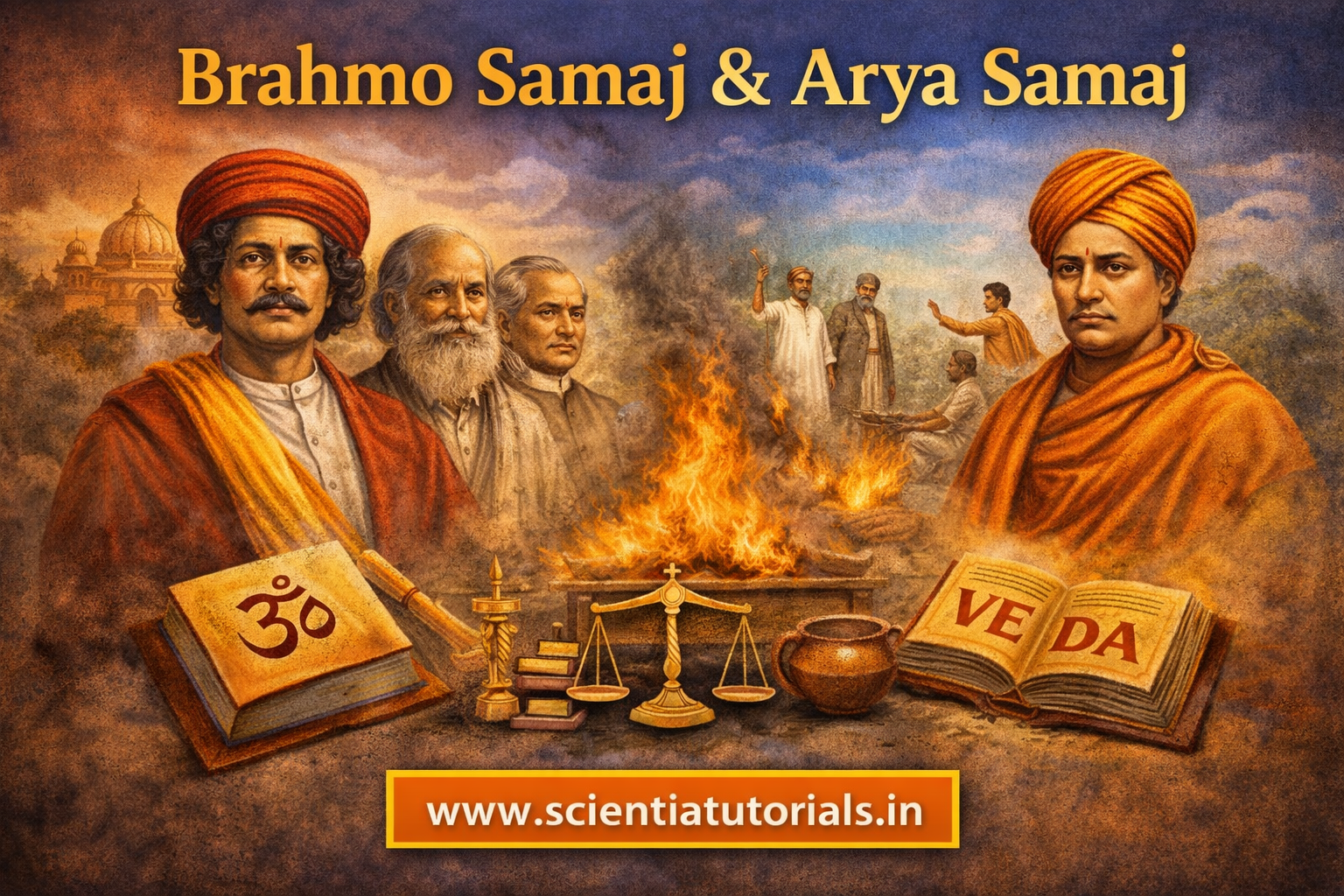

Brahmo Samaj & Arya Samaj | Socio-Religious Reform | History of India
Socio-Religious Reform Movements in 19th Century India
I. Introduction: Socio-Religious Reform in 19th Century India
The 19th century CE witnessed a profound transformation in Indian society as traditional religious beliefs and social practices came under critical scrutiny. The impact of British colonial rule, Western education, and Enlightenment ideas, combined with deep-rooted social evils such as caste rigidity, untouchability, and gender discrimination, gave rise to several socio-religious reform movements.
Among these, the Brahmo Samaj and the Arya Samaj emerged as two of the most influential reform movements within Hindu society. While both sought to purify religion and reform society, they differed significantly in their approach, ideological orientation, and methods. Together, they played a crucial role in shaping modern Indian thought, social reform, and nationalism.
II. Brahmo Samaj: Origin and Historical Background
1. Foundation of the Brahmo Samaj (1828)
The Brahmo Samaj was founded in 1828 in Calcutta by Raja Ram Mohan Roy, often regarded as the father of modern Indian reform movements.
The movement arose in Bengal, a region deeply influenced by:
- Western education
- Christian missionary critique
- Intellectual renaissance known as the Bengal Renaissance
Raja Ram Mohan Roy aimed to reform Hinduism from within by eliminating irrational practices while retaining its ethical core.
2. Philosophical Foundations
The Brahmo Samaj was influenced by:
- Upanishadic monotheism
- Rationalism and humanism
- Western liberal and Enlightenment ideas
It rejected the idea that religion should be based on fear, ritualism, or priestly domination.
III. Ideology and Principles of the Brahmo Samaj
The central principles of the Brahmo Samaj included:
- Belief in one formless God
- Rejection of idol worship
- Opposition to meaningless rituals
- Emphasis on reason and conscience
- Universalism and ethical religion
The Brahmo Samaj viewed religion as a moral and spiritual force, not a set of rigid customs.
IV. Social Reform Agenda of the Brahmo Samaj
1. Women’s Rights and Social Equality
The Brahmo Samaj strongly opposed:
- Sati
- Child marriage
- Polygamy
- Female infanticide
It supported:
- Widow remarriage
- Women’s education
- Legal reforms for gender equality
2. Caste and Social Discrimination
The movement rejected caste discrimination and untouchability, advocating:
- Social equality
- Inter-caste interaction
- Human dignity irrespective of birth
V. Role of Later Brahmo Leaders
1. Debendranath Tagore
Debendranath Tagore institutionalized the Brahmo movement and emphasized the authority of the Upanishads while maintaining rationalism.
2. Keshab Chandra Sen
Keshab Chandra Sen expanded the movement nationally and gave it a more emotional and devotional character.
However, his controversial approval of child marriage led to internal divisions, resulting in:
- Adi Brahmo Samaj
- Brahmo Samaj of India
- Sadharan Brahmo Samaj
VI. Contribution and Limitations of the Brahmo Samaj
Contributions
- Pioneer of modern social reform
- Champion of women’s rights
- Promoted rational religion
- Influenced education and nationalism
Limitations
- Limited mainly to educated elites
- Minimal impact on rural masses
- Internal ideological splits
VII. Arya Samaj: Origin and Historical Context
1. Foundation of Arya Samaj (1875)
The Arya Samaj was founded in 1875 at Bombay by Swami Dayananda Saraswati.
Unlike the Brahmo Samaj, Arya Samaj emerged in a later phase of reform and was shaped by:
- Growing Hindu revivalism
- Reaction against missionary attacks
- Desire to restore Vedic authority
2. Return to the Vedas
The core slogan of Arya Samaj was:
“Back to the Vedas”
Swami Dayananda believed that:
- The Vedas were infallible
- Later Hindu practices represented degeneration
- True reform lay in reviving ancient purity
VIII. Ideology and Religious Principles of Arya Samaj
Key principles included:
- Belief in one God
- Authority of the Vedas
- Rejection of idol worship
- Opposition to superstition and ritualism
- Emphasis on karma and moral life
Unlike Brahmo Samaj, Arya Samaj was assertively reformist and revivalist.
IX. Social Reform Program of Arya Samaj
1. Caste Reform and Social Equality
Arya Samaj:
- Opposed untouchability
- Supported social equality
- Justified varna as functional, not hereditary
2. Women’s Education and Reform
The movement supported:
- Widow remarriage
- Female education
- Opposition to child marriage
However, it upheld a traditional patriarchal family structure.
3. Shuddhi Movement
One of the most distinctive programs was the Shuddhi (purification) movement, aimed at:
- Reconversion of those who had left Hinduism
- Strengthening Hindu identity
This made Arya Samaj more militant and political in nature.
X. Educational and Cultural Contributions of Arya Samaj
Arya Samaj established:
- DAV (Dayanand Anglo-Vedic) schools and colleges
- Gurukuls promoting Vedic learning
These institutions combined:
- Modern education
- Vedic moral values
XI. Comparative Analysis: Brahmo Samaj vs Arya Samaj
| Aspect | Brahmo Samaj | Arya Samaj |
|---|---|---|
| Nature | Reformist & liberal | Reformist & revivalist |
| Religious base | Upanishads & reason | Vedas |
| Attitude to tradition | Selective acceptance | Revival of ancient purity |
| Social base | Urban elites | Wider middle class |
| Approach | Rational & universal | Assertive & activist |
XII. Role in National Awakening
Both movements:
- Challenged social stagnation
- Promoted education and self-respect
- Strengthened cultural confidence
Leaders and institutions influenced early nationalism and later freedom movements.
XIII. Limitations of Both Movements
- Limited rural penetration
- Over-emphasis on religious reform
- Internal contradictions
- Gender reform remained incomplete
Despite these, their historical significance remains immense.
XIV. Conclusion
The Brahmo Samaj and Arya Samaj represent two complementary streams of India’s socio-religious reform movement—liberal-rational reform and revivalist-reformist activism. Together, they laid the intellectual and moral foundations of modern Indian society, contributing to social justice, national consciousness, and cultural regeneration.
They were not merely religious movements but agents of social transformation, shaping India’s transition from tradition to modernity in the 19th century.
Examination Significance
- Core topic for UPSC GS-I, State PSCs, NET History
- Frequently asked in comparative and analytical questions
- Essential for understanding modern Indian reform movements
Brahmo Samaj & Arya Samaj –
Questions and Answers
1. What were socio-religious reform movements in 19th-century India?
Answer:
Socio-religious reform movements were organized efforts to remove social evils, challenge religious orthodoxy, and modernize Indian society by reinterpreting religious beliefs in the light of reason, morality, and human values.
2. Why did Bengal become the birthplace of the Brahmo Samaj?
Answer:
Bengal experienced early exposure to Western education, Christian missionary critique, and intellectual awakening known as the Bengal Renaissance, creating favorable conditions for reformist ideas.
3. Who founded the Brahmo Samaj and in which year?
Answer:
The Brahmo Samaj was founded in 1828 by Raja Ram Mohan Roy in Calcutta.
4. What were the main philosophical ideas of the Brahmo Samaj?
Answer:
The Brahmo Samaj believed in monotheism, rejected idol worship and rituals, emphasized reason and conscience, and promoted a universal, ethical religion.
5. How did the Brahmo Samaj view Hindu scriptures?
Answer:
It accepted the ethical teachings of the Upanishads but rejected blind reliance on scriptures, stressing that reason and morality were superior to ritual authority.
6. What role did the Brahmo Samaj play in women’s reform?
Answer:
The Brahmo Samaj opposed sati, child marriage, and polygamy, while supporting widow remarriage, women’s education, and legal equality for women.
7. How did the Brahmo Samaj address the caste system?
Answer:
It rejected caste discrimination and untouchability, advocating social equality and human dignity irrespective of birth.
8. Who was Debendranath Tagore and what was his contribution?
Answer:
Debendranath Tagore strengthened the Brahmo Samaj institutionally and emphasized spiritual monotheism rooted in the Upanishads.
9. Why did divisions occur within the Brahmo Samaj?
Answer:
Internal disagreements, particularly over social practices like child marriage and leadership style under Keshab Chandra Sen, led to organizational splits.
10. What were the main limitations of the Brahmo Samaj?
Answer:
Its influence was largely confined to urban, educated elites, with limited impact on rural masses and frequent internal divisions.
11. Who founded the Arya Samaj and when?
Answer:
The Arya Samaj was founded in 1875 by Swami Dayananda Saraswati at Bombay.
12. What was the central slogan of the Arya Samaj?
Answer:
The central slogan was “Back to the Vedas”, emphasizing a return to the original purity of Vedic religion.
13. How did the Arya Samaj differ from the Brahmo Samaj in approach?
Answer:
While the Brahmo Samaj was liberal and rationalist, the Arya Samaj was revivalist and assertive, seeking reform through restoration of Vedic authority.
14. What were the religious principles of the Arya Samaj?
Answer:
The Arya Samaj believed in one God, the supremacy of the Vedas, rejection of idol worship, and emphasis on karma, moral life, and discipline.
15. How did the Arya Samaj view the caste system?
Answer:
It opposed untouchability and supported social equality, but justified varna as functional, not hereditary.
16. What reforms did the Arya Samaj support for women?
Answer:
It promoted female education, widow remarriage, and opposed child marriage, though it retained a traditional patriarchal family structure.
17. What was the Shuddhi movement?
Answer:
The Shuddhi movement aimed at reconversion of people who had left Hinduism, strengthening Hindu identity and social cohesion.
18. Why did the Shuddhi movement make the Arya Samaj controversial?
Answer:
It introduced a militant and political dimension to reform, sometimes intensifying communal tensions.
19. What role did education play in the Arya Samaj movement?
Answer:
The Arya Samaj established DAV schools and colleges, combining modern education with Vedic values to create disciplined and socially conscious individuals.
20. Compare the social bases of the Brahmo Samaj and Arya Samaj.
Answer:
The Brahmo Samaj mainly influenced urban intellectual elites, while the Arya Samaj had a wider middle-class following, especially in northern India.
21. How did both movements contribute to national awakening?
Answer:
They promoted self-respect, education, social reform, and cultural confidence, which strengthened early nationalist consciousness.
22. Why are Brahmo Samaj and Arya Samaj considered complementary movements?
Answer:
Together, they represented liberal reform and revivalist reform, addressing social stagnation through different yet mutually reinforcing approaches.
23. What were the common objectives of both movements?
Answer:
Both sought to purify religion, remove social evils, promote education, and reform society from within Hindu traditions.
24. What were the major limitations common to both movements?
Answer:
Limited rural penetration, incomplete gender reform, and excessive focus on religious reform rather than economic issues.
25. Why are Brahmo Samaj and Arya Samaj important in modern Indian history?
Answer:
They laid the foundations of modern social thought, religious reform, and nationalism, shaping India’s transition from tradition to modernity.
Brahmo Samaj & Arya Samaj –
MCQs with Answers and Explanations
1. The Brahmo Samaj was founded in 1828 by:
A. Debendranath Tagore
B. Raja Ram Mohan Roy
C. Keshab Chandra Sen
D. Swami Dayananda Saraswati
Correct Answer: B
Explanation:
Raja Ram Mohan Roy founded the Brahmo Samaj in Calcutta to reform Hindu society by eliminating irrational practices and promoting ethical monotheism.
2. The Brahmo Samaj primarily drew inspiration from the teachings of the:
A. Puranas
B. Smritis
C. Upanishads
D. Tantras
Correct Answer: C
Explanation:
The Brahmo Samaj emphasized Upanishadic monotheism and ethical spirituality while rejecting ritualism and priestly dominance.
3. Which of the following practices was strongly opposed by the Brahmo Samaj?
A. Vedic rituals
B. Idol worship
C. Monotheism
D. Scriptural study
Correct Answer: B
Explanation:
The Brahmo Samaj rejected idol worship and ritualism, advocating a formless God and rational religion.
4. The Brahmo Samaj played a significant role in the abolition of:
A. Untouchability
B. Sati
C. Slavery
D. Dowry
Correct Answer: B
Explanation:
Raja Ram Mohan Roy’s efforts contributed directly to the abolition of sati in 1829, marking a major milestone in social reform.
5. Who institutionalized and systematized the Brahmo Samaj after its foundation?
A. Keshab Chandra Sen
B. Rabindranath Tagore
C. Debendranath Tagore
D. Swami Vivekananda
Correct Answer: C
Explanation:
Debendranath Tagore strengthened the organizational structure of the Brahmo Samaj and emphasized spiritual monotheism.
6. Internal divisions within the Brahmo Samaj occurred mainly due to:
A. British opposition
B. Regional differences
C. Disagreements over social practices
D. Economic issues
Correct Answer: C
Explanation:
Controversies such as Keshab Chandra Sen’s support for child marriage led to ideological splits within the movement.
7. The Brahmo Samaj remained largely confined to:
A. Rural peasantry
B. Tribal communities
C. Urban educated elites
D. Artisan groups
Correct Answer: C
Explanation:
Its rational and intellectual orientation limited its appeal mostly to the urban, English-educated middle class.
8. The Arya Samaj was founded in 1875 by:
A. Swami Vivekananda
B. Ramakrishna Paramahamsa
C. Swami Dayananda Saraswati
D. Ishwar Chandra Vidyasagar
Correct Answer: C
Explanation:
Swami Dayananda Saraswati founded the Arya Samaj to revive Vedic religion and reform Hindu society.
9. The central slogan of the Arya Samaj was:
A. Truth alone triumphs
B. Unity of all religions
C. Back to the Vedas
D. Service to humanity
Correct Answer: C
Explanation:
“Back to the Vedas” reflected the Arya Samaj’s belief that the Vedas represented the purest form of religion.
10. Which religious text was considered infallible by the Arya Samaj?
A. Upanishads
B. Bhagavad Gita
C. Vedas
D. Puranas
Correct Answer: C
Explanation:
The Arya Samaj regarded the Vedas as the ultimate and unquestionable source of religious truth.
11. Unlike the Brahmo Samaj, the Arya Samaj was:
A. Anti-reformist
B. Revivalist in character
C. Opposed to education
D. Supportive of idol worship
Correct Answer: B
Explanation:
The Arya Samaj combined reform with revivalism by restoring Vedic authority while opposing social evils.
12. Which of the following was a major social reform agenda of the Arya Samaj?
A. Promotion of idol worship
B. Support for caste rigidity
C. Opposition to untouchability
D. Defense of superstition
Correct Answer: C
Explanation:
The Arya Samaj opposed untouchability and promoted social equality, though it defended functional varna.
13. The Arya Samaj justified the varna system as:
A. Hereditary and rigid
B. Divinely ordained hierarchy
C. Functional and based on merit
D. Politically necessary
Correct Answer: C
Explanation:
Swami Dayananda believed varna should be based on occupation and merit, not birth.
14. Which movement aimed at reconversion to Hinduism was launched by the Arya Samaj?
A. Satyagraha
B. Bhakti
C. Shuddhi
D. Samarasya
Correct Answer: C
Explanation:
The Shuddhi movement sought to reconvert people who had left Hinduism, strengthening Hindu identity.
15. The Shuddhi movement later became controversial because it:
A. Opposed education
B. Ignored social reform
C. Introduced communal tensions
D. Supported British rule
Correct Answer: C
Explanation:
Its assertive reconversion campaigns sometimes intensified communal rivalries.
16. The Arya Samaj contributed significantly to education through the establishment of:
A. Gurukul schools only
B. Madrasas
C. DAV institutions
D. Missionary schools
Correct Answer: C
Explanation:
Dayanand Anglo-Vedic (DAV) institutions combined modern education with Vedic values.
17. Which reform was supported by both Brahmo Samaj and Arya Samaj?
A. Idol worship
B. Widow remarriage
C. Caste hierarchy
D. Ritual sacrifices
Correct Answer: B
Explanation:
Both movements supported widow remarriage and women’s education, though their ideological bases differed.
18. The Brahmo Samaj can best be described as:
A. Orthodox and conservative
B. Reformist and rationalist
C. Militant and revivalist
D. Political and revolutionary
Correct Answer: B
Explanation:
The Brahmo Samaj emphasized reason, ethics, and universalism in religion.
19. The Arya Samaj gained maximum influence in:
A. Bengal
B. South India
C. Punjab and North India
D. Eastern India
Correct Answer: C
Explanation:
The Arya Samaj had a strong base in Punjab, Uttar Pradesh, and parts of North India.
20. One major limitation common to both movements was their:
A. Support for superstition
B. Lack of religious reform
C. Limited rural penetration
D. Opposition to nationalism
Correct Answer: C
Explanation:
Both movements mainly influenced urban and semi-urban populations, with limited reach among rural masses.
21. How did the Brahmo Samaj differ from the Arya Samaj regarding scriptures?
A. Both accepted the Vedas as infallible
B. Brahmo Samaj rejected all scriptures
C. Brahmo Samaj accepted scriptures subject to reason
D. Arya Samaj rejected all scriptures
Correct Answer: C
Explanation:
The Brahmo Samaj accepted scriptures only insofar as they conformed to reason and morality.
22. Which movement had a more universal and cosmopolitan outlook?
A. Arya Samaj
B. Brahmo Samaj
C. Ramakrishna Mission
D. Aligarh Movement
Correct Answer: B
Explanation:
The Brahmo Samaj emphasized universalism and harmony among religions.
23. The Arya Samaj’s approach to reform can best be described as:
A. Liberal and eclectic
B. Passive and spiritual
C. Assertive and revivalist
D. Anti-religious
Correct Answer: C
Explanation:
Its reform program was energetic, militant, and rooted in Vedic revivalism.
24. Both Brahmo Samaj and Arya Samaj contributed to nationalism mainly by:
A. Leading political agitations
B. Promoting social self-confidence
C. Organizing armed struggle
D. Supporting colonial policies
Correct Answer: B
Explanation:
By reforming society and restoring self-respect, they strengthened the foundations of national consciousness.
25. The historical significance of Brahmo Samaj and Arya Samaj lies in their role as:
A. Purely religious sects
B. Agents of social and cultural modernization
C. Anti-colonial revolutionary groups
D. Rural mass movements
Correct Answer: B
Explanation:
Both movements acted as key agents in India’s transition from tradition to modernity during the 19th century.
Targeting Exams
This lesson is highly relevant for competitive and academic examinations that test modern Indian history and socio-religious reform movements, especially through comparative, analytical, and objective questions.
Targeted Exams:
-
UPSC Civil Services Examination
(Prelims MCQs & GS-I Mains – Modern Indian History) -
State Public Service Commissions
(APSC, BPSC, UPPSC, WBCS, RPSC, etc.) -
UGC NET / SET (History)
-
CUET-PG (History)
-
University UG & PG History Examinations
-
School Board Exams (Class 10–12, Modern India)
Related Keyphrases
-
Brahmo Samaj and Arya Samaj difference
-
Socio-religious reform movements in India
-
19th century reform movements History of India
-
Raja Ram Mohan Roy Brahmo Samaj
-
Swami Dayananda Saraswati Arya Samaj
-
Hindu reform movements in modern India
-
Brahmo Samaj ideology and reforms
-
Arya Samaj Shuddhi movement