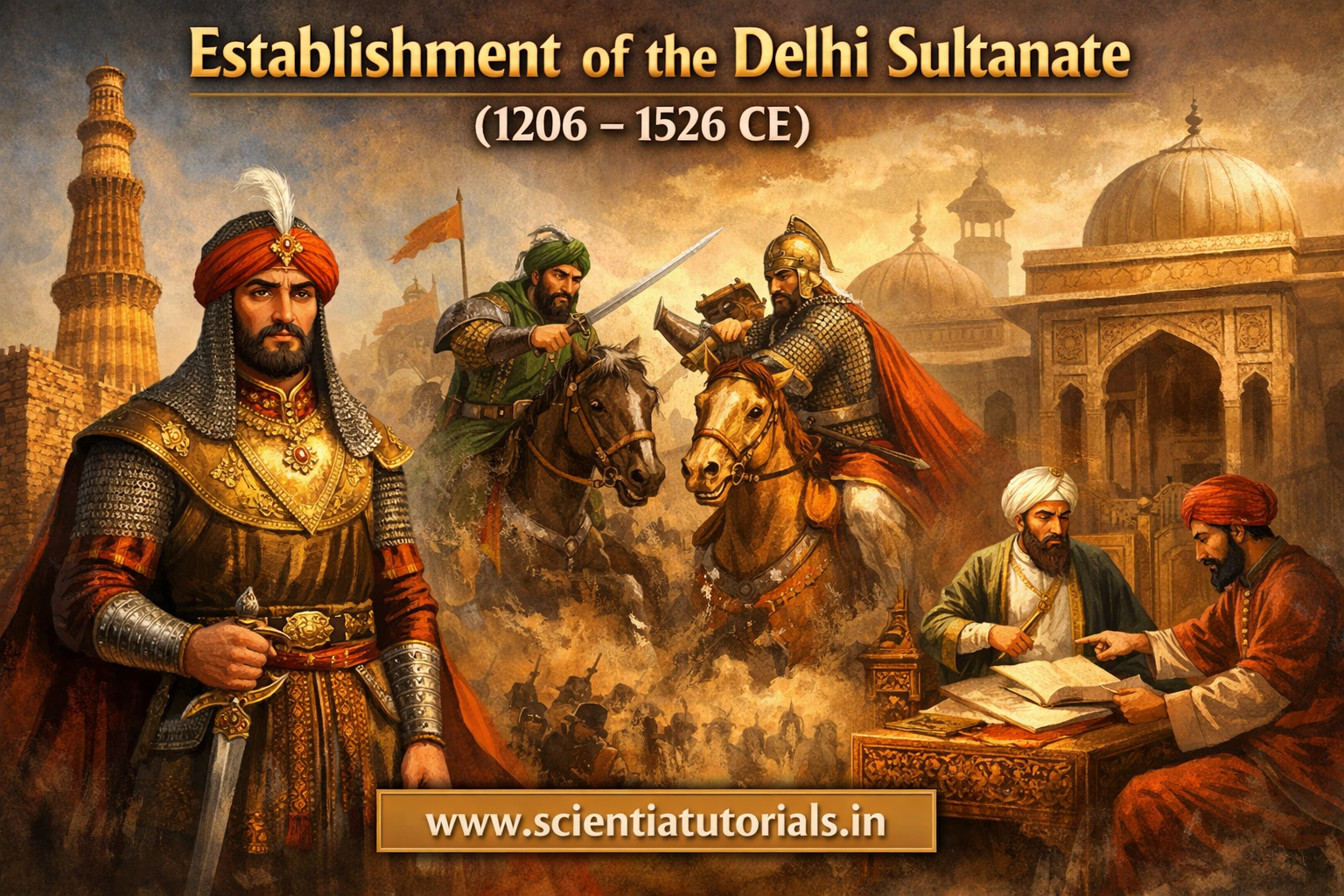
Establishment of the Delhi Sultanate (1206 CE – 1526 CE)
SECTION 8: Delhi Sultanate – Medieval Indian History (Sultanate Phase)
1. Introduction: Transition from Early Medieval to Sultanate Rule
The establishment of the Delhi Sultanate in 1206 CE marks a decisive turning point in Indian history, signifying the formal beginning of Muslim political authority independent of Central Asian control. While earlier Turkish and Afghan rulers had invaded India, the Delhi Sultanate represented the first durable Islamic state rooted in Indian soil.
This phase witnessed:
The collapse of Rajput political dominance in North India
The emergence of Perso-Islamic administrative systems
The integration of India into broader Islamic world networks
A transformation in land revenue, military organisation, architecture, and culture
The foundation of the Sultanate was not sudden; it was the culmination of centuries of interactions, invasions, and political experiments beginning from the 8th century.
2. Pre-Sultanate Background: Early Muslim Contacts with India
2.1 Arab Contacts and Sindh (8th Century CE)
The earliest Muslim political presence in India dates back to 712 CE, when Muhammad bin Qasim conquered Sindh during the Umayyad Caliphate. However, Arab rule remained confined to the northwest and did not expand into the Indian heartland.
2.2 Turkish Invasions (10th–12th Century CE)
The real foundation for the Delhi Sultanate was laid by Turkish military adventurers from Central Asia, driven by:
Economic motives (plunder, tribute)
Political ambition
Religious legitimacy under Islamic banners
Mahmud of Ghazni (r. 998–1030 CE)
Mahmud of Ghazni conducted 17 invasions into India, weakening major North Indian powers such as the Pratiharas and Shahi rulers. His campaigns exposed the military vulnerabilities of Indian kingdoms but did not establish permanent administration.
3. Muhammad Ghori and the Foundations of Sultanate Rule
3.1 Rise of the Ghurids
The decisive phase began with Muhammad Ghori (Muʿizz-ud-Din Muhammad). Unlike Mahmud of Ghazni, Ghori aimed at territorial conquest and governance rather than mere plunder.
3.2 Battles of Tarain (1191 & 1192 CE)
First Battle of Tarain (1191 CE): Ghori was defeated by Prithviraj Chauhan
Second Battle of Tarain (1192 CE): Ghori decisively defeated Prithviraj Chauhan
🔹 Historical Significance:
Opened the Gangetic plains to Turkish rule
Marked the end of Rajput political supremacy in North India
Enabled systematic Turkish expansion
3.3 Expansion Under Turkish Generals
Muhammad Ghori appointed trusted slave generals (mamluks) to consolidate territories:
Qutbuddin Aibak – India
Bakhtiyar Khalji – Bengal and Bihar
4. Establishment of the Delhi Sultanate (1206 CE)
Following the assassination of Muhammad Ghori in 1206 CE, his empire fragmented. In India, Qutbuddin Aibak declared independence, laying the foundation of the Delhi Sultanate.
Why 1206 CE is Crucial
Marks the first independent Muslim dynasty in India
Shift from provincial governorship to sovereign rule
Beginning of Sultanate-era institutions
5. Qutbuddin Aibak and the Mamluk (Slave) Dynasty
5.1 Rise of Qutbuddin Aibak (1206–1210 CE)
Qutbuddin Aibak was a former slave who rose through merit and military loyalty.
6. Early Consolidation: Iltutmish and Institutional Foundations
6.1 Accession of Iltutmish (1211–1236 CE)
Iltutmish was the true consolidator of the Delhi Sultanate.
Major Contributions
Suppressed rival nobles and governors
Secured Caliphal recognition from Baghdad
Introduced Iqta system (land assignments for revenue collection)
Standardised currency: Silver Tanka and Copper Jital
6.2 Territorial Expansion
Iltutmish extended Sultanate authority over:
Bengal
Sindh
Rajputana
Malwa
He transformed a fragile military regime into a centralised state.
7. Nature of the Early Delhi Sultanate State
7.1 Political Character
Military autocracy
Sultan as supreme authority
Loyalty based on personal allegiance rather than ethnicity
7.2 Administrative Structure
Persian as official language
Diwan-i-Wizarat (Finance)
Diwan-i-Arz (Military)
Diwan-i-Insha (Correspondence)
8. Challenges in Establishment of the Sultanate
8.1 Internal Challenges
Turkish nobility factions (The Forty / Chahalgani)
Succession disputes
Slave-origin legitimacy issues
8.2 External Threats
Mongol invasions from Central Asia
Resistance from Rajput chiefs
9. Socio-Economic Impact of the Establishment Phase
9.1 Agrarian Changes
Introduction of systematic land revenue assessment
State control over surplus extraction
9.2 Urbanisation
Growth of cities such as:
Delhi
Lahore
Multan
10. Cultural and Architectural Beginnings
The establishment phase saw the fusion of Indian craftsmanship with Islamic architectural forms:
Qutb Minar
Quwwat-ul-Islam Mosque
Reuse of temple materials (indicative of early transition)
11. Historical Significance of the Establishment of Delhi Sultanate
The establishment of the Delhi Sultanate:
Integrated India into Islamic political and cultural world
Laid the foundation for five dynasties over 320 years
Introduced enduring administrative institutions
Prepared ground for the later Mughal Empire
12. Conclusion
The establishment of the Delhi Sultanate in 1206 CE was not a sudden political accident but the result of prolonged military, political, and institutional developments. From early Arab contacts to Ghori’s strategic vision and Aibak’s declaration of independence, the Sultanate represented a new phase of Indian history—one marked by centralised governance, cultural synthesis, and imperial ambition.
Understanding this phase is essential for grasping:
The evolution of medieval Indian polity
The nature of state formation
The long-term legacy of Sultanate institutions
Below is a well-structured, examination-oriented set of 25 Questions with Clear Answers based strictly on the lesson “Establishment of the Delhi Sultanate”, aligned with SECTION 8: Delhi Sultanate (1206–1526 CE) and suitable for UPSC, State PSC, university exams, and competitive history papers.
Establishment of the Delhi Sultanate – Questions & Answers
Q1. What is meant by the term “Delhi Sultanate”?
Answer:
The Delhi Sultanate refers to the Islamic political authority established in North India in 1206 CE, with Delhi as its capital, ruled by a series of Muslim dynasties until 1526 CE.
Q2. Why is 1206 CE considered a landmark year in Indian history?
Answer:
1206 CE marks the foundation of the first independent Muslim state in India, established by Qutbuddin Aibak after the death of Muhammad Ghori.
Q3. Who laid the foundation of Turkish rule in India?
Answer:
The foundation of Turkish rule in India was laid by Muhammad Ghori, whose conquests led to permanent political control rather than mere plunder.
Q4. How did Arab rule in Sindh differ from the Delhi Sultanate?
Answer:
Arab rule in Sindh (8th century CE) was limited in territorial expansion and influence, whereas the Delhi Sultanate was a centralised empire controlling large parts of North India.
Q5. What role did Mahmud of Ghazni play in the establishment of the Sultanate?
Answer: Mahmud of Ghazni weakened Indian kingdoms through repeated invasions but did not establish a permanent political system in India.
Q6. Why were the Battles of Tarain significant?
Answer:
The Second Battle of Tarain (1192 CE) led to the defeat of Prithviraj Chauhan, opening North India to Turkish political domination.
Q7. What was the main objective of Muhammad Ghori’s Indian campaigns?
Answer:
Unlike earlier invaders, Muhammad Ghori aimed at territorial conquest and governance, not just plunder.
Q8. Who was Qutbuddin Aibak?
Answer:
Qutbuddin Aibak was a former Turkish slave and general of Muhammad Ghori who became the first Sultan of Delhi in 1206 CE.
Q9. Which dynasty did Qutbuddin Aibak establish?
Answer:
He founded the Mamluk (Slave) Dynasty, the first ruling dynasty of the Delhi Sultanate.
Q10. Why is the Mamluk Dynasty known as the “Slave Dynasty”?
Answer:
Because its rulers, including Qutbuddin Aibak and Iltutmish, were former slaves who rose to power through military merit.
Q11. What were the major achievements of Qutbuddin Aibak?
Answer:
Established the Sultanate
Made Delhi the capital
Initiated Islamic architecture
Issued coins in his name
Q12. Why is Iltutmish regarded as the real consolidator of the Delhi Sultanate?
Q13. What was the significance of Caliphal recognition to Iltutmish?
Answer:
It provided religious legitimacy to his rule and strengthened the Sultanate’s authority in the Islamic world.
Q14. What was the Iqta system?
Answer:
The Iqta system was a land revenue assignment system where officers were paid through revenue collection instead of salaries.
Q15. What types of challenges did the early Delhi Sultans face?
Answer:
Turkish noble rivalries
Succession disputes
Resistance from Rajput chiefs
Mongol invasions
Q16. What was the role of the Turkish nobility (Chahalgani)?
Answer:
The Chahalgani or “The Forty” were powerful nobles who often interfered in administration and succession.
Q17. What administrative language was used by the Delhi Sultanate?
Answer: Persian was adopted as the official administrative language.
Q18. Name the main administrative departments of the early Sultanate.
Answer:
Diwan-i-Wizarat (Finance)
Diwan-i-Arz (Military)
Diwan-i-Insha (Correspondence)
Q19. How did the establishment of the Sultanate affect agriculture?
Answer:
It introduced systematic land revenue assessment and strengthened state control over agricultural surplus.
Q20. What was the impact of the Sultanate on urban development?
Answer:
Cities like Delhi, Lahore, and Multan expanded as administrative, military, and commercial centres.
Q21. How did architecture reflect the early Sultanate phase?
Answer:
Early architecture showed a fusion of Indian craftsmanship and Islamic styles, using arches, domes, and reused temple materials.
Q22. Why was Delhi chosen as the capital of the Sultanate?
Answer:
Delhi’s strategic location enabled control over the Gangetic plains and access to trade routes.
Q23. What was the nature of the Sultanate state?
Answer:
It was a centralised military monarchy where the Sultan exercised supreme authority.
Q24. How did the establishment of the Delhi Sultanate integrate India with the Islamic world?
Answer:
Through diplomatic ties, trade, religious legitimacy, administrative models, and cultural exchanges.
Q25. What is the long-term historical significance of the establishment of the Delhi Sultanate?
Answer:
It laid the foundation for over three centuries of Sultanate rule, introduced lasting administrative institutions, and prepared the ground for the Mughal Empire.
Below is a well-structured, examination-oriented set of 25 Multiple Choice Questions (MCQs) with correct answers and detailed concept-clearing explanations, prepared strictly from the lesson “Establishment of the Delhi Sultanate” under SECTION 8: Delhi Sultanate (1206–1526 CE).
Establishment of the Delhi Sultanate – MCQs with Answers & Explanations
MCQ 1.
The Delhi Sultanate was formally established in:
A. 1192 CE
B. 1200 CE
C. 1206 CE
D. 1211 CE
Correct Answer: C
Explanation:
The Delhi Sultanate was established in 1206 CE when Qutbuddin Aibak declared independence after the death of Muhammad Ghori.
MCQ 2.
Who is regarded as the real founder of the Delhi Sultanate?
A. Mahmud of Ghazni
B. Muhammad Ghori
C. Qutbuddin Aibak
D. Iltutmish
Correct Answer: C
Explanation:
Although Muhammad Ghori laid the groundwork, Qutbuddin Aibak founded the first independent Muslim state in India, making him the real founder.
MCQ 3.
Which invasion marked the beginning of permanent Turkish political control in India?
A. Arab conquest of Sindh
B. Mahmud of Ghazni’s invasions
C. Muhammad Ghori’s conquest after Tarain
D. Mongol invasions
Correct Answer: C
Explanation: Muhammad Ghori aimed at territorial control, unlike earlier invaders whose objectives were mainly plunder.
MCQ 4.
The Second Battle of Tarain (1192 CE) resulted in the defeat of:
A. Jaichand
B. Bhoja
C. Prithviraj Chauhan
D. Rana Sanga
Correct Answer: C
Explanation:
The defeat of Prithviraj Chauhan opened North India to Turkish domination.
MCQ 5.
Which dynasty was the first ruling dynasty of the Delhi Sultanate?
A. Khalji
B. Tughlaq
C. Sayyid
D. Mamluk
Correct Answer: D
Explanation:
The Mamluk or Slave Dynasty was founded by Qutbuddin Aibak in 1206 CE.
MCQ 6.
Why is the Mamluk Dynasty also known as the Slave Dynasty?
A. It relied on slave labour
B. Slaves were the main taxpayers
C. Rulers were former slaves
D. It abolished slavery
Correct Answer: C
Explanation:
The rulers, including Aibak and Iltutmish, were former slaves who rose through merit.
MCQ 7.
Who among the following was a slave-general of Muhammad Ghori in India?
A. Balban
B. Qutbuddin Aibak
C. Alauddin Khalji
D. Sikandar Lodi
Correct Answer: B
Explanation:
Qutbuddin Aibak served Muhammad Ghori as his trusted military commander in India.
MCQ 8.
What distinguished Muhammad Ghori’s invasions from those of Mahmud of Ghazni?
A. Use of cavalry
B. Religious motives
C. Establishment of administration
D. Naval power
Correct Answer: C
Explanation:
Ghori aimed at political control and governance, unlike Mahmud’s plundering raids.
MCQ 9.
Which ruler is considered the real consolidator of the Delhi Sultanate?
A. Qutbuddin Aibak
B. Raziya Sultana
C. Iltutmish
D. Balban
Correct Answer: C
Explanation: Iltutmish strengthened administration, expanded territories, and stabilised the state.
MCQ 10.
Why was Caliphal recognition important for Iltutmish?
A. It increased revenue
B. It ensured military support
C. It gave religious legitimacy
D. It improved trade relations
Correct Answer: C
Explanation:
Recognition from the Abbasid Caliph legitimised Iltutmish’s rule in the Islamic world.
MCQ 11.
The Iqta system primarily related to:
A. Judicial administration
B. Land revenue assignments
C. Military recruitment
D. Trade taxation
Correct Answer: B
Explanation:
Under the Iqta system, officials were assigned land revenues instead of salaries.
MCQ 12.
What was the official language of administration under the Delhi Sultanate?
A. Arabic
B. Sanskrit
C. Persian
D. Turkish
Correct Answer: C
Explanation:
Persian became the official administrative language of the Sultanate.
MCQ 13.
Which city was established as the capital of the Delhi Sultanate?
A. Lahore
B. Agra
C. Multan
D. Delhi
Correct Answer: D
Explanation:
Delhi was chosen for its strategic location controlling North India.
MCQ 14.
Which administrative department dealt with military affairs?
A. Diwan-i-Insha
B. Diwan-i-Arz
C. Diwan-i-Wizarat
D. Diwan-i-Qaza
Correct Answer: B
Explanation:
The Diwan-i-Arz was responsible for military organisation and recruitment.
MCQ 15.
The group of powerful Turkish nobles was known as:
A. Ulema
B. Chahalgani
C. Mansabdars
D. Zamindars
Correct Answer: B
Explanation:
The Chahalgani or “The Forty” often influenced succession and administration.
MCQ 16.
Which external threat posed a serious challenge to the early Delhi Sultanate?
A. Portuguese
B. Chinese
C. Mongols
D. British
Correct Answer: C
Explanation:
Repeated Mongol invasions threatened the north-western frontiers.
MCQ 17.
What was the nature of the Delhi Sultanate state?
A. Federal monarchy
B. Tribal confederation
C. Centralised military monarchy
D. Democratic state
Correct Answer: C
Explanation:
The Sultan held supreme authority supported by a centralised bureaucracy.
MCQ 18.
Which factor most weakened the Rajput states before the Sultanate’s rise?
A. Internal rivalries
B. Foreign trade decline
C. Religious conflicts
D. Climatic changes
Correct Answer: A
Explanation:
Lack of unity among Rajput rulers made resistance ineffective.
MCQ 19.
Which area did Bakhtiyar Khalji conquer during the early Sultanate phase?
A. Malwa
B. Bengal
C. Gujarat
D. Deccan
Correct Answer: B
Explanation:
Bakhtiyar Khalji extended Turkish control into Bengal and Bihar.
MCQ 20.
What economic impact did the establishment of the Sultanate have?
A. Decline in agriculture
B. End of taxation
C. Systematic land revenue assessment
D. Abolition of trade taxes
Correct Answer: C
Explanation:
The Sultanate strengthened state control over agrarian surplus.
MCQ 21.
Which architectural feature reflects early Sultanate influence?
A. Rock-cut caves
B. Stupas
C. Arches and domes
D. Wooden temples
Correct Answer: C
Explanation:
Islamic architecture introduced arches, domes, and minarets.
MCQ 22.
Which invasion first integrated India into the Islamic political world?
A. Mahmud of Ghazni
B. Muhammad bin Qasim
C. Timur
D. Babur
Correct Answer: B
Explanation:
The conquest of Sindh by Muhammad bin Qasim marked the earliest political integration.
MCQ 23.
Which factor best explains the success of the Turks in India?
A. Naval superiority
B. Advanced firearms
C. Superior cavalry tactics
D. Numerical strength
Correct Answer: C
Explanation:
Turkish cavalry and military organisation gave them an edge.
MCQ 24.
Which ruler standardised currency during the establishment phase?
A. Qutbuddin Aibak
B. Iltutmish
C. Balban
D. Alauddin Khalji
Correct Answer: B
Explanation:
Iltutmish introduced the silver Tanka and copper Jital.
MCQ 25.
The long-term significance of the Delhi Sultanate lies in:
A. Short-term military success
B. Cultural isolation
C. Foundation of medieval Indian polity
D. Decline of urban centres
Correct Answer: C
Explanation:
The Sultanate introduced enduring administrative, political, and cultural institutions that shaped medieval India.
Targeting Exams
This content is specially designed to support preparation for the following competitive and academic examinations:
UPSC Civil Services Examination (Prelims & Mains)
State Public Service Commissions (PSC)
UGC NET (History)
CUET (UG & PG – History)
University Semester Examinations (BA/MA History)
SSC & Other Government Exams
School-Level Board Exams (Class 7–12 History)
The lesson aligns with frequently asked themes such as state formation in medieval India, Turkish invasions, early Sultanate administration, and chronological developments.