
Causes of Social Reform in Modern India
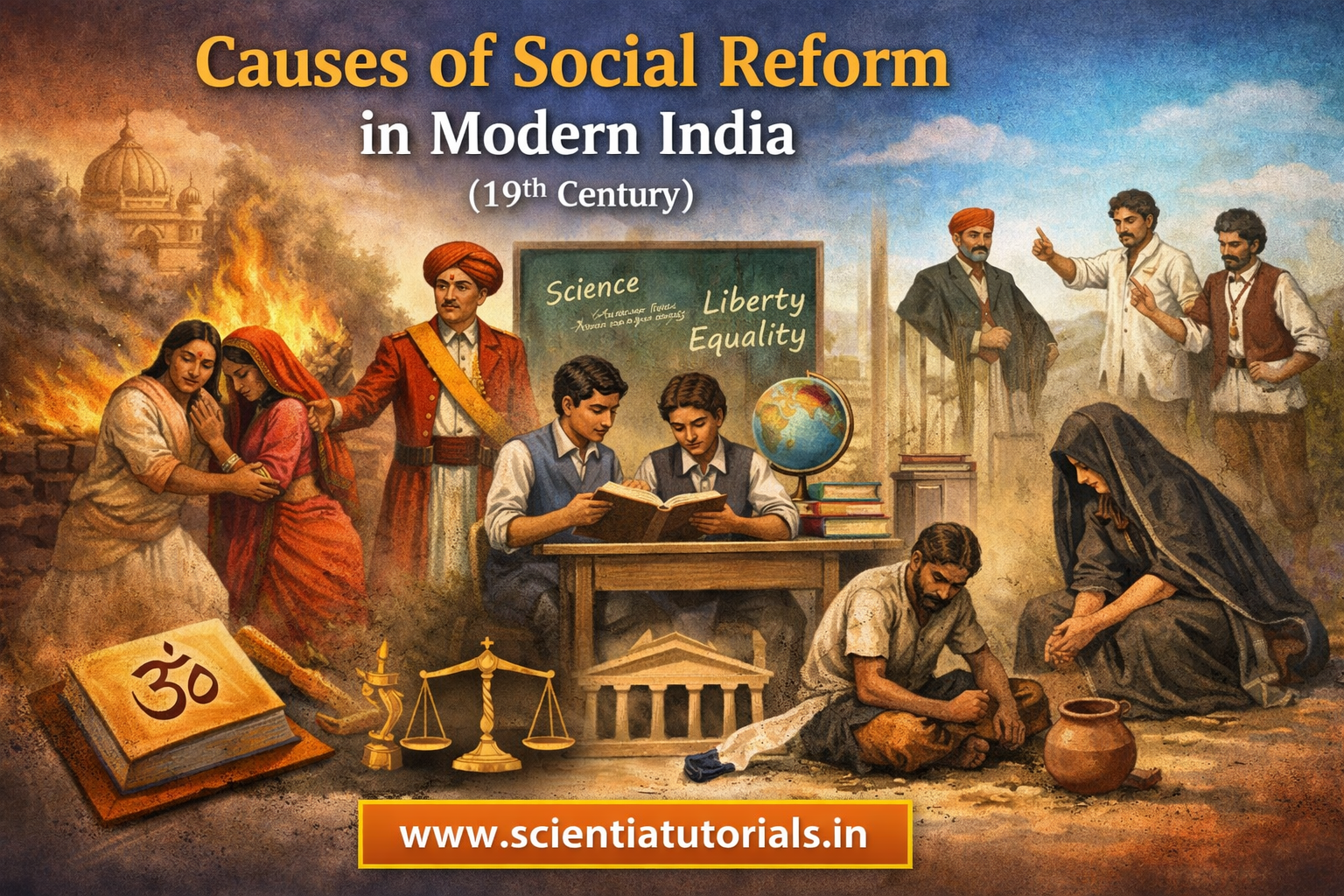

Causes of Social Reform in Modern India | History of India
Course Context
Course: History of India – Complete Chronological and Era-Wise Course
Section 13: Socio-Religious Reform Movements
Timeline: 19th Century CE (Modern Indian History)
Lesson: Causes of Social Reform in Modern India
I. Introduction: Background to Social Reform in Modern India
The 19th century CE marks a decisive phase in Indian history when traditional society encountered unprecedented challenges due to British colonial rule, Western intellectual influence, and internal social stagnation. Indian society at the beginning of this century was characterized by rigid social customs, religious orthodoxy, caste oppression, gender discrimination, and intellectual inertia.
The causes of social reform in modern India emerged from a complex interaction between indigenous social realities and external ideological forces. Reform was not merely a reaction to colonial dominance but also a self-generated response by Indian thinkers who sought to purify, rationalize, and modernize Indian society while preserving its ethical foundations.
II. Social Evils and Internal Decay of Traditional Society
1. Caste System and Untouchability
One of the most compelling internal causes for social reform was the rigidity of the caste system. Over centuries, caste had degenerated from a functional social division into a hereditary, oppressive hierarchy.
- Lower castes and untouchables were denied:
- Access to education
- Temple entry
- Public wells and roads
- Social mobility was virtually impossible
- Caste norms inhibited national unity and social cohesion
Reformers increasingly viewed caste discrimination as morally unjust, socially harmful, and politically dangerous in an age of emerging nationalism.
2. Condition of Women
The deplorable status of women acted as a powerful stimulus for reform. Major issues included:
- Sati system
- Child marriage
- Female infanticide
- Prohibition of widow remarriage
- Lack of female education
- Purdah system
Practices like sati were legitimized through distorted religious interpretations, provoking reformers such as Raja Ram Mohan Roy to challenge scriptural orthodoxy using reason and classical texts.
3. Religious Superstitions and Ritualism
By the 19th century, many religious practices had become:
- Excessively ritualistic
- Priest-dominated
- Detached from ethical and moral values
Blind faith, idol worship, magic, astrology, and fear-based rituals discouraged rational inquiry and social progress. Reformers argued that religion should elevate human morality, not reinforce ignorance and inequality.
III. Impact of British Rule and Colonial Policies
1. Introduction of Western Education
The establishment of English education and modern institutions introduced Indians to:
- Rationalism
- Liberalism
- Humanism
- Ideas of equality and freedom
Thinkers like Thomas Babington Macaulay played a key role in promoting Western education, which indirectly became a catalyst for social reform by producing a new middle class intelligentsia.
2. Growth of Scientific and Rational Thought
Western education encouraged:
- Questioning of tradition
- Scientific temper
- Empirical reasoning
Educated Indians began to critically examine social customs and religious dogmas. Social reform increasingly relied on reasoned argument rather than blind faith.
3. Colonial Legal and Administrative Changes
British rule introduced:
- Codified laws
- Uniform judicial systems
- Concepts of rule of law
Legislative interventions such as the abolition of sati (1829) and the Widow Remarriage Act (1856) exposed Indians to the idea that social customs could be reformed through law.
IV. Influence of Western Ideas and Enlightenment Thought
1. Liberalism and Human Rights
European Enlightenment ideas emphasized:
- Individual dignity
- Equality before law
- Freedom of conscience
These ideas deeply influenced Indian reformers like Ishwar Chandra Vidyasagar, who combined Western rationalism with indigenous ethics.
2. Christian Missionary Criticism
Christian missionaries criticized:
- Idol worship
- Caste discrimination
- Social evils like sati and infanticide
While often biased, their critique compelled Indian intellectuals to defend and reform Hindu society from within, leading to movements such as the Brahmo Samaj.
V. Role of Indian Reformers and Intellectual Awakening
1. Emergence of Reformist Leadership
The 19th century witnessed the rise of reformers who:
- Reinterpreted religious texts
- Advocated social equality
- Promoted women’s rights
- Encouraged modern education
Notable reformers included Swami Dayananda Saraswati, who emphasized Vedic purity and social reform.
2. Print Culture and Public Debate
The expansion of:
- Printing presses
- Newspapers
- Journals
- Pamphlets
enabled reformers to spread ideas rapidly. Public debates on social reform became common, creating intellectual ferment and mass awareness.
VI. Impact of Socio-Economic Changes
1. Rise of Middle Class
British rule created a new urban, educated middle class comprising:
- Professionals
- Teachers
- Lawyers
- Journalists
This class became the backbone of social reform, as they were:
- Economically secure
- Intellectually exposed
- Socially conscious
2. Decline of Traditional Institutions
Old institutions such as:
- Village councils
- Caste panchayats
- Guild systems
lost authority, creating a social vacuum that reform movements sought to fill with modern, ethical alternatives.
VII. Nationalism and Social Reform
1. Social Reform as a Basis for National Unity
Reformers realized that:
- Social divisions weakened resistance to colonialism
- National unity required social equality
Movements against caste discrimination and for women’s education were seen as essential to nation-building.
2. Link between Reform and Political Awakening
Organizations like the Indian National Congress emerged from the same educated elite that championed social reform, highlighting the deep connection between social progress and political freedom.
VIII. Regional and Cultural Factors
Different regions experienced reform due to specific local conditions:
- Bengal: Intellectual renaissance and Brahmo movement
- Maharashtra: Anti-caste movements
- Punjab: Religious purification movements
- South India: Non-Brahmin and self-respect movements
These regional dynamics contributed to the diversity and depth of social reform causes.
IX. Evaluation: Nature of Causes
The causes of social reform in modern India can be categorized as:
- Internal causes: Social evils, religious degeneration, caste oppression
- External causes: Western education, colonial rule, missionary influence
- Intellectual causes: Rationalism, print culture, Enlightenment ideas
- Political causes: Nationalism and unity
- Economic causes: Rise of middle class and new professions
Social reform was therefore neither purely Western nor entirely indigenous, but a creative synthesis of both.
X. Conclusion
The causes of social reform in 19th-century India arose from a profound crisis within traditional society and the transformative impact of colonial modernity. Indian reformers responded with intellectual courage, moral conviction, and historical consciousness, laying the foundation for a more egalitarian, rational, and humane society.
These reforms not only addressed immediate social evils but also prepared India for national awakening, constitutional development, and democratic ideals in the 20th century. Thus, social reform became an indispensable pillar of modern Indian history.
Examination Significance
- Ideal for UPSC GS-I, State PSC, NET History
- Suitable for short notes, essays, and answer writing
- Provides cause-effect clarity and historiographical balance
Causes of Social Reform in Modern India –
Questions & Answers
1. What is meant by ‘social reform’ in the context of 19th-century India?
Answer:
Social reform in 19th-century India refers to organized efforts by Indian thinkers and reformers to eliminate social evils, challenge religious orthodoxy, and modernize Indian society by promoting equality, rationality, and human dignity within the framework of Indian traditions.
2. Why did social reform movements emerge prominently in the 19th century?
Answer:
Social reform movements emerged due to the internal decay of traditional society, exposure to Western education and ideas, British colonial rule, and the growing realization among Indians that social stagnation weakened national strength.
3. How did the caste system contribute to the rise of social reform movements?
Answer:
The caste system had become rigid and oppressive, leading to untouchability, social exclusion, and denial of basic rights to lower castes. This injustice compelled reformers to demand social equality and human dignity, making caste reform a central cause.
4. In what ways did untouchability act as a stimulus for social reform?
Answer:
Untouchability denied large sections of society access to education, temples, and public resources. Reformers viewed it as morally unjust and socially divisive, and its removal was seen as essential for social unity and national integration.
5. Describe the condition of women in early 19th-century Indian society.
Answer:
Women suffered from sati, child marriage, female infanticide, ban on widow remarriage, lack of education, and purdah. These practices highlighted deep gender inequality and became a major cause for social reform.
6. Why was the abolition of sati considered a landmark in social reform?
Answer:
The abolition of sati in 1829 symbolized the first successful challenge to religious orthodoxy through law and demonstrated that inhuman customs could be reformed using reason, ethics, and legislative support.
7. How did religious superstition and ritualism encourage reformist thinking?
Answer:
Blind rituals, priestly dominance, and superstition diverted religion from ethical values. Reformers believed that such practices promoted ignorance and inequality, thus motivating them to advocate rational, ethical, and simplified religion.
8. What role did Western education play in promoting social reform?
Answer:
Western education introduced Indians to scientific reasoning, liberalism, humanism, and equality, enabling them to critically examine traditional customs and demand social change based on reason rather than blind faith.
9. How did English education create a new class of reformers?
Answer:
English education produced an educated middle class of teachers, lawyers, journalists, and administrators who were socially conscious, intellectually exposed, and capable of leading reform movements.
10. In what ways did British legal reforms influence social reform in India?
Answer:
British legal reforms introduced the rule of law and codified legislation, proving that social customs were not immutable. Laws like the Widow Remarriage Act (1856) strengthened reformist efforts.
11. How did Enlightenment ideas impact Indian social reformers?
Answer:
Enlightenment ideas emphasized reason, individual rights, liberty, and equality, inspiring Indian reformers to question tradition and reinterpret religion in a rational and humane manner.
12. What was the impact of Christian missionary criticism on Indian society?
Answer:
Missionary criticism of caste discrimination and social evils, though often biased, forced Indian intellectuals to defend and reform their society from within, accelerating reform movements.
13. Why is Raja Ram Mohan Roy regarded as a pioneer of social reform?
Answer:
He opposed sati, championed women’s rights, promoted rational religion, and used both Indian scriptures and Western ideas to argue for reform, laying the foundation of modern social reform movements.
14. How did Ishwar Chandra Vidyasagar contribute to social reform?
Answer:
He played a key role in promoting widow remarriage, women’s education, and humanitarian values, combining Western rationalism with Indian ethical traditions.
15. What role did print media play in spreading reformist ideas?
Answer:
Newspapers, journals, and pamphlets helped disseminate reformist ideas, encouraged public debate, and created mass awareness about social evils and the need for reform.
16. How did the rise of the middle class support social reform movements?
Answer:
The middle class was economically stable, educated, and socially aware. It provided leadership, organization, and intellectual backing to reform movements across India.
17. Why did reformers link social reform with national unity?
Answer:
Social divisions based on caste and gender weakened collective resistance to colonial rule. Reformers believed that social equality was essential for building a united nation.
18. How were social reform and nationalism interconnected?
Answer:
Both were led by the educated elite and aimed at self-respect, dignity, and collective progress. Social reform strengthened national consciousness, while nationalism reinforced reformist ideals.
19. What regional factors influenced social reform movements in India?
Answer:
Local social conditions shaped reform priorities—Bengal emphasized religious rationalism, Maharashtra focused on anti-caste reform, Punjab on religious purification, and South India on non-Brahmin movements.
20. Why can social reform in India not be seen as purely Western-inspired?
Answer:
Although influenced by Western ideas, reform movements also drew deeply from Indian scriptures, ethical traditions, and historical experiences, making them a synthesis of indigenous and external influences.
21. What internal causes were primarily responsible for social reform?
Answer:
Caste oppression, untouchability, women’s subjugation, religious superstition, and moral degeneration within society were major internal causes.
22. What external factors accelerated the pace of social reform?
Answer:
British rule, Western education, Enlightenment ideas, missionary criticism, and colonial legal reforms acted as external catalysts.
23. How did the decline of traditional institutions contribute to reform?
Answer:
The weakening of caste panchayats and village institutions created a social vacuum, encouraging reformers to introduce modern, ethical, and egalitarian alternatives.
24. Was social reform uniform across India? Explain briefly.
Answer:
No, social reform varied regionally due to differences in culture, social structure, and historical experience, though the underlying causes remained broadly similar.
25. Why are the causes of social reform significant for understanding modern Indian history?
Answer:
They explain the transition from traditional to modern society, the roots of nationalism, and the emergence of democratic and egalitarian values in India.
Causes of Social Reform in Modern India –
MCQs with Answers & Explanations
1. The primary objective of social reform movements in 19th-century India was to:
A. Overthrow British rule
B. Revive ancient political institutions
C. Remove social evils and modernize society
D. Promote European culture
Correct Answer: C
Explanation:
Social reform movements aimed at eliminating caste oppression, gender inequality, and religious superstition while introducing rational, ethical, and egalitarian values. Political freedom was not their immediate goal.
2. Which of the following was an internal cause for the rise of social reform movements?
A. Western education
B. Missionary criticism
C. Caste discrimination
D. Colonial legislation
Correct Answer: C
Explanation:
Caste rigidity, untouchability, and social exclusion were internal problems within Indian society that demanded reform from within.
3. Untouchability became a major concern for reformers primarily because it:
A. Reduced agricultural productivity
B. Violated principles of human dignity
C. Opposed British policies
D. Encouraged urbanization
Correct Answer: B
Explanation:
Reformers saw untouchability as morally unjust and socially divisive, denying basic human rights to large sections of society.
4. Which social evil most directly highlighted gender inequality in early 19th-century India?
A. Idol worship
B. Dowry
C. Sati
D. Joint family system
Correct Answer: C
Explanation:
Sati represented extreme patriarchal oppression and became a focal point for reformers advocating women’s rights and humanitarian values.
5. The abolition of sati (1829) is historically important because it:
A. Ended all religious practices
B. Established Indian self-government
C. Challenged religious orthodoxy through law
D. Introduced Western education
Correct Answer: C
Explanation:
It demonstrated that harmful customs could be reformed through legislation, marking a turning point in social reform.
6. Which factor helped Indians question traditional beliefs using logic and evidence?
A. Oriental education
B. Scientific rationalism
C. Rural self-sufficiency
D. Feudal patronage
Correct Answer: B
Explanation:
Western education promoted scientific reasoning and critical inquiry, weakening blind faith and superstition.
7. English education contributed to social reform mainly by:
A. Creating loyal colonial subjects
B. Producing an educated middle class
C. Eliminating indigenous languages
D. Strengthening caste identities
Correct Answer: B
Explanation:
The educated middle class became the leadership base of reform movements due to exposure to liberal and rational ideas.
8. Which British policy indirectly encouraged social reform in India?
A. Permanent Settlement
B. Doctrine of Lapse
C. Codification of laws
D. Subsidiary Alliance
Correct Answer: C
Explanation:
Uniform laws and modern judicial systems introduced the idea that social practices could be legally reformed.
9. Enlightenment ideas influenced Indian reformers by emphasizing:
A. Ritual purity
B. Divine authority of kings
C. Individual rights and equality
D. Economic nationalism
Correct Answer: C
Explanation:
Ideas of liberty, equality, and human dignity inspired reformers to question social hierarchies and injustices.
10. Christian missionary criticism played what role in social reform?
A. Completely destroyed Indian religions
B. Had no impact on Indian society
C. Provoked Indians to reform their society
D. Promoted caste discrimination
Correct Answer: C
Explanation:
Missionary attacks on social evils compelled Indian thinkers to defend and reform their traditions from within.
11. Who is regarded as the pioneer of modern social reform in India?
A. Swami Vivekananda
B. Raja Ram Mohan Roy
C. Bal Gangadhar Tilak
D. Mahatma Gandhi
Correct Answer: B
Explanation:
He opposed sati, promoted women’s rights, and advocated rational religion, laying the foundation for reform movements.
12. The promotion of widow remarriage is most closely associated with:
A. Dayananda Saraswati
B. Ishwar Chandra Vidyasagar
C. Ramakrishna Paramahamsa
D. Syed Ahmad Khan
Correct Answer: B
Explanation:
Vidyasagar combined humanitarian concern with legal action, leading to the Widow Remarriage Act of 1856.
13. The Brahmo Samaj was founded to promote:
A. Idol worship and rituals
B. Orthodox Hindu practices
C. Rational and ethical religion
D. Political revolution
Correct Answer: C
Explanation:
The Brahmo Samaj aimed to purify religion and remove social evils through monotheism and reason.
14. Print media helped social reform movements by:
A. Promoting colonial propaganda
B. Spreading reformist ideas widely
C. Restricting public debate
D. Encouraging illiteracy
Correct Answer: B
Explanation:
Newspapers and pamphlets enabled reformers to reach a broader audience and generate informed public opinion.
15. The rise of the middle class in India was mainly due to:
A. Decline of agriculture
B. Industrialization alone
C. Colonial education and administration
D. Religious institutions
Correct Answer: C
Explanation:
British rule created new professions and educational opportunities, producing a socially conscious middle class.
16. Why did reformers consider social reform essential for national unity?
A. To promote regional identities
B. To strengthen caste divisions
C. To remove internal social weaknesses
D. To encourage colonial loyalty
Correct Answer: C
Explanation:
Caste and gender inequalities fragmented society, weakening collective national consciousness.
17. Social reform and nationalism were connected because both:
A. Rejected modern education
B. Were led by the same educated elite
C. Opposed women’s education
D. Ignored social issues
Correct Answer: B
Explanation:
The educated middle class led both reform movements and early nationalist organizations.
18. Which organization symbolized the political extension of social awakening?
A. Arya Samaj
B. Prarthana Samaj
C. Indian National Congress
D. Aligarh Movement
Correct Answer: C
Explanation:
Many early nationalists emerged from reformist backgrounds, linking social reform with political awakening.
19. Social reform movements differed regionally mainly because of:
A. Uniform British policies
B. Identical social structures
C. Varied local social conditions
D. Absence of reformers
Correct Answer: C
Explanation:
Local customs, caste structures, and historical experiences shaped regional reform priorities.
20. Which of the following was NOT a cause of social reform?
A. Gender inequality
B. Religious superstition
C. Nationalist sentiment
D. Industrial labor unions
Correct Answer: D
Explanation:
Industrial labor unions emerged later and were unrelated to early 19th-century social reform causes.
21. Why is social reform described as a synthesis of internal and external influences?
A. It rejected Indian traditions
B. It depended only on Western ideas
C. It blended Indian ethics with modern thought
D. It focused only on religion
Correct Answer: C
Explanation:
Reformers used Western rationalism alongside Indian philosophical traditions to promote change.
22. Which social issue most clearly demonstrated the moral decline of traditional society?
A. Joint family system
B. Caste mobility
C. Superstitious rituals
D. Urban migration
Correct Answer: C
Explanation:
Blind rituals and priest-dominated practices diverted religion from ethical values.
23. The decline of traditional institutions contributed to reform by:
A. Strengthening caste panchayats
B. Creating a social vacuum
C. Ending village life
D. Promoting feudalism
Correct Answer: B
Explanation:
The weakening of old institutions opened space for new reformist ideas and organizations.
24. Which group provided leadership and organization to reform movements?
A. Peasantry
B. Princes
C. Educated middle class
D. Colonial officials
Correct Answer: C
Explanation:
Educated professionals played a central role in articulating and organizing reform efforts.
25. The long-term historical significance of social reform movements lies in their role in:
A. Ending colonial exploitation
B. Preparing India for modern democratic values
C. Promoting religious orthodoxy
D. Eliminating regional cultures
Correct Answer: B
Explanation:
Social reforms laid the intellectual and ethical foundations for nationalism, democracy, and social justice in modern India.
Targeting Exams
This content is specifically designed to support preparation for the following competitive and academic examinations:
-
UPSC Civil Services Examination (Prelims & GS-I Mains)
-
State Public Service Commissions (APSC, BPSC, UPPSC, WBCS, etc.)
-
UGC NET / SET (History)
-
CUET-PG (History)
-
University Undergraduate & Postgraduate History Exams
-
School Board Exams (Class 10–12: Modern Indian History)
Related Keyphrases
-
Social reform movements in modern India
-
19th century Indian social reform
-
Causes of social reform in India
-
History of India socio-religious movements
-
Caste and women issues in modern India
-
Impact of British rule on Indian society
-
Western education and social reform in India
-
Modern Indian history reform movements