
Government of India Acts
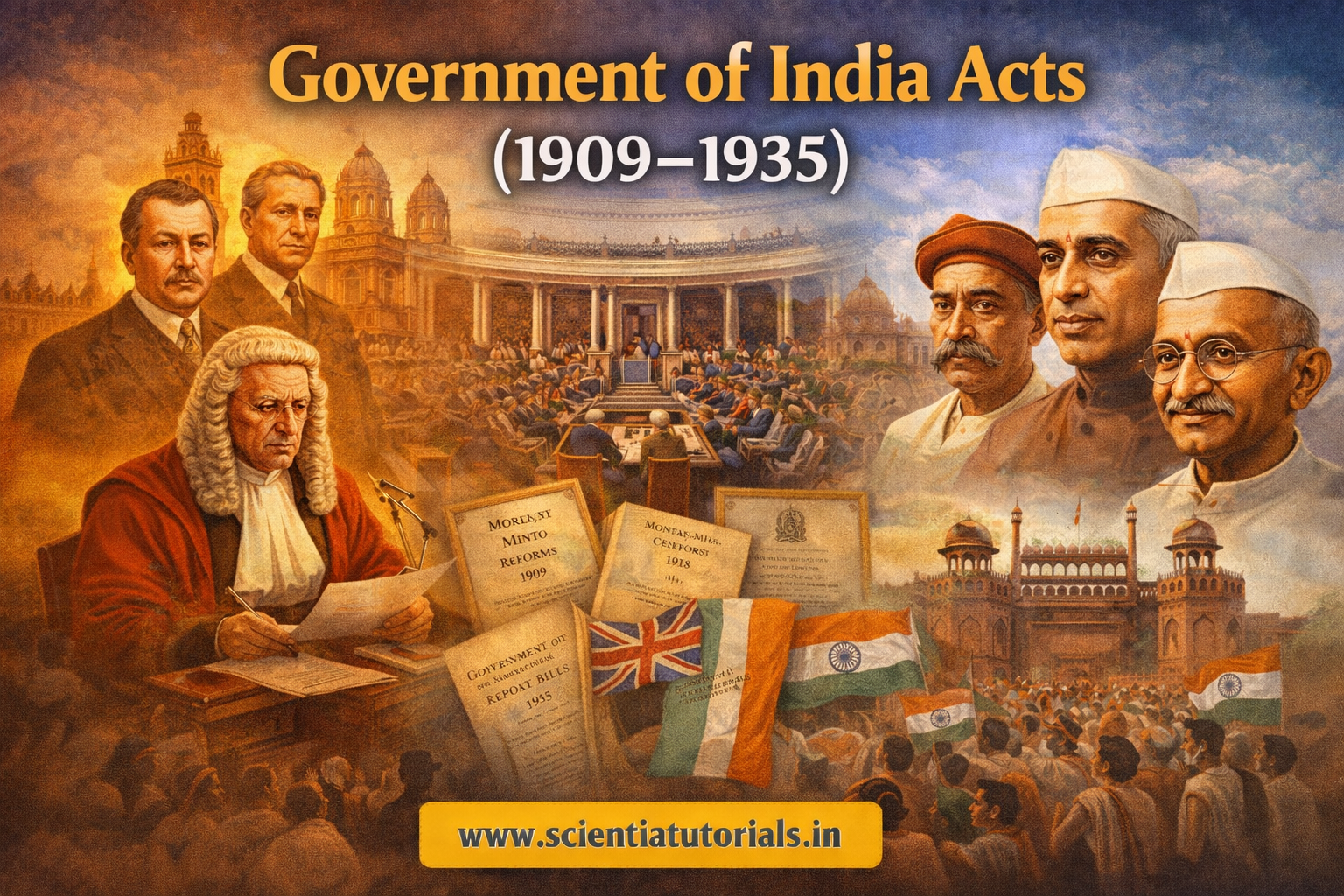

Government of India Acts (1909–1935) Explained | History of India
Course: History of India – Complete Chronological and Era-Wise Course
SECTION 15: Constitutional Developments & Independence
Timeline: 1909 CE – 1950 CE
Lesson: Government of India Acts
Lesson Objectives
This lesson seeks to:
- Trace the chronological evolution of the Government of India Acts enacted during British rule.
- Examine the political context, provisions, and objectives of each Act.
- Analyze the nature of power-sharing and limitations imposed by colonial constitutionalism.
- Understand Indian responses to these Acts and their role in shaping the freedom struggle.
- Evaluate how these Acts laid the groundwork for constitutional governance in independent India.
- Prepare students for university and competitive examinations through structured, analytical study.
I. Background: Constitutional Governance under British Rule
British administration in India was not based on a single written constitution but evolved through a series of parliamentary enactments known as the Government of India Acts. These Acts reflected British attempts to:
- Consolidate colonial control
- Respond to rising Indian nationalism
- Introduce limited political participation without conceding sovereignty
From the early 20th century onwards, constitutional reforms became a crucial arena of contest between colonial authority and Indian aspirations for self-rule.
II. Government of India Act, 1909 (Indian Councils Act – Morley–Minto Reforms)
Historical Context
- Rise of the Indian National Congress
- Growing demands for Indian representation
- British policy of divide and rule
Major Provisions
- Expansion of Central and Provincial Legislative Councils
- Introduction of elective principle (limited franchise)
- Inclusion of Indians in Executive Councils
- Introduction of separate electorates for Muslims
Significance
- First formal step towards representative institutions
- Marked the beginning of electoral politics in India
Limitations
- Official majority retained
- No responsibility of executive to legislature
- Institutionalized communal politics
III. Government of India Act, 1919 (Montagu–Chelmsford Reforms)
Background
- Home Rule Movement
- Indian support during World War I
- August Declaration of 1917 promising gradual self-government
Key Features
a) Dyarchy in Provinces
- Subjects divided into Reserved and Transferred
- Indian ministers administered transferred subjects
b) Central Legislature
- Bicameral legislature introduced
- Expanded Indian representation
c) Other Provisions
- Extension of communal electorates
- Establishment of Public Service Commission
Evaluation
- Introduced partial responsible government
- Dyarchy proved inefficient and confusing
Indian Response
- General dissatisfaction
- Led to Non-Cooperation Movement
IV. Government of India Act, 1935
Historical Context
- Simon Commission (1927)
- Round Table Conferences (1930–32)
- Civil Disobedience Movement
Major Provisions
a) All-India Federation
- Federation of provinces and princely states (proposed)
b) Provincial Autonomy
- Abolition of dyarchy at provincial level
- Elected ministries responsible to legislatures
c) Dyarchy at the Centre
- Defence and foreign affairs reserved
d) Federal Court and Reserve Bank of India
- Establishment of Federal Court
- Creation of RBI
Significance
- Most comprehensive colonial constitutional framework
- Provided administrative experience to Indian leaders
Limitations
- No sovereignty for Indians
- Excessive powers of Governor-General
- Federation never fully implemented
V. Working of the Acts and Indian Experience (1937–1939)
- Congress ministries formed under the Act of 1935
- Implemented welfare-oriented policies
- Highlighted limitations of colonial autonomy
Resignation of ministries in 1939 exposed the ultimate authority of the British Crown.
VI. Comparative Overview of Government of India Acts
| Act | Key Feature | Nature of Power | Major Limitation |
|---|---|---|---|
| 1909 | Separate electorates | Nominal representation | Communal division |
| 1919 | Dyarchy | Partial responsibility | Governor’s dominance |
| 1935 | Provincial autonomy | Limited self-rule | No sovereignty |
VII. Critical Evaluation of Government of India Acts
Positive Contributions
- Introduced representative institutions
- Familiarized Indians with legislative processes
- Trained leadership in governance
Negative Aspects
- Designed to preserve colonial supremacy
- Delayed transfer of power
- Encouraged communal politics
VIII. Role of Government of India Acts in the Freedom Struggle
Each Act intensified nationalist demands:
- 1909 reforms exposed limited intentions
- 1919 reforms led to mass movements
- 1935 Act set stage for final negotiations
Thus, constitutional reforms acted as catalysts rather than solutions.
IX. From Colonial Acts to the Constitution of India
Although framed under colonial constraints, the Government of India Acts:
- Provided administrative experience
- Influenced federal structure and institutions
- Shaped constitutional debates in the Constituent Assembly
The Constitution of India (1950) decisively rejected colonial limitations and established popular sovereignty.
X. Conclusion
The Government of India Acts represented the evolving strategy of British constitutional control in India. While failing to satisfy Indian aspirations, they unintentionally prepared the ground for democratic governance. Studied chronologically, these Acts reveal the gradual transition from colonial administration to independent constitutionalism.
Questions with Answers
Government of India Acts (1909–1935)
Section 15: Constitutional Developments & Independence
Q1. Why were the Government of India Acts introduced by the British?
Answer: The Government of India Acts were introduced to consolidate colonial control, respond to rising Indian nationalism, and introduce limited political participation without transferring real power to Indians.
Q2. Which Act is also known as the Morley–Minto Reforms?
Answer: The Government of India Act, 1909, also known as the Indian Councils Act, is called the Morley–Minto Reforms.
Q3. What was the political background of the Government of India Act, 1909?
Answer: The rise of the Indian National Congress, increasing nationalist demands, and British policy of divide and rule formed the background of the Act.
Q4. What were the main provisions of the Government of India Act, 1909?
Answer: Expansion of legislative councils, introduction of limited elections, inclusion of Indians in executive councils, and separate electorates for Muslims.
Q5. Why is the Government of India Act, 1909 criticized?
Answer: It retained official dominance, denied responsible government, and institutionalized communal politics through separate electorates.
Q6. What circumstances led to the Government of India Act, 1919?
Answer: The Home Rule Movement, Indian support during World War I, and the August Declaration of 1917 promising gradual self-government.
Q7. Explain the concept of dyarchy introduced by the Act of 1919.
Answer: Dyarchy divided provincial subjects into reserved (under British officials) and transferred (under Indian ministers), introducing partial responsibility.
Q8. Why did dyarchy fail in practice?
Answer: Governors retained overriding powers, financial control remained with the British, and Indian ministers lacked real authority.
Q9. How did Indians react to the Government of India Act, 1919?
Answer: The Act was widely criticized for its inadequacy, leading to intensified nationalist movements, including Non-Cooperation.
Q10. What was the significance of the bicameral legislature introduced in 1919?
Answer: It marked a step towards parliamentary institutions, though real power remained limited.
Q11. What role did the Simon Commission play in constitutional developments?
Answer: Appointed to review the 1919 Act, its all-British composition led to nationwide protests and unified nationalist opposition.
Q12. Why is the Nehru Report (1928) important in constitutional history?
Answer: It was the first Indian-drafted constitutional framework proposing dominion status and fundamental rights.
Q13. What factors led to the Government of India Act, 1935?
Answer: Simon Commission recommendations, Round Table Conferences, and the impact of Civil Disobedience Movement.
Q14. What was provincial autonomy under the Government of India Act, 1935?
Answer: Provinces were given elected ministries responsible to legislatures, ending dyarchy at the provincial level.
Q15. What is meant by All-India Federation proposed in the Act of 1935?
Answer: A federation of British provinces and princely states under a central authority, though it was never fully implemented.
Q16. Why is the Government of India Act, 1935 considered the most comprehensive colonial Act?
Answer: It provided detailed administrative structures, provincial autonomy, a federal court, and a central banking system.
Q17. What were the major limitations of the Government of India Act, 1935?
Answer: Retention of British sovereignty, extensive powers of the Governor-General, and weak federal structure.
Q18. What was the significance of Congress ministries (1937–1939)?
Answer: They provided administrative experience and exposed the limitations of provincial autonomy under British rule.
Q19. Why did Congress ministries resign in 1939?
Answer: Britain involved India in World War II without consulting Indian leaders, violating principles of autonomy.
Q20. How did the Government of India Acts influence the freedom struggle?
Answer: Each Act revealed the limitations of colonial reforms, intensifying nationalist demands and mass movements.
Q21. In what ways did the Government of India Acts prepare India for self-rule?
Answer: They introduced legislative practices, elections, and administrative experience for Indian leaders.
Q22. What role did communal electorates play in colonial constitutional policy?
Answer: They divided Indian society along religious lines and weakened nationalist unity.
Q23. How did the Government of India Acts affect the Constituent Assembly debates?
Answer: Many administrative features and federal ideas were discussed, accepted, or rejected based on colonial experience.
Q24. Why are the Government of India Acts important for examination answers?
Answer: They explain the constitutional evolution of India, link reforms with nationalism, and test analytical understanding.
Q25. How should answers on Government of India Acts be structured in exams?
Answer: By maintaining chronology, explaining provisions, highlighting limitations, and linking Acts to nationalist response.
MCQs with Answers and Explanations
Government of India Acts (1909–1935)
Section 15: Constitutional Developments & Independence
Q1. The Government of India Act, 1909 is popularly known as:
A. Montagu–Chelmsford Reforms
B. Morley–Minto Reforms
C. Cripps Proposals
D. Cabinet Mission Plan
Correct Answer: B
Explanation: The Act of 1909 was introduced by Secretary of State John Morley and Viceroy Lord Minto, hence called the Morley–Minto Reforms.
Q2. The most controversial feature of the Government of India Act, 1909 was:
A. Expansion of legislative councils
B. Inclusion of Indians in executive councils
C. Introduction of separate electorates
D. Limited budget discussion
Correct Answer: C
Explanation: Separate electorates for Muslims institutionalized communal politics and deeply affected Indian nationalism.
Q3. The Government of India Act, 1919 was introduced in response to:
A. Revolt of 1857
B. Home Rule Movement and World War I
C. Civil Disobedience Movement
D. Quit India Movement
Correct Answer: B
Explanation: Indian support during World War I and Home Rule agitation compelled Britain to promise gradual self-government.
Q4. Dyarchy introduced by the Act of 1919 was implemented at the:
A. Central level
B. Provincial level
C. District level
D. Princely state level
Correct Answer: B
Explanation: Dyarchy divided provincial subjects into reserved and transferred categories.
Q5. Which of the following was a reserved subject under dyarchy?
A. Education
B. Agriculture
C. Public health
D. Finance
Correct Answer: D
Explanation: Finance remained under British control, limiting Indian ministers’ authority.
Q6. The chief defect of dyarchy was:
A. Absence of elections
B. Lack of Indian ministers
C. Governor’s overriding powers
D. Excessive decentralization
Correct Answer: C
Explanation: Governors could override Indian ministers, making dyarchy ineffective.
Q7. The Simon Commission was appointed to review:
A. Government of India Act, 1909
B. Government of India Act, 1919
C. Government of India Act, 1935
D. Indian Independence Act, 1947
Correct Answer: B
Explanation: The Commission was to assess the working of the Act of 1919.
Q8. Why was the Simon Commission boycotted by Indians?
A. It proposed partition
B. It reduced Indian representation
C. It had no Indian members
D. It opposed dominion status
Correct Answer: C
Explanation: The all-British composition symbolized colonial disregard for Indian opinion.
Q9. The Nehru Report (1928) is significant because it:
A. Supported separate electorates
B. Demanded immediate independence
C. Was the first Indian constitutional draft
D. Accepted British supremacy
Correct Answer: C
Explanation: It represented India’s first major attempt to frame its own constitution.
Q10. Which principle was emphasized in the Nehru Report?
A. Communal electorates
B. Joint electorates and fundamental rights
C. Dyarchy at the centre
D. Absolute monarchy
Correct Answer: B
Explanation: The report rejected communalism and emphasized civil liberties.
Q11. The Government of India Act, 1935 proposed:
A. Complete independence
B. All-India Federation
C. Abolition of provinces
D. Military rule
Correct Answer: B
Explanation: The Act proposed a federation of provinces and princely states, though it never fully materialized.
Q12. Provincial autonomy under the Act of 1935 meant:
A. Dyarchy in provinces
B. Governors ruling alone
C. Elected ministries responsible to legislatures
D. Complete sovereignty of provinces
Correct Answer: C
Explanation: Dyarchy was abolished in provinces and responsible government was introduced.
Q13. Which institution was created by the Government of India Act, 1935?
A. Supreme Court of India
B. Federal Court
C. Election Commission
D. Planning Commission
Correct Answer: B
Explanation: The Federal Court later influenced India’s judicial structure.
Q14. Why is the Act of 1935 considered colonial in spirit?
A. It abolished elections
B. It centralized power completely
C. It retained extensive powers with the Governor-General
D. It introduced universal adult franchise
Correct Answer: C
Explanation: Ultimate authority remained with British officials despite reforms.
Q15. Congress ministries formed under the Act of 1935 resigned in 1939 because:
A. Provincial autonomy failed
B. Elections were cancelled
C. India was dragged into World War II without consent
D. The Act was repealed
Correct Answer: C
Explanation: Britain declared war without consulting Indian leaders, violating autonomy.
Q16. The Government of India Acts collectively aimed to:
A. Grant immediate independence
B. Introduce socialism
C. Gradually expand participation while retaining control
D. End communal politics
Correct Answer: C
Explanation: British policy focused on gradualism and control rather than sovereignty.
Q17. Which Act introduced bicameralism at the centre?
A. 1909 Act
B. 1919 Act
C. 1935 Act
D. 1947 Act
Correct Answer: B
Explanation: The Government of India Act, 1919 introduced a bicameral central legislature.
Q18. A major political impact of the Government of India Acts was:
A. Weakening nationalism
B. Encouraging mass movements
C. Ending colonial rule early
D. Eliminating communalism
Correct Answer: B
Explanation: Limited reforms exposed colonial intentions and intensified nationalist struggles.
Q19. Which Act served as the constitutional framework till 1950?
A. Government of India Act, 1909
B. Government of India Act, 1919
C. Government of India Act, 1935
D. Indian Independence Act, 1947
Correct Answer: C
Explanation: The Act of 1935 governed India until the Constitution came into force.
Q20. From an examination perspective, the Government of India Acts are important because they:
A. Are purely legal documents
B. Show India’s gradual constitutional evolution
C. Focus only on British policy
D. Ignore nationalist response
Correct Answer: B
Explanation: They explain how colonial reforms shaped India’s path to independence.
Targeting Exams
This lesson is highly useful for the following examinations:
- UPSC Civil Services Examination (Prelims & Mains) – Modern Indian History, Constitutional Developments
- State Public Service Commissions (PSC) – Indian Freedom Struggle & Constitutional History
- UGC NET / SET (History) – British Rule and Constitutional Evolution
- CUET (UG & PG) – History of India (Modern Period)
- University Examinations (BA / MA History) – Government of India Acts
- SSC, Railways & Other Government Exams – General Studies (Modern History)
Related Keyphrases
- Morley Minto Reforms 1909
- Government of India Act 1919
- Dyarchy in British India
- Government of India Act 1935 features
- Provincial autonomy in India
- Simon Commission and constitutional reforms
- Nehru Report 1928
- British constitutional reforms in India
- History of India constitutional acts
- Indian freedom struggle constitutional development