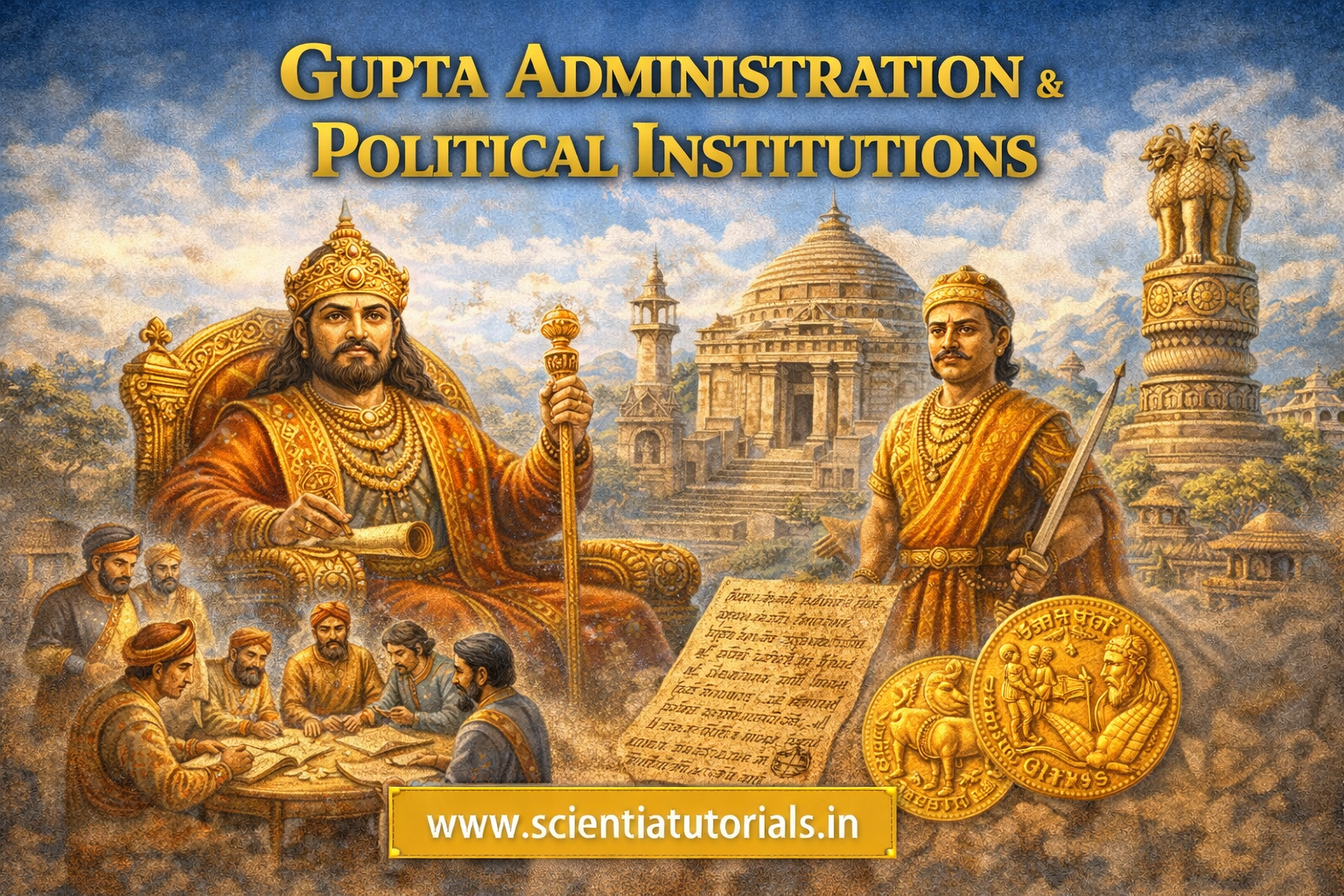
Administration & Political Institutions during the Gupta Age
SECTION 6: Gupta Age & Post-Gupta Developments Timeline: c. 320 CE – c. 600 CE (Ancient Indian History – Classical Age)
Introduction: The Gupta State as a Classical Political System
The Gupta Age is often regarded as the Classical Age of Indian civilisation, not only for its cultural and intellectual achievements but also for the development of a distinctive administrative and political system. Gupta administration represented a departure from the rigid centralisation of the Mauryan state and introduced a more flexible, decentralised, and durable form of governance.
Under rulers such as Chandragupta I, Samudragupta, and Chandragupta II, the Gupta Empire evolved a political structure that balanced:
Central authority
Regional autonomy
Feudatory relationships
Religious-ideological legitimacy
This administrative model proved effective and long-lasting, influencing later Indian polities for centuries.
I. Nature of the Gupta State
1. Monarchical System
The Gupta polity was a hereditary monarchy, with kingship passing from father to son. However, unlike earlier empires, Gupta kingship was less bureaucratic and more ideological.
Key characteristics:
King as supreme authority
Absence of a rigid centralised bureaucracy
Dependence on local elites and feudatories
The king was the pivot of the political system, but governance was shared with a network of officials and local rulers.
2. Theory of Divine Kingship
Gupta rulers promoted the concept of divine kingship, drawing legitimacy from Brahmanical ideology.
Kings were portrayed as:
Protectors of Dharma
Representatives of divine order on earth
Comparable to gods such as Vishnu
This ideological framework strengthened political authority and social acceptance of royal power.
II. Central Administration
1. The King and His Powers
The Gupta king exercised authority over:
Military command
Judicial decisions
Revenue administration
Religious patronage
Royal inscriptions frequently describe the king as:
Parama-Bhagavata (devotee of Vishnu)
Upholder of social and moral order
Despite this exalted status, the king did not interfere excessively in local administration.
2. Council of Ministers
The king was assisted by a council of ministers, though its exact composition is not clearly defined.
Important officials included:
Mantrin (minister)
Amatya (high official)
Mahadandanayaka (chief judicial or military officer)
The council played an advisory role rather than acting as an independent authority.
III. Administrative Divisions of the Gupta Empire
1. Provincial Administration (Bhuktis)
The Gupta Empire was divided into provinces known as Bhuktis.
Each Bhukti was governed by an Uparika
Governors were often princes or trusted officials
Provinces enjoyed considerable administrative autonomy
This system reduced the administrative burden on the central government.
2. District Administration (Vishayas)
Bhuktis were further divided into Vishayas (districts).
Headed by Vishayapati
Assisted by councils consisting of:
Merchants
Artisans
Local representatives
This reflects the participatory nature of Gupta administration.
3. Village Administration
The village was the basic unit of administration.
Village administration involved:
Gramikas (village headmen)
Village councils
Local elders
Villages enjoyed a high degree of autonomy, especially in matters of land and local disputes.
IV. Role of Samantas (Feudatories)
1. Emergence of the Samanta System
One of the most important features of Gupta political institutions was the rise of Samantas (feudatory chiefs).
Samantas:
Were local rulers or chiefs
Accepted Gupta overlordship
Paid tribute and provided military support
This system marked the early stage of Indian feudalism.
2. Importance of the Samanta System
The Samanta system:
Facilitated expansion without direct annexation
Reduced administrative costs
Ensured loyalty through mutual benefit
However, it also contained the seeds of future decentralisation and political fragmentation.
V. Judicial Administration
1. Role of the King in Justice
The king was the supreme judicial authority, but in practice:
Punishments were generally less severe than in the Mauryan period, reflecting a more humane legal system.
VI. Revenue Administration
1. Sources of Revenue
The chief source of revenue was land tax, usually:
One-sixth of agricultural produce
Other sources included:
Taxes on trade and crafts
Fines
Tribute from feudatories
The revenue system was less rigid compared to the Mauryas.
2. Land Grants and Fiscal Decentralisation
A major administrative innovation of the Gupta period was the widespread practice of land grants.
Features:
Tax-free grants to Brahmanas and temples
Transfer of fiscal and administrative rights
Creation of Brahmadeya villages
This led to:
Decline in direct state revenue
Strengthening of local authority
Long-term decentralisation
VII. Military Organisation
1. Standing Army and Feudatory Forces
The Gupta military consisted of:
Standing royal army
Troops supplied by Samantas
The army included:
Infantry
Cavalry
War elephants
Unlike the Mauryas, the Guptas did not maintain a massive permanent army.
2. Military Command Structure
The king was the supreme commander, assisted by:
Mahabaladhikrita
Military governors
Feudatory chiefs
Military organisation was efficient but less institutionalised.
VIII. Local Self-Government
1. Role of Guilds and Urban Bodies
Urban centres had:
Merchant guilds (Shrenis)
Craft organisations
Local administrative councils
These bodies managed:
Trade regulations
Charitable activities
Public works
This reflects a high degree of civic autonomy.
2. Participatory Governance
Inscriptions mention:
Local representatives participating in administration
Collective decision-making at district and village levels
Gupta administration thus combined monarchy with grass-roots participation.
IX. Comparison with Mauryan Administration
Aspect
Mauryan Administration
Gupta Administration
Nature
Highly centralised
Decentralised
Bureaucracy
Extensive
Limited
Local Autonomy
Minimal
Significant
Ideology
Dhamma-based
Brahmanical-Dharmic
Longevity
Short-term
More durable
This comparison explains why Gupta institutions proved more sustainable.
X. Strengths and Weaknesses of the Gupta Administrative System
Strengths
Administrative flexibility
Integration of local elites
Ideological legitimacy
Reduced administrative costs
Weaknesses
Excessive decentralisation
Growing power of Samantas
Decline in state revenue
Weak central control in later period
These weaknesses contributed to the post-Gupta political decline.
Conclusion: Gupta Administration as a Classical Model of Governance
The administrative and political institutions of the Gupta Age represent a mature and adaptive system of governance, striking a balance between authority and autonomy. Unlike the Mauryan model of rigid centralisation, the Gupta system relied on:
Delegation of power
Ideological legitimacy
Cooperation with local elites
For examinations, Gupta administration should be understood as:
A classical Indian model of decentralised monarchy
A transitional stage towards early feudalism
A key factor behind the stability and cultural florescence of the Gupta Age
Despite its later weaknesses, the Gupta administrative system left a lasting imprint on Indian political traditions.
Below is a well-structured, examination-oriented set of 25 Questions with clear and accurate Answers based strictly on the lesson “Administration & Political Institutions (Gupta Age)”, aligned with
SECTION 6: Gupta Age & Post-Gupta Developments (c. 320–600 CE).
The content is suitable for UPSC, State PSCs, CUET, NET/SET.
Administration & Political Institutions during the Gupta Age – Questions with Answers
1. What type of political system existed during the Gupta Age?
Answer:
The Gupta Age was characterised by a hereditary monarchical system, where political power was vested in the king and passed down through dynastic succession.
2. How did Gupta kingship differ from Mauryan kingship?
Answer:
Gupta kingship was more decentralised and ideological, relying on local elites and feudatories, whereas Mauryan kingship was highly centralised and bureaucratic.
3. What role did religion play in legitimising Gupta political authority?
Answer:
Gupta rulers used Brahmanical ideology to legitimise their rule, portraying the king as the protector of Dharma and often associating him with deities like Vishnu.
4. Name two important Gupta rulers associated with administrative consolidation.
Answer: Chandragupta I laid the imperial foundation, while Samudragupta consolidated and expanded the administrative system.
5. What were the main powers of the Gupta king?
Answer:
The Gupta king exercised authority over military command, revenue administration, judicial functions, and religious patronage.
6. What was the role of the council of ministers in Gupta administration?
Answer:
The council of ministers assisted the king in administration and decision-making, mainly in an advisory capacity rather than as an independent authority.
7. What were Bhuktis in the Gupta administrative system?
Answer:
Bhuktis were provincial divisions of the Gupta Empire, each governed by an Uparika who enjoyed considerable autonomy.
8. Who governed the Bhuktis and how were they appointed?
Answer:
Bhuktis were governed by Uparikas, often royal princes or trusted officials appointed by the king.
9. What were Vishayas and who administered them?
Answer:
Vishayas were district-level administrative units, administered by officials known as Vishayapatis.
10. How did local participation feature in Gupta administration?
Answer:
Local participation was ensured through district and village councils that included merchants, artisans, and local representatives.
11. Describe the importance of village administration during the Gupta Age.
Answer:
The village was the basic unit of administration, enjoying considerable autonomy in local governance, revenue collection, and dispute resolution.
12. Who were Samantas in the Gupta political system?
Answer:
Samantas were feudatory chiefs or local rulers who accepted Gupta overlordship and provided tribute and military support.
13. Why is the Samanta system considered significant?
Answer:
It enabled territorial expansion with minimal administrative cost but also contributed to political decentralisation and future instability.
14. What was the role of the king in the judicial system?
Answer:
The king was the supreme judicial authority, though most cases were handled by local courts guided by Dharmashastra principles.
15. Name an important judicial or military officer in Gupta administration.
Answer:
The Mahadandanayaka was a key official associated with judicial and sometimes military functions.
16. What was the main source of revenue for the Gupta state?
Answer:
The primary source of revenue was land tax, generally amounting to one-sixth of agricultural produce.
17. How did land grants affect Gupta administration?
Answer:
Land grants to Brahmanas and temples led to fiscal decentralisation, strengthened local authority, and reduced direct state revenue.
18. What is meant by Brahmadeya grants?
Answer:
Brahmadeya grants were tax-free land grants given to Brahmanas, often including administrative and fiscal rights.
19. Describe the military organisation of the Gupta Empire.
Answer:
The Gupta military consisted of a standing royal army supplemented by troops provided by Samantas, including infantry, cavalry, and war elephants.
20. How did Gupta military organisation differ from that of the Mauryas?
Answer:
Unlike the Mauryas’ large permanent army, the Guptas relied more on feudatory forces and a smaller standing army.
21. What role did guilds play in Gupta administration?
Answer:
Guilds (shrenis) managed trade, crafts, charitable activities, and sometimes local administrative functions, reflecting civic autonomy.
22. How did urban administration function during the Gupta Age?
Answer:
Urban administration involved merchant guilds and local councils responsible for trade regulation, public works, and social welfare.
23. What were the strengths of the Gupta administrative system?
Answer:
Its strengths included flexibility, local participation, ideological legitimacy, and reduced administrative expenditure.
24. Identify two weaknesses of Gupta administration.
Answer:
Excessive decentralisation and growing power of Samantas weakened central authority, especially in the later Gupta period.
25. Why is Gupta administration regarded as a classical model of Indian governance?
Answer:
Because it balanced monarchy with decentralisation, integrated local elites, and ensured political stability while allowing cultural and economic growth.
Below is a well-structured, examination-oriented set of 25 MCQs with correct answers and detailed, concept-clearing explanations based strictly on the lesson “Administration & Political Institutions (Gupta Age)”, aligned with
SECTION 6: Gupta Age & Post-Gupta Developments (c. 320–600 CE).
The content is suitable for UPSC Prelims, State PSCs, CUET, NET/SET.
Gupta Administration & Political Institutions – MCQs with Answers & Explanations
1. The political system of the Gupta Empire can best be described as:
A. Republican
B. Theocratic
C. Hereditary monarchy with decentralisation
D. Military dictatorship
Correct Answer: C
Explanation:
The Gupta state was monarchical but relied heavily on decentralised administration and local elites rather than rigid bureaucracy.
2. Gupta kings derived their political legitimacy mainly from:
A. Military conquest alone
B. Popular assemblies
C. Brahmanical religious ideology
D. Foreign recognition
Correct Answer: C
Explanation:
Gupta rulers projected themselves as protectors of Dharma and were often compared to gods like Vishnu.
3. Which Gupta ruler laid the foundation of imperial administration?
A. Sri Gupta
B. Ghatotkacha
C. Chandragupta I
D. Chandragupta II
Correct Answer: C
Explanation:
Chandragupta I assumed the title Maharajadhiraja and initiated imperial governance.
4. The Gupta administrative system differed from the Mauryan system because it was:
A. More centralised
B. More militaristic
C. More decentralised and flexible
D. Entirely feudal
Correct Answer: C
Explanation:
The Guptas avoided over-centralisation and delegated authority to provinces and feudatories.
5. The highest authority in Gupta administration was the:
A. Council of ministers
B. Provincial governor
C. King
D. Village assembly
Correct Answer: C
Explanation:
The king was the supreme executive, military, and judicial authority.
6. The Gupta Empire was divided into provinces called:
A. Mandalas
B. Rashtras
C. Bhuktis
D. Janapadas
Correct Answer: C
Explanation:
Bhuktis were the largest administrative divisions under the Guptas.
7. Who governed a Bhukti in the Gupta administration?
A. Vishayapati
B. Gramika
C. Uparika
D. Samanta
Correct Answer: C
Explanation:
Uparikas were provincial governors, often princes or trusted officials.
8. Vishayas in the Gupta period were:
A. Provinces
B. Kingdoms
C. Districts
D. Villages
Correct Answer: C
Explanation:
Bhuktis were subdivided into Vishayas (districts).
9. Which official was in charge of a Vishaya?
A. Uparika
B. Mahabaladhikrita
C. Vishayapati
D. Mahadandanayaka
Correct Answer: C
Explanation:
The Vishayapati administered districts with the help of local councils.
10. Which feature reflects local participation in Gupta administration?
A. Standing army
B. Royal spies
C. District councils including merchants and artisans
D. Secretariat system
Correct Answer: C
Explanation:
Gupta administration involved local elites, unlike Mauryan bureaucracy.
11. The basic unit of administration during the Gupta Age was the:
A. Bhukti
B. Vishaya
C. Village
D. City
Correct Answer: C
Explanation:
Villages enjoyed considerable autonomy in local governance.
12. Who was responsible for village administration?
A. Uparika
B. Vishayapati
C. Gramika and village council
D. Samanta
Correct Answer: C
Explanation:
Village headmen and councils managed daily administration.
13. Samantas under the Gupta system were:
A. Royal priests
B. Revenue officials
C. Feudatory chiefs
D. Military slaves
Correct Answer: C
Explanation:
Samantas were local rulers who accepted Gupta overlordship.
14. The Samanta system is important because it:
A. Eliminated central authority
B. Reduced agriculture
C. Encouraged decentralisation and expansion
D. Ended trade
Correct Answer: C
Explanation:
It enabled expansion without direct annexation but weakened the centre later.
15. The chief source of Gupta state revenue was:
A. Customs duty
B. Tribute
C. Land revenue
D. Mining tax
Correct Answer: C
Explanation:
Land tax, usually one-sixth of produce, was the main income source.
16. Land grants during the Gupta period were mainly given to:
A. Soldiers
B. Merchants
C. Brahmanas and religious institutions
D. Foreign traders
Correct Answer: C
Explanation:
Brahmadeya grants strengthened Brahmanical ideology and agrarian expansion.
17. What was a major consequence of land grants?
A. Centralisation of revenue
B. Growth of cities
C. Fiscal and administrative decentralisation
D. Decline of agriculture
Correct Answer: C
Explanation:
Land grants reduced direct state revenue and empowered local authorities.
18. The king was assisted in administration by:
A. Popular assemblies
B. Foreign advisors
C. Council of ministers (Mantrins and Amatyas)
D. Buddhist monks
Correct Answer: C
Explanation:
The council advised the king but did not limit royal authority.
19. The supreme judicial authority in the Gupta Empire was the:
A. Village council
B. Chief priest
C. King
D. Uparika
Correct Answer: C
Explanation:
The king was the highest judge, though local courts handled most cases.
20. Which official was associated with judicial and military functions?
A. Vishayapati
B. Gramika
C. Mahadandanayaka
D. Purohita
Correct Answer: C
Explanation:
The Mahadandanayaka handled judicial and sometimes military duties.
21. The Gupta army mainly consisted of:
A. Mercenaries only
B. Naval forces
C. Standing army plus feudatory troops
D. Tribal militias
Correct Answer: C
Explanation:
Gupta military relied on both royal forces and Samanta contingents.
22. Compared to the Mauryas, the Gupta army was:
A. Larger and permanent
B. Entirely professional
C. Smaller and less centralised
D. Non-existent
Correct Answer: C
Explanation:
Mauryas maintained a massive standing army; Guptas did not.
23. Guilds (Shrenis) during the Gupta Age were associated with:
A. Only religious rituals
B. Military training
C. Trade, crafts, and local administration
D. Tax collection only
Correct Answer: C
Explanation:
Guilds played an economic as well as civic role.
24. Which of the following is a strength of Gupta administration?
A. Rigid bureaucracy
B. Excessive military control
C. Flexibility and local autonomy
D. Uniform laws everywhere
Correct Answer: C
Explanation:
Decentralisation made administration adaptable and durable.
25. A major weakness of Gupta political institutions was:
A. Absence of ideology
B. Strong centralisation
C. Over-dependence on Samantas
D. Excessive taxation
Correct Answer: C
Explanation:
Powerful Samantas later weakened central authority, contributing to decline.
🎯 Targeting Exams
UPSC Civil Services Examination (Prelims – Ancient History)
State Public Service Commissions (PSC)
CUET (UG & PG – History)
UGC NET / SET (History)
University Semester Examinations (BA / MA History)
SSC & other competitive exams (Ancient & Classical India syllabus)