
Administration of Chandragupta Maurya
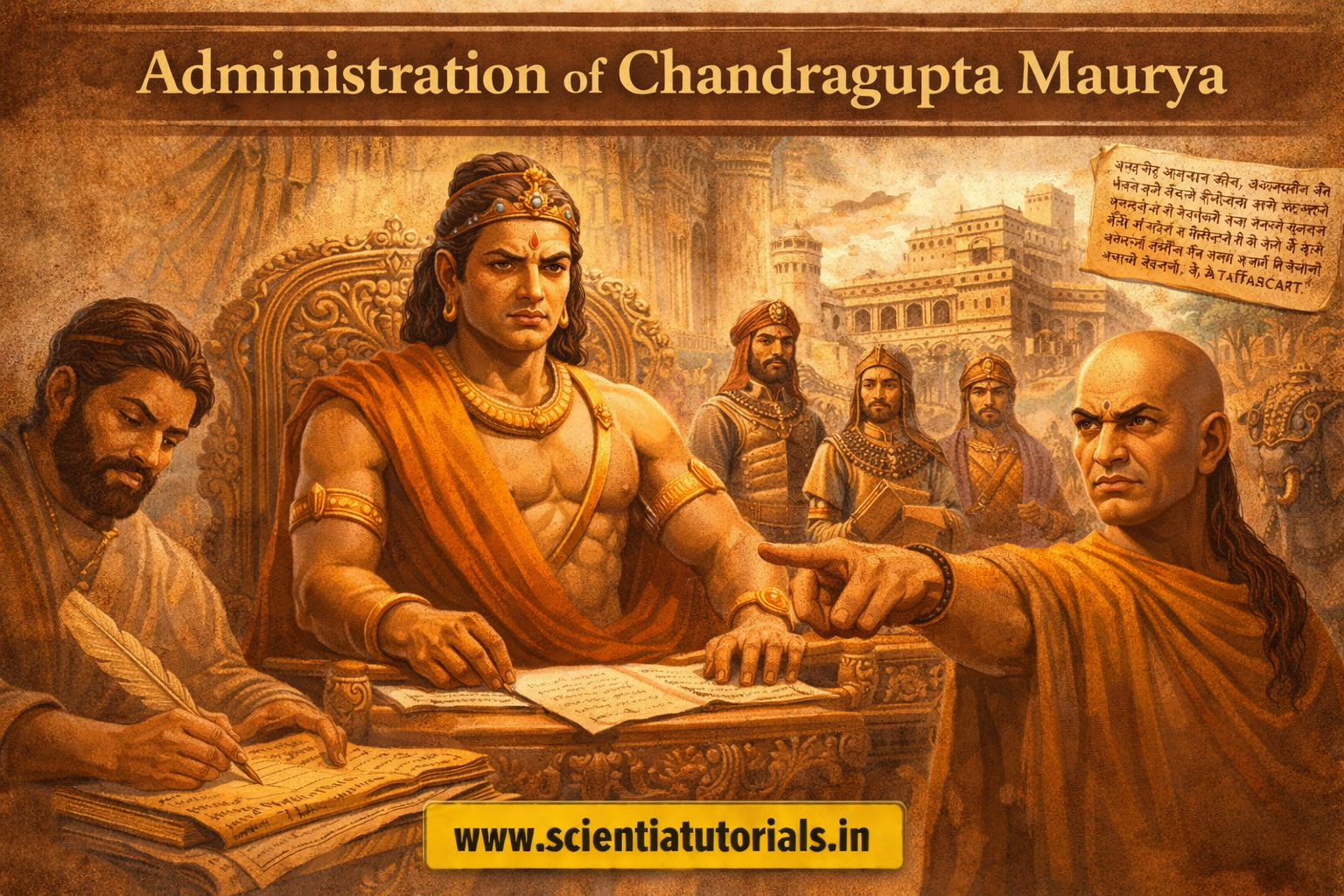

Administration of Chandragupta Maurya | Mauryan Empire History of India
SECTION 5: Mauryan Empire & Post-Mauryan India
Timeline: c. 322 BCE – c. 185 BCE
(Ancient Indian History – Imperial Phase)
Lesson: Administration of Chandragupta Maurya
1. Introduction: Significance of Mauryan Administration
The administration of Chandragupta Maurya represents the first well-documented, systematic, and centralised imperial governance system in Indian history. Unlike earlier regional kingdoms, the Mauryan state established a highly organised bureaucracy, uniform laws, regulated economy, and an extensive intelligence network.
The Mauryan administrative system was largely shaped by the ideas of Chanakya (Kautilya), whose treatise, the Arthashastra, provides unparalleled insight into ancient Indian statecraft. Chandragupta’s administration laid the foundation upon which later rulers—especially Ashoka—built a durable imperial structure.
2. Sources for the Study of Mauryan Administration
2.1 Arthashastra
The Arthashastra is the most important indigenous source for understanding Mauryan administration. It details:
- Duties of kings and officials
- Revenue systems
- Judicial procedures
- Espionage and diplomacy
- Military organisation
It reflects a pragmatic and secular approach to governance, prioritising state stability and economic prosperity.
2.2 Greek Accounts
Greek writers like Megasthenes, who stayed at Pataliputra, described Mauryan administration in his work Indica. His account corroborates the existence of:
- Municipal boards
- A large standing army
- Centralised authority
3. Nature of the Mauryan State
The Mauryan Empire under Chandragupta was a highly centralised monarchy.
Key features:
- The king was the supreme authority
- Administration functioned through salaried officials
- No feudal intermediaries existed
- Strict state control over resources
The primary objective of administration was maintenance of order, economic regulation, and imperial unity.
4. Central Administration
4.1 Role of the King
Chandragupta Maurya was:
- Head of the executive, judiciary, and military
- Final authority in administration
- Guardian of dharma and public welfare
He was assisted by a council of ministers, but real power rested with the monarch.
4.2 Mantriparishad (Council of Ministers)
The king was advised by ministers responsible for:
- Finance
- Military affairs
- Foreign relations
- Internal security
Appointments were based on merit and loyalty, not heredity.
5. Provincial Administration
5.1 Division of the Empire
The empire was divided into provinces, each governed by a royal prince (Kumara) or trusted official.
Major provincial centres included:
- Taxila (north-west)
- Ujjain (west)
- Tosali (east)
- Suvarnagiri (south)
5.2 Provincial Officials
Each province had:
- Civil administrators
- Military commanders
- Revenue officials
They reported directly to the central authority, ensuring tight imperial control.
6. District and Local Administration
6.1 District Administration
Districts were administered by officials responsible for:
- Revenue collection
- Law and order
- Judicial matters
Villages were the basic administrative units, managed by village headmen under state supervision.
6.2 Municipal Administration
Urban centres like Pataliputra had well-organised municipal systems. According to Megasthenes, the city administration was divided into six committees managing:
- Industry
- Foreigners
- Births and deaths
- Trade and commerce
- Manufacture supervision
- Tax collection
This highlights advanced urban governance.
7. Revenue and Economic Administration
7.1 Land Revenue System
Agriculture formed the backbone of the Mauryan economy.
Key features:
- Land tax (Bhaga) generally fixed at one-sixth of produce
- State ownership of land in principle
- Remissions during natural calamities
7.2 State Control over Resources
The Mauryan state exercised monopoly over:
- Mines
- Forests
- Salt production
- Liquor and metals
This ensured steady revenue and economic stability.
8. Judicial Administration
The Mauryan judicial system was:
- Strict
- Centralised
- Uniform
8.1 Courts and Judges
- The king was the highest court of appeal
- Local courts handled minor disputes
- Officials ensured speedy justice
8.2 Laws and Punishments
The Arthashastra prescribed:
- Severe punishments for corruption
- Strict penalties for crimes
- Equality before law in theory
Justice aimed at maintaining social order, not moral reform.
9. Military Administration
9.1 Standing Army
Mauryan power rested on a large standing army, comprising:
- Infantry
- Cavalry
- Chariots
- Elephants
9.2 War Office
A central war office supervised:
- Recruitment
- Training
- Supplies
- Strategy
Greek accounts describe the Mauryan army as one of the largest in the ancient world.
10. Espionage and Intelligence System
One of the most distinctive features of Chandragupta’s administration was the extensive spy system.
Spies:
- Monitored officials
- Collected public opinion
- Prevented rebellion
- Conducted covert operations
The Arthashastra classified spies into multiple categories, reflecting administrative sophistication.
11. Public Welfare Measures
Despite its strict nature, Mauryan administration included welfare initiatives:
- Construction of roads and rest houses
- Irrigation facilities
- Protection of farmers
- Regulation of prices and wages
These measures strengthened loyalty to the state.
12. Chandragupta Maurya and Jain Influence
According to Jain tradition, Chandragupta later embraced Jainism and abdicated the throne. While his administration remained secular, this episode reflects the moral and ascetic currents of the age.
13. Evaluation of Chandragupta Maurya’s Administration
Strengths
- Strong central authority
- Efficient bureaucracy
- Economic regulation
- Military strength
Limitations
- Excessive state control
- Harsh punishments
- Heavy surveillance
Despite limitations, the system was highly effective in maintaining imperial unity.
14. Historical Significance
The administration of Chandragupta Maurya:
- Established India’s first imperial bureaucracy
- Influenced later rulers, including Ashoka
- Demonstrated advanced political thought
- Marked the beginning of scientific governance in India
15. Conclusion
The administration of Chandragupta Maurya represents a landmark in ancient Indian political history. Built on the principles of the Arthashastra, it combined authority, efficiency, and pragmatism. This system transformed India from a collection of regional powers into a unified empire and laid enduring foundations for governance in the subcontinent.
Below is a well-structured, examination-oriented set of 25 Questions with clear and accurate Answers, developed strictly from
SECTION 5: Mauryan Empire & Post-Mauryan India (c. 322–185 BCE)
Lesson: Administration of Chandragupta Maurya
The questions are arranged chronologically and thematically, suitable for UPSC GS-I, State PSC Mains, UG–PG history examinations, and answer-writing practice.
Questions with Answers: Administration of Chandragupta Maurya
1. Why is the administration of Chandragupta Maurya regarded as a landmark in Indian history?
Answer:
It represents the first systematic and centralised imperial administration in India, with a professional bureaucracy, standing army, economic regulation, and intelligence system.
2. What were the main sources for reconstructing Mauryan administration?
Answer:
The primary sources are the Arthashastra of Chanakya and Greek accounts, especially Indica by Megasthenes.
3. What is the Arthashastra, and why is it important?
Answer:
The Arthashastra is a treatise on governance, economy, law, military, and diplomacy. It provides a detailed blueprint of Mauryan administration and statecraft.
4. Describe the nature of the Mauryan state under Chandragupta.
Answer:
It was a highly centralised monarchy, with the king as supreme authority, no feudal intermediaries, and direct control over administration and resources.
5. What position did the king occupy in the Mauryan administrative system?
Answer:
The king was the head of the executive, judiciary, and military, responsible for law, order, and welfare, though assisted by ministers.
6. What was the Mantriparishad?
Answer:
The Mantriparishad was the council of ministers that advised the king on administration, finance, military affairs, and foreign policy.
7. How was the Mauryan Empire territorially organised?
Answer:
The empire was divided into provinces, districts, and villages, ensuring administrative efficiency and central control.
8. Who governed the provinces in the Mauryan Empire?
Answer:
Provinces were governed by royal princes (Kumaras) or trusted officials appointed directly by the king.
9. Name the major provincial centres of the Mauryan Empire.
Answer:
Major centres included Taxila, Ujjain, Tosali, and Suvarnagiri.
10. Describe the district and village administration under Chandragupta.
Answer:
District officials handled revenue, justice, and law and order, while villages were administered by headmen under state supervision.
11. What system of municipal administration existed in Mauryan cities?
Answer:
Cities like Pataliputra had municipal boards, divided into committees responsible for trade, industry, population records, and taxation.
12. How was revenue collected in the Mauryan Empire?
Answer:
The primary source was land revenue, generally one-sixth of agricultural produce, along with taxes from trade and state monopolies.
13. What role did agriculture play in Mauryan administration?
Answer:
Agriculture was the economic backbone, supported by irrigation, state supervision, and tax concessions during famines.
14. What resources were directly controlled by the Mauryan state?
Answer:
The state monopolised mines, forests, salt, metals, and liquor production to ensure steady income.
15. Explain the judicial system under Chandragupta Maurya.
Answer:
The judicial system was centralised and strict, with the king as the highest court of appeal and local courts for minor cases.
16. How were laws enforced in the Mauryan Empire?
Answer:
Laws were enforced through appointed judges and officials, with severe punishments prescribed for crimes and corruption.
17. Describe the organisation of the Mauryan military.
Answer:
The Mauryan army was a large standing force comprising infantry, cavalry, chariots, and elephants, supervised by a central war office.
18. Why was the Mauryan army crucial to imperial administration?
Answer:
It maintained internal order, protected borders, and supported territorial expansion, reinforcing central authority.
19. What was the role of espionage in Mauryan administration?
Answer:
Spies monitored officials, gathered intelligence, checked corruption, and prevented rebellions, ensuring administrative efficiency.
20. How did the Mauryan administration regulate trade and commerce?
Answer:
The state supervised markets, fixed prices, regulated weights and measures, and taxed traders.
21. What public welfare measures existed under Chandragupta Maurya?
Answer:
The state built roads, rest houses, irrigation works, and regulated prices to protect consumers and farmers.
22. How did Chandragupta’s administration differ from earlier Mahajanapada systems?
Answer:
It was more centralised, bureaucratic, and uniform, with direct state control rather than semi-independent local rulers.
23. What limitations can be identified in Chandragupta Maurya’s administration?
Answer:
Excessive state control, harsh punishments, and heavy surveillance could restrict individual freedom.
24. How did Jain tradition influence Chandragupta Maurya’s later life?
Answer:
According to Jain tradition, he abdicated the throne and embraced asceticism, reflecting the influence of Śramaṇa ideas.
25. Evaluate the historical significance of Chandragupta Maurya’s administrative system.
Answer:
It laid the foundation of imperial governance in India, influenced later rulers like Ashoka, and demonstrated advanced political and administrative thought.
Below is a well-structured, examination-oriented set of 25 MCQs with correct answers and detailed concept-clearing explanations, developed strictly from
SECTION 5: Mauryan Empire & Post-Mauryan India (c. 322–185 BCE)
Lesson: Administration of Chandragupta Maurya
The questions are framed at UPSC / State PSC Prelims level, covering sources, central–provincial administration, economy, judiciary, military, and espionage.
MCQs with Answers & Explanations
Administration of Chandragupta Maurya
1. The Mauryan administrative system under Chandragupta Maurya is best described as:
A. Feudal and decentralised
B. Tribal and customary
C. Highly centralised and bureaucratic
D. Democratic and republican
Correct Answer: C
Explanation:
Chandragupta established a centralised imperial state with salaried officials, direct control over resources, and no feudal intermediaries.
2. The most important indigenous source for studying Mauryan administration is:
A. Manusmriti
B. Arthashastra
C. Mahabharata
D. Jatakas
Correct Answer: B
Explanation:
The Arthashastra provides detailed information on administration, economy, law, military, and espionage.
3. The Arthashastra is traditionally attributed to:
A. Panini
B. Patanjali
C. Chanakya
D. Ashoka
Correct Answer: C
Explanation:
Chanakya (Kautilya/Vishnugupta) was the chief strategist of Chandragupta and the principal architect of Mauryan administration.
4. Which Greek ambassador provided valuable information on Mauryan administration?
A. Arrian
B. Herodotus
C. Megasthenes
D. Strabo
Correct Answer: C
Explanation:
Megasthenes resided at Pataliputra and described Mauryan administration in his work Indica.
5. The Mauryan Empire under Chandragupta was divided administratively into:
A. Mandalas only
B. Provinces, districts, and villages
C. Feudal estates
D. Autonomous republics
Correct Answer: B
Explanation:
A multi-tier administrative structure ensured effective control from centre to village level.
6. Provincial administration in the Mauryan Empire was generally headed by:
A. Guild leaders
B. Local landlords
C. Royal princes (Kumaras)
D. Hereditary chiefs
Correct Answer: C
Explanation:
Provinces were governed by Kumaras, usually royal princes or trusted officials, ensuring loyalty to the centre.
7. Which of the following was NOT a major provincial centre under the Mauryas?
A. Taxila
B. Ujjain
C. Tosali
D. Kanchi
Correct Answer: D
Explanation:
Kanchi rose to prominence later; it was not a major Mauryan provincial centre.
8. The basic unit of administration in the Mauryan Empire was the:
A. Province
B. District
C. Village
D. City
Correct Answer: C
Explanation:
Villages formed the lowest and most fundamental administrative units, supervised by state officials.
9. According to Greek accounts, the municipal administration of Pataliputra consisted of:
A. Four committees
B. Five committees
C. Six committees
D. Eight committees
Correct Answer: C
Explanation:
Megasthenes mentions six committees managing urban affairs such as trade, population records, and taxation.
10. The primary source of state revenue under Chandragupta Maurya was:
A. Trade tax
B. Tribute
C. Land revenue
D. Custom duties
Correct Answer: C
Explanation:
Agriculture formed the backbone of the economy, with land tax (bhaga) usually fixed at one-sixth of produce.
11. Which of the following resources was NOT under state monopoly in the Mauryan Empire?
A. Mines
B. Forests
C. Salt
D. Temple offerings
Correct Answer: D
Explanation:
The Mauryan state controlled key economic resources, but temple offerings were not a state monopoly.
12. The Mauryan judicial system was characterised by:
A. Lenient punishments
B. Decentralised village courts
C. Strict and uniform laws
D. Absence of royal authority
Correct Answer: C
Explanation:
The judicial system was centralised and strict, with severe punishments to maintain order.
13. Who was the highest judicial authority in the Mauryan Empire?
A. Chief Justice
B. Provincial governor
C. The King
D. Council of elders
Correct Answer: C
Explanation:
The king served as the highest court of appeal.
14. The Mauryan army consisted of all the following EXCEPT:
A. Infantry
B. Cavalry
C. Elephants
D. Naval fleet
Correct Answer: D
Explanation:
The Mauryan military was primarily land-based; there is no evidence of an organised navy.
15. Which feature made the Mauryan army particularly effective?
A. Tribal recruitment
B. Standing and salaried forces
C. Feudal levies
D. Religious motivation
Correct Answer: B
Explanation:
A standing, state-maintained army ensured loyalty and rapid mobilisation.
16. Espionage played a crucial role in Mauryan administration mainly to:
A. Spread religion
B. Collect land revenue
C. Monitor officials and prevent rebellion
D. Manage foreign trade
Correct Answer: C
Explanation:
Spies ensured administrative efficiency, loyalty, and internal security.
17. The Arthashastra classifies spies based on:
A. Caste
B. Wealth
C. Profession and disguise
D. Military rank
Correct Answer: C
Explanation:
Spies were categorised as ascetics, merchants, householders, etc., to gather information covertly.
18. Regulation of prices and wages in the Mauryan Empire indicates:
A. Laissez-faire economy
B. Guild-controlled economy
C. State-controlled economy
D. Feudal economy
Correct Answer: C
Explanation:
The Mauryan state actively regulated economic life to ensure stability and revenue.
19. Which of the following best reflects the objective of Mauryan administration?
A. Religious conversion
B. Moral reform
C. State security and prosperity
D. Tribal integration
Correct Answer: C
Explanation:
Mauryan administration was pragmatic, focusing on order, revenue, and imperial unity.
20. Public welfare under Chandragupta Maurya included:
A. Free land grants
B. Construction of roads and irrigation works
C. Abolition of taxes
D. Religious charities only
Correct Answer: B
Explanation:
Infrastructure development supported agriculture, trade, and communication.
21. Which factor ensured close supervision of officials in the Mauryan Empire?
A. Hereditary posts
B. Public assemblies
C. Espionage system
D. Guild councils
Correct Answer: C
Explanation:
An extensive spy network prevented corruption and misuse of power.
22. The absence of feudal intermediaries in Mauryan administration implies:
A. Weak central authority
B. Direct state control over land and revenue
C. Tribal autonomy
D. Religious decentralisation
Correct Answer: B
Explanation:
The state directly collected revenue, strengthening central authority.
23. Chandragupta Maurya’s administration differed from Mahajanapada systems mainly in its:
A. Religious orientation
B. Tribal character
C. Degree of centralisation
D. Use of Sanskrit
Correct Answer: C
Explanation:
Mauryan administration was far more centralised and bureaucratic.
24. According to tradition, Chandragupta Maurya later embraced:
A. Buddhism
B. Ajivika sect
C. Jainism
D. Brahmanism
Correct Answer: C
Explanation:
Jain tradition states that Chandragupta abdicated and became an ascetic.
25. The historical importance of Chandragupta Maurya’s administration lies in its:
A. Religious tolerance
B. Military conquests alone
C. Foundation of imperial governance in India
D. Cultural patronage
Correct Answer: C
Explanation:
It laid the institutional foundations of imperial administration, influencing later rulers like Ashoka.
🎯 Targeting Exams
This content is precisely aligned with the syllabus and demand of:
-
UPSC Civil Services Examination
-
GS Paper I – Ancient Indian History
-
-
State Public Service Commissions
-
APSC, BPSC, WBCS, RPSC, MPPSC, etc.
-
-
UG & PG History Semester Examinations
-
NET / SET (History)
-
School & College Competitive History Exams
The article is suitable for:
-
Prelims MCQ preparation
-
10–15 & 20-mark Mains answers
-
Conceptual clarity on Mauryan polity and governance
🔑 Related Keyphrases
-
Chandragupta Maurya administration notes
-
Mauryan administration Arthashastra
-
Mauryan Empire central administration
-
Chanakya Arthashastra polity
-
Mauryan provincial administration
-
Mauryan revenue and economy
-
Mauryan army and espionage system
-
Ancient Indian imperial administration
-
History of India Mauryan period