
Chalukyas, Pallavas & Rashtrakutas
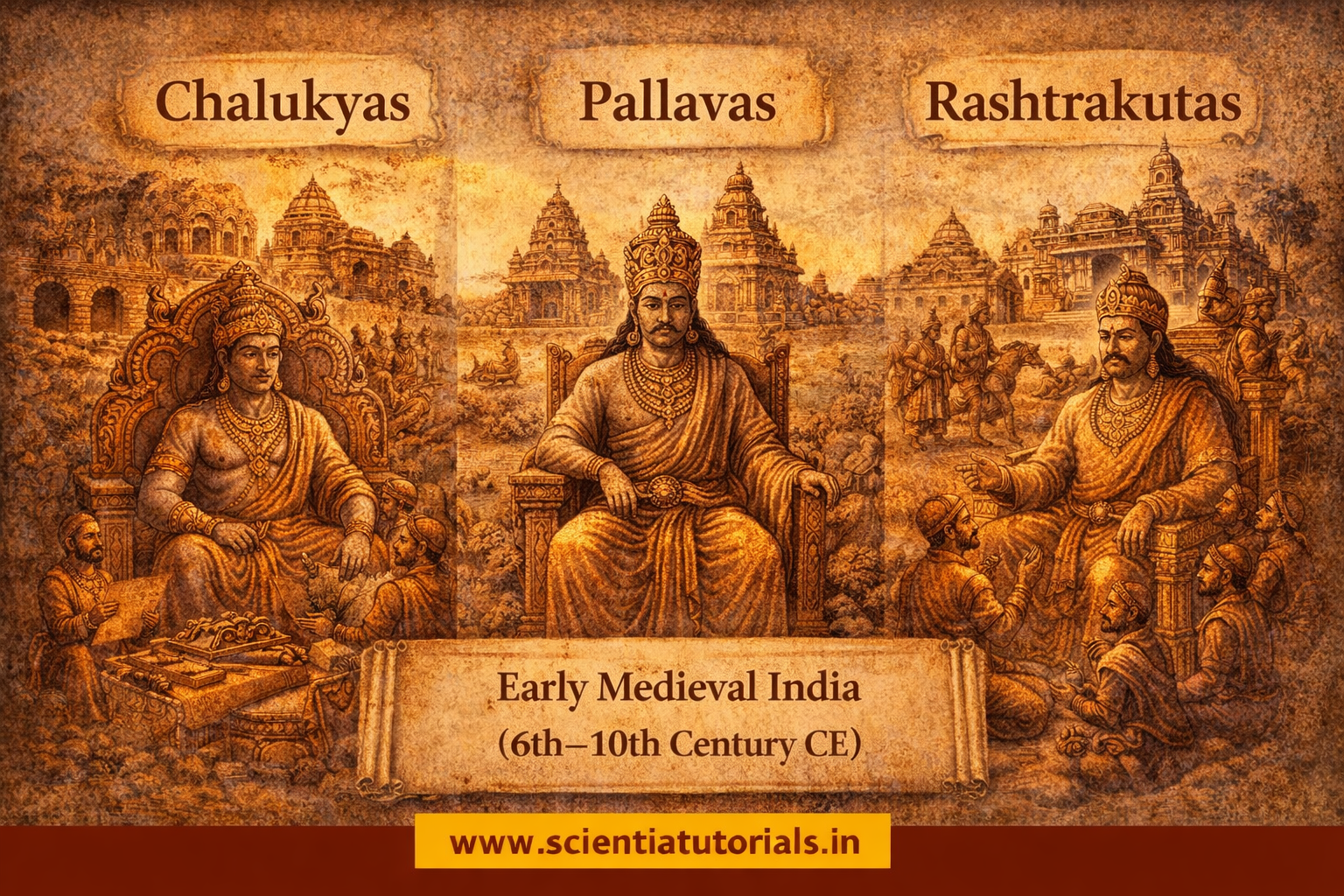

Chalukyas, Pallavas & Rashtrakutas (c. 6th–10th Century CE)
Course: History of India – Complete Chronological and Era-Wise Course
Section 7: Early Medieval India & Regional Kingdoms
Timeline: c. 600 CE – c. 1200 CE
Theme: Regional Powers, Political Rivalry and Cultural Achievements in Early Medieval India
1. Introduction: Regional Kingdoms in Early Medieval India
The period between c. 600 CE and c. 1000 CE witnessed the rise of powerful regional kingdoms in the Deccan and South India, marking a decisive break from the age of pan-Indian empires. Among these, the Chalukyas, Pallavas, and Rashtrakutas played a dominant role in shaping the political, cultural, and architectural history of Early Medieval India.
These dynasties:
- Controlled large territories for long durations
- Developed strong administrative systems
- Encouraged temple architecture and art
- Patronised Sanskrit and regional cultures
- Engaged in prolonged political and military rivalries
Their interactions laid the foundation of regional polity, a defining feature of Early Medieval India.
2. Historical Background
2.1 Post-Gupta Political Scenario
After the decline of the Gupta Empire:
- Imperial unity collapsed
- Power shifted to regional rulers
- The Deccan and South India emerged as major political centres
This environment allowed dynasties like the Chalukyas, Pallavas, and Rashtrakutas to rise.
2.2 Importance of the Deccan and South India
- Strategic location between North and South India
- Control over inland and coastal trade routes
- Fertile river valleys (Krishna, Tungabhadra, Kaveri)
3. The Chalukyas of Badami (c. 543–753 CE)
3.1 Origin and Foundation
The Early or Badami Chalukyas were founded by Pulakeshin I in the mid-6th century CE, with Badami (Vatapi) as their capital.
3.2 Political History
The most powerful ruler of this dynasty was Pulakeshin II.
Major Achievements of Pulakeshin II
- Defeated Harsha on the Narmada River
- Extended Chalukya control over most of the Deccan
- Established Chalukyas as a major regional power
- Maintained diplomatic relations with foreign powers
Pulakeshin II is the first South Indian ruler to stop a North Indian imperial expansion, making him historically significant.
3.3 Administration
- Monarchical system
- Provinces governed by royal family members
- Efficient land revenue system
- Use of feudatories (samantas), reflecting early feudal tendencies
3.4 Chalukya–Pallava Conflict
A defining feature of Chalukya history was their long-standing rivalry with the Pallavas of Kanchipuram over control of the eastern Deccan.
3.5 Cultural Contributions
- Development of Chalukyan temple architecture, a synthesis of Nagara and Dravida styles
- Promotion of Sanskrit learning
- Patronage to art and religion
4. The Pallavas of Kanchipuram (c. 6th–9th Century CE)
4.1 Origin and Rise
The Pallavas emerged as a powerful dynasty in Tamil Nadu, with Kanchipuram as their capital.
They initially served as local rulers and gradually rose to imperial status.
4.2 Important Pallava Rulers
Mahendravarman I
- Introduced rock-cut temple architecture
- Patron of art, music, and literature
- Known for his interest in Shaivism
Narasimhavarman I
- Defeated Pulakeshin II
- Captured Badami and assumed the title Vatapikonda
- Established Pallava military dominance
4.3 Pallava Administration
- Centralised monarchy
- Efficient village administration
- Land grants to Brahmanas and temples
- Use of local assemblies (sabhas and ur)
4.4 Pallava Contributions to Art and Architecture
The Pallavas were pioneers of South Indian temple architecture.
Key Achievements
- Rock-cut temples at Mahabalipuram
- Monolithic Rathas
- Shore Temple (structural temple phase)
They laid the foundation for later Dravida temple architecture.
4.5 Religion and Culture
- Patronage of Shaivism and Vaishnavism
- Promotion of Sanskrit and Tamil literature
- Support to Bhakti traditions
5. The Rashtrakutas (c. 753–973 CE)
5.1 Origin
The Rashtrakutas rose to power after overthrowing the Chalukyas. Their capital was Manyakheta in the Deccan.
5.2 Important Rulers
Dantidurga
- Founded the Rashtrakuta dynasty
- Defeated the Chalukyas
Krishna I
- Built the Kailasanatha Temple at Ellora
Amoghavarsha I
- One of the greatest Rashtrakuta rulers
- Patron of learning and Jainism
- Author of Kavirajamarga
5.3 Political Power and Expansion
- Controlled large parts of Deccan and South India
- Intervened in North Indian politics
- Participated in the Tripartite Struggle for Kannauj
5.4 Administration
- Feudal structure with powerful samantas
- Land grants to temples and Brahmanas
- Efficient revenue system
5.5 Cultural Contributions
- Construction of the Kailasanatha Temple at Ellora, one of the greatest rock-cut temples in the world
- Patronage of Sanskrit, Prakrit, and Kannada literature
- Support to Jainism, Shaivism, and Vaishnavism
6. Tripartite Struggle for Kannauj
One of the most significant political developments of this period was the Tripartite Struggle among:
- Gurjara-Pratiharas
- Palas
- Rashtrakutas
Significance
- Demonstrates political fragmentation
- Shows inter-regional power rivalry
- Highlights importance of Kannauj as a political symbol
7. Comparative Analysis: Chalukyas, Pallavas & Rashtrakutas
7.1 Political Structure
- All three dynasties followed monarchy
- Increasing feudal tendencies
- Use of samantas
7.2 Military Rivalries
- Chalukya–Pallava wars shaped Deccan politics
- Rashtrakutas expanded conflicts to North India
7.3 Cultural Legacy
- Chalukyas: Architectural synthesis
- Pallavas: Foundation of Dravida architecture
- Rashtrakutas: Monumental rock-cut architecture
8. Role in the Transition to Medieval India
These dynasties:
- Strengthened regional political systems
- Encouraged temple-centred society
- Promoted land-based economy
- Supported Bhakti and religious pluralism
They represent core characteristics of Early Medieval India.
9. Decline of These Dynasties
9.1 Chalukyas
- Internal conflicts
- Rise of Rashtrakutas
9.2 Pallavas
- Rise of the Cholas
- Declining military power
9.3 Rashtrakutas
- Weak successors
- Rise of Later Chalukyas
10. Historical Significance (Examination Perspective)
Why These Dynasties Are Important
- Illustrate regionalisation of power
- Show early feudal administration
- Major contributors to Indian temple architecture
- Played key role in political and cultural transition
UPSC / State PSC Focus Areas
- Chalukya–Pallava conflict
- Pallava art and architecture
- Rashtrakuta political expansion
- Tripartite Struggle
- Role in Early Medieval polity
11. Conclusion
The Chalukyas, Pallavas, and Rashtrakutas were among the most influential dynasties of Early Medieval India. Their political rivalries shaped Deccan history, their administrative systems strengthened regional governance, and their cultural contributions—especially in temple architecture—left a lasting imprint on Indian civilisation.
Together, they represent the essence of Early Medieval India, marking the shift from imperial unity to regional diversity, from classical traditions to medieval institutions, and from centralised empires to dynamic regional kingdoms.
Below is a well-structured, examination-oriented set of 25 Questions with Answers based strictly on the lesson
“Chalukyas, Pallavas & Rashtrakutas” from
Section 7: Early Medieval India & Regional Kingdoms (c. 600–1200 CE).
Chalukyas, Pallavas & Rashtrakutas (c. 6th–10th Century CE)
Questions with Answers
1. Why are the Chalukyas, Pallavas, and Rashtrakutas considered important dynasties of Early Medieval India?
They were powerful regional dynasties that shaped political regionalisation, temple architecture, administrative systems, and cultural development in the Deccan and South India during the early medieval period.
2. What historical conditions led to the rise of regional kingdoms like the Chalukyas and Pallavas?
The decline of Gupta imperial authority and the absence of a pan-Indian empire created conditions for strong regional powers to emerge.
3. Who founded the Chalukya dynasty of Badami and where was its capital?
The Chalukya dynasty was founded by Pulakeshin I, with Badami (Vatapi) as the capital.
4. Why is Pulakeshin II regarded as the greatest Chalukya ruler?
Pulakeshin II expanded the Chalukya Empire, defeated Harsha on the Narmada, and established Chalukya supremacy in the Deccan.
5. What is the historical significance of Pulakeshin II’s conflict with Harsha?
It marked the first successful resistance by a South Indian ruler against North Indian imperial expansion, fixing the Narmada as a political boundary.
6. What administrative features characterised the Chalukya state?
- Monarchical rule
- Provinces governed by royal family members
- Use of feudatories (samantas)
- Land-revenue-based economy
7. What was the main cause of the prolonged Chalukya–Pallava conflict?
The struggle for control over the eastern Deccan and strategic trade routes, particularly the region around Vengi.
8. Where was the Pallava kingdom centred, and what was its capital?
The Pallava kingdom was centred in Tamil Nadu, with Kanchipuram as its capital.
9. Which Pallava ruler is associated with the beginning of rock-cut temple architecture?
Mahendravarman I introduced rock-cut temples and promoted art, music, and literature.
10. Why is Narasimhavarman I considered a powerful Pallava ruler?
He defeated Pulakeshin II, captured Badami, and assumed the title Vatapikonda, asserting Pallava military dominance.
11. How did Pallava administration differ from earlier imperial systems?
Pallava administration relied heavily on village assemblies (sabha and ur) and land grants, reflecting decentralised governance.
12. What were the major architectural contributions of the Pallavas?
- Rock-cut caves
- Monolithic Rathas
- Shore Temple at Mahabalipuram
They laid the foundation of Dravida temple architecture.
13. Which dynasty overthrew the Chalukyas and established control over the Deccan?
The Rashtrakutas overthrew the Chalukyas and emerged as a major Deccan power.
14. Who founded the Rashtrakuta dynasty?
The Rashtrakuta dynasty was founded by Dantidurga.
15. Why is Krishna I historically significant?
He constructed the Kailasanatha Temple at Ellora, one of the greatest rock-cut temples in Indian history.
16. Why is Amoghavarsha I regarded as an outstanding ruler?
He was a patron of learning and Jainism, maintained political stability, and authored Kavirajamarga, an important Kannada literary work.
17. What was the political importance of the Rashtrakutas in North India?
They intervened in North Indian politics and played a major role in the Tripartite Struggle for Kannauj.
18. What was the Tripartite Struggle, and why was it significant?
It was a power struggle among the Palas, Gurjara-Pratiharas, and Rashtrakutas for control of Kannauj, symbolising political fragmentation.
19. How did feudal features manifest under these dynasties?
- Land grants to officials and temples
- Rise of samantas
- Hereditary rights over land
- Military service in return for land
20. Compare the architectural contributions of the three dynasties.
- Chalukyas: Synthesis of Nagara and Dravida styles
- Pallavas: Foundation of Dravida architecture
- Rashtrakutas: Monumental rock-cut architecture
21. How did religion influence the policies of these dynasties?
They patronised Shaivism, Vaishnavism, Jainism, and supported temple construction, making religion central to governance.
22. What role did these dynasties play in the transition to medieval India?
They strengthened regional polity, feudal administration, temple-centred society, and agrarian economy, key features of medieval India.
23. Why did the Chalukya dynasty decline?
Internal conflicts, repeated wars with the Pallavas, and the rise of the Rashtrakutas weakened the Chalukyas.
24. What led to the decline of the Pallava dynasty?
The rise of the Cholas and declining military power led to the fall of the Pallavas.
25. Assess the historical significance of the Chalukyas, Pallavas, and Rashtrakutas.
They shaped Early Medieval India through regional governance, cultural innovation, architectural excellence, and political rivalry, leaving a lasting legacy in Indian history.
Below is a well-structured set of 25 Multiple Choice Questions (MCQs) with correct answers and detailed, concept-clearing explanations, prepared strictly from the lesson
“Chalukyas, Pallavas & Rashtrakutas” under
Section 7: Early Medieval India & Regional Kingdoms (c. 600–1200 CE).
Chalukyas, Pallavas & Rashtrakutas
MCQs with Answers and Explanations
1. The rise of the Chalukyas, Pallavas, and Rashtrakutas reflects which major feature of Early Medieval India?
A. Political centralisation
B. Foreign domination
C. Regionalisation of power
D. Decline of kingship
Correct Answer: C
Explanation:
These dynasties illustrate the shift from imperial unity to regional kingdoms, a defining characteristic of Early Medieval India.
2. Who founded the Early (Badami) Chalukya dynasty?
A. Pulakeshin II
B. Pulakeshin I
C. Dantidurga
D. Krishna I
Correct Answer: B
Explanation:
Pulakeshin I founded the Chalukya dynasty in the mid-6th century CE with Badami as the capital.
3. Which ruler is regarded as the greatest Chalukya monarch?
A. Pulakeshin I
B. Vikramaditya I
C. Pulakeshin II
D. Kirtivarman II
Correct Answer: C
Explanation:
Pulakeshin II expanded Chalukya power and famously defeated Harsha, establishing Deccan supremacy.
4. The significance of Pulakeshin II’s defeat of Harsha lies in the fact that it:
A. Ended North Indian empires
B. Unified India
C. Checked North Indian expansion into the Deccan
D. Established Pallava dominance
Correct Answer: C
Explanation:
Pulakeshin II was the first South Indian ruler to halt a North Indian emperor, fixing the Narmada as a political boundary.
5. The long-standing conflict between the Chalukyas and Pallavas was mainly over control of:
A. Kannauj
B. Kaveri delta
C. Eastern Deccan and Vengi region
D. Western Ghats
Correct Answer: C
Explanation:
The eastern Deccan, especially Vengi, was strategically and economically important, leading to prolonged rivalry.
6. The capital of the Pallava kingdom was:
A. Madurai
B. Thanjavur
C. Badami
D. Kanchipuram
Correct Answer: D
Explanation:
Kanchipuram was a major political, religious, and cultural centre of the Pallavas.
7. Which Pallava ruler initiated rock-cut temple architecture?
A. Simhavishnu
B. Mahendravarman I
C. Narasimhavarman II
D. Aparajita
Correct Answer: B
Explanation:
Mahendravarman I introduced rock-cut caves and was a patron of arts and learning.
8. Which Pallava ruler defeated Pulakeshin II and captured Badami?
A. Simhavarman
B. Mahendravarman I
C. Narasimhavarman I
D. Paramesvaravarman
Correct Answer: C
Explanation:
Narasimhavarman I captured Badami and assumed the title Vatapikonda.
9. The Pallavas are historically important because they laid the foundation of:
A. Nagara architecture
B. Vesara architecture
C. Dravida temple architecture
D. Gandhara art
Correct Answer: C
Explanation:
Pallava experiments at Mahabalipuram led to the mature Dravida temple style.
10. The Shore Temple at Mahabalipuram represents which architectural phase?
A. Rock-cut
B. Monolithic
C. Structural stone temple
D. Brick architecture
Correct Answer: C
Explanation:
The Shore Temple marks the transition from rock-cut to structural temple architecture.
11. Which dynasty overthrew the Chalukyas to control the Deccan?
A. Pallavas
B. Cholas
C. Pandyas
D. Rashtrakutas
Correct Answer: D
Explanation:
The Rashtrakutas replaced the Chalukyas as the dominant Deccan power.
12. Who founded the Rashtrakuta dynasty?
A. Govinda III
B. Dantidurga
C. Amoghavarsha I
D. Krishna I
Correct Answer: B
Explanation:
Dantidurga established Rashtrakuta rule after defeating the Chalukyas.
13. Which Rashtrakuta ruler built the Kailasanatha Temple at Ellora?
A. Amoghavarsha I
B. Govinda III
C. Krishna I
D. Dantidurga
Correct Answer: C
Explanation:
The Kailasanatha Temple is one of the greatest rock-cut architectural achievements in India.
14. Which Rashtrakuta ruler is noted for patronising Jainism and literature?
A. Krishna I
B. Govinda II
C. Amoghavarsha I
D. Indra III
Correct Answer: C
Explanation:
Amoghavarsha I was a scholar-king and author of Kavirajamarga.
15. The Tripartite Struggle was fought mainly over control of:
A. Delhi
B. Kannauj
C. Vengi
D. Kanchipuram
Correct Answer: B
Explanation:
Kannauj symbolised political supremacy in North India.
16. Which dynasty participated in the Tripartite Struggle along with the Palas and Pratiharas?
A. Cholas
B. Pallavas
C. Chalukyas
D. Rashtrakutas
Correct Answer: D
Explanation:
The Rashtrakutas intervened repeatedly in North Indian politics.
17. A common administrative feature of these dynasties was:
A. Democratic councils
B. Centralised bureaucracy
C. Use of samantas (feudatories)
D. Republics
Correct Answer: C
Explanation:
All three dynasties showed early feudal tendencies through samantas and land grants.
18. Which economic feature dominated under these dynasties?
A. Maritime capitalism
B. Industrial economy
C. Agrarian land-based economy
D. Coin-based urban economy
Correct Answer: C
Explanation:
Land grants and agrarian revenue formed the backbone of early medieval economies.
19. Which religion received patronage from all three dynasties?
A. Buddhism alone
B. Islam
C. Shaivism and Vaishnavism
D. Zoroastrianism
Correct Answer: C
Explanation:
Shaivism and Vaishnavism flourished widely under these rulers.
20. The Chalukyas are best known architecturally for:
A. Pure Dravida temples
B. Rock-cut monasteries
C. Synthesis of Nagara and Dravida styles
D. Buddhist stupas
Correct Answer: C
Explanation:
Chalukyan architecture represents a Vesara-type synthesis.
21. The Pallavas contributed to cultural history mainly by:
A. Introducing Persian culture
B. Patronising Tamil and Sanskrit traditions
C. Promoting only Jainism
D. Suppressing temple worship
Correct Answer: B
Explanation:
Pallava rulers supported both Sanskrit and Tamil literary traditions.
22. Which feature best distinguishes Rashtrakuta art?
A. Brick temples
B. Wooden structures
C. Monumental rock-cut architecture
D. Buddhist paintings
Correct Answer: C
Explanation:
Ellora’s Kailasanatha Temple is the finest example of Rashtrakuta art.
23. The decline of the Pallavas was mainly due to the rise of the:
A. Rashtrakutas
B. Hoysalas
C. Cholas
D. Pratiharas
Correct Answer: C
Explanation:
The Cholas replaced the Pallavas as the dominant South Indian power.
24. These dynasties are important in Indian history because they:
A. Restored imperial unity
B. Ended temple architecture
C. Strengthened regional political systems
D. Abolished land grants
Correct Answer: C
Explanation:
They consolidated regional polity, a hallmark of Early Medieval India.
25. The combined historical role of the Chalukyas, Pallavas, and Rashtrakutas was to:
A. Delay medieval transition
B. Accelerate urban decline only
C. Shape early medieval political and cultural order
D. Establish a pan-Indian empire
Correct Answer: C
Explanation:
These dynasties defined early medieval governance, culture, religion, and architecture, shaping the next phase of Indian history.
Targeting Exams
This content is optimised for preparation of:
-
UPSC Civil Services Examination (Prelims & Mains – GS I)
-
State Public Service Commissions (APSC, BPSC, UPPSC, WBCS, RPSC, etc.)
-
SSC & Other Competitive Examinations
-
UGC NET / SET (History)
-
University Semester Exams (Early Medieval Indian History)
-
School Board Exams (Class 6–12 – Reference & Enrichment)
Related Keyphrases
-
Chalukyas Pallavas Rashtrakutas UPSC notes
-
Early Medieval India regional kingdoms
-
Chalukya Pallava conflict
-
Pallava art and architecture
-
Rashtrakuta administration and culture
-
Kailasanatha Temple Ellora Rashtrakutas
-
Tripartite struggle Rashtrakutas
-
Deccan kingdoms early medieval India
-
South Indian dynasties medieval period
-
History of India 600 to 1000 CE